Flexor-Pronator Origin Tendinopathy | 50% Ulnar Nerve Involvement | Conservative First Line
- Flexor-pronator origin pathology - pronator teres and FCR most commonly affected
- 50% have ulnar nerve symptoms - must assess cubital tunnel and exclude UCL injury
- Conservative treatment first line - 90% success rate with PT, NSAIDs, activity modification
- Golfer's elbow test - resisted wrist flexion/pronation reproduces medial elbow pain
- Surgical technique - debride degenerative tissue, preserve ulnar nerve, may need transposition
- “Medial epicondylitis is 3-5 times less common than lateral epicondylitis
- “Pain worse with wrist flexion and forearm pronation (golfer's elbow test)
- “Must exclude UCL injury in overhead athletes (valgus stress test)
- “Ulnar nerve symptoms present in 50% - document preoperatively
Overview and Epidemiology
Medial epicondylitis, golfer's elbow, is a degenerative tendinopathy of the flexor-pronator origin at the medial epicondyle of the humerus. It is 3-5 times less common than lateral epicondylitis, and despite the name it affects a wide range of people beyond golfers.
At work. Manual labourers such as carpenters and plumbers are at risk, as is anyone whose job involves repetitive gripping and lifting, forceful wrist flexion or prolonged typing at a computer.
In sport. Golf gives the condition its name, but it is not the only culprit:
- Golf, with improper swing mechanics
- Baseball, in pitchers, from valgus overload
- Tennis with a heavy topspin forehand, and other racquet sports with wrist-heavy strokes
- Weightlifting, with heavy deadlifts and rows
Natural history. Most cases, 90%, resolve with conservative treatment within 6-12 months. Cases that have run for more than 12 months are more likely to need intervention. Involvement is bilateral in 10-20%.
Anatomy
The flexor-pronator origin. The common flexor origin arises from the anterior aspect of the medial epicondyle, and its muscles are described in two layers:
- Superficial layer: pronator teres (the origin of its medial head), flexor carpi radialis, palmaris longus (absent in 15% of the population) and flexor carpi ulnaris, which has a dual origin from humeral and ulnar heads
- Deep layer: flexor digitorum superficialis, flexor digitorum profundus, flexor pollicis longus and pronator quadratus
The two that fail. The medial head of pronator teres and flexor carpi radialis are the primary structures involved and the most commonly affected. Pronator teres is the most medial and superficial muscle, which leaves it vulnerable to overuse. FCR has the most robust tendinous origin and bears significant loads during wrist flexion.
The ulnar collateral ligament. The UCL lies deep to the flexor-pronator mass. Its anterior bundle is the primary valgus stabiliser, running from the anteroinferior aspect of the medial epicondyle to the sublime tubercle of the ulna. In overhead athletes, distinguishing a UCL injury from medial epicondylitis is critical.
The ulnar nerve. The nerve runs through the cubital tunnel behind the medial epicondyle and can be compressed at several points on its way past the elbow.
- Location
- Posterior to medial epicondyle
- Clinical Significance
- Site of compression in 50% of medial epicondylitis patients
- Location
- 8-10cm proximal to medial epicondyle
- Clinical Significance
- First potential compression site
- Location
- Roof of cubital tunnel (FCU aponeurosis)
- Clinical Significance
- Common site of compression, thickened in chronic cases
- Location
- Between humeral and ulnar heads of FCU
- Clinical Significance
- Third compression zone distal to tunnel
Pathophysiology
A failed healing response. Medial epicondylitis is a tendinosis, a failed healing response to repetitive microtrauma at the flexor-pronator origin. The dominant histological finding is angiofibroblastic hyperplasia rather than an inflammatory infiltrate.
Call it tendinosis (a failed healing response), not tendinitis (acute inflammation), but do not overstate this to "no inflammation ever". Both surgical series cited on this page describe inflammatory tissue at operation: Gabel and Morrey found an inflammatory focus in 17 of 30 elbows, and Vangsness and Jobe's microscopy showed reactive fibrous tissue with varying degrees of inflammation. The accurate statement is that inflammation is not the driving process. That is why rest and anti-inflammatories alone often fail, and why load-based rehabilitation is the mainstay.
How the lesion develops. The process runs in three phases:
- Microtrauma. Repetitive eccentric loading during wrist flexion causes microtears in the tendon substance, and pronation adds torsional stress to the common flexor origin.
- Failed healing. Angiofibroblastic degeneration replaces normal type I collagen with disorganised type III. Neovascularisation and nerve ingrowth follow, with substance P and CGRP upregulated in the degenerate tissue; the neoinnervation is the source of chronic pain.
- Chronic tendinosis. Mucoid degeneration leaves grey, friable tissue. The tendon thickens and weakens structurally, loses its normal hierarchical collagen structure, and may tear partially or completely.
Histopathology. Alongside the angiofibroblastic change, the degenerate origin shows:
- Hypercellular fibroblast proliferation
- Ground substance accumulation (mucoid change)
- Disorganised collagen fibres without the normal crimp pattern
- Focal necrosis in severe cases
Eccentric strengthening stimulates collagen remodelling and restores type I collagen architecture. It works in 90% because the tendon retains its healing capacity once the mechanical overload is removed. Surgery is reserved for true failed healing, when conservative measures cannot stimulate repair.
Classification and Severity Grading
Nirschl's phases stage the pain, the clinical severity grade adds strength and duration, and the ulnar nerve is graded separately, because the nerve rather than the tendon drives the surgical result.
The Nirschl classification is the most commonly used. It stages the disease by pain severity and functional limitation, and the pain moves from after activity, to during activity, to rest.
- Symptoms
- Mild pain after activity, self-limiting
- Functional Impact
- No impact on sport or work
- Treatment
- Activity modification, ice
- Symptoms
- Pain during activity, doesn't limit performance
- Functional Impact
- Minimal impact, able to continue
- Treatment
- PT, NSAIDs, activity modification
- Symptoms
- Pain during and after activity
- Functional Impact
- Limits performance in sport/work
- Treatment
- PT, injection consideration
- Symptoms
- Pain during activity, unable to perform
- Functional Impact
- Significant functional limitation
- Treatment
- Aggressive conservative, injection
- Symptoms
- Pain at rest and with activity
- Functional Impact
- Unable to work or participate in sport
- Treatment
- Consider surgical debridement
Phases 1-3 respond well to conservative treatment and phase 4 may need injection. Phase 5, pain at rest, is the surgical indication after 6 months of failed conservative care.
Gabel-Morrey. Gabel and Morrey (1995) found that the single strongest predictor of the result of flexor-pronator debridement was not the tendinosis but the severity of the coexisting ulnar neuropathy, so they graded medial epicondylitis by its nerve involvement:
- Type I, no or only mild ulnar neuropathy, subdivided into IA (no nerve symptoms) and IB (mild, intermittent symptoms with no motor deficit)
- Type II, moderate-to-severe ulnar neuropathy, with persistent symptoms, a motor deficit and abnormal nerve conduction studies
Why the grade matters. Types IA and IB do very well with debridement, 24 of 25 good or excellent in the original series, whereas type II does poorly, only 2 of 5, a statistically significant difference. A moderate-to-severe ulnar neuropathy must therefore be identified, graded and formally addressed by decompression or transposition, and the patient counselled that the nerve, not the tendon, drives the outcome.
Clinical Presentation and Assessment
History. Medial elbow pain radiates into the forearm flexors. It aches or burns and is worse with use, particularly gripping, lifting and wrist flexion. The pain first follows activity, then accompanies it, and finally arrives at rest; night pain suggests severe or chronic tendinosis.
What the patient cannot do. Grip weakens, so opening jars, shaking hands and turning doorknobs become difficult. The golf swing, throwing and racquet sports are painful, and at work the keyboard, tools and heavy lifting become difficult.
Examination. Work through it in order:
- Look. Swelling is rare. Assess the carrying angle and look for muscle atrophy, which appears in chronic cases or with ulnar neuropathy.
- Feel. Maximum tenderness lies 5-10mm distal and anterior to the medial epicondyle, over the flexor-pronator origin. UCL tenderness is more posterior and distal.
- Move. Active and passive motion is usually full, with pain at terminal extension as the flexors are stretched. Compare pronation and supination with the other side.
- Strength. Grip is reduced against the contralateral side, measured objectively with a Jamar dynamometer. Resisted wrist flexion reproduces the pain, and so does resisted pronation (pronator teres).
- Special tests. The golfer's elbow test is positive. Valgus stress at 30 degrees of flexion should be negative unless the UCL is injured as well. The milking manoeuvre, pulling the thumb with the elbow flexed, applies valgus stress to assess the UCL in overhead athletes.
- Neurovascular. The ulnar nerve in every patient (below); the median nerve for pronator syndrome, a rare association; and the radial pulse and capillary refill.
The golfer's elbow test is performed with the elbow extended and the forearm supinated, the examiner resisting active wrist flexion while palpating the medial epicondyle. A positive test reproduces the patient's medial elbow pain, and it is highly specific for medial epicondylitis. In lateral epicondylitis, by contrast, resisted wrist extension reproduces lateral pain.
Up to about 50% of patients with medial epicondylitis have ulnar nerve symptoms. Always perform Tinel's at the cubital tunnel and the elbow flexion test (elbow held flexed at 90 degrees for 60 seconds), and assess intrinsic hand muscle strength in the first dorsal interosseous and abductor digiti minimi. If any is positive, order nerve conduction studies. Failure to address concurrent cubital tunnel syndrome leads to poor outcomes.
Differential diagnosis. The table covers the main alternatives; a flexor-pronator muscle strain should also be considered.
- Key Distinguishing Features
- Pain with resisted wrist flexion/pronation, point tenderness at flexor origin
- Special Tests
- Positive golfer's elbow test
- Key Distinguishing Features
- Overhead athlete, valgus instability, pain with throwing, positive moving valgus stress test
- Special Tests
- Valgus stress at 30 degrees, milking manoeuvre, MRI shows UCL thickening/tear
- Key Distinguishing Features
- Paraesthesias in ulnar nerve distribution, intrinsic weakness, positive Tinel's
- Special Tests
- Elbow flexion test, NCS shows reduced ulnar nerve conduction
- Key Distinguishing Features
- Median nerve compression, forearm pain, thumb/index/middle finger numbness
- Special Tests
- Pronator compression test, reduced median nerve sensation
- Key Distinguishing Features
- Chronic valgus overload, overhead athletes, decreased ROM, mechanical symptoms
- Special Tests
- X-ray shows osteophytes, loose bodies, joint space narrowing
- Key Distinguishing Features
- Neck pain, dermatome pattern, reflex changes, positive Spurling's test
- Special Tests
- Spurling's test, MRI cervical spine
In overhead throwing athletes (baseball pitchers, javelin throwers) with medial elbow pain, a UCL injury is more likely than medial epicondylitis. Throwing stresses the UCL with repetitive valgus loading. Perform the valgus stress test at 30 degrees of flexion and the milking manoeuvre, and obtain an MRI if either is positive or suspicious. UCL reconstruction (Tommy John surgery) has different indications and technique.
Investigations
A clinical diagnosis. History and examination, with a positive golfer's elbow test and point tenderness at the flexor origin, are usually sufficient. Imaging is not routinely required, and MRI is not needed for typical medial epicondylitis that is responding to conservative care.
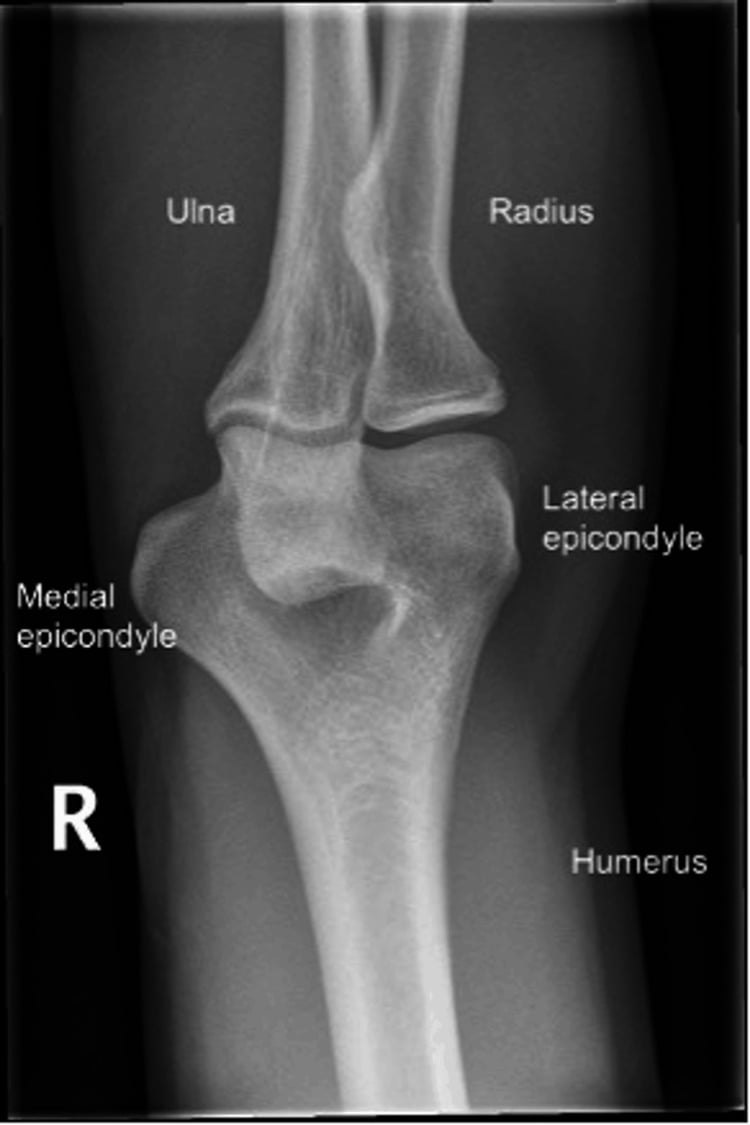
Radiographs. AP and lateral elbow films, taken if the diagnosis is uncertain, are usually normal but may show calcification at the flexor-pronator origin in chronic cases. They rule out bony pathology such as arthritis, loose bodies or fracture, and stress views are added if a UCL injury is suspected.
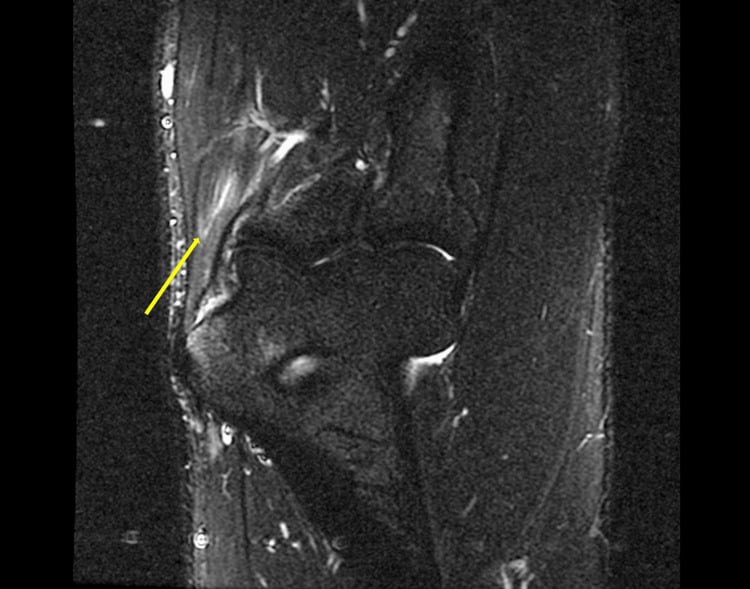
MRI is the gold standard, performed with and without contrast. Order it for:
- Diagnostic uncertainty, when medial epicondylitis cannot be distinguished from a UCL injury
- The overhead athlete with medial elbow pain, to assess the UCL
- Failure of 3-6 months of conservative treatment when surgery is being considered, for surgical planning
- Suspected complete tendon rupture, which is rare but needs repair
What MRI shows. On T2 and STIR the flexor-pronator origin has increased signal from oedema and degeneration, with fluid signal if there is a partial tear, peritendinous oedema in acute exacerbations and bone marrow oedema (stress reaction) in chronic cases. On T1 the signal is normal to slightly low, the tendon is thickened and has lost its normal striated appearance, and a partial tear appears as a focal signal abnormality. The same study assesses the integrity of the UCL.
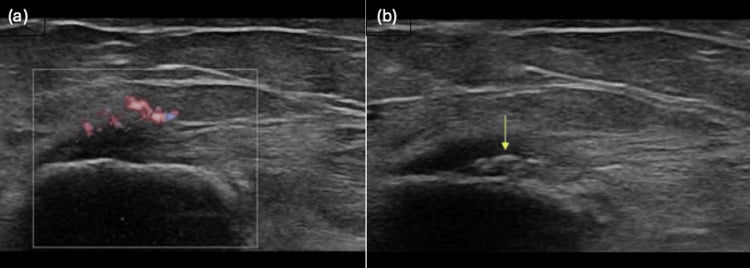
Ultrasound. Dynamic ultrasound is operator-dependent. It can show tendon thickening, hypoechoic regions of degeneration and neovascularisation on Doppler, and it is useful for guided injection, but it gives less detail of the UCL than MRI.
Nerve conduction studies. NCS and EMG of the ulnar nerve are indicated by a positive Tinel's sign, a positive elbow flexion test or intrinsic weakness. They show reduced conduction velocity across the cubital tunnel, and denervation in ulnar-innervated muscles if the neuropathy is chronic, and they guide the need for cubital tunnel release.
- Normal
- Normal bone
- Medial Epicondylitis
- May have calcification
- Complete Tear (Rare)
- Normal or calcification
- Normal
- Fibrillar pattern
- Medial Epicondylitis
- Hypoechoic, thickened, neovascularity
- Complete Tear (Rare)
- Tendon discontinuity
- Normal
- Low signal
- Medial Epicondylitis
- High signal at origin
- Complete Tear (Rare)
- High signal, tendon gap
Management Algorithm
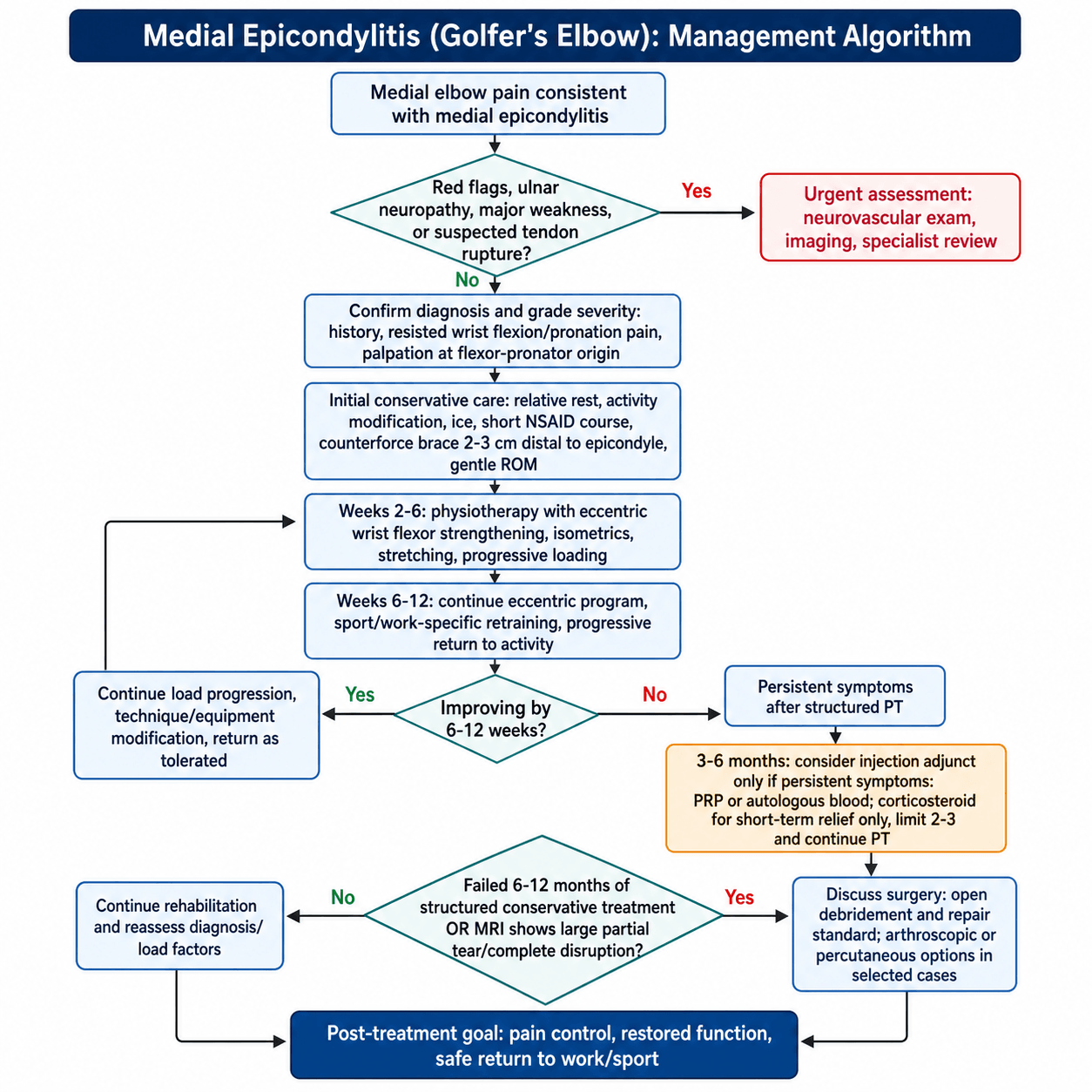
Conservative treatment comes first and succeeds in most patients. Injection is an adjunct for persistent symptoms, and surgery is for genuine failure after a structured trial.
- Clinical Features
- Mild pain, normal strength, no nerve symptoms
- Treatment
- Conservative: PT, activity modification, NSAIDs
- Key Pearl
- 90% resolve - be patient, avoid early surgery
- Clinical Features
- Moderate pain, some weakness, no nerve symptoms
- Treatment
- Corticosteroid injection + continued PT
- Key Pearl
- Maximum 2-3 injections due to tendon weakening risk
- Clinical Features
- Severe pain, weakness, failed conservative
- Treatment
- Surgical debridement + repair
- Key Pearl
- Screen for ulnar nerve - may need decompression
- Clinical Features
- Medial pain + paraesthesias, positive Tinel's
- Treatment
- Assess UCL, consider NCS, surgical if indicated
- Key Pearl
- UCL injury requires different treatment - valgus stress test
The aim. Reduce pain, restore function and promote tendon healing through eccentric strengthening and load management. The protocol runs over 6-12 months.
6-12 Month Conservative Protocol
Symptom control:
- Activity modification (avoid aggravating activities)
- Relative rest (not immobilisation)
- Ice 15-20 minutes TDS
- NSAIDs (oral or topical) for 2 weeks
- Counterforce brace
- Gentle ROM exercises (wrist flexion/extension, pronation/supination)
Physiotherapy programme:
- Eccentric strengthening (the key intervention)
- Isometric strengthening
- Stretching (wrist extensors and flexors)
- Progressive loading
- Activity modification continues
- Return to light activities as tolerated
Gradual return to activity:
- Continue eccentric programme
- Sport-specific training (golf swing mechanics, throwing programme)
- Progressive resistance exercises
- Gradual return to work activities
- Monitor symptoms
Consider injection if symptoms persist after 3 months of PT (see Injection Therapy), and continue PT after the injection.
The eccentric programme. Eccentric exercise is the cornerstone of tendinopathy rehabilitation. A slow, controlled eccentric (lengthening-under-load) contraction of the flexor-pronator mass remodels the degenerate tendon and restores its collagen architecture: load, not rest, is the therapeutic stimulus.
- The basic exercise. The forearm is supported with the wrist over the edge of a table, holding a light dumbbell. The other hand passively lifts the wrist into flexion, and the patient then slowly lowers the weight into extension over 3-4 seconds; the concentric phase is assisted or omitted. Typically 3 sets of 15, once or twice daily, progressing the weight as symptoms allow.
- The FlexBar variant. A rubber resistance bar (Thera-Band FlexBar) is twisted and then allowed to slowly untwist under eccentric control, the medial-elbow analogue of the "Tyler twist" used for lateral epicondylitis. It is cheap, home-based and well evidenced for epicondylar tendinopathy.
- The pain rule. Some discomfort during the exercise is acceptable and expected, provided it settles within 24 hours and is not worsening day to day. If it lingers beyond 24 hours or escalates, reduce the load. Progress the load, not the repetitions, over 6-12 weeks.
Bracing and equipment. A counterforce brace worn 2-3cm distal to the medial epicondyle reduces load on the tendon origin. A night splint holding the wrist in neutral reduces pain from nocturnal wrist flexion. Lighter golf clubs, a larger grip diameter and proper swing mechanics reduce the load on the flexor-pronator origin while it heals.
Surgical Technique - Open Debridement and Repair
Consent. Cover infection, ulnar nerve injury, stiffness, recurrence from incomplete debridement and CRPS (rates under Complications), and a prolonged recovery of 6-12 months.
Equipment. Beyond a standard orthopaedic tray, have ready:
- Upper arm tourniquet (sterile field)
- Rongeur and curette
- Non-absorbable sutures for the tendon repair (FiberWire, Ethibond)
- Suture anchors if bone quality is poor (elderly, osteoporotic)
- Nerve retractors: blunt Hohmann, small Richardson
- Loupe magnification, helpful for the ulnar nerve
Positioning. The patient lies supine with the arm board extended at 90 degrees, the affected arm fully accessible and the head turned away from the operative side. An upper arm tourniquet goes on over padding at 250-300mmHg for adults; the arm may be exsanguinated with an Esmarch or by gravity elevation (avoid if ulnar nerve symptoms). Prep circumferentially from mid-humerus to fingertips and free-drape the arm so the elbow can be flexed and extended during the operation. Confirm that the ulnar nerve is palpable before the incision.
- Incision. A 5-7cm longitudinal incision centred over the palpated medial epicondyle, extending distally along the flexor-pronator mass. An excessive anterior curve endangers the median nerve, an excessive posterior curve the ulnar nerve. Dissect sharply through skin and subcutaneous tissue, ligate or cauterise superficial veins, and identify the branches of the medial antebrachial cutaneous nerve, retracting them or sacrificing them if unavoidable.
- Find the ulnar nerve first. Before any tendon work, palpate posterior to the medial epicondyle and dissect gently to identify the nerve in the cubital tunnel. Check whether it subluxes over the epicondyle with flexion and whether Osborne's ligament is thickened, then pass a vessel loop around it for gentle retraction. Do not over-retract.
- Expose the origin. With the nerve protected, expose the flexor-pronator origin on the anterior aspect of the medial epicondyle through a longitudinal incision, splitting pronator teres and FCR at their origin. The tendon may be elevated from bone subperiosteally to expose the epicondyle. Assess for degenerative tissue.
- Debride. Excise the abnormal tissue, grey, friable, mucoid and without normal tendon architecture, with a scalpel or rongeur, back to healthy, bleeding tendon. Remove only degenerative tissue, not normal tendon, and avoid excessive resection: the UCL lies deep to the flexor mass and is not violated in non-athletes. In an athlete assess UCL integrity; it should be intact, and if it is torn the pathology is different.
- Decorticate. Create a bleeding bone bed for tendon healing: remove cortical bone with a curette or rongeur and make multiple small holes (drill or curette) to expose cancellous bone with punctate bleeding. Excessive bone removal weakens the epicondyle.
- Repair. Reattach the flexor-pronator mass to the medial epicondyle at anatomic tension; over-tightening limits motion and causes stiffness.
- Bone tunnels (traditional): drill 2-3 holes through the epicondyle, pass non-absorbable sutures (FiberWire No. 2) and tie over the bone bridge
- Suture anchors (modern): 2-3 anchors in the epicondyle, allowing earlier ROM
- Side-to-side repair of the split tendon edges if debridement was minimal
- Manage the ulnar nerve according to the preoperative symptoms and the intraoperative findings (below).
The ulnar nerve is at risk throughout medial elbow surgery. The decision rests on preoperative symptoms and what is found at operation:
- No preoperative symptoms and a healthy nerve: gentle inspection only; no decompression is needed
- Preoperative symptoms, or a tight nerve: at minimum an in situ decompression, releasing Osborne's ligament and the arcade of Struthers
- Nerve subluxes over the medial epicondyle with flexion, or severe preoperative neuropathy: anterior subcutaneous transposition, creating a subcutaneous pocket anterior to the medial epicondyle and securing the nerve with a fascial sling
- Submuscular transposition is reserved for revision cases or severe arthrofibrosis risk
Complications
- Incidence
- 2-5% (transient or permanent)
- Risk Factors
- Failure to identify nerve, excessive retraction, thermal injury
- Management
- If transient: observation, nerve glides. If permanent: nerve exploration, neurolysis, possible transposition
- Incidence
- 10-15%
- Risk Factors
- Incomplete debridement, early return to activity, poor rehab compliance
- Management
- Prolonged PT, activity modification. If persistent: revision surgery with more extensive debridement
- Incidence
- 5-10%
- Risk Factors
- Prolonged immobilisation, aggressive surgery, patient factors (diabetes, smoking)
- Management
- Prevention: early ROM. Treatment: dynamic splinting, manipulation under anaesthesia if severe
- Incidence
- 1-2% superficial, less than 1% deep
- Risk Factors
- Diabetes, immunosuppression, contamination
- Management
- Superficial: oral antibiotics, wound care. Deep: surgical debridement, IV antibiotics, possible hardware removal
- Incidence
- Rare (less than 1%)
- Risk Factors
- Excessive bone removal during decortication, osteoporotic bone
- Management
- If stable: immobilisation, protected ROM. If displaced: ORIF with screws or plate
- Incidence
- Less than 1%, but devastating
- Risk Factors
- Genetic predisposition, nerve injury, prolonged immobilisation
- Management
- Early recognition critical. Multimodal pain management, PT, sympathetic blocks, mirror therapy
- Incidence
- 5-10% (numbness only)
- Risk Factors
- Nerve runs through surgical field, may need to be sacrificed
- Management
- Counsel preoperatively. Usually resolves. Persistent numbness well-tolerated
Ulnar nerve injury (2-5%) is the most serious complication. It follows failure to identify and protect the nerve, excessive retraction, thermal injury from cautery or suture entrapment. Prevent it by identifying the nerve before any tendon work, retracting gently with a vessel loop, keeping cautery away from the nerve, and checking at the end of the case that it glides freely with passive elbow flexion and extension. If an injury is suspected postoperatively (new intrinsic weakness, worsening paraesthesias), obtain urgent NCS and consider early exploration.
Recurrence. The commonest cause is incomplete debridement, with grey tissue left behind. Next comes early return to activity with reinjury, and third, poor rehabilitation compliance. If conservative treatment fails again, revision surgery involves:
- MRI to assess the extent of the recurrent pathology
- More extensive debridement, which may need a larger exposure
- Ulnar nerve transposition, if it was not done at the index operation
- Counselling on realistic expectations, since the success rate is lower, 70-80%
Postoperative Care and Rehabilitation
The balance. Rehabilitation weighs early motion, which prevents elbow contracture, against protection of the repair while the tendon heals to bone. Gentle motion therefore starts early, if the repair is stable, but resisted strengthening waits until 6 weeks. The eccentric exercises that begin then are key to tendon remodelling and to preventing recurrence.
Rehabilitation Timeline After Open Debridement
- Posterior splint
- Elevation, ice packs
- Finger ROM encouraged (prevent stiffness, promote circulation)
- Wound care, dressing change at 48 hours
- Pain management (NSAIDs, opioids short-term if needed)
- Remove splint at 7-14 days (based on repair strength)
- Begin gentle active ROM (elbow flexion/extension, forearm rotation)
- Avoid resisted wrist flexion (protect repair)
- No lifting (protect tendon repair)
- Removable splint for comfort/protection between exercises
- Active ROM - full elbow and forearm motion expected by 6 weeks
- Light ADLs - typing, light household tasks
- Gentle stretching - wrist flexors and extensors
- No resisted strengthening yet
- No lifting more than 1kg
- Begin isometric strengthening (wrist flexion, pronation)
- Progress to eccentric exercises
- Grip strengthening (putty, stress ball, then Jamar dynamometer)
- Light resistance exercises (1-2kg)
- Sport-specific training begins (golf swing mechanics, throwing programme)
- Progressive resistance strengthening
- Return to work: desk work 6-8 weeks, manual labour 3-6 months
- Return to sport: see the Return to Sport tab
- Monitor for recurrent symptoms
- Full strength expected by 12 months
- Unrestricted activities
- Ongoing maintenance exercises (eccentric programme)
- Return to baseline function in 80-90% of patients
Outcomes and Prognosis
Conservative treatment. Improvement accumulates over a year, and the table shows what drives it at each stage.
- Success Rate
- 50-60% improvement
- Key Factors
- PT compliance, activity modification
- Success Rate
- 75-85% resolution
- Key Factors
- Eccentric exercises, load management
- Success Rate
- 90% resolution
- Key Factors
- Natural healing, tendon remodelling
Surgical treatment. Good or excellent results are reported in 80-90%, and depend on complete debridement, proper rehabilitation and a conservative trial of 6 months or more. Return to sport or work is achieved in 85-90%, influenced by pre-injury level, a 6-12 month timeline and realistic expectations. Ulnar nerve symptoms improve in 80-90% if the nerve is transposed, depending on preoperative severity, the duration of symptoms and the transposition technique.
Conservative against surgical. Return to activity takes 6-12 months with conservative care, and 6-12 months after surgery. Conservative care is low-cost and its complications minimal, limited to the risks of injection; surgery costs moderate to high and carries complications in 5-10% (nerve, infection, stiffness). Recurrence is 5-10% after successful conservative treatment and 10-15% after surgery.
Poor outcomes (recurrence, persistent pain) are associated with:
- Workers' compensation or litigation (controversial but documented)
- Concurrent psychiatric comorbidity (depression, anxiety)
- A short conservative trial (less than 6 months)
- Smoking (impairs tendon healing)
- Diabetes (impairs healing)
- Bilateral symptoms (systemic factors)
Counsel realistically if any is present.
Where the evidence runs out. Beyond the injection questions under Management, three areas are unsettled:
- Surgical technique. There are no high-quality comparative trials of open, arthroscopic and percutaneous debridement; open remains the reference standard.
- The ulnar nerve. When to decompress rather than transpose in mild or intermittent neuritis is not standardised.
- Eccentric loading. It is the cornerstone of rehabilitation, but the optimal dose, frequency and pain-monitoring threshold remain debated.
If asked about controversy, state plainly that medial epicondylitis is under-studied compared with lateral disease: the surgical evidence base is largely Level 4 case series, the single best injection trial (Stahl & Kaufman) is negative beyond 6 weeks, and PRP recommendations are extrapolated from lateral epicondylitis. This justifies a conservative-first, exercise-led, shared-decision approach.
Guidelines, Registries & Global Practice
Global epidemiology:
- Point prevalence ~0.4% of working-age adults (Finnish population study), versus ~1.3% for lateral epicondylitis - medial disease is roughly 3x less common
- Peak incidence age 45-54, no consistent sex difference
- Accounts for an estimated 10-20% of all elbow epicondylar tendinopathies
- Independent risk factors: repetitive plus forceful work, smoking, obesity, diabetes
- Throwing/overhead sports: baseball pitching, javelin, cricket fast bowling (valgus overload)
- Golf and racquet sports: wrist-flexion- and pronation-dominant strokes
- Manual occupations: construction, plumbing, carpentry, assembly-line work
- Strength sports: heavy deadlifts, rows, repetitive gripping
Society guidance, side by side:
- Core Position
- Load management plus eccentric/progressive flexor-pronator rehabilitation as first line; emphasise tendinosis biology
- Injection Stance
- Corticosteroid for short-term relief only; PRP optional in recalcitrant cases (evidence evolving)
- Surgical Threshold
- Open debridement after 6+ months of failed structured conservative care
- Core Position
- Reassurance and self-management; most epicondylar tendinopathy is self-limiting over 6-24 months
- Injection Stance
- Limit corticosteroid injections; caution re: worse long-term outcomes; PRP not routinely recommended
- Surgical Threshold
- Surgery only for genuinely refractory, well-localised disease
- Core Position
- Exercise-based therapy central; address ergonomic and lifestyle risk factors (smoking, load)
- Injection Stance
- Injectables adjunctive, not curative; shared decision-making
- Surgical Threshold
- Reserve for failed multimodal conservative programme
- Core Position
- Activity modification, simple analgesia and home eccentric programmes form the mainstay
- Injection Stance
- Steroid injection where available; PRP often inaccessible (cost/equipment)
- Surgical Threshold
- Open debridement (no arthroscopy/anchors required) where surgery is indicated
Across AAOS, NICE/BOA and EFORT the message is consistent: medial epicondylitis is a load-related tendinosis that is largely self-limiting, exercise (eccentric/progressive loading) is the highest-value intervention, and corticosteroid offers only short-term relief (Stahl & Kaufman RCT). Surgery is uniformly a last resort after a minimum 6-month structured conservative trial.
Registry and outcome notes:
- Medial epicondylitis involves no implant, so it is not tracked by arthroplasty registries (NJR, AJRR, AOANJRR). Outcome evidence therefore rests on case series (Gabel & Morrey; Vangsness & Jobe) and a small number of RCTs (Stahl & Kaufman; epicondylar PRP trials).
- Reported good/excellent surgical outcomes cluster around 85-90%, consistent across decades and health systems.
- The most robust prognostic signal across series is concomitant ulnar neuropathy severity, not geography.
High- versus limited-resource practice variation:
- Well-Resourced Settings
- Clinical, with MRI/ultrasound available for uncertainty or surgical planning
- Limited-Resource Settings
- Clinical diagnosis alone; imaging often unavailable
- Reason for Difference
- Medial epicondylitis is fundamentally a clinical diagnosis - advanced imaging is confirmatory, not essential
- Well-Resourced Settings
- Supervised physiotherapy with progressive loading and dynamometry
- Limited-Resource Settings
- Home-based eccentric programme with printed/verbal instruction
- Reason for Difference
- The active ingredient (eccentric loading) is achievable without equipment
- Well-Resourced Settings
- Image-guided corticosteroid; PRP available (often self-funded)
- Limited-Resource Settings
- Landmark-guided steroid where available; PRP usually inaccessible
- Reason for Difference
- PRP requires centrifugation, cost and remains evidence-limited
- Well-Resourced Settings
- Open or arthroscopic debridement, suture anchors, formal nerve transposition
- Limited-Resource Settings
- Open debridement with bone tunnels; in situ ulnar decompression
- Reason for Difference
- Open technique with bone tunnels delivers comparable results without implants
Regardless of health system, two records protect both patient and surgeon: (1) a documented preoperative ulnar nerve examination (Tinel's, elbow flexion test, intrinsic strength) - essential if postoperative neuropathy arises, and (2) evidence of a minimum 6-month structured conservative trial before surgery. Consent should specifically cover ulnar nerve injury (2-5%), recurrence (10-15%) and prolonged recovery (6-12 months).
MCQ Practice Points
Q: Which muscles form the common flexor-pronator origin at the medial epicondyle, and which two are most commonly affected in medial epicondylitis? A: The superficial layer includes pronator teres, flexor carpi radialis, palmaris longus, and flexor carpi ulnaris. The pronator teres (medial head) and flexor carpi radialis are most commonly affected in medial epicondylitis.
Q: How do you distinguish medial epicondylitis from UCL injury in an overhead throwing athlete? A: UCL injury presents with valgus instability (positive valgus stress test at 30 degrees flexion, positive milking maneuver), pain during throwing (late cocking/acceleration phase), and MRI shows UCL thickening or tear. Medial epicondylitis presents with pain from resisted wrist flexion/pronation (golfer's elbow test), point tenderness at flexor-pronator origin (more anterior than UCL), and no valgus instability.
Q: What is the most effective conservative treatment for medial epicondylitis and what is the expected success rate? A: Eccentric strengthening exercises are the most effective conservative intervention. The patient uses the unaffected hand to lift the wrist into flexion, then slowly lowers it into extension against resistance (eccentric lowering). Combined with activity modification, NSAIDs, and bracing, 90% of patients improve within 6-12 months of conservative treatment.
Q: What percentage of medial epicondylitis patients have concurrent ulnar nerve symptoms, and how should this be assessed? A: 50% of patients with medial epicondylitis have concurrent ulnar neuritis. Assess with Tinel's sign at the cubital tunnel, elbow flexion test (hold elbow flexed for 60 seconds), and intrinsic hand muscle strength. If positive, order nerve conduction studies. At surgery, perform at minimum in situ decompression (release Osborne's ligament); if nerve subluxes or severe symptoms, consider anterior transposition.
Q: What are the indications for surgical treatment of medial epicondylitis? A: Indications: (1) Failed conservative treatment for minimum 6 months (including PT, activity modification, NSAIDs, bracing, and possibly injection), (2) Persistent pain affecting work or quality of life, (3) Structural damage on MRI (large partial tear, complete disruption), (4) Patient preference after informed discussion with realistic expectations. Surgery should NOT be offered before 6 months of conservative trial.
Q: What is the most serious complication of medial epicondylitis surgery and how can it be prevented? A: Ulnar nerve injury (2-5% incidence) is the most serious complication. Prevention strategies: (1) Identify the ulnar nerve BEFORE any tendon work (palpate in cubital tunnel, protect with vessel loop), (2) Avoid excessive retraction, (3) Avoid cautery near nerve (thermal injury), (4) Assess nerve at end of case (should glide freely with elbow flexion/extension), (5) If preoperative ulnar symptoms, perform in situ decompression or transposition.
Exam Viva Scenarios
Practise clinical reasoning and management decisions out loud
“A 42-year-old male recreational golfer presents with 4 months of medial elbow pain. Pain is worse after playing golf and with gripping activities. No history of trauma. Examination shows point tenderness at the medial epicondyle and pain with resisted wrist flexion. How would you assess and manage this patient?”
“A 38-year-old manual laborer has failed 9 months of conservative treatment for medial epicondylitis. He has severe pain affecting his ability to work. MRI shows degenerative changes at the flexor-pronator origin. He also has intermittent paresthesias in the small and ring fingers with positive Tinel's at the cubital tunnel. You plan surgical debridement. Walk me through your operative approach.”
“You performed open debridement and repair for medial epicondylitis without ulnar nerve transposition (nerve appeared healthy intraoperatively). The patient returns 2 weeks postoperatively with new onset numbness in the small and ring fingers, and weakness of finger abduction (first dorsal interosseous). What is your assessment and management?”
Key Anatomy
- Flexor-pronator origin: PT (most medial), FCR (most affected), PL, FCU
- Ulnar nerve: 50% concurrent neuritis - assess Tinel's, elbow flexion test
- UCL: Deep to flexor mass, assess valgus stress (exclude injury in athletes)
- Pathology: Angiofibroblastic tendinosis (degenerative), not inflammatory
Clinical Assessment
- Golfer's elbow test: Resisted wrist flexion reproduces medial pain (POSITIVE)
- Point tenderness: 5-10mm distal and anterior to medial epicondyle
- Differential: UCL injury (valgus stress), cubital tunnel syndrome, cervical radiculopathy
- Always assess ulnar nerve: Tinel's, elbow flexion test, intrinsic strength
Treatment Algorithm
- Conservative first line (90% success): PT (eccentric exercises), NSAIDs, activity modification, brace
- Duration: 6-12 months for resolution with conservative care
- Injection: Consider at 3-6 months if persistent (corticosteroid or PRP)
- Surgery: Only after 6 months failed conservative - open debridement and repair
Surgical Pearls
- Identify ulnar nerve FIRST (before tendon work) - protect with vessel loop
- Debride all degenerative tissue (gray, friable) back to healthy tendon
- Decorticate medial epicondyle (create bleeding bone bed for healing)
- If preoperative ulnar symptoms: in situ decompression or transposition
- Early ROM at 2 weeks, eccentric strengthening at 6 weeks, full recovery 6-12 months
Complications
- Ulnar nerve injury: 2-5% (most serious - prevention is key)
- Recurrence: 10-15% (incomplete debridement, early return to activity)
- Stiffness: 5-10% (early ROM prevents)
- Infection: 1-2% superficial, less than 1% deep
Evidence Base and Key Trials
Operative Treatment of Medial Epicondylitis - Influence of Concomitant Ulnar Neuropathy
- Retrospective review of 30 elbows (26 patients) treated by flexor-pronator debridement with ulnar nerve decompression/transposition when indicated, mean follow-up 7 years
- Overall 87% good or excellent results; resisted forearm pronation was the most sensitive provocative test (positive in 28 of 30 elbows)
- Outcome was strongly modulated by ulnar neuropathy severity: 24/25 elbows with no or mild neuropathy (type IA/IB) did well, versus only 2/5 elbows with moderate/severe neuropathy (type II) (p = 0.009)
- Grading the associated ulnar neuropathy is essential for prognosis and operative planning
Surgical Treatment of Medial Epicondylitis - Results in 35 Elbows
- Reviewed 35 of 38 consecutive elbows treated operatively after failed conservative care, mean follow-up 85 months
- Residual tears with incomplete healing were consistently found in the flexor origin; histology showed reactive fibrous connective tissue with variable inflammation
- Mean subjective elbow function improved from 38% to 98% of normal; 25 excellent, 9 good, 1 fair (86% with no limitation)
- Isokinetic and grip strength returned to the level of the unoperated elbow