Fundamental principles of moment arms, lever systems, and mechanical advantage in the musculoskeletal system. Essential biomechanics for understanding force transmission, joint mechanics, and clinical applications in orthopaedic surgery.
- Moment = Force × perpendicular distance to axis of rotation
- Third-class levers most common (MA <1, speed/ROM prioritized)
- Patella increases quadriceps moment arm 20-30% at cost of high PFJRF
- Moment arms vary with joint angle - peak torque mid-range (e.g. biceps at 90°)
- Muscles generate forces several times external loads due to MA <1
- “Biceps generates max torque at ~90° flexion where moment arm peaks
- “Forward head posture increases load moment arm, overloading extensors (text neck)
- “Patellectomy reduces knee extension strength 20-30% requiring greater muscle force
- “Joint reaction forces reach 2-5× body weight during walking/running
Moments and Moment Arms
Moment. A moment, or torque, is the rotational equivalent of a linear force. A force acting on a rigid body at a distance from an axis of rotation tends to turn the body about that axis, and the size of that turning effect depends on both the force and the perpendicular distance from its line of action to the axis: M = F × d. The SI unit is the newton-metre (N·m); imperial texts use the foot-pound, and musculoskeletal work is commonly quoted in N·m or N·cm.
Moment arm. The moment arm (lever arm, force arm) is the perpendicular distance from the line of action of the force to the axis of rotation, not the distance from the point of application to the fulcrum. A force whose line passes through the axis has a moment arm of zero and produces no moment however large it is, which is why a muscle generates no torque at the joint angle where its line of action crosses the joint centre. Because the distance is perpendicular, it changes whenever the angle between the force and the lever changes, even with the anatomy fixed. Written in full, M = F × d × sin θ, where θ is the angle between the force vector and the lever arm; a muscle's effective moment arm is r = r₀ × sin θ, where r₀ is its anatomical moment arm and θ the joint angle.
Direction. Moments are vectors with magnitude and direction. The direction follows the right-hand rule: curl the fingers of the right hand in the direction of rotation and the thumb points along the moment vector. By convention anticlockwise moments are positive and clockwise moments negative, though the convention can be reversed with the coordinate system chosen.
Equilibrium. For a system in rotational equilibrium (not accelerating) the sum of all moments about any point is zero, ΣM = 0: the clockwise moments equal the anticlockwise moments. Every unknown muscle force on this page is found from that one condition.
The vocabulary of levers. The fulcrum is the axis of rotation or pivot, in the body usually the joint centre. The effort is the input force, in the musculoskeletal system typically a muscle contraction; the load is the output force or resistance being moved, such as the weight of a limb segment or an external weight. The effort arm is the distance from the fulcrum to the point where the effort is applied and the load arm the distance from the fulcrum to the point where the load acts. The same distinction is drawn between the internal moment arm, from the muscle force to the joint axis and determined by anatomy, and the external moment arm, from the external force to the joint axis, which increases with limb length.
Mechanical Advantage
Definition. Mechanical advantage (MA) is the ratio of output force to input force in a lever system, or equivalently the ratio of the effort arm to the load arm:
MA = Load force / Effort force = Effort arm / Load arm
An MA greater than 1 means the system amplifies force, so a small effort moves a large load; an MA less than 1 means force is sacrificed for displacement and speed; an MA of exactly 1 is a balanced lever with effort equal to load. The velocity ratio is the inverse of the mechanical advantage: speed gained is force sacrificed.
Force against speed. The trade-off follows from energy conservation. Neglecting friction, the work put in must equal the work got out, so Effort force × Effort displacement = Load force × Load displacement, and rearranging, Load force / Effort force = Effort displacement / Load displacement. The left side is the mechanical advantage. The right side says that a lever amplifying force (MA greater than 1) must move its effort through a greater distance than its load, and a lever amplifying speed (MA less than 1) moves the load farther and faster than the effort. A high-MA system moves heavy loads with modest effort, but slowly and through a smaller distance; a low-MA system moves loads rapidly through large distances but needs proportionally greater effort.
What the body chose. Most musculoskeletal lever systems run at an MA less than 1, so muscles must generate forces several times larger than the loads they move. The biceps brachii has a moment arm of roughly 4-5 cm while the centre of mass of the forearm and hand lies about 15 cm from the elbow, an MA of approximately 0.3: to hold 10 kg in the hand the biceps produces about 30 kg of force. Force amplification is rare in the body, the nutcracker action of the jaw being a cited example. The apparent inefficiency serves four purposes:
- Speed amplification - a small muscle shortening produces a large angular excursion at the hand, enabling the rapid movements essential for function and sport
- Range of motion - a muscle shortening 10 cm can move the hand through an arc of 100 cm or more
- Compact design - a high mechanical advantage would need very long muscle moment arms, creating bulky limbs with poor aerodynamics and cosmesis
- Fine motor control - small changes in muscle force produce substantial changes in end-point force, enabling precise manipulation
The disadvantage is that muscles must be strong relative to external loads, which places high demands on muscle cross-sectional area and creates large joint reaction forces; which is why joint forces often exceed 2-4 times body weight during routine activities. Evolution favoured rapid, coordinated movement, tool use, throwing and manipulation over the ability to lift extremely heavy loads with minimal muscle force.
Lever Classes
The class of a lever is fixed by the order of its three elements. To classify any musculoskeletal lever:
- Find the fulcrum (the joint)
- Locate the effort (the muscle insertion)
- Identify the load (the weight or resistance)
Whichever element sits in the middle names the class: the fulcrum for first class, the load for second, the effort for third. Third-class levers comprise over 95% of the body's levers.
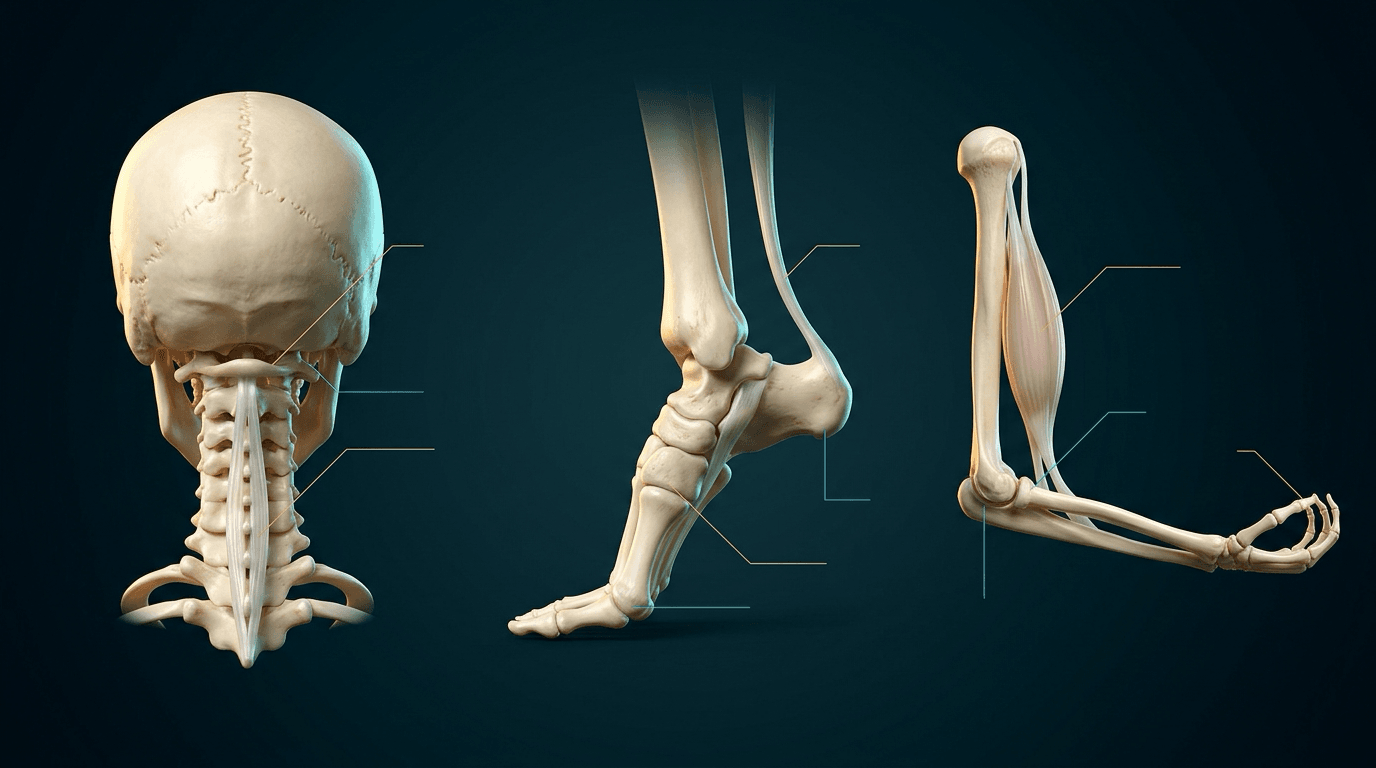
First class: fulcrum in the middle. A seesaw or a balance scale. The mechanical advantage can be greater than, equal to or less than 1 depending on the relative positions of effort and load, so a first-class lever can amplify either force or speed. In the body they are relatively uncommon and typically balance opposing forces or let small muscle displacements produce controlled movement over a balanced range; they offer mechanical versatility rather than the speed of a third-class lever.
- Atlanto-occipital joint - the classic example, nodding the head. The fulcrum is the atlanto-occipital joint, the load the weight of the face and frontal skull anterior to it, the effort the posterior cervical extensors pulling posteriorly on the occiput and upper cervical spine. With the head balanced directly over the spine minimal muscle force is required; as the head tilts forward to look down at a smartphone the moment arm of the head's weight increases dramatically and substantial extensor force is needed to hold it, which is "text neck", chronic forward head posture overloading the cervical extensors.
- Triceps and olecranon - some biomechanists class elbow extension as first class, with the fulcrum at the elbow, the triceps pulling on the olecranon posterior to the joint and the resistance to extension anterior to it. The classification is debatable and depends on how the load is defined.
- Temporomandibular joint - opening the jaw against resistance uses the TMJ as fulcrum, the digastric muscles providing downward effort on the mandible and the resistance (food, a bite block) lying anteriorly between the teeth.
Second class: load in the middle. The wheelbarrow. The effort arm is always longer than the load arm, so the MA is always greater than 1: force is amplified at the expense of speed and displacement, and the load moves through a smaller distance than the effort. Second-class levers are uncommon in the body, primarily because force amplification matters less than speed for most human movement, and the ones that exist are specialised for high force production: propulsion in gait, jumping and climbing stairs.
- The calf raise - rising onto the toes, the most commonly cited example. The fulcrum is the metatarsophalangeal joints (the ball of the foot), the load body weight acting through the ankle joint (approximately midfoot), the effort the Achilles tendon pulling upward on the calcaneus. The effort arm from the MTP joints to the posterior calcaneus is about 12-15 cm and the load arm from the MTP joints to the ankle about 8-10 cm, an MA of approximately 1.2-1.5, one of the few musculoskeletal examples above 1. That amplification lets the calf lift the entire body weight, plus any load carried, repeatedly during walking, running and jumping; the calf muscles are among the strongest in the body relative to their size, though the range of plantarflexion is more limited than dorsiflexion.
- Intertarsal joints in stance - some complex foot movements during the stance phase of gait can be analysed as second-class levers, though the mechanics are complicated by the multi-segmental foot and the changing ground reaction force vector through stance.
Third class: effort in the middle. The effort arm is always shorter than the load arm, so the MA is always less than 1 and the effort must exceed the load, but the arrangement amplifies speed and displacement so that a small contraction produces a large end-point movement. This is by far the commonest class, present at nearly all major limb joints. The MA is typically 0.1-0.3, so muscles generate 3-10 times the external load and joint reaction forces are consequently very high, 2-6 times body weight during normal activities. That demand explains the need for large muscle cross-sectional areas, why humans excel at speed and dexterity rather than raw force amplification, and why strengthening in rehabilitation has to overcome a built-in mechanical disadvantage. The same high muscle and joint forces contribute to joint degeneration and overuse injury, and they are why moment arms are preserved or reconstructed at surgery and restored, as far as possible, in joint replacement design.
Elbow flexion (biceps brachii). The archetype: the fulcrum is the elbow, the effort the biceps insertion on the radial tuberosity about 4-5 cm distal to it, the load the resistance in the hand about 30-35 cm from the elbow. The MA is approximately 4/30 = 0.13, so the biceps generates 7-8 times the hand load; lifting a 5 kg weight costs roughly 35-40 kg of biceps force. In return, when the biceps shortens just 2 cm the hand moves through an arc of about 15 cm, a 7.5-fold amplification of displacement.
Knee extension (quadriceps). The quadriceps inserts on the tibial tuberosity through the patellar tendon about 4-5 cm distal to the knee joint centre, while the external load, body weight in stance or the resistance in a leg extension, acts much farther from the knee. The MA is typically 0.15-0.20, similar to the biceps. The patella lengthens that moment arm by lifting the tendon anterior to the joint centre, and has its own section below.
Hip abduction (gluteus medius and minimus). The abductors insert on the greater trochanter about 5-6 cm from the hip joint centre. In single-leg stance the load arm from the hip centre to the body's centre of mass is about 10-12 cm, an MA of approximately 0.5, and to hold the pelvis level the abductors generate roughly 2-2.5 times body weight. Combined with body weight acting on the femoral head, that abductor pull produces the hip joint reaction forces calculated below.
Shoulder abduction (deltoid). The deltoid inserts on the lateral humerus about 10-12 cm from the glenohumeral joint centre while the arm's centre of mass lies about 15-18 cm from it, so abduction, especially with a weight in the hand, demands very high deltoid force. Supraspinatus initiates abduction and depresses the humeral head, which is what lets the deltoid work efficiently. When supraspinatus is lost the deltoid pulls the head superiorly instead of rotating it, abduction strength falls and the patient produces the characteristic shrug, which is why rotator cuff tears, particularly of supraspinatus, cause such functional impairment.
- Middle element
- Fulcrum
- Order
- E-F-L
- Mechanical advantage
- Variable: greater than, equal to or less than 1
- Body examples
- Atlanto-occipital joint (head nodding), TMJ, triceps at the elbow (debated)
- Middle element
- Load
- Order
- F-L-E
- Mechanical advantage
- Always greater than 1 (force amplification)
- Body examples
- Calf raise: MTP fulcrum, ankle load, Achilles effort; rare in the body
- Middle element
- Effort
- Order
- F-E-L
- Mechanical advantage
- Always less than 1 (speed amplification)
- Body examples
- Biceps, quadriceps, deltoid, hip abductors, hip flexors, most limb muscles
F-L-ELever Classification
Hook:For Love, Load Position - 1-2-3 — First-class lever has Fulcrum between effort and load (F in middle). Second-class lever has Load between fulcrum and effort (L in middle, second letter of alphabet). Third-class lever has Effort between fulcrum and load (E in middle, most common in musculoskeletal system). Think 1-2-3 as F-L-E in the middle progressively. — Most clinical examples are third-class levers (biceps, quadriceps, deltoid) with MA less than 1, requiring high muscle forces but enabling speed and range of motion. Recognizing lever type immediately tells you whether the system amplifies force (rare, second-class) or speed (common, third-class).
Muscle moment arms. The figures worth carrying are approximate and position-dependent; the force demand column is the consequence of a short lever.
- Moment arm
- 5-6 cm
- Force demand
- 2-2.5× body weight in single-leg stance
- Note
- Offset restoration in THA
- Moment arm
- 4-5 cm at 60-70° flexion
- Force demand
- 3-4× body weight climbing stairs
- Note
- Patella adds 20-30%
- Moment arm
- 3-4 cm at 45° flexion
- Force demand
- -
- Note
- -
- Moment arm
- 4-6 cm
- Force demand
- 8-10× body weight running
- Note
- Long Achilles moment arm; significant loading during activity
- Moment arm
- 4-5 cm at 90° flexion
- Force demand
- 7-8× hand load
- Note
- Short moment arm demands high force
- Moment arm
- 2-3 cm at 90° flexion
- Force demand
- -
- Note
- -
- Moment arm
- 2-3 cm at 90° abduction
- Force demand
- -
- Note
- -
- Moment arm
- 1-2 cm
- Force demand
- Variable with position
- Note
- Short moment arm contributes to tear vulnerability
- Moment arm
- 1-2 cm
- Force demand
- -
- Note
- -
Anatomical pulleys. Several structures act as pulleys, changing the path of a tendon; the table gives what each does and why it matters clinically.
- Structure
- Sesamoid in the quadriceps tendon
- Function
- Increases the quadriceps moment arm by 20-30%
- Clinical relevance
- Patellectomy weakens extension significantly
- Structure
- Peroneal tendon pulley
- Function
- Redirects the peroneal tendons posteriorly
- Clinical relevance
- Subluxation causes lateral ankle instability
- Structure
- A1-A5 annular pulleys
- Function
- Prevent bowstringing of the flexor tendons
- Clinical relevance
- A2 and A4 critical for function; trigger finger at A1
- Structure
- Intertubercular sulcus
- Function
- Redirects the long head of biceps
- Clinical relevance
- Pulley lesions cause subluxation or rupture
Force Couples
Levers explain how a single muscle force turns a joint, but many joints are controlled by a force couple, the other fundamental moment-producing arrangement, and the deltoid and rotator cuff working together at the shoulder is the example that runs through this topic.
Definition. A force couple is two equal, parallel, oppositely directed forces acting along separate lines of action. Their translational effects cancel, so the net force is zero, but together they produce a pure moment equal to one force multiplied by the perpendicular distance between the two lines of action. A couple therefore generates rotation without translating the fulcrum, precisely what a joint needs to turn about a stable centre of rotation.
Why it matters. In a simple lever the fulcrum must resist a large reaction force; in a balanced couple the opposing forces hold the centre of rotation stationary while still generating torque. Lose one limb of the couple and it is unbalanced, and the fulcrum migrates.
- Shoulder, coronal plane - the deltoid pulls the humeral head superiorly while the inferior rotator cuff (subscapularis, infraspinatus, teres minor) pulls it inferiorly; balanced, they create a stable fulcrum about which the deltoid abducts the arm. A massive cuff tear unbalances the couple: the deltoid's unopposed superior pull lets the head ride up and abduction fails (pseudoparalysis) despite an intact deltoid.
- Shoulder, transverse plane - subscapularis anteriorly balanced against infraspinatus and teres minor posteriorly centres the head in the glenoid. Shoulder-specific cuff mechanics are developed in the shoulder and rotator cuff topics.
- Trunk and pelvis - the abdominal and erector spinae muscles, and the paired hip abductors, act as couples to control pelvic tilt and spinal rotation.
Variable Moment Arms
Why a moment arm changes. Muscle moment arms are not constant; they vary as the joint moves through its range, and the variation shapes torque production. A muscle's pull on a bone resolves into a rotational component perpendicular to the bone, the only component that produces movement, and a component along the bone, which compresses the joint when directed towards it (stabilising, dominant at small flexion angles) and distracts it when directed away (destabilising, at large flexion angles). At 90° the force is perpendicular to the segment, all of it creates rotation and there is no stabilising or destabilising component; at 0° or 180° the force runs mostly along the bone with minimal rotational component, which is why starting a movement from an extreme position is difficult.
Biceps. At full extension the biceps moment arm is only about 2-3 cm because the muscle's line of action passes close to the joint centre. At 90° of flexion it has risen to about 4-5 cm as the muscle courses farther anterior to the joint, and beyond 90° it gradually falls again. The biceps therefore produces its maximum flexion torque in mid-range, around 90°, and with the length-tension relationship (a muscle generates its greatest force at optimal length) it is strongest in mid-range flexion.
Quadriceps. At full extension the patellar tendon runs nearly parallel to the tibia and the moment arm is small, roughly 3 cm. As the knee flexes the tendon becomes more perpendicular to the tibia and the moment arm rises to its maximum of 4-5 cm at about 60-70° of flexion, then falls to about 3.5 cm at 90° and 2.5 cm at 120°; the greatest mechanical advantage is in mid-range, which is why initiating extension from full flexion is hard. The patella is the spacer that keeps the tendon anterior to the joint centre and holds the moment arm up; patellectomy or patella baja lowers it, potentially contributing to early quadriceps fatigue and extensor mechanism dysfunction.
Deltoid and supraspinatus. The deltoid's abduction moment arm is smallest with the arm at the side, increases to about 60-90° of abduction, then decreases at higher angles. The supraspinatus moment arm is greatest in the first 30°, so the two produce complementary torque across the abduction arc. The hamstring moment arm peaks at about 45° of knee flexion.
The external moment changes too. With a constant weight in the hand the external load moment still varies with joint angle, and is greatest when the limb is perpendicular to the direction of the load: in a biceps curl the external moment peaks at 90° of elbow flexion and is minimal at 0° and 180°.
Rehabilitation. Because torque capacity and muscle activation vary with joint angle, strengthening should cover the full range of motion, and testing strength at several angles separates a true strength deficit from biomechanical disadvantage at that position. After injury or surgery patients may unconsciously alter joint angles to optimise their moment arms, which may point to weakness or pain at the disadvantaged positions, and rehabilitation should restore function throughout the range. Injuries tend to occur when the external moment exceeds what the muscles can counter, most likely where the muscle moment arm is smallest or at extremes of range where the length-tension relationship is suboptimal.
Pathology. Conditions that shorten or abolish a moment arm produce weakness in the presence of an intact muscle:
- Hip dysplasia, coxa vara and a varus femoral neck - reduced abductor moment arm
- Patella baja or alta - altered quadriceps moment arm
- Malunion - changed lever arms for every muscle crossing the segment
- Tendon avulsion - complete loss of the moment arm
Procedures that move a muscle insertion or a joint centre change moment arms just as deliberately, and restoring them is a key goal of reconstructive surgery; the management section takes them in turn.
Joint Reaction Forces
Principle. The joint reaction force is the vector sum of every force acting across the joint: muscle forces, external loads and segment weights. Because most levers run at an MA less than 1, muscle forces substantially exceed external loads, and the joint reaction force is often 2-6 times the external load. In a simplified analysis with colinear forces it is muscle force plus external load; in reality it needs vector addition that accounts for force directions and the other muscles and ligaments crossing the joint.
The simplest case. Holding 10 kg in the hand 35 cm from the elbow, with a biceps moment arm of 4 cm: the external load moment is 10 kg × 35 cm = 350 kg·cm, the required biceps force is 350 / 4 = 87.5 kg, and the elbow joint reaction force is biceps force plus external load, 87.5 + 10 = 97.5 kg, approximately 10 times the external load. The calculation ignores forearm weight and assumes the biceps acts alone, but it shows the principle that joint forces far exceed external loads.
Worked example: the biceps curl. A person holds a 5 kg weight with the elbow at 90°.
- External load 5 kg (49 N) at 35 cm from the elbow; forearm 1.5 kg (14.7 N) acting at 15 cm; biceps moment arm at 90° 4 cm
- External load moment 49 N × 0.35 m = 17.15 N·m; forearm moment 14.7 N × 0.15 m = 2.21 N·m; total 19.36 N·m
- Biceps force = 19.36 N·m / 0.04 m = 484 N (approximately 49 kg), about ten times the external load; MA = 4 cm / 35 cm = 0.11
- Joint reaction force, vertical components only: 484 - 14.7 - 49 = 420 N (approximately 43 kg), a compressive force about 8-9 times the external load
Worked example: single-leg stance. A 70 kg person stands on one leg; the abductors (gluteus medius and minimus) must stop the pelvis dropping on the other side.
- Body weight excluding the stance leg 55 kg (539 N), acting 10 cm from the hip centre; abductor moment arm 5 cm
- Body weight moment 539 N × 0.10 m = 53.9 N·m; abductor force = 53.9 / 0.05 = 1078 N (approximately 110 kg), twice the weight it is balancing; MA = 5 / 10 = 0.5
- The hip joint reaction force needs vector addition because the forces are not colinear; the abductor force acts at roughly 30° from vertical. The simplified result is about 1700-1900 N, or 2.5-2.8 times body weight
Expressed in fractions of body weight, with 5/6 BW through the supporting leg (the standing leg subtracted) acting 10 cm from the hip and the abductors inserting 5 cm from the hip centre: the weight moment is (5/6 BW) × 10 cm = 8.33 BW·cm, the abductor force 8.33 / 5 = 1.67 BW, and in the simplified addition JRF = abductor + weight = 1.67 + 0.83 = 2.5 × BW.
This is why abductor weakness produces a Trendelenburg gait, why the hip carries about 2.5-3 times body weight in walking, why a total hip arthroplasty must withstand high cyclic loading, and why weight loss reduces hip joint force directly and obesity raises the risk of hip arthritis: joint forces scale with body weight.
Worked example: seated knee extension. A 10 kg weight is held on the ankle.
- External load 10 kg (98 N) at 40 cm from the knee; lower leg 3 kg (29.4 N) at 20 cm; patellar tendon moment arm 4.5 cm at 60° of flexion
- Moments 98 × 0.40 = 39.2 N·m and 29.4 × 0.20 = 5.88 N·m, total 45.08 N·m
- Quadriceps force = 45.08 / 0.045 = 1002 N (approximately 102 kg), about ten times the external load
- At 60° of flexion the quadriceps and patellar tendon forces meet at about 120°, so PFJRF = √(Q² + T² − 2QT·cos 120°) with Q ≈ T ≈ 1002 N, giving about 1.7 × Q = 1700 N (approximately 173 kg), roughly 2.5 times body weight on the patellofemoral joint during a modest exercise
The examples make the same point: joint reaction forces far exceed external loads, muscle forces are very high even in modest activity, patients with muscle weakness struggle with anything that needs sustained force, and joint replacements must withstand high cyclic loads during routine activities.
The exam version. A 10 kg weight is held in the hand with the elbow at 90°; the biceps inserts 5 cm from the elbow and the weight is 30 cm from the elbow. What force must the biceps generate?
- Moment from the weight 10 kg × 10 m/s² × 0.30 m = 30 N·m; biceps moment arm 0.05 m
- Biceps force = 30 N·m / 0.05 m = 600 N, which is 6 times the load (MA = 0.05/0.30 = 0.17)
The squat. In a deep squat the external moment from body weight and any added load acting between the knee centre and the ground contact grows progressively with flexion as its moment arm lengthens, while the quadriceps moment arm changes and the patellofemoral contact area shifts proximally on the patella. At 90° of flexion the patellofemoral joint reaction force can reach 3-5 times body weight, rising to 7-8 times at 120°, which is why deep squatting is discouraged in patellofemoral arthritis or chondromalacia.
Peak forces by activity. The table gives the commonly quoted estimates. The directly measured figures from Bergmann's instrumented hips are 238% body weight in level walking and 251-260% on stairs, with the peak loads occurring in stumbling. Faster walking and running raise ground reaction forces and joint loads proportionally.
- Activity
- Walking
- Force (× body weight)
- 2.5-3.0×
- Clinical relevance
- Baseline for implant design
- Activity
- Stair climbing
- Force (× body weight)
- 3-4×
- Clinical relevance
- Higher than level walking
- Activity
- Running
- Force (× body weight)
- 4-5×
- Clinical relevance
- High loads; a concern after arthroplasty
- Activity
- Walking
- Force (× body weight)
- 2-3×
- Clinical relevance
- Transmitted through tibiofemoral contact
- Activity
- Stair climbing
- Force (× body weight)
- 3-4×
- Clinical relevance
- Hip and knee both loaded
- Activity
- Deep squat at 120°
- Force (× body weight)
- 7-8×
- Clinical relevance
- Very high patellofemoral forces
- Activity
- Walking
- Force (× body weight)
- 4-5×
- Clinical relevance
- High because of the short moment arm of the ground reaction
Running transmits impact forces of up to 5 times body weight to the joints, and landing from a jump can exceed 10 times body weight.
Ground reaction force and the external moment. The worked examples use body weight as a static load; the gait laboratory measures the ground reaction force (GRF) instead, and the concept that links them is the external joint moment, the basis of all gait analysis. By Newton's third law, when the foot pushes on the ground the ground pushes back with an equal and opposite GRF. In quiet standing the vertical GRF equals body weight, but in gait acceleration adds inertial loading, so it rises to roughly 1.1-1.3 times body weight in walking and 2-3 times in running, with fore-aft and medio-lateral components as well.
At each joint the external moment = GRF × the perpendicular distance from the GRF vector to that joint axis. Whichever side of the joint the GRF passes, it tends to rotate the joint that way, and the muscles must generate an equal and opposite internal moment to control it. That is why moving the GRF, or the centre of mass, relative to the joint changes joint load without changing body weight: leaning the trunk, a contralateral cane, a lateral-wedge insole or a realignment osteotomy all work this way. A gait laboratory combines the measured GRF from a force plate with limb kinematics from motion capture and segment masses to calculate the net internal moment, power and estimated force at each joint throughout the gait cycle, inverse dynamics, turning the static free-body analysis above into a dynamic, instant-by-instant one.
The knee adduction moment. During stance the GRF passes medial to the knee, creating an adduction (varus) external moment that loads the medial compartment. The knee adduction moment (KAM) is the best surrogate for medial-compartment load and predicts progression of medial osteoarthritis. Interventions that shorten the GRF-to-knee moment arm reduce it and offload the medial compartment: lateral-wedge insoles, gait retraining (toe-out, trunk lean), a contralateral cane, or a valgus high tibial osteotomy.
Lifting and the spine. Bending forward puts the trunk's centre of mass anterior to the spine on a long lever arm, so erector spinae forces during lifting are very high. Disc load is proportional to the moment at that level, and L5/S1, the most loaded, is a common site of degeneration. Intra-abdominal pressure reduces the spinal moment, the reason for the weightlifter's Valsalva and belt, and whether one squats or stoops, keeping the load close to the body shortens its moment arm.
Implants and fixation. Joint replacements must withstand reaction forces that often exceed 3-5 times body weight in routine activity and reach up to 10 times body weight in high-demand activity, and that requirement drives materials selection and fixation methods. Internal fixation devices see forces of the same origin: plates and screws must resist the bending moments and shear forces of the bone-implant construct's mechanical environment.
The Patella as a Moment Arm Enhancer
What it does. The patella is the largest sesamoid bone in the body, and its biomechanical job is to lengthen the quadriceps moment arm. By lifting the patellar tendon anteriorly away from the knee joint centre it increases the perpendicular distance from the quadriceps force vector to the knee axis by approximately 20-30% compared with a theoretical patellectomised knee, so without a patella, or with one that is not functioning, the quadriceps must generate 20-30% more force for the same extension torque.
The price: patellofemoral joint reaction force. As the knee flexes the patella articulates with progressively more proximal regions of the trochlear groove, and contact area and pressure vary with the flexion angle. The patellofemoral joint reaction force is the vector sum of the quadriceps force (Q) and the patellar tendon force (T), which are approximately equal in magnitude: PFJRF = Q + T as vectors. At 90° of flexion the two vectors meet at about 90°, so PFJRF = √(Q² + T²) ≈ 1.4 × Q. Since Q can reach 3-4 times body weight in stair climbing, the PFJRF can reach 4-6 times body weight or higher in demanding activity, which explains the high prevalence of patellofemoral pain and chondromalacia, particularly in people who flex the knee repetitively.
Patellectomy. Removing the patella for a comminuted fracture or severe arthritis reduces quadriceps efficiency by 20-30%, causing weakness, early fatigue and a potential extensor lag. Modern treatment favours preserving the patella, with fragment excision or fixation, even for complex fractures where possible.
Patella baja and alta. A low-lying patella (baja) reduces the quadriceps moment arm at lower flexion angles; a high-riding patella (alta) reduces it at higher flexion angles and increases the risk of instability. Both impair quadriceps function and may cause anterior knee pain.
Tibial tuberosity osteotomy. Moving the tuberosity moves the tendon, and each direction has a purpose:
- Anteriorisation (Maquet) - increases the quadriceps moment arm and so reduces the PFJRF for a given extension torque; used occasionally for patellofemoral arthritis, less than in the past
- Medialisation (Elmslie-Trillat) - addresses patellar instability by changing the direction of the quadriceps force vector rather than its moment arm, altering the medial-lateral moment arms
- Distalisation - for patella alta, lengthening the patellar tendon moment arm at low flexion angles
- Anteromedialisation (Fulkerson) - shifts the tuberosity anteriorly and medially, reducing patellofemoral contact pressure and altering the quadriceps moment arm
Clinical Assessment
Trendelenburg gait. Abductor weakness, or a shortened abductor moment arm, shows in the gait: the pelvis drops on the swing side and the trunk leans towards the stance leg to compensate. The Trendelenburg test is single-leg stance for 30 seconds, positive if the pelvis drops or the trunk compensates. Abductor strength is tested directly with side-lying hip abduction against resistance, and femoral offset is measured on the radiograph and compared with the other side: reduced offset means a reduced moment arm and a greater abductor force requirement. Lateral hip pain is often abductor dysfunction or tendinopathy.
Muscle testing. Position changes the moment arm and therefore the force required, so manual testing is done at the position of maximum mechanical advantage and compared with the contralateral side. Dynamometry gives a quantitative force at standardised positions.
- Clinical finding
- Trendelenburg gait
- Biomechanical explanation
- Reduced abductor moment arm
- Clinical finding
- Extensor lag, weak terminal extension
- Biomechanical explanation
- Reduced quadriceps moment arm
- Clinical finding
- Weakness despite an intact muscle
- Biomechanical explanation
- Altered lever arm geometry
- Clinical finding
- Complete loss of function
- Biomechanical explanation
- Zero moment arm (no force transmission)
The extensor mechanism. Four bedside tests: active extension for an extensor lag (inability to extend fully against gravity), the passive patellar position for alta or baja, the Q-angle, which shapes the resultant force vector, and a single-leg squat as a functional test of moment generation. Weakness with an intact muscle suggests a mechanical, moment arm problem rather than a muscular one. Patellar height is quantified with the Insall-Salvati ratio, patellar tendon length divided by patella length: normal 0.8-1.2, alta above 1.2 (reduced quadriceps moment arm), baja below 0.8. Watching the patient climb stairs or squat shows any lag or compensation.
- What it measures
- Peak torque at a controlled velocity
- Clinical application
- Pre- and post-operative strength, sports clearance
- Limitations
- Equipment cost, position standardisation
- What it measures
- Joint angles and moments during activity
- Clinical application
- Gait analysis, surgical planning
- Limitations
- Expensive, time-consuming
- What it measures
- Ground reaction forces
- Clinical application
- Balance, weight-bearing asymmetry
- Limitations
- Static or limited dynamic information
- What it measures
- Muscle activation patterns
- Clinical application
- Nerve injury, motor control
- Limitations
- Does not directly measure force
Planning a hip replacement. Three measurements matter: femoral offset, the distance from the femoral head centre to the shaft axis; leg length; and the neck-shaft angle, which sets the moment arm. The goal is to restore or optimise the abductor moment arm while balancing leg length and stability, templating for offset within 5 mm of the contralateral hip.
Investigations
Radiographs. The measurements that describe a lever arm are made on plain films.
- Normal value
- 40-50 mm
- Clinical significance
- Abductor moment arm
- How to measure
- Horizontal distance from head centre to shaft axis
- Normal value
- 125-135°
- Clinical significance
- Affects offset and leg length
- How to measure
- Angle between neck and shaft axes
- Normal value
- 0.8-1.2
- Clinical significance
- Patellar height, quadriceps moment arm
- How to measure
- Patellar tendon length / patella length
- Normal value
- Males 10-15°, females 15-20°
- Clinical significance
- Lateral patellar force vector
- How to measure
- ASIS to patella centre to tibial tubercle
The hip. A standard AP pelvis gives femoral offset, the centre-edge angle for acetabular coverage and the neck-shaft angle. Templating needs a magnification marker and the contralateral side for comparison. To measure offset, draw the femoral shaft axis, mark the centre of the femoral head, and measure the perpendicular distance from head centre to shaft axis; normal is 40-50 mm, and every millimetre of change alters the abductor force requirement.
The knee. The lateral radiograph gives the Insall-Salvati ratio and the posterior tibial slope, which affects the moment; the Merchant or skyline view shows patellar tilt and subluxation and allows assessment of trochlear dysplasia.
- What it measures
- Precise bone geometry
- Clinical use
- Complex deformity, revision THA planning
- Advantages
- Accurate offset and version measurement
- What it measures
- Muscle volume, fatty infiltration
- Clinical use
- Rotator cuff, abductor assessment
- Advantages
- Soft tissue detail
- What it measures
- Full limb alignment under load
- Clinical use
- Spine and lower limb assessment
- Advantages
- Low radiation, weight-bearing
- What it measures
- Dynamic joint mechanics
- Clinical use
- Instability assessment, implant position
- Advantages
- Real-time imaging
The gait laboratory. Infrared cameras track reflective markers, force plates measure the ground reaction force and EMG records the timing of muscle activation; the output is joint angles through the gait cycle, joint moments and powers, and muscle activation patterns. Before surgery it quantifies the biomechanical deficit, predicts the benefit and compares options; afterwards it measures outcome objectively, finds persistent abnormalities and guides rehabilitation. What it offers that the clinical examination cannot:
- Quantitative data - precise joint angles and moments rather than subjective assessment
- Timing - when in the gait cycle an abnormality occurs
- Hidden compensations - subtle adaptations not visible clinically
- Objective comparison - numerical pre- and post-operative comparison
- Force calculation - an estimate of internal joint forces, impossible at the bedside
- Purpose
- Predict stress distribution
- Clinical utility
- Optimise implant geometry
- Purpose
- Compare construct stability
- Clinical utility
- Select the optimal fixation method
- Purpose
- Predict force redistribution
- Clinical utility
- Optimise correction angles
- Purpose
- Individual biomechanical prediction
- Clinical utility
- Personalised surgical planning
Management
Non-operative. Physiotherapy cannot change a moment arm, but it can raise the force the muscle produces, so the non-operative strategy is to strengthen, with core strengthening for proximal stability. Walking aids reduce joint reaction force, and are chosen by how much reduction is needed.
The contralateral cane. A cane in the opposite hand shifts the body's centre of mass towards the stance limb and creates a moment opposing the body-weight moment, so the abductors have less to do. It shortens the moment arm of body weight about the hip from about 10-12 cm to 6-8 cm, the abductor force falls by about 30-40%, and the joint reaction force falls with it, by up to 50%; it is particularly useful in hip or knee arthritis. A cane on the same side does not reduce abductor demand. Set the height so the elbow is flexed 15-30° with the hand on the grip. A walker or bilateral crutches give symmetric support, cut the single-leg loading phases and lower peak joint force, which is essential after lower limb surgery or fracture.
Activity modification. Some activities load joints heavily because of long external moment arms or several joints loaded at once; others spare them.
- Limit - deep squatting (patellofemoral 7-8 times body weight at 120°), stair climbing (hip and knee 3-4 times body weight), running (impact up to 5 times body weight), jumping (landing forces above 10 times body weight)
- Prefer - swimming and cycling (low impact, smaller joint reaction forces), shallow squats to less than 90° (moderate patellofemoral force), level walking (hip 2.5-3 times, knee 2-3 times body weight)
- Weight loss - joint forces fall in direct proportion
Surgical strategies. Surgery changes moment arms by moving insertions or joint geometry, and the effect must be planned rather than discovered. Component position is part of it: the tibial slope in a TKA affects the quadriceps and hamstring moment arms, and excessive posterior slope of the tibial component can reduce the quadriceps moment arm; femoral offset in a THA sets the abductor moment arm; glenoid version in a shoulder replacement affects the rotator cuff moment arms. Small positioning changes can significantly alter muscle efficiency and joint force. Derotational femoral or tibial osteotomies change the moment arms of every muscle crossing the segment relative to the rotational deformity, and can optimise function for particular activities or gait patterns.
- Biomechanical goal
- Restore the abductor moment arm
- Moment arm effect
- Increases the effective lever arm and reduces the force required
- Biomechanical goal
- Increase the abductor moment arm
- Moment arm effect
- Lateralises the greater trochanter relative to the centre of rotation
- Biomechanical goal
- Medialised to improve tracking; distalised to increase the quadriceps moment arm
- Moment arm effect
- Alters the quadriceps force vector and moment arm
- Biomechanical goal
- Redirect a force vector
- Moment arm effect
- Creates a new moment arm for a lost function
Why offset matters in THA. Restoring femoral offset restores the abductor moment arm, so less abductor force is needed; that lowers the joint reaction force and with it wear; gait improves and the Trendelenburg limp goes; and soft tissue tension, and so stability, is maintained. The trade-off is that increasing offset can shorten leg length if the same neck length is used.
- Biomechanical effect
- Increase the abductor moment arm by 5-10 mm
- Clinical benefit
- Reduce joint reaction force, improve gait
- Biomechanical effect
- Increase offset without changing the stem
- Clinical benefit
- An option in revision or with a standard stem
- Biomechanical effect
- Increases the quadriceps moment arm
- Clinical benefit
- Improves extension strength
- Biomechanical effect
- Cam mechanism increases femoral rollback
- Clinical benefit
- Increases the quadriceps moment arm in flexion
Osteotomy. A valgus proximal femoral osteotomy increases the abductor moment arm and lateralises the mechanical axis, and is used for coxa vara and avascular necrosis; a varus osteotomy improves coverage in coxa valga and developmental dysplasia but may decrease offset. A high tibial osteotomy shifts load from the medial to the lateral compartment and does not change the quadriceps moment arm significantly. The tibial tubercle osteotomies are covered with the patella above.
Tendon transfer. A transfer succeeds or fails on the new moment arm: the tendon must cross the joint at an angle that can produce the desired motion, and the further its line lies from the joint axis the more torque it generates for a given force. Excursion must match the new function, and strength is finite because a transferred muscle loses approximately one MRC grade. Planning therefore checks that the donor is expendable, at least MRC 4, has adequate excursion, is synergistic (in-phase muscles are easier to retrain) and can be routed to give a useful moment arm. An example is tibialis posterior transfer for foot drop, where the route determines the dorsiflexion moment arm.
- Description
- Tendon must cross the joint at an appropriate angle
- Clinical application
- Determines whether the transfer can produce the desired motion
- Description
- Distance from tendon to joint axis
- Clinical application
- Greater distance means more torque for a given force
- Description
- Distance the tendon can move
- Clinical application
- Must match the requirements of the new function
- Description
- Force-generating capacity
- Clinical application
- Transferred muscle loses approximately one grade of strength
Surgical Technique
Restoring offset in THA. Templating plans the offset to match the contralateral hip, with a high-offset stem if needed; stem selection decides the neck geometry, standard against high-offset with a range of neck lengths; and a longer neck increases both length and offset, so the two may have to be traded. Medialising the cup moves the centre of rotation and increases the abductor moment arm. At trial reduction, compare with the template, feel the abductor tension, and if the patient is awake under a regional block check for a Trendelenburg sign. Loose abductors with the trial in place, or a need for excessive leg length to achieve stability, are the signs of inadequate offset.
When to use a high-offset stem.
- Native offset greater than 45 mm, beyond a standard stem
- Coxa vara, neck-shaft angle less than 125°, with its natural high offset
- A large patient with a correspondingly large offset
- Revision where offset was previously under-restored
High offset increases the bending moment on the stem, so fixation must be adequate.
The extensor mechanism in TKA. Patellar resurfacing thickness, joint line restoration and avoiding over-stuffing, which limits flexion, are the levers on the quadriceps moment arm. The rule is to recreate the original patellar thickness within 2 mm.
- Structures at risk
- External rotators, capsule
- Biomechanical consequence if damaged
- Posterior instability; rotational control affected
- Structures at risk
- TFL, lateral femoral cutaneous nerve
- Biomechanical consequence if damaged
- Minimal abductor impact; preserved moment arm
- Structures at risk
- Gluteus medius
- Biomechanical consequence if damaged
- Trendelenburg if not repaired; reduced abductor moment arm
- Structures at risk
- Medial retinaculum, VMO
- Biomechanical consequence if damaged
- Patellar tracking may be affected
A greater trochanteric osteotomy may weaken the abductors if it does not heal.
Valgus-producing femoral osteotomy. A lateral closing wedge or medial opening wedge increases the neck-shaft angle and with it the offset, fixed with a blade plate or DHS. The blade entry point determines the final neck-shaft angle.
Fulkerson osteotomy. The anteromedialising tibial tubercle osteotomy preserves a distal periosteal hinge, and a shingle osteotomy adds stability.
Tendon transfer routing. The route creates the moment arm.
- Original function
- Inversion, plantarflexion
- New moment arm
- Dorsiflexion moment arm
- Technical key
- Route through the interosseous membrane
- Original function
- Wrist flexion
- New moment arm
- Finger extension moment arm
- Technical key
- Tension at 20° wrist extension, fingers straight
- Original function
- Extension, adduction
- New moment arm
- External rotation moment arm
- Technical key
- Route posterior to the humerus
- Original function
- Adduction
- New moment arm
- Elbow flexion moment arm
- Technical key
- Maintain the line of pull across the elbow
Tensioning a transfer. Position the joint in the resting position wanted for the transferred function, tension the tendon until the muscle belly sits at resting length, secure it with a bone anchor, interference screw or tendon weave, and test passive motion: the tenodesis effect should produce the desired movement. Too loose is ineffective; too tight limits the opposite motion and may rupture.
Complications
- Biomechanical cause
- Reduced abductor moment arm
- Clinical presentation
- Pelvis drops on the swing side; trunk compensates
- Biomechanical cause
- Increased joint reaction force
- Clinical presentation
- Early polyethylene failure, osteolysis
- Biomechanical cause
- Inadequate soft tissue tension
- Clinical presentation
- Recurrent dislocation
- Biomechanical cause
- Reduced quadriceps moment arm
- Clinical presentation
- Cannot fully extend the knee against gravity
- Biomechanical cause
- Increased bending moments on the implant
- Clinical presentation
- Stem or plate fracture
Offset in THA, either way. Under-restoration gives a Trendelenburg gait, a higher joint reaction force and more wear, and may need revision. The chain is short: reduced offset shortens the abductor moment arm; the same external moment (body weight × its lever arm) must still be balanced; the abductors generate greater force; the joint reaction force rises; and the joint reaction force is the primary determinant of polyethylene wear, with wear rate proportional to joint reaction force × cycles × coefficient of friction. Over-restoration brings lateral thigh pain, greater trochanteric impingement and a higher bending moment on the stem.
The joint line in TKA. Elevating it produces mid-flexion instability, a reduced quadriceps moment arm and a patella baja effect. Patellar maltracking alters the force vectors and causes anterior knee pain and accelerated wear.
- Biomechanical cause
- Excessive bending moment
- Prevention strategy
- Appropriate sizing; avoid high offset with poor fixation
- Biomechanical cause
- Cyclic loading with inadequate healing
- Prevention strategy
- Protect until union; use longer plates
- Biomechanical cause
- Force exceeds the bone-screw interface strength
- Prevention strategy
- Bicortical purchase; augmentation in poor bone
- Biomechanical cause
- High contact stress
- Prevention strategy
- Reduce joint reaction force; cross-linked polyethylene; larger head sizes
Stress shielding. Load carried through an implant is load the bone no longer sees, and by Wolff's law bone that is not stressed resorbs. It is most common proximally with cementless THA stems, where load bypasses the proximal femur; the consequences are proximal bone loss, a risk of periprosthetic fracture and a harder revision. A stiff stem (cobalt-chrome, large diameter) carries more of the load and shields more; a flexible stem (titanium, smaller) shares load with the bone and shields less, but a very flexible stem may subside or cause thigh pain from micromotion. Tapered, proximally loading designs aim to load proximal bone while achieving distal stability, and shorter stems and less stiff materials are the other mitigations.
- Biomechanical effect
- Reduced abductor moment arm
- Clinical consequence
- Trendelenburg, increased joint reaction force
- Biomechanical effect
- Lateral compartment overload
- Clinical consequence
- Accelerated lateral osteoarthritis
- Biomechanical effect
- Altered moment arms of all crossing muscles
- Clinical consequence
- Gait abnormality, pain
- Biomechanical effect
- Altered muscle length-tension relationship
- Clinical consequence
- Weakness, gait asymmetry
Postoperative Care
Progressive weight-bearing. Bone healing needs a mechanical stimulus (Wolff's law). Load too early exceeds the strength of the fixation and it fails; load too late and stress shielding brings osteopenia and slower healing. Protected weight-bearing supplies the stimulus without exceeding construct strength.
- Key biomechanical concern
- Protect the abductor repair; restore moment arm function
- Rehabilitation focus
- Abductor strengthening; gait training
- Key biomechanical concern
- Restore quadriceps function
- Rehabilitation focus
- Quadriceps strengthening; range of motion to optimise the moment arm
- Key biomechanical concern
- Protect healing while optimising the new alignment
- Rehabilitation focus
- Protected weight-bearing; muscle retraining
- Key biomechanical concern
- Allow tendon healing; retrain the new function
- Rehabilitation focus
- Immobilisation then progressive loading
Strengthening. Muscle force depends on cross-sectional area, the length-tension relationship, and training and coordination, and the goal of rehabilitation is to maximise it to compensate for fixed moment arms.
- Biomechanical effect
- Minimal joint moment
- Clinical application
- Early after TKA; protects healing
- Biomechanical effect
- High quadriceps demand
- Clinical application
- Late rehabilitation for extensor strength
- Biomechanical effect
- Isolates the abductors without joint reaction force
- Clinical application
- Early abductor training after THA
- Biomechanical effect
- Generates the full abductor moment
- Clinical application
- Late rehabilitation; functional training
Gait retraining after THA. Correct the Trendelenburg compensation, normalise stride length and progress from walker to cane to independent walking as strength recovers; abductor strengthening is the primary goal of gait normalisation. A walker reduces load more than a cane but at a slower gait, and crutches vary with technique.
Tendon transfer rehabilitation. Motor relearning is needed because the muscle now performs a different movement and the brain must learn a new pattern; it is easiest when the transfer is synergistic, EMG or visual biofeedback accelerates it, and automatic use may take 6-12 months.
- Timing
- 4-6 weeks
- Goal
- Allow tendon healing
- Biomechanical rationale
- Minimise tension at the repair site
- Timing
- 6-8 weeks
- Goal
- Prevent adhesions
- Biomechanical rationale
- Gentle tendon gliding without active tension
- Timing
- 8-12 weeks
- Goal
- Initiate motor learning
- Biomechanical rationale
- Low loads during neuromuscular retraining
- Timing
- 12 weeks onwards
- Goal
- Build force production
- Biomechanical rationale
- Progressive loading of the healed tendon
Outcomes
Offset and the hip. Each 1 mm reduction in offset increases the required abductor force by approximately 5-8%, and a 5 mm reduction may raise the joint reaction force by 25-40%, with correspondingly higher wear; the aim is offset within 5 mm of the contralateral or native hip. Restoration improves the Harris Hip Score by an average of 15-20 points compared with under-restoration, with better abductor strength and gait quality, and Oxford Hip Scores are better with anatomic reconstruction. AOANJRR data suggest better survival with appropriate offset and fewer revisions for instability and wear.
- Under-restored offset
- Trendelenburg or compensatory lean
- Properly restored offset
- Normal gait pattern
- Under-restored offset
- Lower because of the limp
- Properly restored offset
- Higher satisfaction scores
- Under-restored offset
- Accelerated (higher joint reaction force)
- Properly restored offset
- Reduced wear rate
- Under-restored offset
- Increased (poor soft tissue tension)
- Properly restored offset
- Reduced risk
- Under-restored offset
- Higher for instability and wear
- Properly restored offset
- Lower revision rates
- Finding
- Normal gait achieved with offset within 5 mm of native
- Clinical implication
- Template to match the contralateral hip
- Finding
- Each mm of reduction increases linear wear by 0.1 mm/year
- Clinical implication
- Significant over a 20-year implant life
- Finding
- Under-restoration increases dislocation 2-3×
- Clinical implication
- Prioritise offset restoration
- Finding
- Under-restoration associated with 15% lower satisfaction
- Clinical implication
- Patient-reported outcomes affected
The knee. Joint line elevation greater than 5 mm in TKA is associated with poorer outcomes, reduced range with persistent stiffness, and mid-flexion instability; patellar resection should aim for a composite thickness matching the native patella. Tibial tubercle osteotomy gives 80-90% good or excellent results for the correct indications, with improved tracking, less pain and resolution of anterior knee pain in the majority; nonunion occurs in 1-2%, and fracture with early mobilisation.
Tendon transfers. Transfers fail for biomechanical reasons: an inadequate moment arm from poor routing, wrong tension, a donor too weak (MRC 4 or better is required), inadequate excursion, and scar or adhesions that stop the tendon gliding. Poor compliance with therapy and unrealistic expectations are the patient factors.
- Success rate
- 80-90%
- Functional gain
- Active dorsiflexion restored
- Key to success
- Adequate tendon length; synergistic function
- Success rate
- 85%
- Functional gain
- Finger extension restored
- Key to success
- Correct tensioning; hand therapy
- Success rate
- 60-70%
- Functional gain
- Variable external rotation improvement
- Key to success
- Patient selection; massive tears may fail
- Success rate
- 75-80%
- Functional gain
- Shoulder stability improved
- Key to success
- Technique dependent; learning curve
Hip contact forces and gait patterns from routine activities
- Average hip contact force was 238% body weight during level walking at about 4 km/h
- Stair climbing generated 251% body weight ascending and 260% body weight descending
- Implant inwards torsion (critical for stem fixation) was about 23% larger on stairs than level walking
- Implants should be tested mainly with loading that mimics walking and stair climbing; stumbling produces the peak loads
Mechanical function of the patella
- Patella increases quadriceps moment arm by ~25% throughout knee flexion range
- Patellofemoral joint reaction force = vector sum of quadriceps and patellar tendon forces
- PFJRF reaches peak at 90-120° flexion, approximately 1.4× quadriceps force magnitude
- Patellectomy reduces knee extension strength by 20-30% and causes early fatigue
Optimizing the femoral offset for restoring physiological hip muscle function in patients with total hip arthroplasty
- Decreased femoral offset correlated with reduced abductor and external-rotator moment arms throughout gait
- Increased offset shortened flexor and adductor moment arms
- Increasing offset by about 2-3 mm raised abductor moment arms while keeping other muscle moment-arm losses under 5%
- Confirms offset restoration as the surgical lever for optimising abductor mechanical advantage
Effect of femoral offset and limb length discrepancy on hip joint muscle strength and gait trajectory after total hip arthroplasty
- Reduction of global femoral offset by more than 5 mm versus the contralateral hip was associated with hip abductor muscle weakness
- Limb-length discrepancy up to 20 mm had no significant influence on abductor or hip-flexion strength
- Straight-leg-raise (flexor) weakness was linked to sagittal-plane gait asymmetry
- Supports templating to within roughly 5 mm of the contralateral offset
In vivo measured joint friction in hip implants during walking after a short rest
- Contact force was not increased during the first step after a rest, but the friction moment was much higher
- Friction moment increases over the gait cycle averaged 32% to 143% and reached up to 621% individually
- Friction moments during continuous walking varied between individuals by factors of 4 to 10, largely due to synovial lubrication
- High initial moments can endanger cementless cup fixation and modular taper connections
Surgical treatment of foot drop: pathophysiology and tendon transfers for restoration of motor function
- Tendon transfer is considered for refractory foot drop without spontaneous recovery, delayed presentation beyond 12 months, or lesions not amenable to nerve reconstruction
- Routing the donor tendon to create a dorsiflexion moment arm is the biomechanical basis of restoring active motion
- The modified Bridle procedure shows excellent functional outcomes for refractory foot drop
- Transferred muscles typically lose approximately one grade of strength after transfer
Guidelines, Registries & Global Practice
Global Registries and Guidance
Arthroplasty registries (population-level evidence):
- AOANJRR (Australia), NJR (England, Wales, NI), SHAR (Sweden), AJRR (USA)
- Offset restoration and implant geometry correlate with revision risk
- Registries provide Level III evidence validating laboratory lever mechanics
Value: Large-scale confirmation that biomechanically sound designs survive longer.
Biomechanics in fellowship training worldwide:
- Core basic-science component of fellowship curricula
- Examiners expect lever classification and moment calculations
- Required for THA offset, TKA joint-line and tendon-transfer planning
Tip: Practise numerical moment/force problems - examiners work them through with you.
- Region
- International
- Focus
- Femoral stem fatigue/endurance under physiological moments
- Evidence Level
- Standard (testing)
- Region
- USA
- Focus
- Appropriate use of hip/knee arthroplasty
- Evidence Level
- Consensus / Level II-III
- Region
- UK
- Focus
- Primary joint replacement quality standards
- Evidence Level
- Guideline (GRADE)
- Region
- UK
- Focus
- Perioperative arthroplasty and revision standards
- Evidence Level
- Consensus standard
- Region
- Europe
- Focus
- Implant lever mechanics, osteotomy planning
- Evidence Level
- Educational consensus
- Region
- AUS / UK / Sweden
- Focus
- Implant survival vs biomechanical factors
- Evidence Level
- Registry (Level III)
How to frame biomechanical evidence in a viva:
- Theory/mathematics (Pauwels) → cadaveric validation → in-vivo telemetry (Bergmann group) → registry confirmation
- Quote that directly measured hip contact force is about 238% body weight in walking and up to 260% on stairs
- State that offset reduction greater than 5 mm versus the contralateral hip predicts abductor weakness
Tip: Pair a number with its source level to demonstrate critical appraisal.
MCQ Practice Points
Q: What are the three classes of levers and which predominates in the musculoskeletal system?
A: First-class: Fulcrum between effort and load (e.g., atlantooccipital joint/head nodding). Second-class: Load between fulcrum and effort, MA greater than 1 (e.g., calf raise - MTP=fulcrum, ankle=load, Achilles=effort). Third-class: Effort between fulcrum and load, MA less than 1 (e.g., biceps, quadriceps, deltoid). Third-class levers comprise greater than 95% of musculoskeletal system - sacrifice force for speed/range.
Q: Calculate the biceps force required to hold a 10 kg weight with the elbow at 90 degrees.
A: Biceps moment arm ≈ 4-5 cm; hand moment arm ≈ 30-35 cm. By moment equilibrium: Biceps force × 4 cm = 10 kg × 30 cm. Biceps force = 75 kg (735 N), approximately 7.5× the load. This demonstrates the mechanical disadvantage of third-class levers - muscles must generate forces much greater than external loads to maintain equilibrium.
Q: How does mechanical advantage relate to moment arms?
A: Mechanical Advantage = Effort arm / Load arm (or Load/Effort). When MA greater than 1, force is amplified (second-class lever). When MA less than 1, speed and range are amplified at cost of force (third-class lever). In the musculoskeletal system, small muscle moment arms relative to long load arms mean muscles must generate very high forces - explains why muscle forces far exceed external loads.
Q: What happens to abductor moment arm and required force if femoral offset is reduced in THA?
A: Reducing femoral offset decreases the abductor moment arm. Since Moment = Force × Distance must remain constant for equilibrium, reducing the moment arm requires proportionally greater muscle force. This increases hip joint reaction force, accelerates polyethylene wear, and may cause abductor weakness/Trendelenburg gait. Every mm of offset reduction increases required abductor force.
Q: Why can the Achilles tendon generate forces up to 8-10× body weight?
A: The gastrocnemius-soleus complex operates as a second-class lever during calf raise. Fulcrum at MTP joints, load at ankle, effort through Achilles tendon. However, the moment arm of the Achilles (4-6 cm) is shorter than the load arm (forefoot length 10-15 cm), requiring high tendon forces. During running/jumping, momentum and impact multiply the load, necessitating peak tendon forces of 8-10× BW.
Summary
Moment arms and lever systems are fundamental to understanding musculoskeletal biomechanics. A moment (torque) is the product of force and perpendicular distance from the force vector to the axis of rotation. The moment arm is specifically this perpendicular distance, which changes as joints move through their range of motion.
Lever systems are classified as first-class (fulcrum between effort and load), second-class (load between fulcrum and effort), or third-class (effort between fulcrum and load). The vast majority of musculoskeletal levers are third-class, with mechanical advantage less than 1. While this requires muscles to generate forces many times larger than external loads, it provides critical functional advantages including speed amplification, large range of motion, fine motor control, and compact limb design.
The patella serves as a moment arm enhancer for the quadriceps, increasing efficiency by approximately 20 to 30 percent but creating very high patellofemoral joint reaction forces. Understanding moment arm variations through range of motion explains why muscles generate maximum torque at specific joint angles and guides rehabilitation protocols.
Joint reaction forces often reach 2 to 6 times body weight during routine activities due to the mechanical disadvantage of third-class levers. This has important implications for joint replacement design, fracture fixation, activity modification, and patient counseling.
For examination purposes, master the definitions of moment, moment arm, and mechanical advantage; know how to classify levers with clinical examples (especially biceps, quadriceps, and hip abductors); understand why the musculoskeletal system uses mechanical advantage less than 1; and be able to discuss how moment arms change with joint position and affect muscle function.
Clinical Decision Scenarios
Practise clinical reasoning and management decisions out loud
“An examiner asks you to explain the concept of mechanical advantage and then requests you to classify the biceps brachii during elbow flexion as a lever system, calculate the mechanical advantage, and explain why the musculoskeletal system uses levers with mechanical advantage less than 1.”
Core Definitions - Must Know Cold
- Moment (torque) = Force × Perpendicular distance from force line to fulcrum
- Moment arm = Perpendicular distance from force vector to axis of rotation (not just any distance!)
- Mechanical Advantage = Load force / Effort force = Effort arm / Load arm
- MA greater than 1 = force amplification; MA less than 1 = speed amplification
- Equilibrium: Sum of clockwise moments = Sum of counterclockwise moments
Lever Classifications - Know the Examples
- First-class: Fulcrum BETWEEN effort and load (F in middle) - Example: Atlantooccipital joint (head nodding)
- Second-class: Load BETWEEN fulcrum and effort (L in middle) - Example: Calf raise (MTP=fulcrum, ankle=load, Achilles=effort), MA greater than 1
- Third-class: Effort BETWEEN fulcrum and load (E in middle) - Example: Biceps, quadriceps, deltoid, nearly all limb muscles, MA less than 1
- Third-class comprises over 95% of musculoskeletal levers
- Only second-class levers provide force amplification (MA greater than 1)
Biceps Example - Classic Viva Topic
- Third-class lever: Elbow = fulcrum, radial tuberosity = effort (~4-5 cm), hand = load (~30-35 cm)
- Mechanical advantage = 4/30 = 0.13 (biceps generates ~7-8× hand load force)
- When lifting 5 kg, biceps generates ~35-40 kg force
- Moment arm peaks at 90° flexion (~4-5 cm), smaller at full extension (~2-3 cm)
- Maximum torque production at mid-range where moment arm is largest
Quadriceps and Patella - High-Yield
- Third-class lever: Knee = fulcrum, tibial tuberosity = effort (~4-5 cm from joint)
- Patella increases quadriceps moment arm by 20-30% by elevating patellar tendon anterior to joint
- Peak moment arm at 60-70° knee flexion when patellar tendon most perpendicular to tibia
- Patellofemoral joint reaction force = vector sum of quadriceps + patellar tendon forces
- PFJRF reaches 4-6× body weight during stair climbing, 7-8× during deep squatting
- Patellectomy reduces knee extension strength by 20-30%
Hip Abductors - Single-Leg Stance
- Third-class lever: Hip joint = fulcrum, greater trochanter = effort (~5-6 cm), body COM = load (~10-12 cm)
- Mechanical advantage ~0.5 (abductors generate ~2× body weight during single-leg stance)
- Hip joint reaction force = 2.5-3× body weight during normal walking
- Gluteus medius/minimus weakness → Trendelenburg gait (pelvis drops on contralateral swing side)
- Cane in contralateral hand reduces hip abductor force by 30-40% (decreases load moment arm)
Moment Arm Variations - Key Concept
- Moment arms are NOT constant - they change with joint position
- Biceps: Minimum at full extension/flexion, maximum at ~90° flexion
- Quadriceps: Minimum at full extension, maximum at 60-70° flexion
- Deltoid: Minimum at 0° abduction, maximum at 60-90° abduction
- Clinical: Strengthening must occur throughout ROM; weakness at specific angles may reflect biomechanical disadvantage
- Surgical procedures altering insertions or joint geometry change moment arms and muscle function
Why MA Less Than 1? - Common Viva Question
- Speed amplification: Small muscle shortening → large end-point displacement
- Range of motion: 10 cm muscle shortening → 100+ cm hand movement arc
- Fine motor control: Small force changes → large end-point force changes
- Compact design: Avoids bulky muscles at distal limbs (aerodynamics, cosmesis)
- Evolution optimized for speed/dexterity (tool use, throwing) NOT brute force
- Disadvantage: High muscle forces (3-10× external loads) and joint reaction forces (2-6× body weight)
Joint Reaction Forces - Clinical Relevance
- JRF = Vector sum of all forces acting on joint (muscle forces + external loads + segment weights)
- Hip: 2.5-3× body weight (walking), 4-5× (running), 8-10× (jumping)
- Knee: 2-3× body weight (walking), 3-5× (stair climbing), 7-8× (deep squatting)
- Elbow: 8-10× external hand load during flexion activities
- High JRF explains: early arthritis, implant loosening, need for strong fixation
- Reduction strategies: Weight loss, assistive devices, activity modification
Surgical Applications - Moment Arm Changes
- Tibial tuberosity anteriorization (Maquet): Increases quadriceps moment arm, reduces PFJRF
- Tibial tuberosity medialization (Elmslie-Trillat): Changes vector direction for patellar instability
- TKA tibial slope: Affects quadriceps/hamstring moment arms
- THA femoral offset: Affects hip abductor moment arm and joint stability
- Tendon transfers: New moment arm determines functional torque capacity
- Rotational osteotomies: Change all muscle moment arms relative to deformity
Numbers to Memorize for MCQs
- Biceps moment arm: 4-5 cm (at 90° flexion), MA ~0.13
- Quadriceps moment arm: 4-5 cm, MA ~0.15-0.20
- Hip abductor moment arm: 5-6 cm, MA ~0.5
- Patella increases quadriceps MA by 20-30%
- Hip JRF: 2.5-3× BW (walking), knee JRF: 2-3× BW (walking)
- Patellofemoral JRF: 4-6× BW (stairs), 7-8× BW (deep squat at 120°)
Evidence Base
Key Evidence for Biomechanical Principles
- Key Finding
- Hip JRF = 2.5-3× body weight in stance
- Clinical Impact
- Foundation for understanding hip biomechanics
- Key Finding
- Defined hip abductor moment arm
- Clinical Impact
- Basis for offset importance in THA
- Key Finding
- Low friction arthroplasty principles
- Clinical Impact
- Understanding of wear and JRF relationship
- Key Finding
- Muscle moment arms through ROM
- Clinical Impact
- Dynamic understanding of force requirements
Biomechanical principles:
- Based on physics and engineering principles
- Validated through cadaveric studies
- Confirmed by in-vivo telemetric implants
- Registry data supports clinical correlates
AOANJRR findings:
- Implant design affects outcomes
- Higher offset stems show good survival
- Revision rates correlate with biomechanical factors
Value: Large-scale validation of biomechanical principles.
How do we know actual joint reaction forces?
Telemetric implant studies (Bergmann et al.):
- Instrumented hip prostheses with strain gauges
- Transmit force data wirelessly
- Confirmed JRF of 2.5-3× BW during walking
- Peaked at 8-10× BW during stumbling
Clinical significance: Validates Pauwels' calculations; explains implant failure modes.