Closed Internal Degloving Injury | Shear Trauma | Dead Space | Recurrence and Infection Risk
- A Morel-Lavallee lesion is a closed degloving injury between subcutaneous tissue and deep fascia.
- The key clinical clue is a fluctuant, mobile, often hypoesthetic swelling after shear trauma.
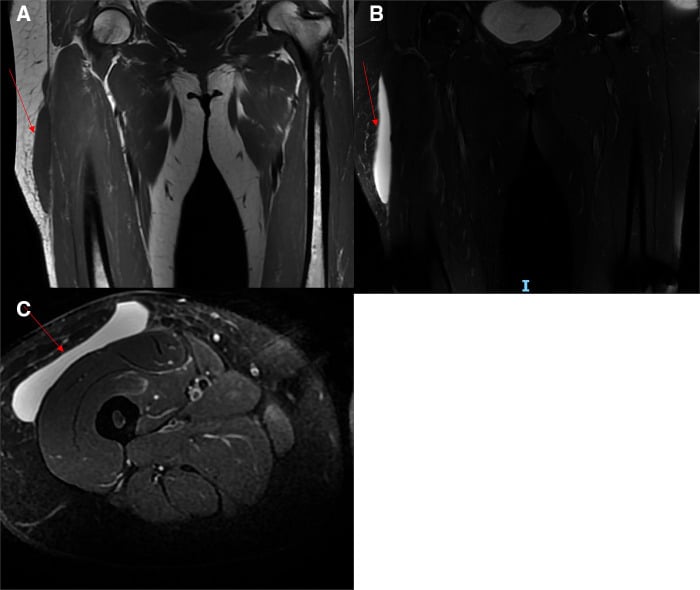
- CT can detect the collection in acute trauma, but MRI best defines chronicity, content and capsule.
- Aspiration alone commonly fails when a capsule or persistent dead space is present - and more than 50 mL aspirated at one sitting is the practical signal that it has failed.
- Do not ignore the lesion before pelvic, acetabular or femoral fixation because bacterial colonisation and skin compromise can convert fixation into a deep infection problem; a negative culture does not clear the lesion, because most of the deep infections in the classic series grew nothing at the first debridement.
- “A 'haematoma' over the greater trochanter after high-energy trauma is a Morel-Lavallee lesion until proven otherwise.
- “Capsule equals chronicity and recurrence risk.
- “Skin necrosis, cellulitis or gas changes the problem from drainage to debridement.
- “Management is driven by skin viability, infection, lesion size, chronicity and planned fracture surgery.
Overview
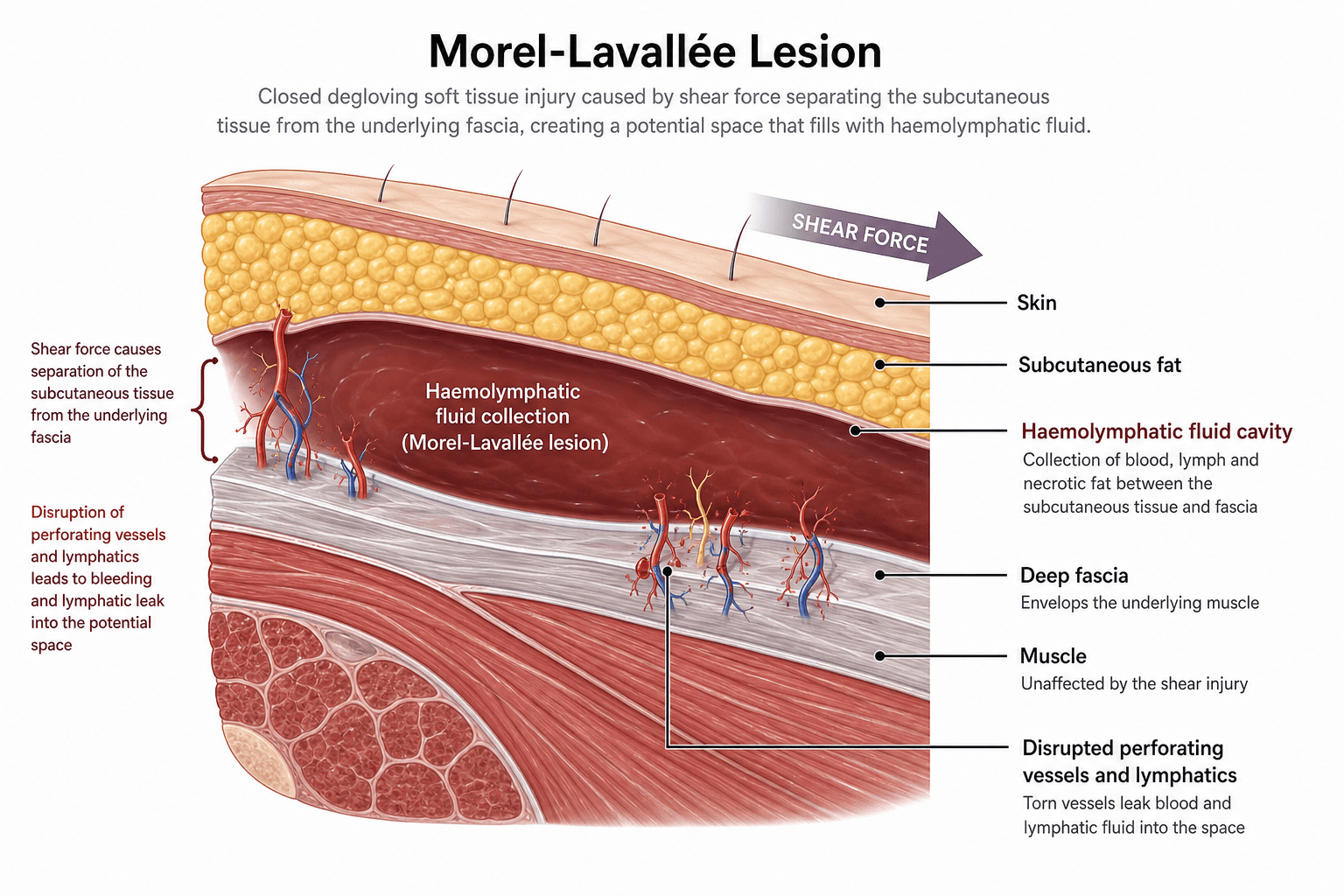
A Morel-Lavallee lesion is a closed internal degloving injury caused by tangential shear trauma. The skin and subcutaneous fat slide away from the underlying fascia, tearing perforating vessels and lymphatics, and the space created fills with a mixture of blood, lymph and necrotic fat. If the cavity persists, inflammation and organisation can form a fibrous pseudocapsule, which makes spontaneous resolution and simple aspiration less reliable.
Why it is not a bruise. The lesion is a dead-space problem, and its clinical importance is disproportionate to how harmless the initial swelling may look. In the acute phase it may be labelled a haematoma, contusion, bursitis or soft-tissue swelling; in the chronic phase it may mimic a soft-tissue tumour or persist as a recurrent fluid collection. Three risks follow:
- It can be missed in polytrauma and later present as a painful mass or recurrent seroma.
- It can become colonised or infected, especially around pelvic and acetabular trauma.
- It can threaten the overlying skin because the subdermal vascular supply has been sheared.
Where it matters most. Five situations:
- Pelvic and acetabular fracture surgery. The collection may overlie the planned approach and increase infection risk.
- Skin compromise. Necrosis, blistering, cellulitis or threatened flap viability requires urgent soft-tissue planning.
- Large dead space. Aspiration alone may recur if the cavity is not obliterated.
- Chronic capsule. The capsule prevents collapse and often needs sclerodesis, quilting or excision.
- Delayed diagnosis. Chronic pain, cosmetic deformity, infection and repeated procedures become more likely.
A patient with high-energy pelvic, acetabular, proximal femoral or lateral thigh trauma should have the skin and subcutaneous tissues examined deliberately. A fluctuant, mobile, hypoesthetic swelling over the greater trochanter, flank, buttock, pelvis, thigh or knee should trigger consideration of a Morel-Lavallee lesion.
Pathophysiology
The plane. The lesion forms at the interface between the subcutaneous tissue and the deep fascia. The deep fascia is relatively fixed to the underlying muscle, while the skin and fat envelope can slide over it, so a tangential force tears:
- perforating blood vessels,
- lymphatic channels,
- small cutaneous nerves, which can reduce sensation over the swelling,
- fibrous septa tethering the skin envelope to fascia.
The contents change with time. The cavity initially contains haemolymphatic fluid and fat globules. Over time, haemoglobin breakdown products, inflammatory tissue and fibrous organisation change the imaging appearance. The pseudocapsule is clinically important because it behaves like a seroma cavity: repeated aspiration may temporarily empty it but does not remove the lining or close the potential space.
Where it occurs. Common sites reflect areas where mobile subcutaneous tissue moves over firm fascia or bony prominences:
- greater trochanter and lateral thigh,
- gluteal and pelvic region,
- flank and lumbosacral region,
- knee and prepatellar region,
- proximal femur and thigh after crush or road trauma,
- less commonly, upper limb, foot, breast or trunk.
Degloving is avulsion of the skin-and-subcutaneous unit off the underlying fascia, shearing the perforating vessels. It is open when the skin envelope is breached (a flap of skin lifted off, often grossly contaminated, with the perfusion-critical question of flap viability) and closed when the skin is intact: the closed internal degloving is the Morel-Lavallee lesion.
The Arnez classification of degloving describes the pattern:
- Type 1: non-circumferential, single-plane
- Type 2: abrasion or avulsion without true degloving
- Type 3: non-circumferential, with a separate Morel-Lavallee component
- Type 4: circumferential multiplane degloving, the most severe
Across the spectrum the injury is to the soft-tissue envelope and its perforator blood supply, not just a fluid collection. The management questions (skin or flap viability, contamination and infection, dead space, and timing relative to any fracture fixation) are the same whether the degloving is open or closed, so frame the Morel-Lavallee lesion as the closed end of that spectrum, whose central problem is a sheared, devascularised soft-tissue envelope.
Mechanism
The classic mechanism is high-energy blunt shear: a road traffic accident, run-over injury, crush injury, motorcycle collision or fall with tangential sliding. Sports mechanisms are described, especially around the hip, pelvis and knee, but a large or recurrent lesion after apparently modest trauma should still be treated seriously if the clinical signs fit.
Mechanism points that change management.
- Crush or run-over injury. Higher risk of skin compromise and necrotic fat.
- Associated pelvic or acetabular fracture. Plan the incision and timing around the lesion.
- Anticoagulation. May increase collection size and persistence.
- Open wound or skin necrosis. Treat as a contaminated soft-tissue problem, not a simple closed seroma.
- Delayed presentation. Suspect capsule, organised haematoma or secondary infection.
Classification
The lesion is described in four ways, and the last is the one that drives treatment.
Acute versus chronic. Acute lesions are early haemolymphatic collections without a mature capsule. Chronic lesions have an organised cavity or pseudocapsule and are more likely to recur after aspiration alone.
Skin status. Viable skin allows compression, image-guided drainage, sclerodesis or quilting depending on symptoms and recurrence. Necrosis, blistering, cellulitis or abscess changes the priority to debridement and soft-tissue planning.
Imaging features. MRI classifications describe shape, signal, capsule, enhancement and sinus formation; the Mellado-Bencardino types are set out under Investigations. In practice the most important features are location superficial to fascia, internal fat and debris, capsule, infection and relation to the surgical approach.
Treatment group. Classify the lesion into one of four groups, which is more useful for management than memorising every MRI subtype:
- Acute small stable
- Symptomatic acute
- Chronic or recurrent
- Infected or threatened
Clinical Presentation and Examination
Presentation depends on timing.
- Typical findings
- Bruising, swelling, fluctuance, pain, hypermobile skin, decreased cutaneous sensation
- Management implication
- Look for the lesion during the secondary survey; compression or drainage may work if small and stable
- Typical findings
- Persistent fluid collection, enlarging swelling, pressure symptoms, skin blistering or erythema
- Management implication
- Image the extent and decide whether aspiration, drain or debridement is needed
- Typical findings
- Pseudocyst, recurrent seroma, pain, tightness, cosmetic mass, capsule on imaging
- Management implication
- Simple aspiration has a high recurrence risk; consider sclerodesis, quilting or capsulectomy
- Typical findings
- Cellulitis, abscess, fever, raised inflammatory markers, gas or purulence
- Management implication
- Drainage alone is insufficient; culture, debride and manage dead space
The signs. The lesion declares itself as a fluctuant swelling after shear trauma, with skin that slides abnormally over the deep fascia, bruising or ecchymosis, and reduced cutaneous sensation over the lesion. Look as well for central pressure necrosis or blistering, for a swelling that has expanded since the initial trauma, for tenderness, erythema or warmth suggesting infection, and for proximity to a planned fracture incision or implant site.
Examine the skin first. Examination should define the lesion and the limb, not just confirm a swelling. Start with the skin:
- Is the skin viable, blistered, necrotic or cellulitic?
- Is there an open wound or drainage?
- Is the collection under tension?
- Does the skin slide abnormally over the fascia?
Then the lesion. Record its size and boundaries, fluctuance, tenderness and compressibility, any recurrence after prior aspiration, altered sensation, and its relation to bony prominences and surgical approaches.
Then the associated trauma.
- pelvic, acetabular, proximal femoral or knee injury,
- vascular status,
- neurological status,
- compartment syndrome if swelling is deep or painful out of proportion,
- contamination risk if there is any open wound.
The phrase "soft tissue swelling" on an early trauma CT does not exclude a Morel-Lavallee lesion. If the clinical swelling is fluctuant, mobile and hypoesthetic, reassess the imaging or obtain targeted ultrasound/MRI.
Investigations
Plain radiographs do not diagnose the lesion. Their role is to identify associated fractures, foreign bodies, avulsions, pelvic ring injury, acetabular fracture or femoral injury.
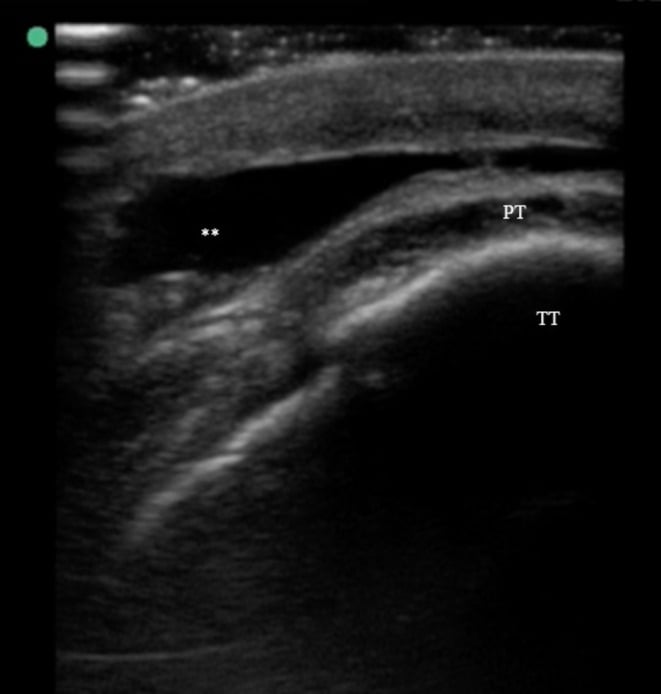
Ultrasound is useful for bedside confirmation, aspiration guidance and follow-up. The typical finding is a compressible hypoechoic or anechoic collection between subcutaneous tissue and fascia, often with septations or mobile echogenic debris; Doppler and compressibility should be assessed before intervention.
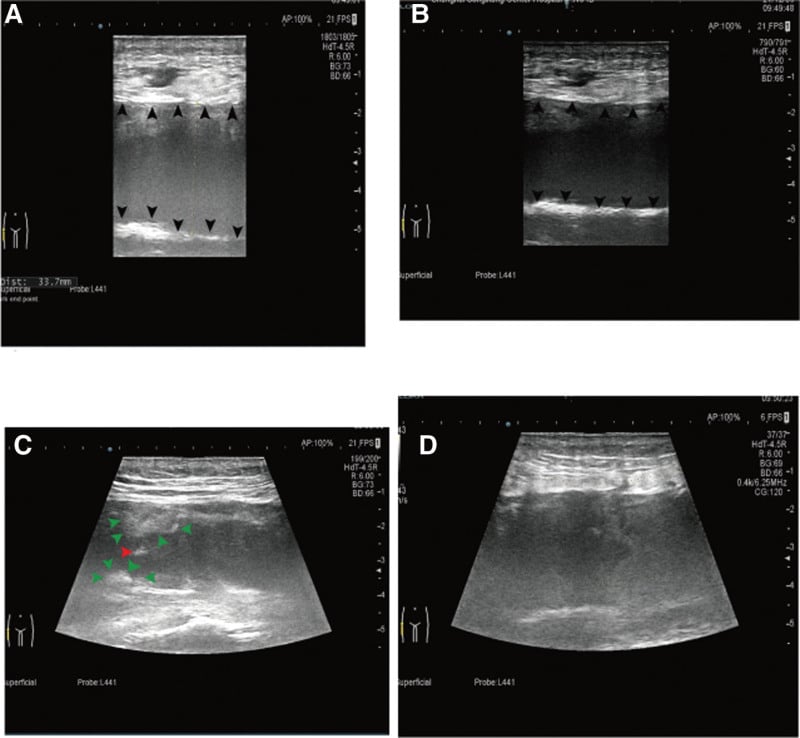
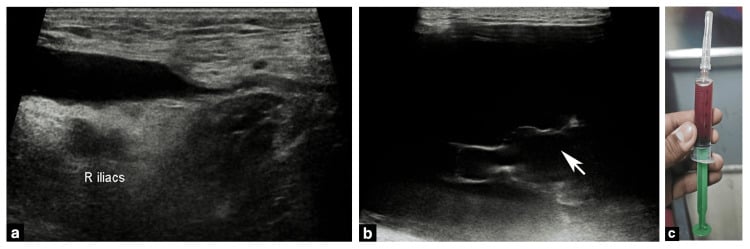
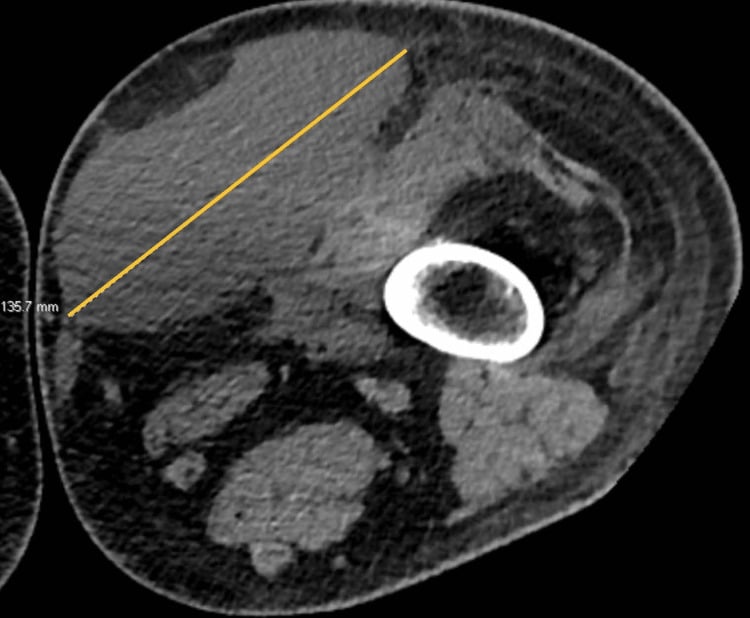
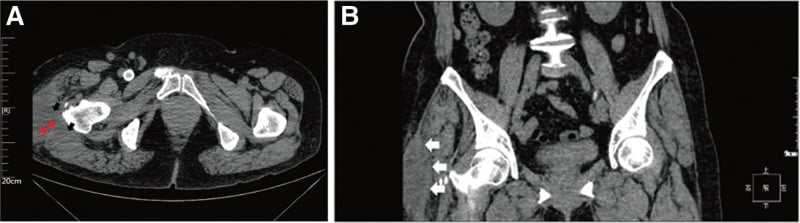
CT is often the first clue in polytrauma. It may show a lenticular fluid collection, internal fat globules, fluid-fluid levels, peripheral enhancement, gas or the relation to fracture surgery corridors.
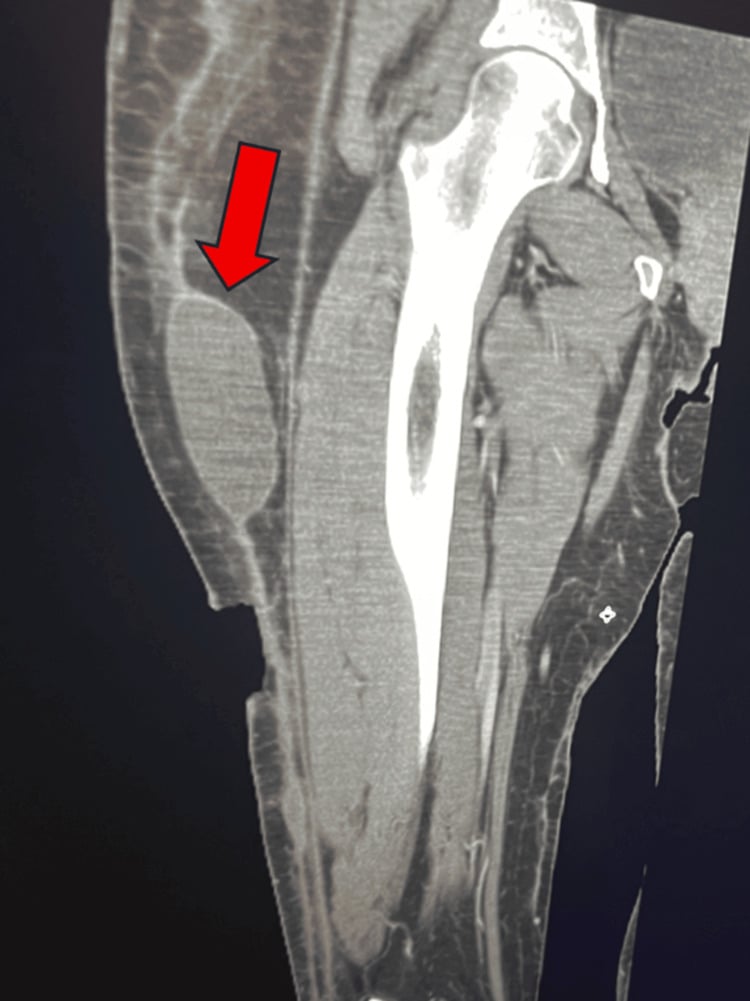
MRI is best for composition, chronicity, capsule, extent and mimics, and is particularly useful for chronic, recurrent, periarticular or tumour-like lesions.
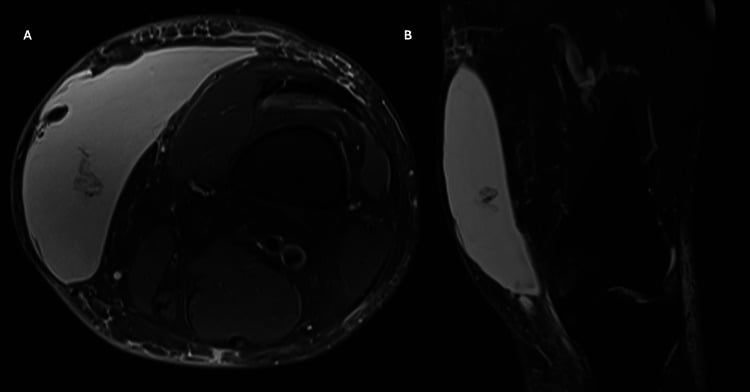
The questions imaging must answer.
- Is the lesion superficial to deep fascia?
- Is it acute and ill-defined, or chronic and encapsulated?
- Are there fat globules, septations, blood products or internal debris?
- Is there gas, rim enhancement or surrounding cellulitis suggesting infection?
- Does the lesion cross or contaminate the planned surgical approach?
- Is there skin thinning or necrosis?
- Is there a tumour mimic that needs specialist imaging review?
Imaging features that change treatment
Several MRI-based classifications exist, including the Mellado-Bencardino system, which separates lesions by MRI morphology, signal, capsule, enhancement and sinus formation. The practical value is not memorising every imaging subtype; it is recognising the features that change treatment.
- What it means
- Early haemolymphatic collection
- Why it matters
- Compression, aspiration or drainage may succeed if the lesion is small and skin is safe
- What it means
- Confirms degloving biology rather than simple oedema
- Why it matters
- Supports diagnosis on CT, ultrasound or MRI
- What it means
- Chronic organised cavity
- Why it matters
- Higher recurrence after aspiration; consider sclerodesis, quilting or excision
- What it means
- Infection or communication
- Why it matters
- Culture, antibiotics and debridement; avoid implant contamination
- What it means
- Subdermal vascular compromise
- Why it matters
- Urgent orthoplastic planning, debridement and staged coverage
FATImaging: FAT
Hook:FAT on imaging points to the degloving plane and chronicity.
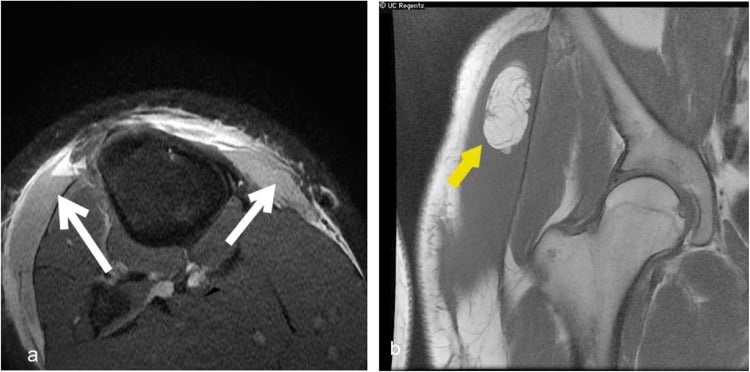
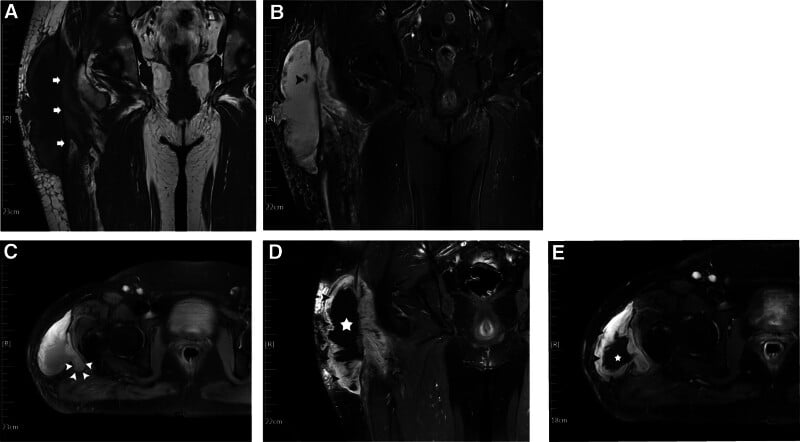
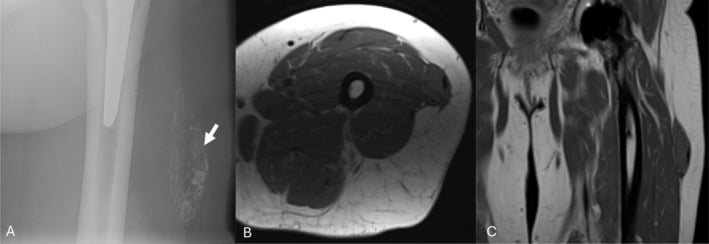
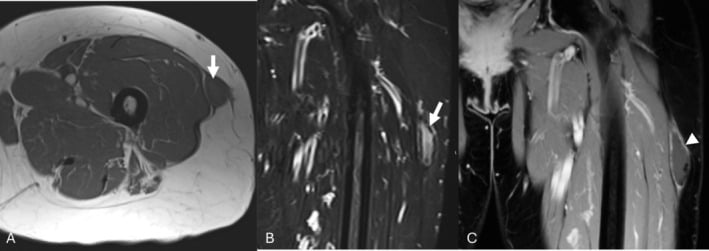
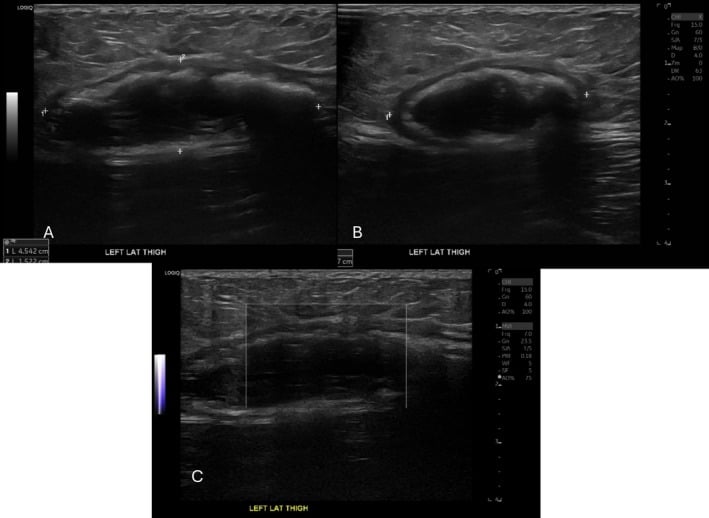
The classification named above, enumerated because examiners ask for it. It grades the lesion on MRI by shape, signal and capsule, and maps onto chronicity (and therefore the likelihood that aspiration will fail):
- Type I - seroma: serous fluid, T1 low / T2 high, no capsule (usually acute).
- Type II - subacute haematoma: T1 and T2 both high (blood products), with a capsule.
- Type III - chronic organising haematoma: heterogeneous signal, thick capsule, internal septations - the chronic lesion that recurs after aspiration.
- Type IV - closed laceration (perifascial dissection): a linear fluid collection along the fascial plane, no capsule.
- Type V - pseudonodular: small rounded encapsulated lesion.
- Type VI - infected: any of the above with a thick enhancing wall, surrounding oedema/cellulitis and internal complexity.
The practical translation: Type I (no capsule) may respond to compression/aspiration; Types II/III/V (encapsulated, chronic) need sclerodesis/quilting/capsulectomy; Type VI needs drainage/debridement and cultures.
Know what this mapping is. The six types come from Mellado and Bencardino's imaging review (Magn Reson Imaging Clin N Am 2005;13(4):775-82, PMID 16275583), which built them to describe a lesion before an operation. It reports no cohort, no interobserver reliability and no outcome, so the treatment column above is a convention derived from the biology the types describe - it has never been prospectively tested, and no type has been shown to predict recurrence. Use the numbers to communicate an MRI precisely; make the treatment decision on capsule, skin, infection, volume and the fixation plan.
Differential Diagnosis
The differential depends on timing and location.
- How it differs
- Usually does not have the classic subcutaneous-fascial plane, fat globules or capsule
- Trap
- Calling every post-traumatic collection a haematoma delays definitive dead-space management
- How it differs
- Bursa has an expected anatomical location; Morel-Lavallee lesion follows the shear plane
- Trap
- Chronic lesions around the trochanter or knee can mimic bursitis
- How it differs
- May show fever, cellulitis, gas or raised inflammatory markers
- Trap
- Infection can complicate a Morel-Lavallee lesion; it is not always a separate diagnosis
- How it differs
- Mass-like chronic lesion needs MRI review and caution before biopsy or excision
- Trap
- A chronic lesion can mimic tumour, and tumour can mimic chronic haematoma
- How it differs
- May be post-traumatic but lacks the full degloving cavity
- Trap
- Often overlaps histologically with chronic lesions
- How it differs
- Systemic toxicity, severe pain, gas, rapidly progressive infection
- Trap
- A missed infected Morel-Lavallee lesion can coexist with or mimic severe soft-tissue infection
Management
Five variables choose the treatment. Every decision on this page comes back to them:
- Skin viability.
- Infection or contamination.
- Lesion size and symptoms.
- Acute fluid versus chronic capsule.
- Relationship to fracture fixation or reconstruction.
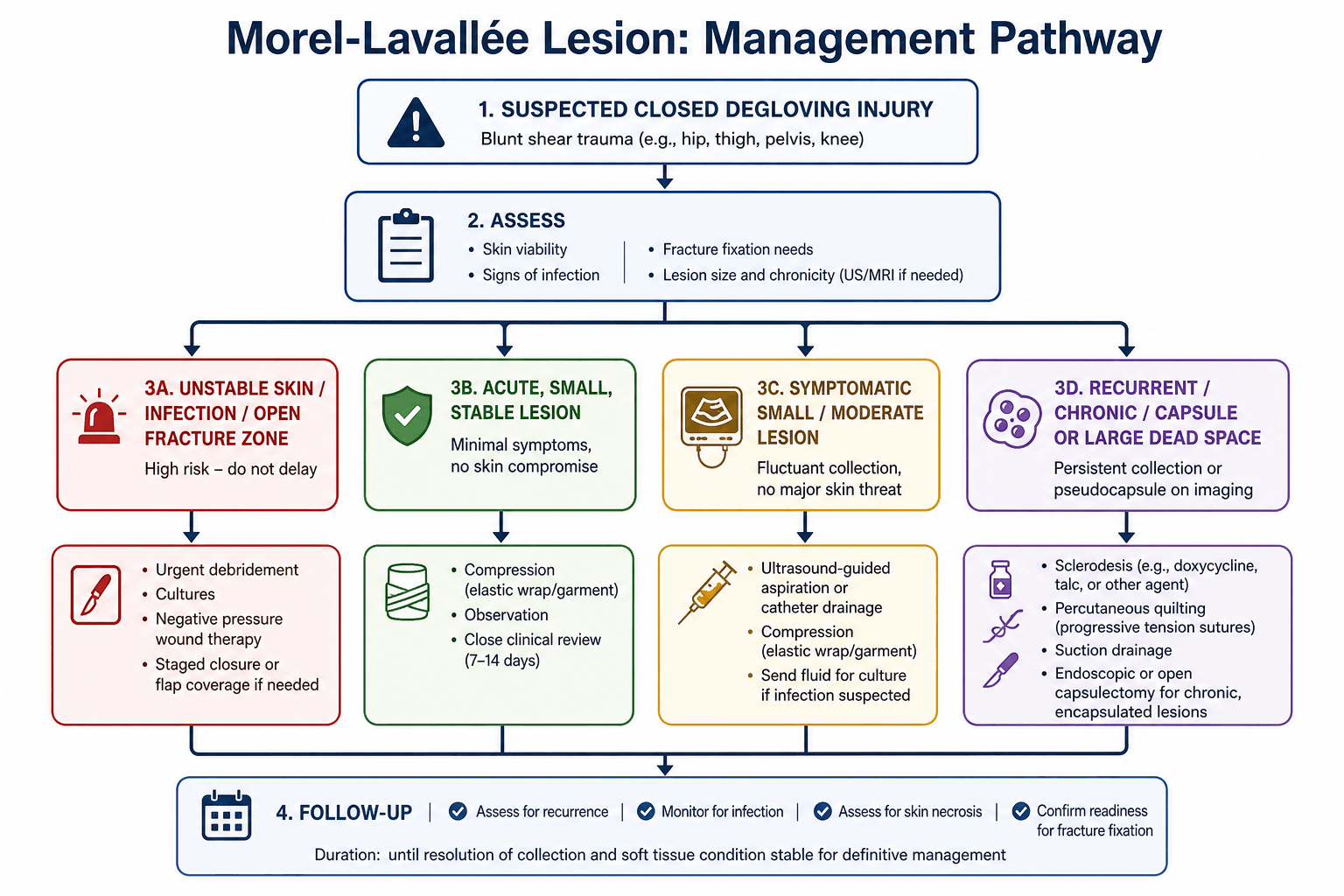
- Best next step
- Compression and early review
- Reason
- The cavity may collapse before a capsule forms
- Best next step
- Ultrasound-guided aspiration or catheter drainage plus compression - and MEASURE what you take off
- Reason
- Drain the fluid and maintain collapse of the dead space
- Best next step
- Treat aspiration as having failed and plan definitive dead-space surgery
- Reason
- The volume predicts recurrence (Mayo guideline, below)
- Best next step
- Sclerodesis, quilting, endoscopic debridement or capsulectomy
- Reason
- Aspiration alone does not remove the lining or close the cavity
- Best next step
- Urgent debridement, cultures and staged wound management
- Reason
- This is an infected or threatened soft-tissue envelope problem
- Best next step
- Coordinate drainage/debridement with fixation approach
- Reason
- Implants placed through compromised tissue risk deep infection
Aspiration may temporarily decompress a symptomatic acute lesion, but it does not close a chronic cavity. The endpoint is viable skin, removal of infected or necrotic tissue, collapse of the cavity, suction drainage when needed, and a plan that does not contaminate fracture fixation.
Acute small stable lesion
Who. The collection is small, the skin is viable, symptoms are mild, there is no infection, and the lesion is compressible.
What.
- compression wrap or garment,
- observation with early review,
- analgesia and activity modification,
- repeat examination to ensure it is shrinking,
- ultrasound follow-up if the clinical course is uncertain.
Where it fails. Compression is least suitable over areas where compression is difficult, such as the greater trochanter or flank, and less reliable for large cavities.
Symptomatic acute lesion
When. Consider intervention when there is pain, tension, persistent fluctuance, progressive enlargement or functional limitation.
Options.
- ultrasound-guided aspiration,
- catheter drainage,
- compression after drainage,
- fluid culture if infection is possible,
- record the aspirated volume - it is the one number that predicts what happens next,
- repeat drainage only if the cavity is clearly collapsing.
Repeated aspiration without compression or dead-space control is a common failure pattern.
Measure the aspirate. In the Mayo series of 87 lesions, taking off more than 50 mL at one sitting separated the lesions that recurred from those that settled: 83 per cent of the recurrences had yielded over 50 mL, against 33 per cent of those that resolved. Their practice guideline is therefore to move to operative management once more than 50 mL comes back, and the wider figure behind it is that recurrence after aspiration ran at 56 per cent, against 19 per cent with compression alone and 15 per cent after surgery. Read those three numbers with the confounding in mind - the surgeons chose who was aspirated and who was operated on - but the practical instruction survives it: a big aspirate means the cavity is too large to collapse on its own, so treat that volume as a decision point rather than a measurement.
Recurrent or chronic lesion
A capsule or repeated recurrence means aspiration alone is unlikely to solve the problem. The options are sclerodesis, quilting or progressive tension sutures, endoscopic debridement and open capsulectomy, chosen by size, capsule, skin and infection.
Sclerodesis aims to scar the cavity walls together. It is useful when the lesion recurs after aspiration, the skin is viable, there is no uncontrolled infection, and the cavity is not so complex that open debridement is required. Risks include pain, inflammation, skin irritation, infection, incomplete obliteration and recurrence.
Quilting or progressive tension sutures mechanically oppose the skin-subcutaneous flap to the fascia. This is useful when the main problem is a persistent dead space rather than necrotic tissue requiring open excision.
Endoscopic or minimally invasive debridement can debride chronic cavity lining and reduce wound morbidity in selected lesions, especially around the knee or cosmetically sensitive areas. The principle is the same as open surgery: remove the pathological lining and eliminate dead space.
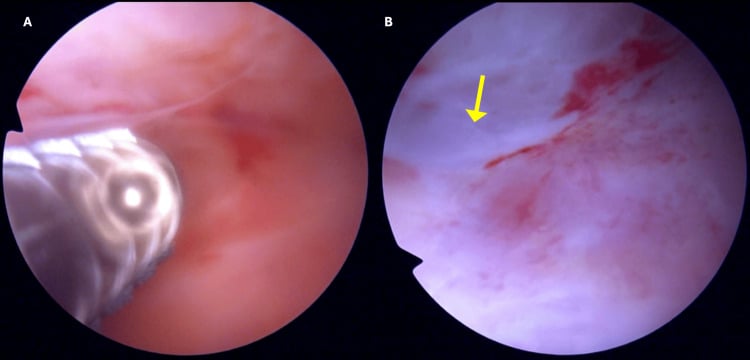
Open debridement or capsulectomy is indicated for:
- skin necrosis,
- abscess or established infection,
- large chronic encapsulated lesion,
- recurrent lesion after less invasive treatment,
- lesion interfering with pelvic, acetabular or femoral fixation,
- necrotic fat and organised debris,
- failed aspiration or sclerodesis.
Skin threat or infection
Necrosis, cellulitis, abscess, gas, purulence or an open wound requires culture, debridement, dead-space control and often staged negative pressure therapy or flap or graft coverage. The sequence is set out under Surgical Technique.
Relationship to fracture fixation
The lesion may sit directly over the intended approach for pelvic, acetabular, proximal femoral or knee surgery, so its management should be coordinated with the trauma fixation plan.
Practical rules.
- Do not place definitive implants through infected or necrotic soft tissue if avoidable.
- If the lesion overlies the approach, consider drainage/debridement before or at fixation.
- If the fracture is urgent, choose an approach that respects the soft-tissue envelope.
- If the lesion is colonised, infection risk must be discussed explicitly.
- If repeated debridement is expected, consider staged fixation and orthoplastic coverage.
Surgical Technique
Technique is selected by the lesion biology. A small acute collection may only need aspiration and compression; a chronic encapsulated cavity needs a method that collapses or removes the lining; necrotic or infected lesions need open debridement, cultures and staged soft-tissue management.
Preoperative planning
Define before choosing. Before any procedure, establish:
- the exact anatomical extent on ultrasound, CT or MRI,
- whether the lesion is acute fluid, chronic capsule, infected collection or necrotic soft tissue,
- whether the skin is viable enough for compression, quilting or closure,
- whether a pelvic, acetabular, femoral or knee approach will cross the lesion,
- whether plastic surgery input is needed for exposed fascia, necrotic skin or likely flap/graft coverage.
Consent should include recurrence, infection, repeat debridement, persistent drainage, contour deformity, skin loss, delayed fracture fixation and possible need for negative pressure therapy or soft-tissue reconstruction.
Image-guided aspiration and catheter drainage
Who. Selected symptomatic acute lesions with viable skin and no established capsule.
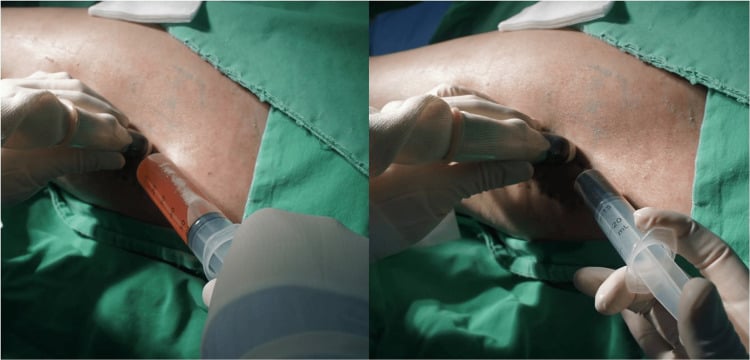
Aspiration steps.
- Confirm the subcutaneous-fascial plane with ultrasound.
- Mark the lesion boundaries and choose a dependent entry point away from planned surgical incisions.
- Prepare the skin using sterile technique and infiltrate local anaesthetic.
- Aspirate the collection completely where possible, documenting volume, colour, fat droplets and clot.
- Send fluid for culture when there is erythema, warmth, fever, necrosis, previous intervention or nearby planned fixation.
- Apply firm compression or a pressure dressing immediately after aspiration.
- Review early; rapid reaccumulation means the cavity has not collapsed and needs a different strategy.
Failure points.
- aspiration without compression,
- aspirating an encapsulated chronic lesion repeatedly,
- placing the needle track through a future fixation approach,
- missing infection because fluid was not cultured.
Catheter drainage is useful when the collection is too large for reliable single aspiration, when it reaccumulates, or when ongoing output needs monitoring.
- Insert the catheter under ultrasound or CT guidance into the dependent portion of the cavity.
- Break down simple loculations only if safe and within the planned image-guided technique.
- Connect to suction or dependent drainage according to local protocol.
- Maintain compression to keep the skin-subcutaneous flap opposed to fascia.
- Monitor output, skin viability and inflammatory signs.
- Remove the drain only when output is low and the cavity is clinically collapsing.
If the drain output remains high or the collection reforms after drain removal, reassess for capsule, missed loculations, infection or a need for quilting, sclerodesis or capsulectomy.
Sclerodesis
Who. Recurrent or persistent cavities when skin is viable and uncontrolled infection has been excluded. It is not a substitute for debridement when there is necrotic skin, abscess or gross contamination.
Principles.
- drain the cavity first,
- confirm that the sclerosant can contact the cavity wall,
- protect surrounding skin from leakage or chemical irritation,
- use the agent and dwell time according to local protocol,
- re-drain as required,
- apply compression,
- follow the patient for pain, inflammation, infection and recurrence.
The agent. Doxycycline, talc, ethanol, fibrin sealant and povidone iodine are all reported, and the choice is local-protocol dependent. The teaching point is not the specific agent; it is the indication: a viable, persistent cavity that needs obliteration of the lining.
Percutaneous quilting or progressive tension sutures
Quilting treats the mechanical problem directly: the mobile skin-subcutaneous flap is tacked back to the deep fascia so the cavity cannot refill. It is most logical when the skin is viable, the lesion is not grossly infected, and the main problem is persistent dead space rather than extensive necrotic tissue.
Steps.
- Position the patient so the full lesion and any associated fracture field are accessible.
- Mark the lesion boundaries using clinical examination and imaging.
- Drain the collection through small incisions or percutaneous access.
- Irrigate the cavity, break down internal septations where appropriate, and remove loose necrotic fat or debris if accessible through the chosen approach.
- Pass multiple absorbable or non-absorbable sutures from the skin-subcutaneous flap to the deep fascia, spacing them across the cavity to eliminate shear space.
- Avoid excessive tension that compromises skin perfusion.
- Place a closed suction drain when needed.
- Apply a compressive dressing or bolster.
- Review skin viability, drain output and recurrence.
Open debridement and capsulectomy
Position and setup.
- position according to lesion location and associated fracture surgery,
- prep widely because the cavity may extend beyond the visible swelling,
- mark skin necrosis, fluctuance, prior needle tracks and planned fixation incisions,
- give antibiotics according to infection status, but obtain cultures first when safe and clinically appropriate,
- use a tourniquet only when anatomically relevant and safe for the limb.
Incision planning.
- avoid raising unnecessary flaps in already degloved skin,
- avoid crossing future pelvic, acetabular or femoral fixation incisions if possible,
- place the incision where drainage, debridement and later coverage can be achieved,
- involve plastic surgery early if the skin envelope is marginal.
Cavity management.
- enter the cavity carefully and send fluid/tissue for microbiology if infection is possible,
- evacuate haemolymphatic fluid, clot and necrotic fat,
- irrigate thoroughly,
- excise non-viable skin and subcutaneous tissue,
- in chronic lesions, excise the pseudocapsule when this can be done without destroying viable skin,
- preserve perforators and any remaining soft-tissue vascularity,
- inspect the deep fascia and surrounding tissues for persistent loculations.
Dead-space closure.
- use quilting or progressive tension sutures to tack the flap to fascia when skin is viable,
- place closed suction drains in dependent positions,
- use compression or bolster dressings when the anatomy allows,
- avoid tight closure over compromised skin.
Closure strategy.
- primary closure is reasonable only if the skin is viable, tension is low and contamination is controlled,
- delayed closure is safer when viability is uncertain,
- negative pressure wound therapy is useful after debridement when repeat inspection or staged closure is needed,
- graft or flap coverage may be required after skin necrosis or repeated debridement.
Staged infected or necrotic lesion
When the lesion is infected or the skin is necrotic, treat it like a soft-tissue envelope failure rather than an elective seroma. The unsafe pattern is definitive internal fixation through an infected or necrotic degloving cavity without a soft-tissue plan.
Sequence.
- assess sepsis and start resuscitation if required,
- obtain imaging to define the collection and relation to implants/fractures,
- debride necrotic tissue and drain the cavity,
- send cultures and tailor antibiotics,
- use negative pressure therapy if the wound cannot be closed safely,
- reinspect and repeat debridement until the wound is clean and viable,
- coordinate definitive fixation, closure, grafting or flap coverage once the envelope is safe.
Complications
Follow-up continues until the cavity has resolved, the skin is safe, and any associated fracture surgery is not threatened by soft-tissue recurrence. Each review looks for the complications below and for the need for a repeat aspiration, drain, sclerodesis or capsulectomy.
- missed diagnosis,
- recurrent fluctuance or seroma,
- pseudocapsule formation,
- persistent drainage,
- cellulitis, abscess or secondary infection,
- skin necrosis and wound breakdown,
- contour deformity,
- chronic pain or tightness,
- delayed fracture fixation,
- deep infection around implants after pelvic or acetabular surgery,
- need for flap or graft reconstruction.
Postoperative Care and Follow-Up
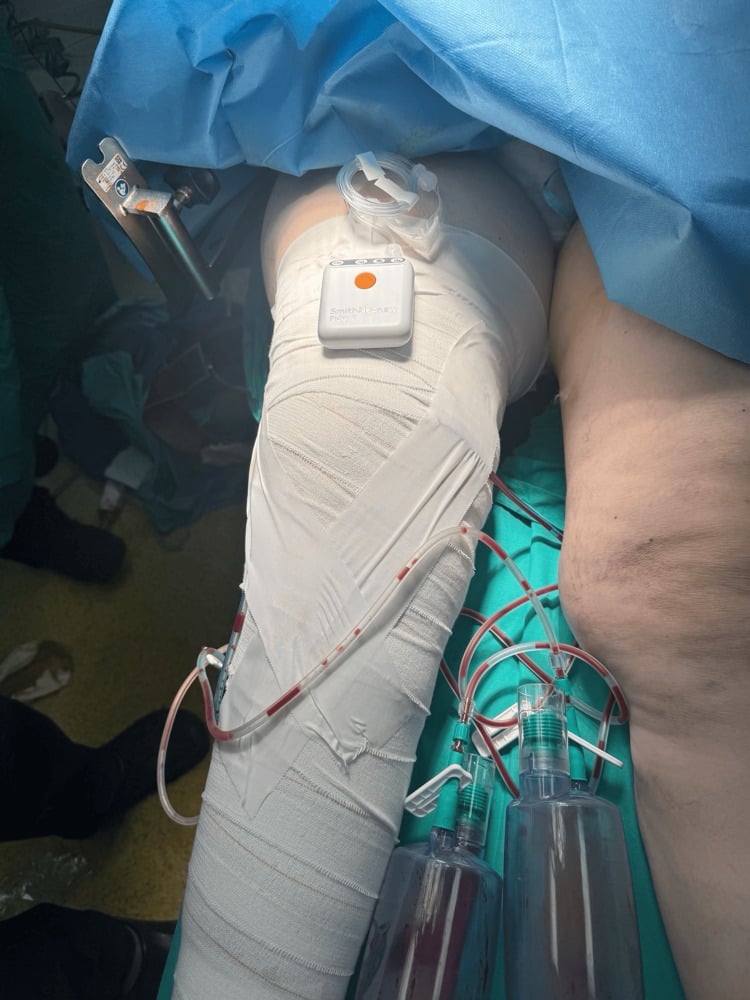
After drainage, sclerodesis, quilting or debridement, review focuses on dead-space collapse and skin safety:
- compression or bolster dressing when anatomically possible,
- suction drain care and output monitoring,
- wound review for necrosis, cellulitis and persistent drainage,
- repeat ultrasound if clinical swelling persists,
- antibiotics guided by cultures when infected,
- physiotherapy and mobilisation adapted to associated fractures,
- timing of definitive fixation or reconstruction once soft tissues are safe.
When to look again. The list above is what to do; the harder question is when to review, and the page's own sources answer it. There is no guideline schedule, so the rail below is assembled from the follow-up protocols the published series actually used.
Review Schedule After Treatment (assembled from published series)
In Tejwani's NFL knees the mean time to both resolution of the collection and full active flexion was 16.3 days - and those players returned to practice long before that, missing a mean of 1.5 practices and 0.1 games. Function returns before the fluid disappears, so a persisting collection at two weeks is not in itself treatment failure. Review the skin, the drain output and the tension of the cavity rather than its mere presence.
Kumar reviewed every case weekly for the first four weeks after percutaneous quilting. This is where a failure of dead-space control shows itself as refilling, and where compression compliance is either established or lost - Bansal's single non-resolving lesion failed for exactly that reason. By four weeks, 11 of Bansal's 16 chronic lesions had fully resolved after doxycycline sclerodesis.
A further 4 of Bansal's 16 resolved between four and eight weeks, taking the total to 15 of 16. A cavity still refilling at eight weeks has effectively declared itself encapsulated: escalate rather than aspirate again, and image to define the capsule before choosing between sclerodesis, quilting and capsulectomy.
Kumar's protocol was monthly review to six months. Recurrence is the outcome being watched for, but so is the residue Bansal documents at long follow-up: a persistent non-fluctuant contour deformity, reduced skin mobility and a feeling of tightness. Warn the patient about these before treatment - they are the commonest long-term complaints even after a technically successful result.
Kumar reviewed at one year; Bansal's mean follow-up was 50 months with no recurrences, which is the single best-evidenced durability claim available here even though the denominator is 16. Beyond a year the literature is essentially silent, so late recurrence rates are unknown rather than low.
Outcomes and Prognosis
Small acute lesions can resolve with compression or limited drainage. Prognosis worsens when diagnosis is delayed, the cavity becomes encapsulated, the lesion is large, overlying skin is compromised, or the lesion overlies fracture fixation. Persistent recurrence usually means the treatment has drained fluid but not closed the cavity.
The endpoint.
- no recurrent fluctuance,
- healed and viable skin,
- no infection,
- collapsed dead space,
- safe timing for associated fracture fixation or reconstruction,
- acceptable contour and pain control.
Guidelines, Registries & Global Practice
There is no formal society guideline (AAOS, NICE, BOA, AO or EFORT) dedicated to the Morel-Lavallee lesion, and the literature is dominated by case series. Practice therefore rests on a few recurring evidence-based principles applied worldwide.
Global epidemiology
- What the evidence shows
- Thigh, hip/peritrochanteric and pelvis; the knee in contact athletes
- Source
- Yang and Tang 2023; Tejwani 2007
- What the evidence shows
- High-velocity blunt shear, most often motor vehicle collision (around 25 percent of a trauma series)
- Source
- Nickerson 2014
- What the evidence shows
- Cultures positive in 46 percent of pelvic/acetabular degloving injuries
- Source
- Hak 1997
- What the evidence shows
- 56 percent after aspiration versus 15 to 19 percent with compression or surgery
- Source
- Nickerson 2014
- What the evidence shows
- Young adult predominance, male preponderance in operative series
- Source
- Kumar 2020; Bansal 2013
Evidence-led practice points (applied internationally)
- Recommendation
- Aspiration of more than 50 mL predicts recurrence and should prompt operative management (Mayo guideline)
- Evidence level
- Level III
- Recommendation
- Use the Mellado-Bencardino MRI classification to distinguish acute seroma from chronic encapsulated lesions - descriptive vocabulary, not a validated predictor
- Evidence level
- Level 5 (imaging review; no outcome data)
- Recommendation
- Debride before or during pelvic/acetabular fixation because of high colonisation and deep-infection risk
- Evidence level
- Level III
- Recommendation
- Doxycycline sclerodesis with compression gives high resolution and low recurrence
- Evidence level
- Level IV
- Recommendation
- Percutaneous quilting/progressive tension sutures obliterate the cavity in viable skin
- Evidence level
- Level IV
Practice variation
Management genuinely varies by setting. In high-resource trauma systems, MRI characterisation, image-guided drainage, negative pressure wound therapy and combined orthoplastic reconstruction are routinely available, and lesions overlying planned pelvic or acetabular fixation are debrided early. In limited-resource settings, ultrasound-guided aspiration, doxycycline sclerodesis and percutaneous quilting (techniques validated in large series from South Asia) offer effective, low-cost dead-space control without specialist imaging or theatre-intensive reconstruction. Across all systems the decisive clinical question is identical: whether the soft-tissue envelope is safe for drainage, fixation, debridement, negative pressure therapy or flap/graft coverage.
Critical Must-Knows
Definition
- Closed internal degloving injury
- Subcutaneous tissue separates from deep fascia
- Cavity fills with blood, lymph and necrotic fat
Diagnosis
- Fluctuant, mobile, often hypoesthetic swelling after shear trauma
- Ultrasound: compressible collection with debris
- CT: subcutaneous collection with fat globules
- MRI: best for chronicity, capsule and extent
Treatment Logic
- Small acute stable lesion: compression and review
- Symptomatic acute lesion: aspiration or drain plus compression
- Chronic/recurrent lesion: sclerodesis, quilting or capsulectomy
- Infected or necrotic lesion: debridement, cultures, dead-space control
Pitfalls
- Missed in polytrauma
- Mislabelled as simple haematoma
- Repeated aspiration despite capsule
- Fracture fixation through compromised soft tissue
MCQ Practice Points
What anatomical plane defines a Morel-Lavallee lesion?
The lesion lies between the subcutaneous tissue and the deep fascia. It is a closed degloving injury, not an intra-muscular haematoma.
What imaging feature makes recurrence after aspiration more likely?
A chronic pseudocapsule. The capsule prevents collapse of the cavity, so aspiration alone often fails unless dead space is also addressed.
You aspirate a peritrochanteric Morel-Lavallee lesion and withdraw 90 mL. What does that volume tell you?
That aspiration has almost certainly failed. In the Mayo series of 87 lesions, 83 per cent of the lesions that recurred had yielded more than 50 mL, against 33 per cent of those that resolved, and their practice guideline is to move to operative dead-space management once more than 50 mL is aspirated. Recurrence after aspiration overall was 56 per cent, versus 19 per cent with compression alone and 15 per cent after surgery - so the volume is a decision, not a measurement. Record it.
Which clinical features make urgent debridement more appropriate than simple aspiration?
Skin necrosis, abscess, cellulitis, gas, purulent drainage or a lesion contaminating a planned fracture fixation corridor.
Why is MRI useful in a delayed Morel-Lavallee lesion?
MRI defines extent, contents, chronicity, capsule formation, surrounding soft-tissue inflammation and tumour-like mimics better than plain radiographs or routine trauma CT.
Viva Scenarios
Practise clinical reasoning and management decisions out loud
“A patient with an acetabular fracture has a large fluctuant swelling over the greater trochanter. CT reports soft-tissue haematoma. What is your approach?”
“A patient has a recurrent lateral thigh fluid collection after two aspirations. MRI shows a thick capsule. What would you do?”
“A patient presents two weeks after a blunt thigh injury with a fluctuant swelling, erythema and a central necrotic scab. What is unsafe about simple aspiration?”
Evidence Base
Classic pelvic and acetabular trauma series
- Closed internal degloving injuries were described in association with pelvic and acetabular trauma, commonly over the greater trochanter, flank and lumbodorsal region.
- Cultures from the lesion were positive in 46 percent of cases (11 of 24), and positivity was independent of time from injury to debridement.
- Three patients developed deep bone infection - but only ONE of them had a positive culture at the initial debridement, so a negative culture does not reassure.
- The single patient whose wound was closed primarily over suction drains developed a chronic deep soft-tissue infection needing multiple debridements; the authors recommended early debridement before or at the time of fixation, leaving the wound open for repeat debridement.
Orthopaedic management review
- Morel-Lavallee lesions are closed degloving injuries from violent shear separating subdermal fat from the underlying fascia, most often peritrochanteric.
- The haematoma has a high rate of acute bacterial colonisation and chronic recurrence, and diagnosis is frequently delayed or missed.
- Conservative outcomes are best when lesions are managed acutely, but no universally accepted treatment algorithm exists.
Contemporary review and management algorithm
- Morel-Lavallee lesions most commonly occur in the thigh, hip and pelvis and are usually associated with high-velocity trauma.
- Missed or delayed diagnosis risks infection at an adjacent fracture site once the lesion progresses, so timely identification is crucial.
- No formal treatment guidelines exist; the authors propose a management algorithm spanning conservative care, percutaneous drainage, sclerodesis and operative debridement.
Aspiration volume predicts recurrence (Mayo guideline)
- Recurrence was far higher after percutaneous aspiration (56 percent) than after non-operative compression (19 percent) or operative management (15 percent).
- Aspiration of more than 50 mL of fluid was much more common in lesions that recurred (83 percent) than in those that resolved (33 percent).
- The authors adopted a practice guideline recommending operative intervention when more than 50 mL is aspirated.
Percutaneous quilting technique
- Single-stage percutaneous suturing of skin to deep fascia (periphery to centre) obliterates the dead space and stops the discordant shear movement.
- Lesions were large - 12 to 60 cm in length - and were treated a mean of 7 days from injury (range 2-60); ALL 22 healed uneventfully, so no recurrence was observed in 22 patients.
- The technique addresses the core recurrence mechanism while reducing the morbidity of a large open approach in selected patients.
Doxycycline sclerodesis for persistent lesions
- Persistent lesions (mean 13 months, most previously aspirated a mean of 3.4 times) were treated with aspiration, doxycycline instillation and compression bandaging.
- Eleven of 16 resolved by 4 weeks and 15 of 16 by 8 weeks, with no recurrences or infections over a mean 50-month follow-up.
- Residual contour deformity, reduced skin mobility and tightness were the main long-term problems.
MRI appearances and the Mellado-Bencardino classification
- MRI shows a characteristic fusiform fluid collection between subcutaneous fat and deep fascia after a shearing injury - fusiform in 12 of 14 and oval in 2.
- Lesions are graded by the Mellado-Bencardino system into six types; in this series seroma (type 1) accounted for 9, chronic organising haematoma (type 3) for 4 and subacute haematoma (type 2) for 1.
- A pseudocapsule was present in only 3 of 14 and septations or nodules in 4, both indicating a chronic, organising lesion; mean time from injury to MRI was 17 days.
Point-of-care ultrasound in a delayed presentation
- A delayed distal femoral lesion presented two weeks after a pedestrian-versus-vehicle injury with fluctuance, erythema and a central crusted necrotic skin change.
- Bedside ultrasound showed an anechoic collection with mobile echogenic debris; CT confirmed a large collection superficial to the deep fascia.
- Point-of-care ultrasound enabled early identification, and the authors stressed that delayed diagnosis drives recurrence, infection and skin necrosis.
Original MRI classification (Mellado-Bencardino)
- This is the source of the six-type MRI classification used throughout this page, grading the lesion by location, morphology, signal behaviour and enhancement pattern.
- The authors' stated purpose is that correct PRE-OPERATIVE MRI diagnosis is useful for treatment planning - the classification was built to describe lesions, not to predict outcome.
- The paper places the lesion in the hip region and proximal thigh, where its typical location, shape and signal make it readily identifiable on routine hip MRI.
Knee lesions in elite contact athletes
- Twenty-seven knee lesions in 24 National Football League players over 13 seasons, 81 percent from a shearing blow on the playing surface; the typical finding was a large suprapatellar area of palpable fluctuance.
- Fourteen knees (52 percent) resolved with compression wrap, cryotherapy and motion exercises alone; 13 (48 percent) needed at least one aspiration and 6 (22 percent) needed multiple aspirations.
- Three knees (11 percent) were treated with doxycycline sclerodesis after three aspirations had failed, with immediate return to play in every case.
- Mean time to resolution of the collection and full active flexion was 16.3 days, yet the mean number of games missed was 0.1 - these athletes returned long before the lesion resolved.