Understanding Normal and Pathological Marrow
Normal yellow marrow: T1 bright, T2 intermediate, STIR suppressed
Red marrow: T1 slightly less bright than fat, T2 intermediate
Oedema: T1 dark, STIR bright
Fatty replacement: T1 bright, STIR suppressed
Fibrosis/sclerosis: T1 dark, T2 dark, STIR dark
Tumour infiltration: T1 dark, T2 bright or intermediate, STIR bright
Key: The first step in marrow assessment: Is the T1 signal brighter or darker than muscle?
- Normal adult bone marrow is predominantly yellow (fatty) and appears BRIGHT on T1: loss of T1 brightness is the cardinal sign of marrow pathology.
- Marrow conversion: red (haematopoietic) marrow converts to yellow (fatty) marrow from distal to proximal and from diaphysis to metaphysis during childhood.
- STIR is the most sensitive sequence for detecting bone marrow oedema from any cause: fracture, infection, tumour, AVN.
- The 'double line sign' on T2 — a band of high signal surrounded by a low-signal rim — is close to 100 percent SPECIFIC for avascular necrosis, but only about 80 percent sensitive, so its absence does not exclude early AVN.
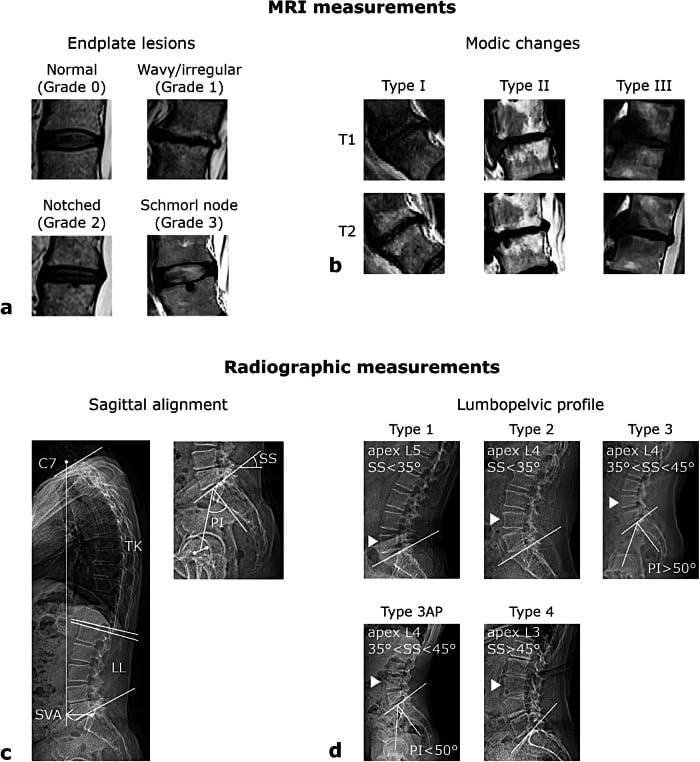
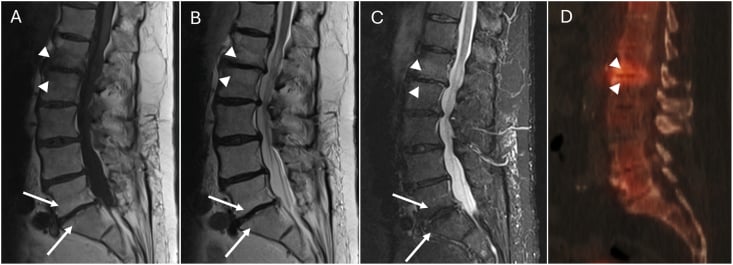
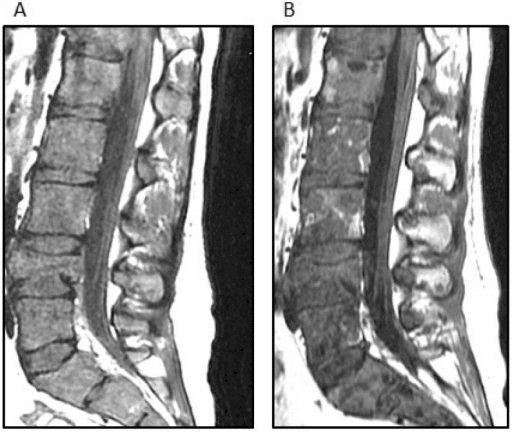
- Modic changes classify vertebral endplate marrow signal: Type 1 (oedema), Type 2 (fatty), Type 3 (sclerotic).
- “On T1-weighted images, normal bone marrow is brighter than muscle. If marrow is DARKER than muscle on T1, it is abnormal.
- “Red marrow reconversion (physiological) can mimic pathological infiltration — look for symmetric distribution and residual fat signal.
- “Stress fractures show marrow oedema (bright STIR) BEFORE a fracture line becomes visible on plain radiographs or CT.
- “Transient osteoporosis of the hip: diffuse femoral head marrow oedema on STIR with no double line sign (distinguishes from AVN).
- “Tumour infiltration typically replaces the normal T1 bright marrow with dark signal and enhances with gadolinium.
Overview
Why marrow signal matters. Bone marrow signal is one of the most clinically important findings in orthopaedic MRI. A change in marrow signal allows early diagnosis of occult fractures, stress injuries, avascular necrosis, infection and tumour infiltration, often weeks or months before any of them is visible on plain radiographs or CT.
The T1 principle. Normal adult marrow is predominantly yellow (fatty), and fat has a short T1, so normal marrow is bright on T1-weighted images. Any process that replaces, displaces or alters that fat reduces the T1 signal, and the abnormal area reads darker than the normal marrow around it. The question is the marrow bright or dark on T1? is the single most important assessment in musculoskeletal MRI.
Pathological Marrow Patterns
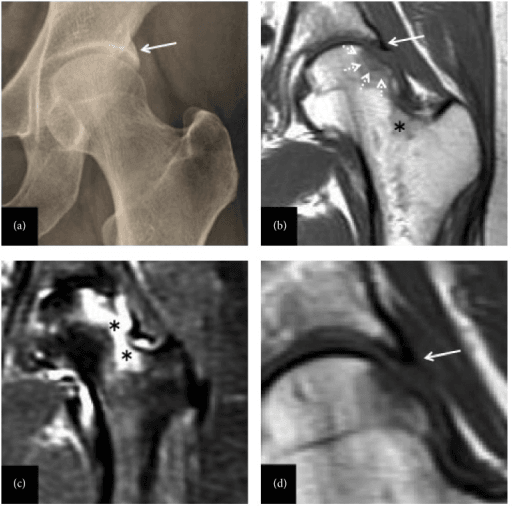
What MRI shows. MRI is the most sensitive and specific imaging modality for avascular necrosis, identifying signal change months to years before plain radiographic change appears.
On T1 the necrotic zone loses its normal bright fatty marrow signal, and a band of low T1 signal, the reactive interface between viable and necrotic bone, is characteristic.
On T2 the double line sign is a band of bright signal (fluid or granulation tissue) bordered by a low-signal rim (sclerotic reactive bone) at the necrotic interface. Its specificity approaches 100%.
Quote its sensitivity as well, because that is the half that changes management. The double line sign is only about 80% sensitive, so it is present in roughly four AVN hips in five and its absence does not exclude early osteonecrosis. "Pathognomonic" describes what a positive finding means; it says nothing about a negative one. A hip with the right risk factors, the right pain and a geographic marrow lesion without a double line is still AVN until something else explains it. The sign can also be mimicked by chemical-shift artefact if the sequence is not technically optimised, so check that the finding survives on a properly acquired T2.
On STIR the reactive zone and the surrounding oedema are bright, and the extent and pattern of that signal help with prognostication.
Staging the femoral head on MRI. The stages run from a normal radiograph to a collapsed head:
- Stage I - normal radiograph, abnormal MRI (marrow oedema or subtle signal change)
- Stage II - sclerosis on radiograph, characteristic MRI changes without collapse
- Stage III - subchondral fracture (crescent sign); MRI shows subchondral high signal on T2
- Stage IV - femoral head collapse and secondary osteoarthritis
ARCO. The Association Research Circulation Osseous (ARCO) system, the modern internationally used staging referenced in EFORT/European guidance and revised in 2019, maps directly onto these MRI findings:
- Stage 0 - all imaging normal, lesion only suspected (the silent hip)
- Stage I - radiographs and CT normal but MRI (or bone scan) positive; the marrow signal change or double line is the only abnormality
- Stage II - radiographic changes (sclerosis, osteopenia, cysts) without subchondral fracture or head flattening
- Stage III - subchondral fracture (crescent sign) and/or head flattening with a preserved joint space, subdivided IIIA (early, depression 2 mm or less) and IIIB (advanced, depression over 2 mm)
- Stage IV - secondary osteoarthritis with joint-space narrowing and acetabular change
The pivotal prognostic boundary is Stage III, subchondral collapse: pre-collapse lesions (0-II) are candidates for joint-preserving surgery, while post-collapse lesions (III-IV) usually require arthroplasty. ARCO also grades lesion size and the proportion of the weight-bearing surface involved, which independently predicts collapse.
The differential that matters. Transient osteoporosis of the hip shows diffuse marrow oedema of the entire femoral head without the double line sign and without a serpentine demarcation line. The distinction is critical because transient osteoporosis is self-limiting while AVN may require surgical intervention.
Modic Changes and Vertebral Marrow
What they are. Modic changes are vertebral endplate and subchondral marrow signal changes associated with degenerative disc disease, classified into three types by their MRI signal characteristics.
They are stages, not categories, and knowing the direction of travel explains the clinical picture. In Modic's original longitudinal follow-up, Type 1 changes converted to Type 2 in five of six patients over fourteen months to three years, while Type 2 changes remained stable over two to three years. That single observation accounts for most of what is otherwise puzzling about Modic changes: Type 1 is a transitional, actively inflammatory state, which is why it correlates with pain and why it is the type that gets better on its own; Type 2 is the settled endpoint, which is why it is the commonest type seen on any given scan and why it correlates poorly with symptoms. A Type 1 change on a scan taken today is unlikely to still be Type 1 in three years.
- T1 Signal
- Dark (hypointense)
- T2/STIR Signal
- Bright (hyperintense)
- Pathology
- Active oedema and inflammation in the endplate
- Clinical Correlation
- Most strongly associated with active low back pain; may convert to Type 2 or improve
- T1 Signal
- Bright (hyperintense)
- T2/STIR Signal
- Bright or isointense
- Pathology
- Fatty replacement of the endplate marrow
- Clinical Correlation
- Most common type; more stable; may or may not be symptomatic
- T1 Signal
- Dark (hypointense)
- T2/STIR Signal
- Dark (hypointense)
- Pathology
- Sclerotic bone in the endplate
- Clinical Correlation
- Least common; represents end-stage sclerosis; usually stable
Type 3 is sclerotic bone with no free water or fat, so it is dark on T1, T2 and STIR alike: the least common type and the end-stage change.
Type 1 in the clinic. Type 1 is the most clinically significant type because it represents active inflammation and is most strongly associated with axial back pain. It may also indicate low-grade infection: Type 1 change can be an early sign of discitis or osteomyelitis and must be interpreted in clinical context. Over time it may progress to Type 2 (fatty) or may persist and remain symptomatic; whether persistent Type 1 change should be treated with antibiotics is taken up under Controversies.
Systematic Approach
Read the marrow in a fixed order. Six steps, each with the question it answers; the T1 comparison with muscle is the first.
- Assessment
- Compare marrow signal to adjacent muscle on T1-weighted images
- Key Question
- Is marrow brighter or darker than muscle? Normal marrow is brighter than muscle on T1
- Assessment
- Check for bright signal on STIR indicating oedema or pathology
- Key Question
- Is there abnormal bright STIR signal? Where is it located? Is it focal, multifocal, or diffuse?
- Assessment
- Assess whether signal changes are focal, multifocal, or diffuse
- Key Question
- Focal = fracture, tumour, or infection. Multifocal = metastases, myeloma. Diffuse = systemic disease, reconversion
- Assessment
- Correlate T1, T2, and STIR signal to characterise the type of abnormality
- Key Question
- T1 dark + STIR bright = oedema. T1 dark + T2 dark = sclerosis. T1 bright = fat. Enhancement = vascular
- Assessment
- Look for fracture lines, cortical disruption, periosteal reaction, soft tissue mass
- Key Question
- These features narrow the differential: fracture line in stress injury, cortical disruption in tumour or infection
- Assessment
- Correlate the pattern with the patient's age, history, and presenting symptoms
- Key Question
- Diffuse marrow oedema in a child may be normal red marrow; in an elderly patient may be metastatic disease
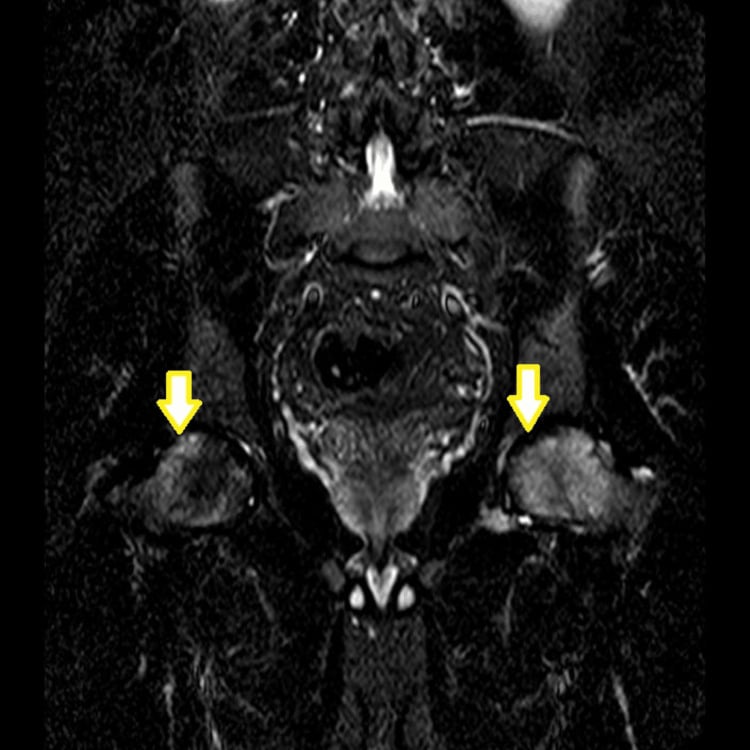
The T1 rule. Compare the marrow with the adjacent skeletal muscle on T1. Normal marrow is brighter than muscle, and marrow that is darker than muscle is abnormal and needs further evaluation, because a T1 signal that falls below muscle indicates oedema, infection, tumour infiltration or fibrosis. Physiological red marrow reconversion is not on that list: however extensive it is, reconverted marrow stays at or above muscle, which is precisely why the comparison with muscle works as a discriminator. This one rule catches the majority of significant marrow pathology.
The patterns. With the T1 signal placed against muscle, the T1, T2 and STIR behaviour together sort an abnormality into one of five patterns:
- Oedema - T1 dark, STIR bright (fracture, infection, tumour, reactive change)
- Infiltration - T1 dark, may enhance with gadolinium (tumour, leukaemia, lymphoma)
- Fatty replacement - T1 bright, STIR suppressed (chronic change, a healed process)
- Fibrosis or sclerosis - dark on T1 and T2, low signal on all sequences (Paget disease, chronic osteomyelitis, radiation therapy)
- Red marrow reconversion - slightly dark on T1, often symmetric and in expected locations (a physiological response to anaemia, chronic illness, smoking)
FISTSCauses of Bone Marrow Oedema
Hook:FISTS cause marrow oedema: Fracture, Infection, Surgery, Tumour, Stress/Transient.
The common viva trap is failing to use the T1 signal as the primary reference when assessing marrow pathology. Many candidates focus only on STIR, which is sensitive but not specific.
Marrow Conversion and Reconversion
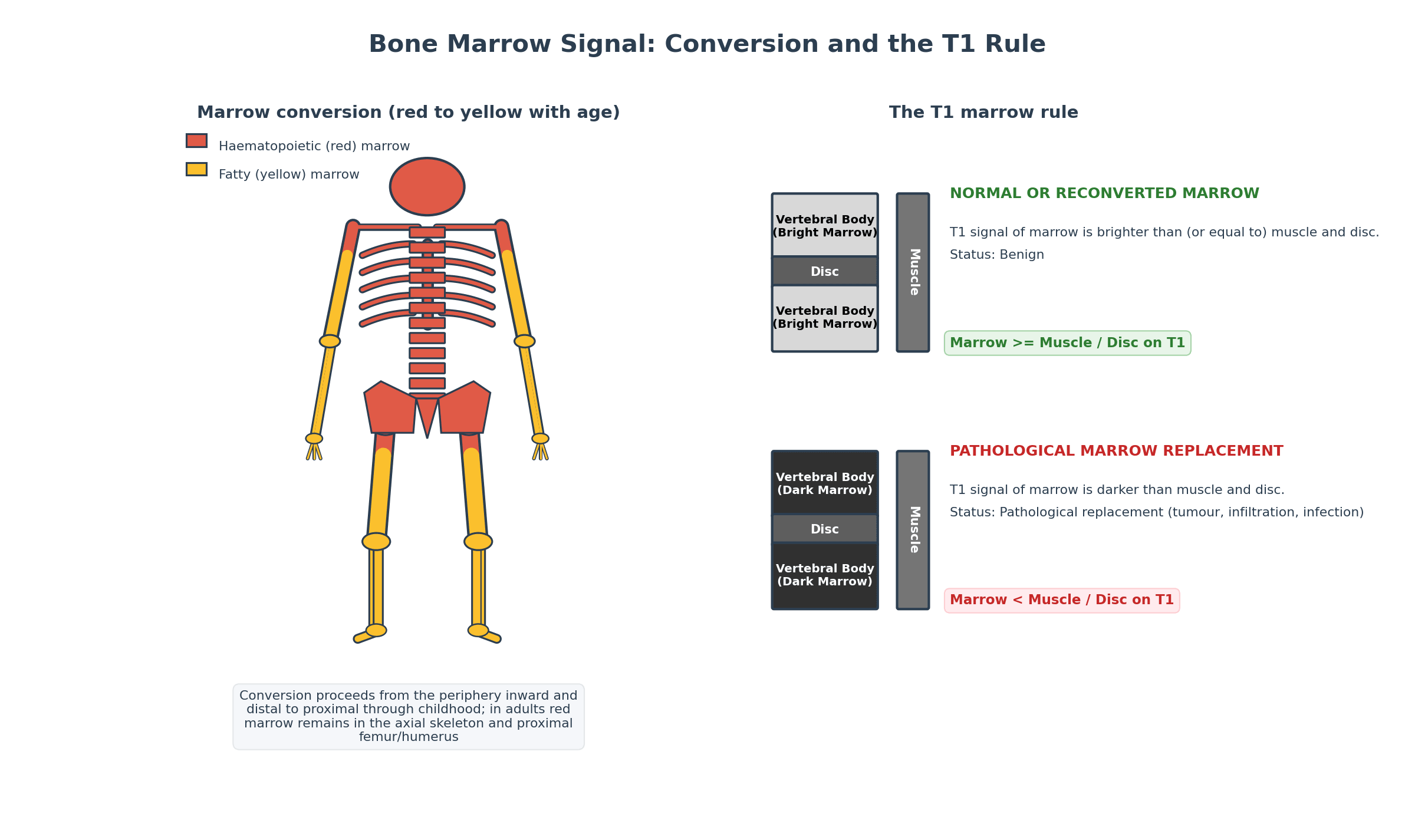
Normal conversion. At birth the entire skeleton contains red (haematopoietic) marrow. Through childhood and adolescence it converts to yellow (fatty) marrow in a predictable order: distal to proximal, so the feet and hands go first and the axial skeleton last, and within each long bone from diaphysis to metaphysis. By approximately age 25 the adult pattern is reached, with red marrow confined to the axial skeleton, the proximal femora, the proximal humeri and some metaphyseal regions. Yellow marrow is T1 bright; red marrow is less bright but still usually brighter than muscle.
Why the sequence matters. Residual red marrow in children, adolescents and young adults may mimic pathology, and knowing the normal order of conversion is what avoids the misdiagnosis.
- Distribution
- Entire skeleton contains red marrow
- MRI Appearance
- Diffusely intermediate-low T1 signal throughout skeleton — different from adult pattern
- Distribution
- Distal appendicular conversion well advanced (hands, feet converted to yellow)
- MRI Appearance
- Distal extremities now T1 bright; axial skeleton remains intermediate
- Distribution
- Epiphyses, diaphyses largely converted; metaphyses and axial skeleton still have red marrow residua
- MRI Appearance
- Most of the long bone shafts are now T1 bright; patchy metaphyseal areas may still be intermediate
- Distribution
- Adult pattern established: yellow marrow except for axial skeleton, proximal femora, proximal humeri
- MRI Appearance
- Normal adult T1 bright marrow; residual red marrow in expected locations
- Distribution
- Stable yellow marrow distribution; slow conversion of residual red marrow continues with age
- MRI Appearance
- T1 bright throughout most of the appendicular skeleton; redder with reconversion stimuli
Reconversion. Under certain physiological and pathological conditions yellow marrow can reconvert to red marrow, and it does so in the reverse pattern: proximal to distal, metaphysis to diaphysis. Reconversion increases the proportion of red (haematopoietic) marrow at the expense of yellow (fatty) marrow, and the practical problem is that reconverted marrow can be mistaken for infiltration. The table separates them.
- Red Marrow Reconversion
- Symmetric; follows expected pattern (proximal to distal)
- Pathological Infiltration
- Often asymmetric, random, or focal
- Red Marrow Reconversion
- Slightly less bright than fat but STILL BRIGHTER than muscle
- Pathological Infiltration
- Darker than muscle on T1
- Red Marrow Reconversion
- Mild increase; less intense than frank oedema
- Pathological Infiltration
- Markedly bright on STIR
- Red Marrow Reconversion
- Scattered fat signal (small foci of T1 bright) within the marrow
- Pathological Infiltration
- Complete replacement of fat signal — no residual bright T1 foci
- Red Marrow Reconversion
- Mild, homogeneous if present
- Pathological Infiltration
- Avid, heterogeneous, may show mass effect
- Red Marrow Reconversion
- Chronic anaemia, heavy smoking, obesity, long-distance running, chronic illness
- Pathological Infiltration
- Metastases, lymphoma, leukaemia, myeloma, primary bone tumours
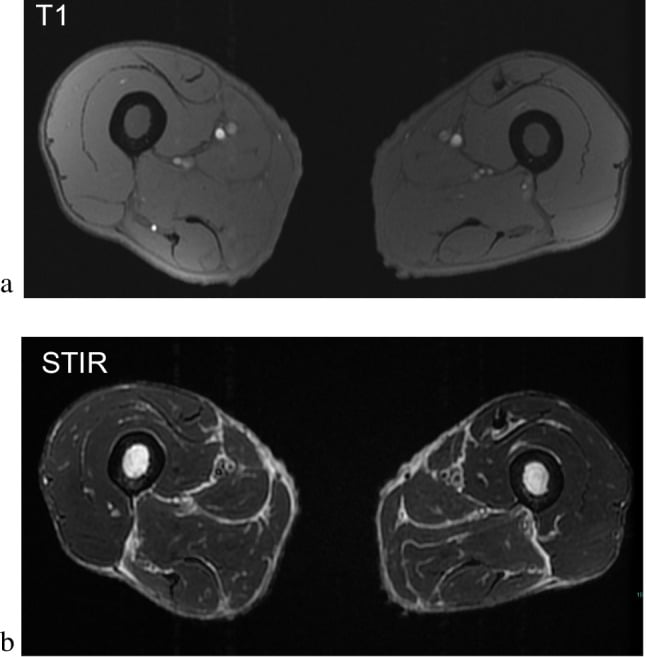
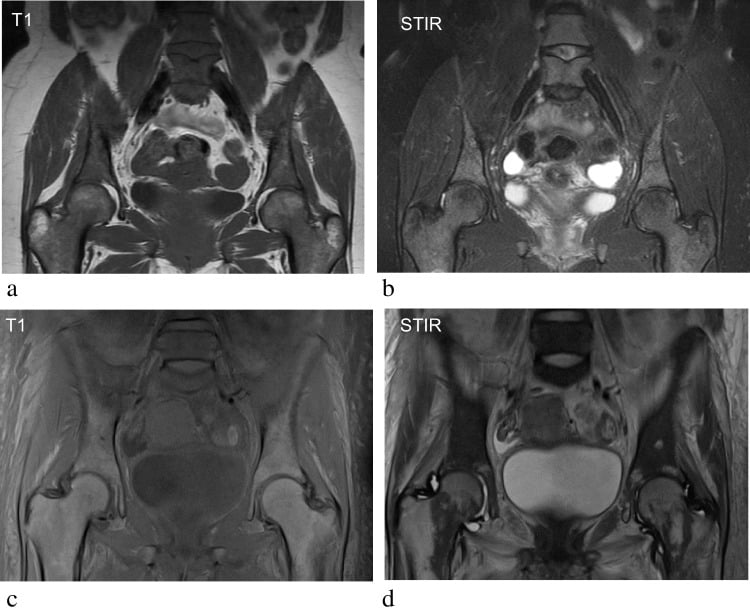
Differential Diagnosis of Marrow Signal
The examination scenario. The commonest one is a marrow signal abnormality where the candidate must generate and prioritise a differential. The decisive variables are the T1 signal relative to muscle, the STIR/T2 behaviour, the distribution, and the presence of an associated fracture line, mass or soft-tissue component.
- T1
- Slightly reduced but STILL brighter than muscle, retains fat foci
- STIR/T2
- Mildly increased
- Distinguishing Feature
- Symmetric, expected sites, no mass, signal does not drop below muscle
- T1
- Linear low-signal line replacing bright marrow
- STIR/T2
- Bright oedema, often beyond the fracture line
- Distinguishing Feature
- Identifiable fracture line; site-typical (femoral neck, tibia, metatarsal)
- T1
- Serpentine low-signal band, geographic lesion
- STIR/T2
- Double line sign; oedema in advanced disease
- Distinguishing Feature
- Subchondral, epiphyseal location with sclerotic rim and viable fat centrally early
- T1
- Confluent marrow replacement (T1 dark)
- STIR/T2
- Bright; rim-enhancing collections
- Distinguishing Feature
- Cortical breach, sinus tract, disproportionate soft-tissue oedema, penumbra sign
- T1
- Darker than muscle, complete fat replacement
- STIR/T2
- Variable, often bright; avid enhancement
- Distinguishing Feature
- Focal/multifocal, asymmetric, may show mass effect or cortical destruction
- T1
- Diffuse low signal across femoral head and neck
- STIR/T2
- Diffuse bright oedema
- Distinguishing Feature
- NO double line, NO geographic lesion; self-limiting, migratory
- T1
- Dark at the endplate
- STIR/T2
- Bright at the endplate
- Distinguishing Feature
- Subchondral endplate location at a degenerate disc; mirror-image across the disc
- T1
- Dark
- STIR/T2
- Dark on all sequences
- Distinguishing Feature
- Low signal on T1 AND T2/STIR; history of radiation, Paget changes, or chronic infection
The highest-value discriminator in this whole topic is the T1 signal relative to muscle combined with whether residual fat is preserved within the lesion. Benign red marrow keeps interspersed fat and never drops below muscle signal; tumour infiltration completely replaces fat and falls to or below muscle signal. Chemical-shift (in-phase/opposed-phase) imaging exploits exactly this: benign fat-containing marrow loses signal on opposed-phase images, whereas tumour that has replaced the fat does not.
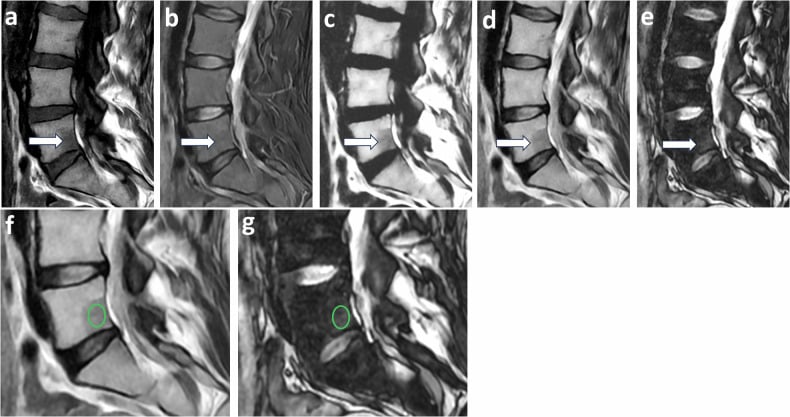
Diffusion-weighted and whole-body MRI. Beyond conventional T1/STIR, diffusion-weighted imaging (DWI) is now central to assessing diffuse marrow disease (myeloma, metastatic infiltration). Highly cellular tumour restricts water diffusion, so it remains bright at high b-values with a low apparent diffusion coefficient (ADC), whereas normal fatty and benign red marrow do not. Whole-body MRI (T1 plus STIR plus DWI from skull to mid-thigh) is recommended by myeloma guidelines (IMWG): it detects focal and diffuse marrow infiltration earlier than skeletal survey, and more than one focal marrow lesion on whole-body MRI is itself a myeloma-defining event. Myeloma marrow has recognised patterns: normal, focal, diffuse, "variegated" or salt-and-pepper, and combined.
A caveat for treatment monitoring. Effective therapy can paradoxically raise the ADC (tumour necrosis and liquefaction), so falling cellularity is interpreted alongside the conventional sequences, and ADC response thresholds remain incompletely standardised.
Guidelines, Registries & Global Practice
Across every major examination system, MRI is regarded as the investigation of choice for suspected occult fracture, stress injury, avascular necrosis, osteomyelitis and marrow infiltration, because bone marrow signal change precedes radiographic change by weeks to months. The cardinal principle — loss of normal T1 fatty (bright) marrow signal — is universal and not country-specific.
- Position on MRI for Marrow Pathology
- Hip fracture guidance recommends MRI when a fracture is suspected despite normal radiographs; if MRI is contraindicated or not available within 24 hours, CT is the accepted alternative.
- Position on MRI for Marrow Pathology
- Supports advanced imaging (MRI preferred, CT acceptable) for the occult hip fracture and emphasises MRI for suspected osteonecrosis and infection where radiographs are inconclusive.
- Position on MRI for Marrow Pathology
- Frames MRI as the modality of choice for early stress injury, osteonecrosis staging and infection, using STIR/fat-suppressed sequences to detect marrow oedema.
- Position on MRI for Marrow Pathology
- Endorses MRI-based osteonecrosis classification (ARCO) and MRI for early marrow change in infection and tumour; promotes standardised whole-body MRI protocols for myeloma.
- Position on MRI for Marrow Pathology
- Whole-body MRI (or diffusion-weighted MRI) is recommended for marrow assessment; more than one focal marrow lesion is a myeloma-defining event.
Global epidemiology and registry context. Femoral neck fragility fractures number in the millions worldwide each year, and a meaningful minority are radiographically occult at presentation — the driver for rapid MRI access. National hip-fracture registries (for example the UK National Hip Fracture Database and equivalents in the Nordic countries, Australia and New Zealand) consistently link early definitive diagnosis and surgery to lower morbidity, which underpins the 24-hour MRI recommendation. Arthroplasty registries (NJR for England and Wales, AJRR in the US, AOANJRR in Australia, and the Swedish and Norwegian registries) report on osteonecrosis and periprosthetic bone quality as factors in revision, where MRI marrow signal informs pre-operative planning.
High- versus limited-resource practice variation. Where MRI is freely available it is the first advanced test for occult fracture, osteonecrosis and infection. In limited-resource or after-hours settings, CT is widely substituted for the occult hip fracture (it detects most though not all non-displaced fractures), and a delayed repeat radiograph at 10-14 days or a technetium bone scan may be used when cross-sectional imaging is inaccessible. For marrow infiltration and myeloma, diffusion-weighted whole-body MRI is expanding in high-resource centres but skeletal survey or low-dose whole-body CT remains the practical alternative elsewhere.
Controversies & Areas of Uncertainty
Antibiotics for Modic Type 1 change. The hypothesis that some Modic Type 1 changes reflect low-virulence disc infection (notably Cutibacterium acnes) led to trials of prolonged oral antibiotics for chronic low back pain, and some authors have advocated antibiotic treatment for persistent Type 1 changes that fail to respond to conservative management (the Modic Antibiotic Spine Therapy concept). Early results were promising, but later, better-controlled studies and meta-analyses have been inconsistent, and concerns about antibiotic stewardship persist. Routine antibiotic therapy for Modic Type 1 change is not standard practice and remains investigational.
Occult hip fracture: MRI versus CT. MRI is the most sensitive test for the occult hip fracture, but multidetector CT detects most non-displaced fractures and is faster and cheaper, and debate continues over whether CT is an adequate first-line substitute. The pragmatic global position is MRI first where available within 24 hours, with CT reserved for when MRI is contraindicated, not tolerated or unavailable, accepting a small false-negative rate for CT.
Defining pathological marrow oedema. 'Bone marrow oedema' on STIR is sensitive but profoundly non-specific: subchondral bone marrow lesions in osteoarthritis, post-traumatic contusion, reactive change adjacent to enthesopathy and early infection can look similar. The term 'bone marrow oedema-like signal' is preferred because true interstitial oedema is only one of several histological substrates, which also include necrosis, fibrosis and marrow fat loss.
Whole-body and diffusion-weighted MRI. Diffusion-weighted whole-body MRI is increasingly used for myeloma and metastatic marrow disease, but protocol standardisation and access remain unsettled, especially outside specialist centres.
Clinical Decision Scenarios
Practise clinical reasoning and management decisions out loud
“A 65-year-old woman presents with hip pain after a fall. Plain radiographs of the pelvis are reported as normal. You are shown an MRI of the hip.”
“You are shown an MRI of the hip in a 40-year-old male on long-term corticosteroids. The T2-weighted image shows a serpentine line in the femoral head with an inner bright band and outer dark band.”
“An examiner shows you an MRI of the lumbar spine with bright T1 and bright T2 signal in the endplates of L4/5, and asks you to classify and discuss the changes.”
“A 38-year-old long-distance runner who smokes and is mildly anaemic has an MRI of both knees for anterior knee pain. The report describes patchy low T1 signal in the distal femoral and proximal tibial metaphyses bilaterally, with mild STIR hyperintensity.”
Normal Marrow Assessment
- Normal marrow is T1 BRIGHT (brighter than muscle) — due to fat content
- If marrow is darker than muscle on T1, it is abnormal
- Physiological red marrow reconversion NEVER falls below muscle, however extensive — that is why the muscle comparison works
- Double line sign: near 100% SPECIFIC but only about 80% SENSITIVE — its absence does not exclude early AVN
- Modic Type 1 converts to Type 2 in 5 of 6 patients over 14 months to 3 years; Type 2 stays put — which is why Type 1 hurts and Type 2 is commonest
- Conversion: distal to proximal, diaphysis to metaphysis (complete by age 25)
- Red marrow reconversion is proximal to distal (reverse of conversion)
Pathological Patterns
- Oedema: T1 dark, STIR bright (FISTS: Fracture, Infection, Surgery, Tumour, Stress)
- Fatty replacement: T1 bright, STIR suppressed (chronic change)
- Fibrosis/Sclerosis: T1 dark, T2 dark (Paget, chronic infection, radiation)
- Infiltration: T1 dark, complete fat replacement, enhancement with gadolinium
AVN Diagnosis
- Double line sign on T2: virtually 100% specific, about 80% sensitive
- Outer dark line = reactive sclerosis; inner bright line = granulation tissue
- Must scan bilaterally — 80% bilateral in steroid-related AVN
- Distinguish from transient osteoporosis: TOH has diffuse oedema WITHOUT double line
Modic Changes
- Type 1: T1 dark, T2 bright = oedema (PAIN associated; most clinically significant)
- Type 2: T1 bright, T2 bright = fat (MOST COMMON; stable)
- Type 3: T1 dark, T2 dark = sclerosis (LEAST COMMON; end-stage)
- Must exclude discitis if clinical features suggest infection
Stress Fracture Grading (Fredericson)
- Grade 1: Periosteal oedema only (STIR positive, T1 normal)
- Grade 2: Marrow oedema on STIR, T1 normal
- Grade 3: Marrow oedema on BOTH T1 (dark) and STIR (bright)
- Grade 4: Visible fracture line — Grade 4b is a complete stress fracture
Evidence Base
MRI versus CT for Occult Hip Fractures
- In 13 elderly patients (mean age 73) with hip pain after a fall and normal radiographs, MRI and CT were compared for detecting occult fractures.
- In the subgroup imaged with both, 4 of 6 CT studies gave a misdiagnosis due to inaccuracy, whereas every MRI study yielded an accurate, prompt diagnosis.
- The authors concluded MRI is more accurate than CT for early diagnosis of occult hip fractures, enabling effective treatment and shorter admission.
MRI for Diagnosing Foot Osteomyelitis
- Pooled across 16 studies of suspected foot/ankle osteomyelitis (many in diabetes), MRI had a diagnostic odds ratio of 42.1 (95% CI 14.8 to 119.9).
- At a 90% sensitivity cut-point the specificity was 82.5%, so marrow signal change on MRI can both rule in and rule out infection.
- MRI markedly out-performed technetium-99m bone scan (DOR 149.9 vs 3.6), plain radiography (81.5 vs 3.3) and white-cell studies (120.3 vs 3.4) in head-to-head comparisons.
Diagnostic evidence strongly supports MRI for occult fractures and infection.