Seddon and Sunderland Classifications | Wallerian Degeneration | Schwann Cell Bands of Büngner | 1mm/day Growth
- Wallerian degeneration occurs distal to injury site within 24-48 hours
- Chromatolysis is the proximal cell body response preparing for regeneration
- Schwann cells form bands of Büngner guiding axonal regrowth
- Growth cone at axon tip extends 1mm per day in peripheral nerves
- Sunderland classification has 5 degrees based on which structures are injured
- “Seddon: neurapraxia, axonotmesis, neurotmesis (increasing severity)
- “Sunderland adds detail: degrees I-V (I = neurapraxia, V = neurotmesis)
- “Tinel sign progression indicates axonal regeneration front
- “Primary repair within 3 months has better outcomes than delayed repair
Overview and Classification
Peripheral nerve injury is common in trauma and as a surgical complication. The biological response to the injury is what predicts recovery and decides the surgical indication: the nerve's capacity to regenerate depends on the severity of the injury, the timing of repair and whether the endoneurial architecture has been preserved.
Scope. This page covers the injury and repair biology: the classifications, Wallerian degeneration, chromatolysis, Schwann-cell reprogramming and regeneration. The underlying structure, conduction and fibre-type basic science (neurone, myelin, nodes of Ranvier, saltatory conduction, endoneurium/perineurium/epineurium, A-alpha through C fibres) is covered on the Nerve Anatomy and Physiology page, and the operative techniques this biology informs (epineurial versus fascicular repair, grafts, conduits and transfers) on the Nerve Repairs page; the three are companion reads.
Why the biology matters. The Seddon and Sunderland classifications set the expected recovery, and electrodiagnostics tell the types apart. Timing follows from the same biology: primary repair within 3 months is optimal, because delay allows the endoneurial tubes to fibrose and the target muscle to atrophy, and after 18-24 months motor recovery is unlikely even with a perfect repair.
The three processes. Regeneration depends on three biological processes working in concert: Wallerian degeneration in the distal stump, chromatolysis in the proximal cell body, and axonal regeneration by the growth cone. All three must succeed for functional recovery. Wallerian degeneration without regeneration leaves the targets denervated, chromatolysis without successful reinnervation leads to neuronal death, and growth-cone navigation without intact endoneurial tubes produces a neuroma.
Anatomy
The sheaths. From inside out: endoneurium around each axon, perineurium around each fascicle, epineurium around the whole trunk. Each is a surgical fact as much as a histological one. The endoneurial tube is the guide a regenerating axon follows; the perineurium is the blood-nerve barrier and the source of the nerve's tensile strength; the epineurium is where the blood supply enters and the surgical plane for nerve repair. Injury to the deeper layers causes more misdirection during regeneration.
- Surrounds
- Individual axons
- Function
- Collagen tubes for Schwann cells
- Clinical Significance
- Preservation critical for regeneration guidance
- Surrounds
- Fascicles (groups of axons)
- Function
- Blood-nerve barrier, tensile strength
- Clinical Significance
- Disruption causes axonal misdirection
- Surrounds
- Entire nerve trunk
- Function
- External protective layer, blood supply entry
- Clinical Significance
- Surgical plane for nerve repair
Schwann cells. In a myelinated fibre one Schwann cell makes one internode of myelin, 1-2 mm long, with a node of Ranvier between internodes; conduction is saltatory and fast. In an unmyelinated fibre one Schwann cell wraps several axons, and conduction is slower.
- Myelination
- Thick myelin
- Diameter
- 12-20 μm
- Conduction Velocity
- 70-120 m/s
- Function
- Motor, proprioception
- Myelination
- Myelin
- Diameter
- 5-12 μm
- Conduction Velocity
- 30-70 m/s
- Function
- Touch, pressure
- Myelination
- Thin myelin
- Diameter
- 2-5 μm
- Conduction Velocity
- 12-30 m/s
- Function
- Pain, temperature
- Myelination
- Unmyelinated
- Diameter
- 0.5-2 μm
- Conduction Velocity
- 0.5-2 m/s
- Function
- Pain, autonomic
Blood supply, and why tension matters. Extrinsic segmental vessels from the adjacent arteries enter through the epineurium, and an intrinsic longitudinal network within the epineurium gives the nerve redundancy. That longitudinal network is what keeps a nerve alive when it is mobilised: mobilisation over several centimetres is safe, but excessive stretch disrupts the intrinsic supply. At a repair, tension over 10% gap strain causes ischaemia at the repair site, then fibrosis, then failure, which is why a gap that cannot be closed without tension is grafted rather than repaired under tension.
Fascicles. Small nerves such as the digital nerves are monofascicular; most peripheral nerves are oligofascicular with 2-5 fascicles; the major trunks (the median and ulnar at the wrist) are polyfascicular, many fascicles joined by plexiform connections. Proximally, motor and sensory fascicles are intermixed and difficult to match at repair; distally they separate and are easier to identify, which is part of why distal repairs do better.
The endoneurial tube is the key to successful regeneration. If it is intact (axonotmesis) the regenerating axon follows its own tube back to its original target; if it is disrupted (neurotmesis) axons enter the wrong tubes, are misdirected, and functional recovery is poor. The bands of Büngner that guide the axon form inside these tubes.
Classification Systems
Seddon's three types and Sunderland's five degrees describe the same spectrum from two directions: Seddon from what recovers, Sunderland from which sheath is torn. The question to ask of any injury is whether the axon is in continuity and, if not, whether the endoneurial tube around it survived.
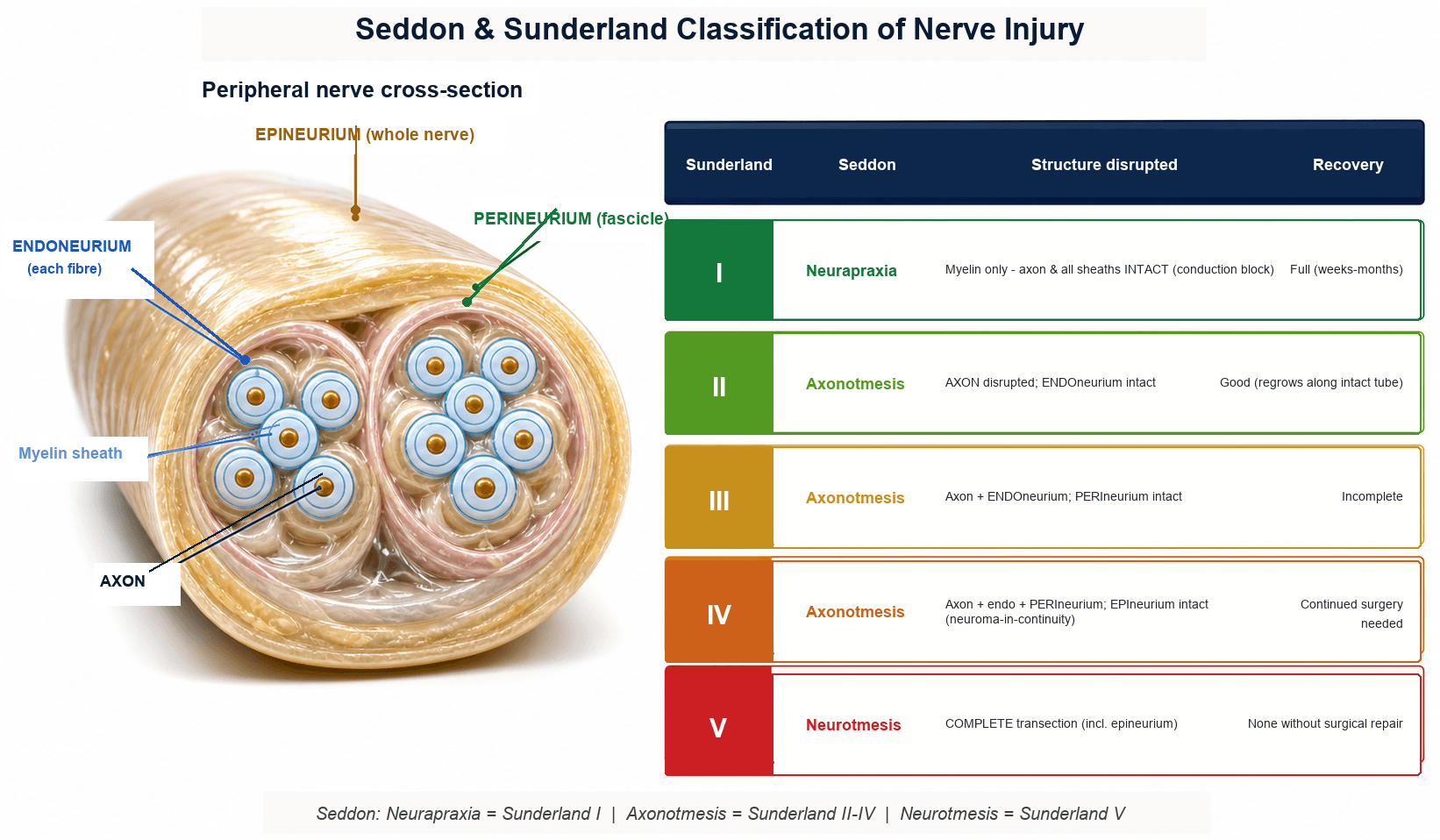
Seddon Classification (1943)
- Neurapraxia
- Intact
- Axonotmesis
- Disrupted
- Neurotmesis
- Disrupted
- Neurapraxia
- Intact
- Axonotmesis
- Intact
- Neurotmesis
- Disrupted
- Neurapraxia
- No
- Axonotmesis
- Yes (distal)
- Neurotmesis
- Yes (distal)
- Neurapraxia
- Blocked locally
- Axonotmesis
- Lost distal
- Neurotmesis
- Lost distal
- Neurapraxia
- Excellent (weeks-months)
- Axonotmesis
- Good (months)
- Neurotmesis
- Poor without surgery
- Neurapraxia
- Demyelination recovery
- Axonotmesis
- 1mm per day regrowth
- Neurotmesis
- Depends on repair quality
Neurapraxia is a local conduction block from myelin injury by compression, traction or ischaemia. The axon remains in continuity, so there is no Wallerian degeneration, and recovery is complete within weeks to months as the myelin regenerates. Saturday night palsy (radial nerve compression) and prolonged tourniquet use are the usual settings, and no surgery is needed.
Axonotmesis is axonal disruption with the endoneurial tubes (and the perineurium and epineurium) preserved, after severe traction, crush or ischaemia. Wallerian degeneration follows distal to the injury, and the proximal axon regenerates through the intact tubes at 1 mm per day. The prognosis is good because the bands of Büngner lead each axon back to its original target.
Neurotmesis is complete transection with disruption of every structure including the endoneurium. Wallerian degeneration occurs but the regenerating axons have no guidance channels, so a neuroma forms at the injury site, and any recovery requires surgical repair. Even after repair, outcomes are limited by misdirection and target-muscle atrophy.
Seddon is the classification most useful clinically.
Seddon (1943) has 3 types based on functional outcomes. Sunderland (1951) has 5 degrees based on anatomical structures injured. Seddon is simpler for clinical use. Sunderland adds detail: degree I equals neurapraxia, degrees II-IV are types of axonotmesis with increasing structural damage, degree V equals neurotmesis.
Wallerian Degeneration
Wallerian degeneration is the breakdown of axon and myelin distal to a nerve injury, named after Augustus Waller, who described it in 1850. It is an active process rather than passive decay, and it needs Schwann cells and macrophages to carry it out. It begins within 24-48 hours and is the necessary first step of regeneration in every injury that has divided the axon.
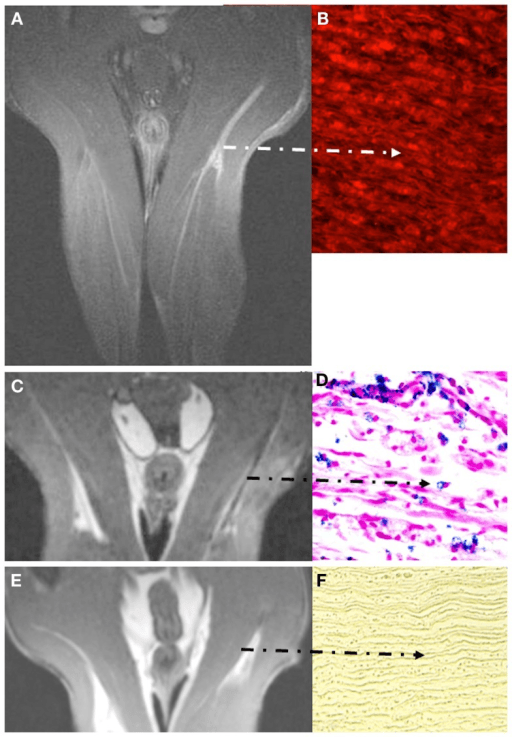
Wallerian Degeneration Timeline
Immediate response: axonal transport is interrupted, the distal axon swells with calcium influx and the cytoskeleton breaks down.
Axonal fragmentation: the distal axon breaks into fragments (ellipsoids) and the myelin sheath begins to fragment. Schwann cells detect the injury signals.
Schwann cell activation: Schwann cells dedifferentiate, proliferate and begin phagocytosing myelin debris. Macrophages are recruited from the blood.
Debris clearance: macrophages and Schwann cells clear the myelin and axonal debris. Schwann cells form columns (bands of Büngner) within the endoneurial tubes.
Ready for regeneration: the endoneurial tubes are clear and the bands of Büngner are secreting neurotrophic factors (NGF, BDNF, GDNF), awaiting the regenerating axon.
The axon. Calcium influx triggers the breakdown, through calpain-mediated degradation of the cytoskeleton, and the ubiquitin-proteasome system degrades the axonal proteins. The axon fragments into ellipsoids and the myelin breaks down into lipid droplets.
The cells. Schwann cells phagocytose 40-50% of the debris themselves and secrete the chemokines CCL2 and MCP-1 to recruit macrophages for the rest. If denervation is prolonged, endoneurial fibroblasts proliferate and the tube fibroses.
Myelin debris contains inhibitory molecules (MAG, myelin-associated glycoprotein, and Nogo) that block axonal growth. Clearing the debris and converting the Schwann cells to a pro-regenerative state creates the permissive environment; without it, regeneration fails.
Proximal (retrograde) degeneration also occurs but is limited, extending 3-5 mm proximal to the injury (one or two nodes of Ranvier). If a severe injury causes cell body death (chromatolysis failure), the entire neurone dies.
Chromatolysis - Cell Body Response
Chromatolysis is the morphological and metabolic response of the neuronal cell body to axonal injury: the neurone switches from neurotransmission mode to regeneration mode. It occurs in the dorsal root ganglion (sensory) and anterior horn (motor) cell bodies and peaks at 7-14 days.
What you see on Nissl staining. The word means dissolution of colour on the Nissl stain, and that is the first feature:
- Nissl substance dispersal - ribosomes and rough endoplasmic reticulum move from the centre to the periphery
- Nuclear eccentricity - the nucleus moves to the cell periphery
- Cell body swelling - volume increases by 30-50%
- Nucleolar enlargement - reflecting increased protein synthesis
What is happening underneath. Neurotransmitter genes (acetylcholine, neurotransmitter receptors) are downregulated and growth-associated genes are upregulated: GAP-43, tubulin, actin and other cytoskeletal proteins. Protein synthesis rises, with more ribosomal RNA and an expanded rough endoplasmic reticulum; the transcription factors ATF3, c-Jun and STAT3 drive the regeneration programme; and axonal transport is enhanced by upregulated kinesin and dynein motors.
- Normal Neuron
- Central distribution
- Chromatolysis
- Dispersed to periphery
- Failed Regeneration
- Absent (atrophy)
- Normal Neuron
- Central
- Chromatolysis
- Eccentric (peripheral)
- Failed Regeneration
- Pyknotic (condensed)
- Normal Neuron
- Baseline
- Chromatolysis
- Increased 30-50%
- Failed Regeneration
- Decreased (shrinkage)
- Normal Neuron
- Neurotransmission
- Chromatolysis
- Growth and regeneration
- Failed Regeneration
- Apoptotic markers
- Normal Neuron
- Normal function
- Chromatolysis
- Regeneration if successful
- Failed Regeneration
- Cell death
Read it as a positive sign. Chromatolysis indicates that the cell has survived and is attempting to regenerate; its absence after nerve injury suggests cell death. Prolonged chromatolysis beyond 3-4 weeks without successful regeneration leads to neuronal atrophy and eventual apoptosis.
Muscle atrophy parallels chromatolysis. Motor neurones that fail to reinnervate muscle within 12-18 months undergo apoptosis, and muscle fibres denervated beyond 18-24 months undergo irreversible fibrofatty degeneration. This is why the timing of nerve repair is critical: delay beyond 6-12 months severely compromises motor recovery.
Schwann Cell Biology in Regeneration
Schwann cells are the glial cells of the peripheral nervous system, and after injury they undergo a dramatic phenotypic transformation to support regeneration. They do four jobs.
Debris clearance. They express phagocytic receptors and phagocytose myelin and axonal debris alongside the macrophages they have recruited.
Bands of Büngner. They align in columns within the endoneurial tubes, forming tubular scaffolds that physically direct regenerating axons toward their original targets. Without endoneurial tubes, as in neurotmesis, the bands collapse and a neuroma forms.
Neurotrophic support. They secrete NGF (nerve growth factor), BDNF (brain-derived neurotrophic factor), GDNF (glial-derived neurotrophic factor), CNTF (ciliary neurotrophic factor) and FGF (fibroblast growth factor), creating the chemical gradient that guides the growth cone.
Remyelination. Once axonal contact is re-established they transition back to a myelinating phenotype and remyelinate the regenerated axon. The new internodes are shorter and the myelin thinner than the original, which is why conduction velocity is slower after regeneration.
The molecular switch. The transcription factor c-Jun is the master regulator of Schwann cell dedifferentiation and the pro-regenerative phenotype: c-Jun knockout mice show failed Wallerian degeneration and poor nerve regeneration. c-Jun upregulation drives dedifferentiation, proliferation and growth factor secretion; Sox2 expression maintains the dedifferentiated state; neuregulin-1 signalling from the regenerating axon promotes remyelination; and laminin and fibronectin in the Schwann cell basal lamina provide the extracellular matrix cues for axonal growth.
The sequence. Within 24 hours the Schwann cell senses the loss of axonal contact, the absence of neuregulin-1 and other axonal signals. Over 1-3 days it downregulates the myelin genes (P0, MBP, PMP22), upregulates c-Jun and the growth factor genes, and begins to proliferate; over 3-7 days the dividing cells align into bands of Büngner within the endoneurial tubes and begin secreting neurotrophic factors. From 1-4 weeks the bands are maintained in a pro-regenerative state. Over the following months the cell either remyelinates an arriving axon or, if no axon has made contact by 3-4 months, the bands gradually deteriorate and the endoneurial tubes fibrose.
Schwann cells maintain bands of Büngner for 3-4 months awaiting a regenerating axon. After this the bands gradually deteriorate and the endoneurial tubes collapse and fibrose, which is why nerve repair beyond 6-12 months has poor outcomes: the Schwann cell guidance and the endoneurial tube integrity are both lost.
Neurotrophins and Their Receptors
The growth factors the repair Schwann cells secrete act on the regenerating neurone only through specific cell-surface receptors, and the ligand-receptor pairing is high-yield basic science.
- Trk (tropomyosin-receptor-kinase) receptors are high-affinity receptor tyrosine kinases, each matched to a neurotrophin:
- TrkA binds NGF (nerve growth factor) - small sensory and sympathetic neurones
- TrkB binds BDNF and NT-4/5 - motor and many sensory neurones
- TrkC binds NT-3 (neurotrophin-3) - large proprioceptive neurones
- GDNF signals through a distinct two-part receptor, the GFR-alpha-1 co-receptor together with the RET receptor tyrosine kinase, and is particularly important for motor and sensory neurone survival after axotomy.
- p75NTR is the low-affinity pan-neurotrophin receptor, a TNF-receptor-superfamily member that binds all the neurotrophins and their immature pro-forms.
On ligand binding a Trk receptor dimerises and autophosphorylates, activating PI3K/Akt (survival), Ras/MAPK (growth and differentiation) and PLC-gamma signalling, which drives neuronal survival, axonal elongation and growth-cone advance.
p75NTR modulates Trk signalling, sharpening ligand specificity and enhancing high-affinity binding, but when expressed without a partnering Trk it can instead trigger apoptosis. It is strongly re-expressed by injured neurones and by repair Schwann cells, so it contributes both to regeneration support and, in a neurone that fails to reconnect, to programmed cell death.
Axonal Regeneration and Growth Cone
Axonal regeneration begins within days of injury. The proximal axon stump forms a growth cone at its tip, which extends processes (filopodia and lamellipodia) that sense the local environment and navigate toward the target.
The growth cone is a specialised structure at the regenerating axon tip:
- Filopodia - thin finger-like projections extending 10-50 micrometres, sensing chemical and physical cues
- Lamellipodia - sheet-like membrane expansions between the filopodia, providing surface for advancement
- Receptors - Trk receptors for neurotrophins (NGF, BDNF, GDNF), integrins for extracellular matrix, semaphorin receptors, ephrin receptors
- Cytoskeletal machinery - actin filaments in the filopodia, microtubules in the central domain, motor proteins (myosin, kinesin) for advancement
- Molecules
- NGF, BDNF, GDNF, CNTF
- Effect
- Growth cone advances toward gradient
- Source
- Schwann cells, target organ
- Molecules
- Laminin, fibronectin, N-CAM
- Effect
- Growth cone adheres and advances
- Source
- Schwann cell basal lamina, ECM
- Molecules
- Semaphorins, Slits
- Effect
- Growth cone retracts from inappropriate paths
- Source
- Non-target tissue
- Molecules
- MAG, Nogo, OMgp (myelin proteins)
- Effect
- Growth cone stalls
- Source
- Myelin debris (if not cleared)
The sequence. From a sealed stump to a mature, remyelinated axon takes six steps, and the clock on each is worth knowing:
- Proximal stump sealing (0-24 hours) - calcium influx triggers membrane sealing at the injury site
- Growth cone formation (24-72 hours) - multiple sprouts emerge from the proximal stump, up to 20-50 initially
- Endoneurial tube entry (3-7 days) - the sprouts that enter endoneurial tubes advance; the others retract
- Elongation (weeks to months) - the growth cone extends at 1-3 mm per day along the bands of Büngner
- Target contact (months) - the growth cone reaches the target (muscle, skin receptor) and forms a synapse
- Maturation (months to years) - axon diameter increases, Schwann cells remyelinate, conduction velocity improves
What limits it. Distance first: a proximal injury (brachial plexus, sciatic nerve) needs months to years for the growth cone to reach its distal targets, and the clinical rule of thumb is 1 mm per day, an inch a month. Age next: the rate is 1-3 mm per day in youth and slower in the elderly. And time: muscle fibres and Schwann cells atrophy once denervation exceeds 12-18 months.
An advancing Tinel sign marks the regeneration front. Percussion over the nerve produces tingling distal to the percussion site, and the point of maximal Tinel advances 1 mm per day as the growth cone progresses. A stationary Tinel suggests a neuroma and failed regeneration.
GAP-43: The Axonal Growth Marker
GAP-43 is one of the growth-associated genes the injured cell body upregulates, and it is the prototypical molecular marker of axonal regeneration.
What it is. GAP-43 (growth-associated protein 43, also called neuromodulin or B-50) is a membrane-associated phosphoprotein highly concentrated in the growth cone and the axonal plasma membrane. Its expression is low in mature, stable neurones and is strongly upregulated by the injured cell body as it switches from a transmission phenotype to a growth phenotype.
What it does. It regulates the actin cytoskeleton and membrane dynamics at the growth cone. It binds calmodulin and is a major substrate of protein kinase C (PKC); its phosphorylation state modulates filopodial extension, growth-cone motility and the axon's capacity to advance and form new connections. It is part of the structural machinery of regeneration, not merely a passive label.
Why it is used. Because GAP-43 rises specifically when an axon is actively elongating, it serves experimentally as a readout of genuine regeneration and helps distinguish a regenerating neurone from one destined to atrophy: it is the molecular counterpart of the clinically advancing Tinel sign.
Factors Affecting Nerve Regeneration
Success depends on patient, injury and surgical factors, and understanding them is what lets the surgeon optimise the repair and set realistic expectations.
- Effect on Regeneration
- Younger better than older
- Mechanism
- Decreased growth factor expression, slower Schwann cell response with age
- Effect on Regeneration
- Impaired regeneration
- Mechanism
- Microangiopathy, neuropathy, decreased neurotrophic support
- Effect on Regeneration
- Delayed regeneration
- Mechanism
- Vasoconstriction, tissue hypoxia, impaired Schwann cell function
- Effect on Regeneration
- Protein and B vitamins essential
- Mechanism
- Axonal protein synthesis requires amino acids, B vitamins for myelin
- Effect on Regeneration
- Cancer, renal failure, immunosuppression
- Mechanism
- Impaired cellular metabolism, healing, growth factor signaling
Age is the most important patient factor. Children regenerate faster and achieve better functional outcomes than adults; elderly patients regenerate more slowly and do worse even with optimal repair. These factors are mostly non-modifiable, which puts the weight on technique.
Critical surgical windows: motor reinnervation must occur within 18-24 months or the motor endplates degenerate. Sensory recovery can occur even after years but is less functional. This is why proximal nerve injuries in adults have a poor prognosis: the regeneration distance is too great to reach the muscle in time.
Investigations
Nerve conduction studies. The distal responses answer the Seddon question, but only once Wallerian degeneration has had time to happen: a study done in the first week can be normal distal to a complete transection. Stimulation across the lesion is what shows a conduction block.
- Neurapraxia
- Normal
- Axonotmesis/Neurotmesis
- Reduced or absent
- Timing
- Wait 7-10 days for Wallerian degeneration
- Neurapraxia
- Normal
- Axonotmesis/Neurotmesis
- Reduced or absent
- Timing
- Wait 10-14 days for sensory axon degeneration
- Neurapraxia
- Present
- Axonotmesis/Neurotmesis
- May be present early
- Timing
- Perform across lesion stimulation
- Neurapraxia
- May be slowed at injury site
- Axonotmesis/Neurotmesis
- Cannot measure if absent response
- Timing
- Focal slowing suggests demyelination
Electromyography. The baseline study is at 3-4 weeks. Denervation potentials - spontaneous fibrillation potentials and positive sharp waves - are present in axonotmesis and neurotmesis and absent in neurapraxia. Motor units show reduced recruitment initially, and then large polyphasic units as reinnervation occurs; on follow-up at 3-month intervals, nascent units are the sign that reinnervation has begun.
Wallerian degeneration takes 7-14 days to complete, and before then the NCS may still show normal distal responses even with a complete transection. Denervation potentials (fibrillations) appear at 2-3 weeks as the muscle becomes hypersensitive, so an early EMG can miss an axonal injury and label it neurapraxia. The exception is intraoperative nerve action potential (NAP) testing during surgery.
Imaging answers a different question, continuity, and is chosen by where the nerve is.
- Indications
- Accessible nerves, identify continuity
- Findings
- Neuroma-in-continuity, nerve swelling, gaps
- Limitations
- Operator dependent, limited in deep nerves
- Indications
- Brachial plexus, deep nerves
- Findings
- T2 hyperintensity (denervation), nerve discontinuity
- Limitations
- Expensive, less available, motion artifact
- Indications
- Root avulsions (brachial plexus)
- Findings
- Pseudomeningoceles indicate avulsion
- Limitations
- Invasive, radiation exposure
Intraoperative nerve action potentials. Stimulate proximal to the lesion and record distal to it. A NAP present means axons are conducting across the lesion and the nerve is observed; a NAP absent means no conduction, and the lesion needs repair or grafting. The recording needs 5000 or more conducting axons to register a signal.
Intraoperative stimulation. Motor stimulation distal to the injury that produces a response shows that some axons are intact distally, but it is valid only within 72 hours, before Wallerian degeneration removes the distal axons. Stimulating proximally and recording distally confirms the level of the lesion and guides how far the exploration extends.
- Expected Findings
- Normal distal NCS even in complete lesion
- Clinical Significance
- Wallerian degeneration incomplete, do not rely on results
- Expected Findings
- Denervation potentials appear, reduced distal amplitudes
- Clinical Significance
- Baseline assessment, confirms axonal injury if abnormal
- Expected Findings
- Nascent motor unit potentials if reinnervating
- Clinical Significance
- Signs of recovery, continue observation if improving
- Expected Findings
- Increased recruitment if recovering, persistent denervation if not
- Clinical Significance
- Decision point for late surgical exploration
Management
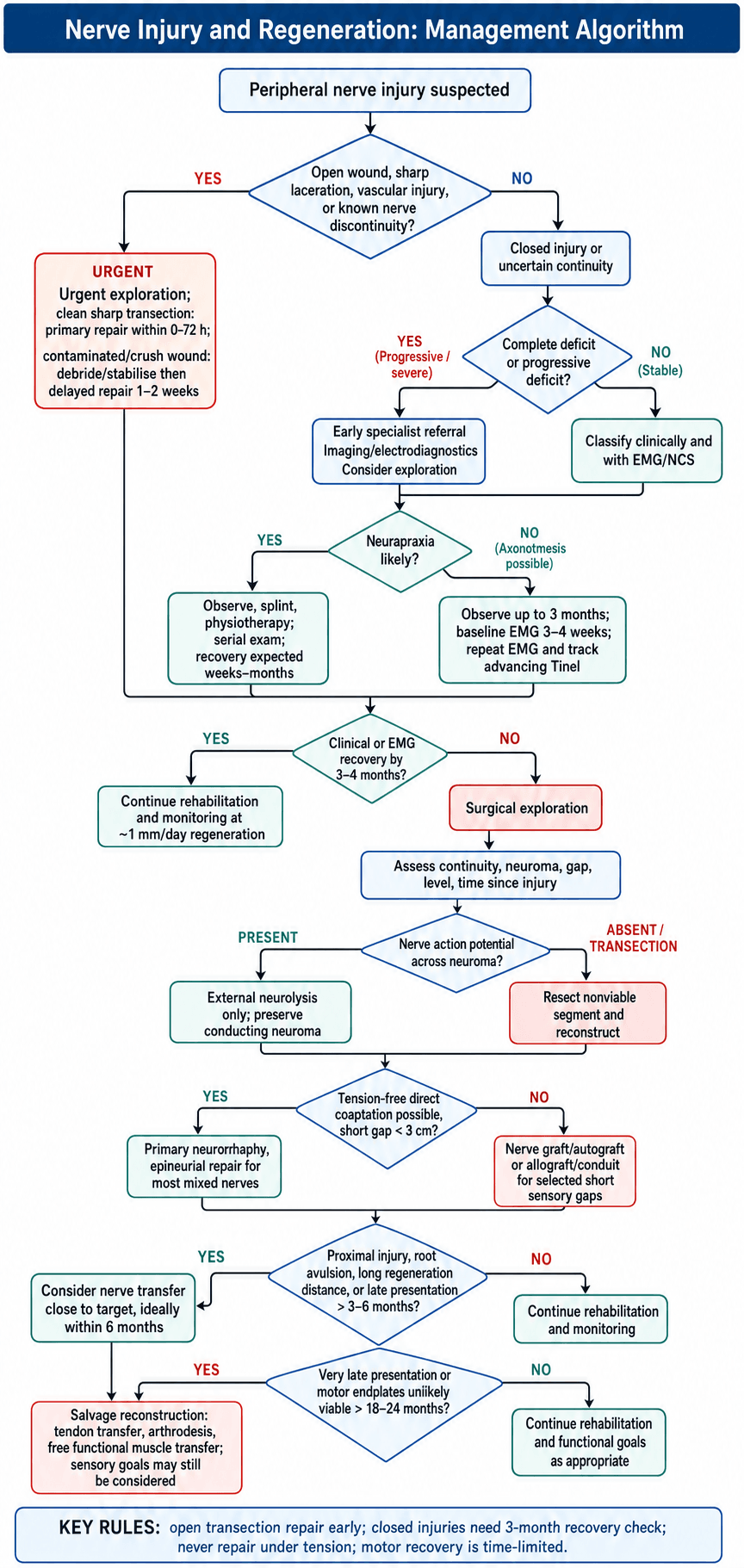
The decision. Open or closed, and if closed, recovering or not. An open injury with a divided nerve is explored and repaired. A closed injury is given time, because a neurapraxia recovers and an axonotmesis with intact tubes regenerates without surgery, and the signs of recovery arrive within three months.
- Initial Management
- Observe, splinting, physiotherapy
- Surgical Indication
- None (spontaneous recovery)
- Expected Outcome
- Complete recovery in weeks to months
- Initial Management
- Observe 3 months, serial EMG
- Surgical Indication
- Surgery if no recovery by 3-4 months
- Expected Outcome
- Good recovery if endoneurium intact
- Initial Management
- Urgent exploration and primary repair
- Surgical Indication
- Immediate surgical repair
- Expected Outcome
- Variable, depends on level and timing
- Initial Management
- Delayed exploration after wound healing
- Surgical Indication
- Secondary repair 2-6 weeks
- Expected Outcome
- Worse than sharp injury
Non-operative care for neurapraxia and closed axonotmesis is splinting to prevent contractures, physiotherapy for joint mobility, serial clinical examination of the Tinel sign, and EMG at 3-4 weeks for a baseline with a follow-up at 3 months. Recovery is declared by an advancing Tinel, nascent motor unit potentials on EMG, and clinical recovery appropriate to the regeneration distance.
Surgery is indicated outright by three findings and considered for three more.
Absolute
- Open injury with nerve discontinuity
- Progressive neurological deficit
- Associated vascular injury requiring exploration
Relative
- No clinical or EMG recovery by 3-4 months
- Stationary Tinel sign
- Neuroma-in-continuity on imaging
Three months is long enough for a neurapraxia to recover as the demyelination resolves, for an axonotmesis to show regeneration (an advancing Tinel), and for EMG to document nascent units. Beyond 3 months, further delay compromises the outcome as the Schwann cell bands deteriorate. The exception is the open injury with a known transection, which is repaired immediately.
The repair options, chosen by the gap and the distance to the target:
- Indication
- Clean transection, gap less than 3cm
- Advantages
- Direct coaptation, no graft morbidity
- Disadvantages
- Risk of tension, limited gap management
- Indication
- Gap greater than 3cm, tension with direct repair
- Advantages
- Gold standard, living tissue
- Disadvantages
- Donor site morbidity, graft survival concerns
- Indication
- Gap greater than 3cm, avoid donor morbidity
- Advantages
- No donor morbidity, off-the-shelf
- Disadvantages
- Requires immunosuppression or decellularized
- Indication
- Small gaps less than 3cm, sensory nerves
- Advantages
- No donor morbidity, simple
- Disadvantages
- Poor for motor or long gaps
- Indication
- Proximal lesion, long regeneration distance
- Advantages
- Bypasses long regeneration, faster reinnervation
- Disadvantages
- Sacrifices donor nerve function
Timing. The biology sets the windows: fresh nerve ends and minimal fibrosis early, Schwann cell bands still viable through the first three months, then declining guidance and advancing muscle atrophy.
Surgical Timing Algorithm
Immediate primary repair for clean sharp lacerations with a visible nerve transection. The wound is not contaminated, the nerve ends are fresh, minimal debridement is needed, and outcomes are best.
Delayed primary repair after wound stabilisation for contaminated or complex wounds. The zone of injury is still identifiable.
Secondary repair after wound healing. The nerve ends may need debridement, and grafting may be needed if contraction has produced a gap. Schwann cells are still viable.
Late repair has declining outcomes: the Schwann cell bands are deteriorating and muscle atrophy is beginning. Graft if there is a gap, and consider nerve transfer for proximal injuries to shorten the regeneration distance.
Very late repair - motor recovery is unlikely, with the Schwann cells atrophied and the endoneurial tubes fibrosed. Sensory recovery may still occur. Consider reconstruction (tendon transfers) instead.
Nerve transfer is considered when the injury is proximal (brachial plexus, high sciatic), when the time to target would exceed 18 months, or when a root avulsion leaves no proximal stump to graft from. It is placed close to the target muscle, so reinnervation is fast, and it should be performed within 6 months for the best outcome; the common transfers are tabulated under Surgical Technique.
Reconstruction is what remains when nerve repair is not viable: tendon transfers for motor function, arthrodesis for joint stability, free functioning muscle transfer, and sensory substitution procedures. None of these is time-dependent in the way regeneration is, so they can be performed late.
Surgical Technique
Repairs are made at one of three levels, and the choice is a trade between precision and intraneural trauma.
- Description
- Sutures through epineurium only
- Indications
- Most common, mixed nerves
- Advantages
- Simple, minimal intraneural trauma
- Description
- Sutures through perineurium of fascicle groups
- Indications
- Large nerves with distinct groups
- Advantages
- Better alignment, more precise
- Description
- Individual fascicle coaptation
- Indications
- Pure motor/sensory nerves
- Advantages
- Most precise but most trauma
The steps of a primary neurorrhaphy, under an operating microscope or loupes with microsurgical instruments and 8-0 to 10-0 nylon:
- Adequate exposure with proximal and distal mobilisation
- Identify healthy nerve tissue (bulb resection)
- Align the fascicular patterns using the surface vessels and epineurial landmarks
- Tension-free coaptation
- Minimal sutures: 4-6 for a digital nerve, 8-12 for a major nerve
Technique. Rotate the nerve to inspect the entire circumference and match the surface blood vessels for orientation. Place the sutures 1-2 mm apart, avoid crushing the nerve with forceps, and coapt at 90 degrees, with slight flexion of the adjacent joints if needed. Fibrin glue can supplement the suture repair.
Epineurial repair is preferred for most injuries: less intraneural dissection trauma, faster surgery, and similar outcomes in mixed nerves. Fascicular repair is reserved for pure motor nerves (anterior interosseous), large nerves with distinct motor and sensory groups (median at the wrist), and any repair that needs specific fascicles matched.
Complications
- Cause
- Misdirected axonal sprouting
- Prevention
- Tension-free repair, good fascicular alignment
- Treatment
- Neuroma resection and grafting
- Cause
- Late repair, poor technique, elderly
- Prevention
- Early repair, microsurgical technique
- Treatment
- Nerve transfer, tendon transfer
- Cause
- Motor axons entering sensory fascicles
- Prevention
- Fascicular matching, intraoperative NAP
- Treatment
- Often irreversible, consider tendon transfer
- Cause
- Prolonged immobilization, muscle imbalance
- Prevention
- Splinting, physiotherapy during recovery
- Treatment
- Tendon lengthening, capsular release
The painful neuroma is disordered axonal sprouting at the injury site; tapping it causes severe lancinating pain. It forms at amputation stumps and failed repairs. Prevention is a tension-free repair, nerve ends covered in vascularised tissue, and buried relocation for the amputation neuroma.
Neuropathic pain and CRPS. Complex regional pain syndrome can follow any nerve injury, with burning pain, allodynia and autonomic changes. Management is early mobilisation and desensitisation, mirror therapy and TENS, gabapentin, pregabalin or duloxetine, and multidisciplinary pain management.
- Incidence
- 5-15%
- Risk Factors
- Tension, infection, poor vascularity
- Management
- Revision with nerve graft
- Incidence
- 10-20%
- Risk Factors
- Large diameter, avascular bed, long graft
- Management
- Revision with vascularized graft or transfer
- Incidence
- Variable
- Risk Factors
- Sural: sensory loss, painful neuroma
- Management
- Accept sensory loss, treat neuroma if symptomatic
- Incidence
- Rare
- Risk Factors
- Contaminated wound, foreign body
- Management
- Debridement, antibiotics, delayed repair
- Mechanism
- Denervation fibrofatty change after 18-24 months
- Prevention
- Early repair, physiotherapy
- Treatment
- Irreversible if prolonged denervation
- Mechanism
- Muscle imbalance, immobilization
- Prevention
- Splinting, passive ROM
- Treatment
- Serial casting, surgical release
- Mechanism
- Scarring around tendons in zone of injury
- Prevention
- Early protected motion
- Treatment
- Tenolysis if necessary
- Mechanism
- Disuse from weakness
- Prevention
- Encourage weight bearing
- Treatment
- Usually improves with function
Always have a reconstruction plan in case regeneration fails:
- Revision nerve surgery - if early (under 6 months), revise with a graft
- Nerve transfer - if the motor endplates are still viable
- Tendon transfer - time-independent and reliable
- Arthrodesis - for joint stability (wrist, shoulder)
- Free functioning muscle transfer - if no local motors are available
Postoperative Care
The repair is protected for three weeks and mobilised over the next three; after that the work is keeping the joints supple and the scar soft while reinnervation is awaited.
Rehabilitation Timeline After Nerve Repair
Protection phase: splint in the position of repair (slight flexion to reduce tension), no active motion across the repair, wound care and oedema control.
Gentle mobilisation: gradual increase in range of motion, wean from the splint during the day, continue the night splint, begin scar management.
Progressive motion: full range as tolerated. Strengthening begins when reinnervation is evident; sensory re-education starts when protective sensation returns.
Reinnervation and strengthening: motor recovery progresses, strengthening intensifies, functional training for activities of daily living.
Splinting protects the repair from tension, prevents joint contracture and holds the hand in the position of function. The rigid splint stays for 3 weeks, a removable splint for 3-6 weeks, and a night splint until reinnervation.
Therapy. The early phase (0-6 weeks) is oedema control, scar management, passive range of motion of the uninvolved joints and desensitisation if the limb is hypersensitive; from 6 weeks the work is active range of motion, strengthening once the motor returns, and sensory re-education. Strengthening progresses from isometric work when a flicker appears, to isotonic work against gravity at M3, to resistance training at M4; EMG biofeedback helps weak muscles, mirror therapy helps cortical reorganisation, and electrical stimulation is of controversial efficacy.
Sensory re-education begins with constant-touch localisation, moving-touch identification and texture grading as protective sensation returns, and progresses to object recognition, functional activity training and adaptive techniques if recovery is incomplete.
Regenerating axons may reach different receptors from the ones they originally supplied, so the cortical representation has to reorganise. Re-education begins when protective sensation returns (the 4.31 monofilament), using texture identification and localisation training. Without it, sensory recovery is suboptimal even with good regeneration.
- Timing
- Monthly
- Significance
- Indicates regeneration front location
- Expected Findings
- Should advance 1mm per day (1 inch per month)
- Timing
- Monthly
- Significance
- Earliest sign of reinnervation
- Expected Findings
- Flicker, then grade 2-3, then strengthens
- Timing
- Monthly
- Significance
- Recovery proximal to distal
- Expected Findings
- Protective first, then discriminative
- Timing
- 3-6 months
- Significance
- Nascent units confirm reinnervation
- Expected Findings
- Polyphasic potentials with reduced recruitment
- Recognition
- Painful sensitivity to cold
- Management
- Protective gloves, gradual desensitization
- Recognition
- Painful response to light touch
- Management
- Desensitization: textures, vibration, graded stimuli
- Recognition
- Reduced passive ROM
- Management
- Intensive stretching, serial casting, consider release
- Recognition
- Burning, lancinating pain
- Management
- Gabapentin/pregabalin, TENS, pain clinic referral
If there is no clinical improvement by 3-4 months after repair:
- Repeat the EMG looking for nascent units
- If there is no electrical evidence of reinnervation, consider revision exploration
- Test the integrity of the repair with an intraoperative NAP
- If the repair has failed, revise with a nerve graft or consider a nerve transfer
Do not wait too long: motor endplate viability is time-limited.
Outcomes
- Description
- No contraction
- Clinical Significance
- Complete denervation
- Description
- Flicker of contraction
- Clinical Significance
- Early reinnervation beginning
- Description
- Contraction with gravity eliminated
- Clinical Significance
- Reinnervation progressing
- Description
- Contraction against gravity
- Clinical Significance
- Useful recovery achieved
- Description
- Contraction against resistance
- Clinical Significance
- Good recovery
- Description
- Normal power
- Clinical Significance
- Excellent recovery (uncommon after repair)
- Description
- No sensation
- Functional Implication
- Complete sensory loss
- Description
- Deep pain only
- Functional Implication
- Minimal protective sensation
- Description
- Some superficial pain and touch
- Functional Implication
- Protective sensation developing
- Description
- Touch and pain, no overreaction
- Functional Implication
- Functional protective sensation
- Description
- Good localization, some 2PD
- Functional Implication
- Useful discriminative function
- Description
- Normal two-point discrimination
- Functional Implication
- Rare after repair
By level. After a distal injury at the wrist or hand, M4-M5 is achievable and S3+ is common. After a proximal injury in the arm or plexus, M3-M4 is typical, S3 is often the best achieved, and intrinsic muscle recovery is rare.
Sensation. Protective sensation usually recovers; fine discriminative sensation is often impaired, and cold intolerance is common. Two-point discrimination grades the result: normal is under 6 mm, functional 6-12 mm, and protective over 12 mm.
Full recovery is uncommon after nerve repair, and what to tell patients is: motor recovery of M3-M4, useful but not normal strength; sensory recovery that is often protective only, with discriminative function limited; cold intolerance that is common and permanent in many; and a recovery that takes 12-24 months depending on level and requires consistent participation in therapy.
- Level
- Finger
- Motor Recovery (M3+)
- N/A (pure sensory)
- Sensory Recovery (S3+)
- 70-90%
- Level
- Wrist
- Motor Recovery (M3+)
- 70-80%
- Sensory Recovery (S3+)
- 60-70%
- Level
- Elbow
- Motor Recovery (M3+)
- 50-60%
- Sensory Recovery (S3+)
- 50-60%
- Level
- Wrist
- Motor Recovery (M3+)
- 60-70%
- Sensory Recovery (S3+)
- 60-70%
- Level
- Elbow
- Motor Recovery (M3+)
- 40-50%
- Sensory Recovery (S3+)
- 50-60%
- Level
- Arm
- Motor Recovery (M3+)
- 60-70%
- Sensory Recovery (S3+)
- 70-80%
- Level
- Trunk level
- Motor Recovery (M3+)
- 30-50%
- Sensory Recovery (S3+)
- 50-60%
Grafts do generally 10-20% worse than primary repair, and the shorter the graft the better; cable grafts serve the larger nerves. Autograft remains the gold standard with a 60-70% good outcome; processed allograft does similarly for gaps under 3 cm, and for longer gaps autograft is preferred.
Transfers reinnervate faster because they are close to the target, bypass the damaged proximal pathway and work even after root avulsion, provided the donor nerve is intact. The Oberlin transfer restores elbow flexion to M4 or better in 80-90%, and spinal accessory to suprascapular succeeds in 70-80%.
- Finding
- 60-80% return to same job
- Clinical Implication
- Lighter duties may be needed initially
- Finding
- Most achieve independence
- Clinical Implication
- May need adaptive techniques
- Finding
- 30-40% have chronic discomfort
- Clinical Implication
- Cold intolerance most common
- Finding
- Moderate improvement with recovery
- Clinical Implication
- Correlation with sensory and motor outcomes
Evidence limitations: most nerve repair outcome studies are retrospective case series with variable follow-up. High-quality RCTs are lacking, and outcomes vary significantly with surgeon experience and patient selection.
The standardised measures, which examiners commonly test: motor by MRC grading (M0-M5); sensory by MRC sensory grading, Semmes-Weinstein monofilaments and two-point discrimination; function by DASH for the upper limb and SF-36 for general quality of life; and return to work by days until return and the type of work.
Clinical Relevance
The biology translates directly into three clinical questions: which Seddon type is this, is it a nerve injury at all, and when will the axons arrive.
Which type. The bedside picture, the EMG at 3 weeks and the behaviour of the Tinel sign together separate the three Seddon types:
- Neurapraxia
- Weakness without atrophy
- Axonotmesis
- Weakness with progressive atrophy
- Neurotmesis
- Complete paralysis with rapid atrophy
- Neurapraxia
- Patchy, incomplete
- Axonotmesis
- Complete in distribution
- Neurotmesis
- Complete in distribution
- Neurapraxia
- No denervation potentials
- Axonotmesis
- Denervation potentials
- Neurotmesis
- Denervation potentials
- Neurapraxia
- Conduction block at injury site
- Axonotmesis
- Absent distal to injury
- Neurotmesis
- Absent distal to injury
- Neurapraxia
- Stationary at injury site
- Axonotmesis
- Advancing 1mm per day
- Neurotmesis
- Stationary (neuroma) without repair
Is it a nerve injury. Acute focal weakness and sensory loss has mimics. A peripheral nerve injury maps to one named nerve; the mimics are told apart by a distribution that does not, or by signs a nerve injury does not produce.
- Distinguishing Features
- Deficit maps to a single peripheral nerve territory; history of trauma, laceration or fracture
- Key Investigation
- Nerve conduction studies / EMG at 3-4 weeks; ultrasound or MR neurography
- Discriminator
- Loss confined to one named nerve distribution
- Distinguishing Features
- Dermatomal/myotomal pattern crossing several peripheral nerves; neck or back pain, positive root tension signs
- Key Investigation
- MRI spine; EMG showing paraspinal denervation
- Discriminator
- Paraspinal muscle involvement and dermatomal (not peripheral-nerve) pattern
- Distinguishing Features
- Multi-nerve, multi-root deficit in one limb; possible Horner sign or pseudomeningocele in avulsion
- Key Investigation
- CT myelography / MRI; EMG mapping
- Discriminator
- Deficit too widespread for a single nerve but limited to one limb
- Distinguishing Features
- Pain out of proportion, tense compartment, pain on passive stretch; deficit not confined to one nerve
- Key Investigation
- Compartment pressures; urgent clinical diagnosis
- Discriminator
- Pain and tense swelling precede and exceed neurological signs
- Distinguishing Features
- Insidious onset, no acute trauma, positional symptoms (e.g. carpal/cubital tunnel)
- Key Investigation
- NCS localising focal slowing/conduction block
- Discriminator
- Chronic course and focal slowing without axonal transection
- Distinguishing Features
- Upper motor neuron signs (hyperreflexia, spasticity, Babinski); deficit not in a peripheral nerve pattern
- Key Investigation
- Brain/spine imaging
- Discriminator
- Upper motor neuron signs and non-peripheral distribution
- Distinguishing Features
- Inconsistent examination, give-way weakness, non-anatomical sensory loss
- Key Investigation
- Diagnosis of exclusion; normal NCS/EMG
- Discriminator
- Findings do not conform to any anatomical territory
When the axons will arrive. Measure the distance from the injury to the target, divide by the regeneration rate and add the 2-3 weeks the cell body spends in chromatolysis before the axon sets off. Two worked examples:
- Median nerve laceration at the wrist, 12 cm to the thenar muscles: 12 cm at 1 mm per day is 120 days (4 months); add chromatolysis and the first motor recovery is at about 5 months, with strength continuing to improve for 12-18 months
- Brachial plexus injury at Erb's point, 35 cm to the hand intrinsics: 350 days (11.5 months); add chromatolysis and the first motor recovery would be at 12-13 months, which exceeds the 18-24 month motor endplate viability: poor prognosis
Set realistic expectations with patients. A brachial plexus injury in a 65-year-old at 9 months post-injury will not regain meaningful motor function even with perfect surgical repair. Offer reconstruction (tendon transfers, arthrodesis) instead of creating false hope.
Guidelines, Registries & Global Practice
Global Epidemiology
- Figure
- 2.8% of multiply-injured patients (200 nerve injuries in 162 of 5,777 patients)
- Source / Context
- Noble et al, Level 1 trauma centre, Canada (PMID 9680023)
- Figure
- Radial nerve
- Source / Context
- Noble et al (PMID 9680023)
- Figure
- Peroneal (common fibular) nerve
- Source / Context
- Noble et al (PMID 9680023)
- Figure
- Motor vehicle crashes (46%)
- Source / Context
- Noble et al (PMID 9680023)
- Figure
- Young, predominantly male (83%)
- Source / Context
- Noble et al (PMID 9680023)
Traumatic peripheral nerve injury is predominantly a disease of young men injured in high-energy mechanisms, with the upper limb (radial nerve) most often affected. Across health systems the dominant mechanisms vary with local injury epidemiology (road trauma, interpersonal violence with sharp lacerations, occupational injury and, in some regions, conflict-related wounds), but the biological principles of repair are universal.
Side-by-Side Guidance on Repair Principles
- Consensus Position
- Immediate/early primary repair (within days)
- Evidence Level
- Low (consistent observational data, expert consensus)
- Consensus Position
- Observe with serial clinical and electrodiagnostic review; explore if no recovery by 3-4 months
- Evidence Level
- Low-Moderate (cohort and IPD meta-analysis, PMID 16079678)
- Consensus Position
- Avoid; graft rather than repair under tension
- Evidence Level
- Low (basic-science and observational data)
- Consensus Position
- Direct repair for short gaps; autograft is the reference standard for larger gaps; conduits/allograft for short sensory gaps
- Evidence Level
- Moderate (RCTs for short-gap conduits/allograft, otherwise observational)
- Consensus Position
- Distal nerve transfer to shorten reinnervation distance
- Evidence Level
- Low-Moderate (consistent cohort outcomes)
No high-level (Grade A) guideline mandates a single timing protocol; international practice is built on consistent observational evidence and basic-science principles. The strongest quantitative evidence for timing comes from individual-patient-data meta-analysis showing recovery odds fall with each month of delay (PMID 16079678).
Basic Science Viva expectations:
- Define Seddon and Sunderland classifications
- Explain Wallerian degeneration timeline and purpose
- Describe chromatolysis and its significance
- Outline bands of Büngner formation
- State regeneration rate (1mm per day)
- Discuss factors affecting regeneration outcomes
MCQ Practice Points
Q: What is the Seddon classification of nerve injuries?
A: Three grades of increasing severity: (1) Neurapraxia: Conduction block without axonal damage, focal demyelination, complete recovery in weeks to months. (2) Axonotmesis: Axon disrupted but endoneurial tubes intact, Wallerian degeneration occurs, regeneration along intact tubes, good recovery. (3) Neurotmesis: Complete nerve transection including endoneurium, no spontaneous recovery, requires surgical repair.
Q: What is the Sunderland classification and how does it relate to Seddon?
A: Five grades: Grade I = Neurapraxia (conduction block). Grade II = Axonotmesis (axon damage, endoneurium intact). Grade III = Endoneurium damaged, perineurium intact. Grade IV = Only epineurium intact. Grade V = Neurotmesis (complete transection). Grades III-V require surgical intervention. Sunderland provides more granular prognosis than Seddon.
Q: What is the rate of nerve regeneration and what factors influence it?
A: Regeneration rate: approximately 1mm/day (or 1 inch/month). Factors affecting regeneration: (1) Age (younger = better). (2) Level of injury (proximal = worse due to longer regeneration distance). (3) Delay to repair (earlier = better). (4) Type of injury (sharp transection better than crush/avulsion). (5) Gap length (tension-free repair preferred).
Q: What is Wallerian degeneration?
A: Distal to injury, the axon and myelin sheath degenerate (occurs within 48-72 hours). Schwann cells proliferate, phagocytose debris, and form Bands of Büngner (tubes guiding regenerating axons). Macrophages clear myelin debris. The cell body undergoes chromatolysis (swelling, nucleus displacement). Wallerian degeneration is prerequisite for regeneration in axonotmesis/neurotmesis.
Q: What are the indications for surgical exploration of a peripheral nerve injury?
A: (1) Sharp transection injuries: Explore and repair within 72 hours (primary repair). (2) No clinical or EMG recovery by 3-4 months: Suggests Sunderland Grade III-V injury. (3) Open fracture with nerve deficit: Early exploration. (4) Closed injury with complete deficit: Observe initially, explore if no recovery by 3 months. (5) Advancing Tinel sign not present at expected time: Suggests failed regeneration.
Basic Science Viva Scenarios
Practise clinical reasoning and management decisions out loud
“The examiner asks: Describe the process of Wallerian degeneration. What is its purpose and what is the timeline?”
“The examiner shows you a diagram and asks: Compare the Seddon and Sunderland nerve injury classifications. Which do you prefer clinically and why?”
“A patient presents with a radial nerve laceration at the spiral groove from a humeral fracture 8 months ago. The nerve was not repaired. What are the chances of motor recovery if you repair it now? What biological factors limit recovery?”
Seddon Classification
- Neurapraxia: myelin injury only, axon intact, full recovery weeks-months, no Wallerian degeneration
- Axonotmesis: axon disrupted, endoneurium intact, Wallerian degeneration distal, regenerates 1mm/day, good prognosis
- Neurotmesis: complete transection all structures, requires surgical repair, poor outcomes even with repair
Sunderland Degrees
- Degree I: neurapraxia (myelin only)
- Degree II: axon disrupted, endoneurium intact (good regeneration)
- Degree III: endoneurium disrupted, perineurium intact (variable, may need surgery)
- Degree IV: perineurium disrupted, epineurium intact (poor without surgery)
- Degree V: complete transection (requires repair)
Wallerian Degeneration
- Distal axon and myelin breakdown starting 24-48 hours post-injury
- Schwann cells and macrophages phagocytose debris over 1-2 weeks
- Purpose: clear inhibitory myelin (MAG), create pro-regenerative Schwann cells
- Schwann cells form bands of Büngner (tubular scaffolds) secreting NGF, BDNF, GDNF
- c-Jun transcription factor is master regulator of Schwann cell dedifferentiation
Chromatolysis
- Cell body response to axonal injury, peaks 7-14 days
- Nissl substance disperses, nucleus eccentric, cell swells 30-50%
- Switch from neurotransmission to regeneration gene expression
- Upregulate GAP-43, tubulin, actin for growth cone extension
- Prolonged chromatolysis beyond 3-4 weeks without regeneration leads to neuronal apoptosis
Growth Cone and Regeneration
- Growth cone forms at proximal axon tip within 24-72 hours
- Filopodia and lamellipodia sense chemical gradients and ECM cues
- Regeneration rate: 1-3mm per day (average 1mm/day clinically)
- Guidance: chemoattraction (NGF, BDNF), contact attraction (laminin), chemorepulsion (semaphorins)
- Tinel sign advances 1mm/day indicating regeneration front
Schwann Cell Functions
- Debris clearance: phagocytose 40-50% of myelin debris, recruit macrophages
- Bands of Büngner: form tubular guidance channels for regenerating axons
- Neurotrophic support: secrete NGF, BDNF, GDNF creating chemical gradient
- Remyelination: wrap regenerated axons (shorter internodes, thinner myelin than original)
- Time limit: bands persist 3-4 months then deteriorate if no axon contact
Factors Affecting Regeneration
- Patient: younger better, diabetes/smoking impair regeneration
- Injury: distal better than proximal, sharp better than crush, shorter better
- Timing: primary repair within 3 months optimal, motor recovery unlikely after 18-24 months denervation
- Technique: tension-free repair critical (strain under 10%), fascicular alignment for mixed nerves
- Gap management: direct repair if gap under 3cm, nerve graft if larger
Critical Timelines
- 24-48 hours: Wallerian degeneration begins
- 7-14 days: Peak chromatolysis
- 1-2 weeks: Debris clearance complete, bands of Büngner formed
- 3-4 months: Schwann cell bands begin to deteriorate without axon
- 12-18 months: Muscle atrophy becomes irreversible
- 18-24 months: Motor endplate degeneration, no recovery possible
Evidence Base
Wallerian Degeneration Mechanisms (PNS vs CNS)
- Wallerian degeneration is an active, programmed clearance of degenerating axons and myelin, not passive decay
- Rapid macrophage recruitment and Schwann cell phagocytosis in the PNS create a permissive, pro-regenerative environment
- Slow debris clearance and persistent inhibitory myelin in the CNS help explain regenerative failure centrally
The Repair Schwann Cell and Bands of Büngner
- Nerve injury reprograms Schwann cells into a dedicated repair phenotype, not simple de-differentiation
- c-Jun is the master transcriptional regulator; its absence yields a dysfunctional repair cell, neuronal death and failed recovery
- Repair cells form Büngner's bands and supply trophic and spatial cues for axonal regrowth, but the phenotype is not indefinitely sustainable
Seddon Classification of Nerve Injury (Landmark)
- Three-tier classification based on functional prognosis rather than histological detail
- Neurapraxia recovers completely; axonotmesis regenerates well through intact endoneurial tubes
- Neurotmesis requires surgical repair, with outcomes limited even after repair
Predictors of Recovery After Median/Ulnar Nerve Repair
- Younger age strongly predicts recovery (motor OR 4.3, sensory OR 27.0 for under-16 vs over-40 years)
- Each month of delay between injury and repair reduces the odds of satisfactory motor (OR 0.94/month) and sensory (OR 0.92/month) recovery
- Ulnar nerve injuries have 71% lower odds of motor recovery than median nerve injuries (OR 0.29); proximal injuries fare worse than distal
Why Delayed Repair Diminishes Functional Recovery
- Numbers of motoneurons reinnervating muscle fell exponentially with each form of chronic delay
- Chronic denervation of the distal nerve stump is a key driver of reduced regeneration, with chronic muscle denervation an additional contributor
- Enlargement of surviving motor units could not compensate for severe loss of regenerating axons through chronically denervated stumps
c-Jun Reprograms Schwann Cells into Repair Cells
- c-Jun controls trophic factor expression, adhesion molecules, formation of regeneration tracks and myelin clearance
- Schwann-cell-specific c-Jun deletion produces a dysfunctional repair cell, with striking failure of functional recovery and neuronal death
- A single glial transcription factor is sufficient and necessary to direct transdifferentiation of Schwann cells into repair cells
Translational Barriers to Human Nerve Regeneration
- Human axons must traverse far greater distances than in rodent models, leaving distal stumps and targets denervated for prolonged periods
- Chronic denervation drives distal Schwann cell atrophy, falling neurotrophic factor expression and loss of basal lamina
- Strategies to accelerate axon growth and to keep Schwann cells and target tissues receptive are the key translational priorities
Epidemiology of Peripheral Nerve Injury in Major Trauma
- Peripheral nerve injury occurred in 2.8% of multiple-trauma patients (162 patients, 200 nerve injuries)
- Motor vehicle crashes were the leading mechanism (46%); the radial nerve was the most commonly injured upper-limb nerve and the peroneal nerve the most common in the lower limb
- Surgery was required in 54% of patients and head injury co-occurred in 60%, underscoring the polytrauma context
References
Key Research Articles
-
Waller A. Experiments on the section of the glossopharyngeal and hypoglossal nerves of the frog, and observations of the alterations produced thereby in the structure of their primitive fibres. Phil Trans R Soc Lond. 1850;140:423-429. doi:10.1098/rstl.1850.0021
-
Seddon HJ. Three types of nerve injury. Brain. 1943;66(4):237-288. doi:10.1093/brain/66.4.237
-
Sunderland S. A classification of peripheral nerve injuries producing loss of function. Brain. 1951;74(4):491-516. doi:10.1093/brain/74.4.491
-
Vargas ME, Barres BA. Why is Wallerian degeneration in the CNS so slow? Annu Rev Neurosci. 2007;30:153-179. doi:10.1146/annurev.neuro.30.051606.094354
-
Jessen KR, Mirsky R. The repair Schwann cell and its function in regenerating nerves. J Physiol. 2016;594(13):3521-3531. doi:10.1113/JP270874
-
Arthur-Farraj PJ, Latouche M, Wilton DK, et al. c-Jun reprograms Schwann cells of injured nerves to generate a repair cell essential for regeneration. Neuron. 2012;75(4):633-647. doi:10.1016/j.neuron.2012.06.021
-
Gordon T, Tyreman N, Raji MA. The basis for diminished functional recovery after delayed peripheral nerve repair. J Neurosci. 2011;31(14):5325-5334. doi:10.1523/JNEUROSCI.6156-10.2011
-
Fu SY, Gordon T. The cellular and molecular basis of peripheral nerve regeneration. Mol Neurobiol. 1997;14(1-2):67-116. doi:10.1007/BF02740621
-
Rosberg HE, Carlsson KS, Höjgård S, et al. Injury to the human median and ulnar nerves in the forearm - analysis of costs for treatment and rehabilitation of 69 patients in southern Sweden. J Hand Surg Br. 2005;30(1):35-39. doi:10.1016/j.jhsb.2004.09.003
-
Brushart TM. Nerve Repair. Oxford University Press. 2011. (Comprehensive textbook on peripheral nerve biology and repair)
-
Lundborg G. A 25-year perspective of peripheral nerve surgery: evolving neuroscientific concepts and clinical significance. J Hand Surg Am. 2000;25(3):391-414. doi:10.1053/jhsu.2000.4165
-
Lee SK, Wolfe SW. Peripheral nerve injury and repair. J Am Acad Orthop Surg. 2000;8(4):243-252. doi:10.5435/00124635-200007000-00005
-
Boyd JG, Gordon T. Neurotrophic factors and their receptors in axonal regeneration and functional recovery after peripheral nerve injury. Mol Neurobiol. 2003;27(3):277-324. doi:10.1385/MN:27:3:277
-
Griffin JW, Thompson WJ. Biology and pathology of nonmyelinating Schwann cells. Glia. 2008;56(14):1518-1531. doi:10.1002/glia.20778
-
Scheib J, Höke A. Advances in peripheral nerve regeneration. Nat Rev Neurol. 2013;9(12):668-676. doi:10.1038/nrneurol.2013.227
-
Jaquet JB, Luijsterburg AJ, Kalmijn S, et al. Median, ulnar, and combined median-ulnar nerve injuries: functional outcome and return to productivity. J Trauma. 2001;51(4):687-692. doi:10.1097/00005373-200110000-00011
-
Australian Orthopaedic Association National Joint Replacement Registry (AOANJRR). Hip, Knee & Shoulder Arthroplasty: 2024 Annual Report. Adelaide: AOA; 2024. (For context on surgical outcomes research standards)
Suggested Reading
-
Mackinnon SE, Dellon AL. Surgery of the Peripheral Nerve. Thieme Medical Publishers. 1988. (Classic text on peripheral nerve surgery)
-
Spinner RJ, Kline DG. Surgery for peripheral nerve and brachial plexus injuries or other nerve lesions. Muscle Nerve. 2000;23(5):680-695. doi:10.1002/(SICI)1097-4598(200005)23:5
-
Terenghi G. Peripheral nerve regeneration and neurotrophic factors. J Anat. 1999;194(Pt 1):1-14. doi:10.1046/j.1469-7580.1999.19410001.x