External rotation symphysis diastasis - the classic pelvic emergency
- PELVIC BINDER immediately - do NOT wait for imaging
- 2.5cm symphysis widening is the surgical threshold
- External rotation OPENS the book - binder CLOSES it
- 80% of bleeding is VENOUS - mechanical closure helps most
- Symphysis fixation alone if posterior ligaments intact (APC-II)
- “Open book = pelvis opens like a book (symphysis = spine of book)
- “Normal symphysis width approximately 5mm, pathological greater than 10mm
- “Greater than 2.5cm widening = anterior SI ligament disruption
- “Assess posterior stability - determines if anterior fixation alone sufficient
- “Urological injury common - check for blood at meatus
Overview
The name. "Open book" is the colloquial term for anteroposterior compression (APC) pelvic injuries, specifically the APC-II pattern. It comes from the AP radiograph: the two hemipelves externally rotate and separate anteriorly at the symphysis, like a book opening, with the symphysis as the spine and the hemipelves as the pages. The external rotation force opens the book; a pelvic binder, applying internal rotation, closes it.
Why it matters. This pattern produces the highest haemorrhage risk of all pelvic fracture patterns. The external rotation mechanism dramatically increases pelvic volume, eliminating the tamponade effect of the intact ring and allowing massive retroperitoneal bleeding, litres of blood loss, so haemorrhage control is time-critical and lifesaving, and massive transfusion is often required. Beyond the bleeding, the rotational instability affects function, and urological, vascular and neurological injuries travel with it. It is also the most recognised pelvic injury pattern, with a classic radiographic appearance.
Mechanism. The classic presentation of an AP compression mechanism, and common in motorcycle accidents:
- Motorcycle collision, with handlebar impact to the pelvis
- Pedestrian struck from the front
- Frontal vehicle collision with AP compression
- Crush injury
- Direct AP compression
Who. Young males predominate. The mechanism is high-energy and associated polytrauma is common.
Anatomy and Pathophysiology
The symphysis. A fibrocartilaginous joint with limited mobility, normally about 5 mm wide (range 3-8 mm); it widens physiologically in pregnancy.
The stability hierarchy. The posterior structures provide 60% of pelvic stability and the anterior structures 40%, which is why symphysis disruption alone does not cause complete instability. Whether an anterior plate is enough depends on what has happened posteriorly, and every grade below is defined by that.
Why it bleeds. Normal pelvic volume is approximately 1.5 litres; an open book can expand to over 4 litres, the tamponade of the intact ring is lost and the retroperitoneal space fills with blood. Be careful with the familiar "the pelvis gains litres of volume" line, though. The better-supported mechanism is that a disrupted ring can no longer generate retroperitoneal counter-pressure, so a low-pressure venous bleed is never tamponaded: in Kohler's cadaveric model, four litres infused into the retroperitoneum raised the pressure by about 20 mmHg with an intact ring but under 3 mmHg once the ring was disrupted, so the haematoma expands against almost nothing. The binder closes the book and restores that pressure response, which makes it a haemostatic intervention rather than a splint.
Where it bleeds from.
- Venous (80%): presacral plexus and internal iliac veins
- Arterial (20%): the superior gluteal artery, which exits the greater sciatic notch, is the most common source; internal iliac branches
- Bone surfaces: cancellous bleeding
The classical teaching that roughly 80 to 90 per cent of bleeding is venous and cancellous traces to Huittinen's 1973 postmortem series, and it justifies mechanical closure first. In the patient who stays unstable after binder, packing and transfusion, arterial bleeding is much likelier, and angioembolisation or REBOA is the next step, not a last resort.
Associated soft-tissue injuries. Symphysis disruption tears the structures attached to it, so urological injury is common: bladder injury in 15-25%, and urethral injury in males. The vascular structures at risk are the presacral venous plexus, the internal iliac branches and the corona mortis (variant vessels, described under Surgical Technique). Neurological injury to the L5 nerve root or the lumbosacral plexus is less common, and less common than in vertical shear injuries.
Classification Systems
Young-Burgess. The anteroposterior compression (APC) grades are the language of open book injuries and guide treatment. The external rotation force fails the ring in sequence: the symphysis first, then the anterior SI and sacrospinous ligaments, and last the posterior SI and sacrotuberous ligaments. The grade records how far along that sequence the injury has gone, and the posterior SI ligaments are the hinge of the system: intact in APC-II, disrupted in APC-III.
- APC-I (stable)
- Under 2.5cm
- APC-II (open book)
- Greater than 2.5cm
- APC-III (complete)
- Greater than 2.5cm
- APC-I (stable)
- Intact
- APC-II (open book)
- Disrupted
- APC-III (complete)
- Disrupted
- APC-I (stable)
- Intact
- APC-II (open book)
- INTACT
- APC-III (complete)
- Disrupted
- APC-I (stable)
- Stable
- APC-II (open book)
- Rotationally unstable
- APC-III (complete)
- Completely unstable
- APC-I (stable)
- Low
- APC-II (open book)
- HIGH
- APC-III (complete)
- VERY HIGH
- APC-I (stable)
- Conservative
- APC-II (open book)
- Symphysis plate alone
- APC-III (complete)
- Anterior AND posterior fixation
- APC-I (stable)
- Usually not needed
- APC-II (open book)
- ESSENTIAL
- APC-III (complete)
- ESSENTIAL
The 2.5 cm threshold. Symphysis widening over 2.5 cm is the surgical threshold, indicating anterior SI ligament disruption (APC-II) and separating stable, conservatively managed injuries from unstable, surgical ones. Treat it as a classification convention rather than a measured cut-point: it is embedded in the Young-Burgess and Tile systems, no primary study validates it as a threshold, and the supine radiograph under-reads the displacement that occurred at the moment of injury because the pelvis recoils, still more so if a binder is already on. A film measuring just under 2.5 cm in a patient with the right mechanism does not exclude the injury.
APC-I (stable). Symphysis widening under 2.5 cm, sometimes with vertical fractures of the pubic rami; the symphysis is stretched or partially disrupted, and the anterior SI, posterior SI, sacrospinous and sacrotuberous ligaments are all intact. The ring is mechanically stable, with no rotational or vertical instability, the haemorrhage risk is minimal and the patient is usually haemodynamically stable; a low-energy mechanism is possible. Conservative management is usually appropriate, with symptom-based mobilisation and protected weight bearing as tolerated; surgery is usually not required, and a binder may provide symptomatic relief. The prognosis is excellent, with early return to activity and a low complication rate.
APC-II (the classic open book). Symphysis widening over 2.5 cm with complete symphysis disruption, the anterior SI ligaments disrupted and the sacrospinous ligament torn, while the posterior SI ligaments and the sacrotuberous ligament remain intact. That intact posterior complex is the defining characteristic: the hemipelvis is rotationally unstable but vertically stable. The haemorrhage risk is high, with the volume expansion described above, the patient is often haemodynamically unstable, both lower limbs lie externally rotated and the symphysis gap is palpable. Treatment is an immediate pelvic binder followed by surgical fixation: symphysis plating alone is sufficient, with no posterior fixation needed because the posterior structures are intact, and the goal is to restore rotational stability. Outcomes are good with appropriate fixation and return to activity is expected; haemorrhage is the main early risk.
APC-III (complete disruption). Symphysis widening over 2.5 cm with complete symphysis disruption, and every ligament gone: anterior and posterior SI, sacrospinous and sacrotuberous, sometimes with a sacral fracture. The hemipelvis is rotationally and vertically unstable, the most severe APC pattern, and vertical displacement or a leg length discrepancy may accompany the external rotation. The haemorrhage risk is very high, with massive volume expansion, and the patient is frequently haemodynamically unstable. Treatment is an immediate binder, external fixation acutely if needed, then both anterior and posterior fixation, a symphysis plate plus SI screw fixation, to restore rotational and vertical stability. The prognosis is more guarded than APC-II: a longer recovery, a higher complication rate and more residual pain.
Clinical Assessment
Primary survey. Open book injuries present in the major trauma context, assessment follows ATLS principles, and the history is the mechanism described above.
Apply the pelvic binder BEFORE completing the examination if an open book injury is suspected. Do NOT repeatedly compress or distract the pelvis: this can dislodge clot and restart haemorrhage. A single gentle assessment is acceptable.
Inspection. External rotation of both legs, perineal swelling or ecchymosis, scrotal or labial haematoma, blood at the urethral meatus (urological injury) and obvious widening of the pubic area.
Palpation, once only. A palpable symphysis gap, tenderness over the symphysis and SI joint tenderness; avoid repeated manipulation.
Signs of haemorrhage. Tachycardia is the early sign; hypotension, reduced consciousness, poor capillary refill and ongoing transfusion requirements follow.
Clinical signs of instability. Bilateral leg external rotation, a palpable symphysis gap over two finger widths, haemodynamic instability and ongoing resuscitation requirements. The radiographic correlates are symphysis widening over 2.5 cm and anterior SI widening, with posterior integrity assessed on CT.
Urological assessment. Before any catheterisation, look for blood at the urethral meatus, a perineal haematoma, a scrotal haematoma and, in males, a high-riding prostate on rectal examination. If urethral injury is suspected, do not attempt urethral catheterisation: retrograde urethrogram first, and a suprapubic catheter if the rupture is complete.
Differential diagnosis. The widened or painful symphysis on an AP pelvis has several mimics, and the discriminators are the mechanism, the degree and symmetry of widening, and the posterior ring on CT. A widened symphysis is not always traumatic: peripartum symphysis pubis dysfunction can exceed 10 mm, and osteitis pubis or septic arthritis of the symphysis causes pain with erosive rather than separated changes. In trauma the discriminator from lateral compression is direction: open book opens the ring (external rotation) whereas lateral compression closes it (internal rotation), which is why a binder helps the former and may overcompress the latter.
- Open book (APC-II/III)
- Anteroposterior compression / external rotation
- Lateral compression (LC)
- Side impact / internal rotation
- Non-traumatic mimics
- Pregnancy, athletic overuse, infection
- Open book (APC-II/III)
- Widened greater than 2.5cm (opens)
- Lateral compression (LC)
- Overlapped or narrowed (closes)
- Non-traumatic mimics
- Widened (peripartum) or eroded (osteitis pubis / infection)
- Open book (APC-II/III)
- Anterior SI disruption +/- posterior (CT defines)
- Lateral compression (LC)
- Sacral impaction / crush fracture
- Non-traumatic mimics
- Normal
- Open book (APC-II/III)
- High to very high
- Lateral compression (LC)
- Lower (but head/abdominal injury common)
- Non-traumatic mimics
- None
- Open book (APC-II/III)
- Closes the book - beneficial
- Lateral compression (LC)
- Risk of overcompression
- Non-traumatic mimics
- Not indicated
- Open book (APC-II/III)
- Binder then fixation per posterior ring
- Lateral compression (LC)
- Often non-operative if stable
- Non-traumatic mimics
- Treat underlying cause (analgesia, antibiotics, obstetric)
Investigations
AP pelvis. First-line, immediate in the trauma bay, and it can be done with the binder in place. Measure the symphysis width at its superior aspect: normal is approximately 5 mm, over 10 mm is suspicious and over 25 mm (2.5 cm) is the surgical threshold. Look also for external rotation of the hemipelves, pubic rami fractures, SI joint widening and a sacral fracture.
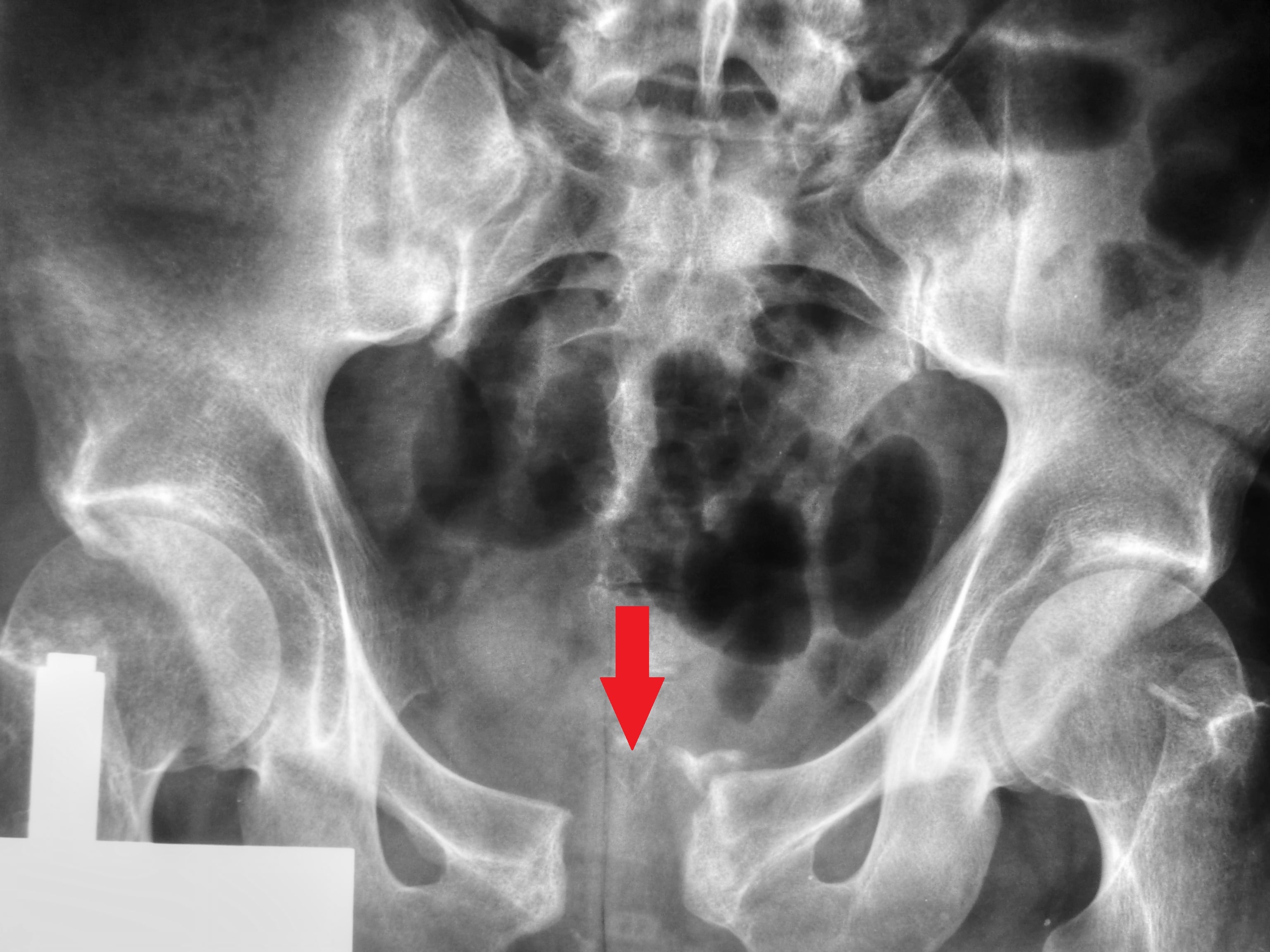
Inlet and outlet views. The inlet view (tube angled 40° caudal) best demonstrates AP displacement: it shows the symphysis widening clearly, the rotational deformity and the anterior SI joint, and is the best view for assessing symphysis diastasis. The outlet view (tube angled 40° cephalad) evaluates vertical displacement, distinguishes a vertical shear component and shows a sacral fracture.
CT. Indicated in all haemodynamically stable patients, for surgical planning and to assess the posterior injury; it is essential for accurate assessment of the SI joints. It measures the symphysis diastasis, shows the anterior SI ligament status and, critically, the integrity of the posterior SI ligaments, along with the associated fractures and the extent of the haematoma. Anterior SI widening suggests ligament disruption; posterior SI widening indicates APC-III. CT angiography shows active arterial bleeding as contrast extravasation and guides angioembolisation.
Retrograde urethrogram. Indicated for blood at the urethral meatus, a high-riding prostate, a perineal haematoma, and before urethral catheterisation whenever there is suspicion. Inject 20-30 mL of water-soluble contrast gently and look for extravasation.
Cystogram. Indicated for gross haematuria with a pelvic fracture, once urethral integrity has been confirmed. An extraperitoneal rupture gives flame-shaped extravasation; an intraperitoneal rupture puts contrast around the bowel.
Management
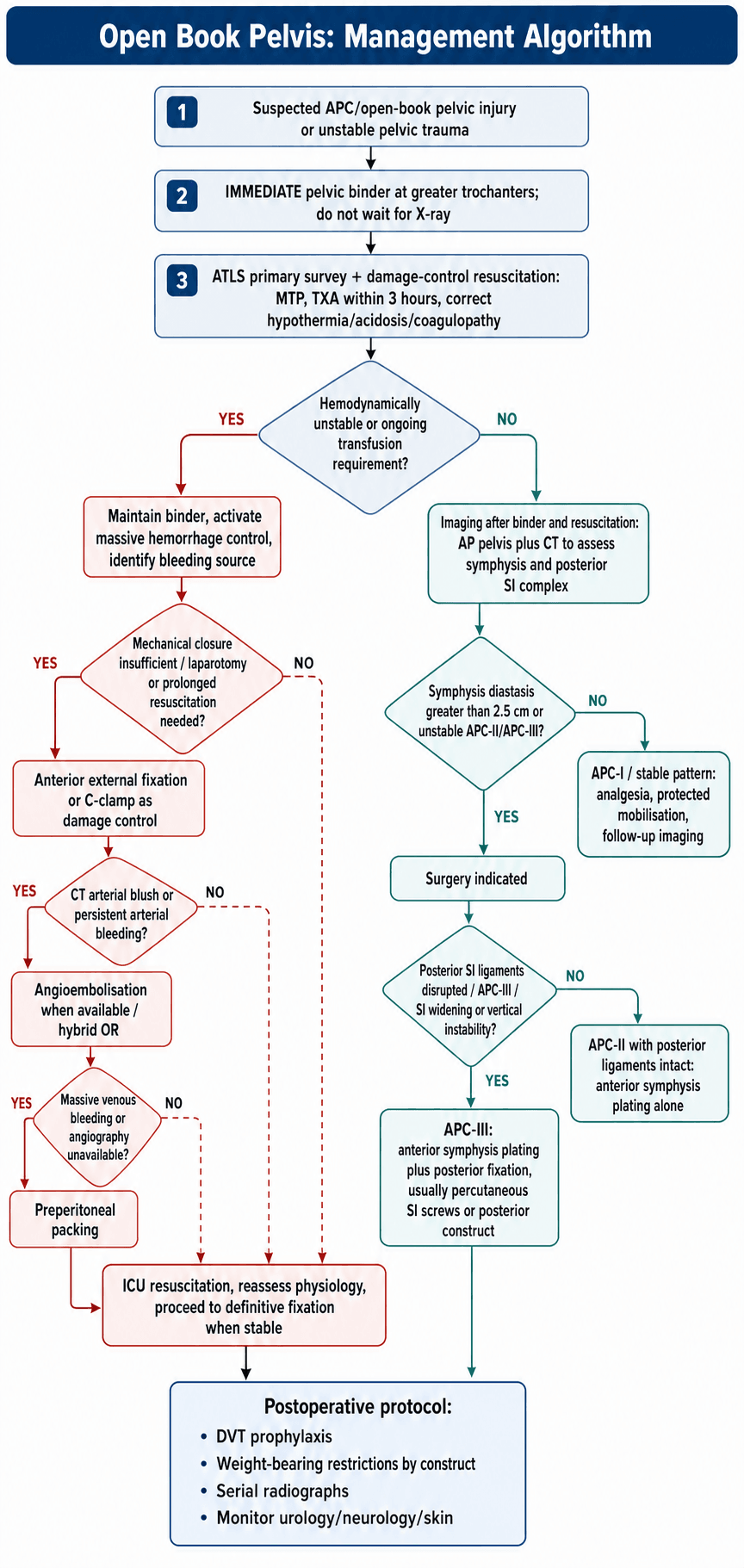
PELVIC BINDER is FIRST-LINE treatment. Apply IMMEDIATELY for ANY suspected open book injury and do NOT wait for X-ray confirmation. This is TIME-CRITICAL haemorrhage control.
The binder. It applies an internal rotation force that closes the open book, reduces pelvic volume, restores the tamponade effect and compresses the bleeding surfaces. It goes at the level of the greater trochanters, not the iliac crests, which are too high for it to be effective; the compression is circumferential and snug but not too tight, with the skin checked, because of the risk of skin necrosis. A commercial binder (T-POD, SAM Pelvic Sling and others) is preferred; a sheet wrap is an acceptable alternative.
Damage control resuscitation. It runs alongside the binder while the bleeding sources are identified:
- Massive Transfusion Protocol, with a 1:1:1 ratio of red cells, FFP and platelets
- Permissive hypotension, systolic 80-90 mmHg, avoiding crystalloid overload
- Tranexamic acid within 3 hours: 1 g bolus, then 1 g over 8 hours
- Correct hypothermia, acidosis and coagulopathy
Three hours is a boundary, not a target. In the CRASH-2 timing analysis, treatment within 1 hour gave RR 0.68 for death from bleeding and 1 to 3 hours RR 0.79, but after 3 hours RR 1.44 (1.12-1.84): late tranexamic acid was associated with more bleeding deaths. Give it as early as possible, and do not give it late "just in case".
External fixation. For the patient in whom the binder alone is insufficient, who needs a laparotomy, or in whom prolonged resuscitation is anticipated. An anterior frame on iliac crest or supra-acetabular pins provides rotational stability; it does not address the posterior injury.
Angioembolisation. Indicated for ongoing haemodynamic instability despite mechanical stabilisation and for arterial extravasation (a contrast blush) on CT; the superior gluteal artery is the most common target. It is part of the damage control algorithm and should not delay definitive care, and a hybrid theatre is ideal.
Preperitoneal packing. For massive haemorrhage unresponsive to the binder, when no angiography is available, and for the venous bleeding that is the majority source. Through a midline infraumbilical incision, staying extraperitoneal, pack the preperitoneal space, close temporarily and remove the packs at 24-48 hours. Which of these adjuncts is used depends on the patient's response and the resources available.
Indications for definitive surgery.
- Absolute: symphysis diastasis over 2.5 cm; an unstable injury (APC-II or higher); an associated posterior injury requiring fixation
- Relative: diastasis of 1-2.5 cm with symptoms; a young, active patient; ongoing instability with conservative treatment
The construct follows the posterior ring. With the posterior SI ligaments intact (APC-II), symphysis plating alone restores stability. Posterior fixation is added for the APC-III pattern, complete SI disruption, vertical instability or SI widening over 2.5 cm on CT, using percutaneous SI screws, open SI fixation or a combination. Timing depends on haemodynamic stability and the soft tissues: acutely, within 24-48 hours if stable, or after damage control external fixation once the patient is medically optimised.
Surgical Technique
Confirm the pattern and the patient. Confirm the APC-II pattern on CT, with the posterior SI ligaments intact. Check for urological injury (cystogram or urethrogram if indicated) and rule out a bladder injury that would need concurrent repair, identify a Morel-Lavallee lesion, which may delay surgery, and confirm haemodynamic stability.
Equipment.
- 3.5 mm reconstruction plate or a symphysis-specific plate
- 3.5 mm cortical screws (6-8)
- Large pointed reduction forceps
- Fluoroscopy with AP, inlet and outlet views
- Pelvic retractors
- Bladder catheter in situ
Posterior SI screw fixation (APC-III). Indicated for APC-III with posterior SI disruption, posterior SI widening on CT or vertical instability. Percutaneous iliosacral screws are preferred, with the patient prone or lateral: entry at the posterior iliac crest, trajectory across the SI joint into the S1 body, guided on the AP, inlet and outlet views, using 6.5 mm or 7.3 mm cannulated screws, one or two depending on stability. The L5 nerve root is at risk and stays superior, the S1 foramen must be avoided, and the screw stays in the safe zone of the S1 body; the outlet view ensures it is below L5.
Complications
Haemorrhagic shock. The primary cause of early mortality; it requires aggressive resuscitation, and the binder is the lifesaving intervention.
Urological injury. Bladder rupture is more commonly extraperitoneal, the symphysis tearing the bladder; intraperitoneal rupture occurs with a full bladder at impact. Urethral injury shows a male predominance (the longer urethra), with the membranous urethra at risk, and blood at the meatus is the cardinal sign.
- Extraperitoneal bladder rupture: catheter drainage for 10-14 days
- Intraperitoneal rupture: surgical repair
- Urethral injury: retrograde urethrogram before catheterisation, a suprapubic catheter if the rupture is complete, and delayed primary repair versus immediate realignment
Vascular injury. Angioembolisation is effective for arterial injuries, the superior gluteal artery being the most common. The corona mortis (aberrant obturator vessels, present in 30%) can cause significant bleeding during anterior approaches.
Morel-Lavallee lesion. A closed degloving injury in which the subcutaneous fat separates from the fascia, creating a fluid-filled cavity, typically over the greater trochanter or iliac crest. It delays surgical fixation, carries an infection risk if not addressed and may need debridement before surgery.
Thromboembolism and infection. The DVT risk is very high: early prophylaxis when safe, and an IVC filter may be needed. Infection is a particular risk with open injuries, a Morel-Lavallee lesion increases it, and surgical site infection also occurs.
Postoperative Care
Immediately after surgery. ICU or HDU monitoring if there was major resuscitation; DVT prophylaxis continued, mechanical and chemical when safe; adequate analgesia by epidural or PCA; monitoring for ongoing bleeding; a bladder catheter initially; regular neurovascular observations. Inspect the wound daily for haematoma and watch for Morel-Lavallee complications; remove the drain when output is under 30 mL per 24 hours, and sutures or staples at 14 days.
Weight bearing after APC-II (symphysis plate alone).
- Weeks 0-6: touchdown weight bearing on both legs, mobilising with a walking frame or crutches, no single leg stance, pelvic tilt exercises in bed and gentle range of motion
- Weeks 6-12: X-rays at 6 weeks to check healing; if union is progressing, partial weight bearing (50%), possibly transitioning to a single crutch
- Weeks 12+: full weight bearing as tolerated, X-ray confirmation of symphysis union, gradual return to activities and formal physiotherapy
Weight bearing after APC-III (anterior and posterior fixation). The higher instability requires longer protection than APC-II.
- Weeks 0-8: touchdown weight bearing, stricter than APC-II, with active hip and knee exercises
- Weeks 8-12: X-rays to assess posterior healing; partial weight bearing if healing well
- Weeks 12-16: progress to full weight bearing and gradual activity; complete posterior healing may need 16 weeks
Physiotherapy.
- Phase 1, weeks 0-6, protection: pelvic floor exercises, gluteal isometrics, ankle pumps, knee extension in bed; avoid hip abduction or adduction against resistance
- Phase 2, weeks 6-12, progressive loading: hydrotherapy (excellent for early mobilisation), stationary bike with no resistance, gentle core strengthening, balance exercises
- Phase 3, weeks 12+, functional restoration: progressive resistance exercises, gait retraining, return-to-work assessment, sport-specific training if appropriate
DVT prophylaxis. The risk is very high, from immobility, pelvic trauma and surgery combined. Mechanical prophylaxis (TED stockings, intermittent pneumatic compression) and LMWH or an alternative once bleeding is controlled, for a minimum of 6 weeks and often 12; consider an IVC filter if bleeding prohibits anticoagulation.
Follow-up.
- 2 weeks: wound check, remove sutures or staples
- 6 weeks: X-rays (AP, inlet, outlet), assess healing, progress weight bearing
- 12 weeks: X-rays, consider full weight bearing if union is evident
- 6 months: final X-rays, functional assessment
- 1 year: long-term outcome assessment; consider plate removal if symptomatic
Plate removal. Usually not needed; the indication is symptomatic hardware (pain with activity), and it is more common in young, active patients. Wait a minimum of 12 months for solid union and ensure the symphysis has healed completely; removal may improve pain in selected patients.
Outcomes and Prognosis
APC-II. A good prognosis: 70-80% return to pre-injury function and most patients ambulate independently by 6 months. Better outcomes are predicted by younger age, an anatomic reduction, no posterior injury, early appropriate fixation and no major associated injuries.
APC-III. More guarded: 50-60% return to their pre-injury level, recovery takes 12-18 months, residual pain rates are higher and permanent limitations are more likely. Chronic SI pain, residual instability, gait abnormalities and the need for revision surgery are all more common.
Mortality. 5-8% for APC-II, mostly from haemorrhage if uncontrolled, and 15-20% for APC-III. Early deaths are from haemorrhagic shock; late deaths from multi-organ failure and pulmonary embolism.
Major morbidity. DVT or PE in 20-30% without prophylaxis, sexual dysfunction in 10-15%, chronic pain in 20-30% and gait abnormality in 10-20%.
Long-term issues. Symphysis pain is common initially, usually improves by 12 months and persists in 15-20%, some of whom benefit from plate removal. Sexual function: erectile dysfunction in males (vascular or neurological), dyspareunia and altered sensation in females; it may improve with time, and counselling is important. Future pregnancy is generally possible, may bring pelvic pain, and an elective caesarean section is considered; discuss this with the patient before fixation. SI joint arthritis is a long-term risk after APC-III, symphysis arthritis is rare with good reduction, and late degenerative changes are monitored for.
Return to activity.
- Desk work: 3-4 months
- Light manual work: 6 months
- Heavy manual work: 9-12 months
- Running and high-impact sport: 9-12 months
- Contact sports: 12+ months, if ever
- Driving: when off narcotics and able to perform an emergency stop, usually 8-12 weeks
Guidelines, Registries & Global Practice
Global Epidemiology
In Balogh's work (J Trauma 2007, DOI), a population-based study of an inclusive trauma system found the overall incidence of pelvic ring fractures was 23 per 100,000 persons per year, split evenly between high-energy (10 per 100,000) and low-energy (10 per 100,000) mechanisms, with 3 per 100,000 dying pre-hospital. High-energy fractures occurred predominantly in younger men, and pelvic-fracture-related mortality was always attributable to bleeding. Demonstrated arterial bleeding was rare (1.3 per 100,000 per year), reinforcing that most haemorrhage is venous and amenable to mechanical control.
In the original Young-Burgess series (Burgess et al., J Trauma 1990, PMID 2381002), anteroposterior compression (open book) injuries had the highest transfusion requirement (mean 14.8 units) and the highest mortality (20%) of all force-vector patterns. Type A (stable) and type B (rotationally unstable, including open book) patterns together account for 70-80% of all pelvic ring injuries (Tile, JAAOS 1996, DOI).
Guideline Comparison (Side-by-Side)
- Trauma-society / international
- WSES / EAST: apply circumferential compression for suspected unstable pelvis (strong recommendation)
- National guidance
- NICE NG37 (UK): apply binder at scene if active bleeding suspected
- Surgical-body guidance
- BOAST (BOA/BAPRAS): binder at greater trochanters, applied early, removed once excluded or fixed
- Trauma-society / international
- WSES grade 1A-2B across recommendations
- National guidance
- NICE: low-to-moderate certainty, consensus-reinforced
- Surgical-body guidance
- BOAST: standard of care / expert consensus
- Trauma-society / international
- WSES: binder then angioembolisation or preperitoneal packing per resources/physiology
- National guidance
- NICE: interventional radiology in networked major trauma centre
- Surgical-body guidance
- BOAST: packing favoured where IR not immediately available
- Trauma-society / international
- TXA within 3 h (CRASH-2, all guidelines concordant)
- National guidance
- TXA within 3 h (NICE)
- Surgical-body guidance
- TXA within 3 h (BOAST / military-derived protocols)
- Trauma-society / international
- AO Foundation: anterior fixation for APC-II; add posterior (SI screw) for APC-III
- National guidance
- AAOS / OTA: stability of posterior ring determines construct
- Surgical-body guidance
- EFORT / AO: damage-control external fixation then ORIF when physiology permits
There is broad international concordance: all major bodies (WSES, NICE NG37, BOA/BOAST, AAOS/OTA, AO Foundation, EFORT) endorse immediate circumferential compression, early tranexamic acid, and posterior-ring-led decision making for definitive fixation. The principal practice variation is in the haemorrhage-control adjunct - North American and Northern European centres with hybrid theatres favour early angioembolisation, whereas systems without immediate interventional radiology (and most military doctrine) favour preperitoneal packing first. The WSES classification and guidelines (Coccolini et al., World J Emerg Surg 2017, DOI) integrate haemodynamic status with anatomical pattern and are the most widely adopted contemporary algorithm.
Registry Evidence
National and regional registries (German Pelvic Trauma Registry / TraumaRegister DGU, UK Trauma Audit and Research Network [TARN], and the Victorian Orthopaedic Trauma Outcomes Registry [VOTOR]) consistently report that bleeding remains the dominant early cause of death in unstable pelvic ring injury, and that mortality is driven more by associated injuries and haemodynamic status than by the anterior diastasis itself. TARN data have been used to quantify the small subset of exsanguinating pelvic patients potentially amenable to REBOA in England and Wales (Barnard et al., Emerg Med J 2015, DOI).
Pharmacological and System Considerations
- Principle
- 1 g IV over 10 min, then 1 g over 8 h, within 3 h of injury
- Notes
- Level I evidence (CRASH-2); concordant across all guidelines
- Principle
- Mechanical immediately; pharmacological (LMWH) once haemorrhage controlled
- Notes
- Very high VTE risk; continue 6-12 weeks; consider IVC filter only if anticoagulation contraindicated
- Principle
- First-generation cephalosporin at induction
- Notes
- Add Gram-negative cover for open injury per local antimicrobial guidance
Practice variation: pharmacological VTE prophylaxis timing also differs - earlier initiation in some European protocols versus more conservative North American thresholds - reflecting the tension between bleeding and thrombosis risk in the polytrauma pelvis. Drug availability, reimbursement and trauma-network maturity differ by jurisdiction and should be checked against local formularies and guidelines.
Exam Focus Points
High-Yield Concepts
REMEMBER: Open book = APC-II = symphysis widening greater than 2.5cm with INTACT posterior SI ligaments. If posterior ligaments are disrupted, it becomes APC-III and requires BOTH anterior and posterior fixation. The posterior injury determines treatment, not the anterior widening.
Critical Numbers
- 5mm: Normal symphysis width
- 10mm: Suspicious for injury
- 25mm (2.5cm): Surgical threshold (APC-I vs APC-II)
- 80%: Proportion of bleeding that is venous
- 1.5L to 4L: Pelvic volume increase with open book
Surgical Decision-Making
- Posterior SI ligaments intact on CT
- Symphysis widening is the primary pathology
- Single anterior approach, symphysis plate
- Posterior SI widening on CT
- SI ligament disruption
- Complete hemipelvic instability
- Need anterior AND posterior fixation
Binder Positioning
Correct: Greater trochanters Incorrect: Iliac crests (too high, doesn't close book effectively)
Viva Scenarios
Clinical Decision Scenarios
Practise clinical reasoning and management decisions out loud
“A 28-year-old motorcyclist is brought in after colliding with a car. He is tachycardic (HR 130), hypotensive (BP 75/50), with both legs externally rotated. The AP pelvis shows 4cm symphysis diastasis. Describe your immediate management.”
“Describe your surgical technique for symphysis plating in an open book pelvic injury. What are the key steps and potential complications?”
“How do you differentiate between an APC-II (open book) injury and an APC-III injury? Why is this distinction clinically important?”
MCQ Practice Points
Q: What symphysis width indicates surgical fixation in open book pelvic injury?
A: Greater than 2.5cm. This threshold distinguishes APC-I (partial disruption, conservative management) from APC-II (complete anterior disruption, requires fixation).
Q: What structure differentiates APC-II (open book) from APC-III injury?
A: Posterior sacroiliac ligaments. APC-II has intact posterior SI ligaments (vertically stable, rotationally unstable). APC-III has complete posterior disruption (vertically AND rotationally unstable).
Q: What percentage of bleeding in pelvic fractures is venous vs arterial?
A: 80% venous, 20% arterial. This is why pelvic binders work - they reduce pelvic volume and restore venous tamponade. Superior gluteal artery is the most common arterial bleeding source.
Q: What is the correct anatomical landmark for pelvic binder placement?
A: Greater trochanters (NOT iliac crests). Binder at trochanter level closes the open book and reduces pelvic volume from greater than 4L back toward normal 1.5L, restoring tamponade.
Q: An APC-II injury is confirmed on CT with intact posterior SI ligaments. What fixation is required?
A: Symphysis plating alone is sufficient for APC-II. Use 3.5mm reconstruction plate via Pfannenstiel approach. APC-III requires both anterior AND posterior (SI screw) fixation.
Key Definitions
- Open book = symphysis widening greater than 2.5cm (APC-II)
- Mechanism: external rotation force (AP compression)
- Normal symphysis = approximately 5mm
- Surgical threshold = greater than 2.5cm (25mm)
- Key distinction: posterior SI ligament status determines treatment
Critical Numbers
- Volume expansion: 1.5L to greater than 4L
- Bleeding source: 80% venous, 20% arterial
- Binder position: greater TROCHANTERS (NOT iliac crests)
- 2.5cm = surgical threshold to remember
Critical Actions
- Hemodynamic instability: immediate pelvic binder at trochanters - do NOT wait for X-ray
- Blood at urethral meatus: do NOT catheterize - retrograde urethrogram first
- APC-II confirmed: symphysis plating alone sufficient (posterior intact)
- APC-III confirmed: both anterior (plate) AND posterior (SI screws) fixation
Exam Mnemonics
- APC: Anterior opens, Posterior determines stability, CT to classify
Common Pitfalls
- Waiting for X-ray before applying binder
- Applying binder at iliac crests (too high - ineffective)
- Blind urethral catheterization with blood at meatus
- Treating APC-III with anterior fixation alone
- Not assessing posterior ligament status on CT
Exam Day Tips
- Open book = APC-II = external rotation = HIGHEST hemorrhage risk
- 2.5cm (25mm) symphysis widening is THE threshold to remember
- Binder at TROCHANTERS closes the book (NOT iliac crests)
- Posterior ligaments determine if anterior fixation alone is enough
- 80% venous bleeding - binder helps most; 20% arterial needs angio
Evidence and Guidelines
Young-Burgess Classification (Defining Landmark)
- Prospective series of 210 high-energy pelvic ring disruptions established the force-vector classification (lateral compression, anteroposterior compression, vertical shear, combined). Anteroposterior compression (open book) injuries had the highest transfusion requirement (mean 14.8 units vs 3.6 units for lateral compression) and the highest mortality (20%), confirming the open book pattern as the most haemorrhagic mechanism.
Stability Determined by Posterior Lesion (Tile)
- The anterior structures (symphysis and pubic rami) contribute approximately 40% of pelvic stiffness, but the posterior sacroiliac complex is more important to ring stability. Classification is therefore based on the posterior lesion: type A stable, type B (open book, bucket-handle) rotationally unstable, type C completely unstable. Type A and B account for 70-80% of injuries.
Circumferential Compression Reduces the Open Book
- Prospective clinical trial of a force-controlled pelvic circumferential compression device in 16 patients. In external rotation (open book) patterns the device reduced pelvic width by 9.9% +/- 6.0%, closely approximating the 10.0% +/- 4.1% reduction achieved by definitive fixation, without overcompressing lateral compression injuries. No complications occurred.