Extensor Mechanism Disruption | Tension Band Principle | Articular Involvement
- Triceps insertion - olecranon fractures disrupt the extensor mechanism
- Articular fracture - olecranon forms proximal ulnohumeral articulation
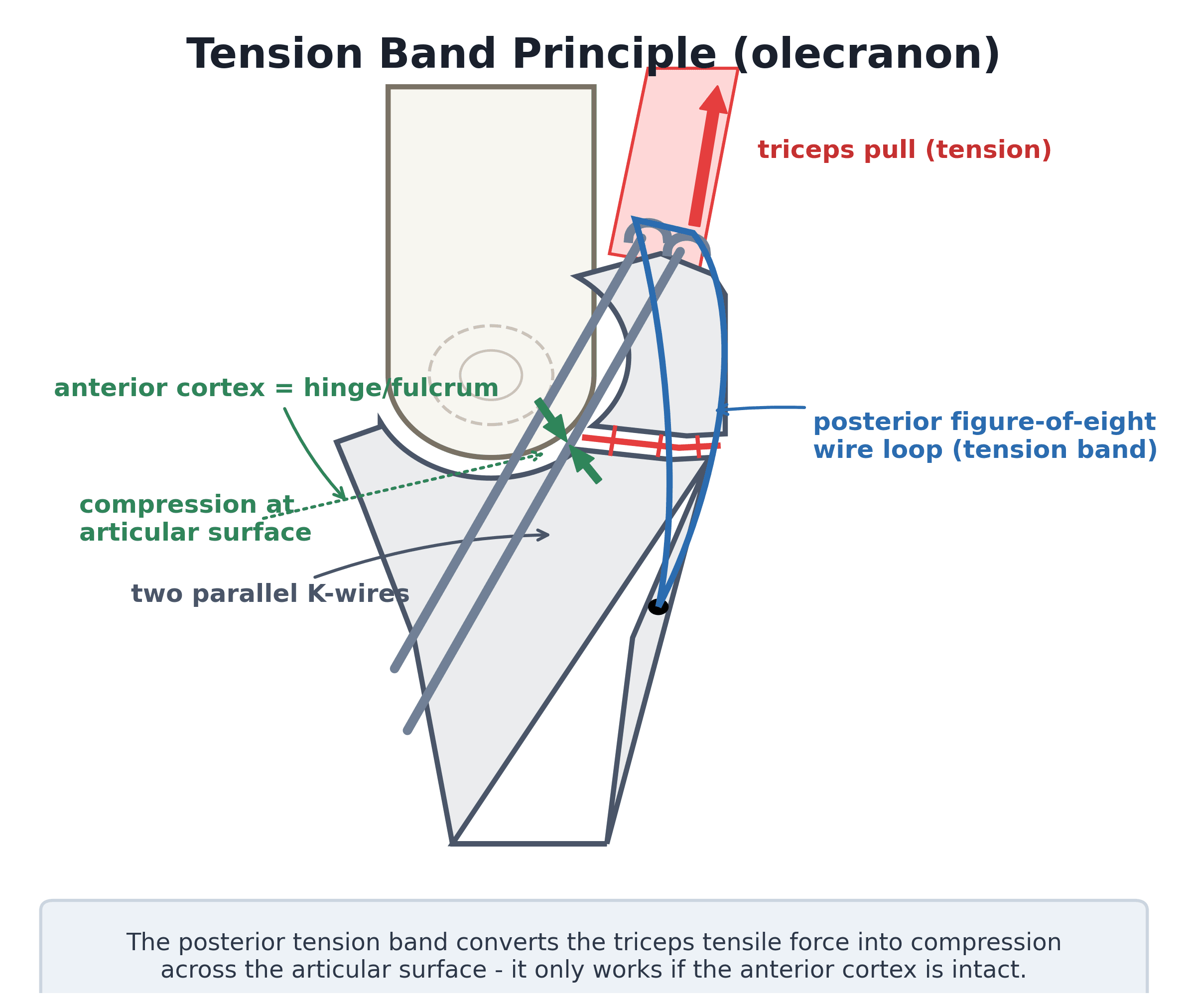
- Tension band principle - converts tensile forces to compressive forces at articular surface
- Plate fixation preferred for comminuted and unstable patterns
- Symptomatic hardware is common (about half of TBW patients in RCT) - discuss removal with patients
- “Tension band works for the SIMPLE TRANSVERSE fracture (Mayo IIA) - it needs an intact anterior cortex to compress against
- “Comminution and oblique patterns require plate fixation: an oblique line lets the fragment shear along the wire instead of being compressed
- “Mayo Type III indicates elbow instability - more complex treatment
- “Check for associated coronoid and radial head fractures (terrible triad)
Overview and Epidemiology
Olecranon fractures are common elbow injuries, and they matter because the olecranon is the insertion of the triceps and forms the proximal ulnohumeral articulation. A fracture therefore does two things at once: it disrupts the extensor mechanism, with loss of active extension, and it breaks the joint surface, with articular incongruity that affects elbow function. Management follows from that biomechanics.
Who. The classic distribution is bimodal: young adults aged 20-40 from high-energy trauma (road traffic accidents, sport, falls from height), and patients over 60 from low-energy falls onto osteoporotic bone. In contemporary high-income populations the curve is unimodal and older rather than showing the young high-energy peak: in a prospective series of 78 proximal ulna fractures from a single Scottish centre the mean age was 57 and 67% followed a simple fall from standing height, so in current practice these behave predominantly as fragility fractures.
Mechanism. The mechanism determines the pattern, and the contrast is a direct blow versus a fall on the flexed elbow. A direct blow, the fall onto the point of the elbow, is the most common. The indirect mechanism is a fall on the outstretched hand with the triceps contracting, which avulses the olecranon, and the two can combine as a direct blow with muscle contraction.
Olecranon fractures in children behave differently from the adult injury and are a recognised exam point:
- They are frequently NOT isolated - the olecranon rarely breaks alone, so always screen for an associated injury: a radial neck fracture, a Monteggia lesion (radial head dislocation with the proximal ulna fracture), or a lateral condyle fracture. Missing the associated injury is the classic error.
- The proximal olecranon ossifies from a secondary centre (apophysis appearing about age 8-10, fusing in the mid-teens), so a normal apophysis or a persistent/sclerotic physis can mimic a fracture - compare with the other side.
- Most minimally displaced fractures are treated non-operatively in a cast, because children have thick periosteum and excellent remodelling; displaced or intra-articular fractures (and those with extensor lag) are fixed, usually with tension-band wiring or screws, on the same biomechanical principles as in adults.
- Consider an underlying bone fragility (e.g. osteogenesis imperfecta) when an olecranon fracture follows trivial trauma or is bilateral.
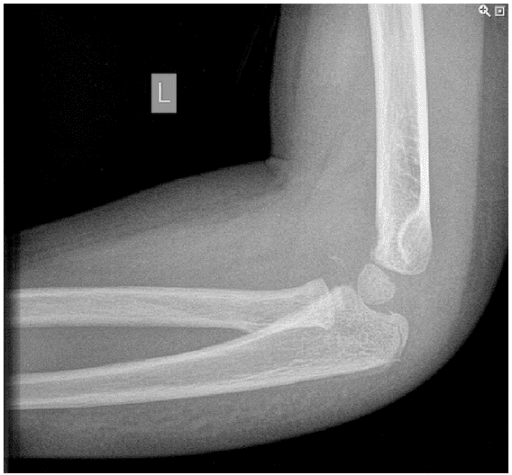
Anatomy and Biomechanics
The bone. The olecranon process is the proximal end of the ulna and forms the posterior prominence of the elbow. The greater sigmoid (trochlear) notch is its articular surface for the trochlea, and the coronoid process is the anterior buttress, critical to stability. The whole structure is subcutaneous, with minimal soft-tissue cover.
The muscles. Triceps brachii inserts on the posterior tip of the olecranon. Anconeus lies lateral to it and acts as a dynamic stabiliser.
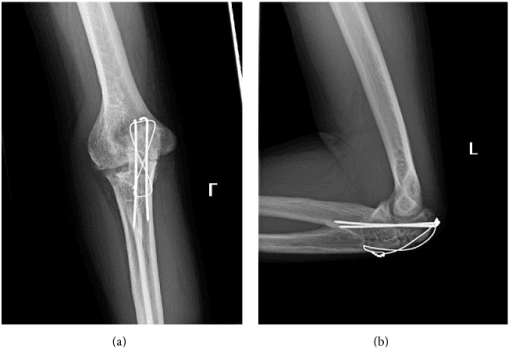
The tension band principle. The triceps generates tensile force on the posterior olecranon, up to 3 times body weight, so during flexion a fracture sees tension posteriorly and compression anteriorly. A figure-of-8 wire on the posterior surface captures that tensile force and, using the intact anterior cortex as a hinge, converts it into compression at the articular surface. That is why the construct needs an intact anterior cortex: comminution disrupts the hinge, and a plate is required instead.
Neurovascular. The ulnar nerve runs posterior to the medial epicondyle and is at risk with medial dissection. The subcutaneous position makes the olecranon easy to reach and makes any hardware prominent.
Classification Systems
Mayo is the most widely used classification because it grades the three things that decide treatment: displacement, stability and comminution. Displacement over 2mm is the surgical threshold, an unstable elbow (Type III) needs the instability addressed as well as the fracture, and comminution (subtype B) takes the fracture out of tension-band territory and into a plate.
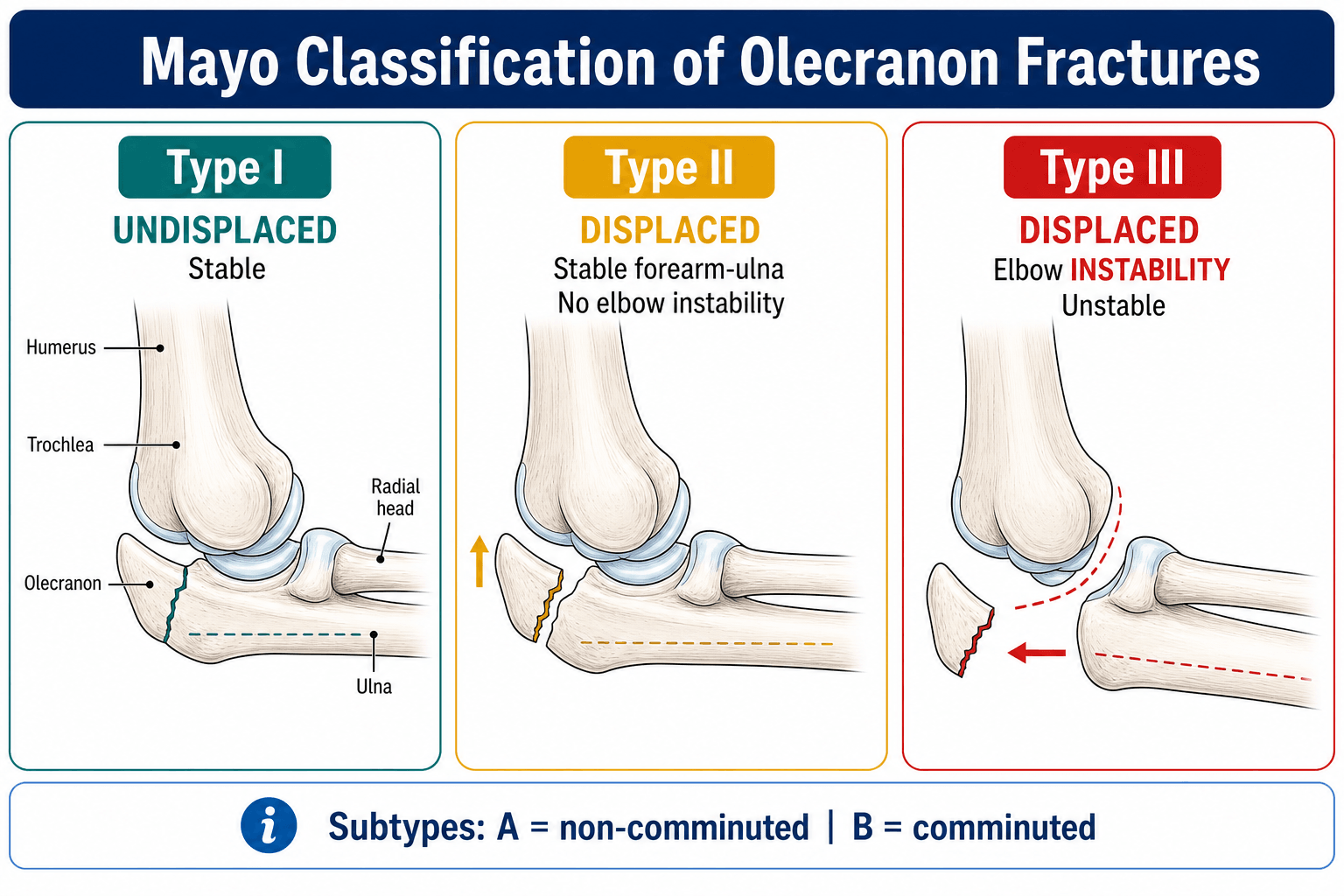
- Displacement
- Undisplaced (less than 2mm)
- Stability
- Stable
- Subtype
- -
- Displacement
- Displaced
- Stability
- Stable
- Subtype
- A = non-comminuted, B = comminuted
- Displacement
- Displaced
- Stability
- Unstable
- Subtype
- A = non-comminuted, B = comminuted
What stable means. A stable elbow has an intact ulnohumeral joint with no subluxation. Unstable means associated elbow instability, subluxation, or a fracture-dislocation pattern, and a Type III injury has to have both the fracture and the instability treated.
Clinical Presentation and Assessment
History. The answers that shape treatment:
- Mechanism (direct blow, fall, sports)
- Ability to extend the elbow after the injury
- Previous elbow problems
- Hand dominance
- Occupation and activity level
Examination. The olecranon is subcutaneous, so a displaced fracture can be felt as a gap posteriorly, and the same subcutaneous position means direct trauma often abrades or lacerates the skin over it. Assess carefully for an open injury: even a closed fracture may have compromised skin, and that affects surgical timing and approach.
- Significance
- Displaced fracture
- Action
- Confirms diagnosis
- Significance
- Extensor mechanism disruption
- Action
- Surgical indication
- Significance
- Open fracture or at risk
- Action
- Antibiotics if open, protect skin
- Significance
- Mayo Type III pattern
- Action
- Plan for additional stabilisation
- Significance
- Articular involvement
- Action
- CT for surgical planning
The active extension test. Ask the patient to extend the elbow against gravity. Inability to do so means the extensor mechanism is completely disrupted and is a surgical indication; intact extension with minimal displacement may be treated conservatively.
Neurovascular examination. Test the ulnar nerve (little-finger sensation, first dorsal interosseous strength), the median and radial nerves, and the vascular status.
Investigations
Radiographs. The true lateral is the most important view: it shows the fracture pattern, displacement, angulation, comminution and articular involvement, and it is where ulnohumeral alignment is assessed. The AP confirms the fracture and shows its medial and lateral extent, and oblique views may help characterise the pattern.
A trans-olecranon fracture-dislocation may be missed by looking only at the olecranon. Anterior subluxation of the ulna relative to the trochlea on the lateral suggests a Mayo Type III injury or a trans-olecranon fracture-dislocation.
CT. Indicated for:
- Complex or comminuted fractures
- Trans-olecranon fracture-dislocations
- Associated coronoid or radial head fractures
- Surgical planning for plate placement
It answers four questions: the fracture pattern and degree of comminution, the extent of articular surface involvement, whether the coronoid is intact, and what associated injuries are present.
Differential Diagnosis
The radiocapitellar dislocation and posterior elbow pain of an olecranon injury overlap with several patterns that change management completely. The discriminators below are high-yield.
- Discriminating feature
- Fracture through olecranon, ulnohumeral joint congruent, radiocapitellar line normal
- Why it matters
- Treat the fracture alone (TBW or plate)
- Discriminating feature
- Comminuted proximal ulna with anterior ulnohumeral subluxation; radiocapitellar relationship usually preserved (coronoid often a large fragment)
- Why it matters
- Must restore trochlear-notch contour with a plate; not a Monteggia [9]
- Discriminating feature
- Ulnar shaft fracture (more distal) with true radial head dislocation - radiocapitellar line disrupted
- Why it matters
- Reduce and fix ulna to length/rotation to relocate radial head
- Discriminating feature
- Radial head fracture + coronoid fracture + posterolateral dislocation; olecranon usually intact
- Why it matters
- Address all three plus LCL to restore stability
- Discriminating feature
- Avulsion of triceps insertion +/- bony flake; loss of active extension with little olecranon comminution
- Why it matters
- Tendon repair, not standard fracture fixation
- Discriminating feature
- Adolescent throwing athlete; sclerotic margins, transverse line; no acute trauma
- Why it matters
- Often non-operative or screw fixation; not an acute trauma construct
Management
The decision. Displacement, the extensor mechanism, stability and the patient. A fracture with less than 2mm of step-off, in a patient who can extend against gravity and whose elbow is stable, can be treated conservatively when that patient is low-demand and will comply with restrictions. Surgery is indicated by:
- Displacement greater than 2mm
- Loss of the extensor mechanism (unable to extend against gravity)
- Elbow instability
- Associated injuries (Monteggia, trans-olecranon fracture-dislocation)
- Mayo Type
- Type I
- Treatment
- Conservative - cast/splint, early motion
- Mayo Type
- Type IIA
- Treatment
- Tension band wiring (TBW)
- Mayo Type
- Type IIB
- Treatment
- Plate fixation
- Mayo Type
- Type III
- Treatment
- Plate fixation + address instability
- Mayo Type
- Complex
- Treatment
- Plate fixation + restore ulnohumeral joint
- Mayo Type
- Variable
- Treatment
- Consider plate or fragment excision + triceps repair
The displaced fracture in the elderly. The 2mm threshold is not the whole story in a low-demand patient aged 75 or older. Two randomised trials in this group found no significant difference in DASH at 12 months between operative and non-operative care, and the Edinburgh trial was stopped early because 9 of 11 operated patients had a complication. Non-operative management is therefore a reasonable default for a displaced stable fracture in a low-demand elderly patient, accepting a small extension deficit and an extensor lag; active extension was better after surgery in SOFIE.
Conservative protocol. Fractures treated conservatively must be watched, because displacement can occur in the first 2 weeks.
- Posterior splint at 45-90 degrees of flexion
- Begin range-of-motion exercises at 1-2 weeks
- Avoid resisted extension for 6 weeks
- Serial radiographs, weekly initially, and convert to surgery if displacement exceeds 2mm
Surgical Technique
Indications. The classic technique, and it belongs to the simple transverse or short oblique fracture that is non-comminuted (Mayo IIA) with an intact anterior cortex, because that is the pattern in which the construct has something to compress against.
Technique.
- Posterior longitudinal incision
- Reduce the fracture anatomically
- Two parallel 1.6-2.0mm K-wires, intramedullary or bicortical
- Figure-of-8 wire (1.0-1.2mm) deep to the triceps and superficial to the K-wires
- Tighten the wire to achieve compression
- Bend and bury the K-wire ends
What makes it work. The K-wires should engage the anterior cortex distally, and intramedullary placement with that engagement is preferred. The wire must lie posterior to the K-wires, on the tension side. Check the reduction through flexion and extension before final tightening.
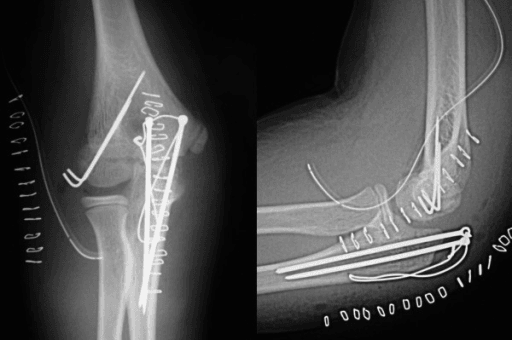
Distinct from fixing an olecranon fracture, the olecranon osteotomy is a deliberate surgical division of the olecranon used to expose the articular surface of the distal humerus (e.g. for a comminuted intra-articular distal humeral fracture). It is examined alongside olecranon fractures because the repair uses the same tension-band/plate principles:
- Make it an apex-distal chevron osteotomy (not transverse) - the V interdigitates, resists rotation and increases the surface area for union.
- Site it through the "bare area" of the trochlear notch (a non-articular sulcus) to spare articular cartilage.
- Predrill and pretap (or provisionally apply the plate/screw) BEFORE cutting, so the fixation re-establishes the exact anatomy on closure.
- Repair with a tension-band construct or a plate, exactly as for a transverse fracture.
- Recognised downsides: osteotomy non-union and symptomatic hardware (the same prominence problem as fracture fixation).
- Key contraindication: do not perform an olecranon osteotomy if the distal humerus may need a total elbow arthroplasty (e.g. unreconstructable articular comminution in the elderly) - it sacrifices the olecranon and extensor mechanism you would otherwise preserve; use a triceps-sparing or triceps-reflecting approach instead.
Complications
- Incidence
- 50% TBW, 22% plate (RCT)
- Management
- Hardware removal after union
- Incidence
- 10-20%
- Management
- Physiotherapy, dynamic splinting, release if severe
- Incidence
- 5-10%
- Management
- Revision fixation with bone graft
- Incidence
- 2-5%
- Management
- Antibiotics, debridement, may need hardware removal
- Incidence
- 5-15%
- Management
- Arthroplasty if severe and symptomatic
- Incidence
- 2-5%
- Management
- Usually neurapraxia, protect nerve intraoperatively
- Incidence
- 5-10% TBW
- Management
- Bend ends, early removal if backing out
Hardware. The olecranon is subcutaneous with minimal soft-tissue cover, so hardware prominence is common and pre-operative counselling about it is essential. About half of tension-band patients need the hardware out; plates have a lower but still significant removal rate.
Stiffness. Common after any elbow trauma. The goal is a functional arc of 30-130 degrees; stable fixation and early motion are the prevention, and physiotherapy, splinting and surgical release are the treatment.
Nonunion. More common with inadequate fixation or infection. Treatment is revision with plate fixation and bone graft, and a triceps advancement may be needed if the fragment has to be excised.
Postoperative Care and Rehabilitation
Early motion is essential, and stable fixation is what permits aggressive motion. Resisted extension is avoided until 6 weeks; hardware prominence may limit motion, and symptomatic hardware is removed once union is confirmed.
- Posterior splint at 90 degrees
- Elevation, ice
- Finger motion encouraged
- Wound check
- Begin active ROM
- Splint between exercises if needed
- No resisted extension
- Gravity-assisted extension
- Progressive active ROM
- Goal: full extension by 6 weeks
- Continue avoiding resisted extension
- May use dynamic splinting if stiff
- Begin gentle strengthening
- Progressive loading
- Functional activities
- Full strengthening
- Return to sport/work
- Hardware removal if symptomatic (after union confirmed)
Outcomes and Prognosis
Tension band versus plate. In the only head-to-head RCT of active adults, the two produced equivalent patient-reported function (1-year DASH 12.8 versus 8.5, not significant), and the Ren meta-analysis found no significant difference in DASH either. The Mayo II meta-analysis found modestly better long-term MEPS and DASH with plates, while long-term flexion and extension deficits did not differ, so the constructs are separated mainly by complication profile rather than by function. [1,2,3]
- Functional outcome
- Equivalent DASH to plate
- Key evidence point
- Higher symptomatic implant removal (50%) [1]
- Functional outcome
- Equivalent DASH to TBW
- Key evidence point
- Lower removal (22%) but infection/revision risk concentrated here [1]
- Functional outcome
- Comparable pain/ROM/strength to ORIF
- Key evidence point
- Fewer local complications and no extensor-strength loss vs ORIF [4]
- Functional outcome
- No significant DASH difference vs surgery at 12 months
- Key evidence point
- Small residual extension deficit; avoids operative complications [5,6]
What predicts the result.
- Fracture complexity (comminution worse)
- Associated injuries (coronoid, radial head)
- Quality of reduction
- Patient compliance with rehabilitation
- Bone quality
Guidelines, Registries & Global Practice
Global epidemiology
Olecranon fractures account for roughly 10% of upper-limb fractures and around 20% of fractures of the proximal forearm. [3,7] In contemporary high-income populations they behave as fragility fractures: in a prospective series of 78 proximal ulna fractures the mean age was 57 years and 67% followed a simple fall from standing height, with a unimodal older-male and older-female (type-F) distribution rather than the classic young high-energy peak. Mayo IIA was the commonest pattern (60%). [8] Younger patients still sustain high-energy injuries (sport, road trauma) and are more likely to have associated proximal radius fractures.
Practice positions, side by side
There is no formal AAOS clinical practice guideline or NICE guideline dedicated to olecranon fractures; practice is driven by RCT and meta-analysis evidence and by AO Foundation principles. The table summarises where guidance converges and where genuine debate remains.
- Position
- Absolute stability for simple articular patterns (TBW for simple stable; plate for comminuted, oblique, Monteggia variants, trans-olecranon). Restore the trochlear-notch contour.
- Evidence level
- Consensus / biomechanical
- Position
- TBW and plate give equivalent function for simple fractures; plate has fewer overall complications (mainly less symptomatic hardware), but infection/revision cluster with plating.
- Evidence level
- Level I [1,2,3]
- Position
- Non-operative care is a reasonable default in low-demand patients aged 75+ - no significant DASH difference, far fewer complications.
- Evidence level
- Level I [5,6]
- Position
- Acceptable for comminuted fractures in low-demand patients if the joint stays stable; equivalent strength to ORIF with fewer local complications.
- Evidence level
- Level III [4]
Registry evidence: Olecranon fixation is not separately tracked by the major arthroplasty registries (NJR, AJRR, AOANJRR, SHAR, NZJR), which capture joint replacement rather than fracture fixation, so registry-level implant-survival data do not exist for this injury. The evidence base is therefore RCT- and meta-analysis-led rather than registry-led.
Global practice variation
- Implant choice: TBW remains widespread worldwide because it is cheap, quick and effective for simple patterns; precontoured locking plates dominate where cost is less constraining, especially for comminuted and osteoporotic fractures. The functional outcome is the same - the difference is reoperation profile and cost. [1,2]
- Elderly displaced fractures: a clear international shift toward non-operative management of low-demand elderly patients, led by Edinburgh and Australasian (SOFIE) randomised data. [5,6]
- Resource-limited settings: TBW and even fragment excision retain a larger role where locking-plate availability and theatre access are limited.
Be ready to argue TBW versus plate with indications for each, to cite the equivalent function but different complication profile (Level I), and to defend non-operative management of the frail elderly using SOFIE and the Edinburgh RCT. Know the tension-band biomechanics cold.
MCQ Practice Points
Q: According to the Mayo classification, what defines a Type III olecranon fracture? A: Displaced fracture with elbow instability. Type I = undisplaced, Type II = displaced but stable, Type III = displaced and unstable. Subtype A = non-comminuted, B = comminuted.
Q: How does tension band wiring work? A: The figure-of-8 wire converts tensile forces (from triceps pull) to compressive forces at the articular surface. This requires an intact anterior cortex to act as a fulcrum/hinge. With elbow flexion, compression increases at the fracture site.
Q: Where should the K-wires engage in tension band wiring? A: The K-wires should engage the anterior cortex of the ulna distally. This creates a more stable construct. Intramedullary placement with engagement of anterior cortex is preferred.
Q: When is plate fixation preferred over tension band wiring for olecranon fractures? A: Oblique fractures (greater than 30 degrees), comminuted fractures, osteoporotic bone, Monteggia variants, trans-olecranon fracture-dislocations, and Mayo Type III (unstable).
Q: What is the approximate rate of symptomatic hardware removal after tension band wiring for olecranon fractures? A: Around 50% in the best randomised data (Duckworth, JBJS Am 2017: 50% vs 22% for plates), with some older observational series quoting higher figures. Hardware prominence is common because of the subcutaneous position of the olecranon. Plate fixation has a lower removal rate but carries the more serious risks of infection and revision.
Clinical Decision Scenarios
Practise clinical reasoning and management decisions out loud
“A 35-year-old man falls directly onto his left elbow. X-rays show a displaced transverse olecranon fracture with 5mm of articular step-off. The elbow is stable on examination. Describe your management.”
“A 72-year-old woman with osteoporosis falls and sustains a comminuted olecranon fracture. The lateral X-ray shows the ulna is anteriorly subluxated relative to the trochlea. How do you manage this?”
“A patient returns 3 months after TBW for an olecranon fracture. They have united but have prominent hardware causing pain and skin irritation. The K-wire is backing out. What is your management?”
KEY CONCEPTS
- Triceps insertion - extensor mechanism disruption
- Articular fracture - affects ulnohumeral joint
- Subcutaneous - high hardware prominence
- 2mm step-off threshold for surgery
MAYO CLASSIFICATION
- Type I: Undisplaced (less than 2mm)
- Type II: Displaced, stable (A = simple, B = comminuted)
- Type III: Displaced, unstable (A = simple, B = comminuted)
- Stability = ulnohumeral joint status
TBW INDICATIONS
- Simple transverse or short oblique fracture
- Non-comminuted (Mayo IIA)
- Intact anterior cortex (for tension band to work)
- Accept ~50% symptomatic hardware removal rate (RCT)
PLATE INDICATIONS
- Oblique fracture (greater than 30 degrees)
- Comminuted (Mayo IIB, IIIB)
- Osteoporotic bone
- Trans-olecranon fracture-dislocation
- Mayo Type III (unstable)
TBW TECHNIQUE
- Two parallel K-wires (1.6-2.0mm)
- Intramedullary or bicortical - engage anterior cortex
- Figure-of-8 wire (1.0-1.2mm)
- Wire deep to triceps, superficial to K-wires
- Tension wire on posterior (tension) side
TRAPS AND PEARLS
- TBW only for simple patterns - plate for comminution
- Check for trans-olecranon subluxation on lateral
- ~50% TBW symptomatic hardware removal - counsel pre-op
- Anterior cortex must be intact for TBW to work
- Early motion essential to prevent stiffness
Evidence Base
Duckworth et al. Plate vs Tension-Band Wire RCT
- Single-centre RCT of 67 active patients (16 to 74 years) with simple displaced olecranon fractures. No significant difference in DASH at 1 year (TBW 12.8 vs plate 8.5; p=0.315) or in range of motion, Broberg-Morrey or Mayo Elbow Score. Overall complication rate was higher with TBW (63% vs 38%; p=0.042), driven by symptomatic implant removal (50% vs 22%; p=0.021). All four infections and all three revision operations occurred exclusively in the plate group.
Ren et al. TBW vs Plate Systematic Review & Meta-analysis
- Thirteen studies (1 RCT, 12 observational) comparing TBW and plate fixation. No significant difference in DASH (SMD 0.07; p=0.73), range of motion, operative time or blood loss. Complications were significantly more frequent after TBW (pooled OR 2.61, 95% CI 1.65 to 4.14; p less than 0.0001).
Jia et al. Mayo II Fractures Meta-analysis
- Eleven studies (449 TBW, 378 plate) restricted to Mayo II fractures. Plate fixation gave modestly better long-term MEPS and DASH and fewer complications (RR 2.13, 95% CI 1.48 to 3.08), while TBW had shorter operative time and less blood loss. Long-term elbow flexion and extension deficits did not differ.
Joshi et al. SOFIE Randomised Controlled Trial
- Multicentre pragmatic RCT (24 hospitals, Australia/New Zealand) of 60 patients aged 75 years or older with displaced isolated olecranon fractures. No significant difference in 12-month DASH (operative 12.3 vs non-operative 18.9; mean difference -6.6, 95% CI -14.9 to 1.8; p=0.12). Active elbow extension was better after surgery, but no other secondary outcome differed.
Duckworth et al. Elderly Non-operative vs Operative RCT
- RCT of patients aged 75 years or older randomised to non-operative or operative care. Stopped early because the operative complication rate (9 of 11; 81.8%) was unacceptable. DASH at 1 year did not differ (non-operative 23 vs operative 22; p=0.763).
Gartsman et al. Excision vs Internal Fixation
- 107 patients with isolated olecranon fractures: 53 primary fragment excision versus 54 ORIF. Pain, function, range of motion, stability and arthritis were similar, with no difference in extensor strength on biomechanical testing. ORIF had more local complications (13 vs 2) plus 13 implant-removal procedures.
Carter et al. Tension-Band Wire Fixation of Olecranon Fractures
- Step-by-step technique description from the Edinburgh unit that ran the plate-versus-tension-band randomised trial, so the operation described is the one that produced that trial's results
- Reserves tension-band wiring for the SIMPLE, ISOLATED, STABLE, DISPLACED fracture (Mayo type IIA) - the pattern in which the construct's mechanics actually work
- Notes that olecranon fractures make up roughly 20 per cent of proximal forearm fractures, and that non-operative management is a legitimate consideration in the low-demand elderly
- Emphasises the technical details that determine whether the wire ends up prominent: parallel K-wire placement engaging the anterior ulnar cortex, and burying the wire knots and bent wire ends deep to the triceps insertion
Ring et al. Trans-olecranon Fracture-Dislocation
- Series of 17 anterior (trans-olecranon) fracture-dislocations. Distinct from anterior Monteggia: the distal humerus is driven through the olecranon, producing a comminuted proximal ulna with the radiocapitellar joint usually intact. Stable anatomic restoration of the trochlear-notch contour gave excellent/good results in 15 of 17 at 25 months.
Duckworth et al. Epidemiology of Proximal Ulna Fractures
- Prospective series of 78 proximal ulna fractures (mean age 57 years). A simple fall from standing height caused 67%; younger patients sustained higher-energy mechanisms. Distribution was a unimodal older-male and older-female (type-F) curve, and Mayo IIA was the commonest olecranon pattern (60%).
References
- Duckworth AD, Clement ND, White TO, Court-Brown CM, McQueen MM. Plate versus tension-band wire fixation for olecranon fractures: a prospective randomized trial. J Bone Joint Surg Am. 2017;99(15):1261-1273. doi:10.2106/JBJS.16.00773
- Ren YM, Qiao HY, Wei ZJ, et al. Efficacy and safety of tension band wiring versus plate fixation in olecranon fractures: a systematic review and meta-analysis. J Orthop Surg Res. 2016;11(1):137. doi:10.1186/s13018-016-0465-z
- Jia Y, Liu A, Guo T, et al. Efficacy and safety of tension band wire versus plate for Mayo II olecranon fractures: a systematic review and meta-analysis. J Orthop Surg Res. 2022;17(1):373. doi:10.1186/s13018-022-03262-7
- Gartsman GM, Sculco TP, Otis JC. Operative treatment of olecranon fractures. Excision or open reduction with internal fixation. J Bone Joint Surg Am. 1981;63(5):718-721. PMID:7240294
- Joshi MA, Le M, Campbell R, et al. Surgery for Olecranon Fractures in the Elderly (SOFIE): results of the SOFIE randomized controlled trial. J Bone Joint Surg Am. 2025;107(5):452-458. doi:10.2106/JBJS.24.00655
- Duckworth AD, Clement ND, McEachan JE, White TO, Court-Brown CM, McQueen MM. Prospective randomised trial of non-operative versus operative management of olecranon fractures in the elderly. Bone Joint J. 2017;99-B(7):964-972. doi:10.1302/0301-620X.99B7.BJJ-2016-1112.R2
- Carter TH, Molyneux SG, Reid JT, White TO, Duckworth AD. Tension-band wire fixation of olecranon fractures. JBJS Essent Surg Tech. 2018;8(3):e22. doi:10.2106/JBJS.ST.17.00071
- Duckworth AD, Clement ND, Aitken SA, Court-Brown CM, McQueen MM. The epidemiology of fractures of the proximal ulna. Injury. 2012;43(3):343-346. doi:10.1016/j.injury.2011.10.017
- Ring D, Jupiter JB, Sanders RW, Mast J, Simpson NS. Transolecranon fracture-dislocation of the elbow. J Orthop Trauma. 1997;11(8):545-550. doi:10.1097/00005131-199711000-00001