Accessory Ossicle | Posterior Impingement | Dancers
- Os trigonum = unfused lateral tubercle of posterior talus
- Present in 7-14% of population (bilateral in 50%)
- Symptomatic in dancers and athletes requiring plantarflexion
- Posterior impingement with forced plantarflexion
- Endoscopic excision is treatment of choice
- “Lateral X-ray shows accessory ossicle behind talus
- “FHL tenosynovitis may be associated
- “Posterior impingement test positive
- “Injection both diagnostic and therapeutic
Overview & Anatomy
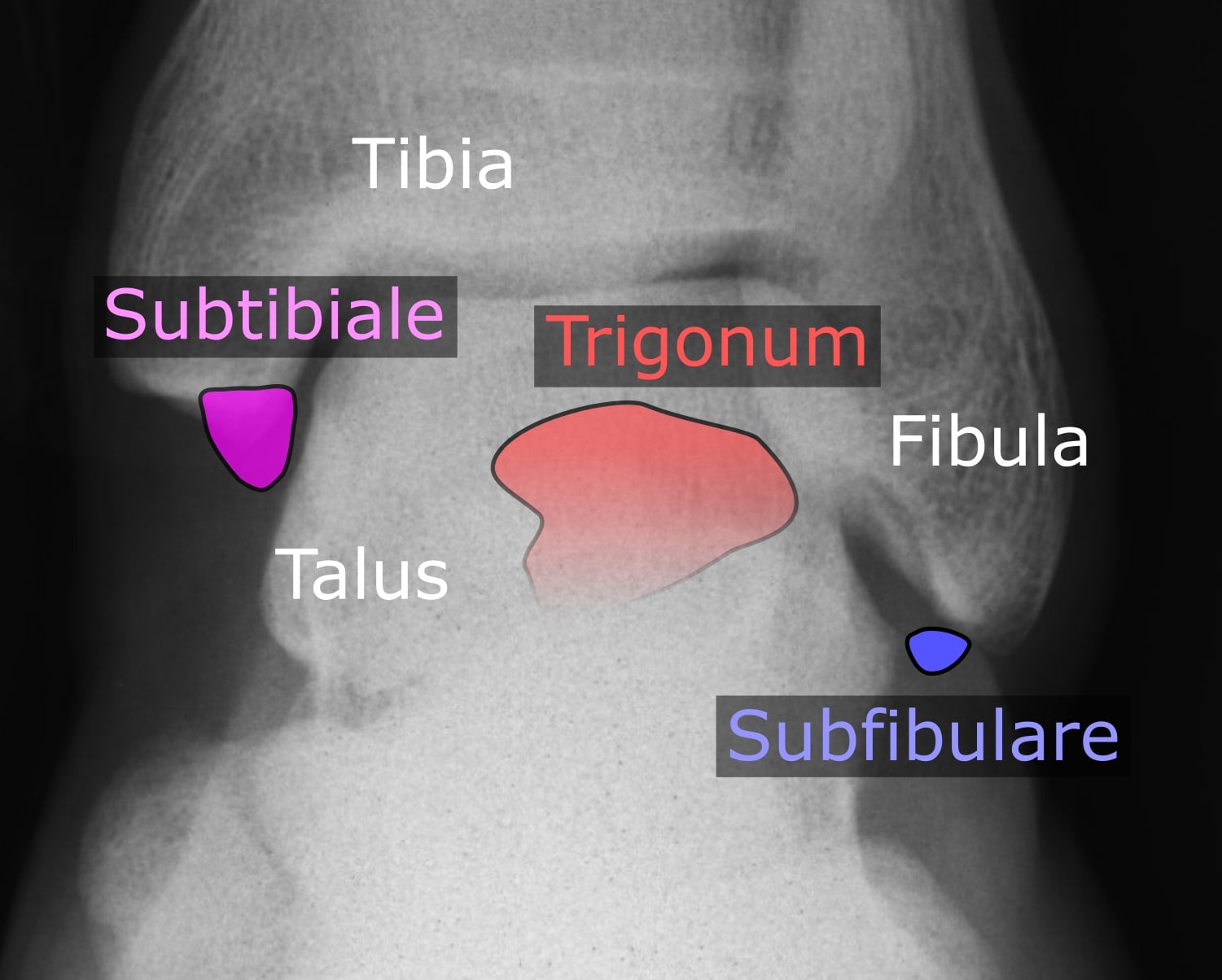
An os trigonum is an accessory ossicle left when the lateral tubercle of the posterior talar process fails to fuse. It is the most common accessory ossicle of the foot, present in roughly 2 to 14% of the population (around 9.8% in large radiographic series) and bilateral in about 50% of those who have one. Most are asymptomatic; symptomatic disease clusters in athletes who load the ankle in plantarflexion.
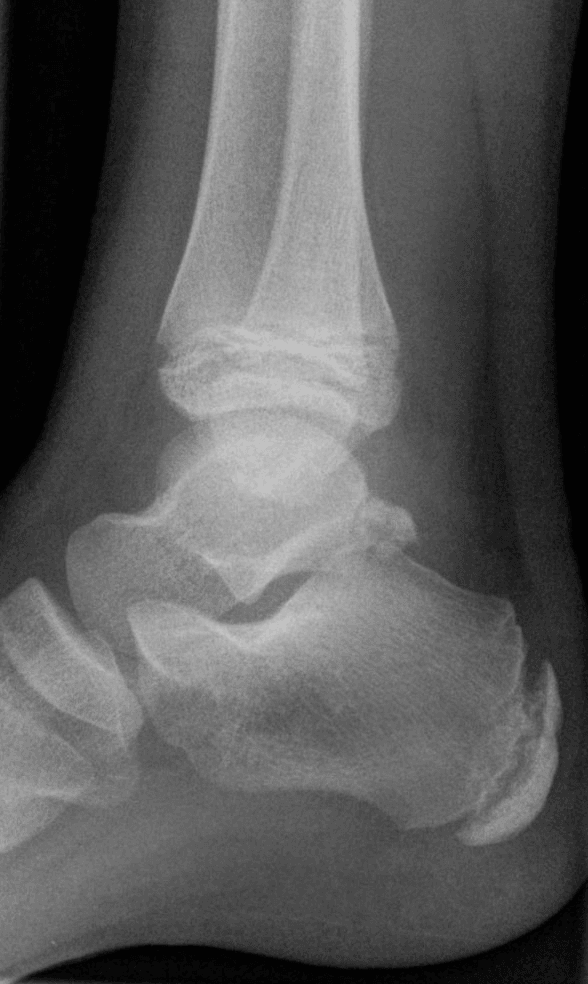
The posterior process. The posterior process of the talus has two tubercles, medial and lateral. The lateral tubercle may develop from a secondary ossification centre that appears at 8-13 years and usually fuses within 1 year. When it fails to fuse, the os trigonum remains as a separate bone, joined to the talus by a synchondrosis.
Os trigonum or Stieda process. A Stieda process is the same lateral tubercle, elongated but fused to the talus. It produces the same clinical picture, and the imaging distinction is set out in the differential below.
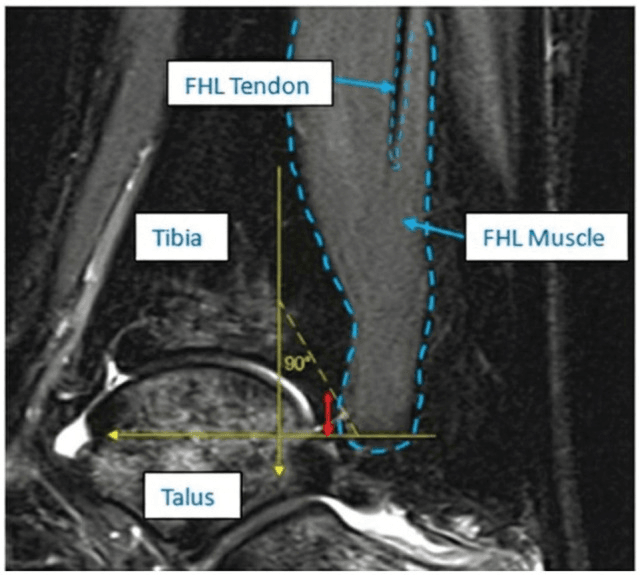
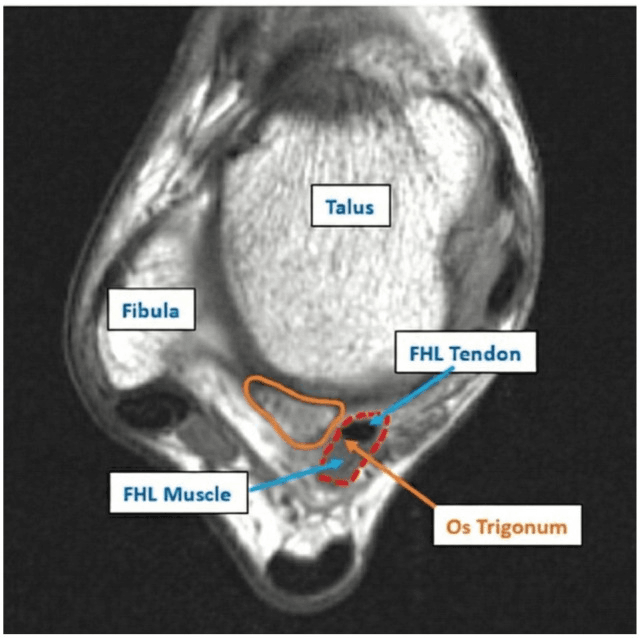
The FHL. The flexor hallucis longus tendon runs in a groove between the medial and lateral tubercles. This close relationship means FHL tenosynovitis commonly accompanies os trigonum syndrome.
Pathophysiology
The nutcracker. Ballet dancers en pointe and footballers kicking downward are the classic patients. Forced or repetitive plantarflexion compresses the os trigonum in a "nutcracker" fashion between the posterior tibia and the calcaneus, and the microtrauma produces bone marrow oedema, injury to the synchondrosis and inflammation.
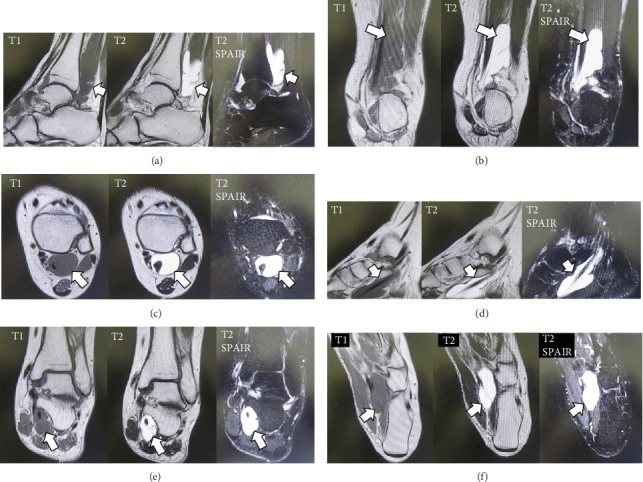
The FHL tunnel. Chronic impingement can enlarge the ossicle and narrow the fibro-osseous tunnel of the FHL. The result is a secondary stenosing tenosynovitis with triggering of the great toe, "dancer's tendinitis".
Acute injury. Acute hyperplantarflexion can instead fracture the synchondrosis or the posterolateral talar process.
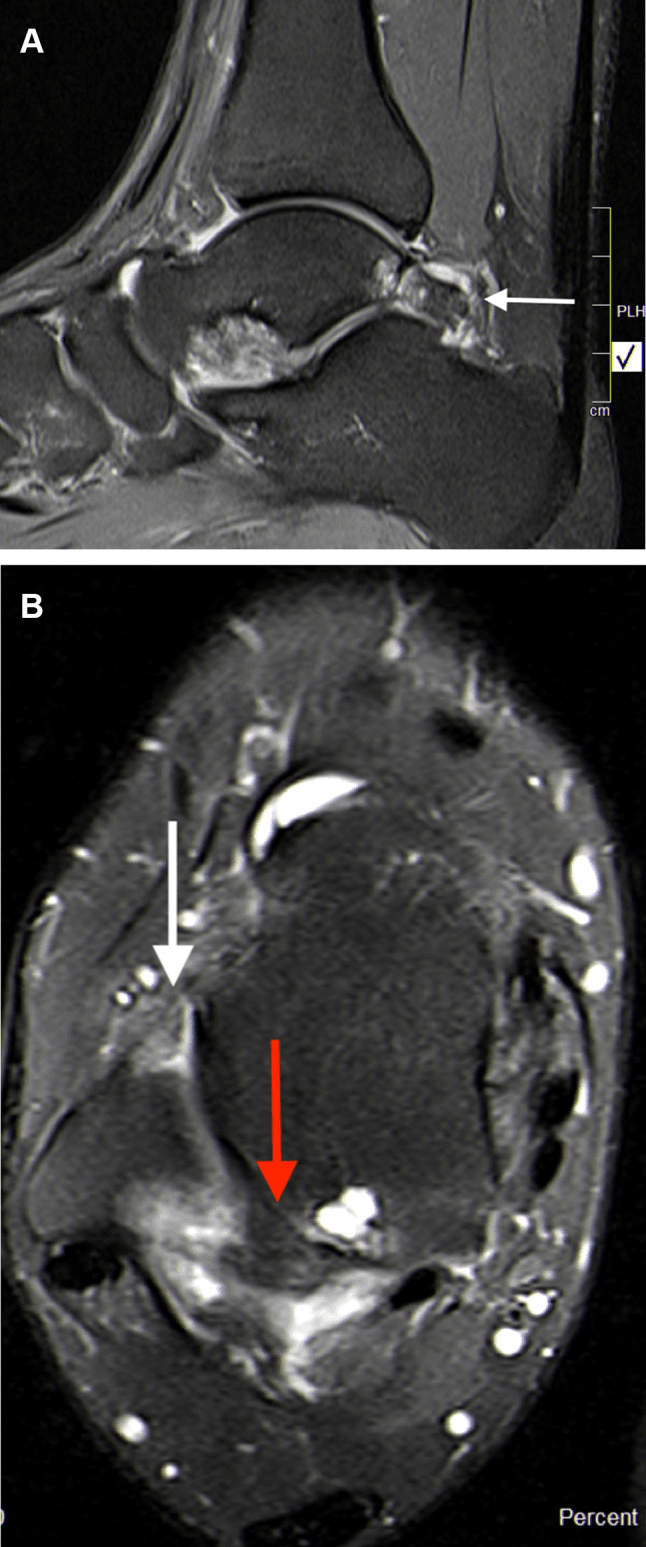
Clinical Presentation
History. Posterior ankle pain in a dancer or athlete whose sport demands plantarflexion, worse en pointe or when kicking downward. The patient may describe the pain as deep and posterior. If the FHL is involved there may be triggering or clicking of the great toe.
Examination. The posterior impingement test is passive forced plantarflexion; reproducing the posterior ankle pain is highly suggestive. Tenderness is deep and posterior, between the Achilles and the peroneal tendons. Passive flexion and extension of the hallux with the ankle in different positions may reveal FHL tenosynovitis or triggering.
Presence is not proof. Finding an os trigonum on a radiograph never proves it is the pain source. Work through the differential systematically before attributing symptoms to the ossicle.
- Pain location & character
- Deep posterior, worse on forced plantarflexion
- Key clinical clue
- Positive posterior impingement test; plantarflexion sport (dance, kicking)
- Confirming test
- MRI bone marrow oedema in ossicle; greater than 70% relief from posterior injection
- Pain location & character
- Identical to os trigonum
- Key clinical clue
- Same picture but tubercle is fused, not a separate ossicle
- Confirming test
- Lateral X-ray / CT shows elongated FUSED process, no synchondrosis
- Pain location & character
- Posteromedial, with triggering of hallux
- Key clinical clue
- Clicking/locking great toe ('dancer's tendinitis'); pain on resisted hallux flexion
- Confirming test
- MRI FHL fluid/thickening; often coexists with os trigonum
- Pain location & character
- Superficial, at calcaneal insertion
- Key clinical clue
- Insertion tenderness, Haglund prominence; impingement test negative
- Confirming test
- Ultrasound/MRI of Achilles insertion
- Pain location & character
- 2 to 6 cm above insertion
- Key clinical clue
- Palpable nodule, arc sign moves with tendon
- Confirming test
- Ultrasound/MRI mid-tendon
- Pain location & character
- Anterior to Achilles at insertion
- Key clinical clue
- Focal bursal tenderness, worse on dorsiflexion
- Confirming test
- MRI/US bursal fluid
- Pain location & character
- Posterolateral, behind fibula
- Key clinical clue
- Retromalleolar pain/swelling, lateral not central
- Confirming test
- Dynamic US, MRI retromalleolar groove
- Pain location & character
- Acute trauma, sharp posterior pain
- Key clinical clue
- Hyperplantarflexion or inversion injury; not a smooth corticated ossicle
- Confirming test
- CT - irregular fracture margins vs smooth synchondrosis
Tarsal tunnel syndrome also belongs on the list: the pain is posteromedial, with tingling.
Investigations
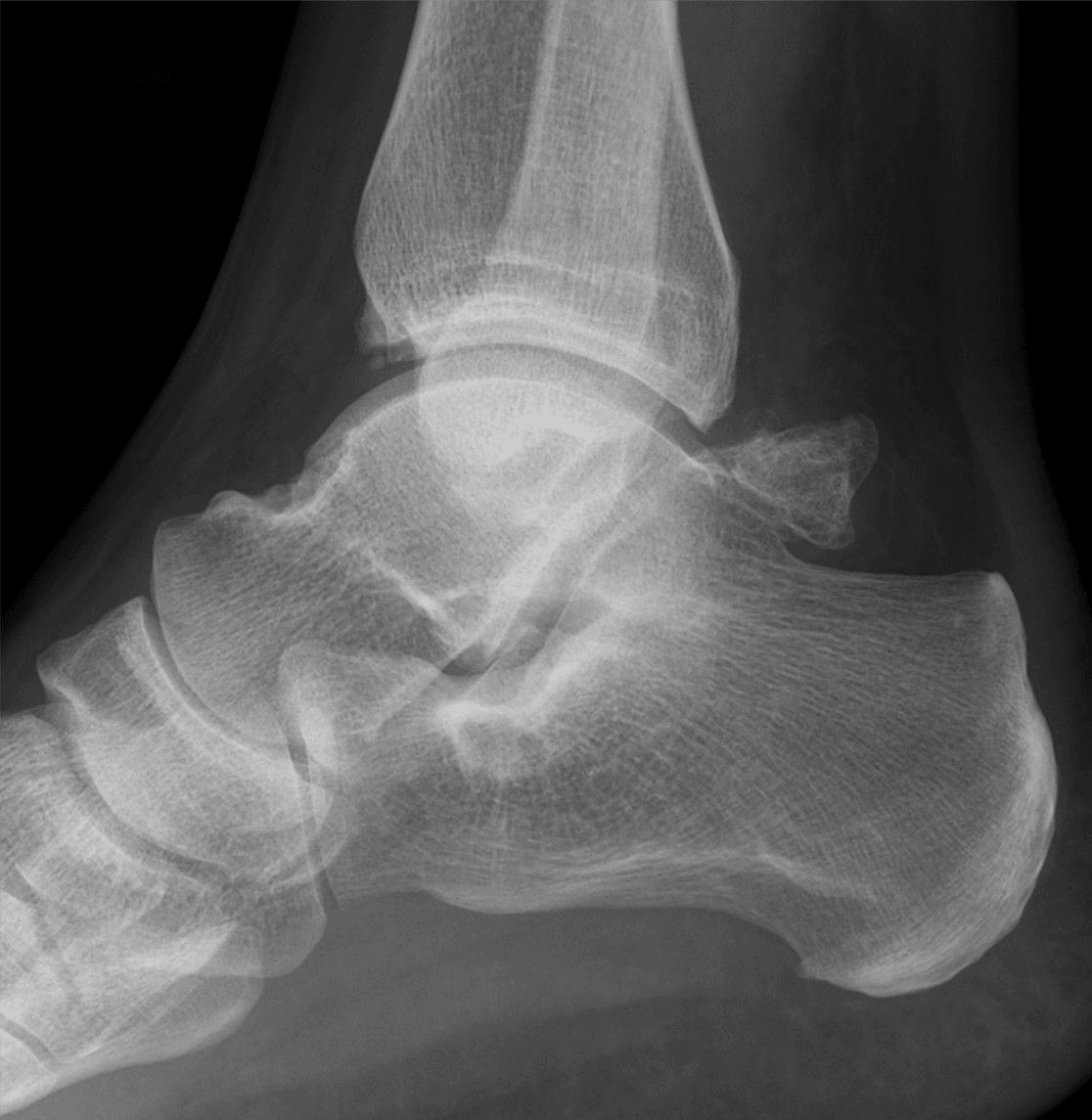
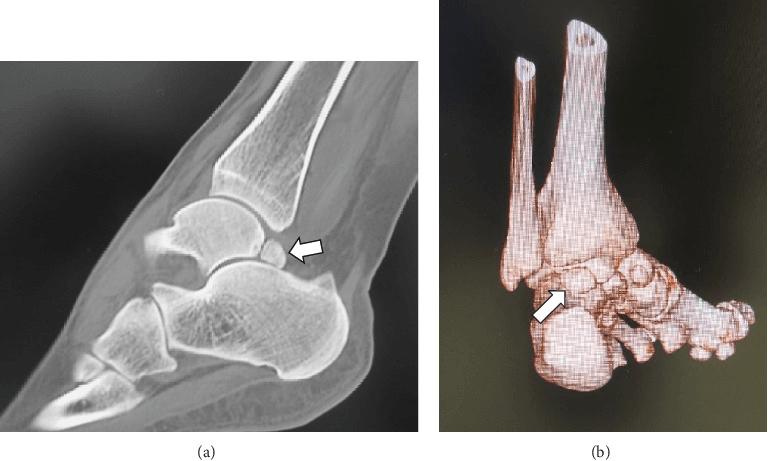
Radiographs. The lateral radiograph shows the os trigonum as a separate ossicle posterior to the talus. If the tubercle is fused but prominent, it may show an enlarged Stieda process instead.
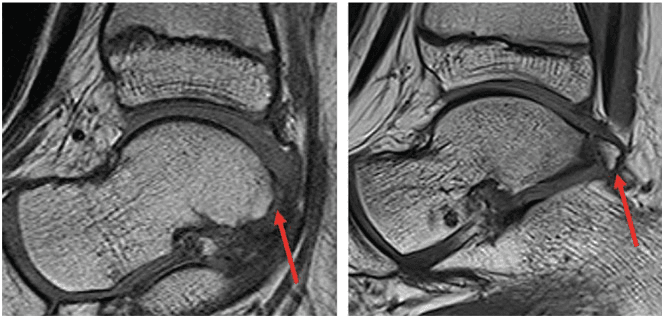
Cross-sectional imaging. MRI shows bone marrow oedema in the os trigonum and adjacent talus, FHL tenosynovitis and soft-tissue inflammation. CT shows degenerative change at the synchondrosis and is useful for surgical planning. SPECT-CT can confirm a symptomatic os trigonum, with increased uptake localising to the ossicle.
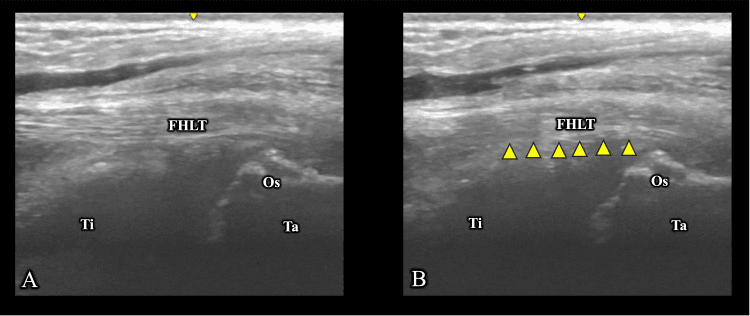
The diagnostic injection. Because an os trigonum is a common incidental finding, the injection is used to prove that it is the pain generator. A small volume of local anaesthetic, with or without corticosteroid, is placed under ultrasound or fluoroscopic guidance into the posterior ankle around the os trigonum or posterior recess. Image guidance matters because the target is deep and the posterior tibial neurovascular bundle and the FHL are close.
Reading the result. Repeat the posterior impingement test and the patient's aggravating activity immediately after the local anaesthetic. Pain relief greater than roughly 70% confirms the ossicle (or posterior impingement) as the source and predicts a good response to excision. Poor relief should send you back to the differential: Achilles, peroneal, primary FHL or other pathology.
Management
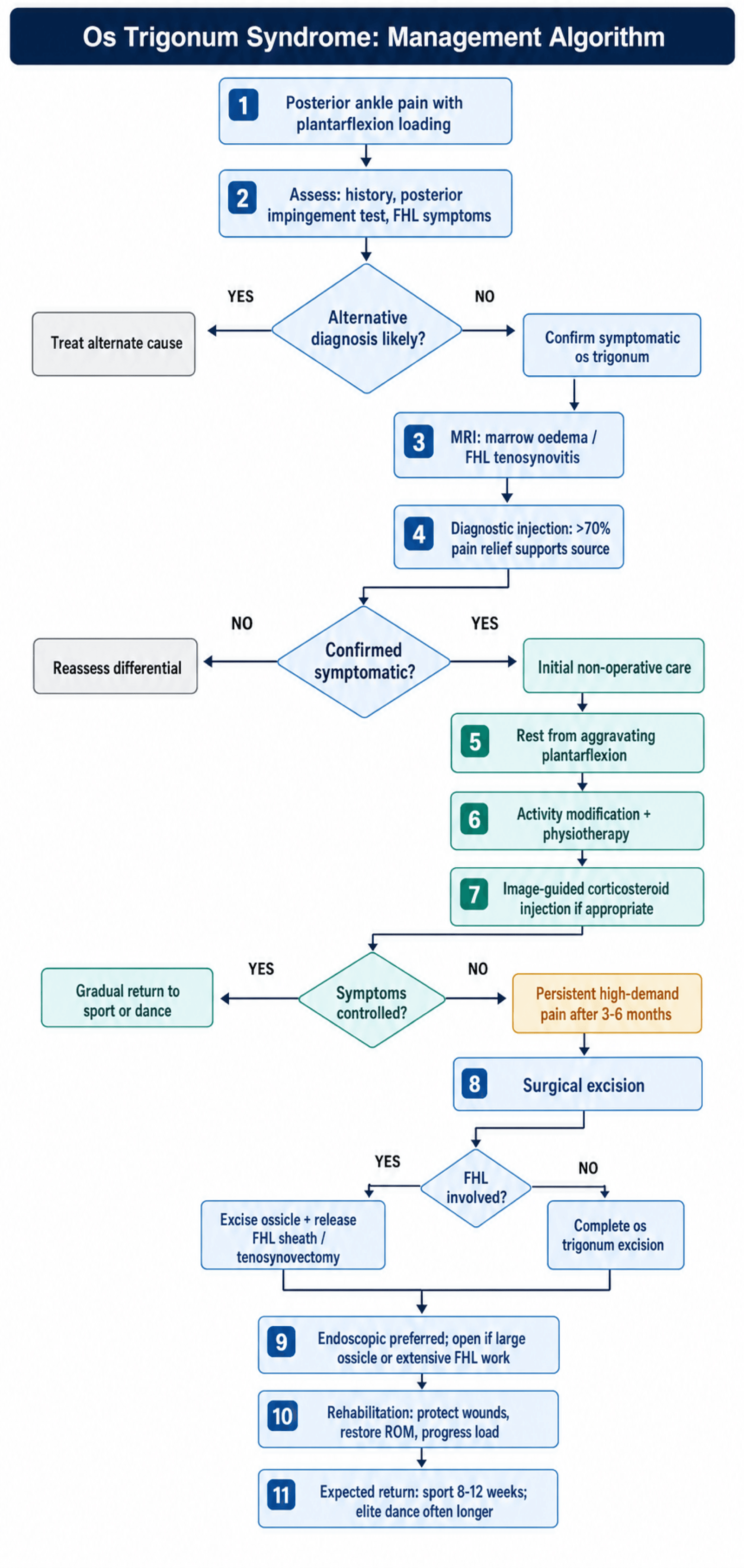
Conservative care. Rest from plantarflexion activities, temporary modification of dance or sport technique, and physiotherapy to address any muscular imbalance while avoiding excessive plantarflexion. When symptoms are controlled, the patient returns gradually to sport or dance. Conservative treatment may be sufficient for some patients, but dancers and athletes often need surgery to return to full activity.
The therapeutic injection. Corticosteroid in the posterior ankle may give weeks to months of relief, and may let an athlete finish a season or a dancer bridge to off-season surgery. It controls symptoms without curing them: the mechanical impingement persists.
The FHL caveat. Corticosteroid deposited close to the FHL tendon carries a theoretical risk of tendon weakening or rupture, catastrophic in a dancer who depends on the FHL for en pointe. Keep the injection in the posterior recess rather than the tendon, limit repetition, and counsel accordingly.
When to operate. Surgery is indicated when conservative treatment has failed, and for athletes and dancers who need to return to plantarflexion activities.
Endoscopic or open. Endoscopic excision is the preferred technique, through a two-portal posterior approach (posterolateral and posteromedial): the os trigonum is excised entirely and the FHL sheath released if it is involved, with a faster recovery than open surgery. Open excision, through a posteromedial or posterolateral approach, gives similar outcomes but a longer recovery.
Outcome. Results are excellent, with 85-95% returning to sport or dance. Rehabilitation follows, with an expected return to sport at 8-12 weeks; elite dance often takes longer.
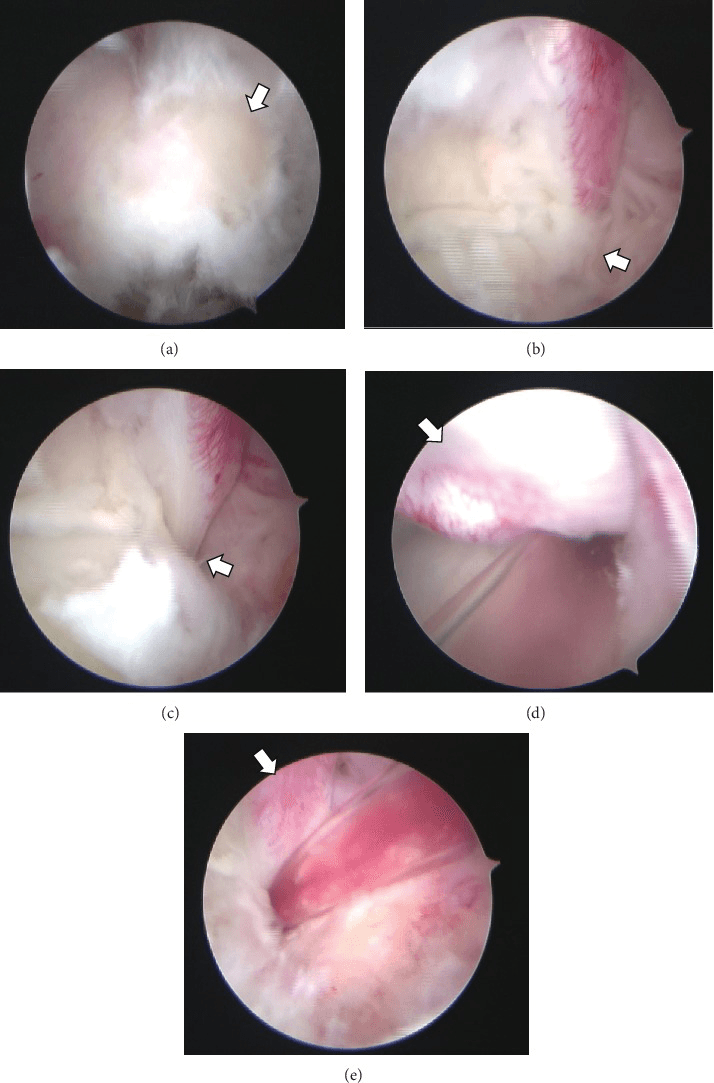
The Two-Portal Hindfoot Endoscopy Technique
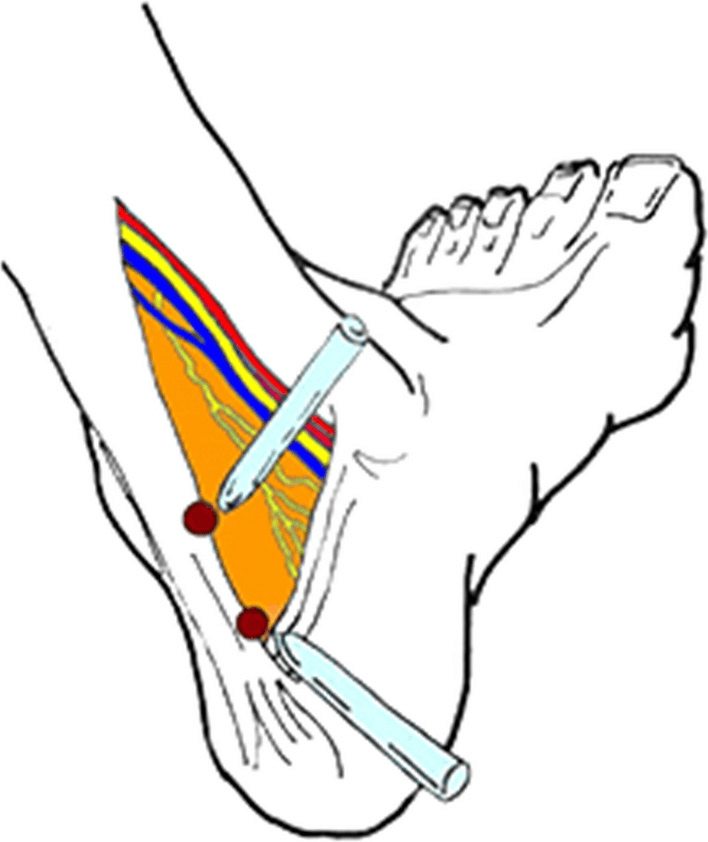
Positioning. The patient lies prone with the foot over the end of the table so the ankle can be dorsiflexed and plantarflexed, with a thigh tourniquet and a support under the lower leg. This is the van Dijk technique.
The portals. Both are made at the level of the fibular tip.
- Posterolateral (viewing) portal, made first: just lateral to the Achilles tendon at or just above the tip of the lateral malleolus, directed towards the first interdigital web space. The sural nerve and short saphenous vein lie lateral, so hug the Achilles.
- Posteromedial (instrument) portal: just medial to the Achilles at the same level and also aimed at the first web space, directed onto the shaft of the arthroscope and then slid down to bone.
The FHL is the medial safety line. The posterior tibial neurovascular bundle lies medial to the FHL, so all dissection is kept lateral to (or directly on) the FHL. Identify the tendon by moving the hallux and watching its excursion, and do not cross it: working medial to it risks the tibial nerve and vessels.
The steps.
- Debride the posterior capsule and scar to expose the ossicle and its synchondrosis.
- Release the synchondrosis and remove the entire os trigonum.
- If tenosynovitis coexists, open the FHL sheath and release any stenosis, preserving tendon bulk.
- Move the hallux through its range to confirm free FHL gliding.
The same two portals also give access to the posterior subtalar and tibiotalar joints.
Complications
Posterior hindfoot surgery is generally low-morbidity, but its risks are specific.
- Neurovascular injury: the sural nerve and short saphenous vein at the posterolateral portal; the posterior tibial neurovascular bundle and its medial calcaneal and plantar branches posteromedially.
- Incomplete excision: a retained ossicle remnant or an under-resected Stieda process leaves persistent impingement and pain.
- Persistent FHL symptoms: if the sheath is not released when tenosynovitis coexists, triggering and posteromedial pain continue.
- FHL weakness: over-aggressive tendon debridement reduces hallux plantarflexion power, functionally catastrophic for a dancer.
- Stiffness and scarring: fibrosis can limit the plantarflexion the surgery was meant to restore; early mobilisation mitigates it.
- Wound complications and infection: low overall. Minor wound problems are more frequent after open approaches, roughly 10% in open dancer series and mostly self-limiting.
- Rate by approach: systematic review data give approximately 12.7% for open lateral, 3.9% for open medial and 4.8% for arthro-endoscopic surgery.
Guidelines, Registries & Global Practice
Global Epidemiology
- Os trigonum is the most common accessory ossicle of the foot, reported in roughly 2 to 14% of feet across radiographic studies (9.8% in a 1651-foot series), with wide variation by population and imaging method; bilateral in about half.
- The vast majority are asymptomatic incidental findings - symptomatic posterior ankle impingement is concentrated in plantarflexion-loading athletes: ballet dancers (the dominant group in the literature, around 62% of reported surgical cases) and footballers/downhill runners.
Where Practice Guidance Actually Comes From
No orthopaedic society has published a guideline on os trigonum syndrome or posterior ankle impingement. This is worth stating plainly, because pages on this condition frequently present a side-by-side table of society positions, and those positions are not traceable to any document. ESSKA-AFAS has issued international consensus statements — on peroneal tendon pathologies and on chronic lateral ankle instability — but not on posterior ankle impingement. AO Foundation surgical-technique material describes hindfoot endoscopy as an operative option; it is a technique resource, not a guideline, and it does not adjudicate indications.
What actually exists is a consistent pathway emerging from Level IV and V evidence, which is what the Evidence Base above is built from:
- What supports it
- Prevalence of roughly 10% in asymptomatic feet (Candan 2022) means presence alone proves nothing; a diagnostic injection is the practical test
- What supports it
- Every operative series on this page enrolled only patients in whom conservative care had already failed — so none of them tests surgery against conservative treatment
- What supports it
- Lowest reported complication rates are arthro-endoscopic 4.8% and open medial 3.9%, against open lateral 12.7% (Ribbans 2015)
- What supports it
- FHL tenosynovitis and posterior impingement travel together in dancers (Hamilton 1996); the posterior endoscopic route permits a more extensive release (Ahn 2013)
The strength of that pathway is the agreement of uncontrolled series, not the authority of a guideline. There is no randomised trial of any step in it.
Registry Note
This is a soft-tissue/bony excision rather than an implant procedure, so it is not captured by arthroplasty registries (NJR, AJRR, AOANJRR). The evidence base is therefore limited to single-centre series and systematic reviews; there is no registry-level survival or revision data.
High- vs Limited-Resource Practice Variation
- Well-resourced settings: MRI and SPECT-CT for confirmation, image-guided diagnostic/therapeutic injection, and posterior endoscopic excision with dancer-specific rehabilitation.
- Limited-resource settings: diagnosis rests on history, posterior impingement test and plain lateral radiograph; treatment is conservative or open excision, which remains safe and effective where endoscopic equipment or expertise is unavailable.
Related pages: Posterior Ankle Impingement for the syndrome as a whole, of which the os trigonum is one bony cause alongside a Stieda process and soft-tissue impingement, and Ankle Impingement Syndromes for the anterior and anterolateral counterparts; Flexor Hallucis Longus Anatomy for the tendon that runs in the groove between the talar tubercles and is released in the same operation; Posterior Process Talus Fractures and Lateral Process Talus Fractures for the Shepherd and snowboarder's fractures an os trigonum is misread as; Haglund Syndrome and Achilles Tendinopathy for the other causes of posterior heel pain; and Subtalar Arthritis for the joint entered during posterior endoscopy.
Controversies & Areas of Uncertainty
The evidence. The evidence base runs from Level V to Level II: case series and one Level II prospective comparison, with no randomised trials. Most recommendations are therefore expert consensus.
Which approach. Ahn et al found no functional difference between subtalar arthroscopic and posterior endoscopic excision, and open posteromedial series (Heyer & Rose) report comparable results. The posterior two-portal endoscopic technique dominates practice for its faster return and lower morbidity, but no approach has proven superior long-term outcomes. Open access is still favoured for very large ossicles or extensive FHL work.
How much to do to the FHL. Posterior impingement and FHL tenosynovitis frequently coexist. There is no consensus on when simple sheath release suffices and when the tendon needs debridement, with over-debridement risking the weakness listed above.
Proving the ossicle is symptomatic. Opinion varies on whether MRI bone marrow oedema, a diagnostic injection or SPECT-CT should be mandatory before surgery. Most authors require at least one positive correlating test.
How long to persist. The optimal length of conservative treatment, commonly quoted as 3 to 6 months, and the role and repetition of corticosteroid injection are not standardised.
Bilateral disease. No comparative data exist on staged versus simultaneous surgery. Staging is preferred pragmatically in high-demand athletes, to avoid bilateral non-weight-bearing and bilateral complication risk.
Exam Viva Scenarios
Practise clinical reasoning and management decisions out loud
“A 20-year-old ballet dancer has posterior ankle pain when going en pointe. Lateral X-ray shows an os trigonum. How do you manage her?”
“You are seeing a 24-year-old semi-professional footballer in your sports injury clinic who has been referred by the team physiotherapist for persistent posterior right ankle pain. He describes a 6-month history of progressive aching pain in the back of his right ankle, particularly after training sessions and matches. The pain is worse with running and kicking activities. He initially thought it was Achilles tendon pain and has tried eccentric loading exercises and a period of rest without significant improvement. He now reports the pain is deep in the back of the ankle rather than at the Achilles insertion. He is frustrated as it is affecting his performance and he has missed several matches. On examination, he has tenderness to deep palpation in the posterior ankle between the Achilles tendon and peroneal tendons. There is mild fullness in this area but no obvious swelling. His Achilles tendon appears normal with no nodularity or insertion tenderness. The retrocalcaneal bursa is non-tender. You perform a posterior impingement test (passive forced plantarflexion) which reproduces his deep posterior ankle pain. You also note he has some discomfort with resisted plantarflexion of the hallux (testing FHL function), but no triggering or clicking of the great toe. Active and passive ankle range of motion is full and pain-free except at extremes of plantarflexion. He has brought his plain radiographs from the sports medicine physician who initially saw him. The lateral ankle X-ray report states: 'Normal alignment. No fracture. Accessory os trigonum noted posterior to the talus. Achilles tendon insertion appears normal. No bony spurs.' The radiologist has noted in brackets: 'Os trigonum is a normal variant present in 7-14% of the population and is usually asymptomatic.' The patient is confused by this report and asks: (1) The radiologist says this bone is normal and usually doesn't cause problems - so is this my problem or is something else causing my pain? (2) How do we know if this os trigonum is the cause of my pain or just an incidental finding? (3) If it is the problem, what are my treatment options and how long will I be out of football? (4) Is there any risk of making it worse if I keep playing through the pain?”
“You are seeing a 22-year-old professional ballet dancer in your complex foot and ankle clinic. She is a principal dancer with a major ballet company and has been referred by the company physician for evaluation of bilateral posterior ankle pain that is significantly affecting her ability to perform. Her RIGHT ankle symptoms started 18 months ago with intermittent pain when en pointe (extreme plantarflexion on the tips of her toes). Over time, this has progressed to constant aching pain and she now describes two distinct components: (1) Deep posterior ankle pain, particularly when going en pointe or during relevé (rising onto the ball of the foot), and (2) Triggering and catching of her great toe, particularly when pushing off from en pointe position. She describes that sometimes her great toe 'gets stuck' in a flexed position and she has to manually extend it - this is extremely problematic during performances. She has also developed similar but less severe symptoms in her LEFT ankle over the past 6 months. She is understandably very anxious as her career is at stake - she is scheduled to perform the lead role in Swan Lake in 6 months and needs to be at full capacity. She has tried extensive conservative management including rest (took 3 months off from performing), custom orthotics, multiple physiotherapy programs, and two series of corticosteroid injections (one in each ankle) which provided only 2-3 weeks of relief each time. She has been seen by another orthopaedic surgeon who recommended surgery but didn't give her clear advice about what exactly needed to be done or the timeline for return to dance. On examination of the RIGHT ankle: There is deep posterior ankle tenderness between the Achilles and peroneal tendons. Forced passive plantarflexion reproduces her deep posterior pain (positive impingement test). When you ask her to actively flex and extend her great toe, you can clearly see and feel TRIGGERING of the FHL tendon with a palpable snap in the posterior ankle. Resisted plantarflexion of the hallux is painful. Passive forced extension of the hallux with the ankle in plantarflexion also reproduces posterior ankle pain (stretches the FHL). Her LEFT ankle examination is similar but less severe - positive impingement test, mild FHL triggering but not as pronounced. You review the MRI scans she brought: RIGHT ankle MRI report: 'Os trigonum present with extensive bone marrow edema (high T2 signal) throughout the ossicle and at the synchondrosis with the talus. Moderate joint effusion in posterior ankle. Flexor hallucis longus tendon is markedly thickened (diameter 8mm, normal less than 6mm) with high T2 signal within the tendon consistent with tendinopathy. There is fluid surrounding the FHL tendon sheath extending from the posterior ankle to the level of the sustentaculum tali (tenosynovitis). The FHL appears stenosed/constricted in the fibro-osseous tunnel between the medial and lateral tubercles of the posterior talus. Findings consistent with os trigonum syndrome with severe FHL tendinopathy and stenosing tenosynovitis.' LEFT ankle MRI report: 'Os trigonum present with mild bone marrow edema. Mild FHL tendinopathy and tenosynovitis, less severe than right side. No significant stenosis.' The patient has multiple questions: (1) The MRI mentions both the os trigonum and the FHL tendon problems - which one is causing my triggering, and do you need to treat both? (2) I have pain in both ankles - do I need surgery on both? If yes, can you do both together or do I need two separate operations? (3) What exactly does the surgery involve and how long will I be unable to dance? I need to know if I can make my Swan Lake performance in 6 months. (4) What are the risks to my FHL tendon? I've read online about dancers who had surgery and developed weakness in their great toe which affected their ability to dance en pointe. (5) Is there any chance this could end my dancing career? The previous surgeon didn't give her clear answers and she is extremely anxious.”
Key Facts
- Unfused lateral tubercle (7-14%)
- Bilateral in 50%
- Dancers and athletes affected
- Nutcracker with plantarflexion
FHL Involvement
- Runs adjacent to os trigonum
- Tenosynovitis common
- Triggering of great toe
- Address during surgery
Diagnosis
- Lateral X-ray: Ossicle posterior to talus
- MRI: Bone marrow edema
- Posterior impingement test
- Injection confirms diagnosis
Treatment
- Conservative: Rest, injection
- Surgical: Endoscopic excision
- Address FHL if involved
- 85-95% return to sport
Evidence Base
van Dijk, Scholten & Krips
- Described the 2-portal hindfoot endoscopic approach in the prone position
- Index case: professional ballet dancer with bilateral os trigonum plus FHL tendinitis
- Os trigonum excised AND flexor hallucis longus released through the same portals
- Patient resumed professional dancing within 2 months of surgery
Morelli et al
- 12 professional ballet dancers, endoscopic 2-portal excision after failed conservative care
- Mean AOFAS hindfoot score improved 67.8 to 96; Tegner 4.3 to 9
- Mean return to sport 8.7 weeks (range 8 to 10)
- No major complications at mean 38.9-month follow-up
Ahn, Kim & Kim
- Retrospective cohort: subtalar arthroscopic (n=16) vs posterior endoscopic (n=12) excision
- Both groups improved VAS, AOFAS and Maryland Foot Score significantly with no difference between them
- Return to sport 7.5 vs 8.0 weeks; the arthroscopic route was more demanding for large ossicles
- Posterior endoscopic approach allowed more extensive FHL release
Heyer & Rose
- 40 ankles in 38 dancers, open posteromedial excision with FHL tenolysis
- Mean pain fell from 7.7/10 to 0.6/10; 94.6% returned to pre-injury dance level
- 42.5% had associated FHL symptoms, all relieved postoperatively
- No neurovascular injury; 10% minor wound complications that resolved