High-energy carpal instability | lateral X-ray diagnosis | urgent reduction | definitive fixation
- 25% missed initially - always look at lateral wrist X-ray
- Lateral X-ray key - capitate should be colinear with radius and lunate
- Lesser arc = pure ligamentous, Greater arc = with fractures (trans-scaphoid)
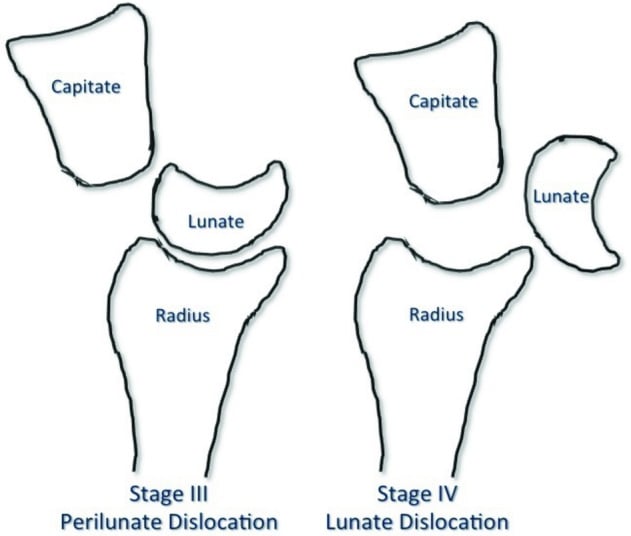
- Lunate maintains contact with radius in perilunate; loses contact in lunate dislocation
- Urgent reduction - median nerve at risk in carpal tunnel
- “On lateral: look for colinearity of radius-lunate-capitate
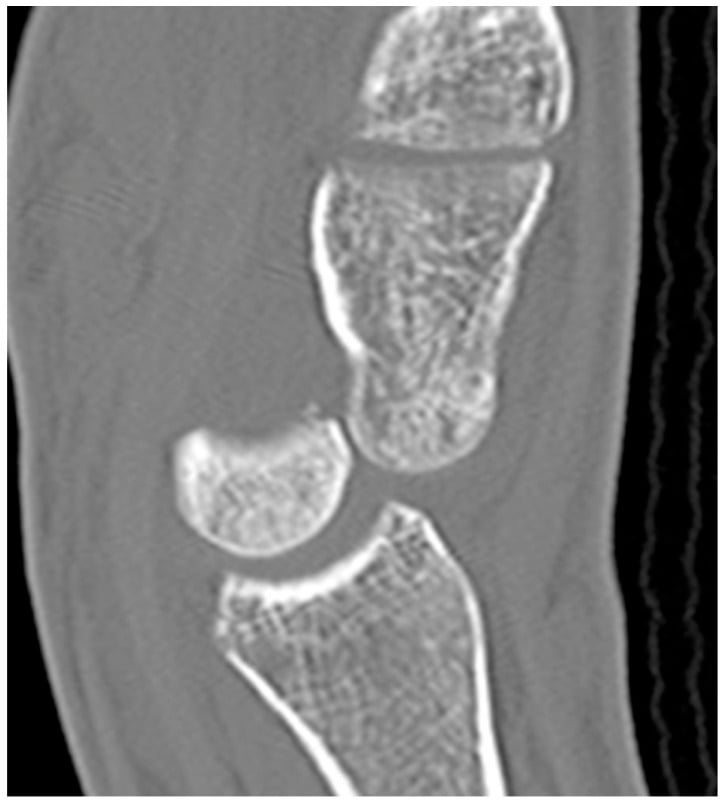
- “Spilled teacup sign = lunate dislocates volarly (Stage IV)
- “Trans-scaphoid perilunate = greater arc injury, may have a better prognosis than pure ligamentous
- “Acute carpal tunnel syndrome common - median nerve compression
Overview and Epidemiology
Perilunate dislocations are high-energy injuries at the most severe end of the carpal instability spectrum. Clinically the injury is usually not subtle; the subtlety is that the radiographs are often misread, and up to 25% are not diagnosed at first presentation.
Mechanism. High-energy hyperextension of the wrist. Force transmitted through the palm makes the ligaments fail in sequence, or in greater-arc injuries fractures through bone, and the energy needed to do either means these are not minor injuries.
- Motor vehicle accidents
- Falls from height
- Industrial injuries
- Sports injuries: a fall on the outstretched hand with significant force
Anatomy and Pathomechanics
The carpal rows. The proximal row is the scaphoid, lunate and triquetrum, with the pisiform; the distal row is the trapezium, trapezoid, capitate and hamate. The lunate is the central keystone and articulates with the radius, and the head of the capitate articulates with the lunate's concavity.
The ligaments. The scapholunate (SL) ligament connects scaphoid to lunate, and its dorsal portion is the strongest. The lunotriquetral (LT) ligament connects lunate to triquetrum. Between the lunate and the capitate, on the volar side, lies the space of Poirier, a weak area.
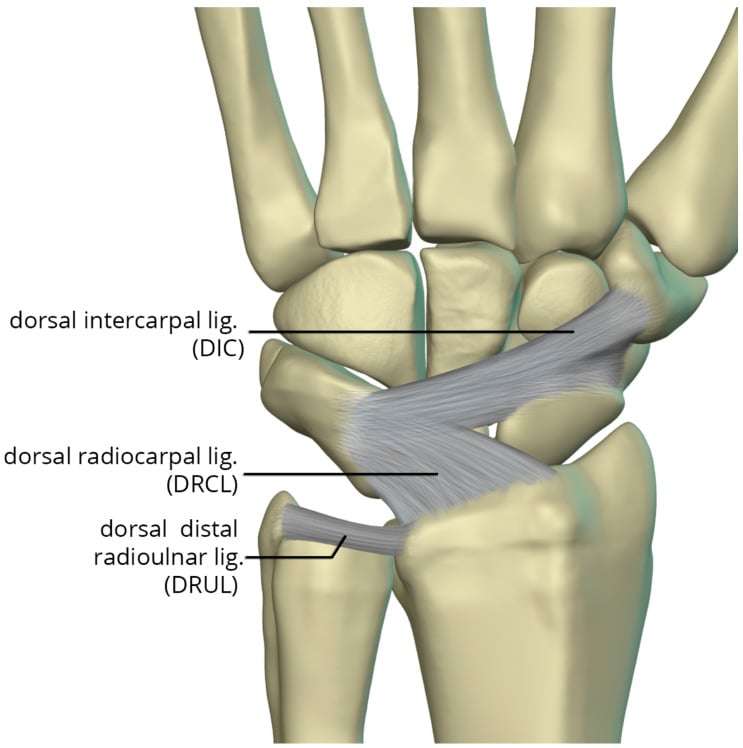
Carpal malalignment. Measured on the true lateral, the normal angles are:
- Scapholunate angle about 30-60 degrees (mean ~47)
- Capitolunate angle under about 30 degrees
- Radiolunate angle under about 15 degrees
DISI (dorsal intercalated segment instability) follows scapholunate dissociation. The unrestrained lunate extends (dorsiflexes) and the scaphoid flexes, so the scapholunate angle exceeds 70 degrees, the radiolunate angle is over 15 degrees dorsal and the capitolunate angle increases. This is the pattern that follows a perilunate or SL injury.
VISI (volar intercalated segment instability) typically accompanies lunotriquetral dissociation. The lunate flexes (volarflexes), the scapholunate angle is low, under about 30 degrees, and the radiolunate tilt is volar.
A DISI deformity on the post-reduction lateral signals inadequate reduction or an unhealed SL ligament, and persistent DISI is the radiographic forerunner of chronic instability and SLAC collapse.
Classification Systems
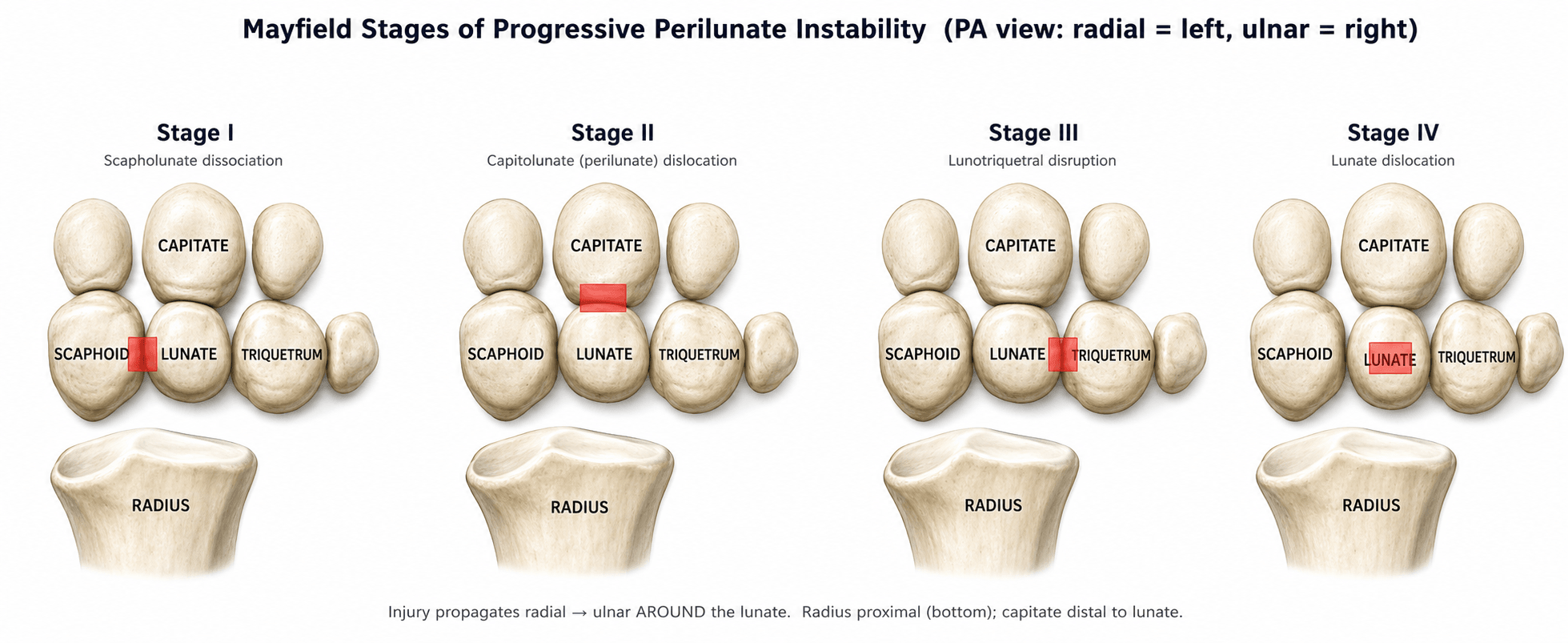
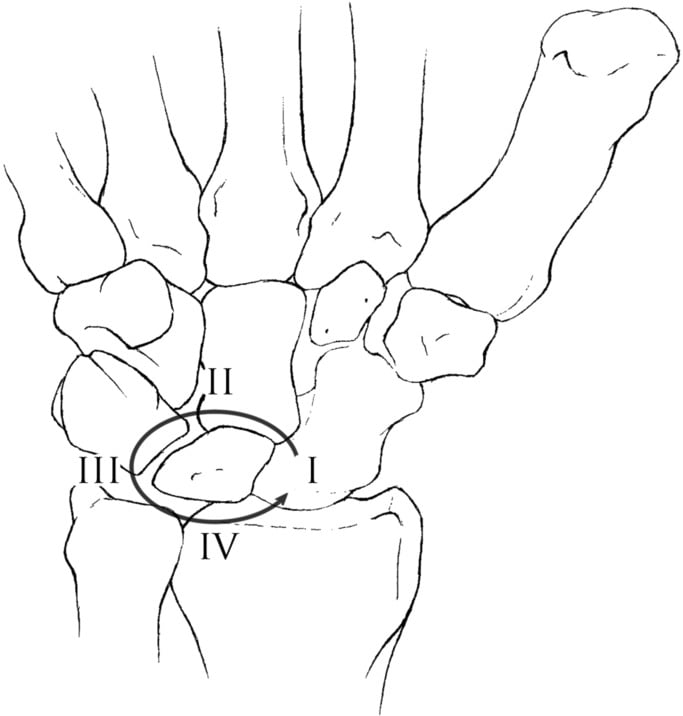
Progressive perilunar instability. Mayfield's stages describe an injury that propagates in an arc around the lunate, from the radial to the ulnar side. Stage I is the SL injury alone; each later stage adds a failed ligament, until in Stage IV the lunate is pushed volarly into the carpal tunnel.
- What has failed
- Scapholunate ligament (scapholunate dissociation)
- Radiograph
- SL widening (Terry Thomas sign)
- What has failed
- + Lunocapitate joint, through the space of Poirier (capitolunate dislocation)
- Radiograph
- Capitate starts to dislocate dorsally
- What has failed
- + Lunotriquetral ligament
- Radiograph
- Complete perilunate dislocation
- What has failed
- + Dorsal radiocarpal ligament
- Radiograph
- Lunate dislocates volarly: lunate dislocation, the most severe stage
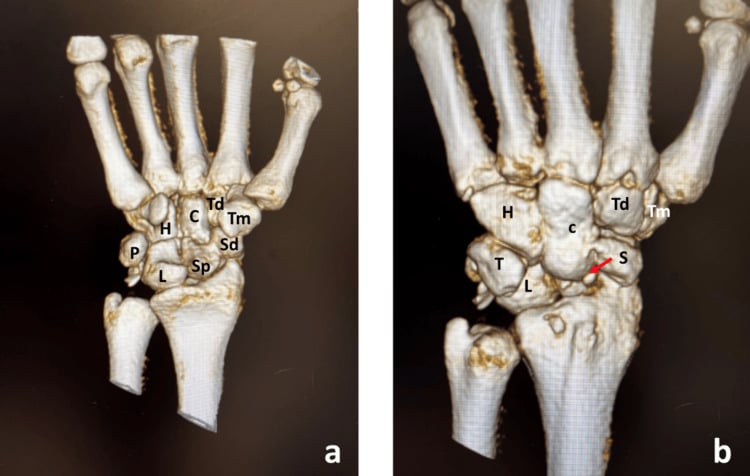
Clinical Presentation and Assessment
Assessment must document mechanism, timing, median nerve function, skin condition and associated carpal fractures, before and after reduction.
- Why It Matters
- Fall from height, motor vehicle crash, motorcycle injury and industrial trauma imply high-energy carpal disruption.
- Management Consequence
- Look beyond the wrist: associated limb, spine and polytrauma injuries may coexist.
- Why It Matters
- Acute injuries are usually reducible and reconstructable; delayed injuries develop contracture, chondral injury and carpal malalignment.
- Management Consequence
- Acute reduction and fixation differs from delayed reconstruction or salvage.
- Why It Matters
- The volar lunate or swollen carpal tunnel may compress the median nerve.
- Management Consequence
- Document before reduction; persistent symptoms after reduction push toward urgent carpal tunnel release.
- Why It Matters
- Manual workers need realistic counselling about grip loss, stiffness and delayed arthritis.
- Management Consequence
- Changes fixation/reconstruction expectations and return-to-work planning.
- Why It Matters
- Old SL injury, scaphoid nonunion or arthritis may change the interpretation.
- Management Consequence
- Pre-existing pathology may alter reconstruction versus salvage decisions.
- How To Examine
- Inspect for swelling, dorsal carpal prominence, volar fullness, skin puckering, open wound, bruising and finger posture.
- What It Means
- Massive swelling or skin compromise increases urgency. Volar fullness may reflect lunate displacement into the carpal tunnel.
- How To Examine
- Palpate distal radius, scaphoid, SL interval, lunate region, triquetrum, metacarpal bases and DRUJ. Avoid repeated painful stress before imaging.
- What It Means
- Localises fracture components and associated carpal/metacarpal injury.
- How To Examine
- Assess active finger flexion/extension first, then gentle wrist motion only if tolerated. Do not force a locked wrist.
- What It Means
- Finger stiffness and tendon irritation matter; a mechanical wrist block supports carpal dislocation.
- How To Examine
- Check thumb, index, middle and radial ring-finger sensation, two-point discrimination if possible, thenar power and pain with passive finger extension.
- What It Means
- Abnormal or worsening median nerve function is an emergency finding.
- How To Examine
- Capillary refill, radial/ulnar pulses, hand temperature, escalating pain and forearm compartment signs.
- What It Means
- Rare but important in high-energy trauma.
- How To Examine
- Repeat median nerve, vascular status, skin tension and radiographic alignment.
- What It Means
- Improvement supports decompression by reduction; persistent median symptoms need operative decompression.
The median nerve. Acute carpal tunnel syndrome occurs in up to 25% of cases. The dislocated carpal bones compress the median nerve in the carpal tunnel, which makes this an urgent indication for reduction, and delay risks permanent nerve damage.
Do not simply write "neurovascularly intact." For this injury, explicitly document median nerve symptoms, two-point discrimination where possible, thenar power and whether symptoms improve after reduction; the release decision that follows is set out under Management.
Investigations
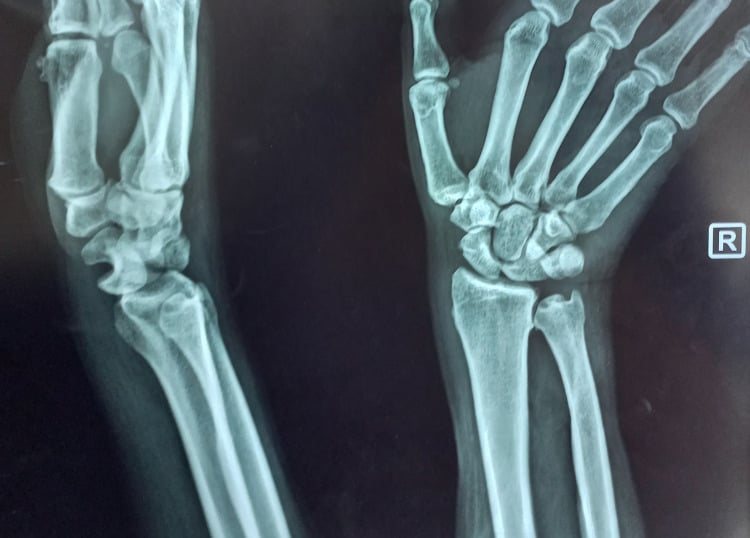
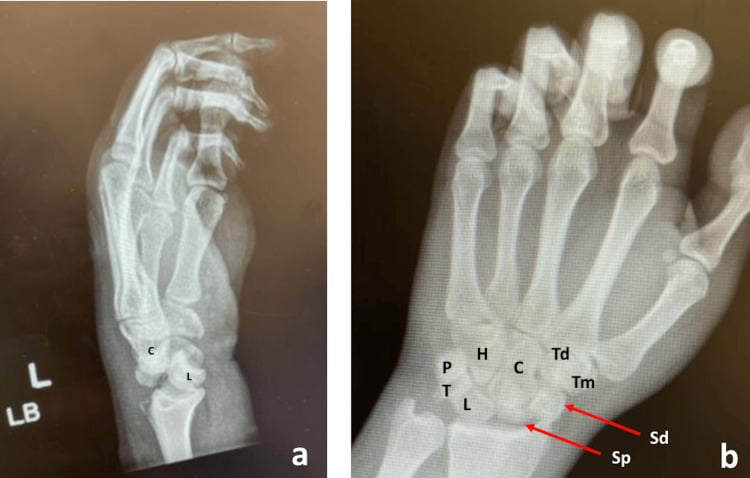
Radiographs. Request PA, true lateral and oblique wrist radiographs immediately. The injury is subtle on the PA view and the diagnosis depends on sagittal carpal alignment, so do not accept a poor lateral film. If the mechanism is high energy or the radiograph shows any carpal crowding, add CT of the wrist to define greater-arc fractures and plan fixation.
- What To Check
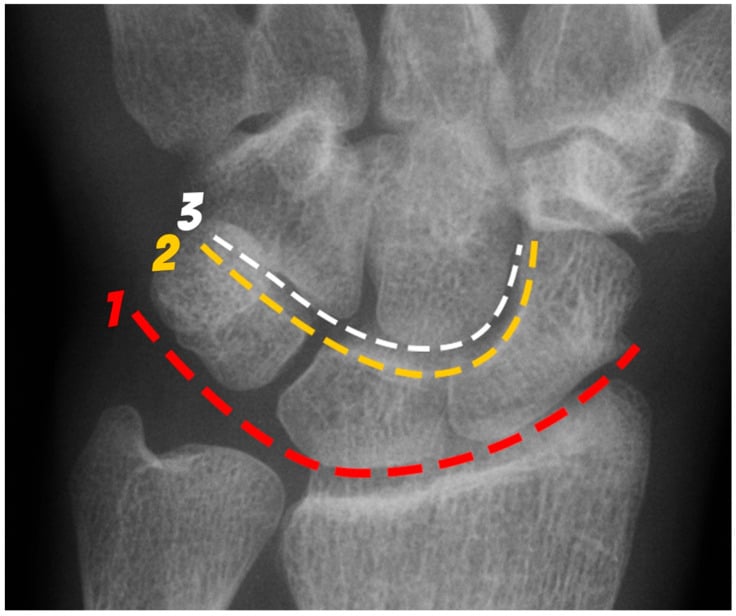
- Trace Gilula arcs, look for SL widening, LT widening, carpal overlap, radial styloid/scaphoid/capitate/triquetral fractures and ulnar styloid injury.
- Abnormal Finding
- Broken arcs, crowded proximal carpal row or associated carpal fracture should trigger lateral review and CT.
- What To Check
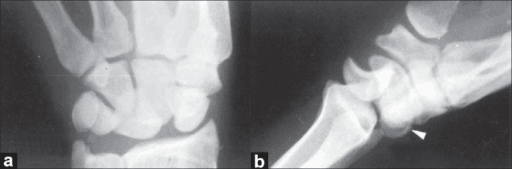
- Assess whether radius, lunate and capitate are colinear, stacked like cups. The lunate should articulate with both radius and capitate.
- Abnormal Finding
- In perilunate dislocation the capitate lies dorsal to the lunate while the lunate remains in the lunate fossa.
- What To Check
- Look for the lunate losing its normal radius relationship and rotating volarly.
- Abnormal Finding
- The classic spilled-teacup appearance represents Stage IV injury and may compress the median nerve.
- What To Check
- Look for scaphoid, triquetral, capitate, hamate or metacarpal base fracture components.
- Abnormal Finding
- Fractures convert the injury into a greater-arc pattern and change fixation.
- What To Check
- Repeat PA and lateral after closed reduction.
- Abnormal Finding
- Residual capitate-lunate malalignment means reduction is inadequate or unstable.
Gilula's lines. Three smooth arcs traced on the PA film. Disruption indicates carpal instability or dislocation.
- Arc 1: the proximal surface of the proximal carpal row
- Arc 2: the distal surface of the proximal carpal row
- Arc 3: the proximal surfaces of the capitate and hamate
A PA wrist film can look deceptively acceptable. The lateral film is the safety check: if the capitate is not seated on the lunate, the wrist is not reduced.
- Indication
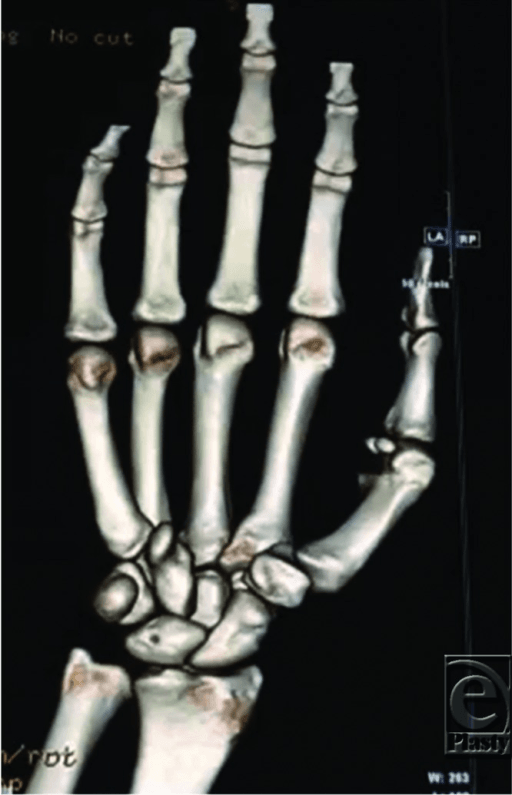
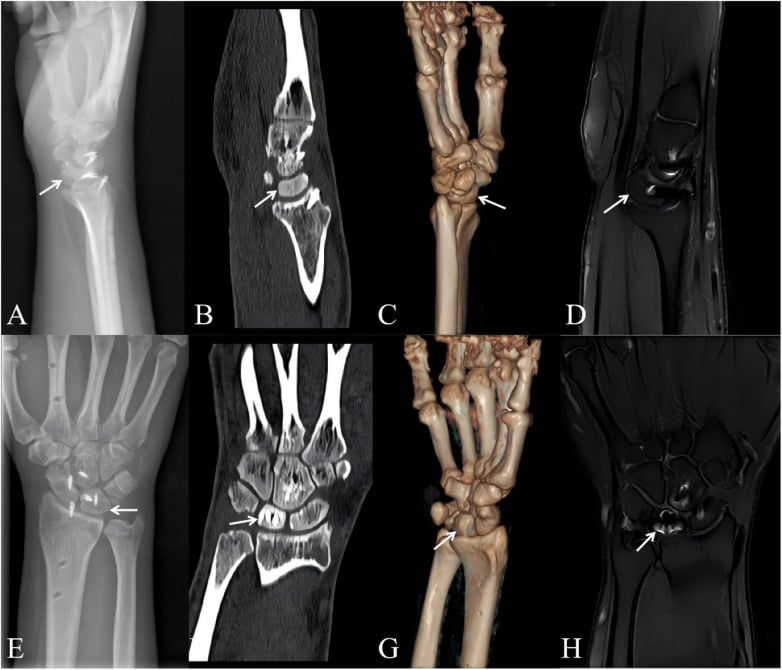
- High-energy injury, suspected greater-arc fracture, poor radiograph quality, preoperative planning or post-reduction confirmation.
- What It Changes
- Defines scaphoid, capitate, triquetral, radial styloid and articular fragments; guides fixation approach.
- Indication
- Subacute or chronic cases when ligament/cartilage viability, occult fracture or osteonecrosis is uncertain.
- What It Changes
- Rarely needed before urgent reduction; more useful when planning delayed reconstruction versus salvage.
- Indication
- Reduction assessment and intraoperative carpal alignment.
- What It Changes
- Confirms capitate-lunate reduction, SL/LT interval control and K-wire trajectory.
- Distinguishing Features
- Capitate dorsal to lunate on lateral; lunate stays in radial fossa; broken Gilula arcs.
- Key Discriminator
- Lunate maintains radius contact; capitate displaced dorsally.
- Distinguishing Features
- Spilled-teacup lunate tipped volarly; loses radius contact; often acute carpal tunnel syndrome.
- Key Discriminator
- Lunate ejected volarly out of the radial fossa.
- Distinguishing Features
- Terry Thomas sign and SL angle greater than 70 degrees, but normal capitolunate colinearity on lateral.
- Key Discriminator
- No carpal dislocation - radius-lunate-capitate remain colinear.
- Distinguishing Features
- Anatomical snuffbox/scaphoid tubercle tenderness; intact Gilula arcs and carpal alignment.
- Key Discriminator
- No dislocation; carpal arcs preserved.
- Distinguishing Features
- Metaphyseal cortical break, dorsal/volar tilt; carpus moves with the distal fragment.
- Key Discriminator
- Fracture line is in the radius, not a carpal malalignment.
- Distinguishing Features
- Normal radiographs including a good lateral; tenderness without bony or carpal malalignment.
- Key Discriminator
- Diagnosis of exclusion only after an adequate lateral film.
Management
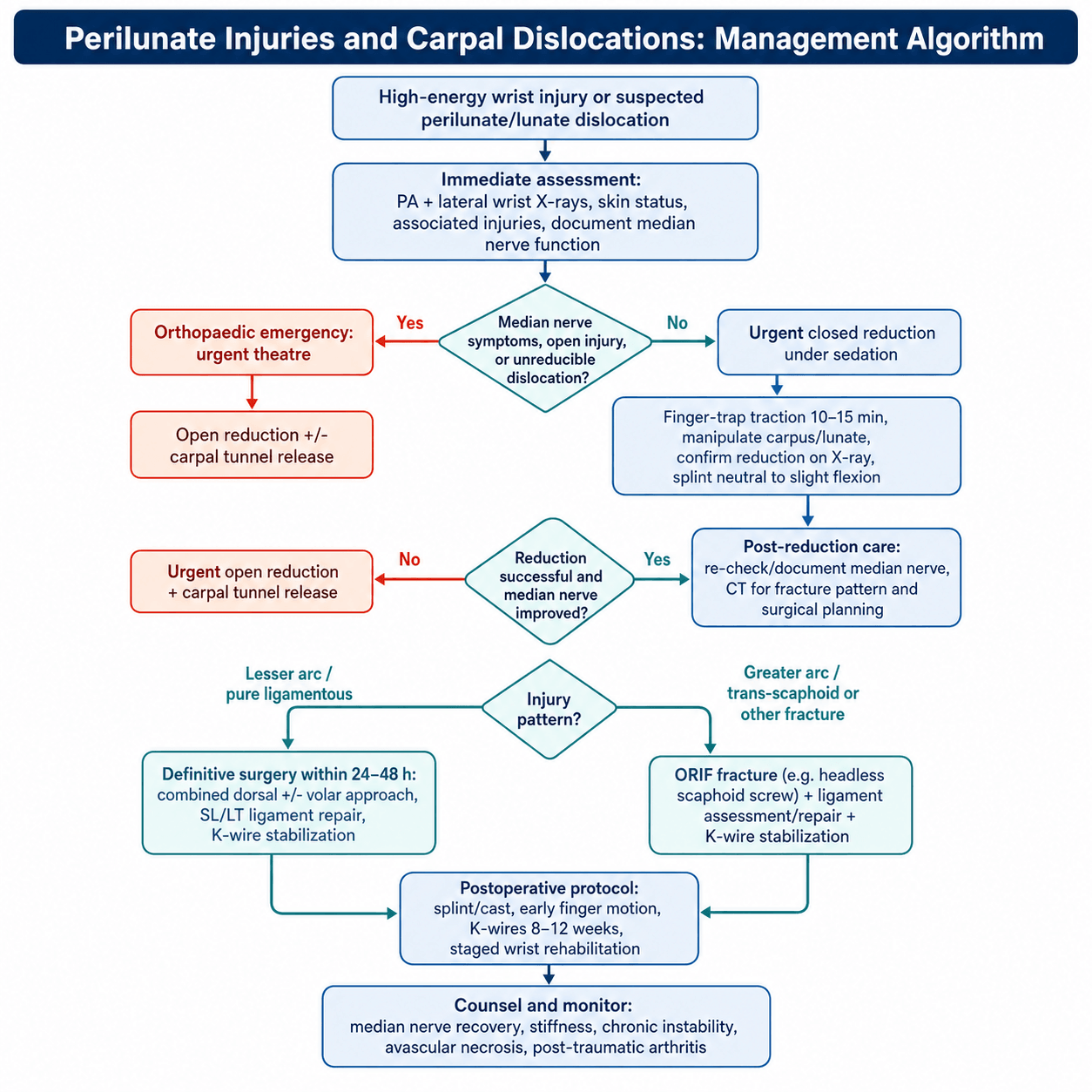
Reduce urgently. Closed reduction is indicated for every perilunate and lunate dislocation and may be done in the emergency department under sedation. Before it, record the median nerve, skin integrity and associated injuries, and have adequate PA and lateral films.
- Finger-trap traction for 10-15 minutes
- Extend the wrist while applying pressure to the carpus
- For a lunate dislocation, press directly on the dislocated lunate from the palmar side
- Flex the wrist to lock the reduction
- Confirm with a radiograph
- Splint the wrist in neutral to slight flexion
After reduction, re-examine the median nerve and arrange definitive surgery.
Who needs surgery. Essentially all perilunate and lunate dislocations, even after a successful closed reduction, because closed reduction alone has unacceptable outcomes. The goals are anatomic reduction, ligament repair, fixation of any greater-arc fracture, and fixation stable enough to allow early motion. Surgery is an emergency for:
- An unreducible dislocation
- Median nerve symptoms persisting after reduction
- An open injury
The approach. Most surgeons prefer a combined dorsal and volar approach. The dorsal limb serves ligament repair (SL, LT), assessment of carpal reduction and K-wire stabilisation; the volar limb gives carpal tunnel release where needed, direct visualisation of the lunate and capitate reduction, and assessment and repair of the volar ligaments. A dorsal approach alone may be adequate for lesser-arc injuries and some surgeons use it in selected cases, but it must still achieve an adequate reduction.
Releasing the carpal tunnel: the evidence. A 2025 review devoted to this question surveyed the small literature on median neuropathy complicating perilunate dislocation and concluded that the treatment of acute median nerve compression in this setting is controversial, proposing a treatment algorithm precisely because the indication is unsettled (DOI). In many patients median symptoms settle once the carpus is reduced, which is why routine release in every case has never become doctrine.
The discriminator is what the nerve does after reduction. Document the nerve, reduce urgently, then examine it again. Symptoms that improve tell you the reduction itself was the decompression. Symptoms that persist or progress after an adequate reduction earn a formal release, and they earn it urgently. Release is also indicated when reduction cannot relieve the compression and when an open injury needs exploration.
The two errors are not symmetrical. Leaving an established, non-resolving compression undecompressed risks permanent median nerve injury, and that is the graver error; it is the one an examiner is testing when they tell you the numbness is worse the next morning. Calling release mandatory in every perilunate injury has its own cost: it commits you to a volar incision you may not need, and shows you have memorised a slogan rather than the decision. Most surgeons release routinely when they use the volar approach, so with a combined approach practice and principle often coincide without the principle being universal.
Release for established or progressive acute carpal tunnel syndrome; reduce first and reassess in everyone else; and if asked, name the debate honestly as unsettled rather than pretending a Level I answer exists.
- Key Finding
- Scapholunate widening, no dislocation
- Treatment
- May be isolated or progress
- Key Finding
- Capitate dorsal to lunate on lateral
- Treatment
- Urgent reduction, operative repair
- Key Finding
- Lunate volarly rotated (spilled teacup)
- Treatment
- Urgent reduction, operative repair
- Key Finding
- Greater arc with scaphoid fracture
- Treatment
- Fix scaphoid + ligament repair
- Key Finding
- Acute carpal tunnel syndrome
- Treatment
- Urgent reduction, consider CTR
- Key Finding
- Chronic dislocation
- Treatment
- Complex reconstruction required
Surgical Technique
- What To Do
- Supine, arm on hand table, tourniquet, image intensifier positioned for true PA and lateral wrist views.
- Key Point
- A poor lateral view intraoperatively risks accepting a malreduced capitate-lunate relationship.
- What To Do
- Mark Lister's tubercle, third/fourth compartments, carpal tunnel incision if volar approach planned, scaphoid and K-wire trajectories.
- Key Point
- Plan for both dorsal and volar access when median nerve symptoms, lunate dislocation or reduction difficulty exists.
- What To Do
- Longitudinal dorsal incision centred over the carpus. Protect dorsal sensory branches and veins. Open retinaculum as needed, mobilise EPL, perform dorsal capsulotomy.
- Key Point
- Preserve capsuloligamentous tissue that may be needed for repair.
- What To Do
- Extended carpal tunnel release when median symptoms, lunate dislocation or routine combined approach is chosen. Release transverse carpal ligament and protect median nerve.
- Key Point
- Reassess the nerve and remove compression; volar exposure also helps lunate reduction.
- What To Do
- Apply traction, derotate lunate/capitate, clear interposed capsule or tendon, restore radius-lunate-capitate colinearity.
- Key Point
- Reduction is judged on both direct view and fluoroscopy, not by feel alone.
- What To Do
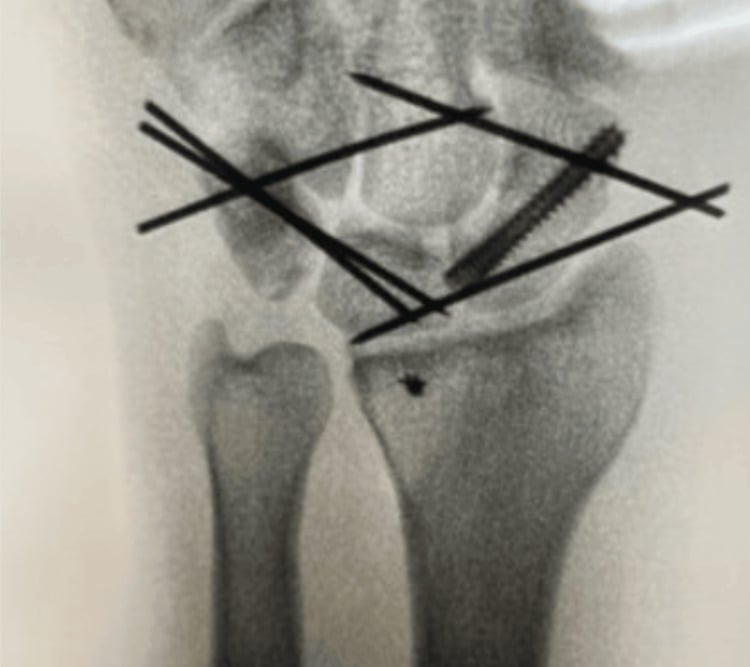
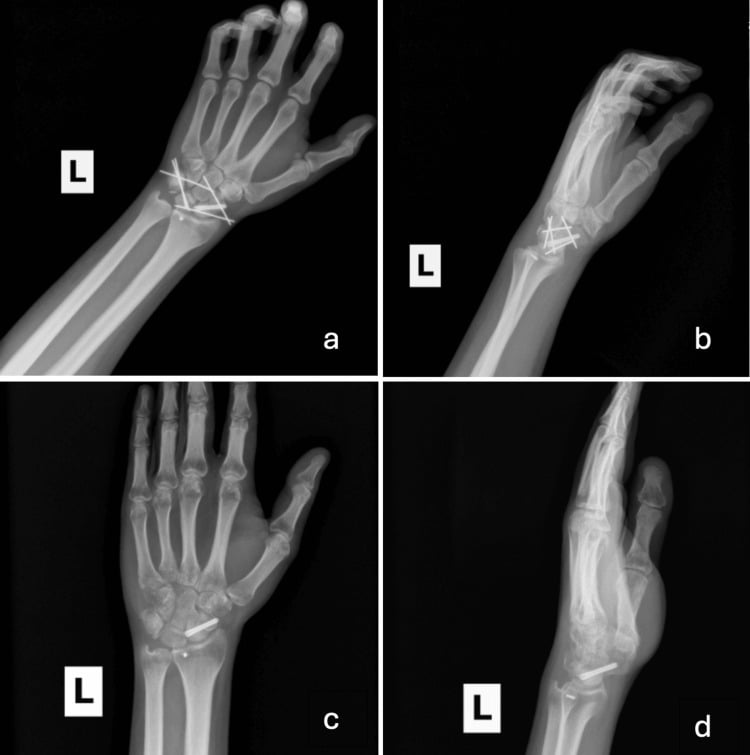
- In greater-arc injuries, fix scaphoid, radial styloid, capitate or triquetral fractures with appropriate screws, wires or plates.
- Key Point
- The scaphoid usually needs stable compression fixation in trans-scaphoid perilunate injuries.
- What To Do
- Temporarily pin SL, LT and/or scaphocapitate intervals according to instability pattern.
- Key Point
- Pins protect ligament healing and prevent recurrent carpal dissociation.
- What To Do
- Repair dorsal SL and LT ligaments when tissue allows; repair capsule and dorsal intercarpal/radiocarpal structures as needed.
- Key Point
- Do not repair an unreduced carpus.
- What To Do
- Confirm PA/lateral alignment, wire position, fracture fixation and median nerve status. Close capsule/retinaculum without tendon tethering.
- Key Point
- Document post-reduction median nerve function and final alignment.
Complications
- Incidence
- 56-80% at long-term follow-up
- Management
- Activity modification, salvage procedures
- Incidence
- 30-50%
- Management
- Reconstruction, fusion options
- Incidence
- 10-15%
- Management
- Prevention with urgent treatment
- Incidence
- 5-10%
- Management
- Revision fixation, bone graft
- Incidence
- Common
- Management
- Physiotherapy, capsular release
- Incidence
- Rare with timely treatment
- Management
- Salvage procedures
- Incidence
- 5-10%
- Management
- Early recognition, MDT treatment
Post-traumatic arthritis is the most significant long-term complication. It affects the radiocarpal and midcarpal joints, develops despite optimal treatment and may progress despite a good initial result, although in the longest follow-up its clinical and functional impact appeared low. Treatment is activity modification and fusion procedures.
Carpal instability. The SL ligament heals poorly, and chronic SL dissociation may persist despite repair. It leads to a DISI pattern and a SLAC wrist, and may need late reconstruction or fusion.
Median nerve injury. Acute compression usually resolves with reduction. Delayed treatment carries a higher risk of permanent deficit, which may need neurolysis or secondary procedures.
Late collapse: SLAC and SNAC. The late sequel of the perilunate or SL injury is a SLAC (scapholunate advanced collapse) wrist, staged I-III. SNAC (scaphoid nonunion advanced collapse) is the analogous cascade after scaphoid nonunion, relevant to the trans-scaphoid greater-arc injury, and is staged the same way around the nonunion. The radiolunate joint is characteristically spared even in advanced disease.
Why the stage chooses the salvage. Motion-preserving salvage relies on the load-bearing radiolunate joint and the proximal capitate and lunate cartilage. PRC needs a healthy capitate head and lunate fossa, so it fails, and is contraindicated, once the capitolunate joint is arthritic. Four-corner fusion excises the scaphoid and fuses the capitate, lunate, hamate and triquetrum, and is preferred when the capitolunate joint is involved but the radiolunate joint is spared.
- Arthritis
- Radial styloid and distal scaphoid
- Salvage
- PRC (healthy capitate head)
- Arthritis
- Whole radioscaphoid joint
- Salvage
- PRC (healthy capitate head)
- Arthritis
- Capitolunate (midcarpal) joint
- Salvage
- Four-corner fusion
- Arthritis
- End-stage disease
- Salvage
- Total wrist fusion, also the high-demand option
Postoperative Care and Rehabilitation
- Volar splint, wrist neutral to slight flexion
- Elevation
- Finger motion immediately
- Monitor median nerve function
- Convert to removable splint
- Gentle active wrist ROM
- Continue finger exercises
- Suture removal
- X-ray to assess healing
- Consider K-wire removal (8-12 weeks)
- Progressive ROM
- Light functional activities
- K-wire removal (usually by 12 weeks)
- Progressive strengthening
- Increase ROM exercises
- CT if concerns about union
- Full strengthening programme
- Grip strength recovery
- Return to work assessment
- Final outcome evaluation
Principles. Fingers move from day one to prevent stiffness, and protected wrist motion starts at 2 weeks. K-wires are typically left for 8-12 weeks to allow ligament healing, the SL ligament being particularly slow to heal; they come out once adequate healing is confirmed, and before aggressive range of motion begins.
Recovery. Grip strength takes 6-12 months to recover, and the wrist needs long-term monitoring for arthritis.
Outcomes and Prognosis
Even with optimal treatment, outcomes are guarded. Counsel patients that long-term problems may develop even after good initial treatment.
- Better Outcome
- Greater arc (trans-scaphoid)
- Worse Outcome
- Lesser arc (pure ligamentous)
- Better Outcome
- Less than 7 days
- Worse Outcome
- More than 7 days
- Better Outcome
- Anatomic
- Worse Outcome
- Residual malalignment
- Better Outcome
- None
- Worse Outcome
- Persistent median neuropathy
- Better Outcome
- Isolated
- Worse Outcome
- Multiple patterns
The arc and prognosis. Greater-arc injuries may have better long-term outcomes than lesser-arc injuries, because bone heals better than ligament. The scaphoid fracture, once healed, provides stability; in a lesser-arc injury the SL ligament rarely heals to normal strength, and the lesser arc has historically carried the worse prognosis.
The arc is not the whole story. In Herzberg's multicentre series, open injury and delayed treatment adversely affected results.
Guidelines, Registries & Global Practice
Global epidemiology (PubMed-verifiable):
- Figure
- Rare, high-energy injury pattern
- Source
- Herzberg multicentre series (PMID 8228045)
- Figure
- 25% (41 of 166)
- Source
- Herzberg 1993 (PMID 8228045)
- Figure
- 97% (palmar only 3%)
- Source
- Herzberg 1993 (PMID 8228045)
- Figure
- 61% of whole series
- Source
- Herzberg 1993 (PMID 8228045)
- Figure
- 56-80%
- Source
- Herzberg 1993 (PMID 8228045); Garcon 2022 (PMID 35609818)
- Figure
- Young adults, male predominance, high-energy MVA/fall/industrial mechanisms
- Source
- Herzberg 1993 (PMID 8228045)
There is no orthopaedic device registry that tracks perilunate dislocation outcomes, because management relies on K-wires, screws and ligament repair rather than registered implants. Arthroplasty registries (AOANJRR in Australia, NJR in England/Wales, AJRR in the USA) therefore do not capture this injury. Evidence is confined to retrospective single-centre and multicentre series; there are no randomised trials.
Side-by-side guidance and society position (global):
- Position on perilunate injury
- Carpal dislocation is a surgical emergency; urgent reduction, then open reduction, ligament repair and internal fixation in a hand unit
- Evidence level
- Expert consensus / Level IV
- Position on perilunate injury
- Open reduction and internal fixation with ligament repair is the standard of care; closed treatment alone is inadequate
- Evidence level
- Expert consensus / Level IV
- Position on perilunate injury
- Combined volar-dorsal or dorsal-only ORIF with carpal stabilisation; carpal tunnel decompression for persistent median symptoms
- Evidence level
- Expert consensus / Level IV
- Position on perilunate injury
- Emergent closed reduction followed by ORIF; scaphoid fixed with headless compression screw in trans-scaphoid patterns
- Evidence level
- Expert consensus / Level IV
Genuine debate persists over (1) dorsal-only versus combined volar-dorsal approach, (2) whether to routinely release the carpal tunnel - Garcon et al. (PMID 35609818) found median symptoms usually resolve with reduction alone - and (3) the role of dorsal spanning plates for early load-bearing. None of these is settled by Level I evidence.
Practical management across health systems: These high-energy injuries should be managed in centres with hand-surgery capability. Urgent closed reduction should be performed at the presenting centre to decompress the median nerve before transfer for definitive fixation. For any open component, antibiotic prophylaxis follows standard open-wound antimicrobial guidelines.
Be prepared to discuss Mayfield stages, X-ray interpretation (especially lateral view), lesser vs greater arc, acute carpal tunnel syndrome, and surgical approach. Understanding why 25% are missed (inadequate lateral film) is commonly tested.
MCQ Practice Points
Q: In Mayfield Stage III, which structures are disrupted? A: SL ligament + lunocapitate joint (space of Poirier) + LT ligament. This represents complete perilunate dislocation. Stage IV adds dorsal radiocarpal ligament failure with lunate dislocating volarly.
Q: What is the key X-ray finding on lateral view for perilunate vs lunate dislocation? A: In perilunate: lunate maintains contact with radius, capitate is dorsal to lunate. In lunate dislocation: lunate loses radius contact and tips volarly ("spilled teacup" sign).
Q: What percentage of perilunate dislocations are missed on initial presentation? A: 25% (approximately one quarter). This is usually due to inadequate lateral X-ray or not recognizing the abnormal carpal alignment. Always look at the lateral view for colinearity of radius-lunate-capitate.
Q: What is the difference between lesser arc and greater arc injuries? A: Lesser arc = pure ligamentous (injury through SL, lunocapitate, LT ligaments). Greater arc = with fractures (most commonly trans-scaphoid - 61%). Greater arc injuries may have better long-term prognosis as bone heals better than ligament.
Q: Why is median nerve assessment critical in perilunate dislocations? A: Acute carpal tunnel syndrome occurs in up to 25% of cases. The dislocated carpal bones compress the median nerve. This is an urgent indication for reduction - delay risks permanent nerve damage.
Clinical Decision Scenarios
Practise clinical reasoning and management decisions out loud
“A 28-year-old man comes to your clinic referred by his GP. He fell off a motorcycle 3 weeks ago and was seen in another hospital's ED. He was told he had a 'wrist sprain' and given a splint. He has persistent pain and weakness. You obtain new X-rays. What are you looking for and what might you find?”
“A 35-year-old woman is brought to ED after a high-speed MVA. She has numbness and tingling in her thumb, index, and middle fingers. Her wrist is swollen and painful. X-rays show a lunate dislocation (Stage IV Mayfield). What is your management?”
“A 25-year-old construction worker falls from scaffolding onto his outstretched hand. X-rays show a perilunate dislocation with a scaphoid fracture through the waist. How does this change your management compared to a pure ligamentous injury?”
MAYFIELD STAGES
- Stage I: Scapholunate ligament rupture
- Stage II: + Lunocapitate (space of Poirier)
- Stage III: + Lunotriquetral (complete perilunate)
- Stage IV: + Dorsal radiocarpal → lunate dislocates volarly
KEY X-RAY FINDINGS
- LATERAL VIEW IS KEY
- Normal: radius-lunate-capitate colinear
- Perilunate: capitate dorsal, lunate maintains radius contact
- Lunate dislocation: lunate tilts volarly (spilled teacup)
LESSER VS GREATER ARC
- Lesser arc: pure ligamentous
- Greater arc: with fractures (trans-scaphoid 61%)
- Greater arc may have better prognosis
- Bone heals better than ligament
CRITICAL POINTS
- 25% missed on initial presentation
- Acute carpal tunnel syndrome in 25%
- Urgent reduction required
- Surgery almost always required
SURGICAL APPROACH
- Combined dorsal and volar approach
- Volar: CTR, visualize reduction
- Dorsal: ligament repair, K-wire fixation
- Fix scaphoid if trans-scaphoid
PROGNOSIS
- 56-80% develop radiographic arthritis long-term
- 30-50% chronic instability
- SL ligament rarely heals to normal
- Even optimal treatment has guarded prognosis
Evidence Base
Mayfield, Johnson & Kilcoyne. Carpal dislocations: pathomechanics and progressive perilunar instability
- Loaded 32 cadaver wrists to failure, producing 13 perilunate and 2 lunate dislocations. Defined the mechanism as extension, ulnar deviation and intercarpal supination, with sequential ligament failure proceeding from radial to ulnar.
- Classified injury into four stages of progressive perilunar instability (PLI): Stage I scapholunate diastasis through to Stage IV lunate dislocation (greatest instability).
- Reduction was achieved by reversing the mechanism (intercarpal pronation, radial deviation, palmar flexion).
Herzberg, Comtet, Linscheid, Amadio, Cooney & Stalder. Perilunate dislocations and fracture-dislocations: a multicenter study
- Series of 166 perilunate dislocations/fracture-dislocations; the diagnosis was missed initially in 41 cases (25%). Displacement was dorsal in 97% and palmar in only 3%.
- Trans-scaphoid perilunate fracture-dislocations represented 61% of the whole series; fracture-dislocations outnumbered pure dislocations roughly two to one.
- In the 115 cases followed (mean 6 years), open injury and delayed treatment adversely affected results; post-traumatic arthritis occurred in 56% even when treated early.
Krief, Appy-Fedida, Rotari, David, Mertl & Maes-Clavier. Results of perilunate dislocations and perilunate fracture dislocations with a minimum 15-year follow-up
- 30 patients (14 dislocations, 16 fracture-dislocations) reviewed at a mean of 18 years. Radiographic arthritis occurred in 70% of cases, yet its clinical and functional impact appeared low.
- Mean flexion-extension arc was 68%, grip strength 70% and mean Mayo wrist score 70 relative to the contralateral side.
- Six patients developed CRPS type 1; the two lowest Mayo wrist scores corresponded to the patients with the most advanced arthritis.
Sotereanos, Mitsionis, Giannakopoulos, Tomaino & Herndon. Perilunate dislocation and fracture dislocation: a critical analysis of the volar-dorsal approach
- Combined volar-dorsal approach in 11 perilunate dislocations/fracture-dislocations, mean 13 hours from injury to surgery, mean follow-up 30 months.
- Flexion-extension arc averaged 71% and grip strength 77% of the contralateral side; all 8 wrist fractures united and patient satisfaction was high in 9 of 11.
- No scapholunate dissociation or significant DISI persisted, although one wrist developed SLAC arthritis.
Garcon, Degeorge, Coulet, Lazerges & Chammas. Perilunate dislocation and fracture dislocation of the wrist: outcomes and long-term prognostic factors
- 32 patients (7 dislocations, 25 fracture-dislocations) at mean 9.9-year follow-up; radiographic osteoarthritis in 79% and residual carpal instability in 16%.
- The magnitude of lunate displacement (injury stage) and older patient age were significant predictors of poorer long-term functional outcome and arthritis.
- Symptoms of median nerve compression generally resolved with reduction alone in this cohort.
Kremer, Sauerbier, Trankle, Dragu, Germann & Baumeister. Functional results after proximal row carpectomy to salvage a wrist
- 45 wrists undergoing proximal row carpectomy (PRC), including chronic perilunate dislocation/fracture-dislocation, with mean 32-month follow-up.
- Active flexion-extension averaged 70 degrees with grip strength 51% of the unaffected side; pain reduced 71% at rest and 44% after strenuous activity.
- PRC is contraindicated when the capitate head or lunate fossa cartilage is degenerate.