Superior Peroneal Retinaculum Tear | Fibular Groove Instability | Recurrent Dislocation
- SPR is PRIMARY restraint preventing peroneal subluxation (not fibular groove depth)
- Acute injury = forced dorsiflexion + reflex peroneal contraction (classic: skiing, soccer)
- Chronic: Recurrent painful 'snap' over lateral malleolus with eversion/dorsiflexion
- Habitual or voluntary instability is a separate phenotype, not modified Eckert-Davis Type IV
- Surgery restores the demonstrated retinacular, tendon and groove pathology; groove deepening is selective
- “Reproduce the patient's snap while palpating or imaging the tendons; the manoeuvre is supportive, not pathognomonic
- “Dynamic ultrasound is best suited to demonstrating frank or intrasheath motion
- “Assess groove morphology and tunnel crowding rather than routing treatment by an unvalidated millimetre cut-off
- “Don't confuse with peroneal tendon tears (longitudinal splits) - different pathology
Peroneal Tendon Subluxation and Dislocation
Overview and Epidemiology
Peroneal tendon instability is an uncommon and often overlooked cause of lateral ankle pain. In frank instability the longus and/or brevis ride over the lateral malleolus after the superior peroneal retinaculum (SPR) fails; in intrasheath instability their relationship changes within an intact retromalleolar tunnel.
Why it is missed. The acute injury presents with lateral ankle pain and swelling and mimics a lateral ankle sprain, and the tendons may relocate spontaneously with plantarflexion. Without a high index of suspicion and specific examination manoeuvres, the diagnosis is delayed until recurrent subluxation develops.
What makes the diagnosis. A reproduced snap, localised by palpation or dynamic imaging, is strongly suggestive. It must still be distinguished from tendon tear, tenosynovitis and other snapping structures.
Pathophysiology and Mechanisms
The retinaculum. The SPR is a 2-4 mm fibrous band, reinforced by fascia, running from the lateral ridge on the posterior aspect of the fibula to the superior aspect of the lateral calcaneus. It holds peroneus longus and brevis in the fibular groove behind the lateral malleolus and is the primary restraint to anterior subluxation. SPR failure, not groove depth, is the primary pathology.
The tendons in the groove. Peroneus brevis lies against the fibula and peroneus longus lies against the brevis. When the SPR gives way, the tendons dislocate anterolaterally over the tip of the fibula.
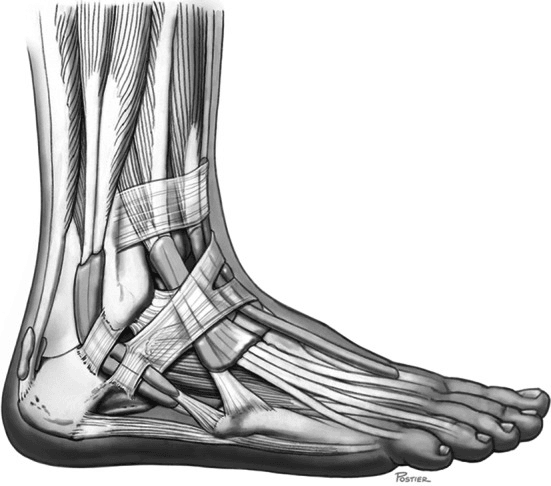
The groove. The fibular groove lies on the posterior aspect of the lateral malleolus, and concave, flat and convex osseous shapes all occur. The effective tunnel depends on more than bone: fibrocartilage, SPR integrity, tendon bulk and accessory muscle or tendon variants all change it, and the fibrocartilaginous ridge may elevate with the SPR in a modified Eckert-Davis Type II injury. A shallow or convex groove may contribute, but it is neither necessary nor sufficient for symptoms. Assess crowding and containment rather than applying a universal 2- or 3-mm threshold.
Mechanism. Sudden forced dorsiflexion with reflex contraction of the peronei tears the SPR. It happens in skiing (the edge catch), soccer and basketball.
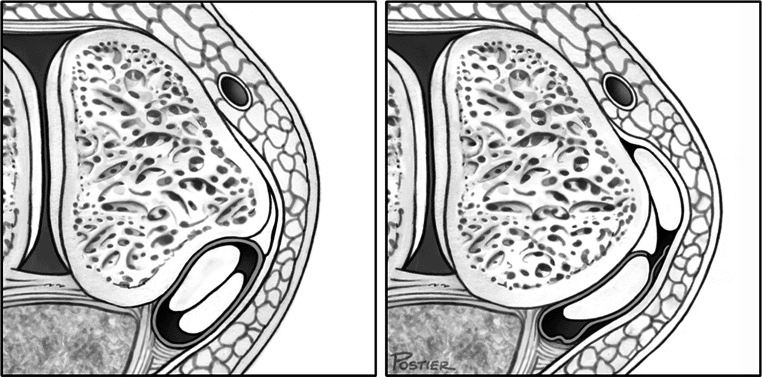
Chronic instability can coexist with a longitudinal peroneus brevis split, tenosynovitis, a low-lying muscle belly or peroneus quartus. Inspect the tendons and tunnel systematically because associated pathology—not an assumed percentage—may explain persistent symptoms and alter repair.
Classification Systems
Modified Eckert-Davis/Oden. Eckert and Davis described Types I-III and Oden added Type IV, posterior SPR avulsion. The table describes the SPR tear pattern and guides the repair, but the number does not itself choose groove deepening: describe the actual pathology.
- Pathology
- SPR elevated from fibula with periosteum
- Clinical Finding
- Tendons pass between bone and elevated periosteum
- Surgical Repair
- Anatomical SPR reattachment
- Pathology
- Fibrocartilaginous ridge elevated with SPR
- Clinical Finding
- Tendons pass beneath the elevated ridge/SPR complex
- Surgical Repair
- Restore retinacular restraint; assess tunnel morphology
- Pathology
- Cortical fibular fragment avulsed with SPR
- Clinical Finding
- Posterolateral fibular fleck may be visible
- Surgical Repair
- Fix or excise fragment according to size/viability, then restore SPR
- Pathology
- SPR avulsed from its posterior attachment
- Clinical Finding
- Retinaculum detached posteriorly
- Surgical Repair
- Posterior repair or reconstruction
Habitual or voluntary instability and flat-groove morphology are separate descriptors, covered in their own section below; neither is Type IV.
By time course.
- Acute - the initial traumatic episode, with swelling and possible spontaneous reduction
- Recurrent - repeated symptomatic external displacement after an initial episode
- Chronic - persistent or recurrent symptoms, with possible tendon tear, tenosynovitis, scarring or tunnel crowding
Duration alone does not dictate a procedure. The operative indication follows disabling, objectively demonstrated instability and the patient's goals, not a six-week or three-month label.
Intrasheath (Intra-Sheath) Subluxation: the 'Normal-MRI Snapper'
This distinct, easily missed entity needs separating from frank (subsheath) dislocation. In intrasheath subluxation the SPR is intact and the tendons never leave the retromalleolar groove; they snap against each other within the sheath instead. That is how a patient can have a convincing painful snap with a normal static MRI and no visible dislocation over the fibula.
The Raikin classification.
- Type A, no tendon tear - peroneus longus and brevis reverse their positions, flipping past each other within an intact sheath
- Type B, with a tear - peroneus longus subluxes through a longitudinal split in peroneus brevis, snapping in and out of the split
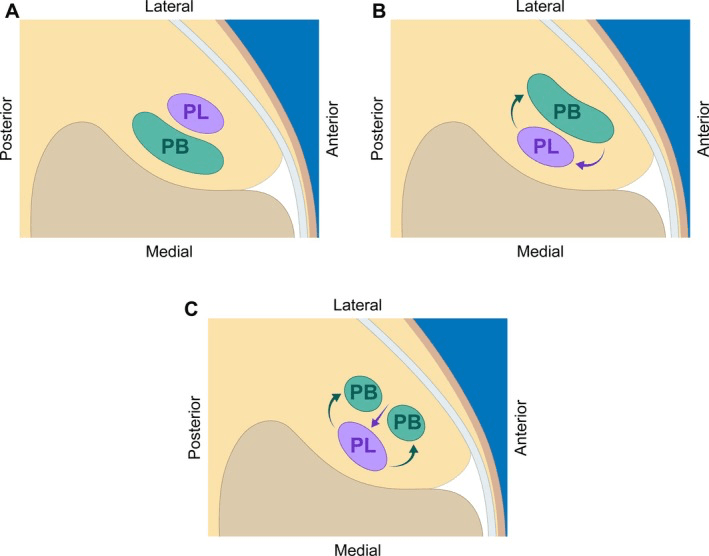
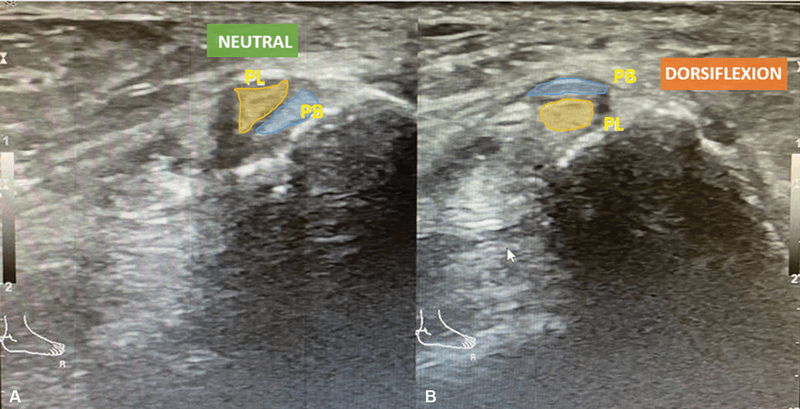
Diagnosis is dynamic. Static MRI can be normal. Dynamic ultrasound during the patient's active provocative manoeuvre demonstrates the position reversal or the passage of longus through a brevis split, and confirms that both tendons remain within the tunnel.
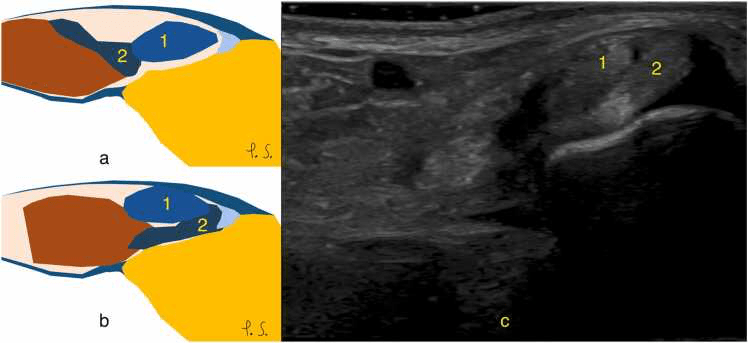
Management. Begin with activity modification and rehabilitation when symptoms permit. For persistent disabling symptoms, inspect the tunnel and treat the demonstrated lesion: debride or repair a split, remove crowding tissue, deepen a deficient groove selectively and/or perform a retinaculoplasty. An isolated SPR reattachment is inappropriate when the SPR is intact.
Clinical Presentation
The acute history. The patient reports an audible or palpable "pop" over the lateral ankle during the injury, then lateral ankle pain, swelling and inability to weight bear.
The chronic history. The classic chronic patient is a young athlete with recurrent painful lateral ankle "snapping" that was first misdiagnosed as an ankle sprain. The snapping comes with eversion and dorsiflexion activities, alongside a sense of giving way that differs from ATFL instability. Running, cutting and pivoting become impossible, and the patient fears subluxation with certain movements.
Inspection. Standing, there may be fullness over the lateral malleolus from chronic thickening. The gait is antalgic and avoids eversion. Swelling is localised to the lateral malleolus in the acute injury and minimal in the chronic one.
Palpation. Tenderness lies over the lateral malleolus, posterior to the fibula. During provocation the tendons may be palpable anteriorly.
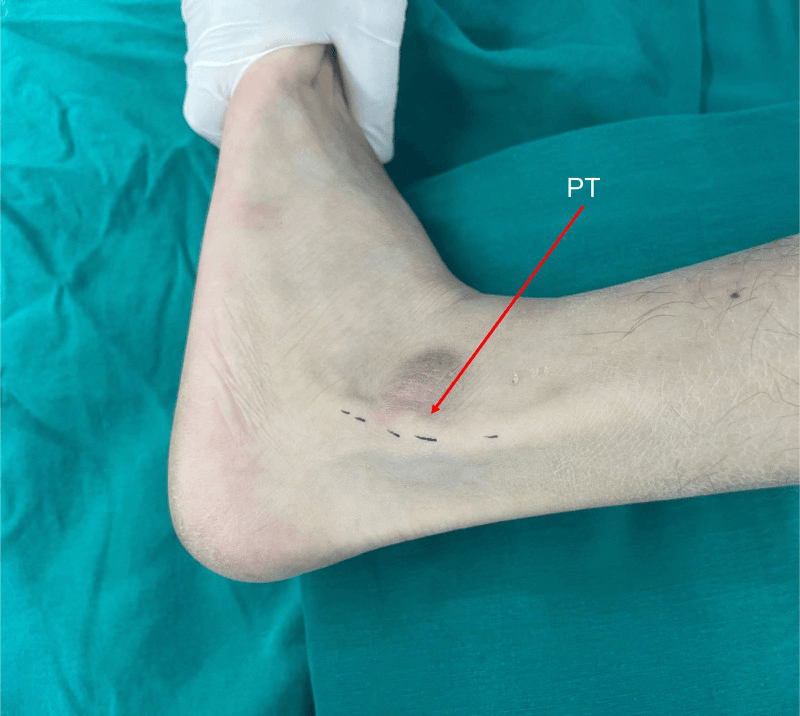
Provocation. Palpate immediately behind and over the lateral malleolus while the patient reproduces the symptomatic movement with active resisted dorsiflexion-eversion, and watch whether the tendons cross the fibula. The passive snap test holds the ankle in dorsiflexion and everts the foot; a palpable or audible snap over the fibula that reproduces the patient's symptoms is positive. When the standard manoeuvre is negative, use the patient's own provoking arc of circumduction.
Reading the snap. A localised, reproduced snap supports peroneal instability but is not pathognomonic. Distinguish external displacement from intrasheath motion, and both from tendon tear or other snapping structures.
- Key Feature
- Painful snap, forced DF mechanism
- Test
- Passive DF + Eversion (reproduces snap)
- Management
- SPR repair
- Key Feature
- Inversion injury, ATFL tenderness
- Test
- Anterior Drawer Test
- Management
- Functional rehab
- Key Feature
- Chronic lateral pain, no snap, MRI split
- Test
- Resisted eversion weakness
- Management
- Debridement/Tubularisation
- Key Feature
- Deep lateral pain, post-sprain
- Test
- Sinus tarsi injection test
- Management
- Injection/Arthroscopy
Investigations
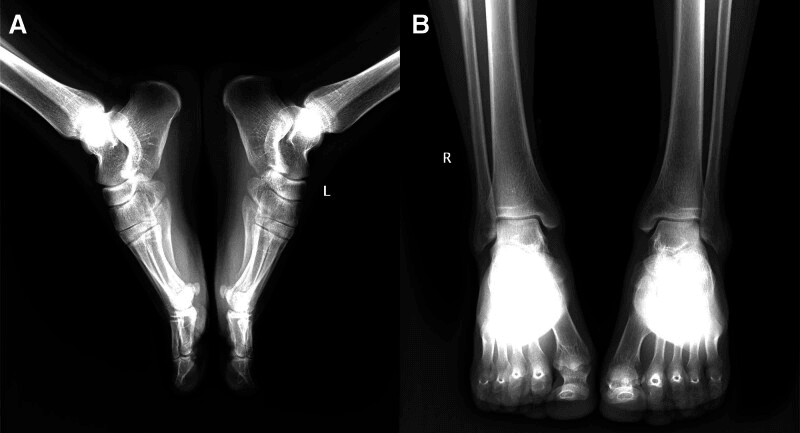
Radiographs. Request weight-bearing AP, mortise and lateral ankle views when tolerated. They are often normal and should not be expected to show tendon motion; look specifically for a posterolateral fibular cortical fleck and other osseous injury.
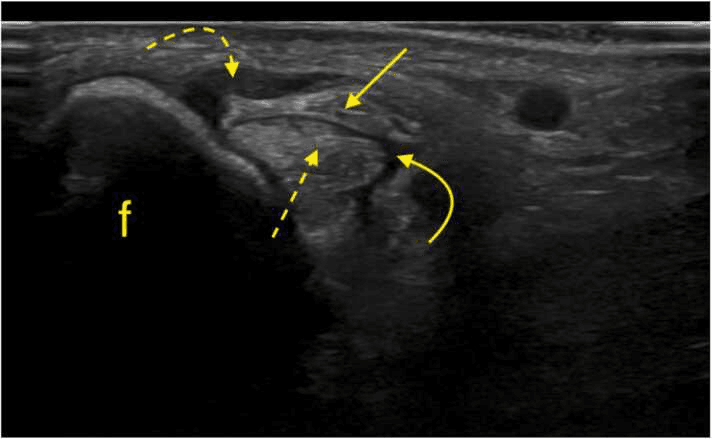
Dynamic ultrasound. This is the dynamic test. Image the retromalleolar tunnel at rest and during the patient's active provocative manoeuvre, and record whether the tendons cross the fibula or merely exchange positions within an intact SPR. The same examination assesses split tear, tenosynovitis and crowding variants.
MRI. Use axial or oblique axial fluid-sensitive sequences through the retromalleolar groove, plus orthogonal planes. A normal static examination does not exclude dynamic instability. What MRI can show:
- SPR discontinuity, a torn retinaculum with high T2 signal
- Abnormal tendon position, lateral or anterior to the fibula
- An avulsion fragment at the fibular insertion (Type III)
- Bone marrow oedema in the fibula (retrofibular oedema)
- Brevis split, degeneration and tenosynovitis
- Low-lying muscle or an accessory tendon, and associated ligament or cartilage injury
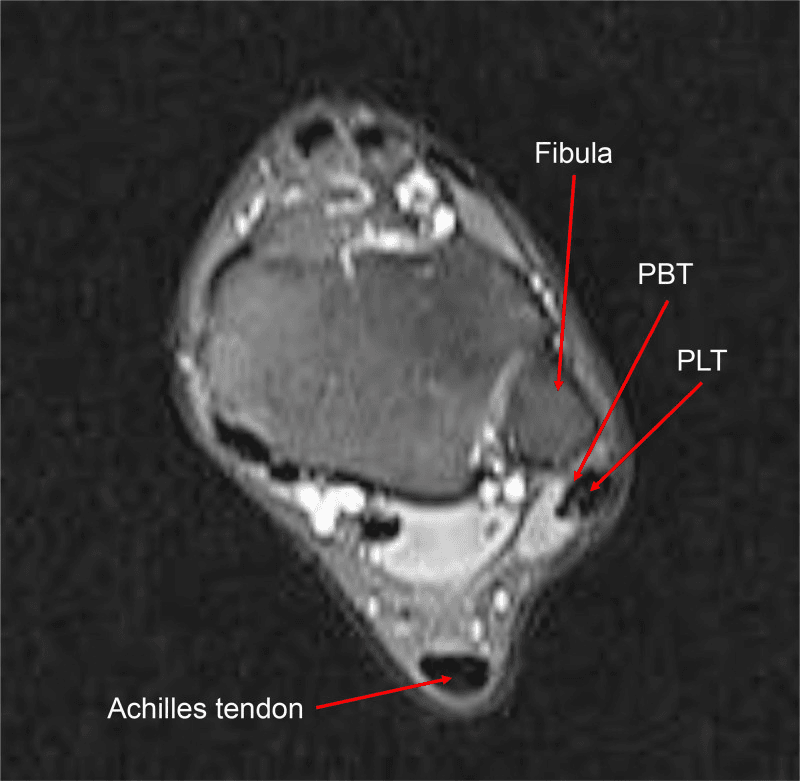
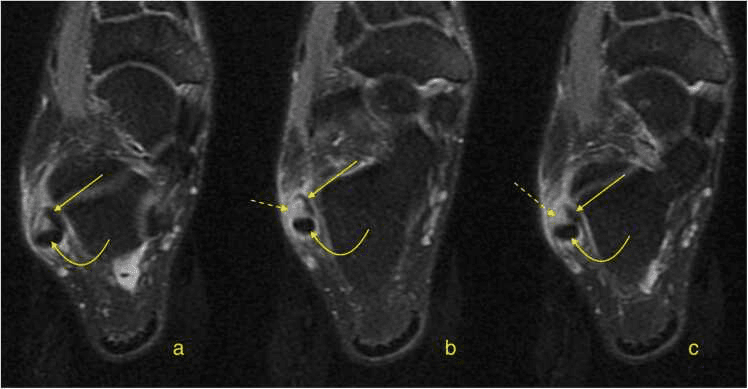
CT. Reserve it for an osseous fleck, a prior bony procedure, complex morphology or revision planning. Groove shape can inform surgery, but no validated depth threshold alone mandates deepening.
Management Algorithm
Non-operative care. It is reasonable for:
- A first traumatic episode with reduced tendons and no repair-requiring associated lesion
- A low-demand or surgery-averse patient
- Symptoms that settle with activity modification and rehabilitation
Discuss immobilisation or a stabilising brace, choosing position, loading and duration from acuity, reducibility, comfort and local protocol rather than a fixed calendar. Then restore pain-free motion, calf and peroneal capacity, balance and sport-specific control without repeatedly provoking displacement. If snapping persists, reassess clinically and dynamically: failure means ongoing disabling instability, not merely completion of a predetermined number of weeks.
Early repair after an acute episode. Discuss immobilisation against early repair using the displacement, the activity demands, any associated injury and the patient's priorities.
Operative indications.
- Recurrent or persistent disabling instability demonstrated clinically or dynamically
- A repair-requiring tendon tear, displaced avulsion or other associated pathology
- A high-demand patient who accepts the trade-offs of early stabilisation after shared decision-making
Choosing the operation. Before choosing surgery for recurrent instability, define the SPR, tendon and groove pathology, then select the procedure from what is found. Neither groove depth nor the classification number is an automatic operation; the evidence on adding groove deepening is set out under Controversies.
- Core procedure
- Anatomical reattachment with anchors or transosseous sutures
- Possible adjunct
- Retinacular augmentation for poor tissue
- Key risk
- Overconstraint or recurrent instability
- Core procedure
- Selective groove-deepening technique
- Possible adjunct
- Address low-lying muscle, quartus or split
- Key risk
- Fibular fracture or tendon injury
- Core procedure
- Fragment fixation or excision plus SPR restoration
- Possible adjunct
- Treat tendon pathology
- Key risk
- Fragment/hardware symptoms
- Core procedure
- Individualised reconstruction or rerouting
- Possible adjunct
- Correct osseous morphology when causal
- Key risk
- Altered biomechanics and stiffness
Surgical Technique
Set-up. Position the patient lateral or supine with a bump, so that the posterolateral fibula is accessible and the foot can be moved through the symptomatic arc. Tourniquet use and incision length follow the exposure needed; mark the sural nerve corridor, and avoid fixed pressure or incision prescriptions.
Approach. Open the SPR in a repairable fashion. Protect the sural nerve, preserve viable retinaculum and minimise stripping of the thin fibular cortex.
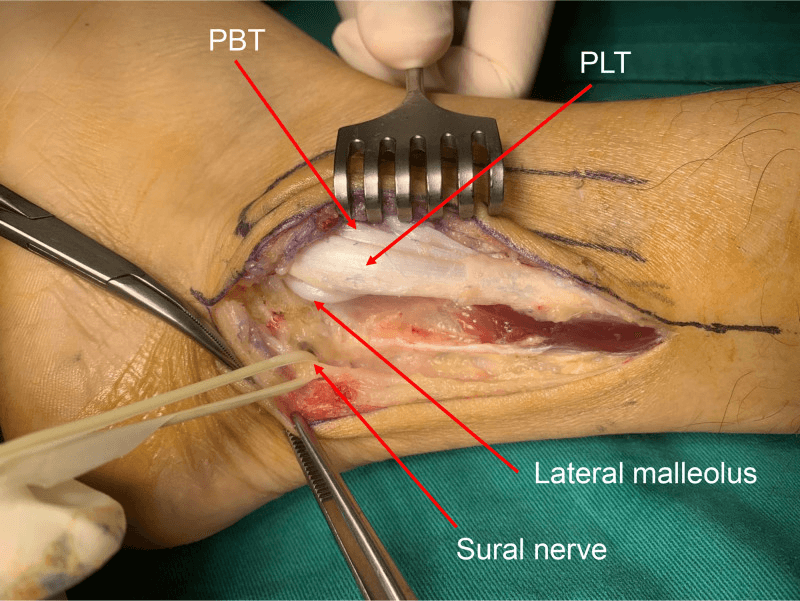
Define every lesion before reconstructing.
- Observe whether the instability is external or intrasheath
- Inspect longus and brevis for split, degeneration and tenosynovitis
- Identify low-lying muscle, peroneus quartus or other crowding tissue
- Assess the SPR attachment and tissue quality, the fibrocartilaginous ridge and the actual groove containment
- Recreate the provoking motion after each corrective step, without forcing the tendons
Anatomical SPR repair.
- Reduce healthy tendons into the tunnel and address repairable tendon pathology.
- Prepare the detached fibular attachment while preserving cortical strength.
- Reattach the SPR with suture anchors or transosseous sutures according to bone, fragment and tissue quality.
- Set tension with the tendons reduced through a safe range: the restraint must prevent external displacement without stenosing the tunnel.
- Re-test dynamically, confirm free tendon glide and close without trapping the sural nerve.
Type I is not synonymous with one number of tunnels, one drill diameter or one foot position. The same principles apply to any repairable detachment pattern; Type III also requires a decision about the fragment, and Type IV requires attention to the posterior attachment.
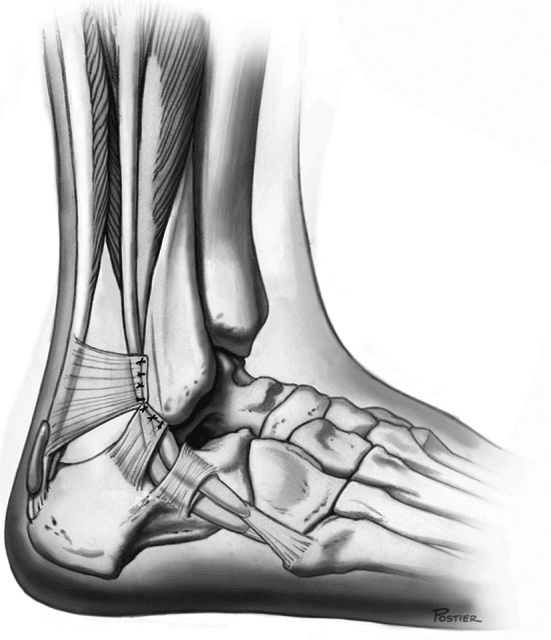
Groove deepening, selectively. Consider it for demonstrated bony deficiency or crowding, selected high-risk morphology, or revision after a failed soft-tissue procedure. Type II or a single CT depth is not an automatic indication.
Preserve a smooth fibrocartilaginous or cortical gliding surface when possible; one technique elevates a cortical flap, removes cancellous bone and replaces the shell to enlarge the retromalleolar tunnel. Deepen only enough to contain the tendons through the provocative arc, protect the fibula from fracture propagation, and avoid sharp edges or tunnel stenosis.
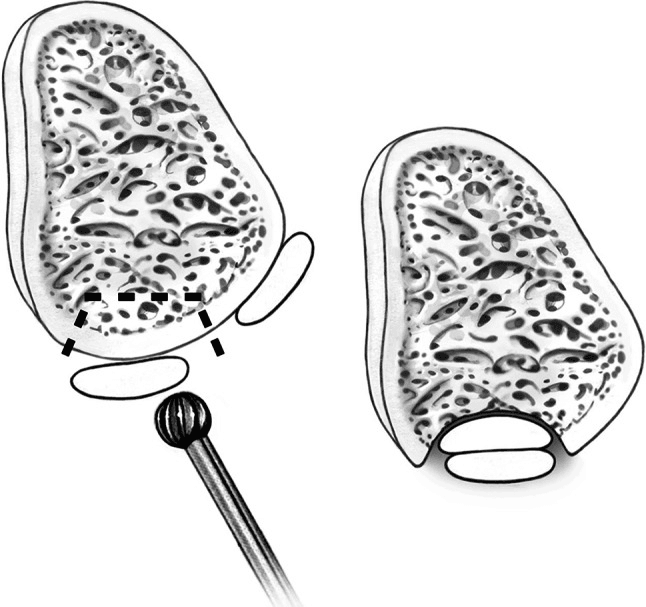
When the retinaculum cannot be repaired. If the SPR is deficient or a prior repair has failed, choose retinaculoplasty, graft reconstruction or a salvage rerouting procedure from the residual tissue, tendon function and bony anatomy. These are not interchangeable operations.
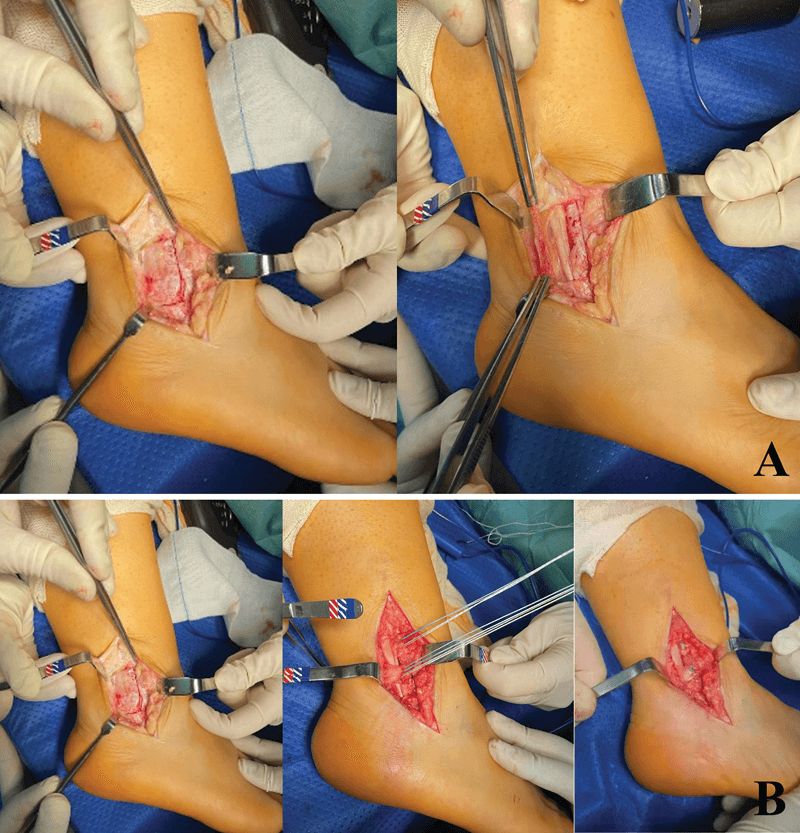
Aftercare. Immobilisation position, weight-bearing, range of motion and resisted eversion depend on the repair, whether bone was cut, the tendon treatment and the fixation strength. Protect the reconstructed restraint initially, then progress motion, loading, peroneal capacity, balance and sport-specific tasks against healing and symptoms. Return to sport is criteria-based (stable painless tendon tracking, recovered strength and control, task tolerance), not a universal month.
Complications
- Mechanism
- Missed lesion, failed fixation, poor tissue or uncorrected causal morphology
- Recognition
- Reproduced external or intrasheath motion
- Response
- Re-image dynamically and revise the demonstrated failure
- Mechanism
- Traction, scar or entrapment near posterolateral exposure
- Recognition
- Sensory symptoms or focal Tinel sign
- Response
- Observation for neurapraxia; targeted exploration/neurolysis when persistent and localised
- Mechanism
- Aggressive groove work or weak cortex
- Recognition
- Intraoperative propagation or postoperative pain/displacement
- Response
- Stabilise according to pattern and construct
- Mechanism
- Overtight repair, sharp groove or excessive crowding
- Recognition
- Painful restricted glide without recurrent external motion
- Response
- Release/reshape and treat tendon injury as required
- Mechanism
- Soft-tissue dissection, immobilisation and host factors
- Recognition
- Clinical examination
- Response
- Cause-specific wound care, rehabilitation or debridement
Outcomes and Prognosis
Most published surgical series report improved function and low redislocation, but they are small, heterogeneous and predominantly retrospective. Prognosis depends on correct phenotyping, repairable tissue, associated tendon or ligament disease, prior surgery, rehabilitation and activity demands. A good result means stable, painless tracking with restored function, not merely the absence of a coded complication.
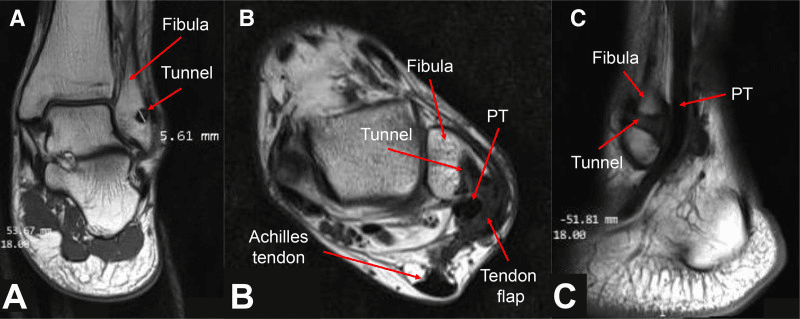
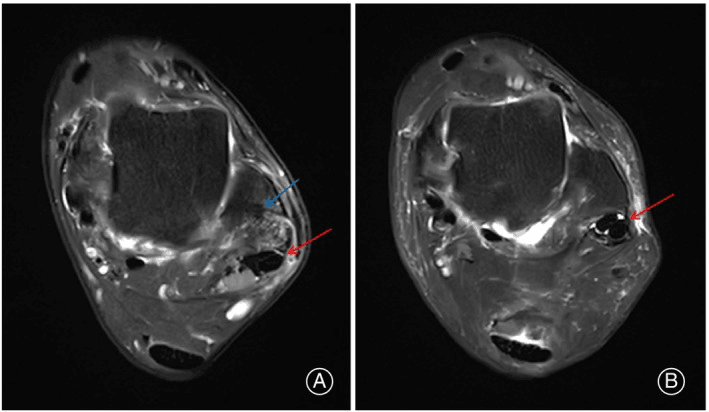
Habitual and Voluntary Subluxation, and the Flat (Convex) Fibula
Habitual or voluntary instability is a clinical phenotype separate from modified Eckert-Davis Type IV, which is posterior SPR avulsion. Describe atraumatic, habitual and voluntary instability separately, then state whether the problem is external displacement, intrasheath motion, deficient restraint, crowding or osseous containment.
Assessment. First confirm whether the tendons actually cross the fibula, exchange positions within the sheath, or whether the snapping has another source. Then assess pain, functional limitation, bilaterality, voluntary control, generalised laxity, groove morphology, SPR competence and tunnel crowding.
Treatment. Observation, education and rehabilitation are appropriate when symptoms are minimal or voluntary. For disabling involuntary instability, tailor surgery to the demonstrated restraint, tendon and osseous abnormality. A flat or convex groove may support selective bony correction, but neither groove deepening nor retinacular reconstruction is automatically mandatory.
Guidelines, Registries & Global Practice
There is no disease-specific AAOS, AOFAS, BOA, EFAS or IOC guideline and no relevant registry. Recommendations therefore come from systematic reviews of small series, comparative cohorts, technical reports and local foot-and-ankle practice.
- Evidence-aware position
- Reproduce the patient's snap and use dynamic ultrasound when available
- Resource adaptation
- Careful palpation and observed motion remain central
- Evidence-aware position
- Defines SPR, tendon, crowding and associated pathology; static normality does not exclude instability
- Resource adaptation
- Reserve when it changes operative planning
- Evidence-aware position
- Persistent disabling or high-demand objectively demonstrated instability after shared decision-making
- Resource adaptation
- Refer when tendon reconstruction or bony correction exceeds local capability
- Evidence-aware position
- Restore demonstrated pathology; groove deepening is selective
- Resource adaptation
- Open anatomical repair remains feasible without advanced arthroscopy
- True incidence and missed-diagnosis rates are uncertain.
- Most outcome studies are small retrospective series.
- Comparative evidence does not establish one universal operative construct.
- Reported percentages should not be presented as population constants.
- Dynamic ultrasound is valuable and potentially more accessible than MRI.
- Plain radiographs identify associated osseous injury but do not exclude instability.
- Open anatomical repair can be effective when the pathology is defined.
- Core principles are accurate phenotyping, sural-nerve protection and treatment of associated tendon disease.
Related pages: Peroneal Tendon Disorders is the umbrella page that separates subluxation from tears and tenosynovitis and carries the comparative imaging accuracy; Peroneal Tendon Tears for the brevis split that accompanies up to a third of these and must be repaired at the same sitting; Peroneus Brevis Anatomy for the low-lying muscle belly and peroneus quartus that crowd the sheath and are found at operation rather than on the film; Lateral Ankle Instability for the diagnosis this is most often mislabelled as, and the ligamentous incompetence that may need addressing alongside; Chronic Lateral Ankle Pain for the wider differential; Cavovarus Foot and Charcot-Marie-Tooth Disease for the hindfoot alignment that overloads the peroneals and, uncorrected, defeats a sound retinacular repair; Ankle Fractures for the rim-avulsion fleck that signals a Type III injury and for the fractures this is missed alongside; and Calcaneal Fractures for the malunited lateral wall that displaces the tendons for entirely mechanical reasons.
Controversies and Areas of Uncertainty
Is groove deepening necessary? This is the central debate. A systematic review of low-level pooled evidence favoured adding groove deepening for return to sport (van Dijk 2016), yet a Level II comparative study (Cho 2014) and a 36-patient series (Park 2021) found that isolated SPR repair gave equivalent outcomes with shorter operating time when groove anatomy is adequate. The pragmatic position is to deepen only for a genuinely shallow or convex groove, not routinely.
Acute injury: operate or splint? No randomised data define a universal acute pathway. Recurrence estimates vary with the immobilisation method and study selection; the threshold is individual rather than a fixed failure percentage.
Open or endoscopic? Endoscopic SPR reconstruction and tendoscopic treatment of intrasheath subluxation are described with less soft-tissue dissection and lower sural nerve risk, but the evidence is limited to technical notes and small series. Open anatomic repair remains the reference standard.
Bone-block or soft tissue? Historical bone-block, tendon-rerouting and sling (Jones-type) reconstructions are now largely abandoned in favour of anatomic retinacular repair, as they alter biomechanics and risk stiffness. They retain a niche only for failed anatomic repair or a true flat or convex fibula.
MCQ Practice Points
Q: What does modified Eckert-Davis/Oden Type IV describe? A: Posterior SPR avulsion. Type I is subperiosteal elevation from fibula, Type II elevates the fibrocartilaginous ridge with the SPR, and Type III avulses a cortical fragment. Habitual/voluntary instability is a separate phenotype.
Q: Which investigation best demonstrates symptomatic tendon motion? A: Dynamic ultrasound during the patient's provocative manoeuvre. It can show tendons crossing the fibula or exchanging positions within an intact sheath. Static MRI maps associated pathology but may miss the instability.
Q: When should fibular groove deepening be considered? A: For demonstrated deficient containment or crowding, selected high-risk morphology, or revision when groove pathology contributes to failure. There is no validated universal CT depth that mandates the procedure.
Exam Viva Scenarios
Practise clinical reasoning and management decisions out loud
“A competitive skier has acute posterolateral ankle pain and a reproducible snap after an edge-catch injury. How do you assess and manage the case?”
“At surgery for recurrent external instability, the SPR is elevated from its fibular attachment. Describe your assessment and repair.”
“A patient has recurrent snapping one year after SPR repair. CT describes a shallow groove. How do you plan revision?”
Phenotype
- External instability: tendon crosses lateral malleolus
- Intrasheath Type A: longus and brevis reverse position
- Intrasheath Type B: longus moves through a brevis split
- Habitual/voluntary instability is not modified Type IV
Modified Eckert-Davis/Oden
- I: SPR elevated subperiosteally from fibula
- II: fibrocartilaginous ridge elevated with SPR
- III: cortical fibular fragment avulsed
- IV: SPR avulsed from posterior attachment
Diagnosis
- Reproduce and palpate the patient's symptomatic motion
- Dynamic ultrasound demonstrates the instability
- MRI maps SPR, tendon and crowding pathology
- Radiographs may be normal; look for a cortical fleck
Treatment
- Reduced first episode: discuss immobilisation/rehabilitation
- Persistent or recurrent disabling motion: consider surgery
- Restore SPR and treat associated tendon pathology
- Deepen the groove selectively, never by number alone
Operative Safety
- Protect the sural nerve
- Inspect longus, brevis and tunnel crowding variants
- Avoid retinacular overconstraint or tendon stenosis
- Set aftercare from the actual repair and any bone/tendon work
Evidence Base and Key Studies
Return to Sport and Outcomes After Surgical Treatment — Systematic Review
- Systematic review and best-evidence synthesis of 14 studies on peroneal tendon dislocation
- Surgery significantly improved postoperative AOFAS scores with high satisfaction rates
- Redislocation rate was less than 1.5% at long-term follow-up
- Combined groove deepening plus SPR repair gave higher return-to-sport rates than SPR repair alone (p = 0.022)
Retinaculum Repair With vs Without Fibular Groove Deepening — Comparative Study
- Prospective non-randomised comparison of 29 patients with recurrent traumatic dislocation
- Group A (repair + groove deepening, n=13) AOFAS improved 59.3 to 92.2
- Group B (isolated SPR repair, n=16) AOFAS improved 58.5 to 91.3 — no significant difference
- Tourniquet time significantly shorter without deepening; mean return to sport ~3 months in both groups