UHMWPE | XLPE Manufacturing | Wear Reduction | Clinical Outcomes
- UHMWPE: molecular weight 3-6 million Da
- XLPE manufacturing: high-dose radiation (50-100 kGy) creates crosslinks, then thermal treatment removes free radicals
- Remelting (above 137C) eliminates all free radicals but reduces crystallinity and toughness
- Annealing (below 137C) preserves crystallinity but leaves some free radicals (slower oxidation)
- XLPE reduces volumetric wear 90% but has reduced fracture toughness (minimum 6-8mm thickness required)
- “Conventional PE gamma sterilised in air oxidises over time, causing delamination and fatigue failure
- “XLPE trade-off: increased wear resistance vs decreased fracture toughness and impact strength
- “Vitamin E stabilised PE: antioxidant prevents oxidation without reducing toughness as much
- “Minimum XLPE liner thickness 6-8mm to prevent rim fracture and maintain fatigue resistance
Overview and Introduction
Polyethylene has been the primary bearing surface in total joint arthroplasty for over 50 years. Ultra-high molecular weight polyethylene (UHMWPE) has excellent wear resistance and biocompatibility, but conventional formulations shed wear particles that caused osteolysis. Highly crosslinked polyethylene (XLPE) reduces wear by 90% through radiation-induced crosslinking, and has dramatically improved implant longevity.
Historical Context
Charnley and the first bearings (1960s-1970s). Sir John Charnley pioneered the use of UHMWPE in total hip arthroplasty: his low friction arthroplasty put a metal femoral head on a UHMWPE acetabular cup. The polyethylene was sterilised by gamma radiation in air (25-40 kGy) and wore at 0.1-0.2mm/year, which was acceptable for the era.
Oxidation emerges (1980s-1990s). Long-term follow-up revealed osteolysis from wear particles. Gamma-sterilised polyethylene oxidised during storage (shelf ageing) and went on degrading after implantation (in vivo oxidation), and the result was delamination and catastrophic failure, the Hylamer disaster among them.
Crosslinking (1990s-2000s). Once it was recognised that crosslinking reduces wear, first-generation XLPE was made with high-dose radiation followed by remelting. It demonstrated a 90% reduction in wear rates, traded against reduced fracture toughness.
Refinement (2000s-present). Annealed XLPE brought better mechanical properties and vitamin E stabilisation added antioxidant protection. Long-term data of 15+ years confirm its durability, and XLPE has become the standard of care.
Principles of Polyethylene Engineering
The polymer. Polyethylene is a simple polymer of repeating ethylene (C2H4) units forming long chains: the monomer is ethylene (-CH2=CH2-) and the polymer is (-CH2-CH2-)n. Chain length is determined by molecular weight, so the higher the molecular weight, the longer the chains.
Molecular weight sets the properties. Strength, toughness and wear resistance all rise with molecular weight, while processability falls: a low molecular weight polymer flows when melted, and UHMWPE cannot be melted at all.
- Low MW (under 100k)
- Low
- High MW (1M)
- Moderate
- UHMW (3-6M)
- High
- Low MW (under 100k)
- Brittle
- High MW (1M)
- Moderate
- UHMW (3-6M)
- Excellent
- Low MW (under 100k)
- Poor
- High MW (1M)
- Moderate
- UHMW (3-6M)
- Excellent
- Low MW (under 100k)
- Easy (melt flow)
- High MW (1M)
- Moderate
- UHMW (3-6M)
- Difficult (cannot melt)
How crosslinks form. Ionising radiation knocks hydrogen atoms off the carbon backbone, and the carbons left behind bond to each other:
- Radiation breaks C-H bonds
- Carbon radicals form: carbon atoms with unpaired electrons (R-C•)
- Adjacent radicals recombine, forming C-C bonds (the crosslinks)
- The crosslinks create a three-dimensional polymer network
The dose. More radiation makes more crosslinks and better wear resistance, but with diminishing returns: above 100 kGy mechanical properties degrade excessively, through excessive chain scission and embrittlement. The optimal dose of 50-100 kGy balances the two, creating enough crosslinks in the amorphous phase to restrict chain mobility while preserving enough mobility for adequate toughness.
Why crosslinks reduce wear. Chains locked together by C-C bonds cannot slide past each other, which is how uncrosslinked polyethylene wears adhesively. Crosslinking therefore:
- Restricts chain mobility
- Increases hardness and scratch resistance
- Reduces adhesive wear (less material transfer)
- Reduces abrasive wear (the surface is harder to plough)
Why crosslinks reduce toughness. The same restriction has a price. Chains that cannot slide cannot dissipate energy, so the material is less ductile; the network cannot elongate before fracture, so impact strength is lower; and with less energy absorbed, cracks propagate more easily.
UHMWPE Structure and Properties
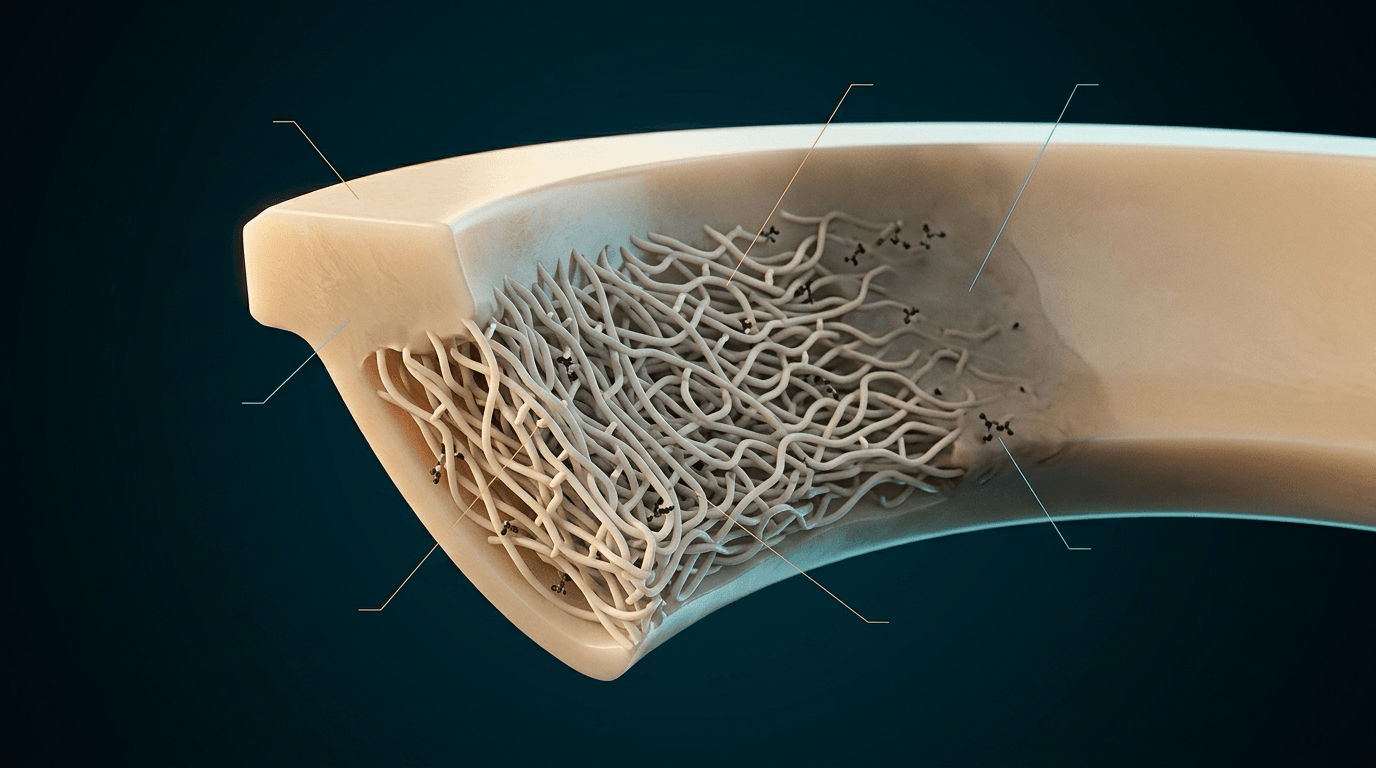
The molecule. UHMWPE is a linear polymer of ethylene monomers (C2H4): repeating -CH2-CH2- units forming long chains with a molecular weight of 3-6 million Da. The long chains entangle, and the entanglement provides strength and toughness. It is semicrystalline, and its morphology is described under Anatomy.
- Standard PE
- 20,000-40,000 Da
- UHMWPE
- 3-6 million Da
- Clinical Significance
- Higher MW = greater strength and toughness
- Standard PE
- 20-30 MPa
- UHMWPE
- 40-50 MPa
- Clinical Significance
- UHMWPE can withstand higher loads
- Standard PE
- Low
- UHMWPE
- High
- Clinical Significance
- UHMWPE suitable for bearing surface
- Standard PE
- Melt processable
- UHMWPE
- Not melt processable
- Clinical Significance
- UHMWPE requires compression moulding or RAM extrusion
Why it cannot be melted and moulded. The chains are too long and too entangled, so the viscosity is too high. UHMWPE is instead compression moulded from powder or RAM (resin as moulded) extruded, and GUR resin, as compression moulded sheets, is the most common starting material.
Medical-grade resin. Implant UHMWPE begins as a fine resin powder, polymerised by the Ziegler process and supplied under the GUR trade designation. The four-digit code is informative: the second digit historically denoted the presence (1) or absence (0) of calcium stearate, and the third digit tracks molecular weight (2 lower, 5 higher). The two modern medical grades differ chiefly in molecular weight.
- Approx. molecular weight
- approximately 3.5 million Da
- Calcium stearate
- None (modern grade)
- Typical use
- Marginally better fatigue/fracture resistance; favoured for tibial inserts
- Approx. molecular weight
- approximately 5.5 to 6 million Da
- Calcium stearate
- None (modern grade)
- Typical use
- Higher molecular weight, most wear resistant; common for acetabular liners
- Approx. molecular weight
- 1120 lower, 1150 higher
- Calcium stearate
- Calcium stearate added
- Typical use
- Withdrawn from modern implant use because of stearate-related fusion defects
The calcium stearate story. Calcium stearate was historically added as a processing aid and acid scavenger. It was implicated in fusion defects, poorly consolidated micro-regions (classically "Type 1" defects, or "white specks" and "dimples") that act as crack-initiation sites and reduce fatigue strength, so the older 1120 and 1150 grades were abandoned. Both modern resins are calcium-stearate-free, and the practical choice between them is molecular weight: GUR 1050 has the best wear resistance and favours acetabular bearings, while GUR 1020 offers marginally better resistance to fatigue crack propagation, useful where cyclic contact stress is high.
Biocompatibility. UHMWPE is inert, with no toxic degradation products, and non-allergenic, with no hypersensitivity reactions. It is stable in the body and does not corrode or dissolve in biological fluids. Its limitation is its wear particles, which activate macrophages and cause osteolysis in a size-dependent way (see Complications).
Conventional UHMWPE and Historical Problems
Gamma sterilisation in air. Conventional polyethylene was sterilised with gamma radiation (25-40 kGy, lower than the XLPE crosslinking dose) in air. The intent was to kill bacteria and spores and deliver a sterile implant; the unintended effect was oxidation. Radiation breaks C-H bonds and leaves free radicals, the radicals react with oxygen to form peroxides, and over time the peroxides break the polymer chains (chain scission) until the material loses its mechanical properties and delaminates.
Shelf ageing. Gamma-sterilised polyethylene stored in air oxidises over months to years. Its mechanical properties deteriorate before implantation, and the surface becomes brittle and prone to delamination.
In vivo oxidation. Implanted polyethylene continues to oxidise in the body, with oxygen from the synovial fluid, and the process is accelerated by synovial lipids. It leads to subsurface cracking, delamination and accelerated wear.
Hylamer PE (1990s) - worst case example: Sterilised with gamma in air, then packaged in air. Severe oxidation caused catastrophic delamination and osteolysis within 5-10 years. Led to widespread recalls and revisions. Lesson: oxidation is the enemy of PE longevity.
The Subsurface "White Band" and How Oxidised Polyethylene Fails
Where the damage sits. Gamma-air damage is concentrated beneath the surface, not on it. As oxygen diffuses inward and reacts with the radiation-generated free radicals, the oxidation rate peaks a short distance below the surface, producing an embrittled zone roughly 1-2mm deep. It appears as a subsurface "white band" on thin sections and corresponds to a peak in the oxidation index measured by FTIR.
Why it delaminates. The depth of maximum oxidation coincides with the depth of maximum subsurface shear (von Mises) stress generated by a non-conforming articulation, which is precisely the situation in the knee. A brittle band sitting where cyclic stress peaks is the recipe for delamination: a crack initiates at or below the white band and propagates parallel to the surface until a sheet of polyethylene lifts off.
- Appearance
- Smooth, shiny region
- Mechanism
- Adhesive removal of surface asperities
- Where it dominates
- Hip (conforming, low contact stress)
- Appearance
- Small surface craters
- Mechanism
- Localised surface fatigue, third-body indentation
- Where it dominates
- Knee
- Appearance
- Sheet-like lift-off, subsurface crack
- Mechanism
- Subsurface fatigue at the oxidised white band under high contact stress
- Where it dominates
- Knee (the classic oxidised-PE failure)
- Appearance
- Linear scratches, embedded particles
- Mechanism
- Third-body (cement, bone, metal) abrasion
- Where it dominates
- Both
A knee problem. The conforming, low-stress hip bearing wears mainly by adhesion and abrasion and tolerates a degree of oxidation. The non-conforming, high-contact-stress knee bearing is vulnerable to fatigue-driven delamination once a brittle band develops, which made delamination the catastrophic failure mode of gamma-air-sterilised, shelf-aged tibial inserts, epitomised by the Hylamer experience. This is also why the oxidation index (the carbonyl-peak ratio on FTIR) is the standard retrieval and quality-control metric, and why every modern strategy (inert-gas sterilisation, barrier packaging, post-irradiation remelting and vitamin E stabilisation) aims to stop the subsurface band from ever forming.
- Mechanism
- Sterilise in nitrogen or argon (no oxygen)
- Effectiveness
- Prevents shelf ageing, some in vivo oxidation
- Current Use
- Replaced by XLPE, rarely used
- Mechanism
- No radiation, no free radicals
- Effectiveness
- No oxidation, but no crosslinking
- Current Use
- Some conventional PE liners use this
- Mechanism
- Vacuum seal prevents oxygen contact
- Effectiveness
- Effective for shelf storage
- Current Use
- Standard for conventional PE if used
Highly Crosslinked Polyethylene (XLPE)
The concept. Crosslinking creates covalent C-C bonds between polymer chains and turns them into a three-dimensional network that restricts chain mobility and raises wear resistance. Crosslinking uses gamma or e-beam irradiation at 50-100 kGy. Remelted and annealed XLPE share one sequence: irradiation in an inert atmosphere, a thermal treatment, controlled cooling to room temperature and machining into liners. The generations differ in how they deal with the free radicals the irradiation leaves behind.
Remelting (first-generation XLPE). After irradiation the polyethylene is heated above its melting point, over 137°C and typically 150°C.
What it achieves. Heating lets the free radicals recombine or be quenched, so all of them are eliminated. With no residual radicals there is nothing for oxygen to react with, and the liner can be stored indefinitely without degradation.
What it costs. Melting destroys the crystalline lamellae, and crystallinity falls from 45% to 30-35%. Lower crystallinity brings lower fracture toughness and impact strength, and the material is more prone to crack propagation under cyclic loading, so remelted XLPE requires a minimum thickness of 6-8mm to prevent rim fracture.
Wear Performance
- Linear Wear Rate
- 0.1-0.2 mm/year
- Volumetric Wear
- 40-60 mm³/year
- Osteolysis Rate (15 years)
- 15-30%
- Linear Wear Rate
- 0.08-0.15 mm/year
- Volumetric Wear
- 30-50 mm³/year
- Osteolysis Rate (15 years)
- 10-20%
- Linear Wear Rate
- under 0.05 mm/year
- Volumetric Wear
- under 10 mm³/year
- Osteolysis Rate (15 years)
- under 5%
- Linear Wear Rate
- under 0.05 mm/year
- Volumetric Wear
- under 10 mm³/year
- Osteolysis Rate (15 years)
- under 5%
What the numbers mean. XLPE takes linear wear below the 0.1mm/year threshold for osteolysis and volumetric wear below the critical 40-50 mm³/year threshold. Osteolysis rates are dramatically reduced as a result.
Anatomy
A semicrystalline polymer. UHMWPE is neither fully crystalline nor fully amorphous. About 40-50% is crystalline: ordered lamellae of polymer chains folded back and forth, approximately 10-50nm thick, in an orthorhombic crystal structure (the most stable). The crystalline phase provides mechanical strength and stiffness, wear resistance (it is the hard phase) and chemical resistance, and the higher the crystallinity, the greater the strength and stiffness. Higher crystallinity means better mechanical properties but lower oxidation resistance.
The amorphous phase. The other 50-60% is disordered, entangled chains in a random coil configuration. It provides toughness and impact resistance, ductility (the ability to deform before fracture) and energy absorption.
- Crystalline Phase
- Higher (1.00 g/cm³)
- Amorphous Phase
- Lower (0.855 g/cm³)
- Clinical Relevance
- Overall density reflects crystallinity
- Crystalline Phase
- High (provides rigidity)
- Amorphous Phase
- Low (flexible)
- Clinical Relevance
- Crystallinity determines stiffness
- Crystalline Phase
- Brittle on own
- Amorphous Phase
- High (energy absorption)
- Clinical Relevance
- Amorphous phase critical for impact resistance
- Crystalline Phase
- Low (ordered structure)
- Amorphous Phase
- High (gaps between chains)
- Clinical Relevance
- Lipid absorption occurs in amorphous phase
Tie molecules. Long polymer chains traverse several crystalline and amorphous regions, and the segments that connect adjacent lamellae through the amorphous phase are the tie molecules. They transfer stress between crystalline regions, so they are critical for mechanical integrity and bind the two phases into a strong interconnected network. The more tie molecules, the better the toughness and fatigue resistance, and the high molecular weight (3-6 million Da) ensures they are abundant.
Lamellar ultrastructure. Primary lamellae are thick (20-50nm) and form during slow cooling; secondary lamellae are thin (10-20nm) and form during recrystallisation. Lamellar thickness is proportional to crystallisation temperature, and lamellae arranged radially form spherulites, visible under polarised light.
Processing changes the morphology. Each processing step affects crystallinity and the lamellae differently.
- Effect on Crystallinity
- Sets baseline crystallinity (45-50%)
- Effect on Lamellae
- Forms primary lamellae during slow cooling
- Clinical Implication
- Starting point for further processing
- Effect on Crystallinity
- Minimal direct effect
- Effect on Lamellae
- Some lamellar disruption
- Clinical Implication
- Creates crosslinks in amorphous phase
- Effect on Crystallinity
- Reduces to 30-35%
- Effect on Lamellae
- Destroys crystalline structure, smaller lamellae reform
- Clinical Implication
- Reduces toughness significantly
- Effect on Crystallinity
- Maintains 40-45%
- Effect on Lamellae
- Preserves original lamellae
- Clinical Implication
- Better mechanical properties than remelting
Where crosslinking helps. Chains in the crystalline regions already have restricted mobility, which makes that phase inherently wear-resistant. Crosslinking therefore gives its greatest benefit in the amorphous regions.
Classification
Generations of polyethylene. Five generations run from gamma-air conventional polyethylene to vitamin E XLPE.
- Type
- Conventional UHMWPE
- Manufacturing
- Gamma sterilised in air (25-40 kGy)
- Key Features
- Oxidation and shelf ageing problems
- Type
- Improved conventional PE
- Manufacturing
- Gamma in inert gas or barrier packaging
- Key Features
- Reduced shelf ageing, some oxidation
- Type
- First-gen XLPE (remelted)
- Manufacturing
- 50-100 kGy + remelting (greater than 137°C)
- Key Features
- 90% wear reduction, reduced toughness
- Type
- Annealed XLPE
- Manufacturing
- 50-100 kGy + annealing (less than 137°C)
- Key Features
- Better toughness, some residual radicals
- Type
- Vitamin E XLPE
- Manufacturing
- Vitamin E blending or diffusion
- Key Features
- Antioxidant protection, maintained toughness
Two numbering systems. The table numbers every generation of polyethylene, so its third, fourth and fifth generations are the three XLPE generations when XLPE is numbered on its own by its treatment after irradiation.
First-generation XLPE is remelted (eliminates radicals, reduces toughness), second-generation is annealed (preserves toughness, some radicals remain) and third-generation is vitamin E stabilised (antioxidant protection without toughness loss). All generations achieve approximately 90% wear reduction compared to conventional PE.
By application. Acetabular liners in THA, fixed or modular, are the most common application, and XLPE is the standard of care there. Tibial inserts in TKA see lower cross-shear wear, and XLPE is increasingly used in them. Polyethylene also forms glenoid components in TSA, dual mobility constructs and constrained liners.
By brand. Each manufacturer combines dose and treatment differently.
- Manufacturer
- DePuy
- Radiation Dose
- 50 kGy gamma
- Thermal Treatment
- Remelted (150°C)
- Manufacturer
- Zimmer Biomet
- Radiation Dose
- 100 kGy e-beam
- Thermal Treatment
- Remelted
- Manufacturer
- Stryker
- Radiation Dose
- 30 kGy x 3 sequential
- Thermal Treatment
- Annealed after each dose
- Manufacturer
- Biomet
- Radiation Dose
- 100 kGy
- Thermal Treatment
- Vitamin E diffused
- Manufacturer
- Zimmer
- Radiation Dose
- 75-100 kGy
- Thermal Treatment
- Vitamin E diffused
By radiation source. Gamma radiation comes from a cobalt-60 source and penetrates the material uniformly, but its dose rate is lower (it takes hours) and the temperature rises during irradiation, which may affect crosslinking. An electron beam (accelerated electrons) delivers a higher dose rate (minutes) with more precise temperature control, but its penetration depth is limited and multiple passes may be needed.
Investigations
Manufacturing quality control. Standard ISO/ASTM testing covers tensile strength (ASTM D638: ultimate tensile strength, yield strength and elongation at break), impact strength (notched Izod specimens, and the Charpy test), crystallinity by differential scanning calorimetry (DSC) and oxidation index by FTIR spectroscopy. Fatigue testing applies cyclic loading to simulate walking cycles and measures the crack propagation rate; XLPE is more susceptible to fatigue crack growth. XLPE adds two tests of its own: crosslink density (gel content, swell ratio) and free radical content (ESR spectroscopy).
Oxidation index. Fourier transform infrared spectroscopy (FTIR) measures the carbonyl absorption peak at 1718 cm⁻¹, and the oxidation index is the ratio of the carbonyl peak to a reference peak. Fresh polyethylene has an index under 0.1 and oxidised polyethylene over 1.0. It is used to assess shelf ageing and in retrieval analysis.
Free radicals. Electron spin resonance (ESR) detects unpaired electrons and so quantifies the free radicals left after manufacturing: near zero in remelted XLPE, detectable residuals in annealed XLPE.
Crosslink density. Three measures are used.
- Principle
- Insoluble fraction after solvent extraction
- Measurement
- Higher % = more crosslinks
- Interpretation
- XLPE typically 95-99% gel content
- Principle
- Volume increase when swollen in solvent
- Measurement
- Lower ratio = more crosslinks
- Interpretation
- Inversely proportional to crosslink density
- Principle
- FTIR peak at 965 cm⁻¹
- Measurement
- Correlates with radiation dose
- Interpretation
- Quality control during manufacturing
Retrieval analysis. When a liner is revised, laboratory analysis of the explant provides valuable information:
- Visual inspection - wear patterns, scratches, rim damage
- Dimensional measurement - comparison with the original dimensions (CMM)
- Oxidation profiling - FTIR through the thickness, surface to bulk
- Mechanical testing - tensile and impact, if there is sufficient material
- Microscopy - subsurface cracking, delamination, third-body wear
Measuring wear in patients. Linear wear is measured as femoral head penetration into the liner (mm/year), compared against the baseline postoperative radiograph. Software-assisted measurement (PolyWare) and RSA improve on manual reading, and CT allows 3D volumetric wear analysis, more accurate than plain radiographs but primarily a research tool. With XLPE, expect under 0.05mm/year, often unmeasurable on plain radiographs.
- Accuracy
- ±0.5-1.0mm
- Advantages
- Widely available, low cost
- Limitations
- Low precision, requires consistent positioning
- Accuracy
- ±0.1-0.2mm
- Advantages
- Better precision, standardised method
- Limitations
- Software required, still 2D limitation
- Accuracy
- ±0.01-0.05mm
- Advantages
- Highest precision, gold standard research
- Limitations
- Requires tantalum beads at surgery, expensive
- Accuracy
- ±0.05-0.1mm
- Advantages
- 3D analysis, no beads needed
- Limitations
- Higher radiation, cost, research setting
Imaging for osteolysis. Plain radiographs look for periarticular lucencies, component migration and liner wear. If osteolysis is suspected, CT is more sensitive than plain radiographs for detecting osteolytic lesions and quantifies lesion volume for surgical planning; metal artefact reduction sequences help. The surveillance schedule is under Postoperative Care.
Management
The decision. The polyethylene is XLPE in every scenario; what varies is the head size, and the head is chosen to preserve liner thickness. Patient age, activity and expected lifespan (the younger the patient, the more cycles) all argue for XLPE. Acetabular size governs the liner thickness available, and the liner must be compatible with the cup design.
- PE Type
- XLPE
- Head Size
- 32-36mm
- Rationale
- Standard of care, balance stability and thickness
- PE Type
- XLPE
- Head Size
- 28-32mm (smaller head)
- Rationale
- Maintain 6-8mm thickness, sacrifice head size
- PE Type
- XLPE
- Head Size
- 36-40mm
- Rationale
- Larger head for stability if adequate thickness
- PE Type
- XLPE
- Head Size
- Based on shell size
- Rationale
- Always XLPE in revision to minimise future wear
Head size by cup. A 32mm head is standard for smaller acetabula (50-54mm cups). A 36mm head is preferred for larger acetabula (56mm+ cups) if the thickness is adequate, and a 40mm head is kept for selected cases (revision, high dislocation risk) with large cups.
A larger head gives better stability (higher jump distance, greater ROM), but in the same cup it leaves a thinner liner. Never sacrifice the minimum 6-8mm thickness for a larger head: a 32mm head with an 8mm liner is safer than a 40mm head with a 4mm liner.
Choosing the formulation. The three formulations differ in toughness and oxidation behaviour.
- Best For
- Standard patients, long track record
- Consideration
- Reduced toughness requires 6-8mm minimum
- Evidence
- 15+ year data, proven durability
- Best For
- Younger patients, thin liners acceptable
- Consideration
- Better mechanical properties, some residual radicals
- Evidence
- 10+ year data, excellent outcomes
- Best For
- Optimal toughness desired, thin liners
- Consideration
- Can potentially use thinner liners or higher doses
- Evidence
- 10+ year data emerging, excellent wear
Dual mobility. A large outer head (effectively 40-48mm+) provides stability around a smaller inner articulation (22-28mm). Some dual mobility cups use conventional polyethylene (design-specific), but XLPE dual mobility is increasingly available and preferred.
The knee. TKA has lower cross-shear wear than THA (more sliding, less rotation), so conventional polyethylene is still acceptable there, with less wear concern. XLPE is increasingly used, but the evidence is less clear than in THA, and cruciate-retaining versus posterior-stabilised design affects the loading pattern.
When a lucency appears. CT quantifies the osteolysis volume, and MRI is added if there is soft-tissue concern (ALTR, pseudotumour). Intervention is planned on lesion size and progression. Consider revision for:
- Measurable linear wear over 0.1mm/year with XLPE (unusual)
- Progressive osteolysis, lesions over 1-2cm
- Component loosening or impending fracture
- Symptoms: pain or instability
Revising the bearing. Isolated liner exchange is possible if the shell is well fixed and well positioned, with bone grafting of osteolytic lesions through the screw holes. Always use XLPE in revision, upgrading from conventional polyethylene to reduce future wear. At head-liner exchange, replace the head as well (a new head on the existing stem) even if it appears acceptable, to optimise the articulation.
Surgical Technique
Planning. The cup outer diameter determines the liner options, and the head size is selected for the liner thickness it leaves. For a 54mm cup:
- 32mm head: ~10mm liner (ideal)
- 36mm head: ~8mm liner (acceptable)
- 40mm head: ~6mm liner (minimum)
Offset. The liner can also be neutral, elevated-lip or lateralised, chosen to optimise stability.
- Description
- Standard liner, symmetric
- Indication
- Standard primary THA
- Trade-off
- Baseline stability, no impingement risk
- Description
- Asymmetric raised rim
- Indication
- High dislocation risk, revision
- Trade-off
- Better posterior stability, may cause impingement if malpositioned
- Description
- Offset centre of rotation laterally
- Indication
- Abductor tension, leg length
- Trade-off
- Increases offset, may thin medial wall
The arithmetic. Liner thickness = (Cup OD - Head size) / 2 + liner wall thickness. For example, a 54mm cup with a 36mm head gives (54-36)/2 = 9mm dome thickness (acceptable).
In theatre. The final decisions are made after reaming:
- Confirm the final cup size after final reaming (typically a 1-2mm under-ream for press-fit)
- Insert the final cup with appropriate press-fit and confirm stable seating
- Select the liner that achieves adequate thickness, and the offset
- Trial liner and head, assessing stability (shuck test, ROM testing), leg length and offset, and impingement through full ROM
- Insert the real liner and confirm full seating, then the real head and confirm taper engagement
Ensure complete liner seating. Modular liners must fully engage the locking mechanism: incomplete seating means micromotion and accelerated backside wear. Confirm circumferential seating with a visual and tactile check; some designs give an audible "click" confirmation.
Modular or fixed. Modular shells dominate modern practice.
- Modular Liner
- Separate metal shell + PE liner
- Fixed (Cemented All-Poly)
- All-polyethylene cup, cemented
- Clinical Implication
- Modularity allows adjustment
- Modular Liner
- Possible at liner-shell interface
- Fixed (Cemented All-Poly)
- None (no metal backing)
- Clinical Implication
- XLPE minimises this concern
- Modular Liner
- Liner exchange possible if shell well-fixed
- Fixed (Cemented All-Poly)
- Requires cup removal
- Clinical Implication
- Modularity advantages in revision
- Modular Liner
- Uncemented THA (most common)
- Fixed (Cemented All-Poly)
- Cemented THA (less common now)
- Clinical Implication
- Modular dominates modern practice
Locking mechanisms. Manufacturers lock the liner differently, with a peripheral snap-fit ring around the liner edge or a central post. Screw holes can give osteolysis access to bone, and some designs cover them. Match the liner to the shell: they are not interchangeable between manufacturers.
Handling. Keep XLPE in its sterile packaging until ready to insert, avoid prolonged exposure to room air (some formulations), do not drop or damage it (rim defects), and follow the manufacturer's storage recommendations. Vitamin E XLPE may have a yellow tint, which is normal, and is handled like any other XLPE.
Complications
Osteolysis. Wear particles of 0.1-10 microns activate macrophages, which release IL-1, IL-6, TNF-alpha and PGE2. Osteoclasts are activated and bone is resorbed, progressively, around the implant.
Osteolysis is the main reason for PE-related revision. The macrophage reaction to wear particles leads to bone loss, component loosening and periprosthetic fracture. The threshold is approximately 40-50 mm³/year of volumetric wear, and XLPE reduces wear below this threshold in most patients.
What XLPE changes. It dramatically lowers osteolysis but brings its own mechanical concerns: rim fracture (reduced toughness), fatigue failure (thin liners) and, for annealed XLPE, long-term oxidation. Minimum thickness and proper cup positioning prevent them.
- Conventional PE
- 15-30% at 15 years
- XLPE
- Under 5% at 15 years
- Prevention
- XLPE reduces wear particles below osteolysis threshold
- Conventional PE
- Possible with high wear rates
- XLPE
- Extremely rare
- Prevention
- Surveillance X-rays
- Conventional PE
- Rare (high toughness)
- XLPE
- Reported (reduced toughness)
- Prevention
- Minimum 6-8mm thickness, proper cup position
- Conventional PE
- High (if gamma in air)
- XLPE
- Low with proper manufacturing
- Prevention
- Remelting, annealing, or vitamin E
Rim fracture. Edge loading concentrates stress at the liner rim, crosslinking has reduced the toughness that would resist it, and a thinner liner has less material to resist fracture. Cup malposition increases the edge loading.
- Risk factors - liner under 6mm, cup abduction over 55 degrees, high activity (more loading cycles), impingement
- Prevention - a 6-8mm minimum liner, optimal cup position (40-45 degrees abduction), no elevated-lip liner if the cup is malpositioned, and a larger cup if the acetabulum permits
Oxidation. The risk depends on how the free radicals were handled.
- Manufacturing
- 25-40 kGy in air
- Oxidation Risk
- High - shelf ageing and in vivo
- Clinical Implication
- Historical problem, no longer manufactured
- Manufacturing
- 50-100 kGy + remelting
- Oxidation Risk
- Minimal - all radicals eliminated
- Clinical Implication
- Excellent oxidation resistance
- Manufacturing
- 50-100 kGy + annealing
- Oxidation Risk
- Low - some residual radicals
- Clinical Implication
- Slow oxidation possible, still excellent
- Manufacturing
- Vitamin E blended/diffused
- Oxidation Risk
- Minimal - antioxidant protection
- Clinical Implication
- Ongoing protection, excellent resistance
Backside wear. Micromotion between a modular liner and its metal shell generates additional particles, and screw holes are especially problematic because they give particles access to bone. A secure locking mechanism and complete liner seating prevent it, and some designs cover the screw holes; XLPE reduces the concern but does not eliminate it.
Dislocation. Liner choice affects stability. Elevated-lip liners increase jump distance, larger heads improve stability at the cost of a thinner liner, lateralised liners change offset, and constrained liners serve high-risk patients. Because its wear penalty is low, XLPE enables the larger heads that improve stability.
Differential Diagnosis: The Painful or Failing Polyethylene-Bearing THA
When a patient with a polyethylene-bearing hip presents with pain, instability or a lytic lesion, the bearing is only one of several explanations, and working through them systematically is a common viva structure. A patient who develops symptoms (pain, instability, clicking) needs a structured workup. Examine gait, ROM and stability, test for impingement and rule out infection (aspiration if needed). Image with AP pelvis and lateral hip radiographs, CT for osteolysis and MRI if there is soft-tissue concern.
- Typical features
- Gradual onset, eccentric head position, expansile periacetabular lucency
- Key investigation
- Serial radiographs, CT for lesion volume
- Discriminator
- Measurable head penetration; far less likely with XLPE
- Typical features
- Sudden pain/instability, often malpositioned or thin liner, active patient
- Key investigation
- Radiograph and CT (fracture fragments)
- Discriminator
- Acute change in a previously well hip; cup abduction often greater than 55 degrees
- Typical features
- Start-up pain, progressive radiolucent lines, migration
- Key investigation
- Serial radiographs, nuclear imaging if equivocal
- Discriminator
- Component migration without focal lysis
- Typical features
- Rest pain, warmth, raised inflammatory markers, early or late
- Key investigation
- CRP/ESR, aspiration with culture and alpha-defensin
- Discriminator
- Positive aspirate; must exclude before attributing pain to wear
- Typical features
- More with metal-on-metal or taper corrosion; effusion, pseudotumour
- Key investigation
- Metal ions (Co/Cr), MARS MRI
- Discriminator
- Soft-tissue mass and metal debris rather than PE particles
- Typical features
- Trochanteric bursitis, tendinopathy, spinal or vascular referred pain
- Key investigation
- Targeted examination, image-guided injection
- Discriminator
- Pain not reproduced by hip loading; normal implant imaging
Postoperative Care
Surveillance schedule. Surveillance continues indefinitely:
- 6 weeks - wound check, early radiograph
- 3 months - clinical assessment
- 1 year - radiograph
- Annually - clinical review, with radiographs every 1-2 years
Reading the radiograph. Take an AP pelvis and a lateral hip view and compare each with the immediate postoperative baseline, looking for linear penetration of the head into the liner, osteolytic lucencies around the components, component migration or loosening, and cup position (abduction, anteversion).
- Wear Finding
- Bedding-in (creep), not true wear
- Osteolysis
- None expected
- Action
- Baseline established
- Wear Finding
- Minimal (less than 0.05mm/year)
- Osteolysis
- Rare (under 2%)
- Action
- Continue surveillance
- Wear Finding
- Still minimal, often unmeasurable
- Osteolysis
- Under 5%
- Action
- Continue surveillance
- Wear Finding
- Less than 1mm total linear wear
- Osteolysis
- Under 5%
- Action
- Excellent long-term performance
Bedding-in (creep) occurs in first 1-2 years as the femoral head settles into the liner under load. This is not true wear and should not be included in wear rate calculations. To calculate true wear rate, compare X-rays from 2 years post-op onwards.
When to watch more closely. Some findings call for enhanced monitoring.
- Finding
- Measurable penetration after 2 years
- Action
- Annual X-rays, consider CT
- Rationale
- XLPE wear should be near-zero - investigate
- Finding
- Periarticular lucency on X-ray
- Action
- CT scan, 6-monthly reviews
- Rationale
- Quantify lesion, monitor progression
- Finding
- Abduction greater than 55 degrees
- Action
- More frequent clinical and X-ray
- Rationale
- Higher risk of edge loading and rim fracture
- Finding
- Less than 6mm thickness
- Action
- Annual X-rays, symptoms monitoring
- Rationale
- Higher risk of rim fracture
Activity. XLPE is designed for active patients, and there are no specific activity restrictions related to polyethylene wear. Higher activity means more cycles, but XLPE handles this well; the general THA precautions still apply (avoid high-impact and contact sports).
Long-term expectations. With XLPE, 10-year survivorship is over 95% and 15-year survivorship over 90%, with 20-year data emerging and excellent.
Weight. Higher BMI increases joint loading, and weight loss benefits implant longevity as well as general health. This is not specific to the polyethylene type, but it reduces overall wear.
Outcomes
XLPE against conventional polyethylene. Linear wear falls from 0.1-0.2mm/year to 0.02-0.05mm/year, an 80-90% reduction, and osteolysis at 10+ years from 15-30% to under 5%. Revision for wear and osteolysis is dramatically reduced, and 15-year survivorship is over 95% for THA and TKA.
Why XLPE hips are revised. Instability or dislocation and infection, neither of them specific to polyethylene; osteolysis, dramatically reduced with XLPE; and liner fracture, rare and preventable with proper thickness.
- Conventional PE
- 0.1-0.2
- XLPE (1st Gen)
- 0.02-0.05
- Vitamin E XLPE
- 0.01-0.03
- Conventional PE
- 50-100
- XLPE (1st Gen)
- 10-30
- Vitamin E XLPE
- 5-20
- Conventional PE
- 15-30%
- XLPE (1st Gen)
- 2-5%
- Vitamin E XLPE
- Under 2% (limited data)
- Conventional PE
- 8-12%
- XLPE (1st Gen)
- Under 2%
- Vitamin E XLPE
- Under 1%
- Conventional PE
- Rare
- XLPE (1st Gen)
- 1-2% (if thin)
- Vitamin E XLPE
- Under 1%
- Conventional PE
- 85-90%
- XLPE (1st Gen)
- 93-96%
- Vitamin E XLPE
- 95%+ (extrapolated)
Before XLPE, polyethylene wear was the Achilles heel of THA - the main cause of late revision. With XLPE achieving wear rates below the osteolysis threshold (less than 40-50 mm³/year), young active patients can now expect implant longevity approaching their lifetime. Registry data confirms over 95% 15-year survivorship with XLPE bearings.
RSA measures true wear. Radiostereometric analysis is the gold standard, with a precision of 0.01mm, and it eliminates the bedding-in artefact. RSA studies of XLPE show:
- Longevity (remelted, Zimmer) - steady-state 0.005 mm/year at 7 years (Thomas/Glyn-Jones 2011, PMID 21508278)
- Marathon (remelted, DePuy) - approximately 0.02 mm/year
- E1 (vitamin E-diffused) - low/near-zero penetration on RSA (Nebergall 2017, PMID 28455465)
Outcomes by formulation. Remelted XLPE (Marathon, Durasul, Longevity) has the lowest wear rates (steady-state often below 0.02 mm/yr on RSA) and long-term RCT and registry data, at the cost of reduced crystallinity and toughness. Annealed and sequentially annealed XLPE (Crossfire, X3) preserves crystallinity and mechanical properties, but its residual free radicals confer some oxidation risk, which sequential irradiation-and-anneal (X3) mitigates. Vitamin E XLPE (E1, Vivacit-E) has excellent early results and the best mechanical properties, and its long-term data are still accumulating.
Registry revision. The AOANJRR 2023 report is cited for 15-year survivorship of 95.4% for THA with XLPE against 89% with historical conventional polyethylene, and for revision for loosening or osteolysis of 1.2% with XLPE against 6.8% with conventional polyethylene at 15 years, with the greatest benefit from XLPE in young patients (under 55). The verified registry and study figures follow.
- Follow-up
- 7-year cumulative
- XLPE Revision
- 2.8%
- Conventional PE
- 5.4% (HR 1.75 for conventional)
- Follow-up
- min 5-year
- XLPE Revision
- Osteolysis OR 0.13
- Conventional PE
- Reference (87% higher risk)
- Follow-up
- 10-year CPR
- XLPE Revision
- 2.7% (best surgeons, XLPE users)
- Conventional PE
- 5.9% (others)
Absolute revision percentages vary between registries because of differing case mix, bearing definitions and reporting years. The reproducible, peer-reviewed signal across the AOANJRR, the UK NJR, the Nordic registries and the US Kaiser cohort is directionally consistent: metal-on-XLPE and ceramic-on-XLPE carry a lower risk of aseptic loosening and osteolysis-driven revision than metal-on-conventional polyethylene. Quote the verified Kaiser hazard ratio (1.75 all-cause; 1.91 aseptic) and the Kurtz osteolysis odds ratio (0.13) rather than non-attributable registry percentages.
The knee. TKA wears differently. Conventional polyethylene in the knee wears less than in the hip (linear wear 0.05-0.1 mm/year) and causes osteolysis less often because the biomechanics differ, but delamination and fatigue failure are more problematic. XLPE in TKA wears at 0.02-0.04 mm/year and reduces wear debris and osteolysis, with a potential trade-off in subsurface fatigue crack propagation, and the AOANJRR shows a modest benefit compared with THA because the failure modes differ.
XLPE benefit is more pronounced in THA than TKA. In THA, volumetric wear and osteolysis are the dominant failure mechanisms - XLPE directly addresses these. In TKA, failure modes are more varied (instability, infection, loosening from alignment issues, polyethylene fracture) and wear-related revision is less common. Registry data shows XLPE provides greater incremental benefit in THA.
Clinical Relevance and Applications
XLPE is the standard of care for THA bearing surfaces. It is indicated for:
- All primary THA - the standard choice for most patients
- Young active patients - essential, because low wear is critical to longevity over high cumulative cycles
- Elderly low-demand patients - still preferred, for better outcomes
- Revision THA - always, to reduce future wear-related complications
- Large femoral heads - XLPE enables 36-40mm heads safely
No routine indication for conventional polyethylene in THA. XLPE is preferred for its 90% wear reduction, AOANJRR data confirm lower revision rates, and although it costs more than conventional polyethylene, it is cost-effective long-term, a cost justified by outcomes. XLPE also replaced metal-on-metal bearings where wear was the concern.
Relative contraindications. Small acetabular components may not achieve the minimum 6-8mm liner thickness, and some dual mobility constructs use conventional polyethylene (design-specific).
Mechanical Properties and Clinical Considerations
The toughness trade-off. Crosslinking buys wear resistance with toughness.
- Conventional PE
- Baseline
- XLPE (Remelted)
- 10x improvement
- Change
- Much better
- Conventional PE
- High (baseline)
- XLPE (Remelted)
- Reduced 20-30%
- Change
- Worse
- Conventional PE
- 40-50 MPa
- XLPE (Remelted)
- 35-45 MPa
- Change
- Slightly worse
- Conventional PE
- Baseline
- XLPE (Remelted)
- Reduced 30-40%
- Change
- Worse
Why toughness falls. Two things happen in remelted XLPE. The crosslinks restrict chain mobility, so chains cannot slide past each other to dissipate energy and the material cannot elongate as far before fracture; and remelting reduces crystallinity, and the crystalline regions provide mechanical strength.
Why a minimum thickness. A thin liner is vulnerable in four ways:
- Rim fracture - edge loading concentrates stress at the liner rim, and thin liners crack
- Fatigue failure - cyclic loading drives subsurface crack propagation, and thin liners fail faster
- Oxidation - thin liners have a higher surface area to volume ratio and age faster
- Impact - thin liners are more susceptible to impingement and fracture
The guideline. XLPE should be a minimum of 6mm thick, preferably 8mm. Larger femoral heads (36-40mm) are used only if an adequate liner thickness is achieved.
Guidelines, Registries & Global Practice
Australian Orthopaedic Association National Joint Replacement Registry (AOANJRR):
- XLPE with ceramic head: 48% of primary THA (most common)
- XLPE with metal head: 38% of primary THA
- Ceramic-on-ceramic: 9% (declining)
- Metal-on-metal: Less than 0.5% (near-abandoned)
XLPE with ceramic femoral head has lowest revision rate of all bearing combinations in AOANJRR
- XLPE is standard of care for all primary THA
- Minimum liner thickness: 8mm recommended
- Head size: 32-36mm optimal (balance stability vs wear)
- Ceramic heads: Preferred in patients under 65
- Vitamin E XLPE: Increasingly used, registry tracking ongoing
- Target 15-year all-cause revision: Under 5%
- Wear-related revision: Under 2%
The AOANJRR is one of the world's largest and most comprehensive joint registries with over 1.5 million procedures recorded. It provides real-world outcome data that informs international practice alongside the UK NJR, the Nordic registries and the US AJRR. In any fellowship examination, quoting registry revision rates and hazard ratios demonstrates knowledge of evidence-based, globally applicable practice.
Frequently asked questions
What is UHMWPE and why is it used in orthopaedic implants?
Ultra-high molecular weight polyethylene (UHMWPE) is a semicrystalline polymer of ethylene monomers with a molecular weight of 3-6 million Daltons. That enormous chain length gives it the toughness, low friction and abrasion resistance needed for arthroplasty bearing surfaces, where it articulates against a metal or ceramic counterface in hip, knee, shoulder and ankle replacements.
How are implantable UHMWPE components manufactured?
Medical-grade UHMWPE resin powder is consolidated by compression moulding or ram extrusion and then machined into the final component. Modern highly crosslinked polyethylene (XLPE) is then irradiated at 50-100 kGy to create C-C crosslinks between chains, followed by thermal treatment - remelting above 137 degrees C eliminates free radicals but reduces crystallinity and toughness, while annealing below 137 degrees C preserves crystallinity but leaves residual radicals. Sterilisation is now performed in inert gas with barrier packaging: historical gamma sterilisation in air (25-40 kGy) caused subsurface oxidation, a brittle white band, delamination and the Hylamer recalls of the 1990s.
What is crosslinked polyethylene (XLPE) and how much does it reduce wear?
XLPE is UHMWPE that has been irradiated at 50-100 kGy so free radicals recombine into crosslinks between polymer chains. Crosslinking cuts adhesive and abrasive wear by about 90 percent - linear wear under 0.05 mm per year compared with 0.1-0.2 mm per year for conventional polyethylene - taking volumetric wear below the osteolysis threshold, with 15-plus-year clinical data confirming durability.
Why is vitamin E added to polyethylene joint replacements?
Vitamin E (alpha-tocopherol) is an antioxidant that scavenges the residual free radicals left after irradiation, protecting the bearing from long-term oxidation without the toughness penalty of remelting. It is incorporated either by diffusing vitamin E into the irradiated component or by blending it into the UHMWPE powder before consolidation.
Which joint replacement components are made from UHMWPE?
UHMWPE forms the acetabular liner in total hip replacement, the tibial insert and patellar button in total knee replacement, and glenoid components in shoulder arthroplasty. Because crosslinking reduces fracture toughness, XLPE components require a minimum thickness of about 6-8 mm, which constrains its use in thin geometries such as small glenoids and patellae.
MCQ Practice Points
Q: What is the molecular weight range of ultra-high molecular weight polyethylene (UHMWPE)? A: 3-6 million Daltons - This compares with 20,000-40,000 Da for standard polyethylene. The high molecular weight provides strength, toughness, and wear resistance.
Q: What radiation dose is used to create highly crosslinked polyethylene (XLPE)? A: 50-100 kGy - This is 2-4 times higher than the 25-40 kGy dose used for conventional gamma sterilization. The high dose creates C-C crosslinks between polymer chains.
Q: By what percentage does highly crosslinked polyethylene reduce volumetric wear compared to conventional polyethylene? A: 90% - XLPE reduces linear wear to under 0.05mm/year vs 0.1-0.2mm/year for conventional PE. This reduces osteolysis rates from 15-30% to under 5% at 15 years.
Q: What is the minimum recommended thickness for XLPE liners in total hip arthroplasty? A: 6-8mm (preferably 8mm) - XLPE has reduced fracture toughness due to crosslinking and reduced crystallinity from remelting. Thinner liners are at risk for rim fracture with edge loading.
Exam Viva Scenarios
Practise clinical reasoning and management decisions out loud
“A 55-year-old active male is 5 years post THA with XLPE liner. He presents with sudden onset pain and instability. X-ray shows the cup is in 60 degrees abduction. What is your differential diagnosis and management?”
“A 45-year-old active male requires primary THA for hip dysplasia with secondary OA. He is concerned about implant longevity. How do you counsel him about bearing surface options?”
“An examiner asks you to justify your choice of bearing surface for a 55-year-old female undergoing primary THA. What evidence do you use?”
UHMWPE Structure
- Molecular weight: 3-6 million Da
- Semicrystalline: 40-50% crystalline, 50-60% amorphous
- Linear chains of ethylene monomers (C2H4)
- Cannot melt process (too viscous, requires compression molding)
XLPE Manufacturing
- Radiation: 50-100 kGy gamma or e-beam (2-4x conventional sterilization)
- Crosslinking: C-C bonds between chains increase wear resistance
- Remelting (over 137C): eliminates radicals, reduces crystallinity (30-35%)
- Annealing (below 137C): preserves crystallinity (40-45%), leaves residual radicals
Wear Performance
- Conventional PE: 0.1-0.2mm/year linear wear (osteolysis risk)
- XLPE: under 0.05mm/year (90% reduction)
- Osteolysis: conventional 15-30%, XLPE under 5% at 15 years
- Critical particle size for osteolysis: 0.1-10 microns
Mechanical Trade-offs
- XLPE wear resistance: 10x better than conventional
- XLPE fracture toughness: 20-30% lower (crosslinks restrict mobility)
- XLPE impact strength: 30-40% lower (reduced crystallinity)
- Minimum thickness: 6-8mm (preferably 8mm) to prevent rim fracture
Clinical Applications
- XLPE is standard of care for THA bearing surfaces
- Enables larger femoral heads (36-40mm) without prohibitive wear
- Head size selection based on maintaining adequate liner thickness
- 32mm heads for smaller acetabula, 36-40mm for larger
Advanced Formulations
- Vitamin E stabilized: antioxidant prevents oxidation without remelting
- Better toughness than remelted XLPE (can use lower radiation or skip remelting)
- Diffusion method: soak in vitamin E (surface distribution)
- Blending method: mix vitamin E into powder (uniform distribution)
Evidence Base
Long-term Survivorship
XLPE vs UHMWPE: 7-Year Wear (Double-Blind RCT, RSA)
- Double-blind RCT: 54 patients randomised to highly cross-linked (Longevity) vs conventional UHMWPE liners, assessed by radiostereometric analysis (RSA)
- Steady-state wear rate: XLPE 0.005 mm/year vs conventional 0.037 mm/year at minimum 7 years (p = 0.007)
- Total femoral head penetration: 0.33 mm (XLPE) vs 0.55 mm (UHMWPE) at 7 years (p = 0.005)
- No XLPE patient exceeded the 0.1 mm/year osteolysis threshold, compared with 9% of the UHMWPE group
First-Generation XLPE: Systematic Review of Wear and Osteolysis
- Systematic review: 28 studies (1503 hips) for XLPE penetration vs 18 studies (695 hips) for conventional UHMWPE
- Weighted mean 2D linear penetration: 0.042 mm/year (XLPE) vs 0.137 mm/year (conventional UHMWPE)
- Pooled odds ratio for osteolysis (XLPE vs conventional) was 0.13 (95% CI 0.06 to 0.27) at minimum 5-year follow-up, an 87% lower risk
- Wear or osteolysis reduction not established for large (greater than 32mm) metallic heads or ceramic heads of any size; few data in TKA
Vitamin E-Diffused XLPE at 5 Years (RCT, RSA)
- Blinded RCT: vitamin E-diffused XLPE (E1, 32 patients) vs medium cross-linked control (ArComXL, 35 patients), assessed by radiostereometric analysis
- Five-year median proximal head penetration: -0.05 mm (E1) vs 0.07 mm (ArComXL); penetration significantly greater in the control at 3 and 5 years (p = 0.019 at 5 years)
- Patient-reported outcomes improved significantly and remained favourable at 5 years, with no difference between groups
- Longest-term RCT comparing vitamin E-diffused XLPE with a prior-generation crosslinked control
Registry Evidence on Revision Risk
Conventional PE vs HXLPE: Revision Risk in a US Registry
- Kaiser Permanente registry cohort: 26,823 primary THAs (1815 metal-on-conventional PE, 25,008 metal-on-HXLPE), 2001 to 2011
- Seven-year cumulative revision: 5.4% (conventional PE) vs 2.8% (HXLPE)
- Adjusted all-cause revision hazard ratio 1.75 (95% CI 1.37 to 2.24) and aseptic revision HR 1.91 (95% CI 1.46 to 2.50) for conventional PE vs HXLPE (both p less than 0.001)
- Findings consistent within manufacturer designs sharing the same femoral and acetabular components
AOANJRR: Crosslinked PE and Lower Revision Rates
- Australian Orthopaedic Association National Joint Replacement Registry, 1999 to 2018, capturing greater than 98% of national arthroplasties
- Surgeons with the lowest revision rates (THA 10-year CPR 2.7% vs 5.9%; TKA 2.6% vs 6.4%) differed mainly in modifiable implant and technical factors
- Low-revision-rate TKA surgeons were more likely to use highly crosslinked polyethylene, patellar resurfacing and AOANJRR best-performing prosthesis combinations
- Patient factors were broadly similar between groups, highlighting implant selection as a modifiable driver
Material Property Trade-off
Crosslinking and the Wear-Fracture Trade-off
- High-dose irradiation used to crosslink UHMWPE markedly improves wear resistance
- Crosslinking simultaneously reduces ductility and resistance to fatigue crack propagation
- Highly crosslinked UHMWPE may be more susceptible than conventional UHMWPE to fracture under severe loading such as impingement or edge loading
- Hip and knee simulators screen wear well, but standardised methods to screen fracture resistance are lacking
Large Femoral Heads with XLPE
XLPE enables use of larger femoral heads (36-40mm) without prohibitive wear.
- Lower dislocation: Higher head-to-neck ratio, greater jump distance
- Greater ROM: Reduced impingement, better function
- Improved stability: Especially in revision or high-risk patients
- Patient satisfaction: Better subjective outcomes
- Conventional PE: Large heads prohibitive (volumetric wear proportional to head size)
- XLPE: Wear so low that large head penalty is acceptable
- Prerequisite: Adequate liner thickness (minimum 6mm, ideally 8mm+)
- Clinical practice: 36mm standard, 40mm for revision or high dislocation risk