OrthoVellum
Knowledge Hub

Study

  • Topics
  • MCQs
  • ISAWE
  • Operative Surgery
  • Flashcards

Company

  • About Us
  • Editorial Policy
  • Contact
  • FAQ
  • Blog

Legal

  • Terms of Service
  • Privacy Policy
  • Cookie Policy
  • Medical Disclaimer
  • Copyright & DMCA
  • Refund Policy

Support

  • Help Center
  • Accessibility
  • Report an Issue
OrthoVellum

© 2026 OrthoVellum. For educational purposes only.

Not affiliated with the Royal Australasian College of Surgeons.

Posterior Ankle Impingement

Back to Topics
Contents
0%

Posterior Ankle Impingement

Comprehensive guide to posterior ankle impingement and os trigonum syndrome for FRCS exam preparation

complete
Updated: 2025-12-25
High Yield Overview

POSTERIOR ANKLE IMPINGEMENT

Os Trigonum | Dancers | Plantarflexion

Os TrigonumCommon cause
DancersClassic population
PF painPlantarflexion pain
EndoscopicTreatment of choice

Causes

Os Trigonum
PatternAccessory ossicle
TreatmentUnfused lateral tubercle
Stieda Process
PatternElongated tubercle
TreatmentProminent lateral talar process
Soft Tissue
PatternFHL, capsule
TreatmentSynovitis, scarring

Critical Must-Knows

  • Os trigonum = accessory ossicle (unfused lateral talar process)
  • Ballet dancers and footballers classically affected
  • Pain with forced plantarflexion (en pointe, kicking downward)
  • FHL tendon may be involved (adjacent, in groove)
  • Endoscopic/arthroscopic excision is treatment of choice

Examiner's Pearls

  • "
    Os trigonum present in 7-14% of population
  • "
    Posterior impingement test reproduces pain
  • "
    Lateral X-ray shows os trigonum or large Stieda process
  • "
    FHL tenosynovitis is common associated finding
Posterior ankle impingement from os trigonum syndrome
Click to expand
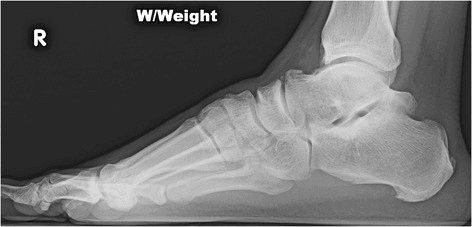
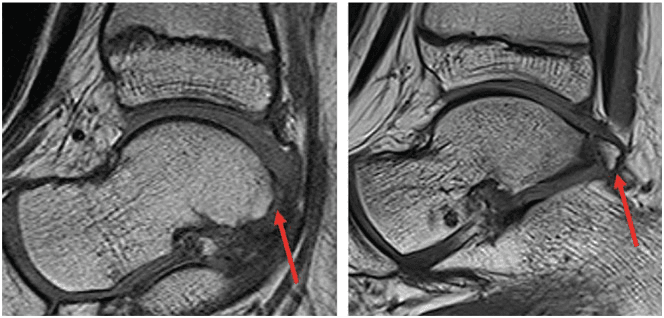
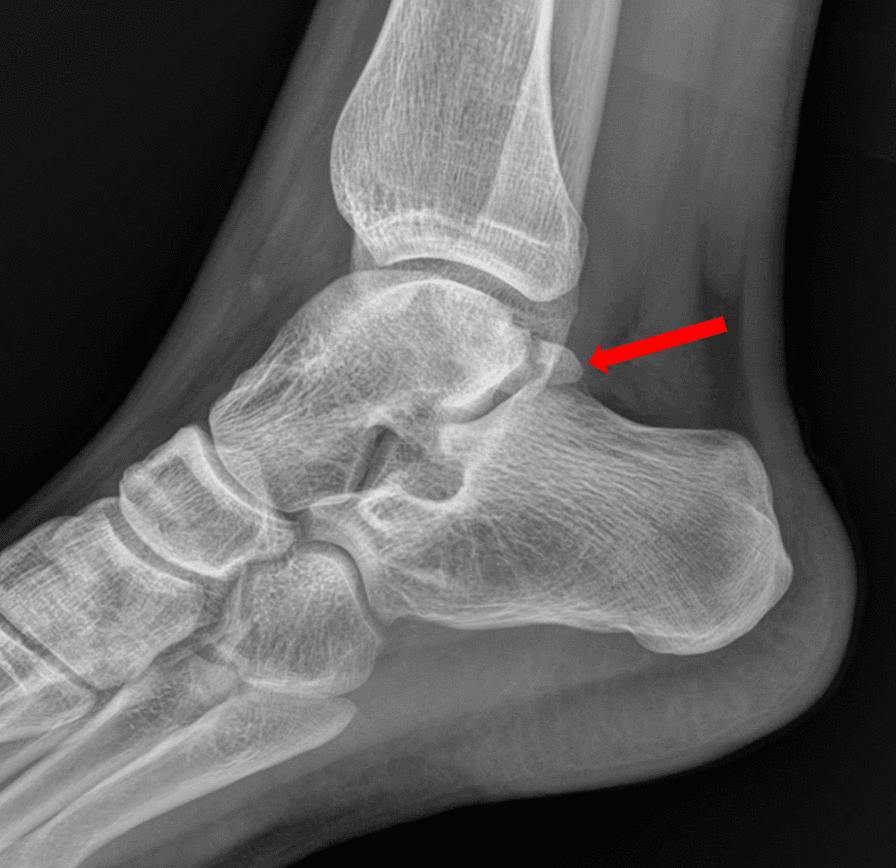
Three-panel (a-c) imaging of posterior ankle impingement from os trigonum syndrome: (a) Lateral ankle X-ray showing os trigonum (black arrow) with adjacent soft tissue swelling (arrowheads) - the os trigonum is an unfused accessory ossicle posterior to the talus. (b-c) Sagittal MRI demonstrating bone marrow edema in the os trigonum and surrounding soft tissue inflammation (arrows, asterisks). Classic presentation in dancers with plantarflexion pain.Credit: Nwawka OK et al., Insights Imaging - CC BY 4.0

Critical Posterior Impingement Exam Points

Anatomy

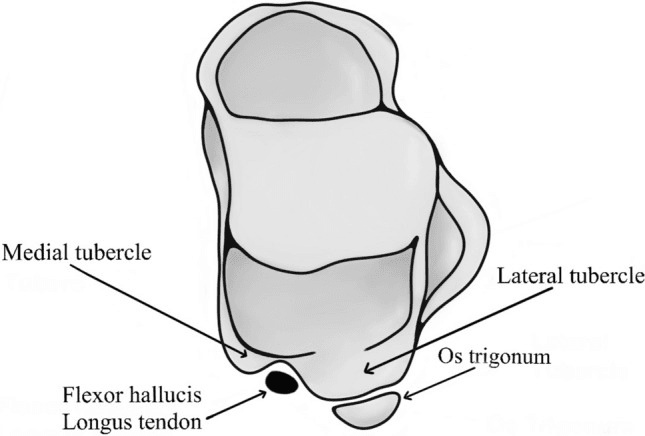
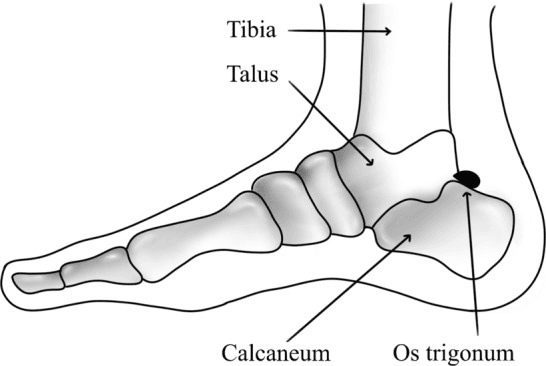
Os trigonum = unfused secondary ossification center of lateral talar process. Stieda process = elongated lateral talar tubercle. Both impinge posteriorly with plantarflexion.

Classic Presentation

Ballet dancers (en pointe) and soccer players (kicking). Pain at posterior ankle with forced plantarflexion. May have triggering from FHL involvement.

FHL Involvement

Flexor hallucis longus runs in groove between lateral and medial talar tubercles. Can become inflamed (FHL tenosynovitis) causing great toe triggering ("dancer's tendinitis").

Treatment

Endoscopic excision is preferred (less morbidity). Access through posterolateral and posteromedial portals. Excise os trigonum, release FHL. Excellent outcomes.

Mnemonic

OSSPosterior Impingement Causes

O
Os trigonum
Unfused accessory ossicle
S
Stieda process
Elongated lateral tubercle
S
Soft tissue (FHL, capsule)
Synovitis, scarring

Memory Hook:OSS = Os trigonum, Stieda, Soft tissue cause posterior impingement!

Overview and Anatomy

Posterior ankle impingement occurs when structures at the posterior ankle are pinched during plantarflexion. The most common cause is an os trigonum or prominent Stieda process.

Anatomy

The lateral talar process (posterior process of talus, lateral tubercle) is at the posterior talus. In 7-14% of people, this develops as a separate ossicle called the os trigonum (unfused secondary ossification center). The Stieda process is an elongated lateral tubercle that is continuous with the talus.

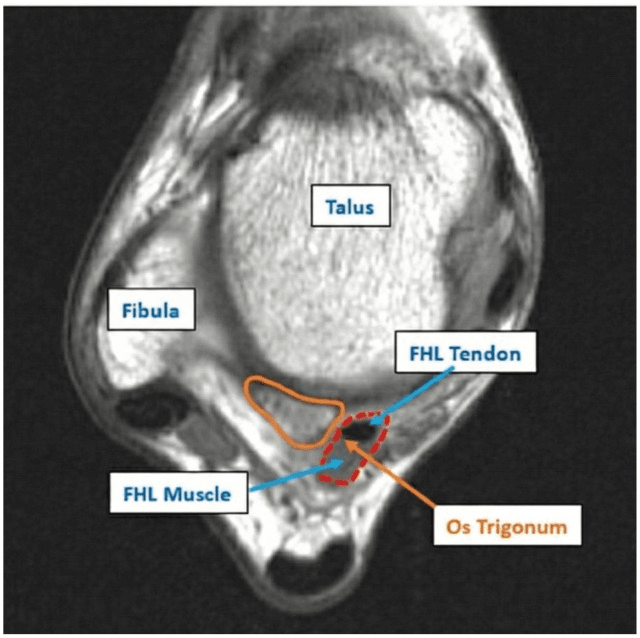
The flexor hallucis longus tendon runs in a groove between the medial and lateral talar tubercles. It can become involved in posterior impingement syndrome.

Pathophysiology

Forced or repetitive plantarflexion (as in ballet dancing en pointe or downward kicking) causes compression of the os trigonum or Stieda process between the tibia and calcaneus. This causes pain and inflammation.

Clinical Presentation

History

Ballet dancers present with posterior ankle pain, particularly with en pointe work. Soccer players may have pain with downward kicking. Swimmers may have pain with push-off. Pain is worse with plantarflexion and may be associated with triggering of the great toe if FHL is involved.

Examination

Posterior Impingement Test: Passive forced plantarflexion of the ankle reproduces posterior pain. Highly specific.

Palpation: Tenderness at the posterolateral ankle, between the Achilles and peroneal tendons.

FHL Assessment: Passive flexion/extension of the great toe with the ankle in plantarflexion may reproduce symptoms or show triggering.

Exclude Achilles pathology: Tenderness at insertion, Thompson test.

Diagnosis

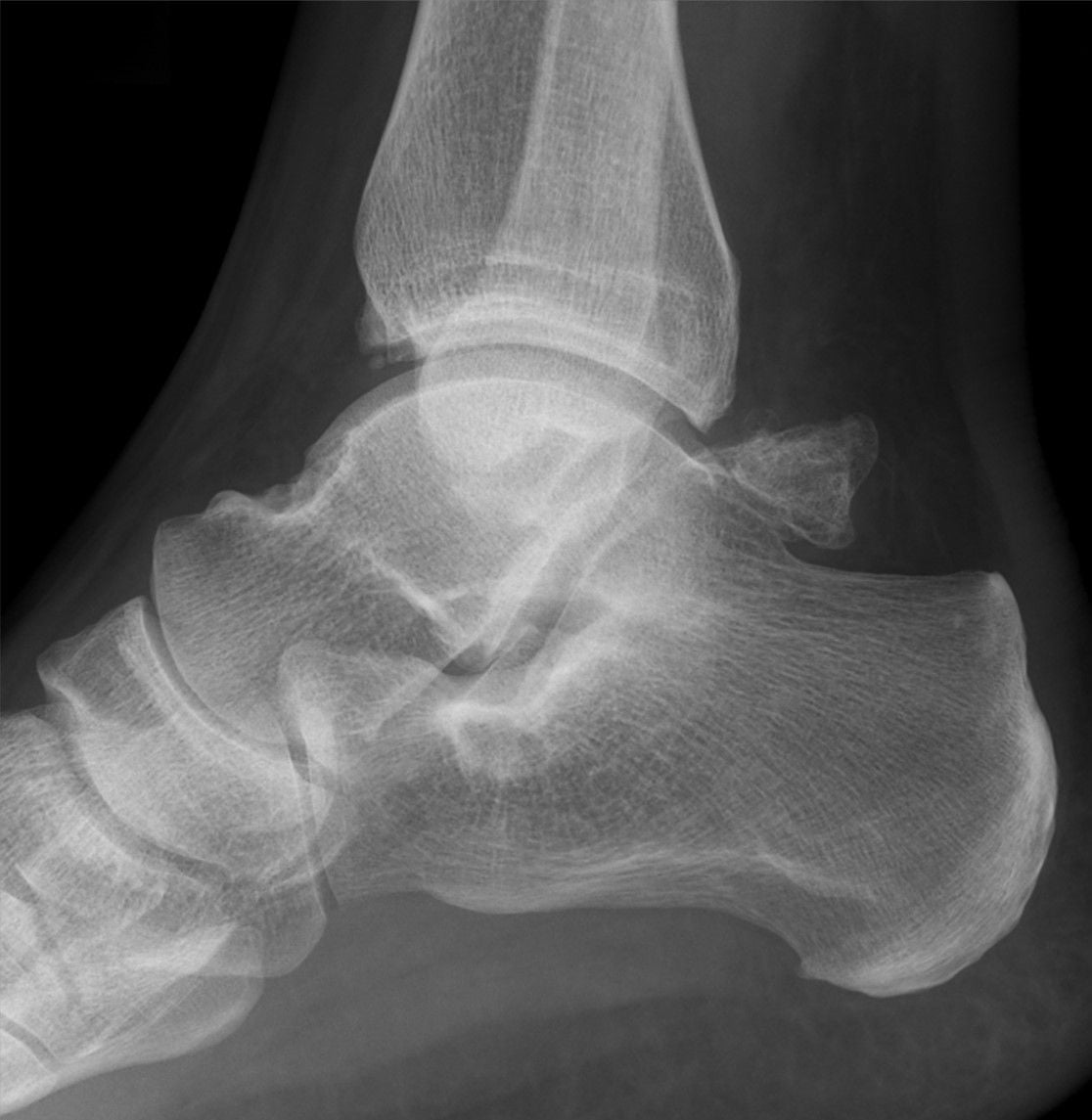
Lateral Radiograph: Shows os trigonum (separate ossicle) or prominent Stieda process (elongated tubercle). Best assessed on true lateral view.

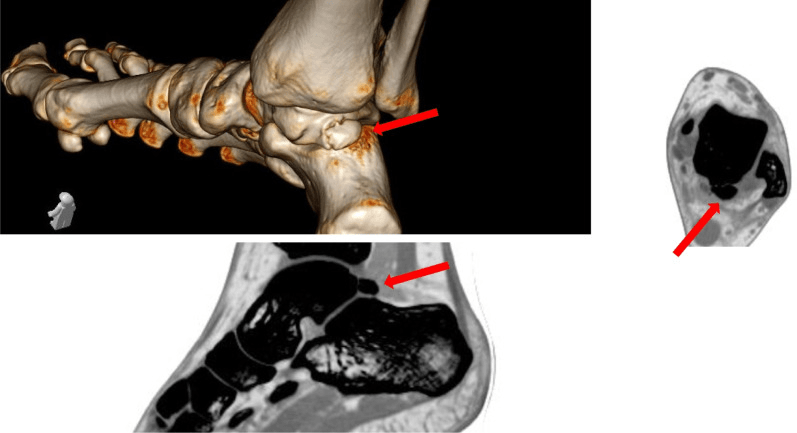
CT Scan: Better defines anatomy, particularly for surgical planning. Shows relationship of ossicle to talus.

CT showing degenerative changes at os trigonum synchondrosis
Click to expand
Two-panel CT imaging demonstrating chronic posterior impingement pathology: (a) Axial CT showing sclerosis and subchondral cyst formation at the os trigonum (white arrow), indicating chronic mechanical stress at the synchondrosis. (b) Sagittal CT demonstrating degenerative changes at the os trigonum-talus junction (arrows). These findings indicate longstanding impingement and may predict patients who will require surgical excision.Credit: Nwawka OK et al., Insights Imaging - CC BY 4.0

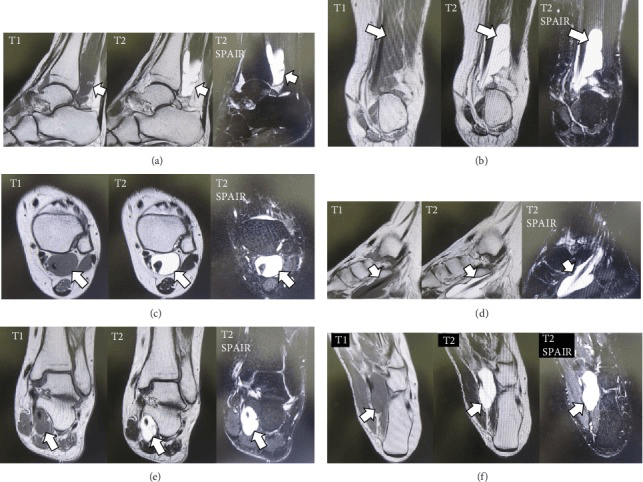
MRI: Shows bone edema in os trigonum or lateral tubercle. Shows FHL tenosynovitis. Shows associated soft tissue inflammation.

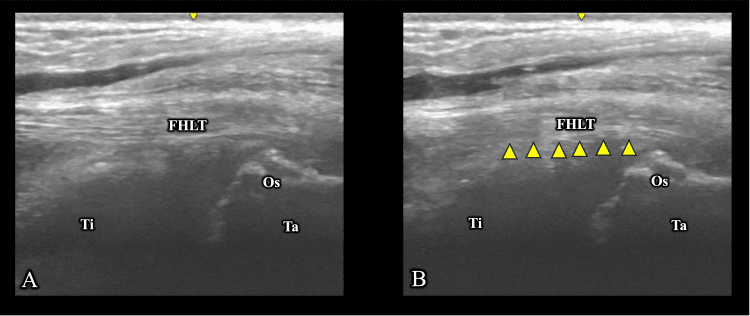
Ultrasound: Can assess FHL tendon dynamically.

Diagnostic Injection: Local anesthetic injection to posterior ankle that relieves symptoms confirms diagnosis.

Management

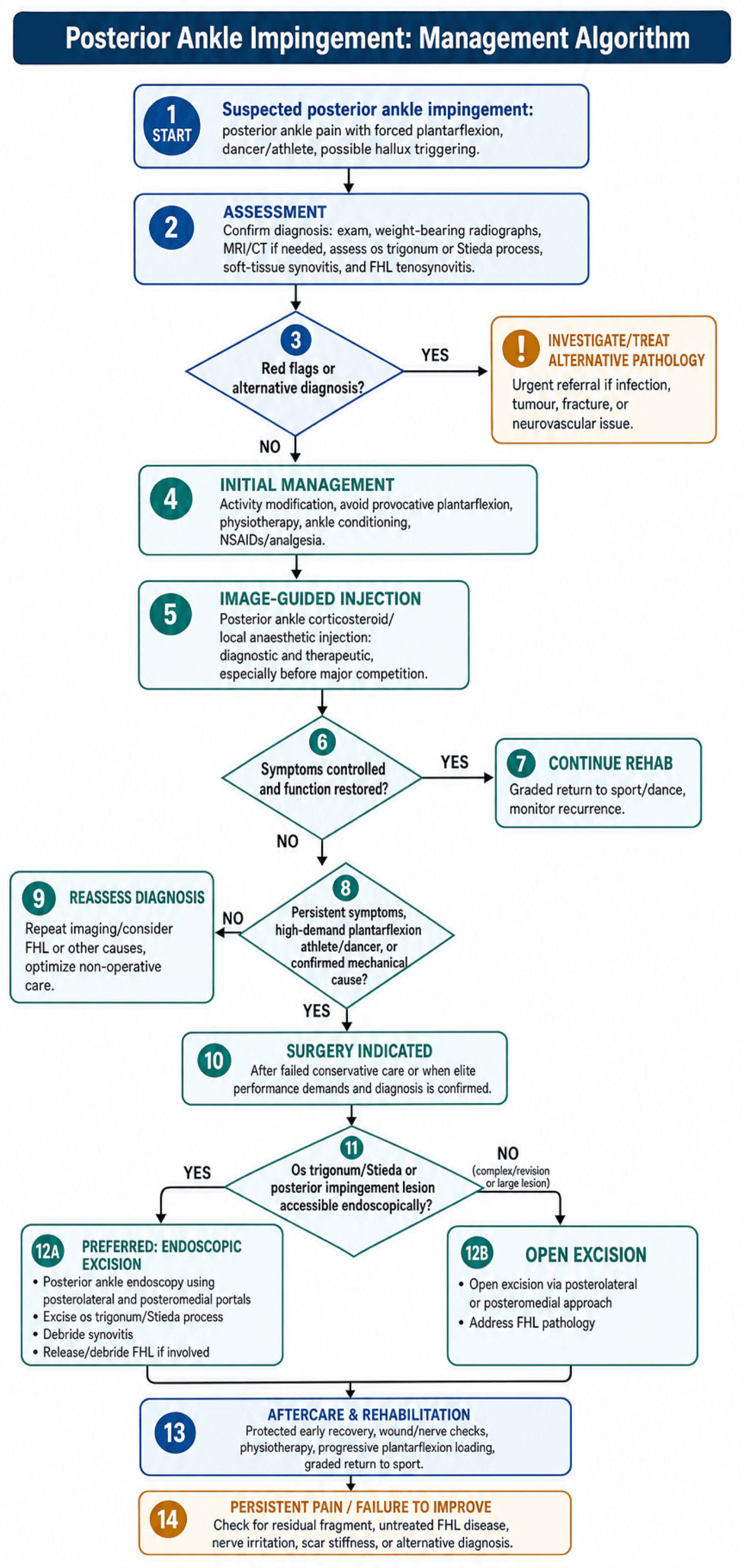
📊 Management Algorithm
Management algorithm for Posterior Ankle Impingement
Click to expand
Management algorithm for Posterior Ankle ImpingementCredit: OrthoVellum

Activity Modification: Avoid provocative plantarflexion activities.

Physiotherapy: Ankle conditioning, avoid excessive plantarflexion.

NSAIDs/Analgesia: Symptomatic relief.

Injection: Corticosteroid to the posterior ankle may provide relief. Both diagnostic and therapeutic.

Conservative treatment may be successful in mild cases but dancers and athletes often require surgery to return to activity.

Indications: Failed conservative treatment. Athletes/dancers requiring plantarflexion. Confirmed posterior impingement with identifiable cause.

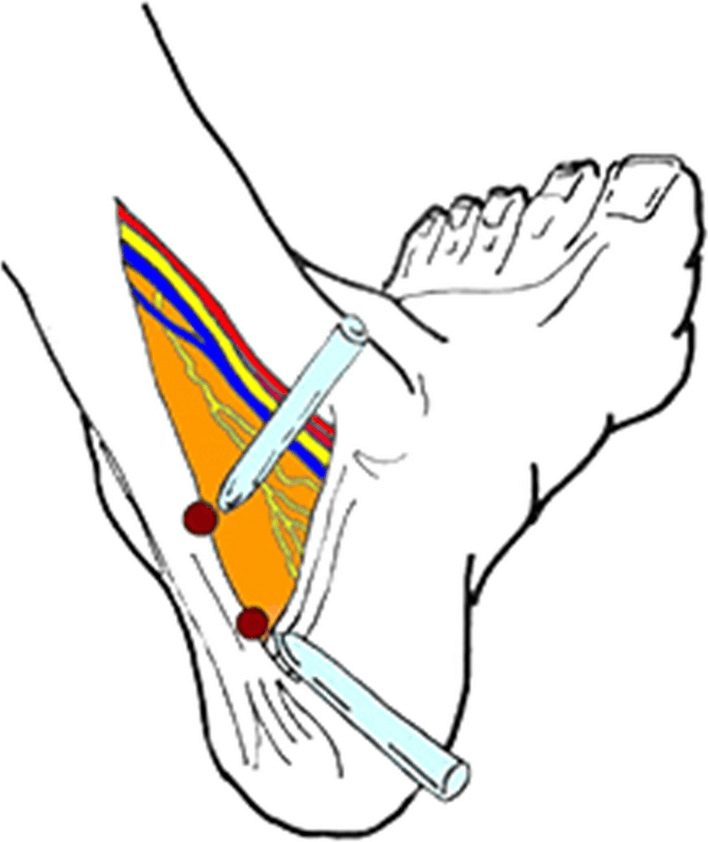
Endoscopic Excision: Preferred method. Two-portal posterior approach (posterolateral and posteromedial). Excise os trigonum or Stieda process. Release FHL if involved. Faster recovery than open surgery.

Open Excision: Via posterolateral or posteromedial approach. Similar outcomes but longer recovery.

FHL Release: Address FHL tenosynovitis during the same procedure if present.

Outcomes: Excellent results with 85-95% return to sport. Faster recovery with endoscopic technique.

Evidence Base

IV
📚 van Dijk et al
Key Findings:
  • Endoscopic treatment of posterior impingement
  • Two-portal technique described
  • Good outcomes
  • Foundation for endoscopic approach
Clinical Implication: Established endoscopic technique as viable option.
Source: Foot Ankle Int 2000

IV
📚 Smyth et al
Key Findings:
  • Outcomes of posterior ankle arthroscopy
  • 91% return to sport
  • Low complication rate
  • Faster recovery than open
Clinical Implication: Supports endoscopic approach for posterior impingement.
Source: Am J Sports Med 2016

Exam Viva Scenarios

Practice these scenarios to excel in your viva examination

VIVA SCENARIOStandard

Scenario 1: Ballet Dancer with Posterior Pain

EXAMINER

"A 22-year-old ballet dancer has posterior ankle pain worse when going en pointe. How do you assess and manage her?"

EXCEPTIONAL ANSWER
This is a classic presentation for posterior ankle impingement in a ballet dancer. The mechanism of going en pointe requires extreme plantarflexion, which compresses structures at the posterior ankle. My history would confirm pain location (posterolateral ankle), relation to activity, and any mechanical symptoms such as triggering of the great toe (suggests FHL involvement). On examination, I would perform the posterior impingement test - passive forced plantarflexion should reproduce her posterior pain. I would palpate between the Achilles and peroneal tendons for tenderness. I would assess the flexor hallucis longus by moving the great toe with the ankle plantarflexed - triggering or pain suggests FHL tenosynovitis. I would obtain lateral radiographs which may show an os trigonum (unfused accessory ossicle) or a prominent Stieda process (elongated lateral talar tubercle). MRI would show bone edema and any FHL pathology. I would trial conservative treatment initially with activity modification, physiotherapy, and possibly a corticosteroid injection which is both diagnostic and therapeutic. However, as a professional dancer requiring extreme plantarflexion, if conservative measures fail she would likely benefit from surgical excision. Endoscopic excision is the preferred technique using posterolateral and posteromedial portals to excise the os trigonum and release the FHL if involved. This has excellent outcomes with 85-95% return to dance.
KEY POINTS TO SCORE
Os trigonum is common cause
Posterior impingement test reproduces pain
FHL tenosynovitis often associated
Endoscopic excision is treatment of choice
COMMON TRAPS
✗Missing FHL involvement
✗Not knowing endoscopic technique
✗Confusing with Achilles pathology
LIKELY FOLLOW-UPS
"What is the difference between os trigonum and Stieda process?"
"What is dancer's tendinitis?"
VIVA SCENARIOChallenging

Scenario 2: Soft Tissue Posterior Impingement WITHOUT Osseous Pathology - Diagnostic Challenge and Management

EXAMINER

"You are seeing a 28-year-old competitive swimmer in your sports medicine clinic who has been experiencing progressive posterior right ankle pain for the past 8 months. She describes deep posterior ankle pain that is particularly worse during the push-off phase of her turns when she plantarflexes forcefully against the wall. The pain started insidiously without any specific injury and has progressively worsened to the point where it is affecting her training and competition times. She has tried 3 months of rest from competitive swimming, physiotherapy focusing on ankle strengthening and flexibility, and NSAIDs without significant improvement. She is frustrated and concerned as she has national championships in 4 months. On examination, she has deep tenderness to palpation in the posterior ankle between the Achilles tendon and peroneal tendons. You perform a posterior impingement test (passive forced plantarflexion) which clearly reproduces her deep posterior ankle pain. Her Achilles tendon is non-tender and normal on palpation. The retrocalcaneal bursa is non-tender. When you assess her flexor hallucis longus (FHL) by asking her to flex and extend her great toe with the ankle in different positions, she has pain with passive hallux extension when the ankle is in plantarflexion (stretches the FHL), but there is NO triggering or clicking of the great toe. Active and passive ankle range of motion is full and symmetrical, but extremes of plantarflexion reproduce her posterior pain. She has brought radiographs from her sports physician. The lateral ankle X-ray report states: 'Normal bony alignment. No fracture. No os trigonum identified. The lateral talar process appears normal in size and morphology (no prominent Stieda process). Achilles tendon insertion appears normal.' The radiologist specifically notes: 'No osseous cause for posterior impingement identified.' The patient is confused and asks: (1) The X-ray shows no bone problem - so what is causing my posterior impingement? (2) How do we diagnose what's causing my pain if there's no os trigonum? (3) Do I still need surgery even though there's no bone to remove? (4) If I do need surgery, what would you actually do if there's nothing to take out?"

EXCEPTIONAL ANSWER
This is an important and diagnostically challenging case that tests understanding that posterior ankle impingement can occur WITHOUT osseous pathology (os trigonum or Stieda process). While os trigonum and Stieda process are the MOST COMMON causes of posterior impingement, they account for only 60-70% of cases. Approximately 30-40% of posterior impingement cases are due to SOFT TISSUE pathology without osseous abnormality. For SOFT TISSUE CAUSES of posterior ankle impingement (without os trigonum/Stieda process): (1) FLEXOR HALLUCIS LONGUS (FHL) PATHOLOGY - this is the MOST COMMON soft tissue cause: FHL TENOSYNOVITIS - inflammation and thickening of the FHL tendon and sheath causes impingement in the fibro-osseous tunnel between the medial and lateral talar tubercles. During plantarflexion, the thickened tendon is compressed in the tunnel causing pain. Unlike classic 'FHL triggering' (which causes great toe catching), pure FHL tenosynovitis presents with posterior ankle pain WITHOUT triggering. Diagnosed by: Pain with resisted hallux plantarflexion, Pain with passive hallux extension (stretches FHL), Pain with passive ankle plantarflexion (compresses FHL in tunnel), MRI shows thickened FHL tendon (greater than 6mm diameter, normal is 4-5mm) with high T2 signal (inflammation) and fluid around tendon sheath. (2) POSTERIOR ANKLE CAPSULAR HYPERTROPHY/SYNOVITIS - chronic inflammation and thickening of the posterior ankle capsule and synovium can cause soft tissue impingement during plantarflexion. This is seen in athletes with repetitive plantarflexion activities. MRI shows thickened posterior capsule with synovial hypertrophy and effusion. (3) POSTERIOR SOFT TISSUE SCARRING - previous ankle injury (even if not surgically treated) can cause scarring in the posterior ankle recess. This scar tissue can impinge during plantarflexion. History of previous ankle sprain or injury supports this. MRI may show irregular soft tissue thickening. (4) FIBROUS BANDS/ADHESIONS - can develop between the posterior ankle structures (talus, tibia, calcaneus) and cause impingement. These are often post-traumatic but can be congenital. (5) PROMINENT POSTERIOR TIBIOFIBULAR LIGAMENT - the posterior-inferior tibiofibular ligament (PITFL) extends into the posterior ankle and can become hypertrophied, causing impingement particularly in plantarflexion and inversion. In this case, the clinical picture suggests SOFT TISSUE posterior impingement, most likely FHL tenosynovitis given: (1) Pain with passive hallux extension with ankle plantarflexed (stretches FHL), (2) Pain with forced plantarflexion (compresses FHL in tunnel), (3) Deep posterior ankle pain (FHL runs deep in posterior ankle), (4) No triggering (suggests tenosynovitis WITHOUT stenosis - vs os trigonum syndrome where FHL triggering is common due to tunnel stenosis from ossicle). For DIAGNOSTIC WORKUP in suspected soft tissue posterior impingement: (1) MRI is ESSENTIAL - this is the GOLD STANDARD investigation when X-rays are normal. MRI will show: FHL tendon thickness (greater than 6mm abnormal), high T2 signal in FHL indicating tendinopathy/tenosynovitis, fluid around FHL sheath, any posterior capsular hypertrophy or synovitis, any soft tissue scarring or fibrous bands, any subtle bone marrow edema that might indicate stress response even without osseous abnormality. I would ORDER MRI as the next investigation to identify the specific soft tissue cause. (2) DIAGNOSTIC/THERAPEUTIC INJECTION - fluoroscopy or ultrasound-guided injection of local anesthetic (with or without corticosteroid) into the posterior ankle can be both diagnostic and therapeutic. If the patient has greater than 70% pain relief with posterior impingement testing immediately after injection, this CONFIRMS that the pain source is indeed posterior impingement (even without osseous pathology). Technique: Inject into the posterior ankle recess, targeting the area between the posterior talus and tibia/calcaneus. Can be done under ultrasound guidance visualizing the FHL and posterior structures. (3) DYNAMIC ULTRASOUND - can assess FHL tendon movement during active hallux flexion/extension and ankle plantarflexion. May show impingement of thickened FHL or adhesions restricting tendon gliding. This is a specialized investigation not routinely available but can be helpful. For CONSERVATIVE MANAGEMENT (should be trialed before surgery even for soft tissue pathology): (1) TARGETED PHYSIOTHERAPY - focus on: FHL stretching - passive stretching of FHL by dorsiflexing ankle and extending great toe simultaneously, Eccentric FHL strengthening - may improve tendon remodeling if tendinopathy present, Posterior ankle capsular stretches, Activity modification - modify swimming technique if possible to reduce forced plantarflexion at turns (some swimmers can adjust turn technique). (2) CORTICOSTEROID INJECTION - therapeutic injection (not just diagnostic) with corticosteroid into the posterior ankle can provide 3-6 months symptom relief by reducing FHL inflammation and posterior capsular synovitis. This buys time for the championships (4 months away). Many athletes get sufficient relief to complete a season and then reassess. Can be repeated if initial injection provides good but temporary relief. (3) ACTIVITY MODIFICATION during conservative trial - continue swimming but modify turns to reduce plantarflexion stress, cross-train with cycling/running to maintain fitness while resting posterior ankle. (4) NSAIDs - limited benefit as this is more mechanical/anatomical than purely inflammatory, but can provide some symptom control. For SURGICAL MANAGEMENT if conservative fails: INDICATIONS: Failed comprehensive conservative trial (3-6 months), Confirmed posterior impingement on clinical exam and imaging (MRI shows soft tissue pathology), Athlete requiring return to high-level plantarflexion activities, Diagnostic injection confirmed pain source. SURGICAL TECHNIQUE - ENDOSCOPIC/ARTHROSCOPIC POSTERIOR ANKLE DEBRIDEMENT: The same TWO-PORTAL posterior ankle approach used for os trigonum excision can be used for soft tissue debridement (van Dijk et al technique): PORTALS: Posterolateral portal (between lateral border Achilles and peroneal tendons), Posteromedial portal (medial border Achilles, anterior to medial border Achilles but posterior to neurovascular bundle). PROCEDURE: (1) Arthroscopic inspection of posterior ankle recess - identify pathology (FHL thickening, posterior capsular hypertrophy, fibrous bands, scarring), (2) FHL SHEATH RELEASE and TENOSYNOVECTOMY - release the fibro-osseous tunnel where FHL runs (between medial and lateral talar tubercles), remove inflamed synovium around FHL tendon (synovectomy), if FHL tendon has significant tendinopathy, can perform longitudinal split to decompress but avoid excising tendon substance (preserve strength), (3) POSTERIOR CAPSULAR DEBRIDEMENT - excise hypertrophied posterior capsule and synovium to create more space in posterior ankle recess, (4) EXCISION of fibrous bands/adhesions if present - release any adhesions restricting posterior ankle motion or causing impingement, (5) Inspect posterior tibiofibular ligament (PITFL) - if hypertrophied and impinging, can debride, (6) Ensure adequate decompression - test range of motion arthroscopically to confirm no further impingement during plantarflexion. ALTERNATIVE: OPEN DEBRIDEMENT via posteromedial or posterolateral approach if surgeon not comfortable with endoscopic technique or if extensive work needed. Longer recovery than endoscopic but same principles. OUTCOMES of soft tissue posterior impingement surgery: Good outcomes reported in the literature, though slightly lower return to sport rates than for osseous impingement (os trigonum excision). Smyth et al (Am J Sports Med 2016) reported 91% return to sport after posterior ankle arthroscopy (this includes both osseous and soft tissue cases). Specific soft tissue cases: 80-85% good to excellent outcomes, 85-90% return to sport at pre-injury level. RECOVERY TIMELINE similar to osseous impingement: 2 weeks NWB in boot, then progressive weight-bearing 2-4 weeks, return to swimming (without forced turns) 4-6 weeks, progressive return to competitive swimming with full turns 8-12 weeks. For her NATIONAL CHAMPIONSHIPS in 4 months: If we proceed NOW with either conservative injection trial OR surgery, the timelines are: CONSERVATIVE with injection: Can inject this week, if good response (70%+ relief), she can return to full training immediately and compete at championships. Risk is that symptoms recur or injection only provides partial/temporary relief. SURGICAL: If surgery performed NOW, she would be 4 months (16 weeks) post-op at championships - this is at the CUSP of return to competitive swimming with full turns (8-12 weeks typical). She might make it but it would be tight and she may not be at peak performance. RECOMMENDATION: I would STRONGLY recommend DIAGNOSTIC/THERAPEUTIC INJECTION first (with corticosteroid). This serves multiple purposes: (1) CONFIRMS diagnosis (if greater than 70% relief, proves posterior soft tissue impingement is the cause), (2) May provide sufficient symptom control to get her through championships (3-6 months relief possible), (3) Buys time - if injection helps, she can compete, then have definitive surgery after championships if needed, (4) Some patients get sufficient relief with injection alone to avoid surgery. If injection provides minimal or very short-term relief, then proceed to MRI for detailed soft tissue assessment and plan surgery after championships. SUMMARY: Posterior impingement can occur WITHOUT os trigonum or Stieda process - soft tissue causes (FHL tenosynovitis, posterior capsular hypertrophy, scarring) account for 30-40% of cases. Diagnosis requires MRI (gold standard) and diagnostic injection to confirm. Conservative management with targeted physiotherapy and corticosteroid injection should be trialed first. If conservative fails, endoscopic posterior ankle debridement (FHL release, capsular debridement, adhesiolysis) is definitive with good outcomes (80-85% return to sport). For this athlete 4 months from championships, diagnostic/therapeutic injection is the best first step.
KEY POINTS TO SCORE
Posterior ankle impingement can occur WITHOUT osseous pathology (os trigonum, Stieda process) - soft tissue causes account for 30-40% of posterior impingement cases. Common soft tissue causes: (1) FHL TENOSYNOVITIS (most common) - thickened inflamed FHL tendon impinges in fibro-osseous tunnel during plantarflexion, pain with passive hallux extension and resisted hallux flexion, may NOT have triggering (vs os trigonum syndrome where triggering common), (2) Posterior ankle capsular hypertrophy/synovitis, (3) Posterior soft tissue scarring (post-traumatic), (4) Fibrous bands/adhesions, (5) Hypertrophied posterior tibiofibular ligament (PITFL).
Diagnostic workup when X-rays normal but clinical examination suggests posterior impingement: (1) MRI is GOLD STANDARD - shows FHL tendon thickness (greater than 6mm abnormal, normal 4-5mm), high T2 signal in FHL indicating inflammation, fluid around tendon sheath, posterior capsular hypertrophy, soft tissue scarring/fibrous bands, subtle bone marrow edema even without osseous abnormality. (2) DIAGNOSTIC/THERAPEUTIC INJECTION - fluoroscopy or ultrasound-guided local anesthetic +/- corticosteroid into posterior ankle recess. Greater than 70% pain relief with posterior impingement test CONFIRMS diagnosis even without osseous cause. (3) Dynamic ultrasound (specialized, not routine) - assesses FHL movement and impingement during active motion.
Conservative management of soft tissue posterior impingement should be trialed before surgery: (1) Targeted physiotherapy - FHL stretching (dorsiflexion + hallux extension), eccentric FHL strengthening, posterior capsular stretches, activity modification (modify swimming turn technique to reduce forced plantarflexion if possible). (2) Corticosteroid INJECTION - may provide 3-6 months symptom relief by reducing FHL inflammation and posterior synovitis, excellent option for athlete mid-season or approaching major competition (buys time, can repeat if initial provides good but temporary relief). (3) Activity modification during conservative trial (continue swimming but modify turns, cross-train). (4) NSAIDs (limited benefit - more mechanical than inflammatory).
Surgical management of soft tissue posterior impingement - endoscopic posterior ankle debridement: Same TWO-PORTAL posterior ankle approach as for os trigonum excision (posterolateral and posteromedial portals - van Dijk technique). Procedure includes: (1) FHL sheath RELEASE and TENOSYNOVECTOMY - release fibro-osseous tunnel where FHL runs, remove inflamed synovium around tendon, if significant FHL tendinopathy can perform longitudinal split to decompress BUT avoid excising tendon substance (preserve strength), (2) POSTERIOR CAPSULAR DEBRIDEMENT - excise hypertrophied posterior capsule and synovium to create space, (3) ADHESIOLYSIS - excise fibrous bands/adhesions restricting motion or causing impingement, (4) Debride hypertrophied PITFL if present, (5) Test ROM arthroscopically to confirm adequate decompression. Open debridement alternative if not comfortable with endoscopic technique.
Outcomes and timeline for soft tissue posterior impingement surgery: Outcomes good but slightly lower than osseous impingement - Smyth et al (Am J Sports Med 2016) reported 91% return to sport after posterior ankle arthroscopy (all causes), soft tissue specific cases 80-85% good to excellent outcomes, 85-90% return to pre-injury sport level. Recovery timeline: 2 weeks NWB in boot, progressive WB 2-4 weeks, return to swimming without forced turns 4-6 weeks, return to competitive swimming with full turns 8-12 weeks. For athlete with major competition 4 months away, RECOMMEND diagnostic/therapeutic injection FIRST (confirms diagnosis, may provide sufficient relief to compete, surgery can be done after competition if needed).
COMMON TRAPS
✗Assuming there is NO posterior impingement just because X-rays show no os trigonum or Stieda process: This is a CRITICAL ERROR. Os trigonum and Stieda process are common osseous causes of posterior impingement, but 30-40% of cases are due to SOFT TISSUE pathology (FHL tenosynovitis, posterior capsular hypertrophy, scarring, fibrous bands). A patient with classic posterior impingement symptoms (pain with plantarflexion, positive posterior impingement test) and normal X-rays likely has SOFT TISSUE impingement. Must proceed with MRI to identify the soft tissue cause - do NOT dismiss the symptoms just because X-ray is normal.
✗Not ordering MRI when X-rays are normal in suspected posterior impingement: When clinical examination clearly suggests posterior impingement (positive impingement test, mechanism consistent, deep posterior pain) but X-rays show no os trigonum or Stieda process, MRI is ESSENTIAL to identify the soft tissue cause. MRI will show FHL tendon pathology (thickening, inflammation, fluid around sheath), posterior capsular hypertrophy, soft tissue scarring, fibrous bands. Without MRI, you cannot plan appropriate treatment. X-ray is NOT sufficient to rule out posterior impingement - it only rules out osseous causes.
✗Telling the athlete 'there's nothing to operate on' because there's no os trigonum to remove: This reflects misunderstanding that surgery for posterior impingement is ONLY for os trigonum excision. When soft tissue pathology is the cause, the surgery is SOFT TISSUE DEBRIDEMENT rather than osseous excision, but the approach is the same (endoscopic two-portal posterior ankle approach). Procedure includes FHL sheath release, tenosynovectomy, posterior capsular debridement, adhesiolysis - all soft tissue procedures. Outcomes are good (80-85% return to sport) even without removing any bone. Do NOT deny surgery just because there's no osseous abnormality - soft tissue impingement is a valid surgical indication.
✗Not offering diagnostic/therapeutic injection to an athlete approaching a major competition: This athlete has national championships in 4 months. A corticosteroid injection into the posterior ankle can provide 3-6 months symptom relief and serves multiple purposes: (1) CONFIRMS diagnosis (if greater than 70% relief, proves posterior impingement is the cause), (2) May provide sufficient relief to compete at championships without surgery, (3) Buys time - if it works, she can compete then have definitive surgery after if needed, (4) Surgery NOW would mean she's 4 months (16 weeks) post-op at championships - at the cusp of return to competitive swimming, may not be at peak performance. Injection is a low-risk intervention that could allow her to compete - should ALWAYS be offered before proceeding straight to surgery in an athlete with an upcoming major event.
LIKELY FOLLOW-UPS
"What is the flexor hallucis longus (FHL) and where does it run in relation to the posterior ankle? Why is FHL tenosynovitis a common cause of soft tissue posterior impingement?"
"Describe the two-portal endoscopic technique for posterior ankle surgery. Where exactly do you place the posterolateral and posteromedial portals and what are the anatomical landmarks?"
"What are the potential complications of endoscopic posterior ankle surgery and how would you avoid injury to the neurovascular structures (tibial nerve, posterior tibial artery)?"
"How would you differentiate FHL tenosynovitis causing posterior impingement from primary FHL tendon pathology (like FHL tendon rupture or severe stenosis requiring different management)?"
VIVA SCENARIOCritical

Scenario 3: Failed Endoscopic Os Trigonum Excision with Persistent Symptoms - Revision Surgery and Alternative Diagnoses

EXAMINER

"You are seeing a 26-year-old professional contemporary dancer in your complex foot and ankle clinic for a second opinion. She underwent endoscopic excision of a symptomatic right os trigonum 9 months ago performed by another surgeon at a different institution. The initial presentation was classic posterior ankle impingement - deep posterior ankle pain worse with plantarflexion during dance, positive posterior impingement test, lateral X-ray showing os trigonum, MRI confirming bone marrow edema in the ossicle. She had failed 6 months of conservative management (rest, physiotherapy, two corticosteroid injections) prior to surgery. The operative report from the previous surgery describes: 'Endoscopic excision of os trigonum via two-portal posterior ankle approach. Posterolateral and posteromedial portals established. Os trigonum identified and excised arthroscopically. FHL visualized and appeared normal. No release performed as no evidence of stenosis. Wounds closed. No complications.' Post-operatively, she was initially better for about 6-8 weeks. However, her symptoms have gradually returned and she now describes similar posterior ankle pain to pre-operative levels. She is extremely frustrated and concerned that the surgery 'didn't work'. She reports: (1) Deep aching posterior ankle pain, particularly with plantarflexion during dance, (2) The pain is in a similar location to before surgery, perhaps slightly more medial, (3) She now also experiences occasional clicking or snapping sensation in the posterior ankle when she moves her great toe, which she didn't have before surgery, (4) The pain is affecting her ability to perform and she is considering whether she should retire from professional dancing. On examination, she has well-healed posterolateral and posteromedial arthroscopic portal scars with no signs of infection or wound complications. There is deep tenderness to palpation in the posterior ankle, slightly more prominent medially than laterally. Passive forced plantarflexion reproduces her posterior ankle pain (positive posterior impingement test - similar to pre-op). When you assess her flexor hallucis longus by asking her to actively flex and extend her great toe, you can palpate and hear a distinct SNAP or CLICK in the posterior ankle, and she reports this is the clicking she has been experiencing. This was NOT documented in her pre-operative assessment. Resisted plantarflexion of the hallux is painful. Passive forceful extension of the hallux with the ankle in plantarflexion reproduces deep posterior pain. Her ankle range of motion is full but extremes of plantarflexion reproduce her posterior pain. You review the post-operative radiographs she brought (taken at 3 months post-op by the previous surgeon): Lateral ankle X-ray report states: 'Post-surgical changes. Partial excision of os trigonum with small residual ossicle fragment noted posterior to talus (approximately 5mm x 3mm). Alignment normal.' You also order a NEW MRI which reports: 'Post-surgical changes in posterior ankle. Small residual os trigonum fragment present (5mm) with surrounding bone marrow edema. Flexor hallucis longus tendon is markedly thickened (8mm diameter, normal less than 6mm) with high T2 signal consistent with tendinopathy. Moderate fluid around FHL tendon sheath (tenosynovitis). The FHL appears stenosed in the fibro-osseous tunnel at the level of the posterior talus. Post-surgical scarring noted in the posterior ankle recess. Findings suggestive of: (1) Incomplete os trigonum excision with residual symptomatic fragment, (2) FHL tendinopathy and stenosing tenosynovitis (possibly missed at initial surgery or developed post-operatively).' The patient has multiple questions: (1) Why didn't the surgery work - did the surgeon not remove the whole bone? (2) The report mentions my FHL tendon - could this be the problem now rather than the bone? Was this missed initially? (3) Do I need another operation? If so, what would be different this time? (4) Is there a risk that revision surgery could make things worse? I'm worried about ending my dance career. (5) Could there be something else causing my pain that everyone has missed?"

EXCEPTIONAL ANSWER
This is an extremely complex case of FAILED posterior ankle impingement surgery that tests advanced understanding of causes of surgical failure, revision surgical planning, and comprehensive differential diagnosis. There are several CRITICAL teaching points. First, understanding the POTENTIAL CAUSES of persistent symptoms after os trigonum excision: (1) INCOMPLETE OSSEOUS EXCISION - residual os trigonum fragment left behind: This is the MOST COMMON cause of failed os trigonum surgery. The os trigonum may be LARGER than appreciated arthroscopically, or may have extensions that are not fully visualized. If any fragment of the os trigonum remains (even small 5mm fragments), it can continue to cause impingement during plantarflexion. This patient's post-op X-ray shows a 5mm RESIDUAL FRAGMENT and MRI shows bone marrow edema in this fragment - this is SYMPTOMATIC incomplete excision. The operative report describes 'os trigonum identified and excised arthroscopically' but clearly the entire ossicle was NOT removed. This is a technical failure. (2) UNRECOGNIZED OR INADEQUATELY TREATED FHL PATHOLOGY: The operative report states 'FHL visualized and appeared normal. No release performed as no evidence of stenosis.' However, this patient NOW has clear evidence of FHL stenosis and tenosynovitis (thickened tendon 8mm, high T2 signal, fluid around sheath, clinical triggering/snapping). This raises the question: Was FHL pathology PRESENT pre-operatively but MISSED (inadequate pre-op assessment or inadequate intraoperative assessment)? OR Did FHL pathology DEVELOP POST-OPERATIVELY (secondary to surgical scarring or compensatory overload after os trigonum excision)? Looking at the history: She did NOT have FHL triggering/clicking PRE-operatively (this is NEW post-op symptom). This suggests the FHL pathology may have developed AFTER surgery, possibly due to: Post-surgical SCARRING in the posterior ankle causing FHL tethering/stenosis, or Altered biomechanics after os trigonum excision causing increased FHL stress. However, it is also possible that mild FHL tenosynovitis was present pre-operatively (it commonly accompanies os trigonum syndrome) but was not recognized or addressed during surgery. (3) POST-SURGICAL SCARRING/FIBROSIS: Endoscopic surgery in the posterior ankle can cause scarring in the posterior recess. This scar tissue can cause continued impingement symptoms even if the os trigonum is completely removed. The MRI mentions 'post-surgical scarring in posterior ankle recess' which could be contributing. (4) ALTERNATIVE/ADDITIONAL PATHOLOGY MISSED: Could there be other causes of posterior impingement that were not identified initially? Examples: Prominent STIEDA PROCESS (elongated lateral talar tubercle - continuous with talus, not separate like os trigonum). If the surgeon only excised the os trigonum but there is ALSO a prominent Stieda process, symptoms would persist. Posterior capsular pathology, Other soft tissue impingement. However, in this case the imaging suggests residual os trigonum and FHL pathology are the likely culprits. (5) NERVE INJURY OR NEUROMA: Endoscopic posterior ankle surgery carries risk of nerve injury (sural nerve laterally, tibial nerve/medial plantar nerve medially). If a nerve was injured or a neuroma developed, this could cause persistent pain. However, her pain pattern (reproduced with impingement test, associated with mechanical symptoms) is more consistent with mechanical impingement than neuropathic pain. For ANALYZING THIS SPECIFIC CASE: The MRI findings are CRITICAL - they show TWO distinct pathologies: (1) Residual 5mm os trigonum fragment with bone marrow edema - this is INCOMPLETE EXCISION causing persistent osseous impingement, (2) FHL tendinopathy and stenosing tenosynovitis (8mm thickened tendon, stenosis in tunnel, fluid around sheath) - this is causing her NEW triggering/clicking symptoms and contributing to posterior pain. BOTH need to be addressed for successful outcome. Her persistent posterior impingement test positivity suggests the residual os trigonum fragment is still impinging. Her NEW FHL triggering/snapping indicates FHL pathology that was either missed initially or developed post-operatively. For COUNSELING THE PATIENT about what went wrong: This requires BALANCED and HONEST discussion: (1) INCOMPLETE EXCISION: The post-op X-ray shows a residual fragment of the os trigonum was left behind. This is a technical issue with the initial surgery. Os trigonum can be larger and have more extensions than appreciated during arthroscopy, and complete excision can be challenging. However, leaving a 5mm symptomatic fragment is suboptimal and is contributing to her ongoing symptoms. (2) FHL PATHOLOGY: Your FHL tendon is now showing significant pathology (thickening, inflammation, stenosis) which is causing the new clicking/snapping you're experiencing. This may have been present but missed at the initial surgery, OR it may have developed afterward due to scarring or altered mechanics. Either way, it needs to be addressed. (3) NOT a surgical complication per se (no infection, no nerve injury) but the surgery was INCOMPLETE and did not achieve the desired outcome. This happens in a small percentage of cases (reported failure rates for os trigonum excision are 5-15%). (4) Importantly, this is FIXABLE with revision surgery if done comprehensively. For REVISION SURGERY PLANNING - what would be different: If revision surgery is undertaken, it MUST address BOTH the residual os trigonum fragment AND the FHL pathology. A revision procedure would include: (1) COMPLETE EXCISION of residual os trigonum fragment: Re-establish the endoscopic portals (may be some scarring from previous surgery), Identify the residual 5mm fragment (use fluoroscopy intraoperatively to confirm location), Excise the ENTIRE residual fragment - ensure NO osseous material remains. This may require burring down the lateral talar tubercle to ensure complete excision, Confirm complete excision with fluoroscopy intraoperatively (no residual fragment visible on fluoroscopic lateral view). (2) COMPREHENSIVE FHL RELEASE AND TENOSYNOVECTOMY: RELEASE the fibro-osseous tunnel where the FHL is stenosed (between medial and lateral talar tubercles), Perform TENOSYNOVECTOMY - remove ALL inflamed synovium around the FHL tendon sheath, If the FHL tendon has significant tendinopathy (which MRI suggests - 8mm thickened, high T2 signal), may need to perform longitudinal SPLIT of the tendon to decompress, BUT must preserve tendon substance/strength (do NOT excise tendon - only split longitudinally). This is critical for a professional dancer, Intraoperatively TEST FHL gliding - passively move the great toe through full flexion/extension while visualizing the FHL arthroscopically. It should glide FREELY without restriction. If there is still restriction, further release is needed. (3) DEBRIDEMENT of post-surgical SCAR TISSUE: Excise any fibrous scar tissue in the posterior ankle recess that may be contributing to impingement, Ensure adequate decompression of the posterior recess. (4) Consider OPEN vs ENDOSCOPIC approach for revision: ENDOSCOPIC revision is possible but may be technically more challenging due to scarring from previous surgery. Visualization may be compromised. OPEN approach (posteromedial incision) may give better access to both the residual os trigonum and the FHL, particularly if extensive FHL work is needed. The decision depends on surgeon comfort and extent of pathology. For a PROFESSIONAL DANCER with significant FHL pathology, I would lean toward OPEN approach to ensure comprehensive FHL release and avoid under-treating the FHL (which was the problem in the first surgery). (5) Post-operative protocol would be similar to primary surgery: 2 weeks NWB in boot, progressive WB 2-4 weeks, early ROM exercises to prevent re-scarring (CRITICAL - more aggressive ROM than after primary surgery to break up adhesions), return to dance training 12-16 weeks, return to professional performance 4-6 months. For RISKS OF REVISION SURGERY - must counsel appropriately: (1) SCAR TISSUE is more extensive in revision surgery - anatomic planes are obscured, risk of nerve injury is HIGHER in revision than primary surgery (sural nerve, tibial nerve, medial plantar branch), (2) Risk of PERSISTENT symptoms despite revision - if there is extensive scarring or if FHL is severely damaged, symptoms may not fully resolve. Revision surgery outcomes are LOWER than primary surgery (primary os trigonum excision 85-95% good outcomes, revision surgery 70-80% good outcomes), (3) Risk of FHL WEAKNESS if too much tendon is debrided - this would be DEVASTATING for a professional dancer. Must preserve tendon substance, (4) Risk of STIFFNESS from post-op scarring - early aggressive ROM is critical, (5) Standard surgical risks (infection, wound complications, etc.). For ALTERNATIVE DIAGNOSES to consider (what else could be causing her pain): While the MRI findings strongly suggest residual os trigonum and FHL pathology are the causes, we should consider: (1) Could this be NEUROPATHIC pain from nerve injury rather than mechanical impingement? Features AGAINST neuropathic pain: Pain reproduced by posterior impingement test (mechanical), Pain related to plantarflexion (mechanical), No burning/shooting/dysesthetic quality described, No hypersensitivity to light touch (allodynia). Features FOR neuropathic pain would be: Burning, shooting, electric pain, Hypersensitivity, Pain out of proportion to exam findings. In this case, mechanical impingement is more likely. (2) Could this be COMPLEX REGIONAL PAIN SYNDROME (CRPS)? Features AGAINST CRPS: No color changes, temperature differences, or swelling, Pain pattern is mechanical (related to plantarflexion), No allodynia. CRPS typically has more dramatic clinical findings. (3) Could there be ANTERIOR ankle impingement (osteophytes) causing pain that is being misinterpreted as posterior? Unlikely - pain is clearly posterior on exam, anterior impingement causes pain with DORSIflexion not plantarflexion. (4) Could this be ACHILLES TENDINOPATHY? Unlikely - Achilles is non-tender on exam, pain is DEEP posterior (not superficial insertion), impingement test positive. In this case, I am confident the diagnosis is residual os trigonum + FHL pathology based on imaging and clinical findings. RECOMMENDATION AND SHARED DECISION-MAKING: This is a complex situation requiring detailed discussion with the patient about her goals and risk tolerance. OPTIONS: (1) REVISION SURGERY (my recommendation): Comprehensive revision procedure addressing BOTH residual os trigonum fragment AND FHL pathology (complete excision of fragment, FHL release and tenosynovectomy, scar debridement). Consider OPEN approach for better visualization and comprehensive FHL work. Realistic expectations: 70-80% chance of good outcome (lower than primary surgery), 4-6 months to return to professional performance, risk that symptoms may not completely resolve despite revision. (2) CONSERVATIVE MANAGEMENT: Trial of: Intensive physiotherapy focusing on FHL strengthening and stretching, Corticosteroid injection to posterior ankle and FHL sheath, Activity modification. However, given she has STRUCTURAL problems (residual bone fragment, FHL stenosis), conservative management is unlikely to provide lasting relief. This may temporize symptoms but won't fix the underlying issues. (3) ACCEPT LIMITATIONS and modify career: Some dancers with persistent posterior ankle issues modify their technique or transition to less demanding roles. This is a LAST RESORT if surgery fails or patient declines revision. For a 26-year-old professional dancer, I would RECOMMEND revision surgery with realistic counseling about outcomes and risks. The alternative is accepting career-limiting symptoms which at her age and level seems premature. However, she needs to understand this is higher-risk revision surgery, not a simple repeat of the first operation. SUMMARY: This is failed os trigonum surgery due to: (1) INCOMPLETE EXCISION (5mm residual fragment - technical failure), (2) UNRECOGNIZED/UNTREATED FHL pathology (either missed initially or developed post-op). Revision surgery must address BOTH pathologies comprehensively. Consider open approach for better access. Revision outcomes are lower than primary (70-80% vs 85-95%) and patient must be counseled about risks including nerve injury, persistent symptoms, FHL weakness. Alternative diagnoses (neuropathy, CRPS) are unlikely based on clinical and imaging findings.
KEY POINTS TO SCORE
Causes of failed os trigonum excision and persistent posterior ankle impingement after surgery: (1) INCOMPLETE OSSEOUS EXCISION - residual os trigonum fragment causing continued impingement (MOST COMMON cause of failure, os trigonum may be larger than appreciated or have extensions not fully visualized arthroscopically, even small 5mm residual fragments can be symptomatic if bone marrow edema present), (2) UNRECOGNIZED or INADEQUATELY TREATED FHL PATHOLOGY - FHL tenosynovitis/stenosis either missed at initial surgery or developed post-operatively (FHL pathology commonly accompanies os trigonum syndrome but may be overlooked if surgeon focuses only on osseous excision), (3) POST-SURGICAL SCARRING/FIBROSIS - scar tissue in posterior ankle recess causing continued soft tissue impingement, (4) ALTERNATIVE PATHOLOGY MISSED - prominent Stieda process, posterior capsular pathology, other causes not identified initially, (5) NERVE INJURY/NEUROMA (less common - presents with neuropathic pain quality).
Analyzing failed os trigonum surgery - systematic approach: (1) Review operative report - what was actually done? Was FHL assessed and addressed if pathologic? Was complete excision documented? (2) Review post-operative imaging - is there residual os trigonum fragment visible? Any other osseous abnormality? (3) NEW MRI essential - shows: residual fragment with bone marrow edema (symptomatic), FHL pathology (tendon thickness, T2 signal, stenosis, fluid around sheath), post-surgical scarring, alternative soft tissue pathology. (4) Clinical examination - posterior impingement test still positive (ongoing impingement), FHL triggering NEW post-op symptom (FHL pathology), nerve exam to exclude neuropathy. (5) Consider alternative diagnoses - neuropathic pain, CRPS, anterior impingement, Achilles pathology.
Revision surgery planning for failed os trigonum excision - must be COMPREHENSIVE: Revision must address ALL identified pathology, not just repeat the initial procedure. Components: (1) COMPLETE excision of residual os trigonum fragment - use fluoroscopy intraoperatively to confirm location and ensure NO residual, may need to burr lateral talar tubercle to ensure complete excision, (2) COMPREHENSIVE FHL release and tenosynovectomy - release fibro-osseous tunnel where FHL stenosed, remove ALL inflamed synovium, if significant FHL tendinopathy may need longitudinal split to decompress BUT preserve tendon substance (critical for dancers), test FHL gliding intraoperatively (passively move hallux - should glide freely), (3) Debride post-surgical SCAR TISSUE in posterior recess, (4) Consider OPEN vs endoscopic approach - endoscopic revision possible but more challenging due to scarring, OPEN (posteromedial) may give better access particularly for extensive FHL work (consider for professional dancers with significant FHL pathology).
Counseling patient about failed surgery - balanced and honest discussion: (1) WHAT WENT WRONG: Incomplete excision (residual fragment left - technical issue, os trigonum can be challenging to fully excise arthroscopically), FHL pathology either missed or developed post-op (either inadequate assessment or post-op scarring/altered mechanics), NOT a complication (no infection/nerve injury) but surgery was INCOMPLETE. (2) WHY IT HAPPENS: Small percentage of failures (os trigonum excision failure rates 5-15% in literature), os trigonum may be larger/more complex than appreciated, FHL commonly involved but may be overlooked. (3) FIXABLE with revision IF done comprehensively addressing both residual fragment and FHL pathology. (4) REVISION OUTCOMES: Lower than primary surgery (70-80% good outcomes vs 85-95% for primary), higher risk due to scarring (nerve injury risk higher, may have persistent symptoms despite revision), recovery 4-6 months to professional performance level.
Alternative diagnoses to consider in persistent post-operative posterior ankle pain: (1) NEUROPATHIC pain from nerve injury - features: burning/shooting/electric quality, hypersensitivity/allodynia, pain out of proportion to exam, vs mechanical impingement: reproduced by impingement test, related to plantarflexion, no dysesthetic quality. (2) COMPLEX REGIONAL PAIN SYNDROME (CRPS) - features: color changes, temperature differences, swelling, allodynia, dramatic clinical findings vs this case: mechanical pain pattern, no autonomic features. (3) ANTERIOR ankle impingement (osteophytes) - causes pain with DORSIflexion not plantarflexion, can distinguish on exam. (4) Achilles tendinopathy - superficial insertion pain, not deep posterior, Achilles tender (vs non-tender in this case). Use clinical reasoning and imaging to differentiate - in this case MRI showing residual os trigonum + FHL pathology strongly supports mechanical impingement as diagnosis.
COMMON TRAPS
✗Simply repeating the same endoscopic os trigonum excision without addressing the FHL pathology: This is a CRITICAL ERROR. The MRI clearly shows BOTH residual os trigonum fragment AND significant FHL tendinopathy/stenosis (8mm thickened tendon, stenosis in tunnel, tenosynovitis). The patient has NEW FHL triggering/clicking post-operatively which was not present pre-op. If you only excise the residual os trigonum fragment but do NOT address the FHL pathology (release the stenosed tunnel, perform tenosynovectomy), the patient will have PERSISTENT symptoms from the FHL even though the bone is removed. This was the mistake in the FIRST surgery (operative report states 'FHL appeared normal, no release performed') and would be repeating the same error. Revision surgery MUST be COMPREHENSIVE addressing ALL identified pathology.
✗Not ordering a NEW MRI to reassess the anatomy before planning revision surgery: The patient has post-operative imaging from 3 months post-op showing a residual fragment, but she is NOW 9 months post-op and has developed NEW symptoms (FHL clicking). The post-surgical anatomy may have changed (scarring developed, FHL pathology evolved). A CURRENT MRI is ESSENTIAL for revision planning to show: exact size and location of residual fragment, extent of FHL pathology (tendon thickness, T2 signal, stenosis), post-surgical scarring, any other pathology. Planning revision based on 6-month-old imaging or just the X-ray would be inadequate - you need current detailed soft tissue assessment. Always get updated MRI before revision surgery.
✗Not counseling realistic expectations about revision surgery outcomes being LOWER than primary surgery: Revision orthopaedic surgery ALWAYS has lower success rates than primary surgery due to: scarring obscuring anatomy, altered biomechanics, potential tissue damage from prior surgery. For os trigonum excision: primary surgery 85-95% good outcomes, revision surgery 70-80% good outcomes (approximately 15-20% lower). Patients often expect revision to have the SAME success rate as primary which is unrealistic. If you tell this patient 'revision surgery will fix you' without caveat, and she ends up in the 20-30% with suboptimal outcome, she will be devastated and lose trust. Must counsel: Good chance of improvement but NOT guaranteed, higher risks than primary (nerve injury, stiffness, persistent symptoms), need to set realistic expectations even if disappointing.
✗Considering this might be 'all in her head' or psychosomatic because the initial surgery 'should have worked': This is a DANGEROUS assumption. The patient has OBJECTIVE findings on imaging (residual 5mm os trigonum fragment with bone marrow edema, FHL tendinopathy and stenosis) and REPRODUCIBLE clinical findings (positive posterior impingement test, FHL triggering on exam). Her symptoms are REAL and have a clear anatomical/mechanical cause. Dismissing persistent post-operative symptoms as psychosomatic without thorough investigation (updated imaging, comprehensive clinical assessment) is both medically inappropriate and damages the patient-physician relationship. The imaging in this case clearly shows why the initial surgery failed (incomplete excision, missed FHL pathology) - this is a technical failure of the first surgery, not a psychological problem.
LIKELY FOLLOW-UPS
"What is the difference between os trigonum and Stieda process? How would this difference affect surgical planning if a patient had BOTH?"
"Describe the endoscopic two-portal technique for os trigonum excision. What are the key steps to ensure COMPLETE excision and avoid leaving residual fragments?"
"If you were performing revision posterior ankle surgery and encountered extensive scarring making endoscopic visualization difficult, what would be your approach? When would you convert to open?"
"What is the natural history of FHL pathology if left untreated in a professional dancer? Could conservative management alone address FHL tenosynovitis or is surgery always needed?"

MCQ Practice Points

Os Trigonum

Q: What is an os trigonum? A: An unfused secondary ossification center of the lateral talar process (posterior process of talus). Present in 7-14% of the population. Causes posterior ankle impingement when symptomatic.

FHL

Q: What tendon pathology is commonly associated with posterior ankle impingement? A: Flexor hallucis longus tenosynovitis ("dancer's tendinitis"). The FHL runs in a groove between the medial and lateral talar tubercles and can be compressed.

Australian Context

Clinical Practice: Posterior ankle impingement is seen in dancers and athletes in Australia. Endoscopic treatment is increasingly available. Associated with ballet companies and football codes.

POSTERIOR ANKLE IMPINGEMENT

High-Yield Exam Summary

Causes (OSS)

  • •Os trigonum (unfused ossicle)
  • •Stieda process (elongated tubercle)
  • •Soft tissue (FHL, capsule)

Clinical

  • •Dancers, footballers
  • •Pain with plantarflexion
  • •Posterior impingement test positive
  • •FHL triggering may be present

Diagnosis

  • •Lateral X-ray shows ossicle/process
  • •MRI shows bone edema, FHL pathology
  • •Injection confirms diagnosis

Treatment

  • •Conservative first if possible
  • •Endoscopic excision preferred
  • •Two-portal posterior approach
  • •85-95% return to sport
Quick Stats
Reading Time119 min
Related Topics

Ankle Impingement Syndromes

Anterior Ankle Impingement

Anterior Tibial Tendon Rupture

Baxter's Nerve Entrapment