Adult acquired flatfoot - Stage II reconstruction, Stage III-IV arthrodesis
- Most common cause of adult acquired flatfoot deformity
- Too many toes sign and failed single heel raise test are key clinical findings
- Stage II flexible - reconstruct: MDCO + FDL transfer ± lateral column lengthening
- Stage III rigid - fuse: triple arthrodesis or tibiotalocalcaneal fusion
- Weight-bearing radiographs essential for talonavicular coverage assessment
- “Single heel raise test: patient cannot invert heel on affected side
- “Too many toes sign: see more than 2 lateral toes from behind
- “Assess flexibility with heel in valgus - correctable = Stage II, fixed = Stage III
- “Stage IV adds deltoid failure with ankle valgus
Posterior Tibial Tendon Dysfunction (PTTD)
Overview and Epidemiology
Posterior tibial tendon dysfunction (PTTD) is a progressive degenerative condition of the posterior tibial tendon that ends in collapse of the medial longitudinal arch and hindfoot valgus. It is the most common cause of adult acquired flatfoot deformity. Because it progresses, the stage it has reached decides the treatment.
Who. Peak incidence is in the fifth and sixth decades, and women outnumber men by 3-10:1. Prevalence is 3.3% in women over 40. Both feet are involved in 10-20% of cases, usually asymmetrically. The typical patient is a woman in her fifties with diabetes, obesity and hypertension, systemic factors that predispose to tendon degeneration.
Risk factors. Obesity (BMI over 30) is the strongest modifiable risk factor. The rest fall into groups:
- Systemic - hypertension, associated with tendon degeneration; diabetes mellitus, through impaired tendon healing and neuropathy; diabetic or peripheral neuropathy; inflammatory arthropathy, rheumatoid or seronegative (psoriatic, reactive)
- Iatrogenic - corticosteroid exposure, by injection or systemically; fluoroquinolone antibiotics, associated with tendinopathy
- Biomechanical - pre-existing pes planus (constitutional flatfoot with hypermobility); hindfoot valgus alignment, which increases eccentric loading on the PTT; first ray hypermobility, with loss of medial column stability; gastrocnemius contracture, whose hindfoot equinus increases the pronation moment; anterior tibial tendon weakness, which overloads the PTT in compensation
- Occupational - prolonged standing, repetitive impact activities
- Others - age over 40 years, a history of immobilisation
Natural history. Without treatment, PTTD typically progresses:
- Stage I to II - 6-18 months, from tendinitis to flexible deformity
- Stage II to III - years, from flexible deformity to rigid peritalar arthritis
- Stage III to IV - variable, from rigid flatfoot to ankle valgus
Early orthotic treatment in Stage I can prevent progression in 70-80% of cases. Once Stage II deformity has developed, progression to Stage III is common without surgical reconstruction.
Pathophysiology and Anatomy
The tendon undergoes degenerative change rather than inflammatory tendinitis. Failure then spreads outwards: from the tendon to the static restraints, from the restraints to bony deformity, and from deformity to arthritis.
The tendon. Degeneration begins in a zone of hypovascularity 2-6cm proximal to the navicular insertion, the watershed between the musculotendinous blood supply proximally and the osseous supply from the navicular distally. Repetitive eccentric loading during stance causes fibre microtears, myxoid degeneration, collagen disorganisation and loss of type I collagen, which is replaced by type III. The tendon then elongates, failing under physiological loads, and progresses from tendinosis to partial or complete rupture. With it go dynamic arch support and control of hindfoot eversion.
The spring ligament. As the PTT fails, load shifts to the spring ligament. Its superomedial band elongates and its plantar bands attenuate or rupture, so the talar head loses its static support, plantarflexes and displaces medially.
The bony deformity.
- Hindfoot valgus - the calcaneus everts with loss of PTT inversion, unopposed peroneal eversion and the lateral vector (valgus thrust) of the Achilles tendon
- Peritalar subluxation - talonavicular uncovering (forefoot abduction), subtalar subluxation (hindfoot valgus) and calcaneocuboid impingement
- Forefoot supination - a compensatory forefoot varus relative to the hindfoot valgus, with first ray plantarflexion and lateral column overload
The joints. Chronic malalignment produces rigid arthritis of the subtalar, talonavicular and calcaneocuboid joints, the transition from flexible Stage II to rigid Stage III. Late in the disease the deltoid ligament becomes insufficient, and medial ankle instability, valgus talar tilt in the mortise and lateral tibiotalar impingement mark Stage IV.
The mechanical cost.
- The windlass mechanism is lost: the plantar fascia can no longer tighten the arch with dorsiflexion
- Calcaneal eversion shortens the Achilles moment arm and reduces its mechanical advantage
- The calcaneocuboid joint bears more load, overloading the lateral column (sinus tarsi pain)
- Lateral forefoot pressures rise, with a risk of ulceration in diabetics
Classification Systems
The Johnson & Strom classification, modified by Myerson to add Stage IV, is the gold standard for staging PTTD. The stage determines the treatment: conservative care, reconstruction or arthrodesis.
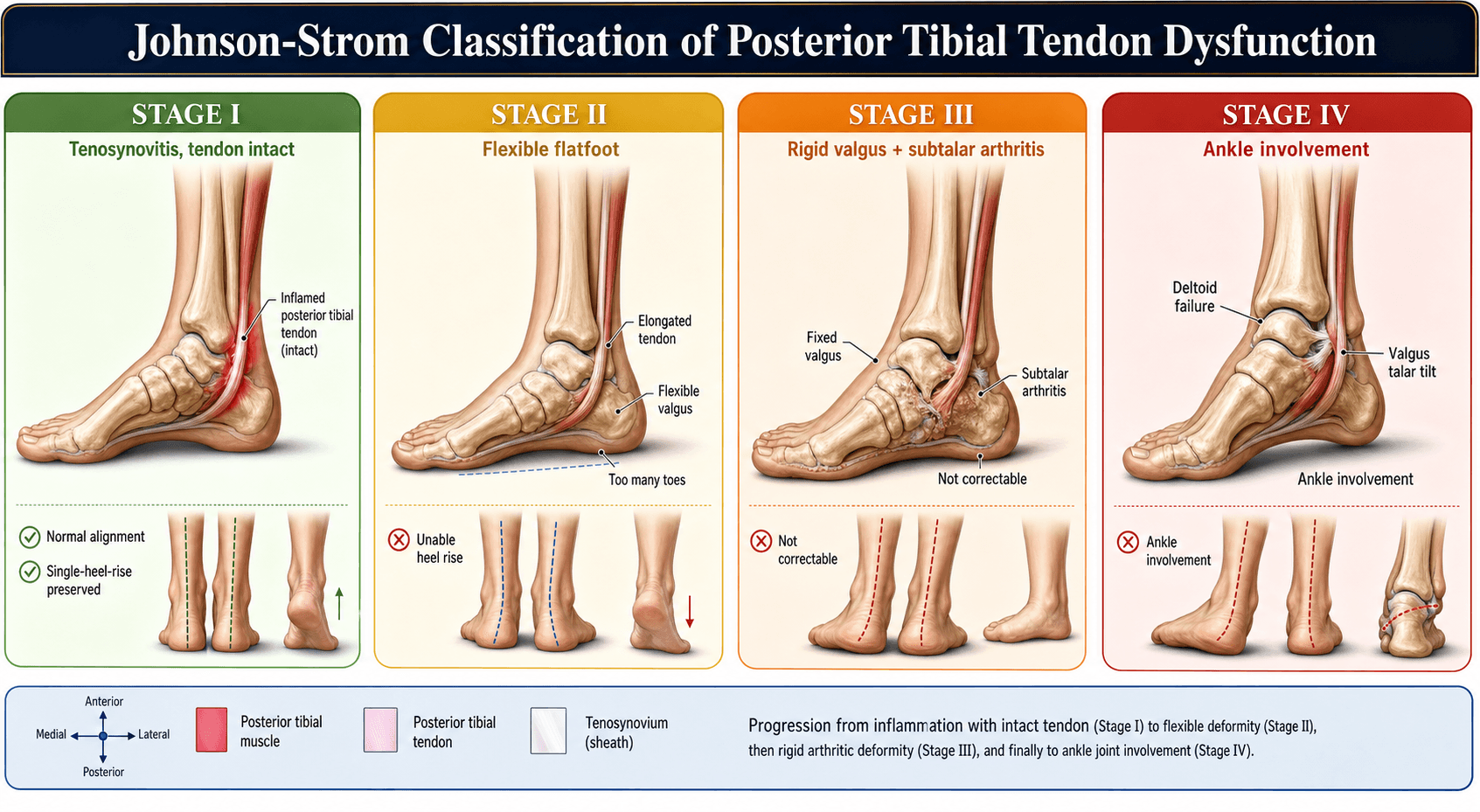
Stage I: tendinitis without deformity. The tendon is inflamed or degenerate but still works, and the foot's architecture is normal. The patient has medial ankle pain along the course of the PTT and fusiform swelling of tenosynovitis behind the medial malleolus. They can perform a single heel raise with heel inversion, the arch height is normal, and weight-bearing radiographs show normal arch parameters.
The prognosis with conservative treatment is good, but there is a risk of progression to Stage II if the biomechanical factors are not addressed.
Stage IIA or IIB. Differentiating IIA from IIB determines surgical strategy: IIB requires lateral column lengthening to address forefoot abduction.
- Stage IIA
- Hindfoot valgus predominant; forefoot abduction minimal
- Stage IIB
- Hindfoot valgus + significant forefoot abduction
- Stage IIA
- Under 30%
- Stage IIB
- Over 30%
- Stage IIA
- Talonavicular uncovering minimal
- Stage IIB
- Lateral column relatively shortened
- Stage IIA
- MDCO + FDL transfer alone
- Stage IIB
- MDCO + FDL transfer + LCL (Evans or Cotton)
- Stage IIA
- Medial procedures sufficient for correction
- Stage IIB
- Requires lateral column lengthening to prevent recurrence
Examiner question: "How do you differentiate Stage II from Stage III?"
Answer: "Passive hindfoot inversion with stress - if the valgus and arch collapse correct, it's flexible Stage II suitable for reconstruction. If rigid, it's Stage III requiring arthrodesis."
Bluman classification. The Bluman classification grades spring ligament pathology on MRI or at operation:
- Grade 1 - attenuation only, elongation without rupture; on MRI the ligament is thickened with increased T2 signal but intact
- Grade 2 - partial-thickness tear; a focal defect of less than 50% of the thickness
- Grade 3 - full-thickness rupture, with complete discontinuity
- Grade 4 - complete disruption with talar head uncovering
Clinical Presentation and Examination
Pain. Medial ankle and hindfoot pain along the course of the PTT, from the medial malleolus to the navicular. It aches, is exacerbated by activity, prolonged standing, uneven ground and stairs, and comes on insidiously over months to years. Acute onset is rare and suggests rupture after a steroid injection.
Swelling and deformity. Medial ankle swelling is worse with activity and better with rest; tenosynovitis gives a fusiform swelling behind the medial malleolus. The arch collapses gradually, the medial heel of the shoe breaks down and shoes become hard to fit, and the gait becomes antalgic with the foot externally rotated.
Function. Stairs are difficult, especially going down, and so is uneven ground. The patient cannot run or play sport, and prolonged standing is painful. Ask about the risk factors listed under Epidemiology, including medications and occupation.
Standing. The too many toes sign is pathognomonic. From behind, a normal foot shows the heel and 1-1.5 lateral toes; in PTTD forefoot abduction brings more than 2 into view, and the more toes visible, the greater the abduction. Normal hindfoot alignment is 5-7° of valgus; in PTTD it exceeds 10°, and side-to-side comparison is critical.
The arch and forefoot. The medial longitudinal arch is lost, the talar head is prominent medially, and the displaced talus can be felt as a medial ankle bulge; the lateral column is relatively short. The forefoot sits in relative supination, a forefoot varus compensating for the hindfoot valgus, with first ray plantarflexion and a callosity under the first metatarsal head.
Gait. Antalgic, with a shortened stance phase on the affected side, excessive external rotation of the foot progression angle and a valgus thrust on loading at heel strike.
Palpation. Tenderness runs along the PTT from behind the medial malleolus to the navicular insertion. Tenosynovitis gives fusiform or nodular thickening, and a palpable gap suggests rupture, which is rare. Over the bones:
- Navicular tuberosity - prominent with spring ligament failure
- Talar head - prominent medially and plantarly
- Sustentaculum tali - tender
- Sinus tarsi - pain from lateral hindfoot (calcaneocuboid) impingement
Differential diagnosis. PTTD is the commonest cause of adult acquired flatfoot, but flexibility, neurological status, age of onset and trauma history distinguish it from its mimics. The table lists the other causes of adult acquired flatfoot first, then the differentials of medial ankle pain: tarsal tunnel syndrome, deltoid ligament injury and accessory navicular syndrome.
- Features
- Insidious progressive flatfoot in middle-aged women; flexible early (Stage II), then rigid (Stage III); too many toes sign, failed single heel raise
- Differentiation
- MRI: degenerate or torn posterior tibial tendon, spring ligament attenuation
- Features
- Polyarticular involvement, systemic symptoms, synovitis
- Differentiation
- Raised inflammatory markers, rheumatoid factor, anti-CCP
- Features
- Rigid flatfoot since adolescence, limited subtalar motion
- Differentiation
- C-sign on lateral radiograph; CT or MRI confirms the bony or fibrous bar
- Features
- Diabetic neuropathy, midfoot collapse, rocker-bottom deformity
- Differentiation
- Loss of protective sensation, midfoot warmth and swelling, fragmentation on radiograph
- Features
- Traumatic onset, midfoot swelling, pain on abduction stress
- Differentiation
- History of trauma, midfoot tenderness, radiographic diastasis
- Features
- Acute medial arch pain, palpable defect, previous plantar fasciitis
- Differentiation
- History of sudden pain (often during sport), bruising
- Features
- Burning plantar paraesthesiae, positive Tinel's sign, night symptoms
- Differentiation
- Nerve conduction studies; predominantly sensory symptoms
- Features
- Acute trauma, lateral ankle ecchymosis (eversion mechanism)
- Differentiation
- History of trauma, ankle stress radiographs
- Features
- Prominence since childhood, os naviculare on radiograph
- Differentiation
- Longstanding symptoms, characteristic radiographic appearance
Investigations and Imaging
Weight-bearing radiographs are MANDATORY for PTTD assessment. Non-weight-bearing films grossly underestimate deformity severity. Examiners will fail candidates who order non-weight-bearing foot films for PTTD staging.
The views. Weight-bearing AP and lateral foot films, a hindfoot alignment (Saltzman) view, and ankle AP and mortise views to assess Stage IV. The measurements that stage the foot:
- View
- AP foot
- Normal
- Under 7°
- PTTD
- IIA 7-20° (mild-moderate forefoot abduction); IIB over 20° (severe, requiring LCL)
- View
- AP foot
- Normal
- Under 10%
- PTTD
- IIA 10-30%; IIB over 30%
- View
- AP foot
- Normal
- 0-4° (aligned)
- PTTD
- Over 15° (forefoot abduction)
- View
- Lateral foot
- Normal
- 0-4° (colinear)
- PTTD
- Over 15° (sagittal sag); severe over 30°
- View
- Lateral foot
- Normal
- 18-25°
- PTTD
- Under 15° (arch collapse); severe under 10°
- View
- Saltzman view
- Normal
- 0-5° valgus
- PTTD
- Over 10° valgus
- View
- Ankle AP/mortise
- Normal
- PTTD
- Over 5° (ankle valgus)
- View
- Ankle AP/mortise
- Normal
- PTTD
- Over 2mm greater than lateral = deltoid insufficiency
The AP foot. The talonavicular coverage angle is the most important measurement: it determines the need for lateral column lengthening. Forefoot abduction also shows as metatarsal divergence, with increased intermetatarsal angles; the first-second intermetatarsal angle may be increased.
The lateral foot. Normally the dorsal cortices of talus and navicular are parallel; in PTTD the talus plantarflexes and the navicular subluxes dorsally. The cyma line, normally a smooth S-curve across the calcaneocuboid and talonavicular joints, becomes disrupted and stepped with peritalar subluxation.
The Saltzman view. The patient stands on blocks with the feet 15cm apart and the ankle centred on the cassette, and the beam is parallel to the floor, showing coronal hindfoot alignment. It quantifies the severity of hindfoot valgus, plans the MDCO, and monitors correction after reconstruction.
The ankle. In Stage IV, look for the talar tilt of deltoid insufficiency and for ankle arthritis: tibiotalar joint space narrowing, lateral gutter impingement, and subchondral sclerosis and cysts.
Management Algorithm
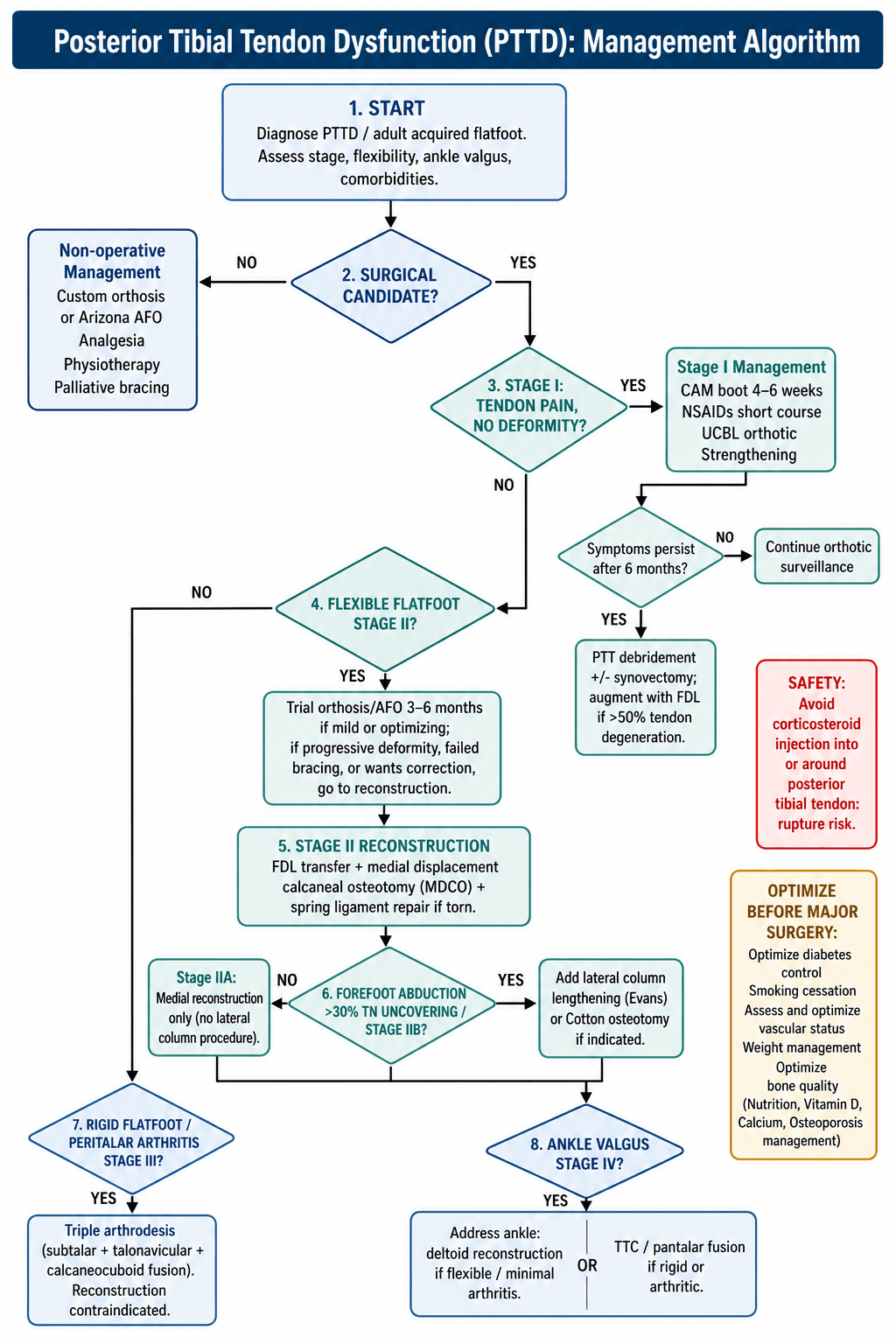
Who is treated without surgery. Every Stage I patient, first. In Stages II-IV, conservative treatment is for patients whose medical comorbidities preclude surgery, who prefer it, or who are non-ambulatory, and for those with a contraindication to surgery such as severe peripheral vascular disease, uncontrolled diabetes or active infection.
When it stops being appropriate. Progressive deformity despite bracing in Stage II, a failed trial of appropriate conservative measures, or a patient who wants the deformity corrected. Conservative treatment does not correct deformity.
What it achieves. Conservative care controls pain and, in compliant Stage I patients, prevents progression; it does not reverse established deformity, and compliance is critical. By stage:
- Stage I - 70-80% respond to immobilisation and a UCBL orthotic, success meaning less pain, better function and no progression. Allow a trial of at least 6 months before considering surgery.
- Stage II - 30-40% achieve symptom control with an Arizona AFO. It does not correct the deformity, and most progress to Stage III despite bracing.
- Stages III-IV - palliative only, for non-surgical candidates; it does not prevent progression.
Immobilisation (Stage I). A CAM walker boot for 4-6 weeks of strict immobilisation, fully weight-bearing in the boot, to reduce tendon inflammation, prevent microtrauma and allow healing. The patient then moves gradually into orthotics over 2 weeks.
Orthoses are the foundation of conservative treatment.
- Design
- Rigid custom foot orthotic moulded from a cast; high medial flange supports the arch, lateral flange controls forefoot abduction, deep heel cup controls hindfoot valgus
- Indications
- Stage I after immobilisation (the gold standard); Stage II non-surgical candidates; protective bracing after reconstruction
- Trade-offs
- Better arch support than standard orthotics; needs a shoe with a removable insole; compliance issues (bulk, shoe limitations)
- Design
- Leather double-upright ankle-foot orthosis; lateral upright controls hindfoot valgus; integrated medial arch support; ankle motion preserved
- Indications
- Stage II non-surgical candidates (better control than UCBL); Stage III palliation; temporarily after triple arthrodesis
- Trade-offs
- Better valgus control than UCBL; allows ankle motion, unlike a rigid AFO; significant compliance issues (bulk, cosmesis, shoe limitations)
- Design
- Semi-rigid thermoplastic, medial posting, arch support
- Indications
- Mild Stage I only; preventive in at-risk patients
- Trade-offs
- Less control than UCBL and insufficient for Stage II or greater; good compliance, as it fits regular shoes
Shoe modifications.
- Medial heel wedge - a 4-6mm medial build-up controls hindfoot valgus and shifts the ground reaction force laterally
- Rocker-bottom sole - reduces forefoot stress and the eccentric load on the PTT, and assists toe-off
- Wide toe box - accommodates forefoot abduction and prevents lateral toe compression
Surgical Management
PTTD is a progressive disorder and its surgery is stage-dependent: Stage I = tendon debridement, Stage II = reconstruction, Stage III-IV = arthrodesis. Failing to recognise rigid Stage III deformity and offering isolated soft-tissue procedures, or Stage II reconstruction (FDL transfer, MDCO), is a critical error that examiners will fail immediately.
Absolute contraindications. Active infection, severe peripheral vascular disease precluding healing, and a non-ambulatory patient, in whom surgery provides no functional benefit.
Relative contraindications, and how to optimise them.
- Diabetes - an HbA1c over 8% defers elective surgery; target under 7.5%, preferably under 7%, with the endocrinology or diabetes team involved
- Smoking - stop for a minimum of 6 weeks, ideally 12, before surgery, with counselling and nicotine replacement; document compliance
- Obesity - a BMI over 40 prompts weight loss with realistic goals (5-10% of body weight), dietitian referral and consideration of bariatric surgery; BMI reduction improves outcomes
- Peripheral neuropathy - risk of Charcot arthropathy after surgery
- Poor bone quality - osteoporosis; assess with DEXA if indicated
- Inflammatory arthropathy - active synovitis; optimise medical management
Vascular and cardiac assessment. Patients with diabetes, a smoking history or symptoms of peripheral vascular disease have an ankle-brachial index measured: under 0.9 is abnormal, and under 0.7 or claudication warrants referral to vascular surgery. Before major surgery (triple arthrodesis, pantalar fusion), assess functional capacity and exercise tolerance, and refer to cardiology if capacity is poor or there is a cardiac history.
Indications. Stage I PTTD with MRI-confirmed tendinosis or partial tear, persistent pain limiting activities of daily living, and failure of 6 months of conservative treatment. There must be no architectural deformity, and the tendon must be structurally intact, with under 50% of its cross-section involved. Deformity means Stage II, which needs reconstruction; involvement over 50% needs augmentation with an FDL transfer. Isolated debridement is rarely performed, as most patients have progressed to Stage II by presentation.
Technique
Set-up. Supine, with a bump under the ipsilateral hip (15-20° of internal rotation) and a thigh tourniquet.
Approach. A longitudinal 8-10cm incision centred 1cm posterior to the medial malleolus, from 4cm proximal to the malleolus to the navicular insertion.
- Identify and protect the saphenous vein and nerve, retracting them anteriorly
- Incise the flexor retinaculum longitudinally, preserving its pulley function for later repair
- Expose the PTT from the myotendinous junction to the navicular insertion
- Inspect the entire tendon for pathology
Assess the tendon. Degeneration is typically in Zone 3, 2-6cm proximal to the navicular. Measure the percentage of the cross-section involved: over 50% is the decision point for augmentation with an FDL transfer (see the Stage IIA tab).
Debride. Make a longitudinal tenotomy along the degenerate segment and excise all degenerate tissue: macroscopically abnormal (yellow-brown discolouration), friable and myxoid, without normal striations. Preserve healthy margins; what remains should be intact, healthy tendon that maintains its structural integrity. Excise all inflamed synovium.
Close. Repair the flexor retinaculum to keep its pulley function, close subcutaneous tissue with absorbable sutures and the skin with monofilament non-absorbable or absorbable subcuticular sutures, and apply a below-knee plaster backslab.
After surgery
- Weeks 0-4 - non-weight-bearing cast
- Weeks 4-6 - weight-bearing cast
- Then - CAM walker boot for 2 weeks with progressive weight-bearing, and a UCBL orthotic from week 8; physiotherapy for range of motion and strength
- Return - light activities at 3 months, full sport at 4-6 months; the orthotic is worn long-term
Outcomes
Good-to-excellent results in 70-80% at 2-5 years. Success is predicted by the absence of deformity, under 50% tendon involvement and appropriate patient selection. Failure is predicted by underlying biomechanical factors (flatfoot, hypermobility) left unaddressed, progression to Stage II deformity, and inadequate orthotic use after surgery. Wound problems occur in 5%, sural nerve injury in 2% and saphenous nerve injury in 5%, and 20-30% progress to Stage II over 5 years.
Complications and Management
Sural nerve injury is the most common neurovascular injury, in 5-10% of lateral approaches (MDCO, lateral column lengthening, triple arthrodesis). Prevention is careful identification and protection throughout. A transection recognised at surgery is repaired primarily; postoperative neuropathic pain is treated with gabapentin and referral to a pain specialist.
Saphenous vein and nerve injury occurs in 5% of medial approaches (FDL transfer). Retract them anteriorly during dissection, avoid ligating the vein if possible, and manage a nerve injury as for the sural nerve.
The posterior tibial neurovascular bundle is at risk from aggressive retraction in the medial approach. Retract gently, with awareness of the anatomy; an injury needs vascular repair and nerve repair or reconstruction.
Calcaneal fracture during MDCO occurs in 2-5%, from aggressive osteotome use or osteoporotic bone. Prevention is an oscillating saw and gentle technique. Fix it at the time with additional screws or a plate, and extend non-weight-bearing afterwards.
Talar fracture is a risk of aggressive joint preparation in triple arthrodesis. Prepare carefully without excessive subchondral bone removal; a fracture is fixed, grafted and immobilised for longer.
Wound problems (first 6 weeks). Superficial dehiscence occurs in 5-10%, more often in diabetics, smokers and obese patients; malnutrition and steroid use add to the risk. Prevention is preoperative optimisation, careful tissue handling, closure without excessive tension, and avoiding haematoma, with a drain after a large dissection. Minor breakdown heals by secondary intention with local wound care; major breakdown needs debridement and delayed closure or flap coverage.
Deep infection occurs in 2-5%. Risk factors are diabetes, immunosuppression, prolonged surgery and haematoma, and it presents with fever, wound erythema and purulent drainage. Staphylococcus aureus is the most common organism, with MRSA and Gram-negatives.
- Early (under 3 weeks) - debridement and irrigation, retaining the hardware if stable
- Late (over 3 weeks) - debridement, consideration of hardware removal, and 6 weeks of IV antibiotics
Haematoma occurs in 5%. Prevention is meticulous haemostasis and a drain (removed at 24-48 hours); a small one is observed, a large or expanding one evacuated.
Cast complications. Prevention of pressure sores is adequate padding, cast checks and education; they are treated by removing the cast and caring for the wound. Compartment syndrome is rare (under 1%): pain out of proportion and pain on passive stretch demand emergency cast removal, assessment, and fasciotomy if confirmed.
Clinical Decision Scenarios
Practise clinical reasoning and management decisions out loud
“A 58-year-old woman with BMI 32 presents with progressive right medial ankle pain and flatfoot deformity over 2 years. Failed 6 months conservative management with UCBL orthotic. On examination: too many toes sign positive, failed single heel raise test, flexible deformity corrects with passive heel inversion. Weight-bearing AP foot radiograph shows 35% talonavicular uncovering, lateral radiograph shows calcaneal pitch 12 degrees, Meary's angle 22 degrees.”
“You are asked to assess a 62-year-old man with chronic flatfoot and medial ankle pain. On examination you notice hindfoot valgus, arch collapse, and he cannot perform single heel raise. The examiner asks you to demonstrate how you would differentiate Stage II from Stage III PTTD.”
“A 55-year-old woman had FDL transfer and MDCO 18 months ago for Stage II PTTD. She initially did well but now at 18 months complains of recurrent medial ankle pain, arch collapse, and difficulty walking. On examination the arch has collapsed again, too many toes sign is positive, and passive correction test shows some flexibility but less than expected.”
“A 52-year-old woman was diagnosed with PTTD Stage I by her GP 6 weeks ago. She was given a corticosteroid injection for 'tendinitis' behind the medial malleolus. She now presents to your clinic with sudden onset severe medial ankle pain 4 days ago while walking, now unable to weight-bear, severe flatfoot deformity, cannot perform heel raise. On examination: marked hindfoot valgus, arch completely collapsed, swelling medial ankle, tender along PTT course.”
Must-Know Classifications
- Johnson & Strom (Myerson Modification): Stage I (tendinitis, no deformity), Stage II (flexible flatfoot), Stage III (rigid flatfoot), Stage IV (ankle valgus)
- Stage IIA (hindfoot valgus, under 30% uncovering) vs IIB (over 30% uncovering requiring LCL)
- Bluman spring ligament: Grade 1 (attenuation), Grade 2 (partial tear), Grade 3 (full rupture), Grade 4 (complete disruption)
- PTT zones: Zone 1 (myotendinous), Zone 2 (behind malleolus), Zone 3 (inframalleolar - most common), Zone 4 (insertion)
Clinical Examination Pearls
- Too many toes sign: See over 2 lateral toes from behind (forefoot abduction)
- Single heel raise test: Cannot perform OR performs without heel inversion (gold standard for Stage II+)
- Passive correction test: Invert heel while palpating talonavicular - corrects = Stage II, rigid = Stage III
- Coleman block test: Stand on 1-inch block under lateral foot - hindfoot corrects if forefoot-driven varus
Radiographic Measurements (Weight-Bearing Mandatory)
- Talonavicular coverage angle (AP): Normal under 7°, IIA 7-20°, IIB over 20° (determines need for LCL)
- Calcaneal pitch (lateral): Normal 18-25°, PTTD under 15° (arch collapse)
- Meary's angle (lateral): Normal 0-4°, PTTD over 15° (sagittal sag)
- Saltzman view (hindfoot alignment): Normal 0-5° valgus, PTTD over 10° valgus
Stage-Appropriate Treatment (Critical)
- Stage I: Conservative first-line (CAM boot 4-6 weeks → UCBL orthotic). Surgery if failed 6 months: PTT debridement
- Stage IIA: FDL transfer + MDCO (medial procedures alone)
- Stage IIB: FDL transfer + MDCO + Lateral column lengthening (Evans or Cotton) - LCL essential if over 30% uncovering
- Stage III: Triple arthrodesis (subtalar + talonavicular + calcaneocuboid fusion). Reconstruction will FAIL
- Stage IV: Pantalar fusion or tibiotalocalcaneal fusion with IM nail
Surgical Techniques - Stage II Reconstruction
- FDL transfer: Harvest at master knot of Henry, Pulvertaft weave into PTT, set tension in neutral foot position
- MDCO: Oblique osteotomy 1-1.5cm posterior to calcaneocuboid joint, medialize 10-15mm, fix with 2x 6.5mm screws
- Evans osteotomy (LCL): Transverse cut 1-1.5cm posterior to calcaneocuboid, distract 8-12mm, tricortical iliac crest graft
- Spring ligament: Grade 3-4 requires allograft augmentation or direct repair
Contraindications and Cautions
- Corticosteroid injection ABSOLUTELY CONTRAINDICATED - causes tendon rupture (examiners will fail you if you recommend this)
- Weight-bearing radiographs MANDATORY - non-weight-bearing grossly underestimates deformity
- Do NOT offer Stage II reconstruction (FDL, MDCO) for Stage III rigid deformity - will fail due to arthritis
- Pre-op optimization critical: HbA1c under 7.5%, smoking cessation 12 weeks, BMI reduction
Complications and Success Rates
- Stage I conservative: 70-80% success. Stage II conservative: 30-40% symptom control only, does NOT reverse deformity
- Stage IIA reconstruction: 85-90% good outcomes at 5 years
- Stage IIB reconstruction: 80-85% good outcomes (lower due to lateral column pain, non-union risk)
- Triple arthrodesis: 75-85% good outcomes, non-union 10-15% (calcaneocuboid highest), adjacent joint arthritis 20-30% at 10 years
- Sural nerve injury: 5-10% in lateral approaches (MDCO, LCL, triple)
Viva Survival - Common Questions
- How differentiate Stage II from Stage III? Passive correction test - flexible = II (reconstruct), rigid = III (fuse)
- Why is LCL needed for Stage IIB? Forefoot abduction over 30% cannot be corrected by medial procedures alone - will recur without LCL
- What if Stage II reconstruction fails? Assess flexibility and imaging - flexible = revise reconstruction, rigid = triple arthrodesis
- Why no steroids? Degenerative not inflammatory, steroids cause collagen degradation and rupture risk, no evidence of benefit
Evidence Base and Literature
Landmark Studies and Systematic Reviews
Structured Non-Operative Protocol for Stage I-II PTTD
- 47 consecutive patients with Stage I or II PTTD treated with an articulated AFO/foot orthosis plus a high-repetition strengthening and gastrocsoleus stretching programme
- After a median of 10 physiotherapy visits over a median of 4 months, 39/47 (83%) had successful subjective and functional outcomes
- 42/47 (89%) were satisfied with the outcome
- Only 5/47 (11%) required surgery after failure of non-operative treatment
- Significant pre-treatment concentric and eccentric weakness across all ankle muscle groups (p less than 0.001)
FDL Transfer + Medial Displacement Calcaneal Osteotomy for Stage II
- 51 patients with classical Johnson & Strom Stage II PTTD treated with MDCO plus FDL transfer; 44 reviewed at a mean follow-up of 51 months
- Mean AOFAS ankle/hindfoot score improved from 48.8 pre-operatively to 88.5 at follow-up
- 43/44 rated good-to-excellent for pain and function; 36/44 good-to-excellent for alignment
- The procedure failed in only 2 patients, who subsequently underwent calcaneocuboid fusion
- Joint-sparing reconstruction gave durable medium-term results without sacrificing hindfoot motion
Lateral Column Lengthening (Evans vs Hintermann) for Flexible Flatfoot
- 53 patients with flexible flatfoot deformity: 17 Evans and 36 Hintermann lateral lengthening calcaneal osteotomies
- Both groups showed significant improvement in FAOS, pain (NRS) and SF-36 scores (p less than 0.05)
- Significant radiographic correction of talus-second metatarsal angle, talonavicular coverage and naviculocuneiform overlap (p less than 0.05)
- Calcaneocuboid degenerative change occurred in 41% after Evans vs 25% after Hintermann osteotomy; subtalar change 18% vs 14% - clinically silent in both
- No secondary arthrodesis required; no significant difference in clinical outcome between techniques
Triple Arthrodesis for the Rigid Arthritic (Stage III) Flatfoot
- Dual-incision triple arthrodesis remains the traditional, reliable and reproducible treatment for the rigid, arthritic adult flatfoot
- Early complications include lateral wound problems, malunion and non-union
- Long-term adjacent-joint (ankle and midfoot) arthritis is an expected consequence rather than a failure of the procedure
- A single medial incision reduces lateral wound complications but limits calcaneocuboid fixation and precludes lateral column lengthening
- Double or modified-double arthrodesis can spare minimally degenerate subtalar or calcaneocuboid joints in selected patients
Anatomical Spring Ligament Reconstruction (Biomechanical Basis)
- Simulated 5-15 degrees talonavicular abduction flatfoot deformity in 10 cadaver foot-ankle specimens under 357 N vertical load
- Three peroneus longus tendon reconstructions of the failed spring ligament were compared
- A superomedial/plantar passage through the calcaneus and navicular best corrected the deformity (talonavicular joint from 9.1 degrees abducted to 1.0 degree adducted)
- Subtalar joint corrected from 3.1 degrees everted to 0.4 degrees inverted with the same construct
- Provides the biomechanical rationale for adding anatomical spring ligament reconstruction to soft-tissue flatfoot correction
Johnson & Strom Staging Classification (Defining Landmark)
- Described the original three-stage classification of tibialis posterior tendon dysfunction (later modified by Myerson to add Stage IV ankle valgus)
- Each stage has characteristic pain symptoms, clinical signs and radiographic changes
- Staging clarifies expected pathology and directs surgical treatment
- Stage I: tenosynovitis, no deformity; Stage II: flexible flatfoot; Stage III: fixed deformity
- Emphasised the role of the tibialis posterior tendon in normal hindfoot function
PTTD as the Commonest, Frequently Overlooked Cause of Adult Flatfoot
- PTTD is the most common cause of adult acquired flatfoot, arising from degenerative change in the posterior tibial tendon
- Untreated disease progresses to fixed deformity and degenerative change in surrounding joints
- Key clinical signs are the 'too many toes' sign and inability to perform a single heel raise
- X-ray, ultrasound and MRI help stage disease and guide management
- Early identification and prompt treatment can halt progression