Congenital Femoral Deficiency | Whole-Limb Phenotype | Reconstruction and Prosthetic Pathways
- Aitken is descriptive, not a treatment algorithm; MRI may reveal an unossified cartilaginous head/neck
- Map the whole limb: hip stability, femoral segment, knee/cruciates, fibula, ankle, foot rays, joints and soft tissues all affect the pathway
- Prediction is a range checked against serial growth, skeletal maturity and prior operations
- Options include observation/extension prosthesis, reconstruction with staged lengthening, rotationplasty and ablative prosthetic pathways
- No one option is universally superior; function, appearance, burden, reversibility, prosthetic access and family/child priorities matter
- “Do not route Type A/B automatically to reconstruction or Type C/D automatically to rotationplasty/amputation
- “Use MRI or ultrasound to define unossified proximal anatomy in infants
- “Assess knee and foot because they may determine prosthetic or rotationplasty feasibility
- “Treat a multiplier estimate as one input, not a centimetre threshold
Overview and Epidemiology
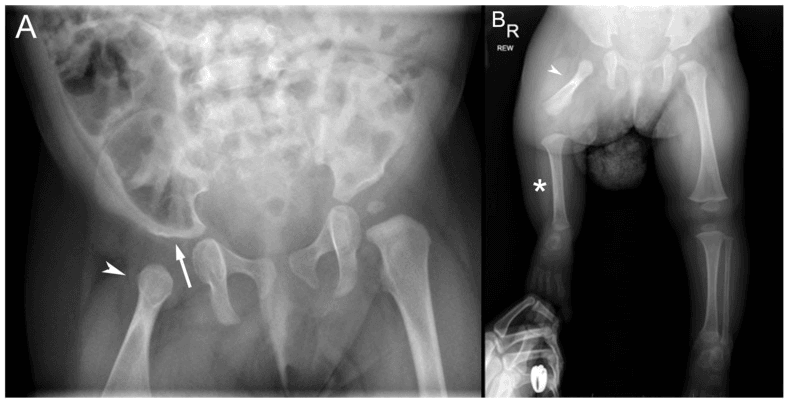
Proximal femoral focal deficiency (PFFD) is a rare congenital condition in which part or all of the proximal femur is absent. It is a spectrum, from mild shortening with coxa vara to complete absence of the proximal femur and acetabulum, and it often involves the knee, fibula, ankle and foot as well.
Who. The incidence is 1 in 50,000 live births, and males and females are affected equally. The left side is affected more often than the right, and roughly 10-15% of cases are bilateral.
Cause. PFFD results from failure of normal development of the proximal femur during embryogenesis, at 4-8 weeks' gestation. The exact cause is unknown and there is no clear pattern of inheritance; the condition is sporadic. Mechanisms that may be involved:
- Vascular insult during development
- Teratogenic exposure
- Genetic factors, with rare familial cases reported
- Failure of mesenchymal condensation
Pathophysiology and Mechanisms
Normal development. The proximal femur develops from mesenchymal condensation at 4-6 weeks' gestation. The femoral head, neck and greater trochanter develop from separate ossification centres that fuse during childhood.
What fails. In PFFD that development fails, and the result ranges across the Aitken types (see Classification):
- Shortened or absent proximal femur
- A short neck with coxa vara (Type A)
- Pseudarthrosis at the neck (Type B)
- Absent femoral head (Types C and D)
- A dysplastic acetabulum (Type C) or an absent one (Type D)
- Associated soft-tissue deficiencies of the muscles and ligaments
The rest of the limb. Understanding the whole-limb anatomy helps determine reconstruction feasibility and treatment planning. Associated deficiencies can change what is feasible more than the proximal-femoral label does:
- Fibular hemimelia, in 50% of cases
- Cruciate ligament deficiency, including anterior cruciate deficiency, and cruciate dysplasia; these are common, and the knee instability they bring affects function
- Foot anomalies, which are common: tarsal coalition, equinovarus and ray deficiency, alongside ankle deformity
- Patellar anomalies
- Tibial shortening, less common than fibular deficiency
Classification Systems
Two systems do different jobs. Aitken records femoral-head and acetabular morphology; Paley adds neck and subtrochanteric ossification and joint function. Neither substitutes for whole-limb assessment or shared decision-making.
Aitken Classification (1969)
Aitken is the most widely used system, based on the radiographic appearance of the femoral head and acetabulum.
- Femoral Head
- Present
- Femoral Neck/Connection
- Short/deficient but connected
- Acetabulum
- Usually adequate
- Interpretation
- Potentially reconstructable morphology
- What Still Must Be Defined
- Continuity, coxa vara, hip stability, whole-limb function
- Femoral Head
- Present, often cartilaginous
- Femoral Neck/Connection
- No osseous continuity
- Acetabulum
- Present
- Interpretation
- MRI and mobility determine anatomy
- What Still Must Be Defined
- Cartilaginous connection, mobility, reconstructability
- Femoral Head
- Absent
- Femoral Neck/Connection
- Absent
- Acetabulum
- Present but dysplastic
- Interpretation
- Severe morphology; plan functionally
- What Still Must Be Defined
- Pelvic-femoral relationship and prosthetic options
- Femoral Head
- Absent
- Femoral Neck/Connection
- Absent
- Acetabulum
- Absent/severely deficient
- Interpretation
- Most severe morphology; plan functionally
- What Still Must Be Defined
- Residual limb, knee/ankle/foot function and goals
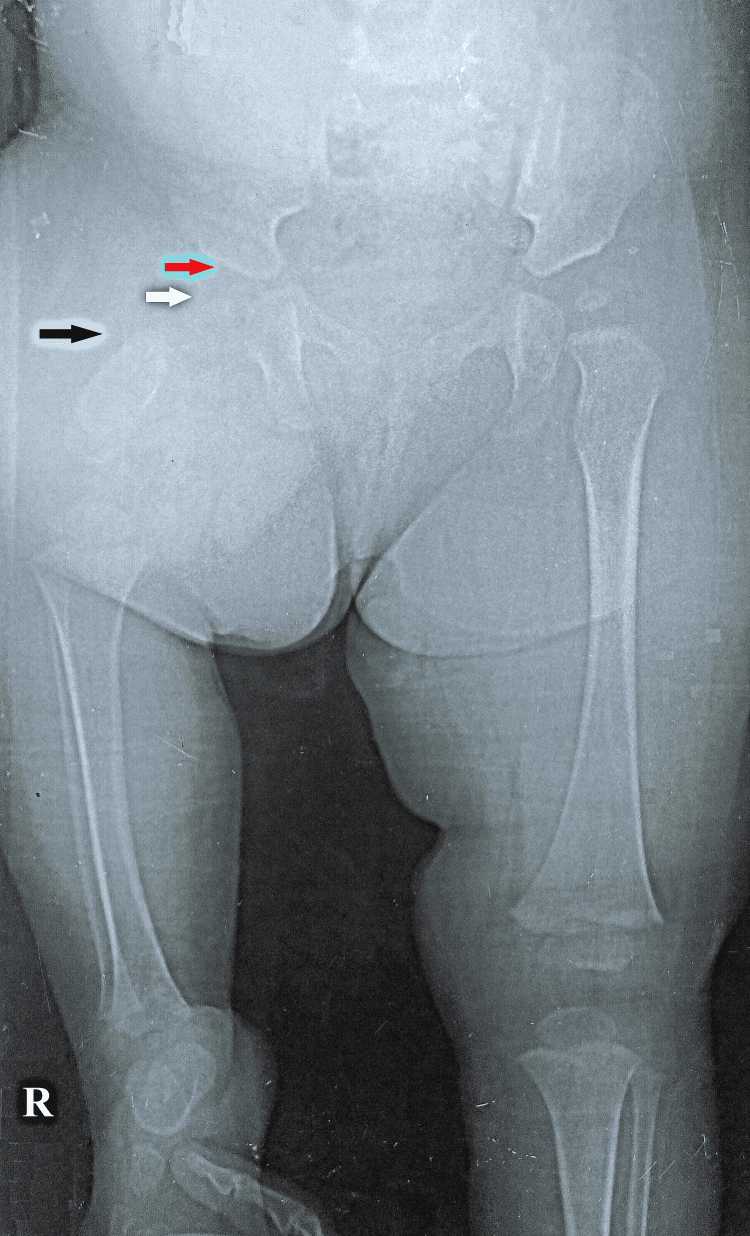
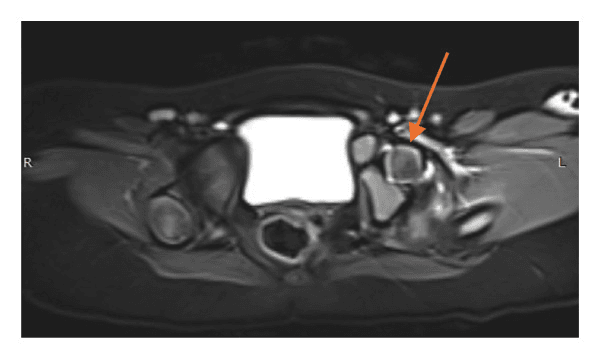
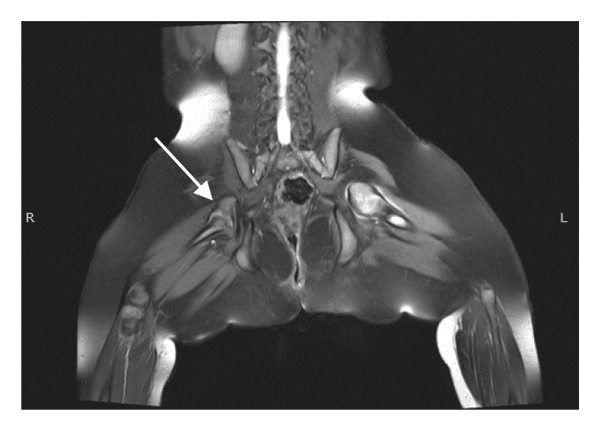
In infants, radiographs can under-call a cartilaginous head or neck, so ultrasound or MRI may change the apparent class. Aitken does not encode the knee, ankle, foot, soft tissues, expected stature, family priorities or prosthetic access, and must not be used as a stand-alone treatment rule.
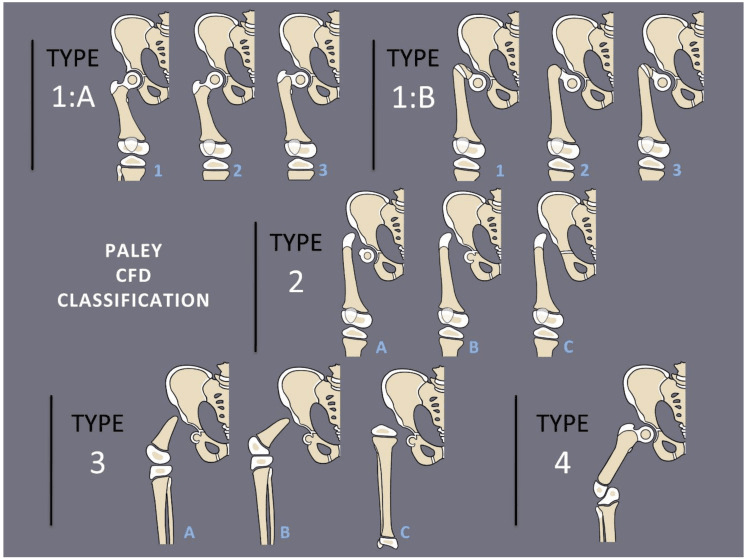
Clinical Assessment
History. The short limb is noticed at birth or in early infancy. Walking may be delayed, a unilateral case may walk with a limp, and activities that require equal leg length are difficult. A family history is rare but may be present.
Inspection. The thigh is short, and the hip sits flexed, abducted and externally rotated, the pseudarthrosis position. The knee may be flexed in compensation. Note the position of the foot for associated anomalies, and compare with the other side.
Palpation. The proximal femur may be absent or very short. The greater trochanter may be palpable in Types A and B, or absent in Types C and D. Assess the stability of the hip and of the knee.
Range of motion. Hip flexion and abduction are limited. The knee may hyperextend or have a flexion contracture, and the ankle is checked for equinus or other deformity.
Limb length. Three measurements:
- True leg length - ASIS to medial malleolus
- Apparent leg length - umbilicus to medial malleolus
- Thigh length - greater trochanter to lateral joint line
Neurovascular. Neurovascular status is usually normal, but assess femoral nerve function, which may be affected in severe cases.
Investigations
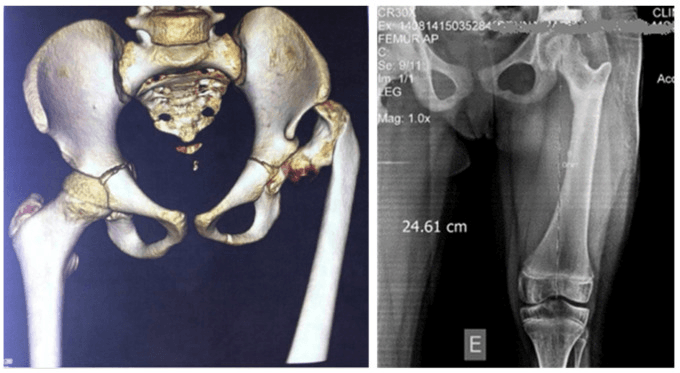
Radiographs. The AP pelvis and hip film answers the anatomical questions:
- Is the femoral head present? Its ossification may be delayed in Type A
- Is the acetabulum present, dysplastic or absent?
- The coxa vara angle, in Type A
- A pseudarthrosis, in Type B
Full-length standing radiographs measure the limb-length discrepancy and alignment, and show associated anomalies such as fibular hemimelia and tibial shortening.
MRI and ultrasound. MRI, when indicated, shows an unossified femoral head, the acetabular cartilage and the soft tissues, muscles and ligaments; in Type A a head may appear absent on X-ray yet be present on MRI. In infants, ultrasound may identify an unossified femoral head and assesses hip stability.
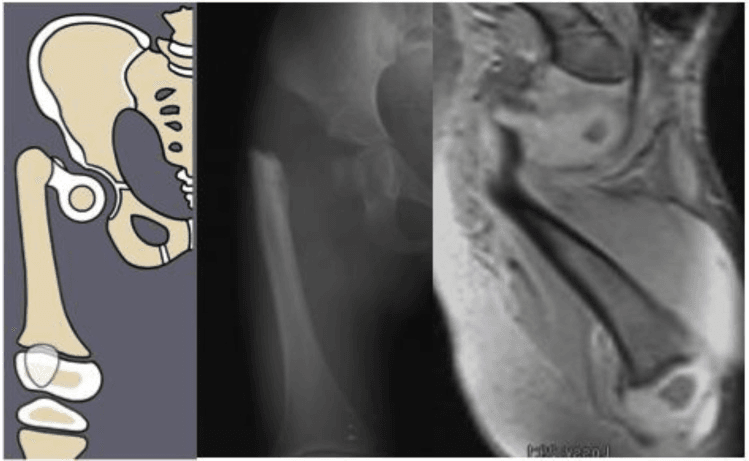
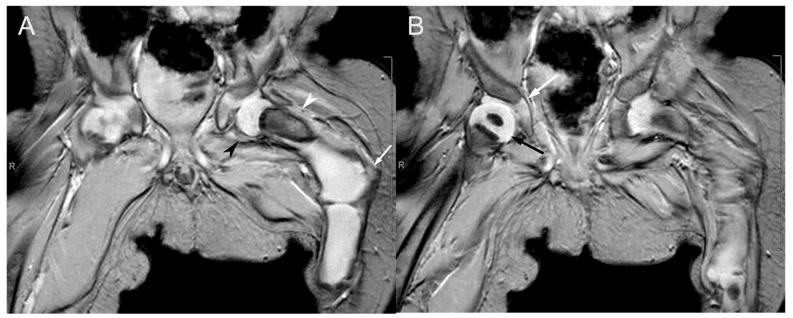
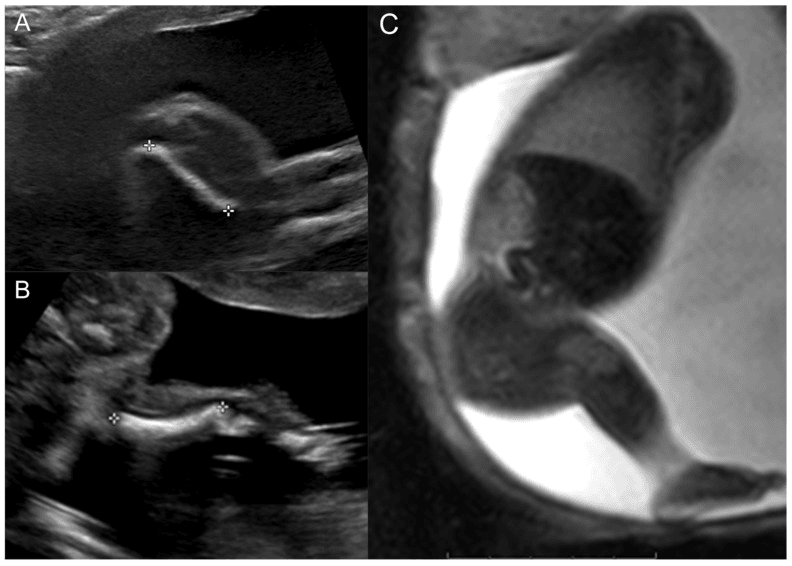
Predicting the discrepancy. Prediction is a range, checked against serial growth, skeletal maturity and prior operations. Two methods:
- Multiplier method - current LLD × the multiplier for age and sex = predicted final LLD
- Paley method - more complex, and accounts for growth remaining
What the number decides. Discrepancy is one variable. It is integrated with hip, knee, ankle and foot function, stature, deformity, surgical burden and prosthetic options, and there is no universal 15-centimetre branch.
Genetic evaluation. Genetic evaluation is usually not indicated, as the condition is sporadic. Consider it if the deficiency is bilateral or there is a family history.
Differential Diagnosis
The shortened, abnormally positioned thigh of PFFD overlaps with several other causes of a congenitally short femur or limb-length discrepancy. The discriminator is the state of the proximal femur, hip and the rest of the limb.
- Proximal Femur / Hip
- Deficient or absent proximal femur; coxa vara, pseudarthrosis or absent head
- Distinguishing Features
- Short, flexed-abducted-externally rotated thigh; ~50% with fibular deficiency
- Key Clue
- Bulky proximal thigh with very short femoral segment
- Proximal Femur / Hip
- Femur present, hip stable, head present
- Distinguishing Features
- Diffuse mild shortening, may have anterolateral bow, no pseudarthrosis
- Key Clue
- Whole femur short but in continuity
- Proximal Femur / Hip
- Femur often near-normal proximally
- Distinguishing Features
- Lateral foot rays/fibula deficient, ball-and-socket ankle, anteromedial tibial bow
- Key Clue
- Foot/ankle anomaly dominates; coexists with PFFD
- Proximal Femur / Hip
- Femur normal length; dysplastic/dislocated hip
- Distinguishing Features
- Galeazzi positive from hip not femoral deficiency; femoral length symmetric
- Key Clue
- Limb-length difference is apparent, not true femoral loss
- Proximal Femur / Hip
- Acquired, prior history
- Distinguishing Features
- Physeal damage, AVN; no congenital dysmorphism
- Key Clue
- History of sepsis/trauma/AVN
Management Algorithm
Build a longitudinal plan
- Define hip/proximal femoral anatomy with age-appropriate radiograph, ultrasound, MRI or arthrography.
- Map femoral length/deformity, knee stability, fibula, ankle, foot rays, motion, muscle power, nerves/vessels and associated anomalies.
- Estimate discrepancy as a range and update it with growth and interventions.
- Compare expected function, appearance, procedure burden, reversibility, complications and prosthetic dependence across pathways.
- Revisit the decision as the child can participate and anatomy/growth become clearer.
Options may include observation with shoe/extension prosthesis, hip/proximal-femoral reconstruction with staged lengthening, rotationplasty, or an ablative level selected for prosthetic fitting. These are pathways, not Aitken-labelled destinations.
The questions that frame rotationplasty counselling, once the options are on the table:
CARSRotationplasty Assessment
Hook:CARS frames rotationplasty counselling; classification and centimetres do not decide alone.
Surgical Techniques
Exposure. Position and approach must expose the actual proximal deformity while protecting the femoral neurovascular structures and preserving growth potential.
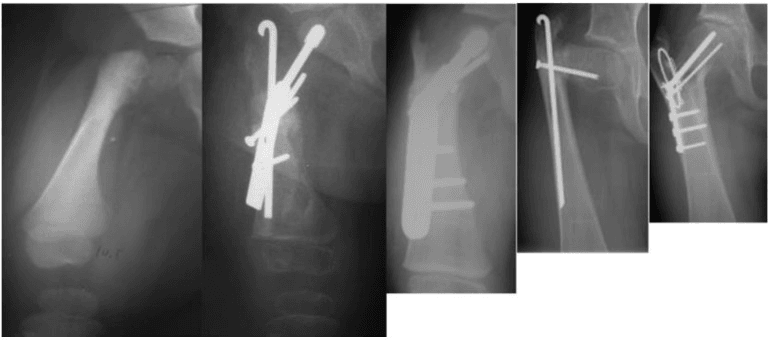
What to correct. Correct contracture, coxa vara, retroversion and acetabular deficiency only when each is demonstrated and functionally relevant. Select the osteotomy, graft or biologic, and plate or other fixation from the cartilaginous and ossified anatomy, bone size and stability.
Before closure. Test hip containment and knee and ankle motion. Postoperative protection follows the construct rather than a universal cast duration.
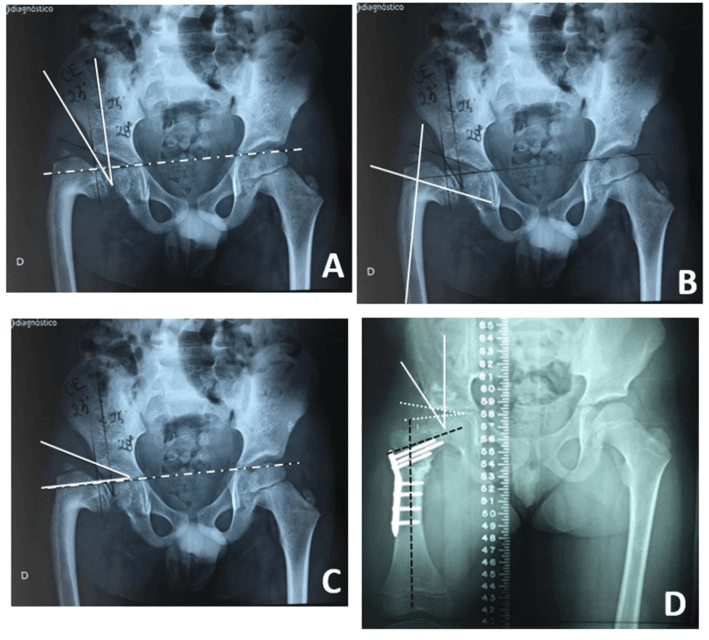
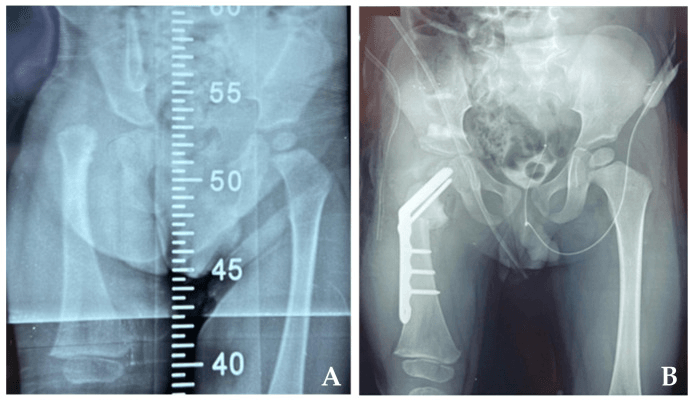
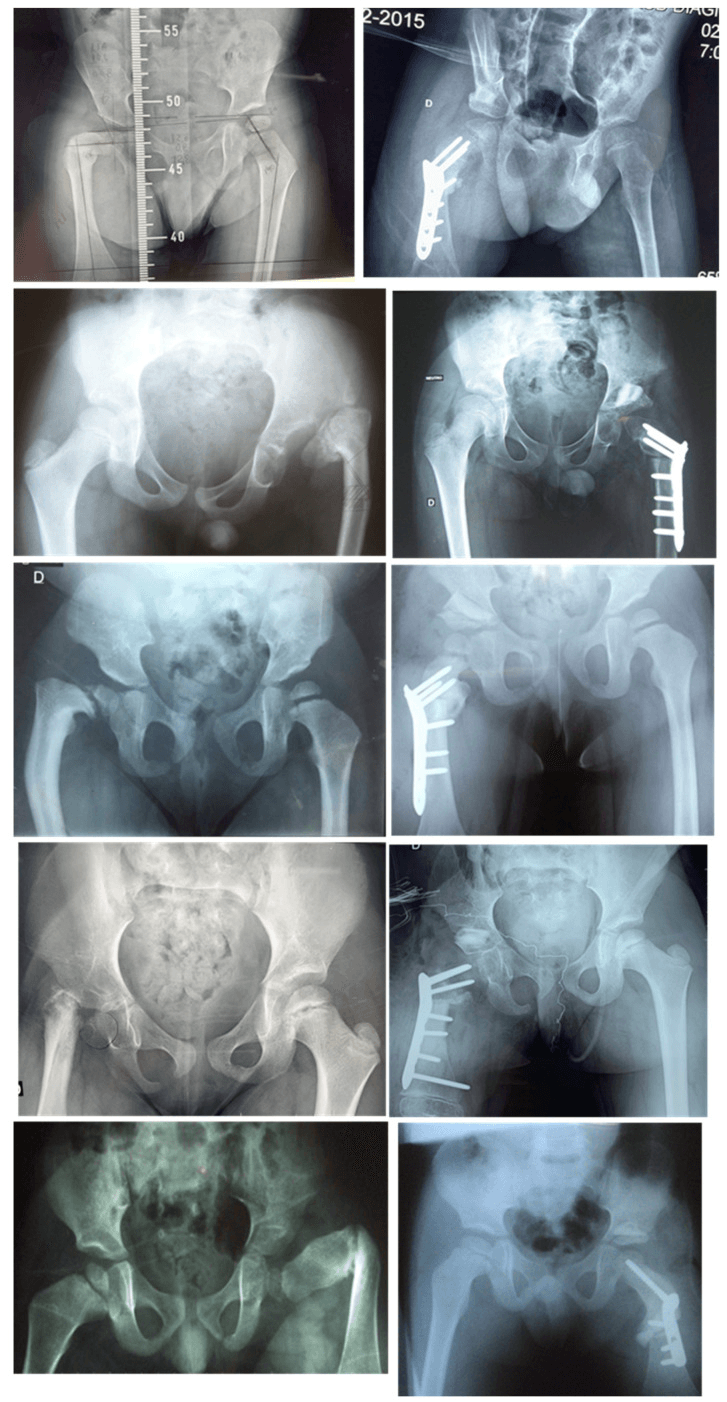
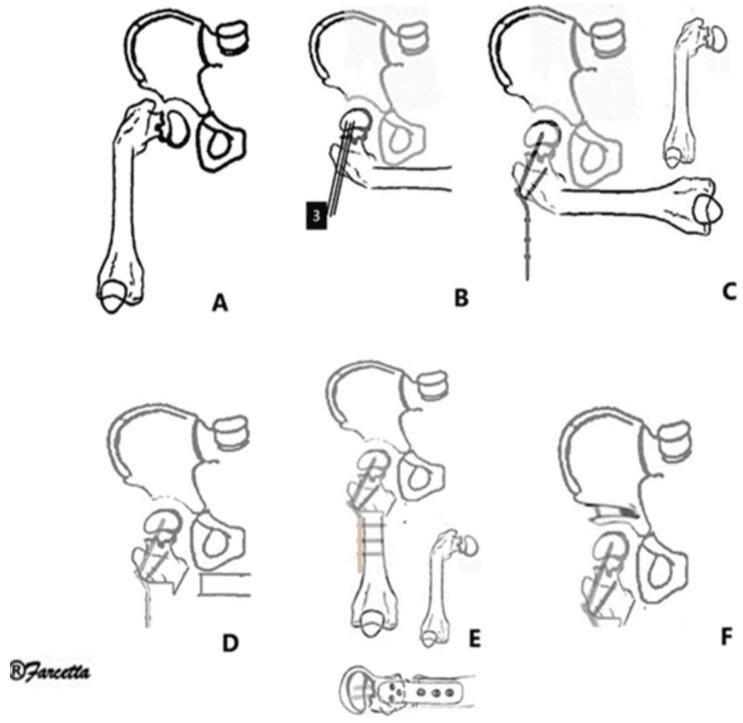
The SUPERhip Procedure: Reconstructing the Deficient Proximal Femur
The SUPERhip is one technically demanding reconstructive strategy for selected Paley Type 1b hips with a mobile femoral head, coxa vara/retroversion, delayed proximal ossification and extra-articular contractures. It may prepare a stable hip for later lengthening, but it does not guarantee it, and it is not required for every reconstructable CFD hip.
Core elements are selected from the demonstrated deformity:
- Release flexion-abduction-external-rotation contractures while protecting neurovascular structures and preserving muscle function
- Correct proximal-femoral varus and rotation with stable fixation suited to bone size and ossification
- Restore abductor mechanics, and address acetabular deficiency only when clinically or radiographically indicated
- Confirm containment and preserve a hip able to tolerate the intended future pathway
Risks. Recurrent coxa vara, persistent delayed neck ossification, stiffness, hardware problems and revision are material risks. Candidacy, fixation, acetabular work and biologics are individual decisions.
Fixation and BMP-2. Retrospective developer-centre data associate fixed-angle fixation and BMP-2 use with improved radiographic ossification and maintenance, but the technique evolved alongside experience. Off-label biologic use requires jurisdiction-specific governance and cannot be presented as mandatory.
The Equinus (Extension) Prosthesis: the Non-Operative Pathway
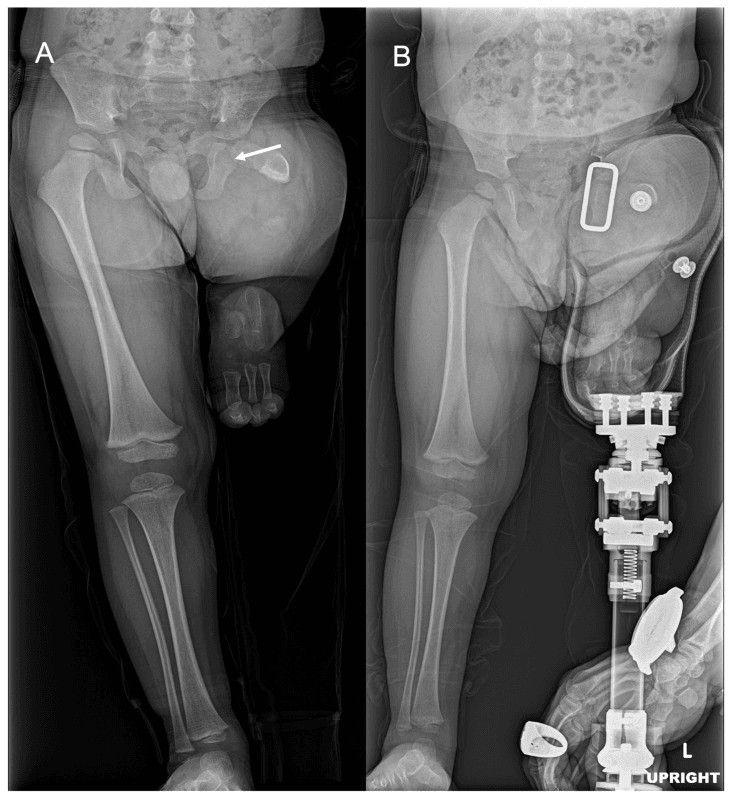
An extension or equinus prosthesis is a limb-preserving option: the intact shortened limb and foot fit within a custom socket that restores length and provides a prosthetic knee and foot arrangement. Socket design and foot position are individual, and maximal fixed equinus is not a universal requirement.
Advantages and trade-offs. It is reversible and avoids irreversible bony conversion at that stage. The trade-offs are bulk, limb-length asymmetry while sitting, skin pressure, joint posture and contracture, frequent refitting with growth, and dependence on specialist prosthetic services.
Suitability. Discuss it alongside reconstruction, rotationplasty and ablative prosthetic pathways. Fit, skin, joint position, function, appearance and service access determine suitability.
Complications
Complications follow the selected pathway and the child's baseline anatomy.
- Key risks
- Instability, recurrent varus, delayed ossification, nonunion, hardware or neurovascular injury
- What to monitor
- Containment, angles, ossification, motion and pain
- Response
- Protect, revise fixation/osteotomy or change pathway according to failure
- Key risks
- Joint contracture/subluxation, poor or premature regenerate, axis drift, pin/device infection, nerve symptoms and fracture
- What to monitor
- Hip/knee/ankle motion, regenerate, alignment and neurovascular status
- Response
- Modify distraction/therapy, treat infection or revise construct/goal
- Key risks
- Wound/neurovascular injury, nonunion, malrotation/derotation and socket difficulty
- What to monitor
- Rotation, union, ankle/foot health and prosthetic fit
- Response
- Cause-specific revision and prosthetic adaptation
- Key risks
- Skin pressure, contracture, overgrowth/neuroma, fit and access problems
- What to monitor
- Skin, joint posture, growth and function
- Response
- Refit, therapy, skin treatment or pathway review
Prevention means realistic target selection, protection of hip, knee and ankle motion, neurovascular surveillance, early response to pain or loss of function and coordinated rehabilitation, not simply more aggressive therapy.
Postoperative Care
Aftercare is specific to the construct and the pathway:
- Immediate: analgesia, wound, skin and neurovascular monitoring, safe positioning, thrombosis and infection measures where indicated, and family education
- Reconstruction: protect fixation according to bone quality and osteotomy and hip stability; restore motion without jeopardising containment
- Lengthening: review the distraction prescription, regenerate, axis, pin or device sites, pain, nerve function and hip, knee and ankle motion frequently enough to act before fixed contracture or subluxation
- Rotationplasty or ablative surgery: protect union and soft tissues, preserve ankle and foot or residual-limb health, and begin prosthetic planning with the rehabilitation team
- Extension prosthesis: monitor skin, joint posture, socket fit and growth-related refitting
Long-term review tracks growth, discrepancy, alignment, joint stability, muscle power, prosthetic fit, participation and the child's evolving preferences. Calendar intervals follow the rate of change and the treatment window rather than a universal annual schedule.
Outcomes and Prognosis
Outcome evidence is dominated by single-centre retrospective series, developer cohorts and a small gait-laboratory comparison. Radiographic correction is not the same as mature function.
- Reconstruction and lengthening: can create a stable aligned limb in selected anatomy, but may require staged surgery and exposes the hip, knee, regenerate and hardware to repeated risk
- Rotationplasty: can support durable prosthetic ambulation in selected patients; derotation, revision, appearance and lifelong prosthetic care remain relevant
- Ablative prosthetic pathway: may reduce reconstruction burden but is irreversible, and introduces residual-limb, overgrowth or neuroma, socket and prosthetic-knee issues
- Extension prosthesis: preserves anatomy and defers irreversible conversion, but requires ongoing fit, skin and joint-posture management
Measure participation, pain, joint health, operation count, psychosocial outcomes and the child's own priorities, not only limb length or radiographic angles.
Guidelines, Registries & Global Practice
There is no global PFFD guideline and no registry comparing complete lifetime pathways. Evidence comes from single-centre reconstruction series, prosthetic cohorts and small gait studies.
- Evidence-aware principle
- Use Aitken for morphology and Paley/functional assessment for reconstruction detail
- Resource adaptation
- Ultrasound can supplement radiographs when MRI is limited
- Evidence-aware principle
- Update a maturity range with serial growth and interventions
- Resource adaptation
- Clinical block testing plus calibrated films remains useful
- Evidence-aware principle
- Compare reconstruction, extension prosthesis, rotationplasty and ablative prosthetic care
- Resource adaptation
- Prosthetic availability and follow-up capacity materially change feasibility
- Evidence-aware principle
- Match to age, physis, canal, deformity and expertise
- Resource adaptation
- External fixation remains versatile where internal systems are unsuitable
Multidisciplinary care includes paediatric limb reconstruction, rehabilitation, prosthetics/orthotics, psychology/social support and—when appropriate—genetics and vascular/plastic expertise. Consent must cover uncertainty, repeated operations/refitting and the possibility that the preferred pathway changes with growth.
Related pages: Fibular Hemimelia, Tibial Hemimelia, Coxa Vara, Rotationplasty, Limb Lengthening Principles, and Prosthetic Limb Components.
Controversies & Areas of Uncertainty
PFFD management is one of the more genuinely contested areas in paediatric limb reconstruction. Examiners reward candidates who can hold the uncertainty rather than reciting dogma.
-
Rotationplasty versus amputation. The long-held belief that rotationplasty is functionally superior has been challenged. The JBJS 2021 gait-analysis comparison found no advantage in oxygen cost, gait deviation index or patient-reported outcomes over Syme amputation with a prosthetic knee, despite more operations. The counterpoint is that rotationplasty preserves an active joint with good long-term acceptance (Kowalczyk 2018) and durable, energy-efficient gait at very long follow-up in rotationplasty cohorts overall (Krebbekx 2026). The honest position: individualised, family-centred decision-making.
-
Reconstruction/lengthening versus prosthetic management. With modern hip reconstruction and serial lengthening (SUPERhip-type strategies, motorized implants), some severe deficiencies once destined for amputation are now reconstructed. Critics note the burden of multiple operations, complications and uncertain long-term durability. There is no level-1 evidence comparing a full reconstructive pathway against early prosthetic conversion.
-
Classification: Aitken versus Paley. Aitken is descriptive and widely known but does not directly guide reconstruction feasibility. The Paley classification is function- and reconstruction-oriented and increasingly used in lengthening centres. Candidates should know both and why the field is shifting.
-
Implant choice in the young child. Intramedullary lengthening nails carry a femoral-head AVN risk in skeletally immature children, so external fixation or motorized expandable plates are used instead - but the plate evidence is early (small case series; Georgiadis 2022).
-
Terminology. "Fibular hemimelia" is increasingly regarded as inaccurate; some authors prefer "postaxial/fibular longitudinal deficiency" and group PFFD with associated fibular and midline metatarsal deficiencies as a single dysvascular spectrum.
MCQ Practice Points
Q: Which Aitken type has a femoral head without osseous neck continuity? A: Type B. MRI may demonstrate cartilaginous continuity that radiographs cannot show. The class describes anatomy; it does not prescribe reconstruction.
Q: What factors support rotationplasty consideration? A: A functional ankle/foot, suitable residual and neurovascular anatomy, achievable rotation/stability, prosthetic and rehabilitation access, and informed child/family acceptance. Aitken class or discrepancy alone is insufficient.
Q: What must be assessed beyond the femur? A: Hip cartilage/containment, knee/cruciates, fibula, ankle, foot rays/coalitions, rotation, muscle power and neurovascular anatomy. Combined postaxial deficiency can change every pathway.
Q: What finding should make distraction slow or stop? A: Loss of hip/knee/ankle motion, joint subluxation, neurologic symptoms, unacceptable pain, poor regenerate or axis drift. Tissue and function determine the rate and target.
Exam Viva Scenarios
Practise clinical reasoning and management decisions out loud
“A toddler has a congenitally short femur with coxa vara and a femoral head visible on radiographs. How do you assess and plan?”
“A child has severe proximal femoral deficiency, a functional ankle and a large projected discrepancy. How do you counsel about prosthetic pathways?”
“During femoral distraction, a child develops progressive knee-flexion contracture. What do you do?”
Classification
- Aitken describes femoral-head and acetabular morphology
- Paley adds ossification, stability and reconstructive anatomy
- MRI/ultrasound may reveal unossified head or neck
- Neither classification is a treatment algorithm
Whole-Limb Assessment
- Hip containment and proximal-femoral continuity
- Femoral length, rotation and mechanical alignment
- Knee/cruciates, fibula, ankle and foot rays
- Muscle power and neurovascular anatomy
Pathways
- Extension prosthesis preserves the limb and is reversible
- Selected reconstruction may precede staged lengthening
- Rotationplasty creates an active prosthetic-knee strategy
- Ablative level is selected for residual-limb and prosthetic function
Decision Inputs
- Serial discrepancy range, not one cut-off
- Joint and foot function
- Procedure burden, appearance and reversibility
- Child/family goals and prosthetic-service access
Lengthening Safety
- Protect hip, knee and ankle motion/stability
- Titrate distraction to regenerate and soft tissues
- Act on nerve symptoms, pain, axis drift or joint subluxation
- Preserve function even if the length target changes
Evidence Base
Aitken Classification of PFFD
- Original description of the four-grade Aitken classification (Types A to D)
- Stratifies severity by presence of the femoral head and the adequacy of the acetabulum
- Type A/B retain a femoral head (reconstructable hip); Type C/D lack a femoral head
- Remains the most widely cited descriptive system for PFFD worldwide
Reconstruction Strategy and Gait/PRO Outcomes (Landmark Comparison)
- 23 unilateral PFFD patients: equinus prosthesis (7), rotationplasty (6), Syme amputation with above-knee prosthesis (10)
- Oxygen cost did not differ between groups; all required greater energy than normal (rotationplasty 144%, Syme 159%, equinus 170%)
- No difference in PODCI pain, sport/physical function, happiness, or global function across groups
- Rotationplasty patients had undergone more procedures (mean 3.3 vs 1.8 Syme vs 0.7 equinus, p=0.001)
Rotationplasty: Long-Term Function and Patient Acceptance
- 8 adolescents with unilateral PFFD treated by rotationplasty; mean follow-up 9.25 years
- All patients were pain-free and able to ambulate outdoors at follow-up
- Foot derotation occurred in 5 of 8, requiring re-rotation osteotomy in 2 (recurrence is a recognised pitfall)
- All patients accepted their appearance and considered the procedure beneficial to function
Proximal Femoral Reconstruction (Paley Type 1b)
- 26 patients with Paley type 1b congenital femoral deficiency, mean age 7 years
- Neck-shaft angle improved from 72.3 to 133.1 degrees; acetabular index improved from 27.8 to 16.4 degrees
- Significant radiographic correction of coxa vara and acetabular dysplasia before lengthening
- Complication rate 15.4%, predominantly in children under 5 years
SUPERhip Procedure for Paley Type 1b CFD
- 72 SUPERhip procedures for Paley type 1b congenital femoral deficiency (1997-2012); 34 revisions performed, 106 procedures analysed
- SUPERhip = Systematic Utilitarian Procedure for Extremity Reconstruction of the hip, developed 1997 to correct proximal-femoral pathoanatomy before lengthening
- Very high risk of recurrent coxa vara and persistent delayed ossification of the femoral neck
- Fixed-angle internal fixation reduced recurrent varus; adding BMP-2 to the un-ossified neck reduced persistent delayed ossification
Multiplier Method for Limb-Length Prediction
- Congenital LLD increases proportionally with growth, so a single measurement times an age/sex multiplier predicts maturity discrepancy
- Validated against limb-lengthening and epiphysiodesis cohorts; comparable or superior to the Moseley straight-line graph
- Multipliers independent of height, race, ethnicity, generation and socioeconomic class
- Requires as few as one or two measurements (no serial scanograms or graph plotting)
Lengthening Nails versus External Fixation in Young Patients
- Systematic review of femoral lengthening comparing motorized intramedullary nails with external fixation (91 femora across 2 comparative studies)
- Both devices reliably achieved target length
- Adverse-event prevalence lower with nails (60-73%) than external fixation (81-100%)
- Nails were used in older patients (15-21 years) than external fixation (9-15 years); no PROs reported
Motorized Plate Lengthening in Young Children
- 7 skeletally immature children (ages 2.7 to 9.7 years) with congenital femoral deficiency
- Mean lengthening 4.1 cm (18% of segment); weight-bearing at mean 13 weeks
- Avoids the femoral-head AVN risk of intramedullary nails in young children
- Complication rate comparable to other femoral lengthening methods (patellar instability, transient hip subluxation, mild regenerate varus)