Failed Fusion | Nonunion After Arthrodesis | Symptomatic vs Asymptomatic
- Pseudarthrosis = failure to achieve solid bony fusion by 1 year post-surgery
- Smoking is the single biggest modifiable risk factor (~2x nonunion risk; 26.5% vs 14.2% in Glassman 2000)
- CT scan is the best imaging test - look for bridging trabecular bone - but surgeons over-read fusion on it (specificity 28-85%, kappa 0.25); surgical exploration remains the reference standard
- Symptomatic pseudarthrosis causes persistent axial pain at fusion level
- Revision includes debridement, fresh autograft, rigid fixation, interbody support
- “Single-level posterolateral fusion: 5-10% pseudarthrosis rate
- “Multi-level fusion plus smoking compounds nonunion risk
- “Not all radiographic pseudarthrosis is symptomatic
- “Hardware breakage suggests pseudarthrosis with instability
- “BMP can augment fusion but smoking still impairs outcomes
Overview and Epidemiology
Definition. Spinal pseudarthrosis, or spinal nonunion, is failure to achieve solid bony fusion after an intended arthrodesis. It is defined as the absence of bridging trabecular bone across the intended fusion site by 1 year after surgery. Fibrous tissue or fibrocartilage fills the gap instead, and this fibrous union lacks the mechanical strength of bony fusion.
The word and its history. From the Greek pseudo (false) and arthrosis (joint). Early spinal fusion techniques had high nonunion rates. Recognition of the risk factors, smoking above all, and better techniques (instrumentation, interbody cages, BMP) have reduced pseudarthrosis but not eliminated it.
How often. It is a recognised complication of spinal fusion, and the incidence varies significantly with the construct:
- Single-level posterolateral fusion (PLF) - 5-10%
- Multi-level PLF - 15-25%
- Interbody fusion (PLIF/TLIF/ALIF) - 3-8%
- Combined anterior-posterior fusion - 2-5%, lower than PLF alone
The effects of the number of levels, the technique, instrumentation and smoking are set out under Risk Factors.
Why symptoms decide. Pseudarthrosis may be symptomatic or asymptomatic, and not all of it requires treatment. Symptomatic pseudarthrosis causes persistent or recurrent axial back pain at the fusion site and typically requires revision. An asymptomatic nonunion discovered incidentally on imaging in a pain-free patient can be observed; the key distinction is clinical correlation.
Risk Factors
Smoking. The single most important modifiable risk factor. Smoking roughly doubles the risk of pseudarthrosis (meta-analysis RR 2.2), and with multi-level fusion the risk factors compound, with reported nonunion rates well above single-level baselines. Glassman's nonunion figures, and what they show about when to stop, are set out under Prevention.
- Even second-hand smoke exposure increases risk
- Nicotine patches and replacement therapy also impair fusion, because nicotine is the problem
- Risk reduction requires complete abstinence, not just cutting down
- Even with revision, smoking impairs outcomes
Diabetes mellitus. Diabetes impairs bone healing through several mechanisms. Microangiopathy reduces the blood supply to the fusion bed, advanced glycation end-products (AGEs) impair bone quality, and the increased infection risk compromises healing further.
Obesity. A BMI over 30 is associated with increased pseudarthrosis, through greater mechanical stress on the fusion construct and the metabolic syndrome (insulin resistance, inflammation). Greater soft-tissue dissection increases the infection risk, and operative times are longer.
Nutrition. Vitamin D deficiency impairs calcium absorption and bone formation, protein malnutrition leaves insufficient substrate for collagen synthesis, and calcium deficiency leaves inadequate mineral for bone matrix. Preoperative nutritional optimisation is recommended.
Age and bone density. Older age is associated with higher nonunion: osteoblast activity and bone-healing capacity fall, medical comorbidities accumulate, and osteoporosis is common. Low bone density gives poor-quality bone for graft incorporation, and hardware loosening is more common.
Pathophysiology of Nonunion
What fusion needs. Successful spinal fusion requires five things:
- Osteoconduction - a scaffold for bone growth, provided by the graft
- Osteoinduction - signals for bone formation (BMPs, growth factors)
- Osteogenesis - viable cells that form bone (osteoblasts from graft or host)
- Mechanical stability - immobilisation allows bone formation
- Vascular supply - blood flow delivers nutrients and cells
How a fusion fails. When fusion fails, the process follows a sequence:
- Weeks 0-6 - the graft is placed. If stability is inadequate or the biology impaired, granulation tissue forms instead of organised bone.
- Weeks 6-12 - fibrous tissue fills the fusion gap. Without rigid fixation, micromotion prevents bone formation.
- Months 3-6 - fibrocartilage may develop at areas of compression, and sclerotic bone forms at the graft-host interface without bridging.
- Months 6-12 - an established fibrous nonunion. If hardware is present, cyclic loading may cause fatigue failure and breakage.
Why smoking impairs fusion. Nicotine acts on bone healing in five ways:
- Direct osteoblast toxicity - inhibits alkaline phosphatase and collagen synthesis
- Vasoconstriction - reduces blood flow to the fusion bed, leaving it hypoxic
- Fewer growth factors - decreased local BMP-2 and TGF-beta
- Immune dysfunction - impaired macrophage and fibroblast function
- More fibrous tissue - promotes fibrous nonunion over bone
Biomechanics. Excessive motion at the fusion site prevents bone formation. Posterolateral fusion alone relies on a tension-band effect and allows more motion. Interbody fusion gives anterior column support and compressive loading and is more stable, and combined 360-degree fusion is the most stable of all, with the lowest pseudarthrosis risk. Multi-level fusion adds greater lever arms and increased stress at each segment.
Clinical Presentation
The pain. Symptomatic pseudarthrosis typically presents with persistent axial back pain localised to the fusion level, worsened by activity, standing and walking and improved with rest and lying down. It may be constant or intermittent. Its course follows one of three patterns:
- Never improved - pain present from surgery that never resolved
- Recurrent - initial improvement (3-6 months), then the pain returns
- Progressive - gradual worsening over months
Leg symptoms point elsewhere. Pseudarthrosis itself causes axial pain, not radiculopathy. If radicular symptoms are present, consider adjacent segment disease or hardware-related nerve compression. Hardware breakage may cause a sudden increase in pain.
Examination. Observe posture and gait, and assess spinal alignment for scoliosis or kyphosis. Palpate for tenderness over the fusion site and for prominent hardware. Painful motion at the fusion level suggests pseudarthrosis: the patient may report a sense of "motion" or "giving way", and flexion-extension may reproduce the pain.
Neurology. Typically normal in isolated pseudarthrosis. Document motor, sensory and reflex findings to establish a baseline, and if there are deficits, consider alternative diagnoses.
Axial pain persisting more than 6-12 months after fusion, especially initial improvement followed by recurrence, should raise suspicion for pseudarthrosis.
Differential diagnosis. The other causes of persistent pain after fusion are compared below. Two more belong on the list: facet arthropathy at unfused levels, and psychosocial factors (depression, secondary gain, disability). Residual stenosis may reflect inadequate decompression.
- Typical pain pattern
- Axial pain at fusion level, activity-related; classically improved then recurred
- Key discriminator
- Hardware breakage / motion at the fused segment
- Best test
- Thin-cut CT (correlate with dynamic films)
- Typical pain pattern
- Axial +/- radicular pain at level above or below fusion
- Key discriminator
- New degeneration/stenosis at adjacent, not fused, level
- Best test
- MRI / standing radiographs
- Typical pain pattern
- Constant rest pain, systemic features
- Key discriminator
- Fever, wound issues, raised CRP/ESR
- Best test
- CRP/ESR, MRI, image-guided biopsy/cultures
- Typical pain pattern
- Focal pain over implants, posture-related
- Key discriminator
- Tenderness directly over screws/rods, often thin patient
- Best test
- Radiographs / CT; diagnostic local block
- Typical pain pattern
- Buttock/groin pain below L5, worse rising/sitting
- Key discriminator
- Provocation tests positive; common after lumbosacral fusion
- Best test
- Image-guided SI joint block
- Typical pain pattern
- Neurogenic claudication, radicular leg pain
- Key discriminator
- Walking-limited leg symptoms, not axial
- Best test
- MRI (or CT myelogram if hardware artefact)
Diagnostic Workup
The best test, not the reference standard. CT with thin cuts (1-2 mm slices) and multiplanar reconstructions is the best imaging test for assessing spinal fusion, and it is what you should order. Call it the gold standard only loosely: the actual reference standard is surgical exploration.
How it performs against exploration. The result was sobering. Across five spine surgeons reading 69 levels with metallic interbody cages, interobserver agreement on "fused or not" was kappa 0.25, only fair, with sensitivity 70-97% but specificity just 28-85% (Carreon, PMID 18280214). The error runs in one direction: raters consistently over-read fusion. The sentinel sign was little better (kappa 0.34, overall accuracy 61%; posterior sentinel sign 74%).
What that changes. A CT reported as "fused" in a patient with persistent, positional, load-related pain and no other explanation does not exclude pseudarthrosis, because the test's weakness is precisely its tendency to call a nonunion solid. Weigh the clinical picture and hardware behaviour (screw haloing, rod fracture) alongside the scan, and be more sceptical of a fused report around metallic cages than around a posterolateral graft mass.
Corroborating an equivocal scan. Correlate it with dynamic flexion-extension films, where motion means nonunion, and with hardware integrity: a broken rod or screw means nonunion regardless of the CT read.
Technique. Thin-cut axial images through the fusion levels, sagittal and coronal reconstructions, and bone windows for optimal visualisation.
Signs of solid fusion. Continuous bridging trabecular bone through the graft on all planes, graft incorporation (remodelling and trabecular integration with host bone), and no radiolucent line at the graft-host interface.
Signs of pseudarthrosis. On CT, look for:
- Lucency at the graft-host junction - a radiolucent line indicates fibrous tissue
- Discontinuous bone - a gap in the expected bone bridge
- Sclerotic margins - dense bone at the edges without bridging suggests nonunion
- Resorption - graft material absorbed without new bone formation
- Hardware loosening - lucency around the screws (halo sign)
- Hardware breakage - rod or screw fracture indicates motion and nonunion
For posterolateral fusion, assess both sides. Unilateral bridging may be insufficient. Need continuous bone bridge bilaterally for solid fusion.
- Sensitivity
- 80-90%
- Specificity
- 90-95%
- Advantages
- Gold standard, visualizes bone detail
- Disadvantages
- Radiation, cost
- Sensitivity
- 50-60%
- Specificity
- 70-80%
- Advantages
- Low cost, widely available
- Disadvantages
- Overlapping structures, less sensitive
- Sensitivity
- 85-95%
- Specificity
- 85-90%
- Advantages
- Shows metabolic activity
- Disadvantages
- High radiation, cost, availability
- Sensitivity
- Variable
- Specificity
- Variable
- Advantages
- Soft tissue detail, no radiation
- Disadvantages
- Metal artifact, not for fusion assessment
- Bridwell interbody fusion grades (for PLIF/TLIF/ALIF): I = fused, remodelled with trabeculae crossing the disc space; II = graft intact, not fully remodelled, no lucency; III = graft intact but with a lucent line above or below; IV = graft resorbed/collapsed (clear pseudarthrosis). Grades III-IV are nonunion.
- Lenke posterolateral fusion grades (for PLF on the AP film): A = bilateral solid trabeculated fusion masses; B = unilateral solid mass with a contralateral thin mass; C = thin masses bilaterally; D = bilateral resorption/pseudarthrosis. Because PLF needs a bilateral bridge, neither B nor C is a solid fusion.
Management Algorithm
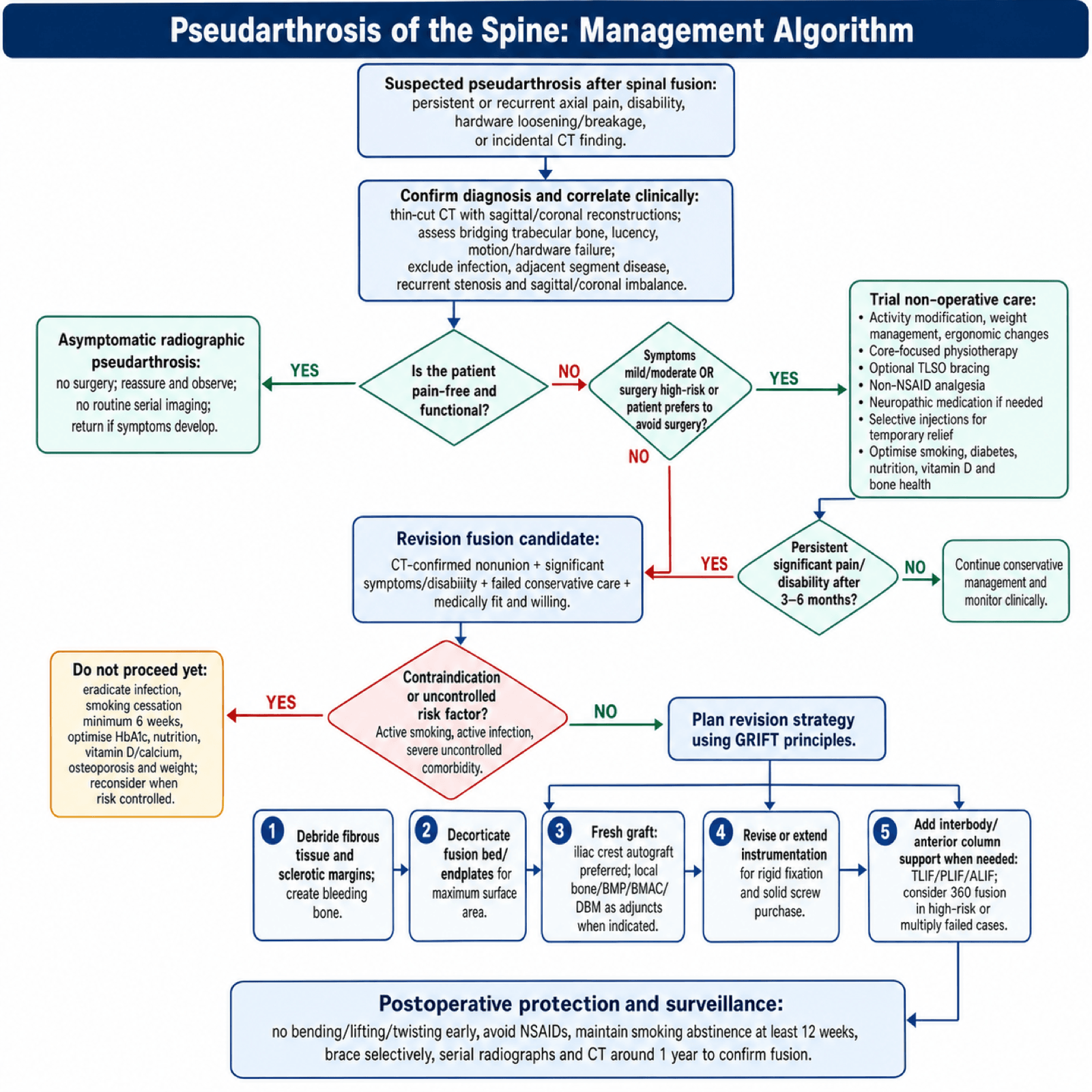
A patient with CT-confirmed pseudarthrosis who is completely pain-free and functional does not need revision surgery. Avoid overtreatment.
What to do. No surgery is indicated. Observe clinically, educate the patient about the diagnosis and reassure them that no treatment is needed. Serial imaging is not necessary while the patient is asymptomatic; they return if symptoms develop.
Why. Surgery should be for symptoms, not for a radiographic finding. Revision has risks (infection, neurological injury, dural tear), and in a pain-free patient the fibrous union may provide adequate stability.
Complications
Of the pseudarthrosis itself. Four complications arise from the nonunion:
- Persistent pain - chronic axial back pain at the fusion level, with impaired quality of life and function, disability and inability to work, and psychological impact (depression, anxiety)
- Hardware failure - rod fracture from metal fatigue under cyclic loading, screw loosening and breakage, and screw pullout with loss of fixation; it requires revision surgery with hardware removal
- Progressive deformity - progression of kyphosis or scoliosis, loss of sagittal balance, adjacent segment degeneration and neurological compromise
- Instability - motion at the intended fusion site, mechanical back pain and a risk of neurological injury
Of revision surgery, in theatre. The intraoperative risks:
- Dural tear - CSF leak requiring repair, with a risk of headache, infection and meningitis
- Nerve root injury (2-5%) - scarring obscures the anatomy and roots are manipulated during hardware removal; it may cause radiculopathy or motor deficit
- Vascular injury (rare, under 1%) - the great vessels in the anterior approach, segmental vessels during pedicle screw placement; it can be catastrophic
- Excessive blood loss - revision surgery is more vascular because of scarring and may require transfusion; cell saver use is recommended
The risk of dural tear is 2-3 times higher in revision surgery (10-15%) compared to primary fusion (3-5%) due to epidural scarring and adhesions. Careful dissection and liberal use of magnification recommended.
Of revision surgery, afterwards. Persistent pseudarthrosis is covered under Management; the others are:
- Infection (5-10%, higher than primary) - superficial wound infection, deep infection requiring irrigation and debridement, possible hardware removal, and chronic infection with biofilm
- Adjacent segment disease (10-15% at 5 years) - degeneration of the level above or below, which may require extension of the fusion
- Hardware complications - malposition requiring revision, prominence causing pain, loosening or breakage
- Medical complications - deep vein thrombosis and pulmonary embolism, pneumonia, urinary tract infection, and cardiovascular events in the elderly
Long-term. Pain persists in 20-30% despite a solid fusion. It may come from adjacent segments or other sources, and it requires multidisciplinary pain management. The other long-term costs are functional (reduced mobility and activity tolerance, inability to return to work, disability claims) and psychological (depression from chronic pain, anxiety about future surgeries, an impact on quality of life).
Prevention Strategies
Smoking cessation. Verify abstinence with urine cotinine (a nicotine metabolite), and provide smoking cessation resources and support. The timing is the part usually taught backwards.
Cessation matters enormously, but the postoperative period is the part Glassman actually showed to work. In his 357-patient series the nonunion rate was 14.2% in non-smokers and 26.5% in those who kept smoking after surgery, falling to 17.1% in those who stopped for more than six months postoperatively - close to the non-smoker rate. Return to work followed the same pattern (71% non-smokers, 53% continuing smokers, 75% postoperative quitters). Critically, he found the nonunion rate was NOT significantly affected by how much the patient had smoked before surgery, nor by how long they had abstained preoperatively.
So counsel accordingly. A patient who stops for six weeks before the operation and lights up in the car park on discharge has, on this evidence, bought very little fusion benefit. The commonly quoted "6 weeks before, 12 weeks after" is a pragmatic convention - preoperative cessation is well justified for anaesthetic risk and wound healing - but for fusion specifically the target is prolonged abstinence after surgery, ideally permanent. Meta-analysis confirms smokers carry roughly twice the nonunion risk overall.
Diabetes. Optimise HbA1c to less than 7% before elective fusion, with tighter perioperative glucose control (less than 180 mg/dL).
Nutrition. Correct vitamin D deficiency (target 25-OH vitamin D over 30 ng/mL), ensure adequate protein intake (1-1.5 g/kg/day), and supplement calcium if deficient.
Bone density. Obtain a DEXA scan if risk factors are present. Consider bone anabolic therapy with teriparatide in severe osteoporosis and in high-risk cases. Bisphosphonate timing can be optimised, although whether bisphosphonates affect fusion is controversial.
Weight. Weight loss is advised if the BMI is over 35 before elective fusion, with bariatric surgery a consideration in morbid obesity.
In theatre. Avoid the technique errors listed under Risk Factors, and build the fusion deliberately:
- Fusion bed - thorough decortication, removing cartilage down to bleeding cancellous bone until there is punctate bleeding (the paprika sign), for a larger fusion surface
- Graft - autograft preferred, in sufficient volume, with cautery near the graft minimised because heat kills osteoblasts; consider BMP augmentation in high-risk cases
- Fixation - pedicle screw instrumentation for stability, compression across the fusion site (interbody cages), and an appropriate rod diameter and material
- Interbody support - consider PLIF, TLIF or ALIF in high-risk cases for anterior column support
Biologics. rhBMP-2 is osteoinductive and improves fusion rates. It is expensive, has side effects, and is controversial in the anterior cervical spine because of the swelling risk, but it is effective in high-risk lumbar fusions. Bone marrow aspirate augments fusion when combined with a scaffold, and its concentrate (BMAC) is used as an adjunct.
After surgery. The postoperative measures:
- Activity - no bending, lifting or twisting (BLT) for 12 weeks, then a gradual return to activity after 3 months; compliance is critical in the first 3 months, while the fusion consolidates
- Bracing (controversial) - some surgeons use a TLSO for 3 months; the evidence is mixed on whether it improves fusion, though it may improve compliance with restrictions
- Analgesia - many surgeons avoid NSAIDs for 3-6 months after fusion, using paracetamol and opioids instead; the evidence behind that convention is under Risk Factors
- Smoking - continued abstinence, as above
- Monitoring - serial plain radiographs at 6 weeks, 3 months, 6 months and 1 year, and a CT scan at 1 year to confirm fusion
- What it is: teriparatide (recombinant PTH 1-34) is an anabolic agent that, given intermittently (daily subcutaneous), stimulates osteoblasts and net bone formation - unlike the antiresorptive bisphosphonates.
- Why it helps fusion: it improves bone quality and accelerates graft incorporation. In postmenopausal/osteoporotic patients it has been shown to raise spinal fusion rates and speed union (and to improve pedicle-screw purchase/reduce loosening), making it the rational adjunct precisely in the low-bone-density population at high pseudarthrosis risk.
- How it differs from BMP: BMP (rhBMP-2) is a local osteoinductive implant placed at the fusion bed; teriparatide is a systemic anabolic agent given perioperatively for weeks to months. They target different parts of the fusion biology and are not interchangeable.
- Caveats: it does not overcome ongoing smoking; historical osteosarcoma signal in rodents prompted duration limits (now relaxed) and it is avoided in patients with prior skeletal radiation, bone metastases or Paget disease.
Guidelines, Registries & Global Practice
Pseudarthrosis is a complication of an extremely common operation: lumbar fusion volumes have risen markedly across high-income healthcare systems over the last two decades, so even a single-digit percentage nonunion rate generates a large absolute burden of symptomatic patients and revision surgery. The evidence base is dominated by North American and European cohorts, randomised trials and systematic reviews rather than by dedicated spinal-fusion registries, which remain less mature than the arthroplasty registries.
Global Epidemiology and Evidence Base
- High-level evidence (40-study meta-analysis, 7516 procedures) shows smokers carry roughly 2.2x the nonunion risk across fracture, fusion and arthrodesis (Pearson 2016, BMJ Open).
- Reported nonunion rates vary widely by technique: posterolateral fusion alone has the highest rate, falling progressively with instrumentation, interbody support and circumferential (360-degree) fusion.
- Instrumentation roughly doubled radiographic fusion (82% vs 45%) in a landmark RCT, although short-term clinical outcome was similar (Fischgrund 1997, Spine).
- Symptomatic nonunion matters at long-term follow-up: excellent/good outcomes 86% with solid fusion vs 56% with pseudarthrosis at mean 7.7 years (Kornblum 2004, Spine).
Guideline and Society Guidance (Side-by-Side)
- Position relevant to pseudarthrosis
- Evidence-based guidelines on fusion for degenerative conditions; smoking cessation and risk-factor optimisation emphasised before fusion
- Evidence basis
- Systematic-review-derived recommendations
- Position relevant to pseudarthrosis
- Education and classification frameworks; promotes interbody/circumferential support and rigid fixation to reduce nonunion in high-risk constructs
- Evidence basis
- Expert consensus + cohort data
- Position relevant to pseudarthrosis
- Cautious stance on lumbar fusion for non-specific low back pain; restricts elective fusion, indirectly limiting fusion-related pseudarthrosis burden
- Evidence basis
- HTA / guideline appraisal
- Position relevant to pseudarthrosis
- rhBMP-2 approved for stand-alone ALIF with specific cages; off-label posterolateral/cervical use carries recognised adverse-effect warnings
- Evidence basis
- IDE trials (Burkus) + post-marketing safety
Registry and Adjunct Evidence
National spine-fusion registries are less established than joint-replacement registries; the strongest pooled data are from systematic reviews. Postoperative electrical stimulation increased the odds of fusion 2.5-fold across 7 RCTs (Akhter 2020, Sci Rep), and the NSAID effect on fusion is dose-dependent — high-dose ketorolac raised nonunion (RR 2.87) while short-course normal-dose NSAIDs did not (Li 2011, Spine).
Practice Variation
Spinal fusion is performed worldwide for degenerative disease, deformity and trauma, with thin-cut CT the standard modality for assessing fusion at major centres. Across high-income settings, many units operate mandatory preoperative smoking-cessation pathways (abstinence for a minimum of 6 weeks before elective fusion, sometimes verified with urine cotinine) alongside HbA1c optimisation (commonly targeting less than 7%) before elective surgery. Recombinant human BMP-2 is regulator-approved for stand-alone ALIF, but reimbursement and access vary internationally, so in practice its use is largely confined to high-risk and revision cases; iliac crest autograft remains the biological gold standard, typically harvested posteriorly to limit donor-site morbidity. Practice variation internationally is driven mainly by indication thresholds (notably the restrictive NICE position on fusion for non-specific back pain), choice of interbody versus posterolateral technique, and access to biologics, rather than by differing definitions of nonunion.
MCQ Practice Points
Q: What is the gold standard imaging modality for diagnosing spinal pseudarthrosis?
A: CT scan with thin cuts (1-2mm) and multiplanar reconstructions. Look for continuous bridging trabecular bone (fusion) or lucency at graft-host interface (pseudarthrosis). CT has 80-90% sensitivity and 90-95% specificity, superior to plain radiographs (50-60% sensitivity).
Q: What is the single most important modifiable risk factor for spinal pseudarthrosis?
A: Smoking. Smokers carry roughly twice the nonunion risk (meta-analysis RR 2.2; Glassman 26.5% in continuing smokers vs 14.2% in non-smokers). Nicotine directly inhibits osteoblasts, reduces blood flow, and creates a hypoxic environment. Smoking cessation minimum 6 weeks before surgery is essential.
Q: What is the definition of spinal pseudarthrosis?
A: Failure to achieve solid bony fusion by 1 year post-surgery. Fibrous or fibrocartilaginous tissue instead of bridging bone at the intended fusion site. May be symptomatic (persistent axial pain) or asymptomatic (incidental finding).
Q: A patient has rod fracture on 1-year follow-up X-ray after spinal fusion. What does this indicate?
A: Hardware breakage is highly specific for pseudarthrosis. Cyclic loading and motion at the fusion site causes metal fatigue and fracture. This only occurs with nonunion. CT scan needed to confirm extent of pseudarthrosis and plan revision.
Q: What is the expected fusion rate for revision surgery for pseudarthrosis?
A: 70-80% for first revision if risk factors controlled (especially smoking cessation). Second revision decreases to 50-60%. BMP augmentation improves rates by 10-15%. Continued smoking dramatically reduces success.
Q: How do you manage a patient with CT-confirmed pseudarthrosis who is completely pain-free?
A: Observation only. Asymptomatic pseudarthrosis does not require surgery. Fibrous union may provide adequate stability. Revision surgery risks not justified when patient pain-free. Advise return if symptoms develop. Treat the patient, not the radiograph.
Exam Viva Scenarios
Practise clinical reasoning and management decisions out loud
“A 55-year-old male smoker presents with persistent axial back pain 18 months after L4-L5 posterolateral fusion with pedicle screw instrumentation. He had partial improvement for 6 months but pain has returned. How do you assess and manage?”
“A 62-year-old woman with diabetes presents for routine 1-year follow-up after L3-L5 posterolateral fusion. X-ray shows rod fracture at L4 level. She has mild back pain but is otherwise functional. What does this finding indicate and how do you proceed?”
“A 48-year-old woman had L5-S1 ALIF with posterior instrumentation 2 years ago for degenerative spondylolisthesis. She is completely pain-free and functional. CT scan obtained for unrelated reason shows lucency at graft-host interface suggesting pseudarthrosis. What is your management?”
Definition
- Failure to achieve solid bony fusion by 1 year
- Fibrous tissue instead of bridging bone
- May be symptomatic (pain) or asymptomatic
- Single-level PLF: 5-10%, multi-level: 15-25%
Risk Factors
- Smoking: ~2x nonunion risk; 26.5% vs 14.2% (biggest modifiable factor)
- Multi-level fusion (each level adds risk)
- Obesity (mechanical and metabolic)
- Key nutrients lacking (Vit D, Ca, protein)
- Inadequate graft/technique
- NSAIDs and steroids
- Glucose intolerance (diabetes)
Clinical Presentation
- Persistent axial back pain at fusion level
- Pain worsened by activity, better with rest
- Pattern: never improved OR recurrent after initial improvement
- Painful motion on examination
- No radicular symptoms (unless other pathology)
Diagnosis - CT Gold Standard
- CT: thin cuts with multiplanar reconstructions
- Fusion: continuous bridging trabecular bone
- Pseudarthrosis: lucency at graft-host junction
- Hardware breakage highly specific for nonunion
- SPECT/CT if equivocal
Prevention
- Smoking cessation: 6 weeks preop is convention; more than 6 months POSTOP is what improved fusion (Glassman)
- Optimize diabetes (HbA1c less than 7%)
- Nutritional optimization (Vit D, Ca, protein)
- Adequate decortication (bleeding bone)
- Sufficient graft volume (autograft preferred)
- Rigid fixation with instrumentation
- Consider interbody fusion in high-risk cases
- BMP augmentation in revision/high-risk
Management
- Asymptomatic: observation only (no surgery)
- Symptomatic: trial conservative 3-6 months
- Revision indications: persistent pain + CT confirmed + failed conservative
- Smoking cessation MANDATORY before revision
- Revision success: 70-80% first revision, 50-60% second
Revision Principles (GRIFT)
- Graft: fresh autograft (iliac crest)
- Remove: fibrous tissue, sclerotic bone
- Instrumentation: revise/extend for rigid fixation
- Fix: risk factors (smoking cessation essential)
- Thorough: decorticate to bleeding bone
- Add interbody support (PLIF/TLIF/ALIF)
- Consider BMP augmentation
Key Exam Points
- CT scan is gold standard (80-90% sensitive)
- Smoking roughly doubles nonunion risk
- Hardware breakage = pseudarthrosis
- Asymptomatic pseudarthrosis = observation
- Treat patient not X-ray
- Revision needs smoking cessation
Evidence Base
Glassman et al. Cigarette Smoking and Smoking Cessation on Spinal Fusion
- Retrospective review of 357 instrumented L4-L5/L4-S1 fusions
- Nonunion 14.2% in non-smokers vs 26.5% in patients who continued to smoke postoperatively (P less than 0.05)
- Patients who quit for more than 6 months had a 17.1% nonunion rate (intermediate)
- Return-to-work: 75% in quitters vs 53% in continuing smokers
- Landmark study validating postoperative smoking cessation
Pearson et al. Smoking and Risk of Delayed/Non-union (Systematic Review and Meta-Analysis)
- Meta-analysis of 40 studies (7516 procedures) of fracture, fusion, osteotomy and arthrodesis
- Smokers had 2.2x (95% CI 1.9-2.6) the risk of delayed and/or non-union
- Increased risk was at least 1.6x in every subgroup analysed
- Time to union prolonged by a mean of 27.7 days in smokers
Carreon et al. Fine-Cut CT Accuracy for Interbody Fusion Status
- 49 patients / 69 levels with surgical exploration as reference standard
- Fine-cut CT sensitivity 70-97% but specificity only 28-85% for fusion
- Raters consistently over-read fusion (low specificity)
- Posterior sentinel sign accuracy 74% vs sentinel sign 61%
Burkus et al. Six-Year Outcomes of ALIF with rhBMP-2 and Tapered Cages
- FDA IDE cohort, 277 enrolled; 6-year clinical/radiographic follow-up
- 98% (128/130) fused at 6 years with stand-alone cages plus rhBMP-2
- Worst-case fusion rate 91% (128/141) including reoperations for pseudarthrosis
- Durable improvement in ODI, SF-36 and pain scores to 6 years
Carreon/Glassman et al. AGF (Platelet Gel) Fails to Improve Posterolateral Fusion
- 76 instrumented posterolateral fusions with autograft plus autologous growth factor (AGF) vs matched controls
- Nonunion 25% with AGF vs 17% with autograft alone (P = 0.18, not significant)
- Platelet concentrate did not enhance fusion despite high platelet concentration
- Authors recommend against platelet gel as an autograft supplement
Fischgrund et al. (1997 Volvo Award) Instrumentation and Fusion Rate in Degenerative Spondylolisthesis
- RCT of 76 patients, instrumented vs non-instrumented posterolateral fusion
- Successful arthrodesis 82% instrumented vs 45% non-instrumented (P = 0.0015)
- Pedicle screws substantially raise fusion rate
- Clinical outcome was not significantly different between groups at 2 years
Kornblum et al. Long-Term Influence of Pseudarthrosis on Clinical Outcome
- Prospective RCT cohort, 47 patients with degenerative spondylolisthesis, mean 7.7-year follow-up
- Excellent/good outcome 86% with solid fusion vs 56% with pseudarthrosis (P = 0.01)
- Solid fusion superior for back/leg pain and symptom-severity scores
- Demonstrates that symptomatic nonunion does worsen long-term results
Li et al. Perioperative NSAIDs and Spinal Fusion (Meta-Analysis)
- Meta-analysis of 5 comparative studies (1403 patients)
- High-dose ketorolac increased nonunion risk (RR 2.87, 95% CI 1.53-5.38)
- Normal-dose short-course NSAIDs (less than 14 days) did not increase nonunion (RR 1.39, 95% CI 0.74-2.61)
- Effect on fusion appears dose-dependent
Akhter et al. Electrical Stimulation for Spinal Fusion (Meta-Analysis of RCTs)
- Meta-analysis of 7 RCTs (941 patients); moderate-quality evidence
- Electrical stimulation increased odds of successful fusion 2.5-fold (OR 2.53, 95% CI 1.86-3.43)
- Benefit across PEMF, direct current and capacitive coupling
- No significant subgroup interaction by smoking or number of levels