Protecting Surgeons and Patients from Ionising Radiation
Deterministic effects: threshold dose, severity increases with dose (burns, cataracts, radiation sickness)
Stochastic effects: NO threshold, probability increases with dose (cancer induction, genetic effects)
Linear No-Threshold (LNT) model: assumes any dose carries some cancer risk
Key: ALARA is based on the LNT model — since there is no proven safe threshold, all radiation exposure should be minimised
- ALARA (As Low As Reasonably Achievable) is the overarching principle: every exposure should use the minimum dose for adequate diagnostic quality.
- Occupational dose limit: 20 mSv/year averaged over 5 years, no single year exceeding 50 mSv (ICRP/IAEA standard adopted worldwide).
- TDS: Time (minimise exposure duration), Distance (inverse square law), Shielding (lead aprons, thyroid shields).
- Scatter radiation from the patient is the PRIMARY source of occupational dose to the surgeon — not the primary beam.
- Orthopaedic surgeons, particularly trauma and spine surgeons, are among the highest radiation-exposed medical staff.
- “The inverse square law means doubling distance from the source reduces dose to one-quarter — standing 1 metre vs 2 metres away is a 75% dose reduction.
- “A 0.5mm lead apron stops over 99% of the radiation that strikes it, but measured dose under the apron falls only about 75% - scatter reaches you around the edges, from below and through everything the apron does not cover. It also does NOT protect the head, arms or lower legs.
- “The hands receive the highest dose in orthopaedic surgery (especially during guidewire/K-wire manipulations under fluoroscopy).
- “Pregnant staff should have a declared dose limit of 1 mSv to the fetus for the remainder of the pregnancy.
- “Personal dosimetry badges should be worn under the lead apron at waist level as the primary monitor.
Radiation safety is one of the most frequently tested physics topics in the fellowship exam. You MUST know: the difference between deterministic and stochastic effects, dose limits (occupational and public), the inverse square law, TDS principles, lead protection effectiveness, personal dosimetry requirements, and pregnancy dose limits. A classic trap is not knowing the specific dose limits or confusing deterministic with stochastic effects.
Overview
Why it matters. Orthopaedic surgeons use fluoroscopy routinely, during fracture fixation, arthroplasty, spinal instrumentation and guided interventions, and are among the highest radiation-exposed medical professionals. Individual procedure doses are generally low, but the cumulative effect of years of fluoroscopy-guided surgery poses a real, quantifiable cancer risk that demands active dose management.
Why orthopaedic surgeons in particular. Published studies show that trauma surgeons receive approximately 5 times more radiation than elective orthopaedic surgeons. The exposure comes from:
- Frequent fluoroscopy use during surgery
- Proximity to the patient and the X-ray source during procedures
- Long operative times requiring extended fluoroscopy
- Hands frequently near or in the primary beam during wire and pin manipulation
- Trauma and spine surgery, which have the highest fluoroscopy usage
The approach. Ionising radiation causes biological damage at the molecular level. Most diagnostic exposures carry very small individual risks, but the lifetime cumulative effect should still be minimised through systematic, disciplined application of ALARA and the TDS strategies of time, distance and shielding.
The Three ICRP Principles: Justification, Optimisation, Dose Limitation
ALARA is the principle everyone can name, and it is only the middle one of three. The ICRP system of radiological protection (Publication 103) rests on justification, optimisation and dose limitation, applied in that order. Optimising an exposure that should never have been requested is the wrong answer to the wrong question.
- Core question
- Does the exposure do more good than harm?
- How it is applied
- No radiograph or fluoroscopy without a net benefit; if a non-ionising test (ultrasound, MRI) or no imaging answers the question, choose that. The first gate before any exposure
- Core question
- Is the dose as low as reasonably achievable?
- How it is applied
- For patients: diagnostic reference levels (DRLs) and low-dose protocols. For staff: the TDS strategies. Economic and societal factors are taken into account
- Core question
- Is the individual dose within the legal limit?
- How it is applied
- Statutory dose limits apply to staff and the public from regulated sources
A common exam trap. The numerical dose limits (20 mSv/year occupational, 1 mSv/year public) protect staff and the public; they do not cap the dose a patient may receive from a justified diagnostic or therapeutic exposure. Capping a patient's dose could deny them a needed diagnosis. Patient protection is delivered instead through justification (is the test warranted?) and optimisation (diagnostic reference levels and the lowest dose for an adequate image).
Radiobiology
Direct effects. Ionising radiation damages DNA directly by causing single-strand and double-strand breaks. Double-strand breaks are more difficult for cellular repair mechanisms to correct and are the primary cause of radiation-induced cell death and mutation.
Indirect effects. These are more common at diagnostic radiation energies. Radiation ionises water, which makes up approximately 70% of cells, producing highly reactive hydroxyl free radicals that go on to damage DNA, proteins and cell membranes. Approximately 60-70% of DNA damage from diagnostic X-rays is caused this way.
What the cell does with the damage. Most DNA damage is successfully repaired by cellular repair enzymes (base excision repair, nucleotide excision repair, homologous recombination). Misrepaired or unrepaired damage can lead to:
- Cell death (deterministic effects)
- Mutation (stochastic effects, potentially leading to cancer)
- No clinical consequence
Radiosensitivity. Rapidly dividing cells are more radiosensitive (the Bergonie and Tribondeau law). Lymphocytes are the most sensitive, then the gonads, bone marrow and intestinal epithelium; mature neurons and muscle are the most resistant. The full hierarchy runs lymphocytes, spermatogonia, erythrocytes, epithelial cells, endothelial cells, connective tissue, bone, and finally nerve and muscle.
Deterministic effects have a threshold dose below which they do not occur, and above it their severity increases with dose. Skin burns, cataracts and radiation sickness are deterministic.
Stochastic effects have no threshold: any dose carries some probability, and it is the probability, not the severity, that increases with dose. Cancer induction is the main stochastic effect. Genetic (heritable) effects are theoretical but not proven in humans.
The linear no-threshold model. LNT states that any radiation dose, no matter how small, carries some probability of cancer induction, that there is no dose below which the risk is zero, and that the probability increases linearly with dose. Because no dose is completely safe, every dose should be minimised, and LNT is therefore the basis of ALARA and of international radiation protection standards. It should be your reference in examinations, although its validity at low doses is debated (see Controversies).
Skin injury. Radiation skin injuries are deterministic effects with specific dose thresholds. Although rare in orthopaedic practice, they can occur during prolonged fluoroscopy-guided procedures, and the thresholds are relevant in complex interventional procedures with extensive fluoroscopy, such as prolonged spinal surgery or difficult fracture fixation with repeated fluoroscopy. A standard orthopaedic fracture fixation rarely approaches these doses, but awareness is essential.
- 2 Gy: transient erythema, appearing hours after exposure and fading within days
- 3-5 Gy: temporary epilation (hair loss) and persistent erythema
- 6 Gy: moist desquamation (blistering and peeling)
- 10 Gy: dermal necrosis
- 18 Gy: late skin necrosis and ulceration requiring surgical intervention
The sentinel threshold. ARPANSA and international bodies define a skin dose of 2 Gy or more from a single procedure as a reportable event (a sentinel event or notification trigger). Facilities must have protocols to monitor for this during extended procedures.
Protection in Theatre: Time, Distance, Shielding
The source of your dose. Scatter from the patient, not the primary beam, is the primary source of occupational dose to the surgeon. Scatter is greatest on the X-ray tube side, so the tube is kept under the table and the detector close to the patient.
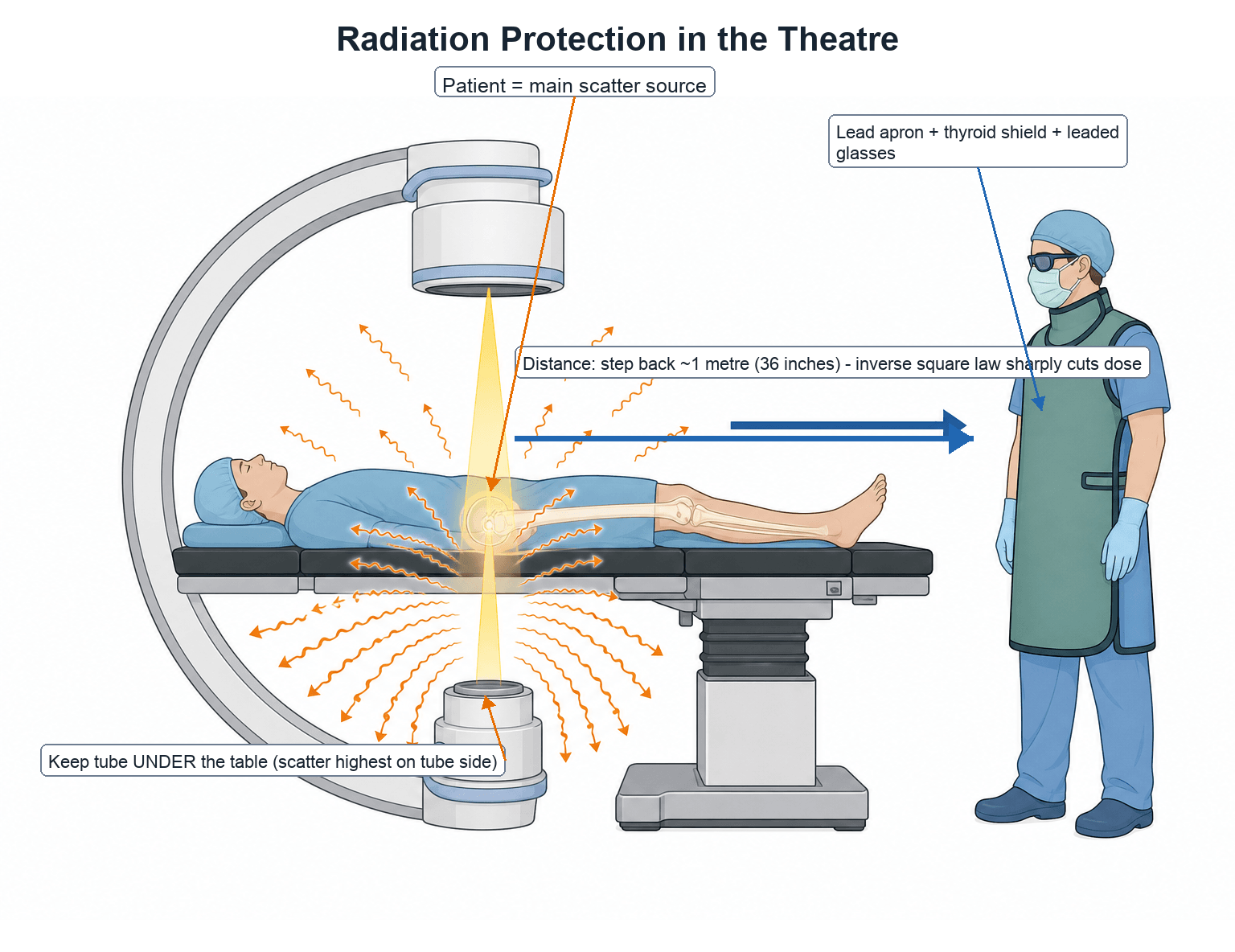
Time. Total dose is directly proportional to screening time, so every second of screening saved reduces dose proportionally.
Distance. Dose obeys the inverse square law: it is inversely proportional to the square of the distance from the source. Doubling the distance reduces dose to one-quarter, so standing 2 metres away rather than 1 metre is a 75% reduction.
- Action
- Pulsed fluoroscopy at the lowest rate, brief exposures, release the pedal when not actively screening, last image hold
- Impact
- 50-90% dose reduction
- Action
- Step back when not actively operating. Use long instruments. Never lean over the beam
- Impact
- Even 30cm extra distance is meaningful
- Action
- Narrow the beam to the region of interest using C-arm shutters
- Impact
- Reduces irradiated volume AND scatter production by 30-50%
- Action
- Stand on the image receptor side (away from the X-ray tube)
- Impact
- Scatter is 2-5x higher on the tube side. Correct positioning is a simple, zero-cost intervention
Shielding comes last. It is the last of the three, not the first. The apron, thyroid shield and lead glasses are worn by all staff in the field:
- Lead apron, 0.5mm Pb minimum, weighing 5-7kg
- Thyroid shield, mandatory for all fluoroscopy. The thyroid is particularly radiosensitive, and the shield reduces thyroid dose by approximately 90%
- Lead glasses. The eye lens is sensitive to radiation, with a cataract threshold of 0.5 Gy cumulative, and lead glasses reduce lens dose by 85-90%
- Above-table shield, when available. A ceiling-suspended lead glass screen protects the upper body and face without the weight of personal lead
Two true numbers for one apron. Quoted attenuation figures for a 0.5 mm lead apron range from about 75% to better than 99%. The discrepancy is not a measurement error: the figures answer different questions.
- The material, tested narrow-beam, gives an attenuation factor of roughly 70 to 280 (typically about 200) at clinical tube potentials, so better than 99% of the radiation that strikes the lead is stopped.
- The wearer, measured in a real theatre with dosimeters over and under the apron under broad-beam conditions, sees a far smaller reduction: about 74.6% for the apron itself, 60.6% for the thyroid protector and 70.1% for goggles.
Why they differ. Scatter in a theatre does not arrive as a narrow beam from in front. It comes from the patient in every direction and reaches the wearer around the apron edges, from below, from behind when you turn, and through everything the apron does not cover: the head, eyes, arms and lower legs. The apron is close to a perfect absorber of what hits it and only a fair reducer of what reaches you.
Bench versus real world. Bench (narrow-beam) testing yields the quoted 90-95% apron attenuation, but broad-beam, real-world studies report lower effective protection, around 75% in some prospective theatre data. Quote both: aprons are highly effective for the covered torso, but do not over-rely on them, and never substitute shielding for distance.
What follows. Two consequences:
- The protective equipment is not the primary control. Time, distance and collimation are, because they reduce the scatter that exists rather than intercepting a fraction of it.
- The fit and coverage of the garment matter more than another tenth of a millimetre of lead, which is why wrap-around and two-piece designs are measurably better, and a correctly sized thyroid shield outperforms a heavier but gaping one.
For scale. In a prospective series of 71 cases in a mobile C-arm theatre, the operating surgeon's six-month effective dose was 3.85 mSv and the scrub nurse's 1.31 mSv. That is well inside the 20 mSv annual limit, but not so far inside that habits are irrelevant.
Personal Dosimetry: Devices and the Double-Badge Method
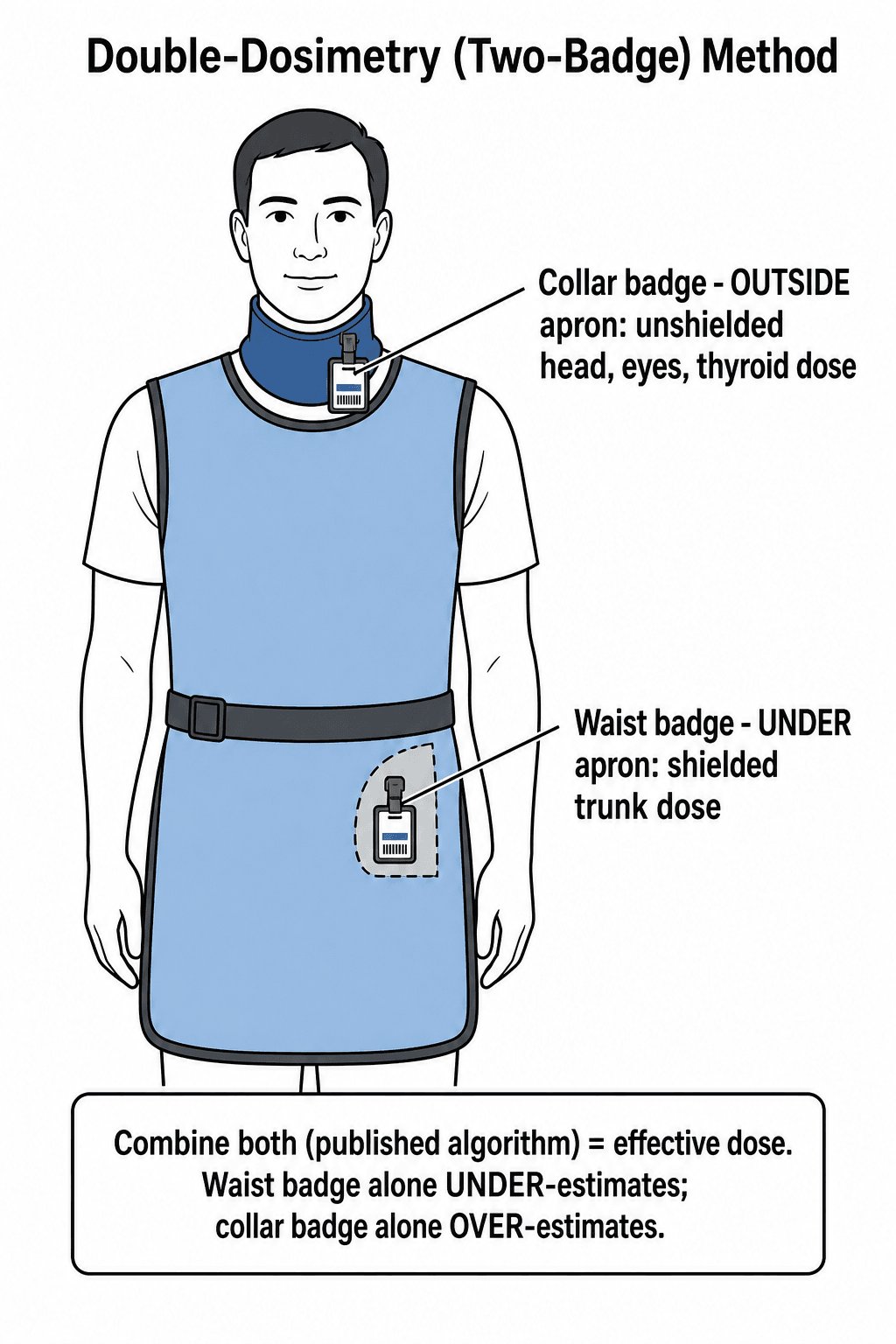
The everyday monitor. A personal dosimetry badge is required for all radiation workers and provides the cumulative dose record for regulatory compliance. The standard convention is a single badge worn under the apron at waist level, which estimates the shielded trunk dose. Badges are typically exchanged and read monthly or quarterly.
- How it works
- Photographic film darkens with dose; filters infer radiation type and energy
- Strengths and limits
- Cheap, gives a permanent record; less sensitive, fades with heat/humidity, not re-readable, no real-time readout
- How it works
- Heating releases stored energy as light, proportional to dose
- Strengths and limits
- Accurate over a wide range and small enough for a finger ring; reading erases the signal (no re-read), not real-time
- How it works
- A laser releases the stored signal as light
- Strengths and limits
- Very sensitive and re-readable; now the common whole-body badge; still not real-time
- How it works
- Solid-state detector with a live digital display
- Strengths and limits
- Instant readout and an audible dose-rate alarm — useful for high-dose procedures; battery-dependent
- How it works
- Finger-worn TLD placed near the beam
- Strengths and limits
- Monitors the hand — the highest-dose site in orthopaedic fluoroscopy
The limit of one badge. On its own, the waist badge under-estimates effective dose, because it misses the unshielded head, eyes and thyroid. For high-exposure interventional and spine work the recommended approach is double dosimetry: a second badge at collar level outside the apron estimates the unshielded head, eye and thyroid dose, and a published algorithm combines the two readings into an effective-dose estimate. A collar badge read alone, conversely, over-estimates effective dose.
Guidelines, Registries & Global Practice
Radiation protection is one of the most internationally harmonised areas in medicine because almost every national framework is built on the same scientific foundation: the recommendations of the International Commission on Radiological Protection (ICRP, Publication 103) and the International Atomic Energy Agency (IAEA) Basic Safety Standards. As a result, the numerical dose limits are essentially identical worldwide, while the regulatory machinery (licensing, training, dosimetry providers) differs by country.
- Limit
- 20 mSv/year averaged over 5 years (max 50 mSv in any single year)
- Notes
- Identical under ICRP, IAEA BSS, EU Directive 2013/59/Euratom, US NRC (10 CFR 20 uses 50 mSv/yr), AU ARPANSA
- Limit
- 20 mSv/year averaged over 5 years
- Notes
- Reduced from 150 mSv (ICRP 2011) after cataract evidence; adopted by EU 2018, IAEA, ARPANSA. US NRC still lists 150 mSv but most institutions apply 20 mSv
- Limit
- 500 mSv/year
- Notes
- Localised limit protecting hands, the highest-dose orthopaedic site
- Limit
- 1 mSv for the remainder of the pregnancy (ICRP/EU/IAEA); US NRC: 5 mSv over gestation
- Notes
- The main genuine inter-jurisdiction difference — know both numbers
- Limit
- 1 mSv/year
- Notes
- Applies to non-radiation workers and visitors
Society and Regulatory Frameworks Side by Side
- Framework
- ICRP 103 system of protection; IAEA Basic Safety Standards (GSR Part 3)
- Practical requirement for surgeons
- Justification, optimisation (ALARA) and dose limitation — the three-pillar basis adopted everywhere
- Framework
- IR(ME)R / IRR17 (UK); EU Directive 2013/59/Euratom; supported by BOA and RCR guidance
- Practical requirement for surgeons
- Named duty-holders, mandatory dosimetry, periodic equipment QA, eye-lens monitoring for high-dose operators
- Framework
- NRC 10 CFR 20 and state programs; ACR-AAPM technical standards; The Joint Commission fluoroscopy requirements
- Practical requirement for surgeons
- Fluoroscopy operator credentialing, cumulative skin-dose tracking, sentinel-event reporting for high skin dose
- Framework
- AO and orthopaedic-society educational guidance on intraoperative fluoroscopy
- Practical requirement for surgeons
- Operative TDS discipline, pulsed/low-dose protocols, navigation where available
- Framework
- ARPANSA Radiation Protection Series; state/territory radiation-use licensing
- Practical requirement for surgeons
- Radiation Use Licence or supervised use, mandatory dosimetry, designated Radiation Safety Officer
Registries, Monitoring and Global Practice Variation
- Dose registries and dosimetry: National personal-dosimetry registries (e.g. UK HPA/UKHSA dose record-keeping, US NCRP/REIRS reporting, ARPANSA Australian National Radiation Dose Register) collate occupational dose so cumulative career dose can be audited. There is no implant-style "radiation outcomes" registry; surveillance relies on these occupational-dose datasets.
- High- vs limited-resource settings: In well-resourced theatres, modern C-arms default to pulsed, low-dose and last-image-hold modes, ceiling-suspended screens and lead glasses are routine, and medical physicists perform scheduled QA. In limited-resource settings, older continuous-fluoroscopy units, scarce or poorly maintained lead aprons, inconsistent dosimetry, and absent physics support shift the protection burden almost entirely onto operator behaviour (time and distance) — making the low-cost TDS principles disproportionately important.
- The constant across all settings: Justification, optimisation and dose limitation are universal. Exam answers should be framed around these ICRP principles rather than any single country's regulator.
Special Populations
- Key Concern
- Fetus is more radiosensitive, especially in first trimester (organogenesis)
- Management
- Declared pregnancy limit, fetal dosimeter and modified duties (see below)
- Key Concern
- Must balance diagnostic need against fetal risk. Radiation teratogenesis threshold approximately 100 mGy
- Management
- Shield the pelvis whenever possible. Use non-ionising alternatives (US, MRI without gadolinium). If fluoroscopy essential, use minimum dose and document the exposure estimate
- Key Concern
- Children are more radiosensitive and have longer life expectancy to express stochastic effects
- Management
- Strict ALARA. Reduce kV and mA (child-specific protocols). Minimise number of exposures. Use non-ionising alternatives (US) when possible
- Key Concern
- Cumulative career dose from repeated procedures
- Management
- Personal dosimetry review every 3 months. Dose audit comparing personal dose to colleagues. Active dose reduction strategies
The declared pregnancy. When a staff member declares a pregnancy, the dose limit for the fetus is 1 mSv for the entire remaining duration of the pregnancy, approximately the dose from 2-3 abdominal X-rays. In practice:
- An additional monitoring badge is worn at waist level under the lead apron to estimate fetal dose
- The staff member should avoid direct involvement in high-fluoroscopy procedures when possible, and duties can be modified to reduce exposure
- If fluoroscopy work continues, strict TDS principles and adequate shielding must be maintained
Fetal dose in practice. Lead aprons provide excellent fetal protection. The fetal dose from scatter through a 0.5mm Pb apron during a typical orthopaedic fluoroscopy procedure is negligible, less than 0.01 mSv per procedure.
Controversies & Areas of Uncertainty
Radiation protection rests on a small number of genuinely unresolved scientific questions. Examiners use these to separate candidates who have memorised the rules from those who understand the underlying biology.
Is the LNT model correct at low doses? The model is an extrapolation from high-dose data (atomic-bomb survivors) down to the very low doses of occupational fluoroscopy. Some argue for a practical threshold, and a minority propose radiation hormesis, low doses being mildly protective. The evidence below 100 mSv is genuinely inconclusive because the excess risk is too small to detect against background cancer rates. The exam-safe position is to use LNT as your default while acknowledging that it is conservative and debated at low dose.
Lead gloves and the auto-exposure paradox. Lead-impregnated sterile gloves seem intuitively protective for hands near the beam and provide partial hand protection. If the gloved hand enters the field, however, the C-arm's automatic exposure control detects the attenuation and increases tube output, raising scatter to the rest of the body and often negating any net benefit. The better answer is to keep the hand out of the primary beam entirely rather than rely on gloves.
The eye-lens limit and monitoring gaps. The ICRP cut the eye-lens limit from 150 to 20 mSv/year in 2011, but routine eye-lens dosimetry, though increasingly added, is still inconsistently implemented, and adoption into national law has been staggered (EU 2018; the US NRC still lists the older figure). High-fluoroscopy orthopaedic and spine surgeons may approach the new limit, making lead glasses and dedicated lens monitoring increasingly relevant.
Clinical Decision Scenarios
Practise clinical reasoning and management decisions out loud
“An examiner asks you to explain the principles of radiation protection during fluoroscopy-guided orthopaedic surgery.”
“A scrub nurse who has just discovered she is pregnant asks you whether she can continue to work in theatres where fluoroscopy is used.”
“An examiner asks you to compare deterministic and stochastic radiation effects and to explain how they relate to radiation protection standards.”
TDS Principles
- Time: pulsed mode, brief exposures, last image hold
- Distance: inverse square law (2x distance = 1/4 dose)
- Shielding: quote the bench value (over 99% for the material) and the wearer value (about 75% apron, 60% thyroid, 70% goggles) - and say which you mean
Dose Limits (ICRP/IAEA — global)
- Occupational: 20 mSv/year averaged over 5 years (max 50 mSv any single year)
- Eye lens: 20 mSv/year (reduced from 150 mSv by ICRP in 2011)
- Skin/extremities: 500 mSv/year
- Pregnant staff (fetal): 1 mSv remaining pregnancy (ICRP/EU/IAEA); 5 mSv over gestation (US NRC)
- General public: 1 mSv/year
Deterministic vs Stochastic Effects
- Deterministic: THRESHOLD dose, SEVERITY increases (burns, cataracts, radiation sickness)
- Stochastic: NO threshold, PROBABILITY increases (cancer induction)
- LNT model: any dose carries some cancer risk — basis for ALARA
- Radiosensitivity: lymphocytes, then gonads, then marrow, then epithelium, then connective tissue, then nerve/muscle
Skin Dose Thresholds
- 2 Gy: transient erythema
- 6 Gy: moist desquamation (blistering)
- 10 Gy: dermal necrosis
- 18 Gy: late skin necrosis requiring surgery
Positioning and Equipment
- Stand on IMAGE RECEPTOR side (away from X-ray tube)
- Scatter is 2-5x higher on tube side
- Hands receive highest dose — keep out of primary beam
- Personal dosimetry badge: worn UNDER lead apron at waist level
Evidence Base
Occupational Dose to Eyes, Thyroid and Hands in Orthopaedic Staff
- Systematic review (PRISMA) of 42 eligible studies measuring occupational dose to the eyes, thyroid and hands of orthopaedic staff.
- Across studies, mean doses to all three anatomical sites were below recommended dose limits, but with wide variation driven by procedure type, distance and use of personal protective equipment.
- Surgeons received higher doses during minimally invasive (fluoroscopy-heavy) procedures than open procedures, and junior surgeons were at higher risk than seniors.
Occupational Dose and Lifetime Cancer Risk Estimate (BEIR VII Approach)
- Prospective measurement across 71 cases in a mobile C-arm hybrid theatre: 6-month effective dose was 3.85 mSv for the operating surgeon and 1.31 mSv for the scrub nurse.
- Measured attenuation of lead apron, neck (thyroid) protector and goggles was 74.6%, 60.6% and 70.1% respectively under real-world broad-beam conditions.
- Using the BEIR VII model, estimated lifetime attributable cancer incidence was 2,355 per 100,000 (surgeons) and 795 per 100,000 (scrub nurses); scatter at 100 cm fell to 0.003-0.009 mSv per 10 minutes.
Occupational exposure is quantifiable and manageable with discipline.