Fixed Pronation Deformity | Congenital vs Post-Traumatic | Cleary and Omer Classification
- Congenital failure of segmentation (longitudinal)
- Fixed pronation deformity is classic presentation
- Functional deficit determines treatment (eating, hygiene)
- Derotation osteotomy is treatment of choice
- Mobilisation (excision) has high recurrence rate and is contraindicated in congenital
- “Bilateral in 60% of cases
- “Associated with Apert, Carpenter, Klinefelter syndromes
- “Shoulder abduction compensates for pronation loss
- “Look for posterior radial head dislocation (Type III)
Overview and Epidemiology
Congenital proximal radioulnar synostosis is a failure of longitudinal segmentation: the radius and ulna never separate at their proximal ends, and the forearm is left fixed, usually in pronation. It is bilateral in about 60% of cases. Post-traumatic synostosis produces the same block by a different route, a bone bridge across the interosseous space after a fracture, and it is managed differently.
Who. The child is usually noticed at 2-5 years, when complex hand tasks accumulate. Because the shoulder and wrist compensate so well, the problem is often not noticed until school age.
Associations. The synostosis can be one feature of a syndrome, so always examine the whole patient: hips, heart and kidneys.
- Apert syndrome (acrocephalosyndactyly)
- Carpenter syndrome
- Klinefelter syndrome (XXY)
- Fetal alcohol syndrome
- Arthrogryposis
- Holt-Oram syndrome
Anatomy
The bones. The radius is often larger, bowed and longer than normal. The radial head may be absent, hypoplastic or dislocated, posteriorly more often than anteriorly.
The soft tissues. The supinators may be absent or fibrotic, and pronator teres is often shortened and fibrotic. The posterior interosseous nerve may take an aberrant course, running adjacent to or through the synostosis mass, which is one reason the proximal forearm is a dangerous place to operate.
What the forearm loses. Normal rotation is 100° of supination and 80° of pronation, and most activities of daily living need 50° of supination to 50° of pronation. Patients compensate for fixed pronation with shoulder abduction and wrist hypermobility: abduction compensates for the lack of pronation, and shoulder adduction increases reach.
What the child cannot do. Wiping requires supination, and a forearm fixed in over 60° of pronation makes it impossible with the affected hand. Eating shows the deficit most plainly. The child brings the dorsum of the hand to the mouth, the classic "back of hand" sign, and the eating mechanics look unsightly.
Pathophysiology
Normal segmentation. Between weeks 5 and 7 of gestation a common cartilaginous mass differentiates into the radius and ulna, which share a continuous cartilaginous anlage (perichondrium). Apoptosis in the interzone between them separates the two bones longitudinally, from distal to proximal, and separation is complete by week 8.
Congenital synostosis. The interzone fails to form, or separation arrests before it reaches the proximal end, and the bones remain fused proximally. HOX gene abnormalities and defective apoptotic signalling are the molecular faults described, with FGFR2 mutations in Apert syndrome and HOXD13 in polysyndactyly; the synostosis is often associated with other anomalies.
Post-traumatic synostosis. Bone bridges the interosseous space after fracture healing, as heterotopic ossification in the interosseous membrane. Periosteal stripping at surgery, haematoma in the interosseous space and delayed mobilisation after the fracture all contribute. The risk factors:
- Monteggia fractures - highest risk
- Both-bone forearm fractures - especially same-level fractures
- High-energy trauma with extensive soft-tissue injury
- Delayed surgery - more periosteal reaction
- An open approach to both bones through the same incision
- Bone grafting - graft material in the interosseous space
- Head injury - increased heterotopic ossification risk
Classification
Cleary and Omer classified the synostosis by its radiographic appearance and the position of the radial head. In Types I and II the head is reduced and the difference is whether the bridge is fibrous or bony; Types III and IV add a dislocated head. Type III is the most common pattern, and it is treated by osteotomy without attempting to reduce the head.
- Description
- Fibrous synostosis (no bone bridge)
- Head Position
- Reduced
- Description
- Bony synostosis
- Head Position
- Reduced
- Description
- Bony synostosis
- Head Position
- Posterior Dislocation
- Description
- Bony synostosis
- Head Position
- Anterior Dislocation
Clinical Presentation
History. The complaint is functional: difficulty holding a soup bowl, which needs supination, or an awkward running style. Typing, using cutlery and hygiene are hard. Pain is unusual, and when present it suggests radial head instability or a post-traumatic cause.
Examination. The forearm is usually fixed in 15-60° of pronation, with a block to rotation; elbow flexion and extension are often normal. Assess shoulder range as well, because the shoulder carries a high demand for rotation. Palpate for a dislocated radial head (a posterior prominence) and rule out associated neurological conditions.
Judge the function, not the angle. Watch the child bring the hand to the mouth and use a keyboard, rather than recording only the fixed position.
Investigations
Radiographs. PA and lateral views of the extended forearm show three things: the proximal radius and ulna fusion, the radial head position (Types III and IV) and radial bowing.
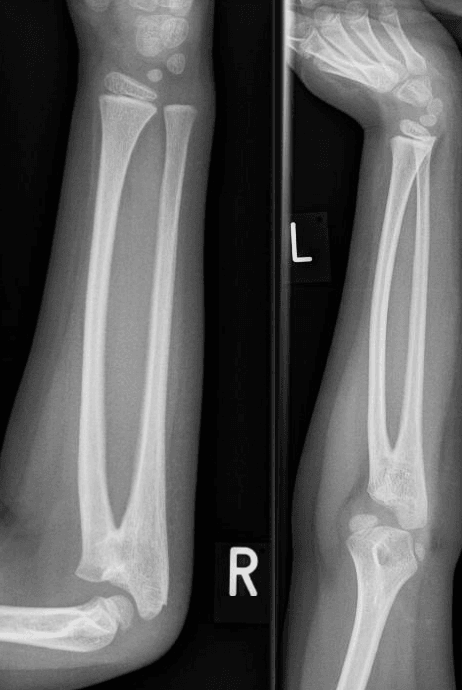
CT is rarely needed for diagnosis but is useful for surgical planning, to choose the osteotomy site. MRI can identify the fibrous band of a Type I synostosis, and is rarely indicated.
Differential Diagnosis
The hallmark of synostosis is a fixed block to forearm rotation with preserved elbow flexion and extension. Distinguish it from the other causes of limited supination and pronation:
- Distinguishing Feature
- Painless, fixed pronation, often bilateral
- Key Discriminator
- Bony/fibrous bridge proximally on radiograph
- Distinguishing Feature
- Limited rotation but NO synostosis bridge
- Key Discriminator
- Convex, dome-shaped radial head; no fusion
- Distinguishing Feature
- Acquired stiffness after Monteggia/both-bone fracture
- Key Discriminator
- History of trauma; discrete bridge across interosseous space
- Distinguishing Feature
- Distal radius growth arrest, wrist deformity
- Key Discriminator
- Volar-ulnar distal radial tilt; rotation often preserved
- Distinguishing Feature
- Dynamic pronation, partly correctable under anaesthesia
- Key Discriminator
- Increased tone; rotation passively improves when relaxed
- Distinguishing Feature
- Multiple rigid joint contractures
- Key Discriminator
- Generalised joint involvement, absent skin creases
Management
The decision. Function, not a fixed angle, drives intervention. A functional deficit is an indication for surgery regardless of the angle. Without one, the severity of the fixed pronation guides the plan:
- Mild (under 30-60° pronation) - observation, with occupational therapy for adaptive strategies
- Severe (over 60° pronation) - surgical correction
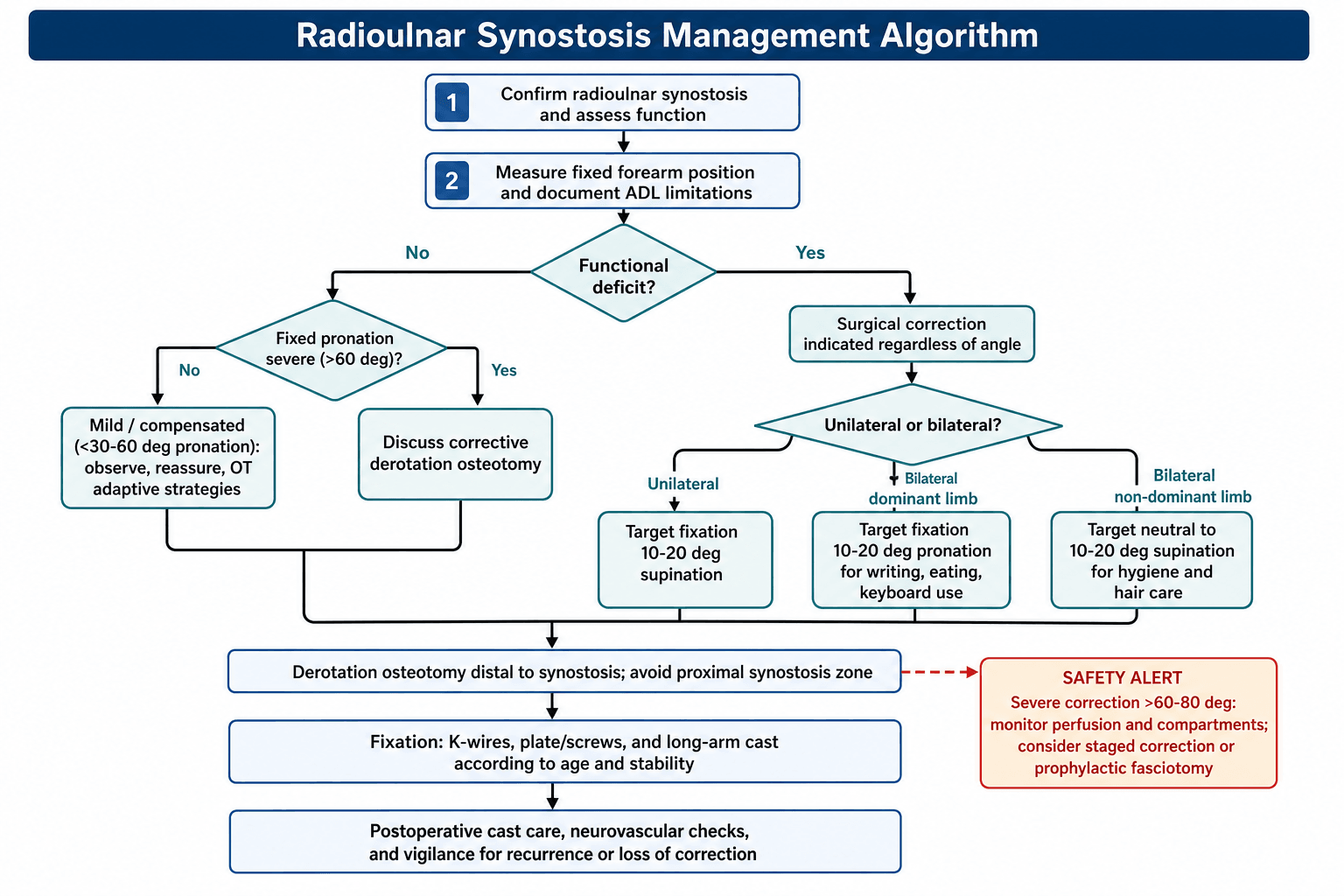
Target position. The position the forearm is fixed in depends on whether the synostosis is unilateral or bilateral.
- Target Position
- 10-20° Supination
- Rationale
- Maximal function
- Target Position
- 10-20° Pronation
- Rationale
- Writing, Eating, Keyboard
- Target Position
- Neutral to 10-20° Supination
- Rationale
- Perineal hygiene, Hair
BADIndications for Surgery
Hook:Surgery is BAD - Bilateral, Angle, Deficit!
Surgical Technique
Derotation osteotomy is the gold standard for congenital synostosis.
Surgical Steps
A distal or mid-shaft approach, with the osteotomy distal to the synostosis. A proximal approach, at the synostosis, is dangerous because of the neurovascular structures there.
Transverse or Z-osteotomy through the radius and ulna if they are fused distally, or through the radius/ulna individually if the synostosis is proximal. Subperiosteal dissection is critical to protect the soft tissues.
Rotate the forearm to the target position (for example 10° of supination), watching the pulse and perfusion. The interosseous membrane will be tight.
Crossed percutaneous K-wires are standard and easier to remove. A plate and screws (2.7mm or 3.5mm LC-DCP) is more stable but requires removal in children. A long arm cast is required, with meticulous moulding to hold the rotation. The choice of fixation follows age and stability.
Check compartment pressure. If tight, consider leaving the deep fascia open or performing a fasciotomy. Close the skin without tension.
Correction of a severe deformity (over 80°) tightens the interosseous membrane and vessels, with a high risk of compartment syndrome, Volkmann's ischaemia and neurovascular compromise. Consider staged correction or prophylactic fasciotomy for severe angles.
Complications
Recurrence and loss of correction. After osteotomy, re-ankylosis in the new position is the goal, but loss of rotational correction can occur if fixation is inadequate or removed early. Non-union at the osteotomy site is rare because of the robust periosteum in children.
Compartment syndrome (Volkmann's ischaemia). Severe derotation, over 60-80°, wrings out the interosseous membrane and vessels. Prevention is prophylactic fasciotomy or staged correction, and after surgery the checks are vigilant, with a low threshold for splitting casts.
Nerve and vessel injury.
- Posterior interosseous nerve - the anatomy is distorted; a distal osteotomy avoids this zone
- Radial artery - can kink; document the radial pulse before and after correction
- Median nerve - can be compressed under pronator teres during pronation-to-supination correction
Scars. Forearm scars can hypertrophy.
Postoperative Care
A long arm cast is worn for 6-8 weeks, until bony union. Overnight admission for compartment checks is mandatory. Follow-up confirms union, and hardware removal is often required.
Outcomes
What surgery gives. The improvement in activities of daily living, eating and hygiene especially, is excellent, and most parents report high satisfaction with the functional gains. The awkward arm position while running or at rest is resolved. Satisfaction is generally high if the target angles are met, and bilateral severe cases derive the most benefit.
What it does not. Rotation is not restored: the operation leaves a fusion in a better position, and patients adapt well using shoulder motion. No long-term data suggest an increased risk of elbow or wrist arthritis, as the articular surfaces are generally spared (unless there is a Type IV, anterior, dislocation).
Post-Traumatic Synostosis: Prevention and Resection
Prevention is the first principle. Most post-traumatic radioulnar synostosis is iatrogenic or technique-related, and avoidable. The highest-risk settings - Monteggia injuries, same-level both-bone fractures, high-energy trauma and the head-injured patient - warrant the most meticulous technique.
- Rationale
- A single approach to both bones risks bridging the interosseous space - especially with same-level fractures
- Rationale
- Periosteal reaction and haematoma in the interosseous space are the substrate for the bone bridge
- Rationale
- Graft material can seed an interosseous bridge
- Rationale
- Restores the interosseous gap and limits stiffness/heterotopic bone
- Rationale
- Indomethacin/NSAID or single-dose radiation are options - the pharmacology and evidence are developed in heterotopic ossification; note Jupiter's series achieved good results WITHOUT prophylaxis
Resection. A discrete, mature post-traumatic bridge can be excised to restore rotation, the opposite of the rule in congenital disease. The bridge is excised and the interosseous space restored; free-fat interposition did not significantly change outcome in the Jupiter series.
When. Wait for maturity: a well-defined cortical margin on CT and a metabolically quiescent ("cold") bone scan with a plateaued or normalising alkaline phosphatase, classically around 6-12 months. Jupiter and Ring resected at a mean of 19 months, and in their series resecting before versus after 12 months did not significantly change the rotation regained.
Outcome. Non-recurring limbs regained an average of 139° of rotation. The single recurrence was the only patient with a closed head injury, the key recurrence risk factor.
Guidelines, Registries & Global Practice
Global Epidemiology
- Proximal radioulnar synostosis is the most common congenital anomaly of the proximal forearm, but is rare overall (a few hundred cases reported worldwide).
- Bilateral in roughly 60% of cases; both sexes affected, with most non-syndromic isolated cases linked to SMAD6/NOG variants or sex-chromosome aneuploidy.
- Largest contemporary series (97 patients, 122 forearms; European multicentre) confirms Type III as the most frequent radiographic pattern.
Side-by-Side Guidance
There is no dedicated society guideline for this rare condition; evidence is case-series level. Principles converge across bodies:
- Position
- Avoid resection in congenital disease; derotational osteotomy for functional deficit; non-operative for mild
- Position
- Function (not angle alone) drives surgery; position dominant limb in slight pronation, non-dominant near neutral
- Position
- Centralised paediatric hand units; OT-led adaptation first; operate for fixed hyperpronation impairing ADLs
- Position
- Excision of mature, discrete post-traumatic synostosis once 'cold'; prophylaxis (NSAID/radiation) debated
Registries
- No arthroplasty/implant registry captures this condition. Outcome data derive from single-centre and pooled case series (e.g. the 2022 meta-analysis of 383 forearms and the 2025 European multicentre cohort).
High- vs Limited-Resource Practice
- Well-resourced settings: early occupational therapy, genetic testing (SMAD6/NOG, karyotype for Klinefelter), CT planning, and plate-fixed proximal osteotomy with overnight compartment monitoring.
- Limited-resource settings: diagnosis often delayed until school age; plain radiographs suffice; single-bone derotation held with K-wires and a long-arm cast is a pragmatic, low-cost alternative to plating. Genetic services may be unavailable, so clinical syndrome screening (whole-patient examination) is essential.
Related pages: Congenital Radial Head Dislocation is the deformity most often confused with this one and the one that is also left alone - a domed hypoplastic radial head with a convex capitellum, and no fusion; Nursemaid's Elbow for the toddler who will not rotate the forearm for a quite different reason; Monteggia Fractures for the missed ulnar lesion that produces the acquired fixed rotation this must be distinguished from; Radial Head Fractures and Both-Bone Forearm Fractures for the injuries whose treatment produces the post-traumatic synostosis discussed above, and where the prevention - avoiding a single incision for both bones and never grafting into the interosseous space - actually happens; Heterotopic Ossification for the biology of the bone that bridges the interosseous space and the evidence on prophylaxis; and Cerebral Palsy for the other cause of a fixed pronated forearm in a child, where the problem is tone rather than bone.
Controversies & Areas of Uncertainty
Osteotomy site. An osteotomy through the synostosis allows a single-cut correction but concentrates the neurovascular and compartment risk. A distal, single-bone osteotomy is safer but technically may under-correct. No high-level evidence settles this.
Acute or staged correction. The safe single-stage limit is debated, often quoted as 60-85°; the warnings above use over 60-80° and over 80°. Some advocate gradual correction with an external fixator for severe deformity; others perform prophylactic fasciotomy and correct acutely. No randomised data exist.
Who needs surgery. The largest cohort found no significant difference in patient-reported outcome between operated severe cases and non-operated mild cases, so unilateral, well-compensated children are often best observed.
MCQ Practice Points
Q: What are the most common syndromic associations with radioulnar synostosis?
A: Apert Syndrome (Acrocephalosyndactyly) and Klinefelter Syndrome (XXY). Also Carpenter, Fetal Alcohol, and Arthrogryposis. However, most cases are isolated with no syndromic features.
Q: In bilateral radioulnar synostosis, what is the ideal position for the dominant arm?
A: 10-20° pronation for the dominant arm (facilitates writing and eating). The non-dominant arm should be fixed in neutral to slight supination for perineal hygiene.
Q: Why is excision contraindicated in congenital radioulnar synostosis?
A: Recurrence rate approaches 100% even with interposition materials. Soft tissues are foreshortened, muscles absent/fibrotic, and active rotation cannot be restored. Derotation osteotomy is the only option.
Q: At what gestational stage does radioulnar synostosis occur?
A: Weeks 5-8 when longitudinal segmentation of the forearm anlage occurs. Segmentation proceeds distal to proximal, so failure at the proximal end causes proximal radioulnar synostosis.
Q: A child undergoes 80° derotation osteotomy and develops increasing pain with passive finger stretch. What is the diagnosis?
A: Compartment syndrome. Acute correction over 60-80° tightens the interosseous membrane and vessels. Prophylactic fasciotomy is recommended for large corrections.
Additional Quiz Questions
Viva Scenarios
Practise clinical reasoning and management decisions out loud
“A 4-year-old presents with bilateral fixed pronation of 90 degrees. Parents are concerned about his eating.”
“Why do you not simply excise the bridge to restore motion?”
“What are the risks of performing a one-stage correction of 90 degrees?”
Key Classification (Cleary Omer)
- Type I: Fibrous
- Type II: Bony
- Type III: Posterior Head
- Type IV: Anterior Head
Treatment Angles
- Unilateral: 10-20 Sup
- Bi-Dom: 10-20 Pro
- Bi-NonDom: Neutral
- Max correction: 60-80 degrees
Buzzwords
- Failure of Segmentation
- Fixed Pronation
- Shoulder Abduction Compensation
- Compartment Syndrome
Evidence
Cleary and Omer: Natural History and Classification (Landmark)
- Natural-history study of 23 non-operated patients with 36 congenital proximal radioulnar synostoses; forearms fixed at a mean of 30 degrees pronation.
- Described four radiographic patterns based on the osseous synostosis and radial head position - the descriptive classification still used today.
- Forearm position was NOT related to subjective limitation, employment, or objective (Jebsen) hand-function testing; most patients had few or no functional limitations.
- Concluded that operative treatment is RARELY indicated and that objective function, not the fixed angle alone, should drive assessment.
Bilateral Synostosis: Position of Fixation
- 33 patients (17 bilateral) treated with derotational osteotomy.
- 82% good or excellent results; 8 complications, 4 neurovascular.
- Best end position: 10-15° pronation in the dominant limb, neutral in the other.