Posterior Heel Pain | Haglund Association | Two-Finger Squeeze Test
- Two-finger squeeze test - compress bursa anterior to Achilles
- Avoid steroid injection into bursa - Achilles rupture risk
- Parallel pitch lines quantify Haglund deformity on XR
- Preserve at least 30 degree calcaneal pitch during Haglund resection (avoid over-resection)
- Associated with seronegative spondyloarthropathies
- “Differentiate from superficial (retroachilles) bursitis by location
- “Morning stiffness suggests inflammatory arthropathy association
- “MRI shows T2-bright fluid in bursa with surrounding oedema
- “Endoscopic vs open approach depends on surgeon expertise
Overview
Retrocalcaneal bursitis is inflammation of the bursa between the Achilles tendon and the posterosuperior calcaneus. It is often associated with Haglund's deformity, a posterosuperior calcaneal prominence, and it has to be told apart from its two neighbours: superficial calcaneal bursitis in the retroachilles bursa between skin and tendon, and insertional Achilles tendinopathy.
The key clinical finding is the two-finger squeeze test. Conservative management (activity modification, NSAIDs, heel lifts) succeeds in 80-90%. The trap is the injection: steroid directly into the bursa risks Achilles rupture. Refractory cases come to bursectomy with or without Haglund resection.
Pathophysiology and Risk Factors
Mechanism. Repetitive compression of the bursa during activity leads to an inflammatory response within the bursal sac.
Haglund's deformity. Named after the Swedish orthopaedic surgeon Patrick Haglund (1928), it is a prominent posterosuperior calcaneal tuberosity, the "pump bump". When it is joined by the other two elements it forms the classic triad of Haglund syndrome:
- Posterosuperior calcaneal prominence
- Retrocalcaneal bursitis
- Insertional Achilles tendinopathy
The geometry of the prominence is quantified on the lateral radiograph, described under Investigations.
- Specific Factors
- Haglund deformity, high-arched foot, varus hindfoot alignment
- Mechanism
- Abnormal bony prominence increases bursal compression during activity
- Clinical Significance
- May require surgical correction of underlying deformity
- Specific Factors
- Running, jumping sports, hill training, increased mileage
- Mechanism
- Repetitive eccentric Achilles loading with bursal compression
- Clinical Significance
- Activity modification essential in conservative treatment
- Specific Factors
- Rigid heel counter, inadequate heel cushioning, new shoes
- Mechanism
- Direct pressure on posterosuperior heel increases friction
- Clinical Significance
- Heel lifts and soft heel counter recommended
- Specific Factors
- Seronegative spondyloarthropathies, RA, gout, diabetes
- Mechanism
- Inflammatory arthropathies cause bursal inflammation
- Clinical Significance
- Screen for systemic disease in bilateral or recurrent cases
Anatomy
The retrocalcaneal bursa. A synovial bursa sitting deep to the Achilles, with the tendon behind it and the posterosuperior calcaneal tuberosity in front, just anterior to the Achilles insertion. Its superior boundary is the substance of the tendon and its inferior boundary the superior aspect of the calcaneal attachment; the insertion itself lies on the posterior calcaneus below the bursa. It does not communicate with the ankle joint. Normally it measures 6mm anteroposterior by 3mm deep and holds less than 1mL of synovial fluid.
What it does. The bursa reduces friction between the Achilles and the calcaneus during ankle dorsiflexion. Compression is greatest at end-range dorsiflexion, and a Haglund prominence on the posterosuperior tuberosity increases the compressive load on it.
The superficial calcaneal bursa. Also called the retroachilles or subcutaneous calcaneal bursa, it lies between the Achilles tendon and the skin, behind the tendon. It develops in response to friction from the shoe counter and produces the pump-bump tenderness of shoe pressure, presents as visible swelling at the back of the heel, and often coexists with retrocalcaneal bursitis.
Vessels and nerves. The bursa is supplied from the adjacent soft tissues. The Achilles tendon has a watershed area 2-6cm proximal to its insertion. The sural nerve is at risk in the surgical approach; its course and how to protect it are set out under Surgical Technique.
Classification
There is no validated severity grading system for retrocalcaneal bursitis, and examiners expect you to say so. The condition is classified instead by its cause and by the pathology that comes with it, and it is the presence and extent of associated Achilles and bony disease, not a numeric grade, that drives treatment planning and the choice of surgical approach.
By aetiology. Mechanical, inflammatory or septic.
- Features
- Most common. Activity-related, associated with Haglund deformity and biomechanical overload
- Investigations
- Lateral radiograph, MRI if needed
- Management
- Conservative first, surgery if fails
- Features
- Seronegative spondyloarthropathies. Bilateral, morning stiffness, systemic symptoms, often HLA-B27 positive
- Investigations
- HLA-B27, RF, ESR, CRP
- Management
- Treat underlying disease, rheumatology
- Features
- Rare bacterial infection of the bursa. Acute onset, erythema, fever, elevated WBC
- Investigations
- Aspiration for culture
- Management
- Antibiotics, surgical drainage
By associated pathology. This is the axis that guides treatment. Isolated bursitis has the best prognosis and responds better to conservative management than combined pathology.
- Isolated bursitis - bursal inflammation alone, without bony or tendon involvement
- Haglund syndrome - prominence, retrocalcaneal bursitis and insertional Achilles tendinopathy together
- Combined superficial and deep bursitis - both bursal spaces involved
A descriptive gradation follows the same axis: mild is bursal inflammation only with minimal functional limitation, moderate adds a Haglund deformity, and severe is combined pathology with insertional Achilles tendinopathy.
Clinical Presentation
The typical patient. A 40-year-old recreational runner presents with six months of posterior heel pain, worse on running and particularly at push-off, aggravated by rigid-heeled shoes, with a noticeable prominence at the back of the heel.
Why that history fits. Push-off is maximal ankle dorsiflexion under load, which is exactly when the calcaneal tuberosity is driven into the anterior surface of the Achilles and the bursa between them is compressed; pain at push-off rather than at heel strike is the discriminating detail. The rigid heel counter compresses the same area from outside, which is why footwear is both an aggravating factor and the first thing to change. The prominence is the Haglund deformity, a pre-existing bony shape that narrows the space; the running did not create it.
The rest of the history. Onset is gradual, and the pain is worse with activity, running and jumping especially, and with direct pressure on the posterosuperior heel. Morning stiffness that improves with initial activity is part of the picture. Establish the duration, the relationship to activity and sport, the footwear, the treatments already tried, and any systemic symptoms: bilateral disease with morning stiffness suggests an inflammatory cause.
Red flags for another diagnosis. Each of these points somewhere else:
- Acute onset - Achilles rupture
- Night pain - infection or tumour
- Bilateral symmetric involvement - inflammatory arthropathy
- Fever or constitutional symptoms - septic bursitis
Examination
Inspection. Standing, look at hindfoot alignment (varus predisposes to lateral impingement), for a visible posterosuperior prominence, for erythema suggesting superficial bursitis, and for swelling anterior to the Achilles insertion. The two bursae look different from behind: superficial bursitis gives obvious fluctuant swelling superficial to the Achilles, whereas retrocalcaneal bursitis shows only subtle fullness on either side of the tendon.
Gait. Antalgic, with a shortened stance phase and reduced push-off power; the patient may adopt a toe-walking pattern to avoid dorsiflexion. Check for a limb length discrepancy.
Palpation. Work through the posterior heel in order:
- Achilles tendon substance - nodularity or thickening
- Achilles insertion on the calcaneus - tenderness here suggests insertional tendinopathy
- Retrocalcaneal space - anterior to the Achilles on either side
- Posterosuperior calcaneus - the bony prominence
- Superficial bursa - between Achilles and skin
Separating bursa from tendon. Palpate with the ankle in slight plantarflexion, which relaxes the Achilles and lets you get in front of it. Tenderness that remains anterior to the slack tendon is bursal; tenderness that moves with the tendon is tendinous. This works because the bursa lies deep (anterior) to the tendon, between it and the calcaneus, so relaxing the tendon uncovers the bursa instead of dragging your finger over it.
The two-finger squeeze test. Compress the area just anterior to the Achilles between thumb and index finger, from medial and lateral; a positive test reproduces the characteristic pain. Its sensitivity is reported as high in clinical teaching, but no validated figure exists. It is more specific than simple palpation of the posterior heel, and done with the ankle plantarflexed it isolates the bursa.
Coexistence. Bursitis and insertional tendinopathy coexist in roughly a third of patients, and the superficial bursa adds a third possible pain generator behind the tendon. Localising the pain decides whether treatment targets the footwear and the superficial bursa, the deep bursa and the bony prominence, or the tendon insertion itself.
Range of motion. Measure dorsiflexion with the knee extended (gastrocnemius tight) and flexed (gastrocnemius relaxed); normal is 15-25° with the knee extended. Ankle equinus, dorsiflexion less than 10°, is present in approximately 60% of patients and contributes to bursal pressure during gait; assessment should include both the gastrocnemius and the soleus contribution. Pain at end-range dorsiflexion suggests bursal compression.
Provocative tests. Four manoeuvres:
- Forced dorsiflexion - passive ankle dorsiflexion compresses the bursa and reproduces posterior heel pain
- Resisted active plantarflexion - may reproduce pain if the Achilles is involved
- Single heel raise - assesses Achilles function and reproduces pain
- Painful arc - pain in a specific arc of ankle motion, typically mid to end-range dorsiflexion, indicating bursal compression during movement; it helps differentiate from Achilles tendinopathy
Excluding the alternatives. Thompson test to rule out Achilles rupture (it should be negative) and Simmonds test for Achilles continuity. Check for sinus tarsi tenderness (lateral hindfoot pathology) and palpate the tarsal tunnel structures (posterior tibial nerve). A complete examination takes in the whole kinetic chain, since hip rotation, knee alignment and foot pronation can all contribute to abnormal heel loading.
Investigations
Radiographs first. The weight-bearing lateral is the primary study, because it shows the Haglund prominence and the bony anatomy, though it gives no soft tissue detail; weight-bearing is preferred so that the calcaneus sits in its true position. An AP view rules out other hindfoot pathology, and a calcaneal axial view is added if indicated.
Measuring the prominence. Several measurements quantify the posterosuperior calcaneus on the lateral view:
- Parallel pitch lines - a first line along the plantar aspect of the calcaneus, a second from the posterior plantar calcaneus to the posterosuperior corner, and a third from the posterior plantar calcaneus to the medial tubercle; Haglund deformity is present if the posterosuperior corner lies above the second line
- Fowler-Philip angle - the intersection of a line parallel to the calcaneal undersurface and a line from the posterosuperior corner to the medial tubercle. Normal is 44-69°. More than 75° indicates a prominent posterosuperior tuberosity, and angles less than 44° are associated with increased retrocalcaneal pressure and an increased risk of retrocalcaneal bursitis
- Posterior calcaneal angle (Chauveaux-Liet angle), increased in Haglund deformity
- Calcaneal inclination (pitch) angle
How far to trust them. Treat these thresholds with caution. In Tang's series of operated Haglund deformities (see Evidence Base), the Fowler-Philip angle and parallel pitch lines did not separate patients from asymptomatic controls, whereas bump height and the bump-calcaneus ratio did.
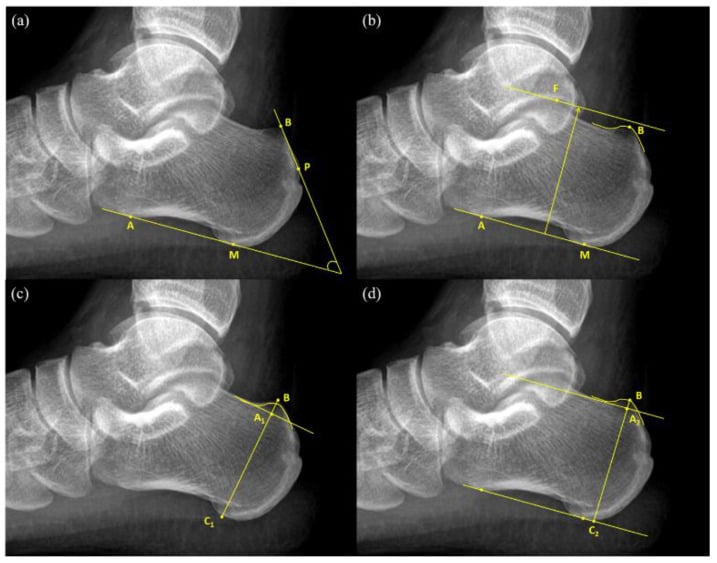
Ultrasound, MRI and CT. MRI is for diagnostic uncertainty or surgical planning; ultrasound assesses the bursa and guides injection.
- Key Findings
- Bursal distension greater than 3mm, anechoic or hypoechoic fluid collection, Achilles thickening at insertion, Doppler shows hypervascularity
- Advantages
- Dynamic assessment with dorsiflexion, real-time evaluation, no radiation, low cost, readily available
- Limitations
- Operator-dependent, limited bony detail, cannot assess full extent of Achilles pathology
- Key Findings
- High signal in bursa on T2 (distension greater than 3mm), bursal thickening, Achilles signal changes if tendinopathy, reactive bone marrow oedema in calcaneus, soft tissue inflammation
- Advantages
- Best soft tissue detail, assesses Achilles tendon pathology, evaluates bone marrow, pre-operative planning
- Limitations
- Expensive, time-consuming, over-diagnosis, not always necessary for diagnosis, limited availability
- Key Findings
- Precise bony anatomy of Haglund deformity, cortical irregularity, calcifications within bursa or tendon
- Advantages
- Excellent bony detail for complex deformity, surgical planning for osteotomy, 3D reconstruction possible
- Limitations
- Radiation exposure, poor soft tissue contrast, usually not first-line investigation
Reading the MRI. A standard ankle protocol with sagittal, axial and coronal sequences; T2-weighted and STIR images best show bursal fluid. The finding is a triangular area of high signal between the Achilles and the calcaneus on the sagittal images, the bursa taking the shape of the space it occupies.
Two cautions. A small amount of fluid in this bursa is normal, and asymptomatic bursal fluid is present in 20% of normal subjects on MRI, so the diagnosis rests on distension plus surrounding inflammatory change and always on correlation with the clinical findings. And the scan should answer a specific question: is the Achilles insertion itself diseased, is there intratendinous change or a partial tear, and is the posterosuperior prominence the driver? Those answers decide whether treatment is bursa-directed or must address tendon and bone, and they are the reason to image a diagnosis that is otherwise clinical.
Blood tests. Order them for bilateral involvement, recurrent or refractory disease, constitutional symptoms, features of inflammatory arthropathy, or a young patient with no clear mechanical cause:
- ESR and CRP - elevated in inflammatory arthropathy
- Rheumatoid factor and anti-CCP antibodies
- HLA-B27 for seronegative spondyloarthropathy
- Uric acid if gout is suspected
- Full blood count if infection is a concern
Aspiration. Rarely indicated; consider it if septic bursitis is suspected. Send the fluid for cell count, Gram stain, culture and crystal analysis. Cloudy fluid with an elevated white cell count suggests infection, and crystals may indicate gout or pseudogout.
Differential Diagnosis
- Key Distinguishing Features
- Tenderness AT insertion rather than anterior to it. Palpable thickening. Morning stiffness prominent.
- Imaging Findings
- Achilles thickening, intratendinous signal change on MRI, possible calcification at insertion
- Management
- Eccentric exercises, shockwave therapy, surgical debridement if refractory
- Key Distinguishing Features
- Visible swelling posterior to Achilles. Fluctuant mass palpable between tendon and skin.
- Imaging Findings
- Fluid collection superficial to Achilles on ultrasound or MRI. No retrocalcaneal fluid.
- Management
- Padding, shoe modification, aspiration if large, excision rarely needed
- Key Distinguishing Features
- Pain in mid-substance Achilles. Crepitus with motion. No focal tenderness at insertion.
- Imaging Findings
- Fluid around Achilles but not in retrocalcaneal space. Normal tendon signal.
- Management
- Activity modification, eccentric exercises, NSAIDs
- Key Distinguishing Features
- Tenderness in the deep posterior ankle. Pain with plantarflexion rather than dorsiflexion. Os trigonum often present.
- Imaging Findings
- Os trigonum or prominent posterior talar process. Posterior joint effusion on MRI.
- Management
- Activity modification, injection, os trigonum excision if persistent
- Key Distinguishing Features
- Inability to perform single heel raise. Pain with medial-lateral calcaneal squeeze.
- Imaging Findings
- Fracture line visible on MRI or CT. May be occult on plain radiographs initially.
- Management
- Non-weight bearing immobilisation for 6-8 weeks until healing
Management
The sequence. Structured conservative care comes first and fixes most patients. The programme is staged, with a minimum trial of 12 weeks and reassessment at 3-6 months, and surgery is considered only after at least 6 months of failed treatment.
- Treatment Phase
- Activity modification
- Interventions
- Rest, heel lifts, NSAIDs, soft heel counter
- Treatment Phase
- Physical therapy
- Interventions
- Eccentric exercises, stretching, ESWT consideration
- Treatment Phase
- Reassess
- Interventions
- MRI if not done, optimise conservative measures
- Treatment Phase
- Surgery consideration
- Interventions
- Bursectomy with/without Haglund resection
Activity. Reduce or stop the aggravating activities, avoiding hill running and excessive dorsiflexion, and cross-train with low-impact exercise such as cycling or swimming. Return to sport follows a gradual protocol once symptoms resolve.
Footwear. A soft heel counter, or none at all, and a wider heel box to reduce compression. Heel lifts of 6-12mm reduce dorsiflexion stress. New or poorly fitted shoes are avoided.
Physiotherapy. Eccentric Achilles strengthening, gastrocnemius and soleus stretching, manual therapy for soft tissue mobilisation, and ultrasound therapy for its anti-inflammatory effect. Biomechanical factors such as equinus and a varus hindfoot are addressed.
Medication. NSAIDs for 2-4 weeks if there is no contraindication, with topical NSAIDs as an alternative, and simple analgesics for pain. Oral corticosteroids are avoided (limited evidence).
Injection. The Achilles lies immediately adjacent to the bursa and corticosteroid weakens tendon structure. High-quality evidence for steroid injection is limited, and the rupture risk outweighs the potential benefit in most cases. Evidence for PRP or autologous blood injection is insufficient.
If an injection is given at all, it is under imaging guidance and the patient is counselled about the rupture risk.
Shockwave therapy. Low to moderate energy ESWT, typically 3-5 sessions over 6-12 weeks, may stimulate healing and reduce inflammation. The evidence for it in retrocalcaneal bursitis specifically is limited; there is more for insertional Achilles tendinopathy, and there the highest-level trial (Mansur, in the Evidence Base) found that adding shockwave to eccentric loading did not improve the outcome at 24 weeks.
Surgery
Indications. Surgery is considered for:
- Failure of conservative treatment for a minimum of 6 months
- Significant functional impairment affecting daily activities or sport
- MRI-confirmed retrocalcaneal bursitis, with or without a Haglund deformity
- Patient understanding of the post-operative rehabilitation requirements
- Optimisation of comorbidities - smoking cessation and diabetes control
Matching the operation to the pathology. Three patterns, three operations:
- Isolated bursitis - bursectomy alone may suffice
- With Haglund deformity - bursectomy plus calcaneal ostectomy
- With insertional tendinopathy - may require Achilles detachment and reattachment
Surgical Technique
Set-up. Prone or lateral decubitus, with a bump under the ipsilateral hip if prone. A tourniquet is optional, and the set-up must give adequate fluoroscopy access.
Steps. In sequence:
- Incision - 6-8cm posterolateral, centred over the posterosuperior calcaneus and lateral to the Achilles midline to avoid scar contracture
- Dissection - identify and protect the sural nerve branches, incise the deep fascia and find the retrocalcaneal bursa lateral to the Achilles
- Bursal excision - excise the thickened bursal tissue completely and visualise the Achilles insertion on the posterosuperior calcaneus
- Haglund resection - if prominent, resect it with an osteotome or sagittal saw parallel to the posterior facet of the calcaneus
- Recontouring - smooth the remaining bone with rongeur or burr, leaving no sharp edges and preserving the insertion
- Achilles assessment - inspect for insertional pathology, debride diseased tissue if present, and repair the insertion if it has been detached
- Closure - layered, with deep dermal sutures and interrupted or continuous skin sutures, a sterile dressing and a posterior splint in plantarflexion
The limits that matter. The incision must be lateral, because a midline incision invites wound-healing problems. Preserve at least 1cm of the superior calcaneal attachment of the Achilles, and resect the prominence while keeping calcaneal pitch greater than 30°. Aggressive debridement of the Achilles risks rupture.
The posterolateral approach gives excellent visualisation of the retrocalcaneal space and allows complete bursectomy, with or without Haglund resection, while protecting the Achilles insertion.
FHL transfer to augment the insertion
When. Augment when more than 50% of the Achilles insertion has to be detached or debrided. The transfer adds strength and brings blood supply, and it guards against post-debridement rupture.
Why the FHL. It is the strongest expendable posterior-compartment tendon. Its muscle belly is low-lying and vascularised, bringing blood supply to a poorly vascular insertional zone; it is in phase with the gastrocnemius-soleus (both plantarflex); and it lies immediately deep to the Achilles, so it is harvested through the same wound.
Harvest. The FHL is found deep to the Achilles through the posteromedial part of the exposure. A single-incision harvest divides it as far distally as can be reached behind the ankle; a two-incision technique adds a medial midfoot incision for extra length, and then the medial and lateral plantar nerves must be protected at the master knot of Henry, where the FHL crosses the FDL.
Fixation. After the bursectomy, Haglund resection and tendon debridement, the FHL goes into a calcaneal bone tunnel or is fixed with an interference screw or anchor just anterior to the debrided Achilles footprint, tensioned with the ankle in slight plantarflexion. The residual Achilles insertion is then reattached over it with suture anchors.
The cost. Loss of independent hallux interphalangeal flexion, which is well tolerated because the FDL and the intrinsics compensate. The FHL transfer for chronic Achilles rupture is developed in the Achilles-rupture topic.
Protecting the sural nerve
Course. The sural nerve is the structure most at risk in posterolateral hindfoot surgery, with an injury rate of about 3%. It forms in the calf from the medial sural cutaneous nerve (from the tibial nerve, between the two heads of gastrocnemius), usually joined by a peroneal communicating branch. It pierces the deep fascia in the mid-calf, runs alongside the small saphenous vein, and passes about 1-1.5cm posterior (and slightly inferior) to the lateral malleolus. It then curves forward below the malleolar tip toward the base of the fifth metatarsal, supplying sensation to the posterolateral leg, lateral heel and lateral border of the foot.
Why it is at risk. In a posterolateral approach to the retrocalcaneal space the nerve lies just anterolateral to the Achilles at the operative level. A too-lateral incision, retractor pressure or a distal-lateral endoscopic portal can catch it, producing lateral heel and foot numbness or a painful neuroma.
Staying safe. Keep the incision just lateral to the Achilles midline but posterior to the nerve's course, and dissect bluntly straight down to bone. For endoscopic calcaneoplasty, place the lateral portal at the superior calcaneal level with care, respecting the small saphenous vein: it is the surface marker, because the nerve runs with it.
Open or endoscopic
- Open
- Excellent
- Endoscopic
- Good but limited
- Open
- Can address extensively
- Endoscopic
- Limited debridement only
- Open
- Standard
- Endoscopic
- Steep
- Open
- 4-6 months
- Endoscopic
- Potentially faster
- Open
- Wound healing 6%, sural nerve 3%
- Endoscopic
- Similar overall
Reading the two studies together. The pooled review below reports markedly fewer complications and failures endoscopically, while a single-unit cohort comparing both techniques found no difference in any score. Pooled series compare surgeons who chose the technique they favour, so the honest position is that endoscopy is at least equivalent and probably lower-morbidity; the choice rests on the extent of Achilles involvement and on the surgeon's expertise.
Alessio-Mazzola M, et al. Endoscopic calcaneoplasty for Haglund's deformity provides better functional outcomes, lower complication rate and shorter recovery compared to open procedures: a systematic review. Knee Surg Sports Traumatol Arthrosc. 2021;29(8):2462-2484.
- 35 studies, 1260 ankles (1147 patients); overall good results and high satisfaction
- Endoscopic vs open: AOFAS 90.7 vs 87.1, complications 4.1% vs 15.5%, failures 1.2% vs 6.0% (all p less than 0.001)
- Faster return to sport with endoscopic (11.9 vs 20.7 weeks)
Pi Y, et al. Open versus endoscopic osteotomy of the posterosuperior calcaneal tuberosity for Haglund syndrome: a retrospective cohort study. Orthop J Sports Med. 2021;9(4):23259671211001055.
- 47 patients (20 open, 27 endoscopic); no significant difference in any outcome score (VAS, AOFAS, FFI, Tegner, SF-36)
- Extent of bony resection equivalent between techniques
- Sural nerve paraesthesia only in open group (2 patients); endoscopic surgery took longer (65 vs 45 min)
- Endoscopic learning curve plateaued after the fourth case
Complications
- Incidence
- 6%
- Prevention
- Lateral incision, meticulous tissue handling
- Treatment
- Local wound care, delayed closure if needed
- Incidence
- Less than 2%
- Prevention
- -
- Treatment
- Antibiotics, surgical debridement if deep
- Incidence
- -
- Prevention
- Meticulous haemostasis, drain placement
- Treatment
- Drainage if symptomatic
- Incidence
- 3%
- Prevention
- Identify and protect during lateral dissection
- Treatment
- Desensitisation, neuroma excision if symptomatic
- Incidence
- 2%
- Prevention
- Preserve insertion, FHL if greater than 50% debridement
- Treatment
- Surgical repair with augmentation
- Incidence
- 5-10%
- Prevention
- Adequate Haglund resection
- Treatment
- Revision surgery
Wound healing. Delayed healing follows from the tenuous soft tissue coverage of the posterior heel. Most infections are superficial wound infections; deep infection is rare but serious.
Sural nerve injury. Numbness over the lateral heel and foot, and painful neuroma formation. Management is stepped: observation and desensitisation first, neuropathic medication such as gabapentin for persistent pain, and surgical excision of a symptomatic neuroma with burial of the nerve.
Achilles rupture. The key modifiable risk factor is the extent of debridement: the risk rises with aggressive debridement and is higher when more than 50% of the insertion is debrided. Limit debridement of the insertion to less than 50%, and protect weight-bearing after surgery.
Recurrence. Inadequate Haglund resection is the most common cause; failure to address the biomechanical factors is another. Revision means reassessing the adequacy of the first resection, performing an adequate calcaneal ostectomy, and dealing with any contributing factor left untreated. The resection should be adequate but not excessive.
Postoperative Care
- Timeframe
- Weeks 0-2
- Restrictions
- Non-weight bearing in posterior splint or CAM boot in plantarflexion. No active dorsiflexion.
- Goals
- Wound healing, oedema control, maintain toe ROM, quad sets, hip strengthening
- Timeframe
- Weeks 2-6
- Restrictions
- Partial weight bearing in CAM boot. Gentle passive ROM, progressing to active. No resisted plantarflexion.
- Goals
- Progressive weight bearing, achieve neutral dorsiflexion, begin active ROM, gait normalisation, pool therapy if available
- Timeframe
- Weeks 6-12
- Restrictions
- Weight bearing as tolerated. Avoid impact activities. Progress from boot to supportive shoe.
- Goals
- Full ROM, eccentric strengthening, proprioceptive training, functional exercises
- Timeframe
- Months 3-6
- Restrictions
- Gradual return to impact. Use interval training programmes. Monitor for symptoms.
- Goals
- Sport-specific training, plyometrics, full strength and endurance, unrestricted activity
Milestones. Wound healed and sutures out at 2 weeks, full passive range at 6 weeks, a pain-free single heel raise at 12 weeks, and return to running and sport at 4-6 months.
If the Achilles was detached. Everything slows down: plantarflexion positioning is extended to 4 weeks, active range of motion is delayed to 4-6 weeks, strengthening progresses more gradually, and return to sport is typically 6-9 months rather than 4-6. Where more than 50% of the insertion was detached or debrided and FHL augmentation used, weight-bearing is protected for 6 weeks, and early aggressive rehabilitation risks Achilles rupture.
- Without Achilles Detachment
- 0-2 weeks
- With Achilles Detachment
- 0-4 weeks
- Without Achilles Detachment
- 2 weeks
- With Achilles Detachment
- 4-6 weeks
- Without Achilles Detachment
- 6 weeks
- With Achilles Detachment
- 8-12 weeks
- Without Achilles Detachment
- 4-6 months
- With Achilles Detachment
- 6-9 months
Outcomes
Conservative treatment. Resolution takes on average 3-6 months, and 10-15% recur on returning to previous activity levels. Early intervention, good compliance and modification of the risk factors predict success. Complications of conservative care are minimal, and return to sport after it is variable.
Surgery. Good to excellent results in around 85% at 3-5 year follow-up (approximate, from pooled surgical series), with 90% achieving significant pain improvement and satisfaction of 88-91%. AOFAS hindfoot scores improve from 52 to 88. Return to the previous activity level is 75-80%, and the overall complication rate is 11%.
What predicts the result. Outcomes are better with isolated retrocalcaneal bursitis without Achilles pathology, a mechanical rather than inflammatory cause, an adequate non-operative trial before surgery, good surgical technique with complete resection, excellent rehabilitation compliance, and not smoking. They are worse with inflammatory arthropathy as the underlying cause, extensive Achilles pathology requiring detachment, a workers' compensation claim or litigation, smoking or uncontrolled diabetes, and previous failed surgery. Workers' compensation claims and smoking are independent predictors of a poor outcome. Address the modifiable factors before operating.
Recurrence risk factors. Recurrence is more likely with:
- Inadequate Haglund resection
- Persistent equinus contracture
- Returning to high-impact activities too quickly
- Failure to modify footwear
- An underlying systemic inflammatory condition
In the long term. Most patients keep a good result if they continue their activity modifications, and a small percentage develop insertional Achilles tendinopathy later. Ongoing Achilles flexibility and strength work matters, with reassessment if symptoms recur.
Guidelines, Registries & Global Practice
Global Epidemiology and Practice
- Posterior heel pain (insertional Achilles tendinopathy, retrocalcaneal bursitis and Haglund deformity overlap clinically) accounts for roughly one third of Achilles disorders; the spectrum is most common in adults aged 40-60 and in running/jumping athletes.
- There is no procedure-specific national joint registry for calcaneoplasty or bursectomy (registries capture arthroplasty, not soft-tissue/foot-and-ankle minor procedures), so evidence rests on systematic reviews and cohort series rather than registry survivorship data.
- Universal first principle across all societies: a structured conservative programme for a minimum of 3-6 months before surgical referral.
Imaging access by setting:
- Weight-bearing lateral radiograph is the universally available, low-cost first-line study.
- Ultrasound is the preferred soft-tissue and dynamic tool in most systems (cheap, no radiation).
- MRI is reserved for diagnostic uncertainty or surgical planning and may be rationed in publicly funded or limited-resource settings.
Related pages: Haglund Syndrome is the same clinical territory approached from the bone rather than the bursa, and the two pages should be read together - Haglund's is the posterosuperior prominence, retrocalcaneal bursitis is the inflamed bursa it impinges, and most operated patients have both; Achilles Tendinopathy for the insertional disease that completes the triad and that most of the evidence carded here actually studied, since the trials enrol "insertional Achilles tendinopathy" rather than bursitis alone; Achilles Tendon Rupture for the complication that limits how much insertion can safely be debrided and the reason FHL transfer exists; Calcaneal Fractures and Calcaneal Tuberosity Fractures for the traumatic causes of posterior heel pain that must be excluded on the lateral radiograph; Septic Bursitis for the infected bursa, which is a different and urgent problem; and Seronegative Spondyloarthropathy for the inflammatory enthesitis that presents bilaterally in a young patient and is the reason bilateral disease prompts blood tests rather than an operation.
Controversies & Areas of Uncertainty
- No robust conservative-vs-surgical RCT exists; the 6-month conservative threshold is consensus-based, not trial-proven.
- Optimal extent of Haglund resection is undefined; over-resection risks calcaneal fracture or Achilles avulsion, under-resection risks recurrence.
- Radiographic thresholds are contested - Fowler-Philip angle and parallel pitch lines correlate poorly with symptoms (Tang 2022); newer bump-based ratios may be better but are not validated prospectively.
- Adjunctive ESWT did not improve insertional disease over eccentrics alone in a Level I RCT (Mansur 2021), challenging routine use.
- Zadek (dorsal closing-wedge) osteotomy is gaining favour as a tendon-sparing alternative that reduces posterior impingement without touching the insertion.
- Minimally invasive / percutaneous osteotomy shows lower reported complication rates but limited case numbers.
- Distinguishing the pain generator (bursa vs insertion vs bone) remains imprecise; asymptomatic bursal fluid is common on MRI, so imaging must be correlated clinically.
Ko VM, et al. Comparative short-term effectiveness of non-surgical treatments for insertional Achilles tendinopathy: a systematic review and network meta-analysis. BMC Musculoskelet Disord. 2023;24(1):102.
- 9 RCTs, 464 participants; very low overall certainty of evidence
- Eccentric exercise plus soft-tissue therapy ranked highest for short-term pain (SUCRA 84.8)
- No single non-surgical modality could be definitively recommended over others
Bakaes Y, et al. Percutaneous vs open Zadek osteotomy for treatment of insertional Achilles tendinopathy and Haglund's deformity: a systematic review. Foot Ankle Orthop. 2024;9(2):24730114241241320.
- 17 studies, 611 subjects, 625 Zadek osteotomy procedures
- Both open and percutaneous improved AOFAS, FFI, VISA-A and VAS scores
- Reported complication rate 5.8% percutaneous vs 10.2% open
- Percutaneous data still limited (only 11% of cases)
Wiegerinck JI, et al. Treatment for insertional Achilles tendinopathy: a systematic review. Knee Surg Sports Traumatol Arthrosc. 2013;21(6):1345-1355.
- 14 trials, 452 procedures in 433 patients; surgical satisfaction high across techniques (mean 89%)
- ESWT superior to both wait-and-see and eccentric training for non-calcified disease
- Eccentric exercises reduced VAS but full-range protocols had high dissatisfaction
- Insufficient evidence to recommend any single surgical technique
Mansur NSB, et al. Shockwave therapy plus eccentric exercises versus isolated eccentric exercises for Achilles insertional tendinopathy: a double-blinded randomized clinical trial. J Bone Joint Surg Am. 2021;103(14):1295-1302.
- 119 patients randomised to eccentrics plus radial ESWT versus eccentrics plus sham
- No between-group difference in VISA-A at 24 weeks (63.2 vs 62.3, p=0.876)
- ESWT group had higher failure (38.3% vs 11.5%) but lower recurrence (17.0% vs 34.6%)
- No complications in either group
Tang SC, et al. Novel radiographic measurements for operatively treated Haglund's deformity. Tomography. 2022;8(1):284-292.
- 43 operatively treated Haglund patients versus 41 asymptomatic controls
- Traditional Fowler-Philip angle and parallel pitch lines did NOT differ between groups
- Bump height (cut-off 4mm or more) and bump-calcaneus ratio (7.5% or more) distinguished symptomatic deformity
- Bump-calcaneus ratio had the highest reliability (inter-observer ICC 0.889)
MCQ Practice Points
Q: What is the difference between retrocalcaneal bursitis and superficial (Achilles) bursitis?
A: Retrocalcaneal bursitis: Inflammation of bursa deep to Achilles tendon, between tendon and calcaneus. Associated with Haglund's deformity (posterosuperior calcaneal prominence). Pain anterior to Achilles insertion, worsened by dorsiflexion (compresses bursa). Superficial (retroachilles/Achilles) bursitis: Inflammation of bursa superficial to Achilles insertion, between skin and tendon. Often from shoe friction ("pump bump"). Visible swelling posterior to tendon insertion. Both may coexist. Distinction important for treatment planning.
Q: What is Haglund's deformity and how does it cause retrocalcaneal bursitis?
A: Haglund's deformity is a prominent posterosuperior calcaneal tuberosity that impinges on the Achilles tendon and retrocalcaneal bursa during dorsiflexion. Causes: Congenital bone prominence, high-arched (cavus) foot, tight Achilles. Mechanism: Repetitive dorsiflexion causes bursa and anterior tendon surface to be compressed against the bony prominence, leading to bursitis and insertional tendinopathy. Radiographic measurement: Parallel pitch lines or Fowler-Philip angle (greater than 75 degrees indicates prominent tuberosity). Often bilateral.
Q: What imaging findings are seen in retrocalcaneal bursitis and Haglund's syndrome?
A: Radiographs: Lateral view shows posterosuperior calcaneal prominence (Haglund's), loss of normal retrocalcaneal recess (soft tissue swelling), may show calcification at Achilles insertion (insertional tendinopathy). MRI: Distended retrocalcaneal bursa (high T2 signal), Achilles tendon thickening and degeneration at insertion, bone marrow edema in calcaneus, intrasubstance tendon signal changes. Ultrasound: Bursal fluid collection, tendon changes, can guide aspiration/injection. Imaging helps differentiate from isolated insertional tendinopathy or intratendinous pathology.
Q: What is the non-operative management of retrocalcaneal bursitis?
A: Activity modification: Avoid aggravating activities (hills, stairs). Footwear: Open-backed shoes or soft heel counters, heel lifts (reduce dorsiflexion). Physical therapy: Achilles stretching, eccentric strengthening (limited evidence for insertional disease compared to mid-portion). Anti-inflammatory: NSAIDs, ice. Injections: AVOID corticosteroid injection into the retrocalcaneal bursa - the Achilles lies immediately adjacent and steroid weakens the tendon, risking rupture; this is the high-yield trap. Heel pad/cushioning: Reduce pressure on posterior heel. Trial of 3-6 months conservative treatment before surgery.
Q: What are the surgical options for refractory retrocalcaneal bursitis with Haglund's deformity?
A: Endoscopic bursectomy and calcaneal ostectomy: Minimally invasive, faster recovery; removes bursa and resects posterosuperior calcaneal prominence; avoid excessive bone removal (detaches Achilles). Open surgery: For severe cases or combined insertional tendinopathy; bursectomy + calcaneal exostectomy + debridement of degenerative tendon + possible tendon augmentation (FHL transfer) if greater than 50% tendon detachment required. Postoperative: Protected weight-bearing 2-6 weeks, gradual return to activity 3-6 months. Complications: Wound healing problems (posterior heel), Achilles detachment, persistent pain.
Viva Scenarios
Practise clinical reasoning and management decisions out loud
“A 45-year-old recreational runner presents with 8 months of posterior heel pain that has failed to improve with rest, physiotherapy, and NSAIDs. Clinical examination reveals tenderness anterior to the Achilles insertion bilaterally. MRI demonstrates retrocalcaneal bursitis with Haglund deformity. How would you manage this patient?”
“You are reviewing a patient 4 weeks after open bursectomy and Haglund resection. The patient complains of numbness over the lateral border of the foot and painful hypersensitivity in that region. What has happened and how would you manage this complication?”
Definition
- Inflammation of the retrocalcaneal bursa between Achilles tendon and posterosuperior calcaneus
- Often associated with Haglund deformity (pump bump)
Clinical Diagnosis
- Posterior heel pain worse with activity and dorsiflexion
- Tenderness ANTERIOR to Achilles insertion
- Positive two-finger squeeze test
- Painful arc with ankle dorsiflexion
Investigation Sequence
- Lateral radiograph with parallel pitch lines and Fowler-Philip angle
- MRI shows high T2 signal in bursa
- Screen for inflammatory arthropathy if bilateral (ESR, CRP, RF, HLA-B27)
Conservative Treatment
- 80-90% success rate
- Activity modification, heel lifts 6-12mm, soft heel counter shoes
- NSAIDs, eccentric Achilles exercises, ESWT
- Minimum 12 week trial
- AVOID direct bursal steroid injection
Surgical Indications
- Failure of 6 months conservative treatment
- Functional impairment
- MRI-confirmed pathology
- Posterolateral approach for bursectomy and Haglund resection preserving Achilles insertion
Complications
- Wound healing 6%
- Sural nerve injury 3%
- Achilles rupture 2%
- Recurrence 5-10%
- FHL augmentation if greater than 50% Achilles debridement needed
Outcomes
- 85% good-excellent results at 3 years post-surgery
- Return to sport 4-6 months
- Worse outcomes with inflammatory arthropathy, extensive Achilles pathology, smoking
Differential Diagnosis
- Insertional Achilles tendinopathy (pain AT insertion)
- Superficial bursitis (visible swelling)
- Paratendinitis (mid-substance)
- Posterior impingement (plantarflexion pain)
Evidence Base
Key Evidence
- Conservative management successful in 80-90% of cases
- Surgery reserved for failure of 6+ months conservative treatment
- No significant difference in long-term satisfaction between approaches
- Open vs endoscopic: Similar satisfaction rates (91% vs 88%)
- Endoscopic may have faster return to work
- Complication rates similar between approaches
- Limited high-quality evidence
- Risk of Achilles rupture outweighs potential benefit
- Not routinely recommended