Posterior Instability | Impression Fracture | McLaughlin Lesion
- Often associated with posterior shoulder dislocation (seizures, electrocution)
- Lightbulb sign on AP X-ray due to internal rotation
- Critical defect size is greater than 25% (some sources say 20%)
- Modified McLaughlin transfers subscapularis/lesser tuberosity into defect
- Chronic locked posterior dislocations are frequently missed
- “Demonstrate the 'Posterior Drawer' and 'Jerk Test' in viva
- “Axillary lateral view is mandatory to confirm diagnosis
- “Distinguish between 'engaging' and 'non-engaging' lesions
- “Review the 3 'E's of posterior dislocation: Epilepsy, Ethanol, Electricity
Overview and Epidemiology
A reverse Hill-Sachs lesion is an impaction fracture of the anteromedial humeral head, made when the anterior head impacts against the posterior glenoid rim during a posterior dislocation. Its glenoid-side partner is the reverse Bankart lesion, an injury to the posterior glenoid labrum. Both occur in posterior shoulder instability and dislocation.
The missed dislocation. Posterior dislocations are the most commonly missed major joint dislocation, with over 50% missed at first presentation. Many are found late as a locked posterior dislocation, in which the head is impacted on the rim and cannot be reduced closed. Always check the axillary view.
Acute or chronic. Under 3 weeks is acute; over 3 weeks is chronic. The distinction affects whether the head can be reduced and whether it is still viable.
Pathophysiology and Mechanisms
Mechanism. Axial loading of the adducted, internally rotated arm, or violent muscle contraction. The internal rotators (latissimus dorsi, pectoralis major, subscapularis) are stronger than the external rotators, and during a seizure or electrocution their massive contraction overpowers the external rotators and drives the head posteriorly.
3 EsCauses of Posterior Dislocation
Hook:The 3 Es force the head out the Back!
The mirror image. The defect is a reflected image of the standard Hill-Sachs lesion, which is posterolateral:
- Hill-Sachs
- Anterior
- Reverse Hill-Sachs
- Posterior
- Hill-Sachs
- Posterolateral
- Reverse Hill-Sachs
- Anteromedial
- Hill-Sachs
- Bankart (Anterior)
- Reverse Hill-Sachs
- Reverse Bankart (Posterior)
- Hill-Sachs
- Abduction + Ext Rotation
- Reverse Hill-Sachs
- Adduction + Int Rotation
Associated injuries. Look for these alongside the humeral defect:
- Reverse Bankart, a posterior labral tear
- Posterior glenoid rim fracture, the "reverse bony Bankart"
- Lesser tuberosity fracture, which can be avulsed by subscapularis
- Posterior capsular stretch, typically present in chronic cases
The Glenoid Track: Why a Reverse Hill-Sachs Engages
A Reverse Hill-Sachs lesion is considered "engaging" if the defect falls off the posterior glenoid rim when the arm is internally rotated and flexed (functional position). This causes recurrent instability.
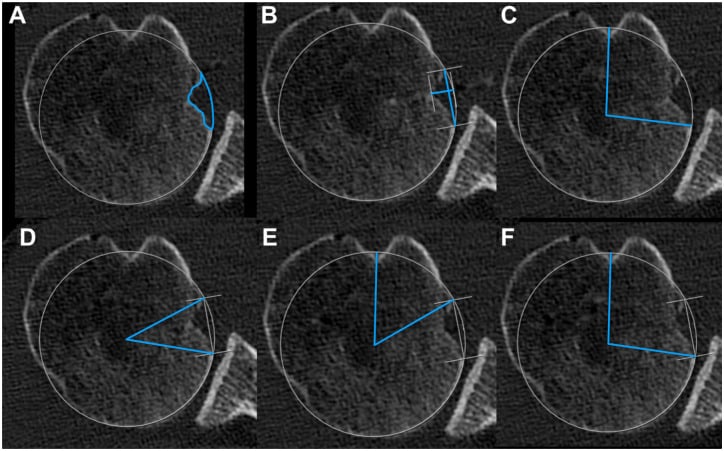
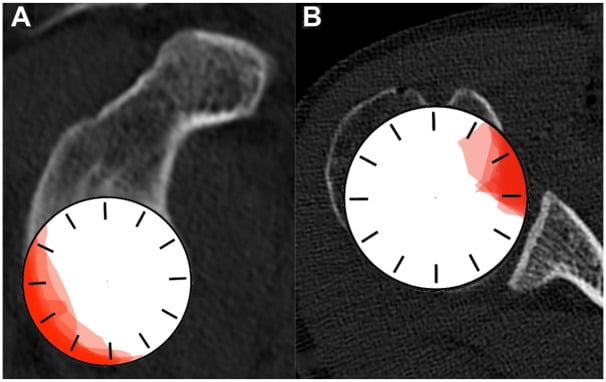
The glenoid track. The concept was developed for anterior instability. Through the range of motion the glenoid keeps a contact zone that sweeps across the humeral head, the glenoid track, classically about 83% of the glenoid width. A defect that stays within that zone throughout motion is on-track: the rim never drops into it and the shoulder is stable. A defect that extends beyond the medial margin of the track is off-track: the rim falls into it and the head dislocates, or engages.
The posterior analogue. Applied to the reverse Hill-Sachs, the same logic runs against the posterior rim. Posterior glenoid bone loss and an anteromedial humeral-head defect are opposing lesions, and they combine to narrow the contact track that remains (see the clockface maps below):
- Anterior (Hill-Sachs)
- Anterior glenoid
- Posterior (reverse Hill-Sachs)
- Posterior glenoid
- Anterior (Hill-Sachs)
- Defect clears the anterior track and engages
- Posterior (reverse Hill-Sachs)
- Anteromedial defect clears the posterior track and engages
- Anterior (Hill-Sachs)
- Address bone (remplissage/Latarjet) not labrum alone
- Posterior (reverse Hill-Sachs)
- Address bone (remplissage/McLaughlin/graft) not reverse Bankart alone
Why it matters. An off-track reverse Hill-Sachs is exactly the lesion in which an isolated soft-tissue (reverse Bankart) repair fails. The bony defect must be filled or bypassed, by reverse remplissage, modified McLaughlin or allograft, or the track effectively widened. A small on-track defect can be stabilised by soft-tissue or non-operative means, and this is the biomechanical justification for the size-based algorithm and for the engaging-lesion warning.
The caveat. The glenoid-track and gamma-angle numbers are extrapolated from anterior instability. They are biomechanically plausible but not yet validated in robust posterior cohorts, so use them as a framework rather than a hard cut-off (see Controversies). The fully validated anterior glenoid track is developed in the Hill-Sachs and glenoid-bone-loss topics.
Classification Systems
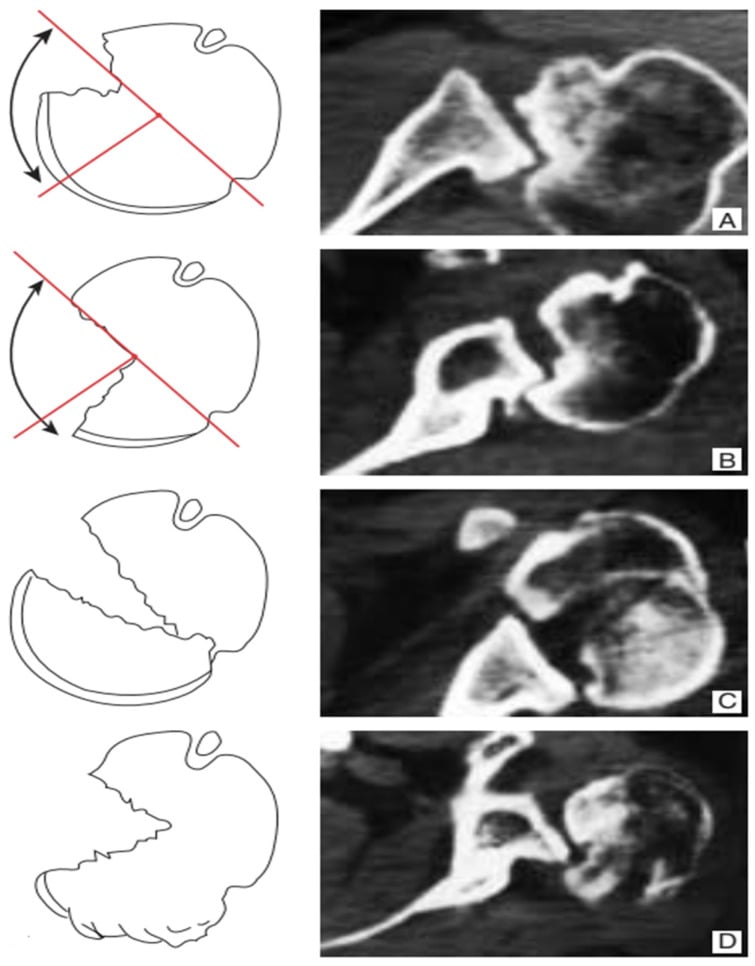
Defect size. The percentage of the articular surface involved is the most clinically useful classification for decision making. The critical size is put at 20-25% depending on the source: larger defects are unstable and engage with the posterior glenoid rim.
- % of Head
- under 20%
- Stability
- Stable
- % of Head
- 20-45%
- Stability
- Unstable
- % of Head
- over 45-50%
- Stability
- Grossly Unstable
Gamma angle. The angle between the axis of the defect and the anatomical neck, used to predict instability. An angle greater than 90 degrees suggests a higher risk of engaging.
Chronic dislocations. One classification separates 20-50% humeral-head deficiency, over 50% deficiency and fracture-dislocation patterns, because each demands a different reconstructive ceiling.
Clinical Assessment
History. A seizure, an electric shock, or a fall on the flexed, adducted arm, followed by pain, a "locked" shoulder and inability to externally rotate. In the missed case the patient has been treating it as a "frozen shoulder" for months.
Examination. The arm is held in adduction and internal rotation. The anterior shoulder is flattened and the coracoid prominent, with fullness posteriorly. A block to external rotation is pathognomonic of a locked posterior dislocation.
Tests for posterior instability. Always compare with the contralateral side:
- Posterior drawer test - supine; axial load plus posterior force
- Jerk test - seated; flexion to 90, adduction and axial load, with a "clunk" as the head subluxes posteriorly
- Kim test - a variation of the jerk test for inferior-posterior labral pathology
- Load and shift - grades translation (Grade I-III)
Neurovascular. Test the axillary nerve: sensation over the regimental badge area and deltoid function. It is less commonly injured in posterior than in anterior dislocation, but verify it.
Investigations
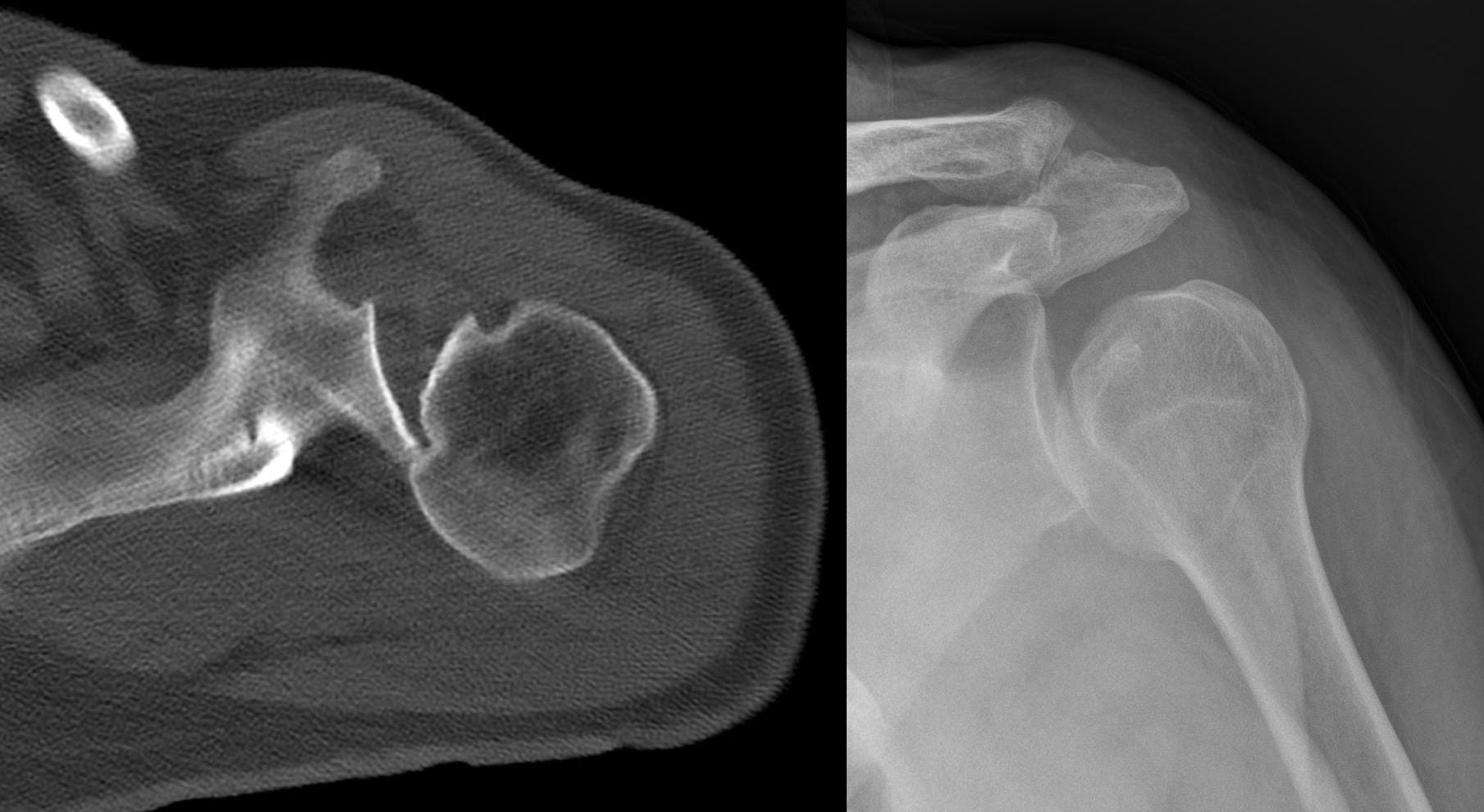
Radiographs. The trauma series is an AP, an axillary lateral and a scapular Y. The axillary lateral is the gold standard, showing the head posterior to the glenoid; on the scapular Y the head lies posterior to the intersection of the Y. The AP carries its own signs:
- Lightbulb sign - the internally rotated head looks symmetrical (pearl below)
- Loss of the half-moon overlap
- Trough line sign - the impression fracture seen on the AP
- Rim sign - joint space widened to greater than 6mm
On AP X-ray, the humeral head is fixed in internal rotation. The greater tuberosity rotates anteriorly, making the head look perfectly round (like a lightbulb) rather than its normal walking-stick appearance.
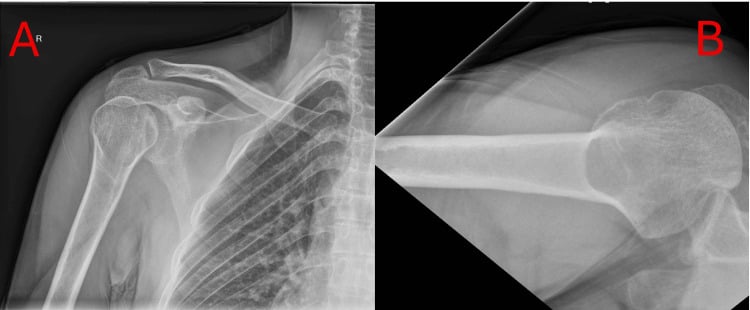
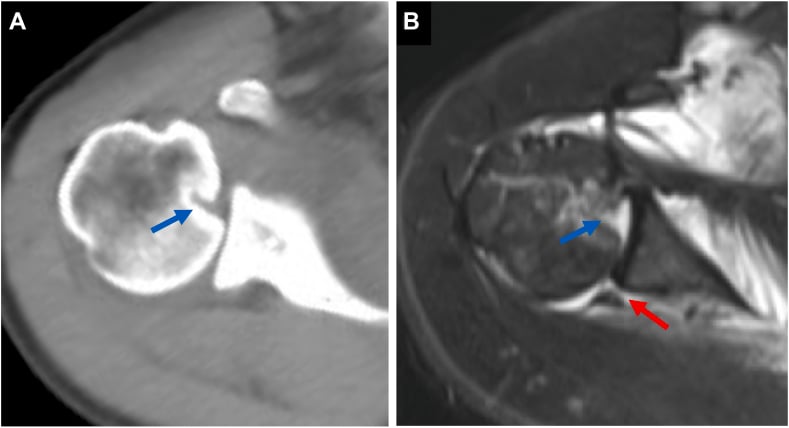
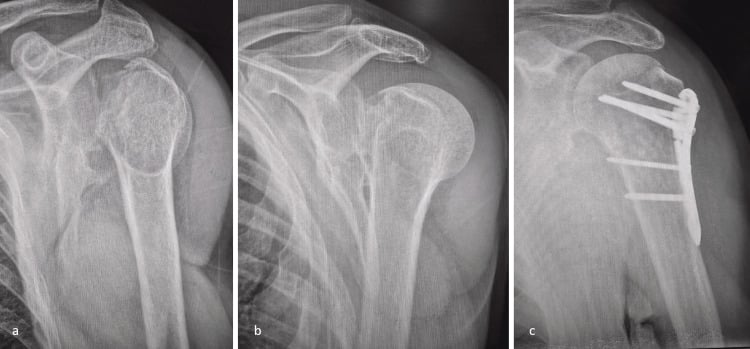
CT is mandatory for operative planning. It quantifies the defect as a percentage of the articular surface and assesses glenoid bone loss, the reverse bony Bankart.
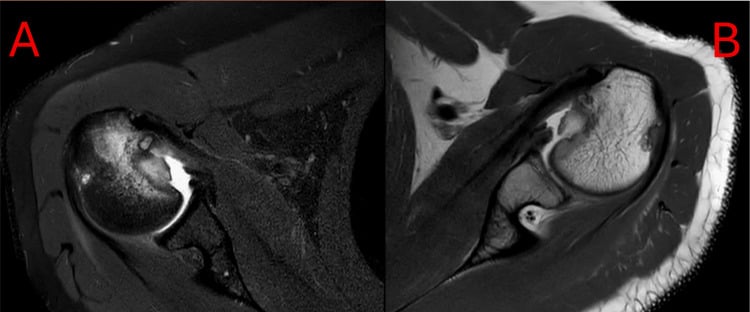
MRI assesses the posterior labrum (reverse Bankart) and cuff integrity (subscapularis). It is often done if the diagnosis is unclear or for chronic pain.
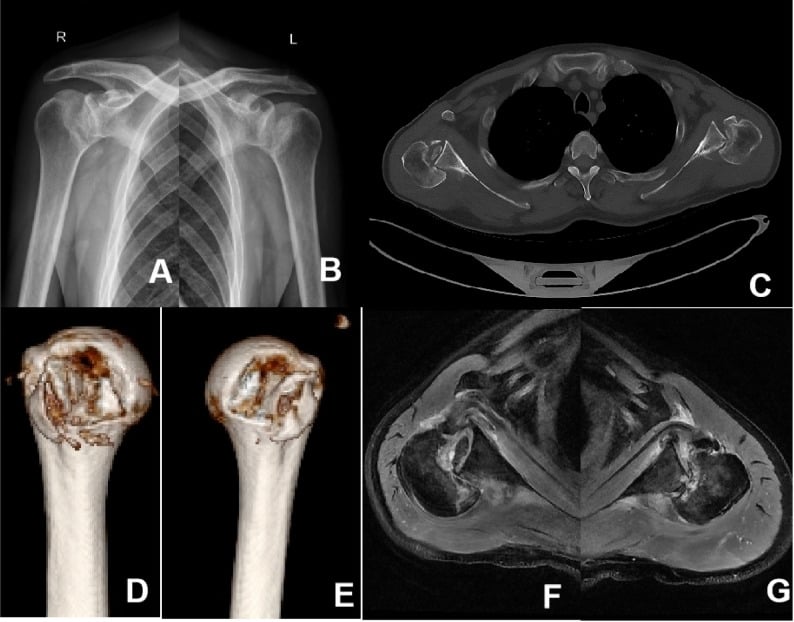
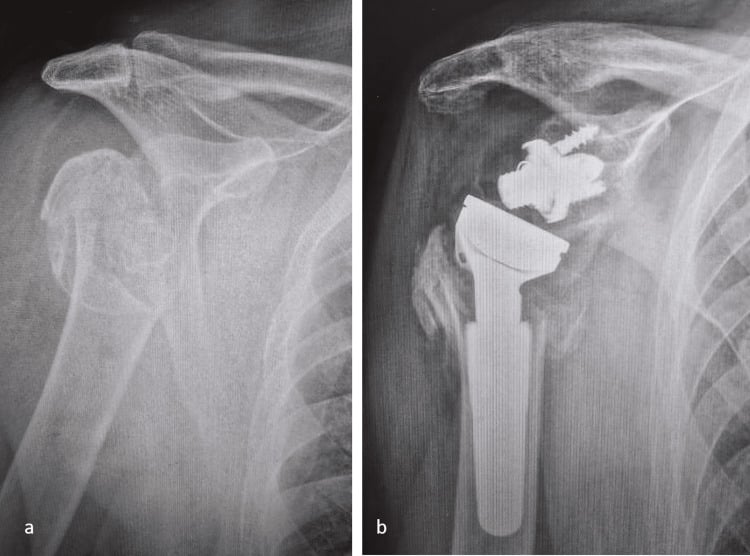
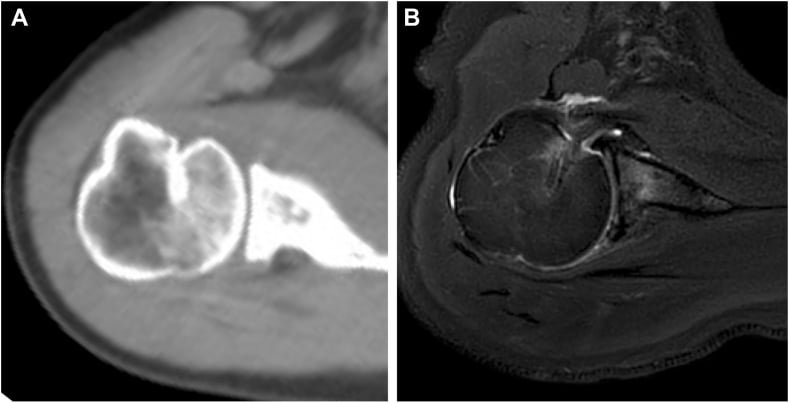
Bilateral dislocations. When both shoulders are injured, pairing radiographs, CT, 3D reconstruction and MRI exposes side-to-side differences in defect size, head viability and cuff condition before reconstruction.
Differential Diagnosis
A patient with a painful, stiff, internally-rotated shoulder after a seizure or fall is easily mislabelled. The differentials below are the classic exam traps.
- Discriminating Feature
- Fixed internal rotation, block to external rotation, lightbulb sign
- Key Investigation
- Axillary lateral / CT
- Pitfall
- Missed as 'frozen shoulder'
- Discriminating Feature
- Global loss of passive AND active ROM, normal joint congruity
- Key Investigation
- Normal radiographs
- Pitfall
- Both block ER, but capsulitis has a congruent joint
- Discriminating Feature
- Discrete fracture lines, crepitus, ecchymosis
- Key Investigation
- AP + axillary; CT for comminution
- Pitfall
- Fracture-dislocation may coexist
- Discriminating Feature
- Arm in abduction/ER, posterolateral head defect
- Key Investigation
- AP + axillary
- Pitfall
- Opposite engaging position (Abd+ER)
- Discriminating Feature
- Recurrent positional subluxation, no impaction defect
- Key Investigation
- MR arthrogram
- Pitfall
- Soft-tissue repair alone fails if a bony defect is present
Management Algorithm
Acute (under 3 weeks). The goal is to reduce the head and keep it reduced. Closed reduction is done under conscious sedation or GA with traction and gentle anterior pressure; avoid force, which risks fracture. Early reduction minimises cartilage damage.
Small defects (under 20%) are stable after reduction and are treated by closed reduction or neglect.
After reduction. A stable shoulder is immobilised in external rotation (gunslinger brace) for 4-6 weeks. If it redislocates or engages in functional range of motion, it goes to surgery.
Chronic or unstable: operate by size. Once the head is judged salvageable, defect size chooses the procedure:
- Procedure
- Arthroscopic Remplissage / Plication
- Rationale
- Fill small defect with capsule
- Procedure
- Modified McLaughlin
- Rationale
- Transfer Lesser Tuberosity into defect
- Procedure
- Allograft Recon
- Rationale
- Femoral head / Humeral head allograft
- Procedure
- Hemi / Total Arthroplasty
- Rationale
- Head geometry destroyed
Surgical Technique
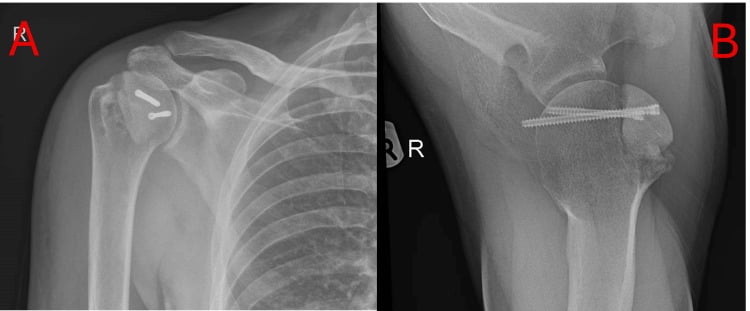
Modified McLaughlin. McLaughlin's original operation transfers the subscapularis tendon into the defect; the modified procedure transfers the lesser tuberosity with subscapularis attached. The bony plug fills the hole and the tightened subscapularis acts as a check-rein preventing internal rotation. Careful protection of the axillary nerve is required.
- Deltopectoral approach
- Identify the anteromedial impression fracture
- Lesser tuberosity osteotomy, with subscapularis attached
- Reduce the humeral head into the glenoid
- Prepare the defect bed with curette or burr to encourage healing
- Secure the lesser tuberosity bone block into the defect with screws or suture anchors
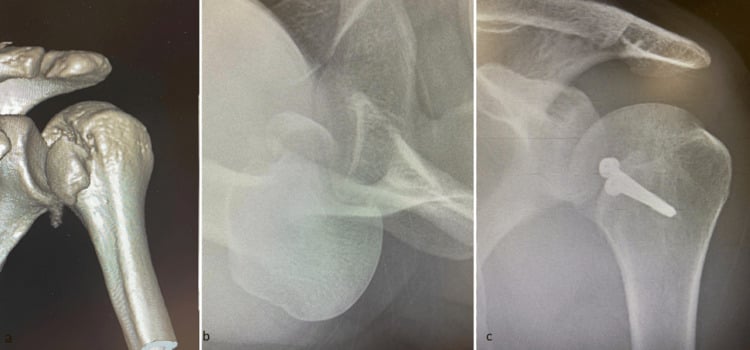
Disimpaction and grafting. In an intermediate defect the impacted articular surface is elevated, the void packed with cancellous graft and the subscapularis repaired anatomically (see Controversies for disimpaction against filling the defect).
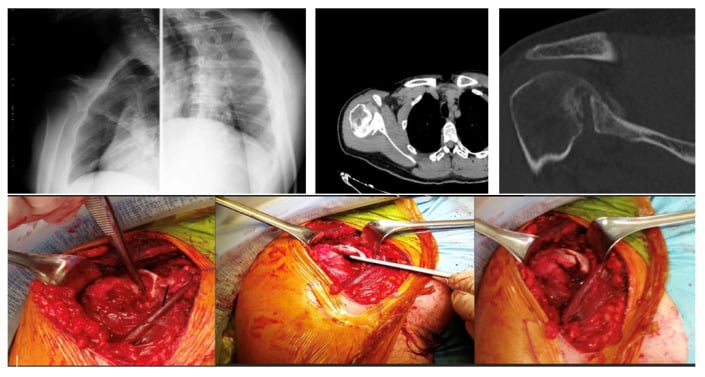
Segmental allograft. Used when the defect is large but the joint is salvageable, in a young patient. Through a deltopectoral approach, a fresh femoral head or humeral head allograft is shaped to match the defect ("snowman" or wedge shape) and fixed with countersunk headless compression screws. It restores spherical head shape effectively, but allograft availability can be a limiting factor.
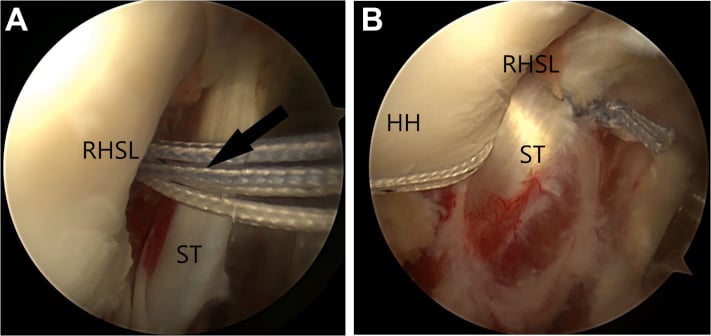
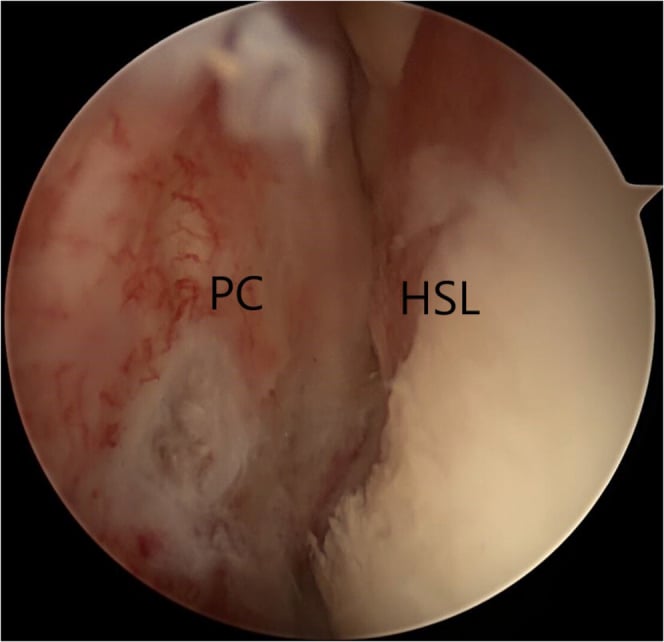
Arthroscopic reverse remplissage. The defect is filled with subscapularis via suture anchors: an anterior anchor is placed at the centre of the prepared defect and mattress sutures secure the subscapularis into it. In the case below the posterior labrum is repaired at the same time, addressing both humeral and glenoid-sided instability. The technique is good for small and medium defects, although the size algorithm above lists it for defects under 20% (see Controversies).
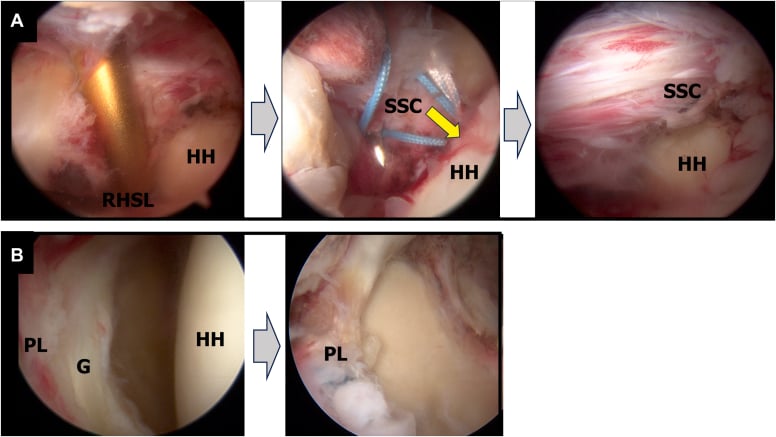
Combined bipolar defects. When a Hill-Sachs and a reverse Hill-Sachs lesion coexist, posterior anchors capture capsule and infraspinatus while the anterior subscapularis transfer fills the reverse defect.
Arthroplasty. Reserved for defects over 45-50% or older low-demand patients. The choice follows the glenoid and the cuff:
- Hemiarthroplasty if the glenoid is intact, though it is less commonly used now due to glenoid erosion risk
- Anatomic total shoulder if the glenoid is arthritic but the cuff intact
- Reverse total shoulder if the cuff is deficient or in the very elderly
Complications
- Risk Factors
- Undersized graft, Missed engaging lesion
- Prevention/Management
- Ensure defect is filled/bypassed
- Risk Factors
- Damage to cartilage, hardware penetration
- Prevention/Management
- Countersink screws, accurate reduction
- Risk Factors
- Poor fixation of osteotomy
- Prevention/Management
- Protect range of motion (ER) post-op
- Risk Factors
- Screw heads prominent
- Prevention/Management
- Use headless screws
Postoperative Care
Rehab Protocol (Modified McLaughlin)
Gunslinger brace, neutral to external rotation. No internal rotation, which protects the subscapularis transfer; passive external rotation is allowed.
Wean the sling, start active-assisted range of motion and begin gentle internal rotation stretching.
Rotator cuff and scapular stabiliser strengthening; return to sport or work assessment.
Outcomes and Prognosis
Modified McLaughlin. Good to excellent results in 75-85% of patients, with a low recurrence rate if sized correctly.
Allograft. A technical procedure, but it shows good survival at 10 years. The risks are graft resorption and necrosis.
Neglected cases. Associated with poor functional outcomes and rapid progression to osteoarthritis if left unreduced.
Guidelines, Registries & Global Practice
Posterior dislocation accounts for roughly 2-5% of all shoulder dislocations. Population-based data (Edinburgh cohort) give a prevalence of about 1.1 per 100,000 per year, with peaks in men aged 20-49 and in the elderly; roughly two-thirds are traumatic and most of the remainder seizure-related.
There is no single dedicated guideline; AAOS (US), BOA/BESS (UK), AO Foundation and EFORT teaching converge on the same principles — mandatory axillary/CT imaging, treat by defect size, and prefer joint preservation in young patients.
- Emphasis
- Anatomy of impaction & fixation principles
- Practical Point
- Restore head sphericity; countersunk/headless fixation
- Emphasis
- Avoiding missed diagnosis; specialist referral
- Practical Point
- Three radiographic views mandatory after seizure/electrocution
- Emphasis
- Joint preservation in the young
- Practical Point
- Reconstruct rather than replace where the head is viable
Arthroplasty registries (NJR, AJRR, AOANJRR, Swedish/Norwegian) do not isolate reverse Hill-Sachs as an indication, but they inform implant choice when arthroplasty is required: reverse total shoulder is increasingly preferred over hemiarthroplasty in older patients with cuff compromise or unreconstructable bone loss.
Where CT and allograft banking are available, defect quantification and osteochondral allograft expand head-preserving options. In limited-resource settings, autograft modified McLaughlin (no implant dependency) and rotational osteotomy are favoured, and late presentation of neglected locked dislocations is more common.
Related pages: Posterior Shoulder Instability is the parent condition and the page that matters most here - a reverse Hill-Sachs is one structural cause of it, and the recurrent instability Robinson quantified is managed there; Hill-Sachs Lesions for the anterior mirror image, whose glenoid-track and remplissage concepts are borrowed by this page but were derived for the opposite direction and the opposite bone loss; Proximal Humerus Fractures because a fifth of Hawkins' locked dislocations carried an undisplaced proximal humeral fracture and the fracture-dislocation is a different operation; Avascular Necrosis of the Shoulder for the head-viability question that overrides defect size in the algorithm above; and Reverse Total Shoulder Arthroplasty and Total Shoulder Arthroplasty for the salvage end of the ladder once the head is unreconstructable.
Controversies & Areas of Uncertainty
Quoted cut-offs (20%, 25%, 40%, 50%) come from small heterogeneous series, not prospective comparisons. Most authors reconstruct intermediate defects (~25-50%) and reserve arthroplasty for over ~45-50% with head collapse, but the exact threshold for any individual head remains judgement-based.
Arthroscopic transfer / capsular fill techniques are increasingly described for small-to-intermediate engaging lesions, but comparative evidence against open modified McLaughlin is limited to case series. Open transfer remains the most validated approach for larger defects.
Some advocate elevating the impacted articular fragment with subchondral bone grafting to restore native cartilage, versus filling/bypassing the defect (McLaughlin, allograft). No high-level data favour one strategy.
The glenoid-track and "gamma angle" concepts are extrapolated from anterior instability; their predictive value for posterior engagement is biomechanically plausible but not yet validated in robust clinical cohorts.
MCQ Practice Points
Q: What is the most common nerve injury associated with posterior shoulder dislocation? A: While the Axillary nerve is most common in anterior dislocations, checking it is still mandatory. However, posterior dislocations have a lower rate of nerve injury overall compared to anterior.
Q: Which fracture is pathognomonic for a posterior shoulder dislocation? A: A Lesser Tuberosity fracture (avulsion by the subscapularis tendon) is pathognomonic and indicates a posterior dislocation mechanism.
Q: What is the 'Rim Sign' on an AP shoulder X-ray? A: The Rim Sign is a widening of the glenohumeral joint space greater than 6mm on the AP view, indicating posterior displacement of the head.
Q: What is the 'Trough Line Sign'? A: It appears as two parallel lines of dense cortical bone on the AP X-ray, representing the impaction fracture (Reverse Hill-Sachs) of the anteromedial humeral head.
Q: Which muscle group is responsible for posterior dislocation during a seizure? A: The massive internal rotators (Latissimus Dorsi, Pectoralis Major, Subscapularis) overpower the weaker external rotators, driving the head posteriorly.
Exam Viva Scenarios
Practise clinical reasoning and management decisions out loud
“A 45-year-old male presents with a 'frozen shoulder' for 3 months after a seizure. He cannot externally rotate past neutral. Show me the X-rays you would order and describe the findings.”
“You confirm a locked posterior dislocation. A CT scan shows a Reverse Hill-Sachs lesion involving 35% of the articular surface. The head is viable. How do you manage this?”
“Explain the concept of an 'Engaging' Reverse Hill-Sachs lesion and how it differs from an engaging anterior Hill-Sachs.”
Anatomy
- Impaction of Anteromedial Head
- Engages in Adduction + IR
- Posterior dislocation association
- Subscapularis tendon involvement
Classification (Size)
- Small (under 20%) = Stable
- Medium (20-45%) = Unstable/Recon
- Large (over 45%) = Arthroplasty
- Gamma angle greater than 90 deg = Unstable
Clinical Signs
- Locked in Internal Rotation
- Prominent Coracoid
- Flattened anterior shoulder
- Posterior fullness (humeral head)
Imaging
- Lightbulb Sign (AP)
- Trough Line Sign (Impaction)
- Axillary Lateral = Diagnostic
- Rim Sign: Widened joint space greater than 6mm
Treatment
- Acute less than 3wks + Small = Reduction + Brace
- Chronic/Med = Mod. McLaughlin
- Large/Collapse = Hemi/Total
- Remplissage for small engaging lesions
Complications
- Missed diagnosis (common)
- Recurrent instability
- AVN (late collapse)
- Arthritis
Evidence Base
Locked Posterior Dislocation — the Landmark Series
- Diagnosis had been missed by the initial physician in the majority of cases; mean injury-to-diagnosis interval was 1 year
- Causes: motor-vehicle accident, seizure, alcohol-related injury, or electroshock therapy
- An axillary radiograph confirmed the diagnosis in all 41 shoulders and showed the defect size
- Lesser-tuberosity transfer succeeded in all 4 shoulders treated; subscapularis transfer succeeded in 4 of 9
Defect-Size Treatment Algorithm
- Small impression defects are usually stable after closed reduction
- Intermediate defects (roughly 25-50%) require reconstruction (McLaughlin / bone graft)
- Defects over ~50% with head collapse require prosthetic replacement
- CT quantification of the defect is central to the decision
Epidemiology & Risk of Recurrence
- Prevalence of posterior dislocation 1.1 per 100,000 population per year
- 67% caused by trauma, most of the remainder by seizures
- 17.7% of shoulders developed recurrent instability within the first year
- Age under 40, seizure mechanism, and large reverse Hill-Sachs (over 1.5 cm3) predicted recurrence
Head-Preserving Surgery for Chronic Dislocation
- For chronic posterior dislocation, the two dominant techniques were McLaughlin / modified McLaughlin and bone-graft reconstruction
- Both consistently produced good functional outcomes with few complications
- Chronic anterior dislocation techniques were far more variable with high resubluxation and early arthrosis
- Conservative neglect of chronic dislocation produced poor functional results
Osteochondral Allograft in the Shoulder
- Reverse Hill-Sachs lesions were the single most common indication for shoulder OCA (33 of 83 shoulders)
- 68 of 83 shoulders had favourable outcomes (graft incorporation, pain, function, satisfaction)
- Mean follow-up 45.7 months
- Unfavourable results clustered in concomitant surgery and pain-pump chondrolysis cases
Modified McLaughlin — Functional Outcomes
- Lesser-tuberosity transfer plus artificial bone fixed with lag screws and sutures for 30-40% defects
- Constant-Murley score improved from 46.0 to 85.8 at mean 19.8 months (p=0.001)
- No residual instability and full return to daily activity in all 5 patients
- Reinforces the modified McLaughlin as a reliable joint-preserving option for intermediate defects