Most Common Carpal Instability | DISI Pattern | Watson Test | SLAC Progression
- Dorsal SL ligament is strongest and most important - tears progress palmar to membranous to dorsal
- Watson scaphoid shift test - thumb on scaphoid tubercle, radial deviation produces painful clunk
- Terry Thomas sign - SL gap over 3mm on PA radiograph (named after gap-toothed comedian)
- DISI pattern - lunate extends as scaphoid flexes, SL angle over 70 degrees on lateral
- SLAC wrist is the pattern an untreated STATIC dissociation follows - radial styloid to scaphoid fossa to capitolunate - but it is not the fate of every SL tear; low-grade tears found incidentally at distal radius fixation often never become static
- “Always compare Watson test to contralateral side - may be positive bilaterally in lax patients
- “Acute repair (under 6 weeks) has best outcomes - direct ligament repair with K-wire fixation
- “Chronic SL injury needs reconstruction not repair - tissue too degenerated to hold sutures
- “SLAC wrist spares radiolunate joint - allows salvage with PRC or 4-corner fusion
Overview
Scapholunate dissociation is the most common and most important form of carpal instability, the most common carpal instability pattern (95%). It results from failure of the scapholunate interosseous ligament (SLIL), which allows abnormal motion between the scaphoid and lunate and, with it, carpal malalignment.
Why it matters. The injury is often missed at first presentation, because the instability is occult, and the success of treatment is highly time-dependent. An untreated static dissociation follows a predictable pattern of arthritis, the SLAC wrist. Understanding SL pathology is fundamental to wrist surgery.
Who. The true incidence is unknown, since many cases go undiagnosed at first. Young adults aged 20-40 are the commonest group, with a male predominance put down to occupational exposure.
Associated injuries. Look for the SL ligament whenever one of these is present:
- Distal radius fracture - 5-30% have an SL injury
- Perilunate injury - the SL ligament is always involved
- Greater arc (trans-scaphoid) injury
Natural history. The torn ligament starts as dynamic instability. In the wrists that progress, static instability develops over months to years and the SL gap widens, and the arthritis that follows runs in the SLAC sequence staged below. Not every patient progresses: the rate varies with activity level and with the competence of the secondary stabilisers.
The teaching that every untreated scapholunate tear marches to arthritis comes from looking backwards, at wrists that already have SLAC, and asking what caused them. Asked forwards it does not hold. 51 consecutive patients under 60 with displaced distal radius fractures were assessed arthroscopically and 32 had an SL ligament tear — 10 of them complete Lindau grade 3 — and none of these tears was treated (DOI, prognostic level II). At 13 to 15 years, 38 patients returned: grip strength 83% of the other side after a complete tear versus 92% after a partial or absent tear, median DASH 2 versus 9, and no significant difference in pain, motion or forearm rotation. Critically, not one patient developed a static SL dissociation or a SLAC wrist. The authors note no grade 4 tear was present in the series, which is exactly where the caveat lies.
What survives, and it is most of the teaching. The SLAC sequence is real and is examined for good reason: radial styloid, then scaphoid fossa, then capitolunate, with the radiolunate joint spared, which is precisely why a proximal row carpectomy works. A static dissociation with a fixed gap and a DISI lunate is a mechanically failed wrist and does progress. What is false is applying that fate to every torn fibre.
Both directions matter here, and over-treatment is the graver one. Believing the injury is universally missed leads to under-diagnosis of the true static dissociation — real, and the reason the Watson test and a clenched-fist view still matter. But believing progression is universal leads to operating on incidental low-grade tears found during distal radius fixation, and that surgery is not benign: a systematic review of 17 studies of chronic non-arthritic SL dissociation reported a 20% complication rate and 3.8% CRPS, with the authors explicitly flagging the implication for consent (DOI).
So what do you actually do. Separate the two situations before choosing. A partial tear found arthroscopically at the time of distal radius fixation, with normal static radiographs, is watched and rehabilitated, not stabilised. A widened gap on a PA with the fist clenched, a DISI lunate on the lateral, or a tear that is complete and unstable to probing, is the wrist that earns reconstruction — and the honest consent line is that surgery is offered to protect against a risk of progression, not a certainty of it.
Anatomy
The ligament. The SLIL is C-shaped and joins the scaphoid and lunate along their proximal articular margins. Its three regions differ in structure and in strength, and the dorsal region is the one that matters.
- Composition
- True ligament (collagen fibres)
- Yield strength
- Strongest: 260.3 N (SD 118.1)
- Role
- Greatest constraint to differential translation; with the palmar region, constrains differential rotation
- Composition
- True ligament
- Yield strength
- Second: 117.9 N (SD 21.3)
- Role
- With the dorsal region, constrains differential rotation
- Composition
- Fibrocartilage
- Yield strength
- Weakest: 62.7 N (SD 32.2)
- Role
- Minimal structural role
The yield strengths come from Berger's study of 24 cadaver wrists (PMID 10509273). The dorsal standard deviation is nearly half its mean, so the rank order is secure but the gap between any two individual wrists is not. Whether examining or reconstructing, focus on the dorsal component: repair or reconstruction must address it.
Secondary stabilisers. When the SLIL fails, other ligaments give some restraint. Where they are competent, a patient may keep function despite the SL injury, which is why not every injury progresses.
- Intrinsic - scaphotrapezial (ST) and scaphocapitate (SC) ligaments
- Extrinsic - radioscaphocapitate (RSC), dorsal intercarpal (DIC) and dorsal radiocarpal (DRC) ligaments
Normal kinematics. The scaphoid, set obliquely, naturally tends to flex. The lunate is the intercalated segment, with no tendon attachments; while the SL ligament is intact it couples the two bones, and the lunate follows the scaphoid into flexion.
After the ligament fails. The unconstrained scaphoid flexes further while the lunate follows the triquetrum into extension. That is dorsal intercalated segment instability (DISI), and the SL gap widens progressively. Complete SL sectioning is required to produce the DISI pattern.
Classification Systems
Garcia-Elias staging is the most useful clinical staging system. Each stage carries its treatment:
- Findings
- Partial tear, no DISI; radiographs normal
- Treatment
- Arthroscopic debridement, thermal shrinkage
- Findings
- Complete tear, repairable; dynamic instability, reducible; radiographs normal or abnormal on stress views only
- Treatment
- Direct repair with bone anchors, dorsal capsulodesis, K-wire fixation
- Findings
- Complete tear, irreparable
- Treatment
- Dorsal capsulodesis
- Findings
- Complete tear with static instability: widened SL gap, DISI reducible, no arthritis
- Treatment
- Soft-tissue (tendon) reconstruction - modified Brunelli, SLAM
- Findings
- Fixed, irreducible DISI, no arthritis
- Treatment
- SL arthrodesis or limited fusion (STT/SC)
- Findings
- DISI with arthritis: SLAC changes, up to severe diffuse (pancarpal) arthritis
- Treatment
- Salvage - PRC or four-corner fusion; total wrist arthrodesis for end-stage disease
Dynamic instability. The resting radiographs are normal and the widening shows only under stress, such as a clenched fist; the secondary stabilisers are still functioning. The prognosis is better, and it may respond to capsulodesis.
Static instability. The SL gap is widened on resting films, without stress. The ligament has failed completely and the secondary stabilisers have failed with it, and the wrist requires reconstruction.
The SLAC wrist. Untreated static dissociation degenerates in a predictable order, and the stage sets the treatment:
- Arthritis
- Radial styloid-scaphoid articulation
- Radiographic finding
- Radial styloid osteophytes and sclerosis
- Timeline quoted
- 5-10 years
- Treatment
- Radial styloidectomy with denervation
- Arthritis
- Entire radioscaphoid joint
- Radiographic finding
- Scaphoid fossa joint-space narrowing, subchondral cysts
- Timeline quoted
- 10-15 years
- Treatment
- PRC or four-corner fusion
- Arthritis
- Capitolunate articulation
- Radiographic finding
- Midcarpal joint-space narrowing
- Timeline quoted
- 15-20+ years
- Treatment
- PRC (if capitate head intact) or four-corner fusion
The timelines are convention: the series that named the pattern could not tell how often or how fast an untreated dissociation progresses.
The radiolunate joint is always spared. The lunate keeps a congruent articulation with the radius, and no abnormal load is transmitted across the radiolunate joint. That preservation is the key to salvage surgery: a proximal row carpectomy relies on the intact lunate fossa for the capitate to articulate with.
Geissler arthroscopic grading describes the tear as seen through the arthroscope:
- Radiocarpal View
- Attenuation/haemorrhage
- Midcarpal View
- No incongruency
- Treatment Implication
- Conservative or debridement
- Radiocarpal View
- May have incongruency
- Midcarpal View
- Step-off, cannot pass probe
- Treatment Implication
- Debridement or pinning
- Radiocarpal View
- Incongruency
- Midcarpal View
- Can pass 1mm probe
- Treatment Implication
- Arthroscopic or open repair
- Radiocarpal View
- Gross instability
- Midcarpal View
- Can pass 2.7mm scope
- Treatment Implication
- Open repair essential
- CID - Carpal Instability Dissociative: the abnormal motion is within a single carpal row, i.e. between bones connected by an interosseous ligament. Scapholunate dissociation (DISI) and lunotriquetral dissociation (VISI) are the two members. This is where SL dissociation sits.
- CIND - Carpal Instability Non-Dissociative: instability between rows (radiocarpal or midcarpal) with the intrinsic interosseous ligaments intact - e.g. midcarpal instability, the "catch-up clunk."
- CIC - Carpal Instability Complex (Combined): features of both dissociative and non-dissociative patterns together - e.g. perilunate dislocation (combined greater/lesser-arc instability).
- CIA - Carpal Instability Adaptive: carpal malalignment driven by an extra-carpal cause, classically a malunited distal radius (dorsal tilt) producing a compensatory midcarpal/DISI-like posture - treated by correcting the radius, not the carpus.
Asked to classify carpal instability, lead with the four categories, then place SL dissociation as the commonest CID, and remember that CIA means looking at the distal radius before blaming the ligaments.
Clinical Assessment
History. The typical story is a fall on the outstretched hand, with the wrist in hyperextension and ulnar deviation. There may have been an initial "sprain" that never fully recovered, followed by progressive wrist pain and weakness, with clicking or clunking on movement. The questions that shape treatment:
- Time since injury - critical for treatment planning
- Previous treatment attempts
- Hand dominance and occupation
- Functional demands
Inspection and palpation. Look for dorsal wrist swelling and, if the gap is wide, a scaphoid prominence, and compare with the other wrist. The SL interval lies 1cm distal to Lister's tubercle, in line with the third metacarpal. It is tender over the dorsal SL ligament, and a step-off between scaphoid and lunate may be felt.
The Watson scaphoid shift test is the primary clinical test, and the gold standard for SL instability.:
- Patient seated, forearm pronated
- Examiner's thumb on the scaphoid tubercle (palmar)
- Other hand controls the wrist
- Start in ulnar deviation (scaphoid extended)
- Apply dorsal pressure on the scaphoid tubercle
- Move the wrist from ulnar to radial deviation
- In radial deviation the scaphoid wants to flex, and the pressure blocks it
- Positive: painful dorsal subluxation of the scaphoid
- Release the pressure: a painful clunk as the scaphoid reduces
Reading the Watson test. A positive test requires pain with the clunk, not just motion, and apprehension is also significant. Physiological laxity is common, so always compare the opposite side. A negative test does not rule out an SL injury.
Other tests.
- Scaphoid compression test - axial load on the scaphoid causes pain
- SL ballottement - stabilise the lunate and translate the scaphoid dorsally and palmarly
- Finger extension test - pain with resisted finger extension
Grip strength. Measure it against the other side: it is often 50-70% of normal. It is an important functional measure and tracks with the success of treatment.
- Distinguishing Features
- Positive Watson test, dorsal SL tenderness, FOOSH mechanism
- Key Investigation
- SL gap over 3mm on PA, SL angle over 70 degrees on lateral
- Distinguishing Features
- Anatomical snuffbox and scaphoid tubercle tenderness, axial thumb pain
- Key Investigation
- Scaphoid-view radiographs, MRI/CT if occult
- Distinguishing Features
- Ulnar-sided pain, positive Reagan ballottement/shuck test
- Key Investigation
- Volar tilt of lunate (VISI), broken Gilula arc ulnarly
- Distinguishing Features
- High-energy injury, gross swelling, median nerve symptoms
- Key Investigation
- Loss of carpal arcs, 'piece of pie'/'spilled teacup' on lateral
- Distinguishing Features
- Ulnar-sided pain, positive fovea sign, painful supination/pronation
- Key Investigation
- MR arthrography or wrist arthroscopy
- Distinguishing Features
- Soft dorsal swelling, transilluminates, no instability on Watson
- Key Investigation
- Ultrasound or MRI
- Distinguishing Features
- Older patient, insidious pain, crepitus rather than clunk
- Key Investigation
- Radial styloid and radioscaphoid joint-space changes
Investigations
Radiographs. Four views, and the other wrist for comparison:
- PA in neutral rotation (forearm pronated)
- True lateral - radius and ulna superimposed
- Clenched-fist PA - the stress view
- PA in radial and ulnar deviation
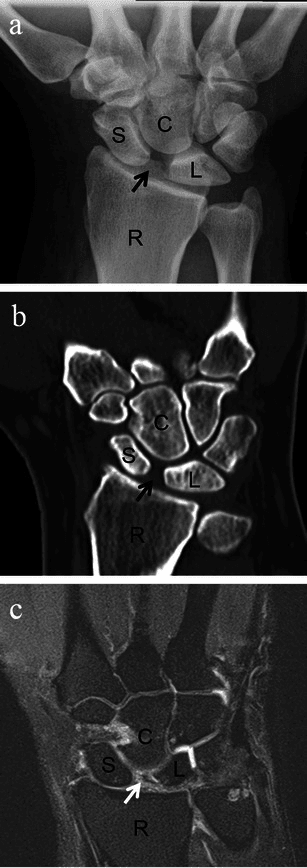
The Terry Thomas sign (the David Letterman sign) is an SL gap greater than 3mm on the PA, and indicates SL ligament injury. It is named after the gap-toothed British comedian; compare with the contralateral wrist.
The scaphoid ring sign. The flexed scaphoid appears foreshortened on the PA and its distal pole projects as a ring, a cortical outline. It indicates scaphoid malrotation, the rotatory subluxation of the scaphoid.
Gilula's arcs. Disruption of any arc indicates carpal malalignment:
- Arc I - proximal surfaces of the proximal carpal row
- Arc II - distal surfaces of the proximal carpal row
- Arc III - proximal surfaces of the hamate and capitate
The SL angle is measured on the true lateral, from the scaphoid axis to the lunate perpendicular. Normal is 30-60°; greater than 70° is the DISI pattern.
- Draw a line along the palmar surface of the scaphoid (or through its proximal and distal poles)
- Draw a line perpendicular to the lunate distal articular surface
- Measure the angle between them
The capitolunate angle runs between the long axis of the capitate and the lunate perpendicular. Normal is under 15°; greater than 15° confirms malalignment.
Stress and comparison views. A clenched fist during the PA loads the carpal joints and widens the SL gap, and may reveal dynamic instability when the static films are normal. Contralateral comparison is essential for interpretation: some bilateral laxity is normal, and the side-to-side difference is more significant than the absolute values.
MRI can visualise the SL ligament directly, but its diagnostic performance depends on field strength. In a systematic review and meta-analysis of 24 studies (1902 examinations, SLIL injury prevalence approximately 33%), pooled sensitivity was 45.7% for 1.5T MRI, 75.7% for 3.0T MRI and 82.1% for MR arthrography, with specificity 80.5%, 97.1% and 92.8% respectively (Hafezi-Nejad et al., 2016). It is less reliable for partial tears, and MR arthrography and 3.0T imaging are preferred when MRI is used.
CT is best for associated fractures; CT arthrography is useful if MRI is contraindicated.
Arthroscopy is the gold standard. It visualises the SL ligament directly, allows Geissler grading, and can treat the injury at the same sitting by debridement or repair.
Management Algorithm
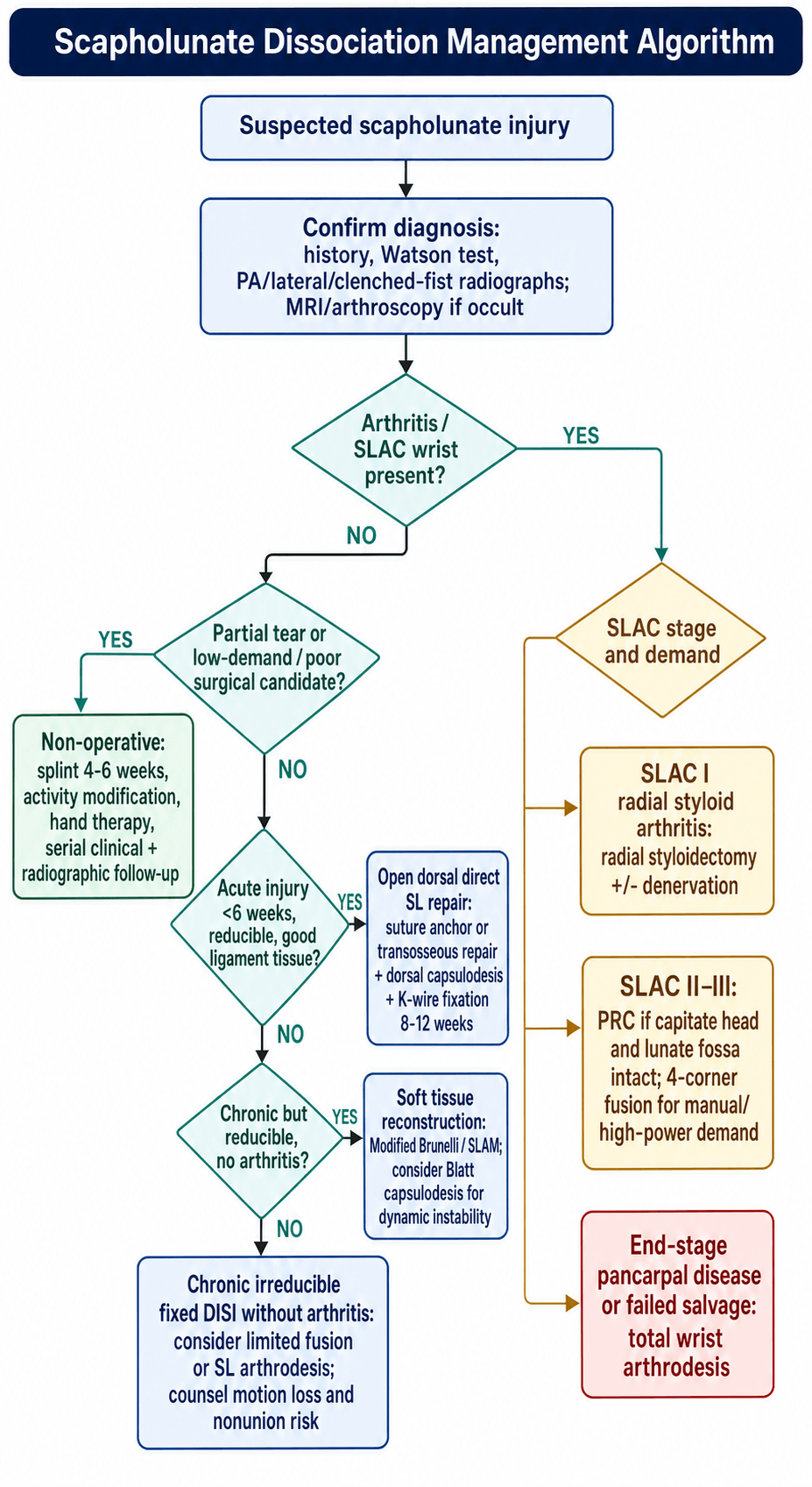
The decision. Time since injury, whether the malalignment reduces and whether there is arthritis set the treatment; the table puts them side by side.
- Presentation
- Recent injury, reducible
- X-ray Findings
- Dynamic widening
- Treatment
- Direct repair + K-wires
- Presentation
- Months old, reducible gap
- X-ray Findings
- Static widening, no arthritis
- Treatment
- Tendon reconstruction
- Presentation
- Fixed DISI deformity
- X-ray Findings
- Static widening, no arthritis
- Treatment
- SL arthrodesis or limited fusion
- Presentation
- Radial-sided pain
- X-ray Findings
- Radial styloid arthritis
- Treatment
- Styloidectomy + denervation
- Presentation
- Diffuse wrist pain
- X-ray Findings
- Scaphoid fossa +/- CL arthritis
- Treatment
- PRC or 4-corner fusion
Non-operative management. It suits partial tears (Geissler I-II), low-demand patients and poor surgical candidates. Partial tears have a good prognosis with conservative treatment and typically respond well to it, but there is a risk of progression without treatment, and the patient must be counselled about the natural history.
- Splinting for 4-6 weeks
- Activity modification
- Hand therapy for proprioception
- Serial clinical and radiographic follow-up
Acute repair, within 6 weeks. A complete tear that is reducible, with good ligament tissue, is repaired directly, and early surgical repair offers the best chance of recovery. The window is 6 weeks, ideally under 3. Through an open dorsal approach the dorsal SL ligament is repaired with bone anchors or transosseous sutures, augmented with a dorsal capsulodesis, and held with K-wires (two SL, one SC) for 8-12 weeks. The steps are under Surgical Technique.
Chronic reducible instability, no arthritis. A chronic injury, over 6 weeks, needs reconstruction rather than repair: the tissue is too degenerated to hold sutures. Soft-tissue reconstruction can restore acceptable function. The options:
- Dorsal capsulodesis (Blatt) - a radially based capsular flap secured to the dorsal scaphoid; good for dynamic instability, less reliable for static
- Modified Brunelli - a strip of half the FCR tendon passed through a scaphoid tunnel and secured to the lunate, combined with capsulodesis
- SLAM (scapholunate axis method) - adds a volar limb to the Brunelli; more anatomical, at higher complexity
- Bone-ligament-bone graft - a free bone-SL-bone graft from cadaver; technically challenging and of limited availability
RASL - Reduction and Association of the Scaphoid and Lunate is a named option an examiner may raise alongside capsulodesis, Brunelli/three-ligament tenodesis, SLAM and arthrodesis. After the SL gap is reduced, a headless compression screw is placed across the scapholunate interval, scaphoid into lunate. The aim is not a bony fusion: the screw holds the reduction while a stable fibrous union/pseudarthrosis forms across the interval, allowing some preserved scapholunate motion.
It is used for chronic reducible SL instability without arthritis, as an alternative to soft-tissue reconstruction, with cannulated headless screws and more recently a continuous-compression implant. The catch is a notable rate of screw loosening/breakage, scaphoid and lunate osteolysis/cyst formation around the screw, loss of reduction and the need for hardware removal: a named option with a high reoperation and loosening profile. That is why many surgeons prefer tendon-based reconstruction (three-ligament tenodesis) for chronic reducible instability, and why RASL has largely been superseded by tendon reconstruction in many units.
Chronic irreducible instability, no arthritis. A fixed DISI deformity that will not reduce, or a failed reconstruction, leaves fusion. SL arthrodesis decorticates the SL articular surfaces, adds bone graft and fixes them with headless screws or K-wires. It has a 30-50% nonunion rate, reduces motion by approximately half and is not recommended first-line; consider reconstruction alternatives first, and STT or SC fusion as alternatives to it. Counsel about motion loss. Limited fusion is a last resort before salvage.
Salvage for the SLAC wrist. Indicated for SLAC stage II or III, significant arthritis, or failed prior reconstruction; stage I is treated by styloidectomy (SLAC table above).
- Proximal row carpectomy (PRC) - remove the scaphoid, lunate and triquetrum so that the capitate articulates with the lunate fossa. Requires intact capitate head cartilage, intact lunate fossa cartilage and no inflammatory arthritis. For lower-demand patients, with faster recovery
- Scaphoid excision and four-corner fusion (the SLAC procedure) - remove the scaphoid and fuse the capitate, lunate, hamate and triquetrum. For manual workers who need power
- Total wrist fusion - for end-stage disease; pain relief at the cost of complete motion loss
Motion-sparing salvage gives good pain relief, with reduced but functional motion that allows a return to modified activities.
Choosing between PRC and four-corner fusion. The outcome figures below favour four-corner fusion for grip and PRC for motion and speed of recovery. The systematic review of 52 studies by Mulford and colleagues found grip strength, pain relief and subjective outcomes similar between the two; PRC gave better range of movement and avoided fusion-specific complications, at the price of more subsequent, usually asymptomatic, radiocarpal osteoarthritis. Patient demand and the state of the capitate head should guide the choice.
Surgical Technique
Indication. An acute tear (under 6 weeks) that is reducible.
Set-up.
- Supine, arm table
- Regional or general anaesthesia
- Upper arm tourniquet
Approach.
- Longitudinal incision over Lister's tubercle (4-5cm)
- Retract EPL radially
- Incise the extensor retinaculum between the 3rd and 4th compartments
- Ligament-sparing capsulotomy, preserving the DRC and DIC ligaments
- Expose the SL interval
Repair.
- Debride fibrous tissue from the SL interval
- Assess the quality of the dorsal ligament
- Reduce the SL gap with pointed reduction forceps
- Place bone anchors (1.4-2.0mm) in the scaphoid and lunate
- Pass the sutures through the dorsal ligament remnants
- Tie the sutures with the interval reduced and the wrist neutral
- Raise a radially based capsular flap
- Advance the capsule to the dorsal scaphoid (Blatt capsulodesis)
- Insert K-wires: two across the SL joint, one scaphoid to capitate
- Confirm reduction and wire position with fluoroscopy
The wires are 1.1-1.25mm, may be buried or left proud, and are removed at 8-12 weeks.
Closure. Repair the extensor retinaculum, close the skin, and apply a volar splint with the wrist neutral.
Complications
Of the injury. The wrist that progresses develops SLAC arthritis in the sequence staged above, with chronic pain and disability: grip weakness, activity limitation and impaired work capacity.
Of surgery in general. Stiffness is the most common.
- Infection (1-2%)
- CRPS
- Nerve injury - superficial radial nerve, PIN
Of repair and reconstruction. Recurrent instability in 20-40%, K-wire complications (migration, infection, breakage) and donor-site morbidity from the FCR harvest.
Of arthrodesis. Nonunion (30-50% for SL fusion), hardware prominence and adjacent joint degeneration.
Of salvage. Radiocapitate arthritis in the long term after PRC; nonunion, hardware failure and hardware prominence after four-corner fusion.
Postoperative Care
After acute repair. The wrist is immobilised for the first 8 weeks in a volar splint or short arm cast, wrist neutral, thumb free, K-wires in situ.
- 8-12 weeks - K-wire removal as an office procedure under local anaesthesia, after confirming healing and maintained reduction on X-ray
- 8-16 weeks - hand therapy referral after wire removal; gentle active range of motion, avoiding forceful gripping at first; progressive strengthening from 12 weeks
- 4-6 months - gradual return to sport and work, which may need modification, with continued strengthening
After reconstruction. Healing takes longer than after acute repair. The wrist is immobilised in a cast or splint for 10 weeks with the K-wires protecting the tenodesis, and the wires come out at 10-12 weeks. Check for recurrent widening at removal, although some gap recurrence is expected. Rehabilitation from 12 to 20 weeks is progressive range of motion and strengthening, aimed at functional goals rather than normal anatomy, accepting some residual weakness.
After PRC. Early motion is the key advantage: there is no internal fixation to protect, and functional recovery is rapid.
- Volar splint for 2 weeks; sutures out at 2 weeks
- Active range of motion immediately after the splint comes off
- Progressive strengthening from 6 weeks
- Full activity at 3-4 months
After four-corner fusion. Immobilisation in a cast or splint for 8-12 weeks, until serial X-rays confirm fusion. Range-of-motion exercises start once the fusion is solid and strengthening at 4-6 months: later motion than PRC, but better strength.
Outcomes/Prognosis
- Satisfactory result
- 80-90% good to excellent
- Motion
- 80-90% of contralateral
- Grip
- 70-80% of contralateral
- Pain
- Significant improvement in 85%
- Other
- 10-20% recurrent instability
- Satisfactory result
- 60-70%
- Motion
- 70-80% of normal
- Grip
- 60-70% of normal
- Pain
- Relief in 70-80%
- Other
- Some gap recurrence common, but may be asymptomatic; residual weakness common
- Satisfactory result
- Only 50-60%
- Motion
- Approximately 50% lost
- Grip
- Pain
- Other
- Nonunion 30-50%; not recommended first-line
- Satisfactory result
- Satisfaction 80-85%
- Motion
- 50-60% preserved (40-50° flexion-extension)
- Grip
- 70-80% of contralateral
- Pain
- Relief in 80-90%
- Other
- Radiocapitate arthritis 10-20% at 10+ years
- Satisfactory result
- Satisfaction 80-90%
- Motion
- 40-50% preserved
- Grip
- 80-90% of contralateral
- Pain
- Relief in 85-90%
- Other
- Nonunion 5-15%; 10-20% need hardware removal
Why acute repairs fail. Delayed repair (over 3 weeks), poor tissue quality and non-compliance are the risk factors for recurrent instability.
Prognostic factors.
- Worse
- Chronic injury, including presentation beyond 12 weeks
- Worse
- Irreducible deformity
- Worse
- Associated fractures
- Worse
- Heavy manual labour
- Worse
- Smoking, diabetes
- Worse
- Poor compliance
Guidelines, Registries & Global Practice
Global Epidemiology
Scapholunate dissociation is the most common pattern of carpal instability, yet its true incidence is unknown because many injuries are occult or misdiagnosed as a simple wrist sprain. The best population-anchored data come from its strong association with distal radius fractures: in Geissler's arthroscopic series of 60 displaced intra-articular distal radius fractures, SLIL tears were present in 32% and any intracarpal soft-tissue injury in 68% (Geissler et al., 1996). Across diagnostic imaging cohorts, the prevalence of SLIL injury among patients investigated for wrist pain is approximately 33% (median, interquartile range 25-42%) (Hafezi-Nejad et al., 2016). Typical patients are young, working-age adults sustaining a fall on the outstretched hand with the wrist in extension, ulnar deviation and intercarpal supination.
Guideline and Society Guidance (Side-by-Side)
No single body publishes a disease-specific clinical practice guideline for scapholunate dissociation; management is governed by consensus from hand-surgery societies and the primary literature rather than by graded national guidelines. The table summarises the orientation of the major bodies.
- Nature of guidance
- No disease-specific CPG; ASSH educational consensus favours early diagnosis, acute primary repair under 6 weeks, reconstruction for chronic reducible injury, salvage for SLAC
- Evidence base
- Expert consensus / Level III-IV cohorts
- Nature of guidance
- No NICE guideline for SL injury; BSSH education and UK practice mirror the stage-based algorithm; arthroscopic assessment widely used
- Evidence base
- Expert consensus / Level III-IV
- Nature of guidance
- Endorse Garcia-Elias prognosis-based staging and three-ligament tenodesis for chronic reducible instability
- Evidence base
- Level IV technique series
- Nature of guidance
- Technique-level recommendations for arthroscopic and open repair within the broader carpal instability literature
- Evidence base
- Expert consensus
Registry Evidence
There is no dedicated arthroplasty-style registry for scapholunate dissociation, as the index procedures are soft-tissue repair, reconstruction, limited fusion and motion-sparing salvage rather than joint replacement. The highest-level comparative evidence for end-stage (SLAC) management is therefore systematic-review level: Mulford et al. pooled 52 studies and found similar grip, pain relief and patient-reported outcomes between proximal row carpectomy and four-corner fusion, with PRC giving better motion but more frequent (usually asymptomatic) radiocarpal arthritis (Mulford et al., 2009).
Practice Variation
- Diagnosis: where 3.0T MRI or MR arthrography is available, advanced imaging is used to characterise partial tears; in resource-limited or rural settings, clinical examination, plain and stress radiographs, and diagnostic arthroscopy remain the mainstay given the poor sensitivity of 1.5T MRI (Hafezi-Nejad et al., 2016).
- Acute repair: the threshold for arthroscopic versus open repair varies by unit and surgeon volume; the agreed principle internationally is that the best outcomes follow repair within the acute window.
- Chronic reconstruction: tendon-based reconstructions (three-ligament tenodesis and its variants) predominate in Europe and increasingly worldwide; dorsal capsulodesis is reserved for dynamic instability.
- Salvage: choice between PRC and four-corner fusion is driven by occupational demand, age and capitate-head status rather than by registry mandate.
- Occupational injury and rehabilitation: because typical patients are working-age adults and the injury often arises at work, structured functional capacity assessment, hand therapy and a planned return-to-work programme with workplace modification are central to managing manual workers.
MCQ Practice Points
Q: Which portion of the scapholunate ligament is the strongest and most important to reconstruct? A: Dorsal portion - yield strength 260.3 N against 117.9 N for the palmar region and 62.7 N for the proximal fibrocartilaginous region (Berger, J Hand Surg Am 1999), and it is the primary constraint to differential translation. Quote the rank order confidently; note the dorsal figure carries a standard deviation of 118 N, so it is a population ranking rather than a per-wrist certainty.
Q: What is the diagnostic threshold for Terry Thomas sign on PA radiograph? A: SL gap greater than 3mm - Named after the gap-toothed British comedian. Also look for scaphoid ring sign indicating rotatory subluxation.
Q: What SL angle on lateral radiograph confirms DISI pattern? A: Greater than 70 degrees - Normal SL angle is 30-60 degrees. DISI occurs as scaphoid flexes while uncoupled lunate extends.
Q: What constitutes a positive Watson scaphoid shift test? A: Painful clunk with dorsal subluxation - Thumb pressure on scaphoid tubercle during ulnar-to-radial deviation blocks scaphoid flexion. Must compare to contralateral side.
Q: What is the optimal timing window for direct SL ligament repair? A: Less than 6 weeks (ideally under 3 weeks) - Acute repair achieves 80-90% good results. Chronic injuries require reconstruction as tissue degenerates.
Q: What is the predictable pattern of SLAC wrist arthritis and which joint is always spared? A: Radial styloid → Radioscaphoid → Capitolunate. Radiolunate joint ALWAYS spared - This preservation allows PRC and 4-corner fusion salvage procedures.
Clinical Decision Scenarios
Practise clinical reasoning and management decisions out loud
“A 28-year-old rock climber falls while bouldering, landing on an outstretched hand. He presents at 10 days with dorsal wrist pain and weakness. On examination, Watson test is markedly positive with pain and clunk. PA X-ray shows 4mm SL gap and scaphoid ring sign.”
“A 42-year-old carpenter presents with 2-year history of wrist pain after an injury. He has grip weakness limiting his work. Examination shows positive Watson test. X-rays show 5mm SL gap, SL angle 85 degrees, but no arthritis.”
“A 55-year-old woman presents with progressive wrist pain over 5 years. X-rays show widened SL gap, sclerosis at the radial styloid and radioscaphoid joint, but the capitolunate joint appears preserved. How do you manage this?”
Key Anatomy
- Most common carpal instability (95%)
- Dorsal SL ligament = strongest (yield 260 N vs 118 N palmar, 63 N proximal)
- Complete SL sectioning + secondary stabilizer failure = DISI
- Lunate is intercalated segment (follows triquetrum into extension)
Radiographic Findings
- Terry Thomas sign = SL gap greater than 3mm
- Scaphoid ring sign = flexed scaphoid on PA
- Normal SL angle 30-60°, DISI greater than 70°
- Capitolunate angle greater than 15° confirms carpal collapse
Clinical Tests
- Watson test = painful clunk with dorsal subluxation
- Compare to contralateral side (physiologic laxity common)
- Positive test requires PAIN, not just motion
- Finger extension test may cause pain (resisted extension)
Treatment Algorithm
- Acute (under 6 weeks) = direct repair + K-wires
- Chronic reducible = Modified Brunelli/SLAM
- Chronic irreducible = Limited fusion or salvage
- SLAC Stage II/III = PRC or 4-CF salvage
SLAC Progression
- Stage I = radial styloid (5-10 years)
- Stage II = radioscaphoid (10-15 years)
- Stage III = capitolunate (15-20+ years)
- Radiolunate ALWAYS spared = allows PRC/4CF
Key Outcomes
- Acute repair = 80-90% good results
- Chronic reconstruction = 60-70% satisfactory
- SL arthrodesis = 30-50% nonunion rate
- PRC = faster recovery, 4CF = better grip
Evidence Base
Gross and Histologic Anatomy of the SLIL
- Serial dissection of 37 cadaver wrists showed the SLIL is consistently divisible into three regions. The dorsal region is thick with short, transversely oriented true collagen fibres; the proximal region is principally fibrocartilage; the palmar region is thin with obliquely oriented fascicles.
Biomechanical Stabilisers of Scaphoid and Lunate
- In a wrist simulator, the scapholunate interosseous ligament was the primary stabiliser between scaphoid and lunate, with the radioscaphocapitate and scaphotrapezial ligaments acting as secondary restraints. Repetitive cyclic motion after sectioning produced further kinematic deterioration.