Anterior vs Posterior | Locked Dislocations | Reverse Hill-Sachs | Tuberosity Integration
- Posterior Dislocation Trap: Often missed on AP X-ray. Look for 'Lightbulb Sign', 'Rim Sign', and 'Trough Line'.
- Reverse Hill-Sachs: Impression fracture of anteromedial head. Size determines stability (less than 20% stable, greater than 40% unstable).
- Reduction Risk: Reducing a fracture-dislocation can cause iatrogenic anatomical neck fracture (completing the fracture). Do it gently or in OT.
- Terrible Triad of Shoulder: Anterior Dislocation + Rotator Cuff Tear + Brachial Plexus Injury (check axillary nerve!).
- “Anterior Fx-Dislocation in Elderly = High risk of cuff tear leads to RTSA often preferred
- “Axillary view (or Velpeau) is non-negotiable for diagnosis
- “Seizure / Electric Shock = Posterior Dislocation until proven otherwise
- “First time dislocation greater than 40y has 30% risk of cuff tear. Greater than 60y has greater than 80% risk.
Overview
Fracture-dislocations of the shoulder are a severe subset of proximal humeral injuries. The combination of instability and fracture significantly complicates management, and the priority is a stable reduction that preserves the blood supply to the humeral head.
Who. The pattern is bimodal: high-energy injury in the young, low-energy osteoporotic injury in the elderly. Anterior fracture-dislocations are common in trauma. Posterior dislocations are rare, 2-4% of shoulder dislocations, yet 50% are missed at first presentation.
Mechanism. The direction of the force sets the pattern.
- Anterior: an abduction and external-rotation force. The greater tuberosity shears off, allowing the head to escape anteriorly.
- Posterior: an adduction and internal-rotation force, as in a seizure or electric shock. The head impacts on the posterior glenoid, causing an anterior impression fracture, the reverse Hill-Sachs lesion.
Anatomy and Pathophysiology
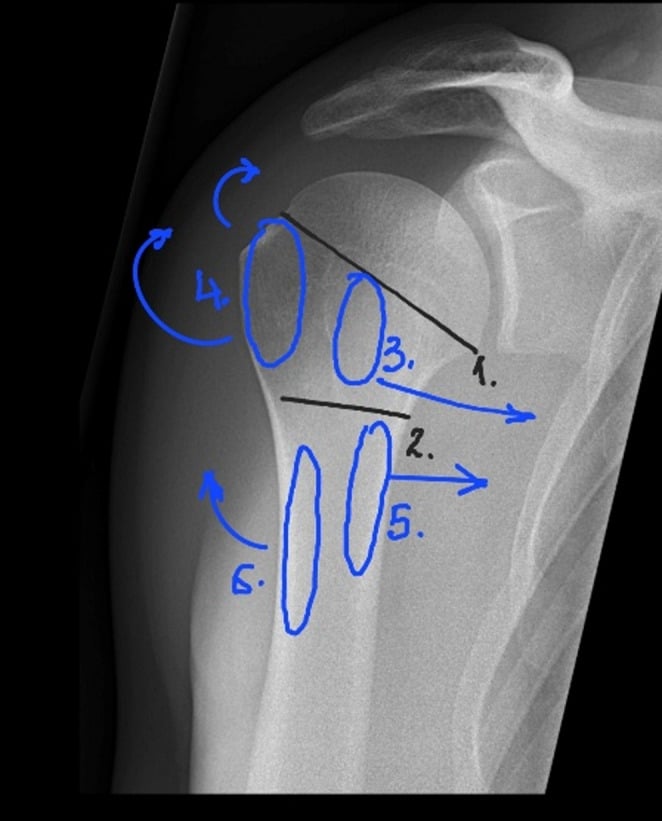
The greater tuberosity. In an anterior fracture-dislocation the greater tuberosity is often fractured or avulsed. Reducing the head often reduces the tuberosity with it, through the periosteal sleeve and the rotator cuff, but a fragment that remains posterior can block reduction.
- A widely displaced tuberosity compromises cuff function
- A tuberosity that heals in malposition causes impingement and loss of abduction
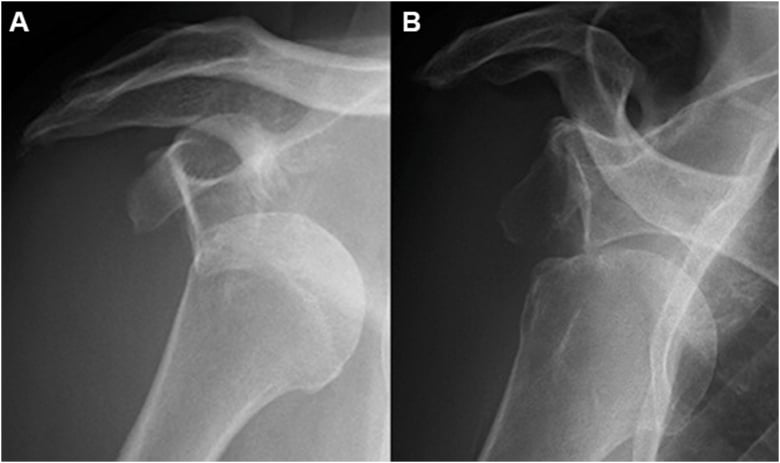
The reverse Hill-Sachs lesion. In a posterior fracture-dislocation the head strikes the posterior glenoid rim, leaving an impression fracture of the anteromedial head. If the defect engages the glenoid rim in functional internal rotation, the shoulder will re-dislocate, and it needs structural filling, by transfer or graft, to restore stability.
Defect size. The size of the defect dictates treatment. Under 20% is generally stable and over 40% generally unstable, and a large defect over 40% will re-dislocate if it is not addressed by transfer or arthroplasty.
The blood supply. The arcuate artery, the ascending branch of the anterior humeral circumflex, enters at the bicipital groove and is disrupted in anatomical-neck fractures. Fracture-dislocations have higher rates of AVN, due to extensive soft-tissue stripping and potential tethering of vessels, so gentle reduction is the key to preserving the head.
Predicting ischaemia. Hertel (2004) identified the features that predict an ischaemic head:
- Calcar (metaphyseal extension): less than 8mm attached to the head
- Medial hinge: disrupted, with translation of the head over 2mm
- Fracture pattern: an anatomical-neck fracture
When all are favourable (calcar over 8mm, hinge intact), the risk of ischaemia is low even in complex fractures. When all are unfavourable, they predict ischaemia with a positive predictive value of up to 97%.
Ischaemia is not necrosis. An ischaemic head does not always go on to AVN and collapse; many revascularise by creeping substitution. Hertel judged perfusion at the time of surgery and did not follow patients to collapse, which is how his finding below sits beside the higher AVN rates of fracture-dislocations.
In Hertel's series the dislocation itself was a poor predictor of ischaemia (accuracy 0.49, no better than chance), as were head-split components (0.49) and three-part patterns (0.38). Do not let a dislocation raise your estimate of head ischaemia: measure the calcar and look at the medial hinge.
Classification
Anterior fracture-dislocation. Counted by the parts involved, and often described as valgus-impacted or displaced.
- 2-part: head dislocated with a greater-tuberosity fracture; head and shaft intact
- 3-part: head dislocated with greater-tuberosity and surgical-neck fractures
- 4-part: head dislocated with greater-tuberosity, lesser-tuberosity and surgical-neck fractures; the tuberosities are separated and AVN risk is high
Posterior locked dislocation.
- Type I: locked posterior dislocation with an impression fracture only
- Type II: posterior dislocation with a surgical-neck fracture, leaving the head free-floating
- Type III: posterior dislocation with a tuberosity fracture
Type II is the dangerous one. Manipulation moves the shaft while the head stays locked, so assess the continuity of the surgical neck carefully before any attempt at reduction.
Clinical Assessment
History. Hold a high index of suspicion for posterior dislocation when the story includes one of these:
- Seizure: an unwitnessed fall, tongue biting, urinary incontinence
- Electric shock: an industrial accident
- Electroconvulsive therapy
- Alcohol intoxication: a fall while unconscious
The anterior shoulder. The arm is held in slight abduction and external rotation. The acromion is prominent, squaring off the shoulder, and the head is palpable anteriorly.
The posterior shoulder. The arm is locked in adduction and internal rotation, and the patient cannot externally rotate, which is pathognomonic. The head makes the back of the shoulder full, and the front is flattened with the coracoid prominent.
Neurovascular status. Checking the axillary nerve and radial pulse is mandatory, and the rate of axillary nerve injury is high. Document the axillary nerve (deltoid contraction and regimental-badge sensation) before and after reduction.
Investigations
Radiographs. Never accept an AP alone. The trauma series:
- AP: the lightbulb sign of a posterior dislocation, and the overlap sign
- Scapular Y: head position relative to the centre of the Y
- Axillary: the gold standard, defining the direction of dislocation and the state of the tuberosities
- Velpeau view: when the patient cannot abduct for an axillary view
Reading the AP. The central trap of this topic is the posterior dislocation missed on a single AP film. The head can look symmetrical and the overlap misleads, so these signs should make you demand an orthogonal view:
- What you see on the AP
- The head looks symmetrical and round instead of the normal walking-stick profile with the greater tuberosity laterally
- Why it appears
- Humerus is locked in internal rotation
- What you see on the AP
- A second vertical sclerotic line running parallel to the medial humeral articular cortex
- Why it appears
- The impacted reverse Hill-Sachs defect (compressed cancellous bone seen end-on)
- What you see on the AP
- The space between the anterior glenoid rim and the humeral head articular surface is widened to more than 6 mm
- Why it appears
- The head sits behind the glenoid, so the normal head-on-glenoid overlap is lost
- What you see on the AP
- Loss of the normal elliptical "half-moon" overlap of head on glenoid
- Why it appears
- The head is no longer congruent in the socket
These signs only raise suspicion. An axillary or Velpeau view and CT confirm the diagnosis, and the sizing and engagement of the reverse Hill-Sachs defect are developed in the reverse-hill-sachs-lesions topic.
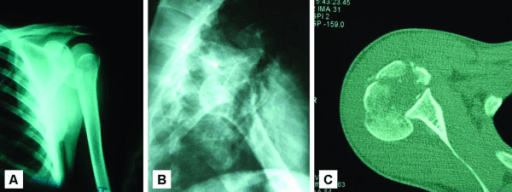
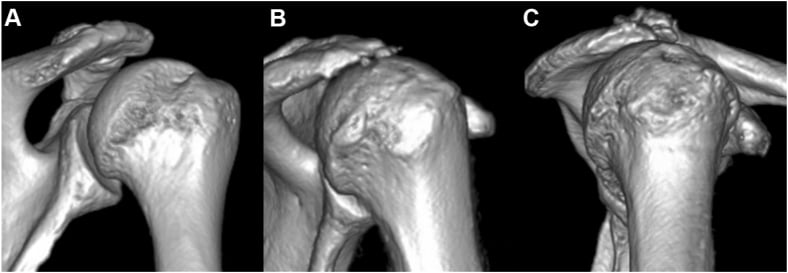
CT. Essential for the surgical decision between fixing and replacing. It is indicated to:
- confirm the diagnosis when the radiographs are equivocal or pain limits the views
- quantify the bone defect, the reverse Hill-Sachs percentage
- plan surgery, counting the fragments
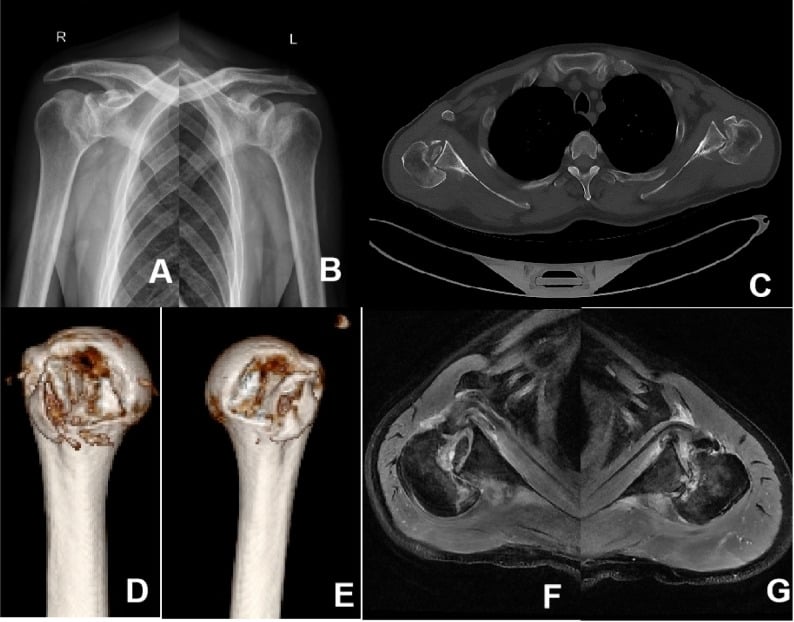
MRI. Not first-line for bone trauma. It assesses the rotator cuff, in the acute anterior dislocation of the elderly, and brachial plexus injury, and is reserved for the soft tissues once the bony options are clear.
Differential Diagnosis
- Key Clinical Clue
- Fixed internal rotation, cannot externally rotate
- Best Discriminating Test
- Axillary view / CT (reverse Hill-Sachs, head behind glenoid)
- Key Clinical Clue
- Arm in slight abduction/ER, squared-off acromion
- Best Discriminating Test
- Axillary view (head anteroinferior, greater tuberosity status)
- Key Clinical Clue
- Head congruent with glenoid on orthogonal view
- Best Discriminating Test
- Scapular Y / axillary view confirms reduction
- Key Clinical Clue
- Global passive restriction, no acute trauma, normal bony alignment
- Best Discriminating Test
- Normal orthogonal radiographs
- Key Clinical Clue
- Fixed IR but no impression defect or neck fracture
- Best Discriminating Test
- CT shows congruent head, no reverse Hill-Sachs
- Key Clinical Clue
- Arm fixed in abduction/elevation, high neurovascular risk
- Best Discriminating Test
- AP radiograph (head inferior to glenoid)
Management Algorithm
Reducing an anterior fracture-dislocation. Use conscious sedation or general anaesthesia and gentle traction-countertraction. Avoid the Kocher leverage manoeuvre, which risks a spiral fracture.
After anterior reduction. Check stability, then treat the greater tuberosity by where it lies:
- Reduces to under 5mm of displacement: conservative, in a sling
- Displaced over 5mm: ORIF with screws or sutures
- Unstable shoulder: surgical stabilisation
Always repeat the radiographs, and often a CT, after reduction to confirm that the reduction is concentric and the tuberosity is in position.
Reducing a posterior fracture-dislocation. Muscle relaxation under general anaesthesia is essential. Apply axial traction with gentle anterior pressure on the head, and do not externally rotate forcefully, because the head is locked.
After posterior reduction. A stable shoulder is immobilised in external rotation in a gunslinger brace for 4 weeks; if it is stable in external rotation, a simple brace may suffice provided the patient is compliant. A shoulder that is unstable because the defect engages needs surgery: a modified McLaughlin or a graft.
Forceful reduction of a proximal humeral fracture-dislocation can displace a non-displaced surgical-neck fracture or shear the head, causing devastating devascularisation. Reduce gently, or in the operating theatre.
The locked posterior dislocation. Defect size and time from injury decide the treatment, as set out in the table below. A medium defect can be filled with a graft as an alternative to the lesser-tuberosity transfer.
Where the cut-offs come from. They vary: 20% and 40% for stability, 20-45% for the transfer and over 45% for arthroplasty, 25% for the defect that must not be ignored. They are conventions from small series, often quoted as 20-25% and 40-50% (see Controversies), and engagement in functional rotation, bone quality and chronicity matter as much as the percentage.
- Defect Size
- Small (less than 20%)
- Time from Injury
- Acute (less than 3 weeks)
- Treatment
- Closed Reduction + Immobilisation (ER)
- Defect Size
- Medium (20-45%)
- Time from Injury
- Acute
- Treatment
- Modified McLaughlin (Lesser Tuberosity Transfer)
- Defect Size
- Large (greater than 45%)
- Time from Injury
- Chronic (greater than 3 weeks)
- Treatment
- Hemi (Young) or RTSA (Elderly)
- Defect Size
- Comminuted
- Time from Injury
- Elderly
- Treatment
- Reverse Total Shoulder Arthroplasty
Surgical Technique
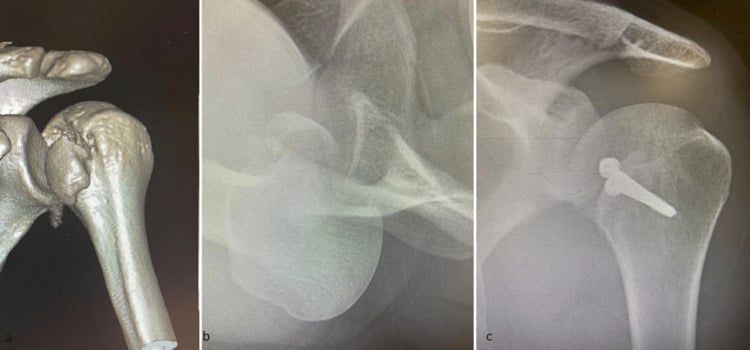
Modified McLaughlin. For a posterior dislocation with a medium defect (20-45%), through a deltopectoral approach. The lesser tuberosity, with subscapularis attached, is moved into the defect. This converts a bone-loss problem into a tendon-transfer solution and prevents the posterior rim from engaging the defect.
- Identify the lesser tuberosity, which is often intact
- Osteotomise it with the subscapularis tendon attached
- Reduce the humeral head, disimpacting it from the glenoid
- Internally rotate slightly to expose the defect
- Transfer the lesser tuberosity into the anteromedial defect
- Fix with two cannulated screws or suture anchors
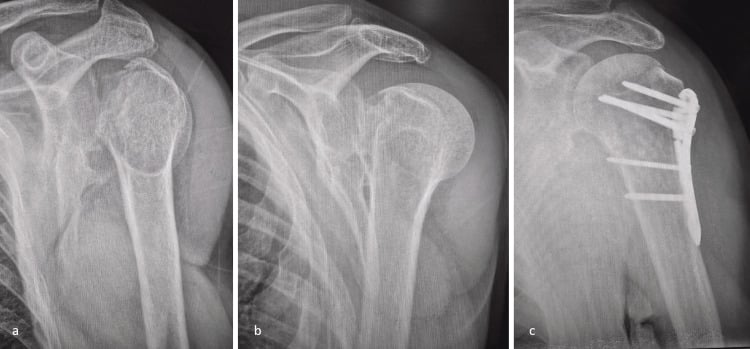
ORIF of the anterior fracture-dislocation. For the displaced three- or four-part anterior fracture-dislocation in the young. Reduce the head onto the glenoid first, then fix with a proximal humeral locking plate, pulling the tuberosities to the plate with heavy cuff sutures ("rotator cuff reduction"). Restore medial support with a calcar screw and avoid varus collapse.
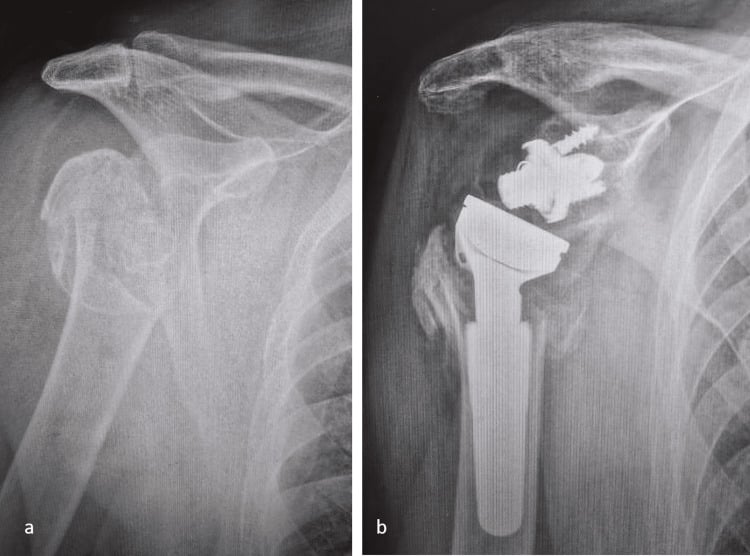
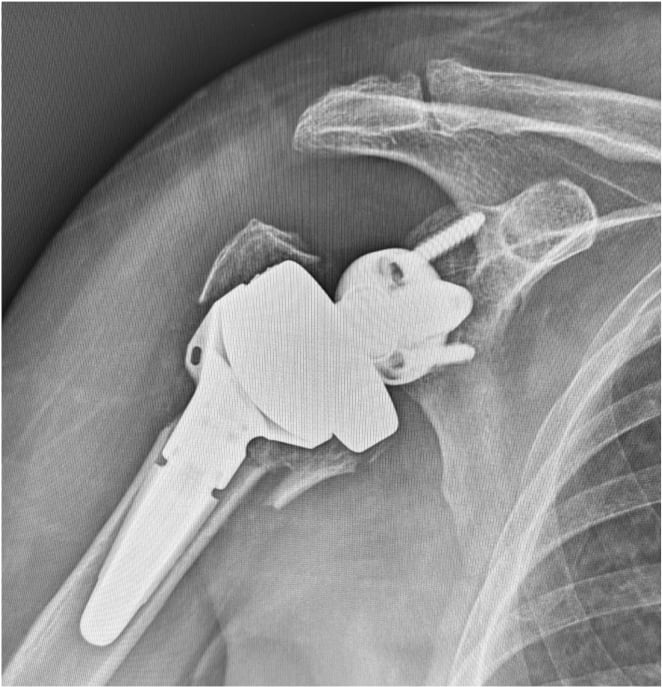
Arthroplasty. Indicated for a head split, a chronic locked posterior dislocation (over 3 weeks) and the elderly patient with poor bone. Hemiarthroplasty is for the young patient with a non-reconstructable head, which is rare. Reverse total shoulder arthroplasty (RTSA) is for the elderly (70+), depends on the deltoid, and is becoming the default for complex fracture-dislocations in the elderly.
Complications
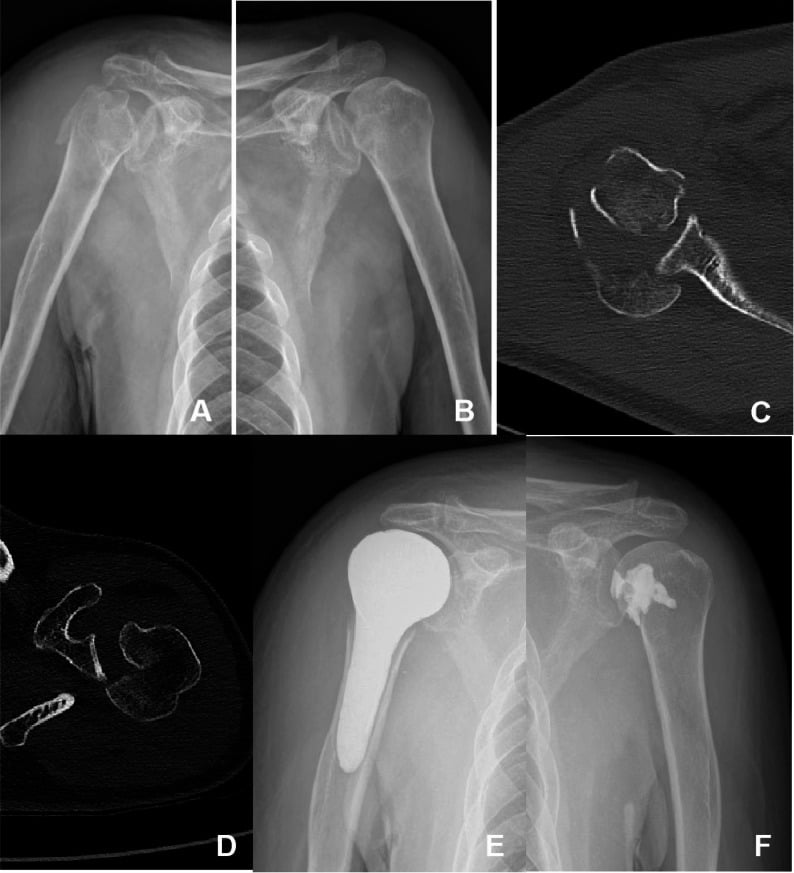
The missed diagnosis. The chronic locked posterior dislocation is common, with an average delay to diagnosis of 3-6 months; in Hawkins' series the mean was a year. It then needs major reconstruction, allograft or arthroplasty, where an early diagnosis needed only a simple reduction.
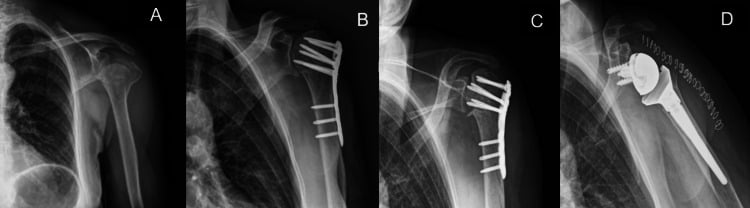
AVN. Four-part fracture-dislocations have a high AVN rate and can collapse late. Warn the patient before surgery that later conversion to arthroplasty may be needed.
Recurrent instability. The result of failing to address the defect: a reverse Hill-Sachs lesion over 25% that is ignored will dislocate again.
Axillary nerve injury. Traction neuropraxia is common, and 90% recover spontaneously in 3-6 months. If deltoid firing has not recovered, request EMG and nerve conduction studies at 6 weeks.
Stiffness and infection. Surgery and immobilisation both cause fibrosis and stiffness, so early range of motion is the key once the shoulder is stable. Secondary adhesive capsulitis is common, and hydrodilatation may be needed later. Infection is a surgical risk.
Heterotopic ossification. Associated with head injury or prolonged coma. Prophylaxis with indomethacin or radiation may be considered in high-risk groups.
The Terrible Triad of the Shoulder
What it is. After an anterior glenohumeral dislocation, a rotator cuff tear combined with a neurological injury. The cuff tear is often massive: a first dislocation over 40 carries roughly a 30% cuff-tear risk, and over 60 more than 80%. The nerve is most often the axillary, sometimes a wider infraclavicular brachial-plexus lesion.
Why it is missed. After reduction the cuff tear and the nerve injury mask each other, and the dislocation masks both. Persistent inability to abduct or elevate is wrongly blamed on pain and stiffness, or on an axillary nerve palsy, when a large, repairable cuff tear is being missed, or the reverse.
Sorting it out. The pre- and post-reduction axillary nerve examination is the baseline.
- If the deltoid is firing but the patient still cannot actively elevate at 2 to 3 weeks, suspect a rotator cuff tear and image with ultrasound or MRI
- If a neurological deficit persists, EMG/NCS at about 3 to 6 weeks characterises the lesion
Management. The components run on their own tracks. An acute, repairable cuff tear in an active patient is repaired, often once the nerve picture has clarified, while the nerve injury is usually observed; an older patient with an irreparable massive cuff tear and an axillary injury may ultimately need reverse arthroplasty. Detailed cuff and axillary nerve management belong to their own topics; the examiner's point is to recognise the triad and not stop at the first diagnosis.
Postoperative Care
- Anterior: Sling in internal rotation.
- Posterior: Braced in neutral or external rotation (gunslinger) to relax the posterior capsule and keep the defect away from the rim.
- Gentle passive ROM.
- Limit IR for posterior repairs.
- Limit ER for anterior repairs (Bankart/subscapularis).
- AAROM then AROM.
- Hydrotherapy.
- Wean the brace.
- Cuff strengthening.
- Scapular stabilisation.
- Return to sport at 6-9 months.
Outcomes
By injury. A simple dislocation with a greater-tuberosity fracture has an excellent outcome if the tuberosity heals anatomically. The missed posterior dislocation does poorly without surgery; arthroplasty is usually successful for pain, but range of motion is limited.
By operation. The McLaughlin procedure gives good outcomes for medium defects with a low recurrence rate. RTSA gives predictable elevation to 130 degrees and good pain relief, though functional rotation is often limited.
- Relief
- High
- ROM
- Excellent (if no AVN)
- Re-operation Risk
- Moderate (Screw cutout/AVN)
- Relief
- High
- ROM
- Good (Limit IR)
- Re-operation Risk
- Low
- Relief
- High
- ROM
- Functional (Limit Rot)
- Re-operation Risk
- Low (if stable)
- Relief
- Moderate
- ROM
- Unpredictable
- Re-operation Risk
- High (Tuberosity failure)
Guidelines, Registries & Global Practice
Global epidemiology
- Posterior fracture-dislocation incidence is approximately 0.6 per 100,000 per year, with a peak in middle-aged men (Robinson 2007).
- Posterior dislocations make up only 2-4% of shoulder dislocations but are missed initially in up to half of cases.
- Bimodal injury pattern: high-energy trauma in the young versus low-energy osteoporotic injury in the elderly.
Society guidance, side by side
- Position relevant to fracture-dislocation
- Evidence on proximal humeral fractures is largely inconclusive; shared decision-making and individualised treatment recommended
- Position relevant to fracture-dislocation
- Orthogonal imaging mandatory before reduction; urgent senior review for locked and neurovascularly compromised dislocations
- Position relevant to fracture-dislocation
- Classification-led planning; preserve medial calcar and head vascularity; ORIF for reconstructable patterns
- Position relevant to fracture-dislocation
- Reverse arthroplasty favoured over hemiarthroplasty in elderly unreconstructable heads
Registry signals
- Arthroplasty registries (AOANJRR, NJR, AJRR, Swedish/Norwegian) show a sustained shift from hemiarthroplasty toward reverse total shoulder arthroplasty for acute fracture in older patients, mirroring RCT evidence (Sebastia-Forcada 2014).
- RCT-level evidence (PROFHER) shows no benefit of surgery over nonoperative care for isolated displaced surgical-neck fractures, so registry surgery trends should be read as selective, not blanket.
High- versus limited-resource practice
- High-resource: routine CT for defect quantification, axillary/Velpeau views, arthroplasty backup, sub-specialist upper-limb referral for chronic locked dislocations.
- Limited-resource: reliance on plain orthogonal radiographs, greater use of closed reduction and transfer procedures, and earlier acceptance of deformity when implants are unavailable.
Related pages: Proximal Humerus Fractures is the parent injury and carries the Neer classification, the fixation techniques and the PROFHER debate in full - remember PROFHER studied surgical-neck fractures and excluded the fracture-dislocation this page covers; Posterior Shoulder Instability and Reverse Hill-Sachs Lesions for the posterior injury spectrum and the impression-defect ladder that decides between transfer, graft and arthroplasty; Anterior Shoulder Instability and Hill-Sachs Lesions for the anterior mirror; Greater Tuberosity Fractures for the fragment whose displacement after reduction most often changes the plan; Avascular Necrosis of the Shoulder for what happens when the Hertel criteria are unfavourable and the head is fixed anyway; Reverse Total Shoulder Arthroplasty for the salvage carded above; and Axillary Nerve Anatomy for the nerve to document before and after any reduction attempt.
Controversies and Areas of Uncertainty
Cut-offs for transfer versus arthroplasty (often quoted as 20-25% and 40-50%) are derived from small series, not prospective trials. Engagement in functional rotation, bone quality and chronicity matter as much as the percentage.
PROFHER showed no benefit of surgery over nonoperative care for displaced surgical-neck fractures, but it largely excluded true fracture-dislocations and head-splits, so it cannot be extrapolated to lock the door on surgery here.
RCT and registry data favour reverse arthroplasty in older patients with unreconstructable heads because outcomes are less dependent on tuberosity healing, but reverse implants carry notching, long-term loosening and revision concerns in younger patients.
Osteochondral allograft, autograft, disimpaction-grafting and rotational osteotomy aim to preserve the native joint in large defects, but comparative evidence is limited to case series with no consensus on the optimal technique.
MCQ Practice
Self-Assessment Questions
Q: Which physical examination finding is pathognomonic for a locked posterior shoulder dislocation?
- A) Loss of abduction
- B) Fixed Internal Rotation (loss of External Rotation)
- C) Fixed External Rotation (loss of Internal Rotation)
- D) Palpable anterior mass
- E) Wrist drop
A: B - The hallmark of a locked posterior dislocation is the inability to externally rotate the arm (often blocked at neutral or in internal rotation) due to the head being engaged on the posterior glenoid rim.
Q: A Reverse Hill-Sachs lesion is a defect of the:
- A) Posterolateral humeral head
- B) Anteromedial humeral head
- C) Anterior Glenoid rim
- D) Posterior Glenoid rim
- E) Greater Tuberosity
A: B - A Reverse Hill-Sachs lesion (impression fracture) occurs on the Anteromedial aspect of the humeral head due to impaction against the posterior glenoid rim during posterior dislocation. (Standard Hill-Sachs is Posterolateral).
Q: The Modified McLaughlin procedure involves transfer of which structure into a reverse Hill-Sachs defect?
- A) Greater Tuberosity / Supraspinatus
- B) Lesser Tuberosity / Subscapularis
- C) Conjoined Tendon
- D) Latissimus Dorsi
- E) Pectoralis Major
A: B - The Modified McLaughlin procedure involves osteotomy of the Lesser Tuberosity (with Subscapularis attachment) and transferring it into the anteromedial defect to fill the void and prevent internal rotation instability.
Q: Which nerve is most commonly injured in anterior fracture-dislocations of the shoulder?
- A) Radial Nerve
- B) Musculocutaneous Nerve
- C) Axillary Nerve
- D) Suprascapular Nerve
- E) Median Nerve
A: C - The Axillary nerve (wrapping around the surgical neck) is at highest risk during anterior fracture-dislocations, especially in elderly patients. Incidence ranges from 5-30%.
Q: You attempt closed reduction of a chronic (4 week) fracture-dislocation in the ED. What is the major risk?
- A) Recurrent dislocation
- B) Iatrogenic fracture of the surgical neck
- C) Brachial artery injury
- D) Rotator cuff tear
- E) Infection
A: B - Forceful manipulation of a chronic dislocation or fracture-dislocation risks completing the fracture pattern (e.g., propagating a crack into a complete surgical neck fracture), creating a free-floating head that requires complex surgery.
Viva Scenarios
Practise clinical reasoning and management decisions out loud
“A 45-year-old man presents 4 weeks after an 'epileptic fit' with a stiff painful shoulder. X-rays are reported as normal. Diagnosis?”
“You are treating a 75-year-old female with an anterior fracture-dislocation (3-part). What factors influence your decision between ORIF and Arthroplasty?”
“Describe the 'Lightbulb Sign'.”
Key Facts
- Posterior = Seizure/Shock/Blocked ER
- Anterior = Trauma/Abducted
- Signs: Lightbulb (Post), Axillary view (Gold std)
- Defect: Reverse Hill-Sachs (Check size)
- Risk: Axillary nerve palsy
Surgical Steps
- Acute Anterior: Reduce then Fix Tuberosities
- Acute Posterior: Reduce then Gunn slinger brace
- Unstable Posterior: Modified McLaughlin (Subscap transfer)
- Chronic/Elderly: RTSA (Reverse)
- Approach: Deltopectoral (Workhorse)
- Fixation: Locking plates + Sutures for cuff
Common Pitfalls
- Missing the posterior dislocation on AP X-ray
- Breaking the surgical neck during reduction
- Ignoring the engaging defect (will redislocate)
- Not checking Axillary nerve
- Accepting a varus reduction (high failure rate)
Examiner Favorites
- Lightbulb sign description
- McLaughlin procedure details
- Hertel criteria for Ischemia
- Management of the missed posterior dislocation
- Blood supply to the humeral head (Arcuate artery)
Radiology Signs
- Lightbulb Sign (Posterior)
- Rim Sign (Glenoid)
- Trough Line (Reverse Hill-Sachs)
- Mercedes Benz Sign (3-part GT fracture)
Evidence Base
Key Studies
Hawkins - Locked Posterior Dislocation
- 41 locked posterior dislocations in 40 patients; diagnosis missed by the initial physician in the majority
- Mean interval from injury to diagnosis was 1 year; causes were MVA, seizure, alcohol, electroshock
- An axillary radiograph confirmed the diagnosis in every shoulder and showed the impression-defect size
- Treatment included accepted deformity, closed reduction, subscapularis or lesser-tuberosity transfer, hemi- and total arthroplasty
Neer - Displaced Proximal Humeral Fractures (Classification)
- Part I paper establishing the 4-segment classification (head, greater tuberosity, lesser tuberosity, shaft)
- Defines a part as displacement over 1 cm or angulation over 45 degrees
- Describes fracture-dislocation as a distinct, high-risk subgroup
- Forms the anatomical basis for fracture-dislocation pattern description
Robinson - Anterior Fracture-Dislocation ORIF
- 58 acute anterior fracture-dislocations; mean age 66 years
- Type-I head retains capsular attachment with arterial back-bleeding; type-II head devascularised
- Osteonecrosis in 2/23 type-I vs 4/7 type-II injuries after ORIF
- ORIF justified for type-I; elderly type-II best treated by hemiarthroplasty
Robinson - Complex Posterior Fracture-Dislocation
- Incidence of posterior fracture-dislocation 0.6 per 100,000 per year; peak in middle-aged men
- Most injuries occurred during a seizure or a fall from height
- All cases had an anatomical-neck fracture propagating from a reverse Hill-Sachs lesion; three subtypes described
- ORIF gave a median 2-year Constant score of 83.5 with low complication rate
Cicak - Posterior Dislocation of the Shoulder
- Review of diagnosis and management of posterior shoulder dislocation
- Emphasises clinical sign of fixed internal rotation with loss of external rotation
- CT recommended to quantify the reverse Hill-Sachs defect and guide treatment
- Defect size and chronicity direct the choice between transfer, graft and arthroplasty
Hertel - Predictors of Humeral Head Ischemia
- Prospective study of 100 intracapsular proximal humeral fractures
- Best ischemia predictors: short calcar (under 8 mm), disrupted medial hinge, anatomical-neck pattern
- Combined criteria gave a positive predictive value of up to 97% for ischemia
- Ischemia does not always progress to collapse (creeping substitution)
PROFHER - Surgery vs Nonsurgery for Proximal Humeral Fracture
- Multicentre RCT of 250 adults with displaced surgical-neck fractures (mean age 66)
- No significant difference in Oxford Shoulder Score over 2 years (39.07 surgical vs 38.32 nonsurgical)
- No difference in complications, secondary surgery or mortality
- Results do not support the trend of increasing surgery for these fractures
Sebastia-Forcada - RSA vs Hemiarthroplasty in Fracture
- Blinded RCT of 62 patients over 70 years with acute proximal humeral fracture
- Reverse shoulder arthroplasty gave higher Constant (56.1 vs 40.0) and UCLA scores than hemiarthroplasty
- Forward elevation 120 vs 80 degrees favouring RSA; outcome independent of tuberosity healing in the RSA group
- Lower revision rate with RSA (6 hemiarthroplasties required revision for proximal migration)