Quantitative measurements linking pelvis and spine - critical for deformity surgery and THA stability
- Pelvic incidence (PI) is FIXED - does not change with position or age after skeletal maturity
- PI-LL mismatch predicts disability: under 10° good, over 20° severely disabled
- SVA (sagittal vertical axis) measures global balance: under 50mm normal, over 95mm severe imbalance
- In THA: high PI increases dislocation risk by allowing more functional pelvic tilt
- Roussouly classification: 4 morphotypes defined by SACRAL SLOPE (Types 1-2 both under 35°, 3 is 35-45°, 4 is over 45°) - not by PI, and Types 1 and 2 are separated by lordosis shape
- “PI is the fundamental parameter - all others derive from or relate to it
- “Standing lateral X-ray from C7 to femoral heads required for full assessment
- “PI-LL mismatch drives compensatory mechanisms: pelvic retroversion, knee flexion, thoracic hyperkyphosis
- “In deformity surgery, goal is LL = PI ± 9 degrees
Spinopelvic Parameters
Overview and Fundamentals
Spinopelvic parameters put numbers on the biomechanical relationship between the pelvis and the spine. They are how a surgeon plans deformity correction, judges sagittal balance and assesses the stability of a total hip arthroplasty.
Where they are used.
- Deformity surgery planning - the correction needed, the osteotomy type and the number of levels
- Outcome prediction - PI-LL mismatch predicts postoperative disability
- THA instability - pelvic incidence and spinal stiffness change dislocation risk
- Degenerative disease - mismatch accelerates adjacent segment degeneration
- Spondylolisthesis - a high PI predisposes to the slip
A short history.
- Contribution
- Recognition that sagittal balance matters, not just coronal deformity
- Contribution
- Duval-Beaupère describes pelvic incidence (PI) as fixed morphological parameter
- Contribution
- Schwab classification links PI-LL mismatch to disability
- Contribution
- Integration into deformity surgery planning and THA instability assessment
- Contribution
- Machine learning models predict optimal alignment for individual patients
Pathophysiology
The pelvis is the foundation. The pelvis carries the spine, and pelvic morphology, expressed as the pelvic incidence, determines the ideal spinal curvature above it. The parameters describe how the two maintain sagittal balance together.
Energy-efficient standing. The body seeks an upright posture that keeps the gaze horizontal with minimal muscular effort. That requires:
- C7 aligned over the sacrum (SVA near zero)
- Reciprocal sagittal curves, thoracic kyphosis balancing lumbar lordosis
- A pelvic position that optimises spinal alignment
The compensatory cascade. When ideal alignment is lost, for example through loss of lumbar lordosis, the body activates compensatory mechanisms in sequence. As compensation progresses, energy expenditure increases and disability worsens, correlating with increasing PI-LL mismatch and SVA.
- SVA
- 0-50mm
- Mechanism
- Pelvic retroversion (increased PT)
- Energy cost
- Low - bony compensation
- SVA
- 50-80mm
- Mechanism
- Knee flexion, ankle dorsiflexion
- Energy cost
- Moderate - muscular compensation
- SVA
- 80-120mm
- Mechanism
- Thoracic hyperkyphosis
- Energy cost
- Moderate - ligamentous stress
- SVA
- Over 120mm
- Mechanism
- Hip extension loss, forward lean; cannot compensate
- Energy cost
- High - exhausted, symptomatic
Pelvic Parameters
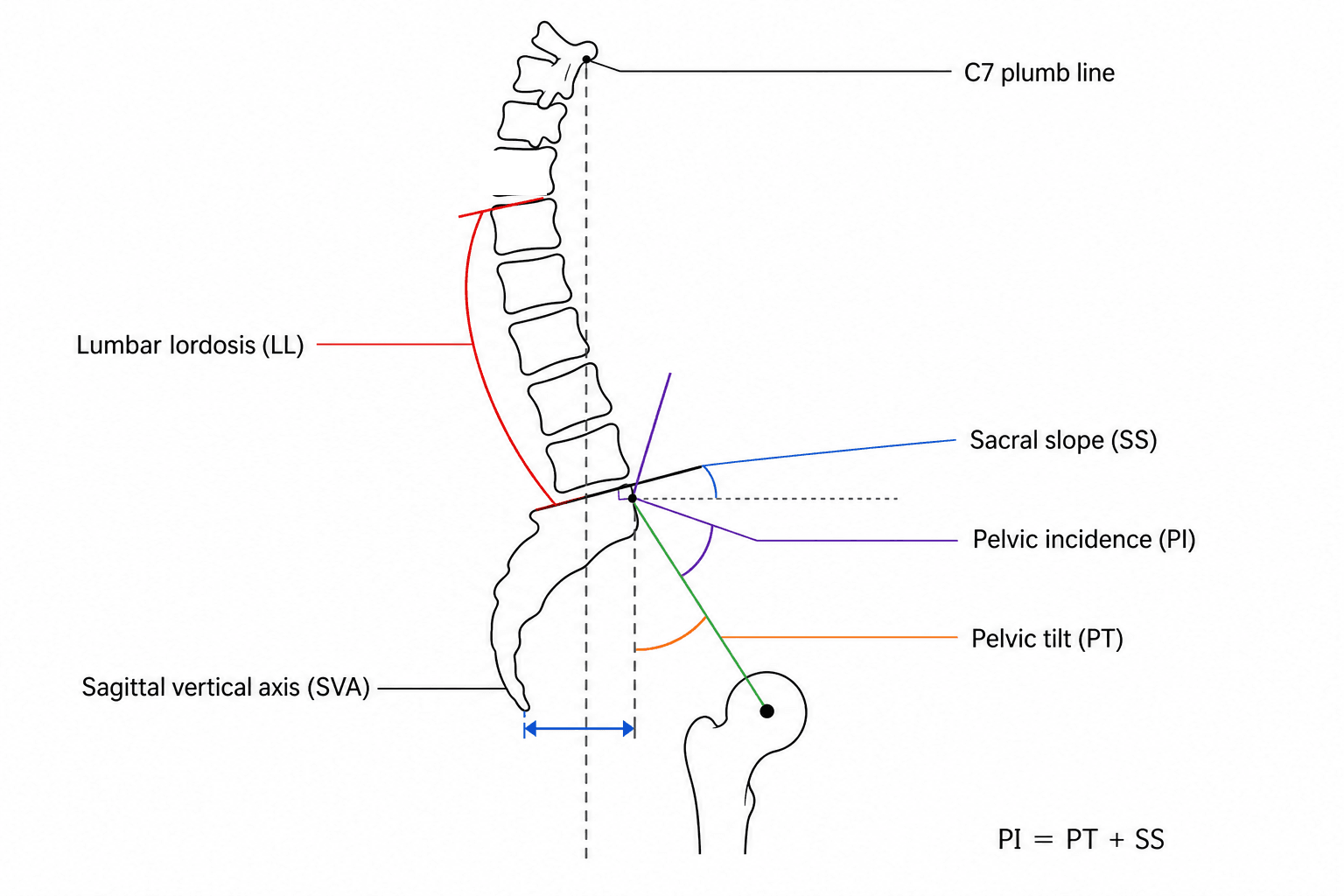
Two landmarks. The three pelvic angles are built around the midpoint of the S1 superior endplate and the centre of the femoral heads, taken as the midpoint of the line joining both head centres. The line joining those two points is one arm of both PI and PT; SS uses only the sacral endplate and the horizontal.
Pelvic Incidence (PI)
Definition. The angle between the line from the femoral head centres to the midpoint of the sacral endplate and the perpendicular to the sacral endplate at that midpoint. To measure it:
- Identify the centre of both femoral heads and draw the line connecting them
- Identify the midpoint of the sacral endplate (S1 superior endplate)
- Draw a line from the femoral head midpoint to the sacral endplate midpoint
- Draw a line perpendicular to the sacral endplate at its midpoint
- Measure the angle between these two lines
A morphological constant. PI is determined by pelvic anatomy at skeletal maturity and does not change with position, posture, age or surgery. Even after major deformity surgery that changes LL and PT dramatically, PI remains unchanged. The normal range is 35-85°, with an average of 50°, and PI determines the ideal lumbar lordosis.
PI is the only fixed parameter; PT, SS and LL are all positional and can change. That makes PI the foundational parameter: know PI and you know what the patient's ideal alignment should be.
High and low PI. A PI under 45° constrains sacral slope, so these patients typically have a Roussouly Type 1 or 2 morphology, with a flat-back tendency. A PI over 60° permits a high sacral slope and typically goes with Type 3 or 4, a hyperlordotic tendency. PI predisposes to a type but does not define it: confirm the type on the measured SS, especially where pelvic retroversion is present.
Pelvic Tilt (PT)
Definition. The angle between the line from the femoral head centres to the sacral endplate midpoint and the vertical axis. Draw the line connecting the two landmarks, drop a vertical through the femoral head midpoint, and measure the angle between them.
What it tells you. PT is positional and changes with pelvic rotation. Retroversion increases it, as compensation for a positive SVA; anteversion decreases it, as seen with a hip flexion contracture. The normal range is 10-25°, averaging 12°, and it should be under 20°. PT indicates the degree of compensation for sagittal imbalance, and pelvic retroversion is the first rung of the cascade.
- Interpretation
- Normal pelvic position
- Compensation
- Minimal compensation
- Interpretation
- Moderate retroversion
- Compensation
- Moderate compensation for imbalance
- Interpretation
- Severe retroversion
- Compensation
- Severe compensation, likely symptomatic
- Interpretation
- Extreme retroversion
- Compensation
- Exhausted pelvic compensation, knee flexion needed
Sacral Slope (SS)
Definition. The angle between the sacral endplate and the horizontal: draw a line along the S1 superior endplate and measure its angle to a horizontal line. SS is positional, changing with pelvic rotation, with a normal range of 30-50° and an average of 40°. It affects lumbar lordosis and acetabular coverage in THA.
PI = PT + SS is always true mathematically. If PI is fixed and PT increases (pelvic retroversion), SS must decrease by the same amount. This explains why compensatory retroversion flattens the sacrum and reduces lumbar lordosis: as PT rises, SS falls, reducing the lordotic drive from the pelvis.
Spinal Parameters
Lumbar Lordosis (LL)
Definition. The Cobb angle from the superior endplate of L1 to the superior endplate of S1 (L1-L5 in some systems). The normal range is 40-70°, and it should approximate LL = PI ± 9°, the Schwab-SRS goal. About two-thirds of the total lordosis lies at L4-5 and L5-S1.
PI-LL mismatch. Subtract LL from PI. Loss of lordosis drives the mismatch, and a large mismatch is the hallmark of sagittal malalignment. The mismatch predicts disability better than any single parameter:
- Disability (ODI)
- Under 20
- Interpretation
- Good balance, minimal symptoms
- Disability (ODI)
- 20-40
- Interpretation
- Moderate disability, increasing compensation
- Disability (ODI)
- Over 40
- Interpretation
- Severe disability, exhausted compensation
- Disability (ODI)
- Over 50
- Interpretation
- Extreme disability, strong surgical indication
Why lordosis is lost.
- Degenerative disc disease (loss of disc height anteriorly)
- Compression fractures
- Iatrogenic (flat back syndrome post-Harrington rod)
- Ankylosing spondylitis
- Previous laminectomy with muscle stripping
Thoracic Kyphosis (TK)
TK is the Cobb angle from the superior endplate of T4 to the inferior endplate of T12, normally 20-50° with an average of 40°. It is reciprocal to lordosis, not equal to it: in a balanced spine TK is typically 10-20° less than LL. Increased TK often compensates for decreased LL, and hyperkyphosis develops when pelvic compensation is exhausted.
Sagittal Vertical Axis (SVA)
Definition. The horizontal distance from the C7 plumb line to the posterior-superior corner of the S1 endplate, and the global measure of whether the trunk is balanced over the pelvis. Drop a vertical plumb line from the centre of the C7 vertebral body and measure horizontally to that corner. A positive SVA means the C7 plumb line lies anterior to S1 (imbalance); a negative SVA means it lies posterior (overcorrected).
- Category
- Normal
- Clinical impact
- Minimal symptoms, good balance
- Category
- Moderate imbalance
- Clinical impact
- Moderate disability, compensating
- Category
- Severe imbalance
- Clinical impact
- Severe disability, surgical consideration
- Category
- Extreme imbalance
- Clinical impact
- Exhausted compensation, high surgical risk
Beyond 95 mm. The increased disability correlates with pain and functional limitation. Compensation is extensive, with pelvic retroversion, knee flexion and muscle fatigue, and the forward trunk shift is visible on examination.
Cervical Sagittal Alignment
The neck has its own spinopelvic logic. The parameters above stop at the lumbar spine and pelvis, but the compensatory cascade and gaze regulation continue cranially, and the cervical analogues are examinable in their own right.
- T1 slope - the angle of the T1 superior endplate to horizontal. It behaves as the cervical spine's "pelvic incidence/sacral slope", setting the cervical lordosis the neck must generate to keep the head balanced: a high T1 slope demands more cervical lordosis
- C2-C7 cervical lordosis (CL) - the cervical Cobb angle
- T1 slope minus cervical lordosis (T1S-CL) mismatch - the cervical equivalent of PI-LL. A mismatch over roughly 20 degrees indicates cervical malalignment and correlates with disability, exactly as PI-LL does in the lumbar spine
- C2-C7 sagittal vertical axis (cSVA) - plumb line from the C2 centroid to the posterosuperior corner of C7; over roughly 40 mm indicates cervical sagittal imbalance
- Chin-brow vertical angle (CBVA) - the angle between the chin-to-brow line and the vertical, with the neck in its fixed/neutral position. It is the parameter for horizontal gaze, used to plan correction of a fixed cervical/cervicothoracic flexion deformity (classically ankylosing spondylitis) so that a cervical or C7 osteotomy restores forward gaze without over- or under-correction
Coupled to the whole spine. Thoracolumbar positive sagittal balance drives compensatory cervical hyperlordosis, and correcting a lumbar deformity changes the cervical requirement. Never assess the neck in isolation from the whole sagittal profile.
Roussouly Classification
Four normal shapes, sorted by sacral slope. Roussouly described 4 types of normal sagittal alignment, and the discriminator is the sacral slope. In the original paper the lordosis characteristics were "determined by the angle of the superior endplate of S1 with respect to the horizontal axis", which is SS by definition. Do not describe it as a PI-based classification.
Why the distinction matters. PI constrains the SS a person can achieve, so the two correlate, but SS is what is measured. The difference shows in exactly the patients who need it: a compensating deformity patient with pelvic retroversion has a low SS despite a normal or high PI, and classifying on PI would type them wrongly.
- Sacral slope
- Under 35°
- Lordosis shape
- Short hyperlordosis
- Characteristics
- Apex low at L5; short lordotic segment with a long thoracolumbar kyphosis above it
- Sacral slope
- Under 35°
- Lordosis shape
- Flat, hypolordotic
- Characteristics
- The true "flat back"; hypolordotic AND hypokyphotic; apex at the base of L4
- Sacral slope
- 35-45°
- Lordosis shape
- Well-balanced lordosis
- Characteristics
- The commonest type; apex at the centre of L4; harmonious TK and LL
- Sacral slope
- Over 45°
- Lordosis shape
- Long hyperlordosis
- Characteristics
- Apex at the base of L3 or higher; more vertebrae in the lordosis
A later revision added Type 3 anteverted pelvis (Type 3AP) for the anteverted pelvis that does not fit the original four.
Type 1: short hyperlordosis over a thoracolumbar kyphosis. SS is under 35°, typically with a low PI, but SS is the defining measurement. The short, sharply angled hyperlordosis is confined to the lowest segments, and the long thoracolumbar kyphosis above it, not flatness, is the hallmark. These spines are prone to flatback deformity, and degenerative changes may quickly cause imbalance, so plan carefully to avoid over-correction:
- They need less lordosis restoration (target LL = 35-40°) and lower osteotomy angles
- Avoid over-lordosing, which will create a new imbalance; they are at risk of proximal junctional kyphosis if overcorrected
- Surgery may need to extend to the upper lumbar or lower thoracic spine
Type 2: the true flat back. SS is under 35°, the same band as Type 1, but the lordosis is long and shallow rather than short and sharp. This is the pattern most vulnerable to iatrogenic flatback and to sagittal decompensation, because there is little reserve lordosis to lose: it tolerates degenerative loss of lordosis poorly, small losses decompensate it, and it is vulnerable to iatrogenic flatback if fused in even slight kyphosis. With a low PI there is little scope for pelvic retroversion, so the patient compensates through the knees and hips instead.
Operating on a Type 2. Restore lordosis to match the individual's low PI and aim for the patient's own pre-degenerative shape: the target is proportion, not an absolute number. Do not over-correct toward a "normal-looking" lordosis, which a low-PI spine does not need or tolerate. Where lordosis must be regained, use anterior column support or a moderate osteotomy.
Type 3: the well-balanced spine. SS is 35-45°, the commonest and the harmonious pattern. The lumbar lordosis is long and well distributed with its apex at the centre of L4, and thoracic kyphosis and lumbar lordosis are in proportion. Type 2 is the flat back, not the ideal.
Type 4: long hyperlordosis. SS is over 45°, typically with a high PI, and the apex sits at the base of L3 or higher, with more vertebrae included in the lordosis than in any other type. The reciprocal curves are exaggerated, and high shear across the lumbosacral junction is why this morphology is associated with spondylolysis and isthmic slip.
Types 3 and 4 in practice.
- Loss of lordosis poorly tolerated (large PI-LL mismatch)
- Prone to isthmic spondylolisthesis (high SS)
- Require large lordosis restoration (LL = 60-70°), aggressively, with large osteotomies; PSO often required, and multi-level correction may be needed
- Higher risk of proximal junctional kyphosis
- Higher risk of THA dislocation (high functional acetabular anteversion)
The types show that there is no single "normal": each patient's ideal alignment is determined by their PI.
Clinical Assessment
History. Ask about forward lean, such as needing to lean on a shopping cart or walker, and establish:
- Back pain: location, character, aggravating and relieving factors
- Leg symptoms: radiculopathy versus neurogenic claudication
- Walking tolerance: the distance before symptoms force rest
- Functional limitations: the ability to stand upright, cook and socialise
Scoring disability. The Oswestry Disability Index (ODI, 0-100) correlates strongly with PI-LL mismatch. The SRS-22 (Scoliosis Research Society questionnaire) measures quality of life in deformity patients, and the SF-36 (Short Form 36 health survey) general health status.
Posture and gait. Standing, look for forward lean and visible pelvic retroversion, with the hips and knees flexed to maintain balance. The gait has flexed knees, a shortened stride and unsteady balance, and the C7 plumb line falls anterior to the sacrum (positive SVA).
Flexibility. Forward flexion assesses lumbar mobility, loss of extension correlates with LL loss, and side bending evaluates coronal plane flexibility. Compare posture and symptoms sitting and standing.
Investigations
The standing lateral radiograph. Full assessment needs a standing lateral film from C7 to the femoral heads:
- 36-inch cassette covering the full spine and pelvis
- Patient standing in a comfortable stance, knees straight
- Fists on clavicles or arms on supports, out of the field
- Both femoral heads clearly visible
- Exposure adequate to visualise the L5-S1 disc space
Common measurement errors.
- Problem
- Cannot measure PI, PT
- Solution
- Ensure pelvis in field, adequate exposure
- Problem
- Obscures upper thoracic spine
- Solution
- Fists on clavicles or arms on supports
- Problem
- Alters PT, SS, creates artificial compensation
- Solution
- Instruct patient to stand with knees straight
- Problem
- Missing functional alignment
- Solution
- Must be standing radiograph
- Problem
- Artificial balance
- Solution
- Patient must stand unsupported if able
Standing and sitting laterals before THA. Take a standing and a sitting lateral radiograph and calculate the change in pelvic tilt between them. A mobile spine changes PT by 20-30°, the normal protective mechanism; a change of less than 10° marks a stiff spine, with a high dislocation risk. Because PI is fixed, any change in PT is matched by an equal and opposite change in SS, so the Hip-Spine Classification's definition of stiffness as less than 10° change in sacral slope (see the evidence section) describes the same spine.
Flexion-extension films before deformity surgery. They assess lumbar spine mobility, which decides the osteotomy. Where the disc spaces are mobile an SPO may be effective; in a rigid spine an SPO will not work and a PSO is needed.
Management
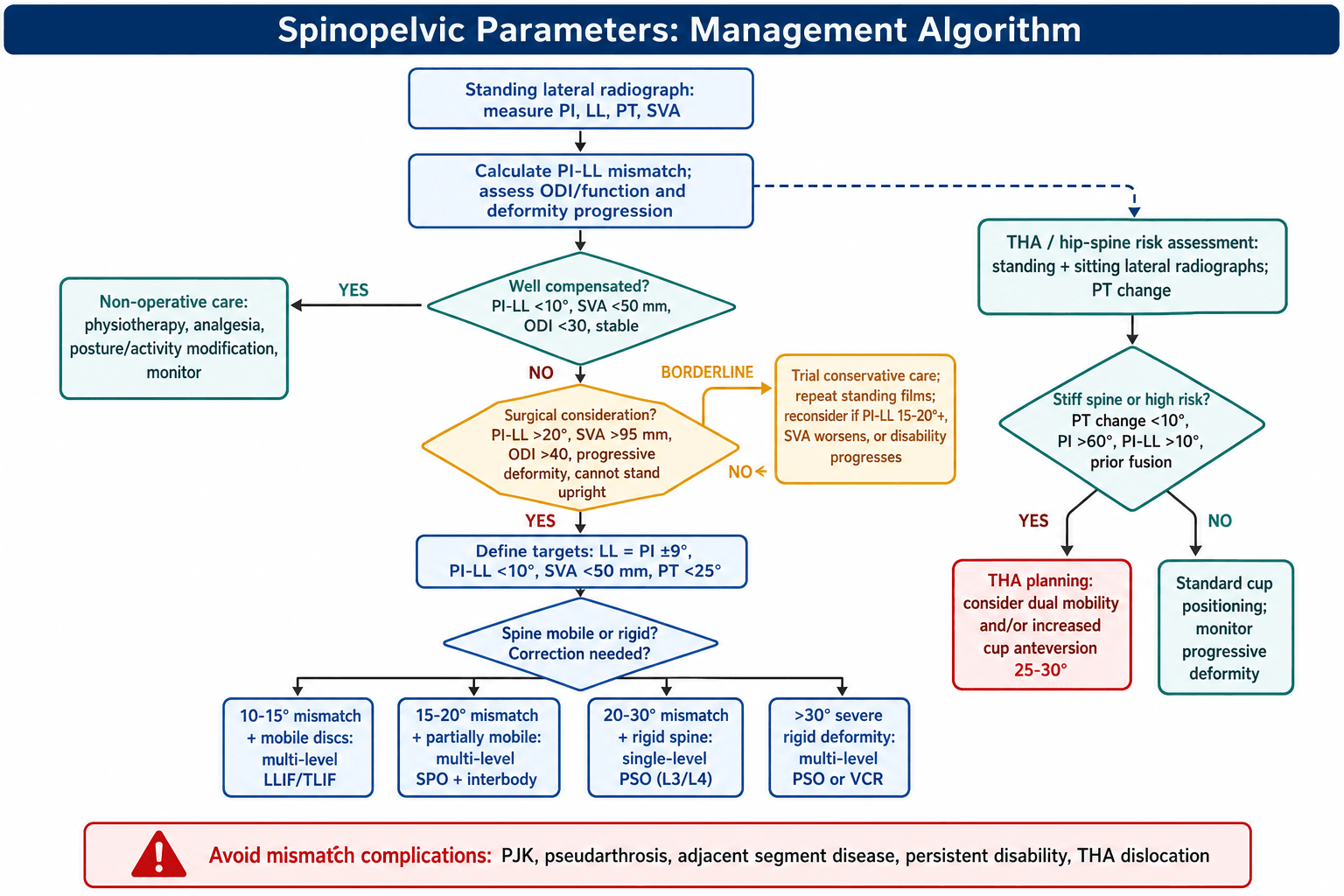
The goal. Deformity surgery restores sagittal balance by matching lumbar lordosis to pelvic incidence and achieving a normal SVA (under 50mm). Plan it in order:
- Measure the spinopelvic parameters on a standing lateral radiograph
- Calculate the PI-LL mismatch (PI minus LL)
- Assess spine rigidity (flexion-extension films)
- Select the osteotomy type by mismatch magnitude and spine flexibility
- Determine the fusion levels to achieve a stable construct
- Set the postoperative goals below
- Preoperative (typical)
- 20-40° (symptomatic)
- Postoperative goal
- Under 10°
- Preoperative (typical)
- 80-150mm (imbalanced)
- Postoperative goal
- Under 50mm
- Preoperative (typical)
- 30-50° (compensating)
- Postoperative goal
- Under 25°
- Preoperative (typical)
- 20-40° (loss of lordosis)
- Postoperative goal
- PI ± 9°
Absolute targets and proportion. These numerical goals are evidence-based and predict optimal outcomes. The GAP score in the evidence section goes further, setting goals in proportion to the patient's PI and lordosis distribution rather than as absolute numbers.
Complications and Pitfalls
Complications of mismatch. Each has a parameter behind it and a way to prevent it:
- Relationship to parameters
- Over-correction (negative PI-LL), high PI
- Prevention
- Match LL to PI, extend fusion if high PI
- Relationship to parameters
- Excessive stress if PI-LL not corrected
- Prevention
- Adequate correction at index surgery
- Relationship to parameters
- Residual PI-LL mismatch
- Prevention
- Aim for PI-LL under 10°
- Relationship to parameters
- Under-correction, residual SVA
- Prevention
- Achieve SVA under 50mm, PI-LL under 10°
- Relationship to parameters
- High PI, spinal imbalance
- Prevention
- Dual mobility, increased anteversion
Under-correction. Restoring too little lordosis (residual PI-LL over 10°) leaves the patient symptomatic and disabled, and the spine may progress to late deformity and junctional failure.
Over-correction. Excessive lordosis, a negative PI-LL mismatch, brings a risk of proximal junctional kyphosis and a patient who feels "thrown backward". It is difficult to correct without major revision.
The wrong osteotomy. An SPO in a rigid spine will not achieve correction, a PSO in a low-PI patient over-corrects, and an SPO strategy can fail through an insufficient number of levels.
Clinical Applications
Adjacent Segment Disease
Mismatch accelerates degeneration. Patients with residual PI-LL mismatch after fusion have accelerated adjacent segment degeneration, and adequate correction at index surgery reduces long-term revision risk.
- Annual ASD risk
- 2-3% per year
- Mechanism
- Minimal mechanical stress
- Annual ASD risk
- 4-6% per year
- Mechanism
- Moderate stress, compensatory hypermobility
- Annual ASD risk
- 8-12% per year
- Mechanism
- Severe stress, rapid degeneration
The annual-risk percentages above are illustrative conventional estimates conveying the dose-response, not measurements from a single cohort; the sourced anchor is that residual PI-LL mismatch increases segmental joint loads (Senteler 2014, reference 15) and accelerates adjacent-segment degeneration.
Spinopelvic Parameters in Spondylolisthesis
High PI drives the slip. A high PI increases lumbosacral shear (anterior shear force at L5-S1) and is an established risk factor for the development and progression of both isthmic and developmental (dysplastic) spondylolisthesis. PI is consistently higher in patients with spondylolisthesis than in controls, and tends to be highest in high-grade slips.
The high-grade slip. The lumbosacral junction kyphoses (the slip angle, or lumbosacral kyphosis), which drives global sagittal imbalance and forces the pelvis to retrovert: high PT, low SS, a "vertical/retroverted sacrum".
The SDSG classification. The Spinal Deformity Study Group classification of high-grade spondylolisthesis is built on PI and on whether the spinopelvis is balanced or unbalanced:
- Balanced pelvis - high SS, low PT (nutated sacrum)
- Unbalanced (retroverted) pelvis - low SS, high PT, often with an unbalanced (kyphotic) spine in which the C7 plumb line falls forward
Reduce or fuse in situ. The balanced-versus-unbalanced distinction informs this debate. An unbalanced, retroverted pelvis with global imbalance benefits from reduction of the slip angle and restoration of lumbosacral lordosis to rebalance the spine, accepting the risk of L5 nerve-root stretch, whereas a balanced high-grade slip may be managed by in-situ fusion. Always measure PI and pelvic balance (PT/SS) in spondylolisthesis: they predict progression and guide whether to reduce.
Guidelines, Registries & Global Practice
Global Epidemiology
Adult spinal deformity is common and increasingly prevalent with population ageing. In community-dwelling adults older than 60, the prevalence of adult scoliosis has been reported as high as 68% in a volunteer cohort, although clinically and radiographically significant sagittal malalignment is less frequent. Sagittal, rather than coronal, parameters are the dominant drivers of disability across populations.
- Reported value
- About 50-55° (wide range 35-85°)
- Source (PubMed)
- Roussouly 2005 (PMID 15682018)
- Reported value
- About 47% (352/752)
- Source (PubMed)
- Glassman 2005 (PMID 16166889)
- Reported value
- Roughly linear worsening of SRS/SF-12/ODI with rising C7 plumb-line offset
- Source (PubMed)
- Glassman 2005 (PMID 16166889)
- Reported value
- 0.8% overall; 99.2% 5-yr survival free of dislocation
- Source (PubMed)
- Vigdorchik 2021 (PMID 34192913)
Guideline and Society Positions (Side-by-Side)
There is no single randomised-trial-based guideline mandating specific spinopelvic targets; practice is driven by validated classifications and society consensus. Evidence levels below reflect the underlying literature, not formal GRADE recommendations.
- Position on spinopelvic alignment
- Restore PI-LL to less than 10°, PT less than 20-25°, SVA less than 50mm
- Evidence basis
- Validation/reliability study (PMID 22045006)
- Position on spinopelvic alignment
- Aim for a "proportioned" spine using PI-based proportional targets and lordosis distribution
- Evidence basis
- Development/validation cohort, AUC 0.92 (PMID 28976431)
- Position on spinopelvic alignment
- Screen THA candidates for PI-LL mismatch and standing-to-seated spinal stiffness; use dual mobility for stiff flatback
- Evidence basis
- Prospective series, Otto Aufranc Award (PMID 34192913)
- Position on spinopelvic alignment
- Match restored lordosis shape to the patient's native PI-defined type
- Evidence basis
- Prospective descriptive cohort (PMID 15682018)
Imaging and Planning - Global Standards
- Full-length standing radiograph from C7 (ideally external auditory meatus) to femoral heads is the universal standard for measurement.
- EOS biplanar imaging delivers low-dose, weight-bearing whole-body assessment and is widely used in high-volume European, North American and Australasian centres.
- Standing-and-seated lateral films are standard for hip-spine assessment before THA in patients with spinal pathology (PMID 34192913).
- Planning software (e.g. Surgimap and equivalents) computes PI-based ideal lordosis; the GAP score adds proportional and lordosis-distribution targets (PMID 28976431).
Practice Variation and Registry Evidence
- Targets are largely consistent internationally (PI-LL less than 10°, SVA less than 50mm), but osteotomy preference varies: three-column osteotomy (PSO) use is higher in some North American series, while anterior-column realignment and multilevel interbody techniques are increasingly favoured to reduce three-column-osteotomy morbidity.
- National arthroplasty registries (e.g. AOANJRR, NJR, AJRR) record dislocation and revision but do not yet capture spinopelvic parameters, so registry data underestimate the hip-spine contribution to instability - a recognised data gap.
- Dual-mobility uptake for stiff-spine THA has risen markedly following hip-spine classification evidence (PMID 34192913).
MCQ Practice Points
Q: What is pelvic incidence (PI) and why is it clinically important?
A: Pelvic incidence (PI) is the angle between a line perpendicular to the sacral endplate at its midpoint and a line connecting this point to the femoral head centers. It is the only fixed spinopelvic parameter (does not change with posture) and determines the amount of lumbar lordosis needed for sagittal balance. PI = PT + SS. Higher PI requires more lordosis. The ideal relationship is PI minus LL within 10 degrees (PI-LL mismatch). Average PI is approximately 50-55 degrees.
Q: What is the sagittal vertical axis (SVA) and what values indicate positive sagittal balance?
A: SVA is the horizontal distance from the C7 plumb line to the posterosuperior corner of S1. Normal SVA is less than 5cm (C7 plumb line falls over or behind the sacrum). Positive sagittal balance (SVA greater than 5cm) means C7 is anterior to the sacrum, requiring compensatory mechanisms (pelvic retroversion, knee flexion, hip extension). SVA greater than 9.5cm is associated with significant disability. Every 1cm increase in SVA correlates with worsening patient-reported outcomes (Glassman study).
Q: What is pelvic tilt (PT) and what does an elevated PT indicate?
A: Pelvic tilt (PT) is the angle between a vertical line and the line connecting the sacral endplate midpoint to the femoral head centers. Normal PT is 10-25 degrees. Elevated PT (greater than 25-30 degrees) indicates pelvic retroversion - a compensatory mechanism for positive sagittal balance where the pelvis rotates backward to bring the trunk over the pelvis. High PT is associated with poor clinical outcomes, increased energy expenditure for walking, and indicates the patient is "using up" their compensatory reserve.
Q: How do you calculate the ideal lumbar lordosis for a patient?
A: The Schwab formula: Ideal LL = PI plus or minus 10 degrees. For example, a patient with PI of 60 degrees needs LL of 50-70 degrees. Other formulas exist: LL = PI + 9 (Legaye) or LL = 0.5 × PI + 25 (Le Huec). The lordosis should be distributed with two-thirds between L4-S1. When planning corrective surgery, target SVA less than 5cm, PT less than 25 degrees, and PI-LL mismatch less than 10 degrees. Failure to restore appropriate lordosis leads to flatback syndrome.
Q: What are the compensatory mechanisms for sagittal imbalance?
A: Compensatory mechanisms occur in sequence: 1) Pelvic retroversion (increased PT) - pelvis rotates backward; 2) Hip extension - reduces hip flexion contracture reserve; 3) Knee flexion - moves center of mass posteriorly; 4) Cervical hyperlordosis - attempts to maintain horizontal gaze. When all mechanisms are exhausted, the patient develops positive sagittal imbalance with forward stooped posture. Assessment should include full-length standing spine radiographs with hips and knees in view to evaluate compensation.
Exam Day Cheat Sheet
Differential Diagnosis - Causes of Positive Sagittal Imbalance / Loss of Lumbar Lordosis
When a patient presents with forward stooped posture and a positive SVA, the underlying driver must be identified, as it changes management. Key discriminators are whether the deformity is fixed or flexible and where the lordosis loss originates.
- Key Feature
- Anterior disc-height loss across lower lumbar levels
- PI / Parameters
- PI normal; LL reduced; PI-LL mismatch
- Flexibility / Distinguisher
- Often partly flexible early; rigid late
- Key Feature
- Lordosis lost within a prior straight fusion
- PI / Parameters
- Fixed PI; rigid fused segment, large PI-LL
- Flexibility / Distinguisher
- Rigid - needs osteotomy, not SPO alone
- Key Feature
- Global ankylosis, chin-on-chest, raised inflammatory markers
- PI / Parameters
- Rigid spine, large SVA, fused SI joints
- Flexibility / Distinguisher
- Rigid; HLA-B27; needs PSO; anaesthetic airway risk
- Key Feature
- Focal kyphosis at fracture level, osteoporosis
- PI / Parameters
- Focal angular deformity; may be mobile
- Flexibility / Distinguisher
- Acute vs chronic; MRI marrow oedema if acute
- Key Feature
- Posture corrects when supine; truncal weakness
- PI / Parameters
- Dynamic, position-dependent, often flexible
- Flexibility / Distinguisher
- Reducible supine - distinguishes from fixed bony deformity
- Key Feature
- Trunk lean driven by the hip, not the spine
- PI / Parameters
- Reduced PT/anteversion; LL may be preserved
- Flexibility / Distinguisher
- Thomas test positive; correct hip before judging spine
Clinical Decision Scenarios
Practise clinical reasoning and management decisions out loud
“A 65-year-old woman presents 20 years post-Harrington rod instrumentation for adolescent idiopathic scoliosis. She has progressive forward lean and can only walk 50 meters before back and leg pain forces her to sit. Standing lateral radiograph shows PI 55°, LL 25°, PT 35°, SVA 120mm. She asks if surgery can help.”
“A 68-year-old man undergoes primary THA for osteoarthritis. He has a history of L4-S1 fusion for degenerative spondylolisthesis performed 5 years ago. At 3 months post-THA, he has had 2 posterior dislocations despite standard positioning (40° inclination, 20° anteversion). Standing spine films show PI 70°, LL 45°, PT 35°, rigid lumbar spine. The referring surgeon asks your opinion on revision strategy.”
“A 62-year-old woman with degenerative scoliosis (Cobb 45°) has severe disability (ODI 55). She has neurogenic claudication limiting walking to 100 meters. Standing films show PI 50°, LL 20°, PT 40°, SVA 140mm. L2-S1 is rigid on flexion-extension films. She asks if surgery can help and if so, what type.”
“A 58-year-old man presents with increasing low back pain and difficulty standing upright. He leans forward when walking and uses a shopping cart for support. Standing lateral radiograph shows PI 45°, LL 35°, PT 25°, SVA 60mm. He works as a pharmacist and finds it difficult to stand for long periods. ODI score is 32. He asks if he needs surgery.”
Pelvic Parameters (Fixed vs Positional)
- Pelvic Incidence (PI): FIXED morphological parameter, average 50° (35-85°), does NOT change
- Pelvic Tilt (PT): Positional, normal under 20°, increases with retroversion (compensation)
- Sacral Slope (SS): Positional, average 40°, PI = PT + SS (always true)
- PI determines ideal lumbar lordosis: Target LL = PI ± 9°
Spinal Parameters
- Lumbar Lordosis (LL): L1-S1, normal 40-70°, should match PI ± 9°
- PI-LL Mismatch: Under 10° good, 10-20° moderate, over 20° severe disability (ODI over 40)
- Sagittal Vertical Axis (SVA): C7 plumb to S1, under 50mm normal, over 95mm severe imbalance
- Thoracic Kyphosis (TK): T4-T12, normal 20-50°, reciprocal to LL
PI-LL Mismatch - Disability Correlation
- Under 10°: ODI under 20, minimal disability, good balance, no surgery needed
- 10-20°: ODI 20-40, moderate disability, consider surgery if symptomatic
- 20-30°: ODI 40-50, severe disability, strong surgical indication
- Over 30°: ODI over 50, extreme disability, major correction needed (PSO/VCR)
Roussouly Classification (defined by SACRAL SLOPE)
- Type 1: SS under 35° - SHORT hyperlordosis, apex L5, with a long thoracolumbar kyphosis above
- Type 2: SS under 35° - the TRUE FLAT BACK, hypolordotic and hypokyphotic, apex base of L4
- Type 3: SS 35-45° - well-balanced and the COMMONEST type, apex centre of L4
- Type 4: SS over 45° - long hyperlordosis, apex base of L3 or higher, most vertebrae in the lordosis
- Types 1 and 2 share the same SS: morphology separates them, not a number. A later revision added Type 3AP for the anteverted pelvis
Surgical Planning - Osteotomy Selection
- SPO (Smith-Petersen): 5-10° per level, for MOBILE discs, PI-LL 10-20°, multi-level
- PSO (Pedicle Subtraction): 25-35° per level, for RIGID spine, PI-LL 20-35°, single level
- VCR (Vertebral Column Resection): 40-60° per level, extreme deformity, PI-LL over 35°
- Surgical goals: PI-LL under 10°, SVA under 50mm, PT under 25°
THA Considerations
- High PI (over 60°): Increased dislocation risk via greater functional anteversion change
- Stiff spine (fused): Lost protective pelvic tilt when sitting, increased dislocation risk
- PI-LL mismatch: Pelvic retroversion reduces functional anteversion in sitting
- Revision strategy: Dual mobility for stiff spine, increased anteversion 25-30°
Compensatory Mechanisms (Cascade)
- Stage 1 (SVA 0-50mm): Pelvic retroversion (increased PT up to 30°)
- Stage 2 (SVA 50-80mm): Knee flexion, ankle dorsiflexion added
- Stage 3 (SVA 80-120mm): Thoracic hyperkyphosis develops
- Stage 4 (SVA over 120mm): Exhausted compensation, hip extension loss, cannot stand upright
Measurement Technique
- PI: Femoral heads to sacral endplate, perpendicular to sacral plate
- PT: Femoral heads to sacral endplate, vertical reference
- SS: Sacral endplate angle to horizontal
- LL: L1 superior to S1 superior endplate (Cobb angle)
- SVA: C7 plumb line horizontal distance to posterior-superior S1
Evidence Base
Schwab Realignment Objectives - Current Concepts Review
- Current concepts review establishing spinopelvic realignment objectives for adult spinal deformity surgery
- Identified sagittal vertical axis, pelvic tilt and lumbar lordosis as the key parameters correlating with pain and disability
- Proposed restoring a low SVA and low PT combined with lumbar lordosis proportional to pelvic incidence
- Advocated a global, individualised alignment approach rather than universal numerical targets
- Provided the conceptual framework later operationalised in the SRS-Schwab classification
SRS-Schwab Adult Deformity Classification - Validation
- Reliability/validation study of the SRS-Schwab classification incorporating pelvic parameters
- Adds three sagittal modifiers - PI-LL mismatch, pelvic tilt and SVA - each graded 0, plus or double-plus
- Modifier cut-offs were derived from health-related quality of life data in a multicentre deformity database
- Inter-rater kappa was 0.75 to 0.86 for PI-LL, 0.97 to 0.98 for PT and 0.96 for SVA (substantial to almost perfect)
- Nine readers grading 21 cases twice demonstrated excellent intra-rater reliability (kappa about 0.88 to 0.97)
Roussouly Classification - Normal Sagittal Alignment
- Prospective radiographic study of 160 asymptomatic volunteers in standardised standing position
- Described four reproducible types of normal sagittal lumbopelvic morphology
- Sacral slope (and thus PI) determined lordosis magnitude, apex position and number of lordotic vertebrae
- Type 1-2 (low PI/SS) show short or flat lordosis; Type 3-4 (high PI/SS) show longer, more curved lordosis
- Provided a normative framework so restoration targets the patient's own type rather than a universal value
Acetabular Anteversion Change After Spinal Realignment
- Retrospective multicentre series of 41 hips (33 patients) with prior THA who later underwent spinal realignment
- Acetabular anteversion fell significantly after spinal correction (mean change about minus 5°, p less than 0.001)
- Change in anteversion correlated most strongly with change in pelvic tilt (r about 0.83)
- Anteversion decreased roughly 1° for every 1.1° reduction in pelvic tilt - close to a one-to-one relationship
- Patients with spinopelvic malalignment frequently had excessively anteverted cups that normalised after realignment
Pelvic Tilt and Truncal Inclination Predict Disability
- Prospective analysis of 125 adult deformity patients (mean age 57) with full-length standing radiographs
- Pelvic tilt correlated with health-related quality of life (r about 0.28 to 0.42) and with SVA (r about 0.64)
- High PT reflects compensatory pelvic retroversion for sagittal malalignment
- T1 spinopelvic inclination (truncal inclination) correlated with HRQOL and outperformed raw SVA
- Sagittal, not coronal, parameters drove disability - establishing PT as a key compensatory marker
Positive Sagittal Balance Predicts Disability (SVA)
- Multicentre review of 752 adult deformity patients; 352 had positive sagittal balance
- All health-status measures (SRS, SF-12, ODI) worsened as C7 plumb-line deviation increased
- Symptom severity rose in a roughly linear fashion with progressive sagittal imbalance
- Even mildly positive sagittal balance was detrimental to patient-reported outcomes
- Lumbar (relative) kyphosis was poorly tolerated, whereas upper thoracic kyphosis was better tolerated
Global Alignment and Proportion (GAP) Score
- Developed and validated in 222 patients fused 4 or more levels and followed at least 2 years
- PI-based proportional score using relative pelvic version, relative lumbar lordosis, lordosis distribution index and relative spinopelvic alignment plus age
- Area under the ROC curve of 0.92 for predicting mechanical complications
- Proportioned spines had a 6% mechanical complication rate versus 47% (moderate) and 95% (severe disproportion)
- Improves on absolute Schwab targets by accounting for the whole PI spectrum and lordosis distribution
Hip-Spine Classification Reduces THA Dislocation
- Prospective multicentre series of 2,081 THAs (2021 Otto Aufranc Award)
- Flatback deformity defined as PI-LL greater than 10°; stiff spine as less than 10° change in sacral slope standing to seated
- Group 2B (flatback plus stiff spine) and patients with more than three fused levels all received dual-mobility components
- Five-year survivorship free of dislocation was 99.2% (overall dislocation rate 0.8%)
- Patient-specific component positioning guided by spinopelvic mobility markedly reduced instability in high-risk hips
References
- Duval-Beaupère G, Schmidt C, Cosson P. A Barycentremetric study of the sagittal shape of spine and pelvis: the conditions required for an economic standing position. Ann Biomed Eng. 1992;20(4):451-462.
- Legaye J, Duval-Beaupère G, Hecquet J, Marty C. Pelvic incidence: a fundamental pelvic parameter for three-dimensional regulation of spinal sagittal curves. Eur Spine J. 1998;7(2):99-103.
- Schwab F, Patel A, Ungar B, et al. Adult spinal deformity-postoperative standing imbalance: how much can you tolerate? An overview of key parameters in assessing alignment and planning corrective surgery. Spine. 2010;35(25):2224-2231.
- Schwab F, Ungar B, Blondel B, et al. Scoliosis Research Society-Schwab adult spinal deformity classification: a validation study. Spine. 2012;37(12):1077-1082.
- Roussouly P, Gollogly S, Berthonnaud E, Dimnet J. Classification of the normal variation in the sagittal alignment of the human lumbar spine and pelvis in the standing position. Spine. 2005;30(3):346-353.
- Lafage V, Schwab F, Patel A, Hawkinson N, Farcy JP. Pelvic tilt and truncal inclination: two key radiographic parameters in the setting of adults with spinal deformity. Spine. 2009;34(17):E599-E606.
- Glassman SD, Bridwell K, Dimar JR, Horton W, Berven S, Schwab F. The impact of positive sagittal balance in adult spinal deformity. Spine. 2005;30(18):2024-2029.
- Buckland AJ, Vigdorchik JM, Schwab FJ, et al. Acetabular anteversion changes due to spinal deformity correction: bridging the gap between hip and spine surgeons. J Bone Joint Surg Am. 2015;97(23):1913-1920.
- Vigdorchik JM, Sharma AK, Buckland AJ, et al. 2021 Otto Aufranc Award: A simple Hip-Spine Classification for total hip arthroplasty: validation and a large multicentre series. Bone Joint J. 2021;103-B(7 Supple B):17-24.
- Smith JS, Klineberg E, Schwab F, et al. Change in classification grade by the SRS-Schwab Adult Spinal Deformity Classification predicts impact on health related quality of life measures: prospective analysis of operative and nonoperative treatment. Spine. 2013;38(19):1663-1671.
- Yilgor C, Sogunmez N, Boissiere L, et al. Global Alignment and Proportion (GAP) Score: development and validation of a new method of analyzing spinopelvic alignment to predict mechanical complications after adult spinal deformity surgery. J Bone Joint Surg Am. 2017;99(19):1661-1672.
- Bridwell KH, Glassman S, Horton W, et al. Does treatment (nonoperative and operative) improve the two-year quality of life in patients with adult symptomatic lumbar scoliosis: a prospective multicenter evidence-based medicine study. Spine. 2009;34(20):2171-2178.
- Protopsaltis T, Schwab F, Bronsard N, et al. The T1 pelvic angle, a novel radiographic measure of global sagittal deformity, accounts for both spinal inclination and pelvic tilt and correlates with health-related quality of life. J Bone Joint Surg Am. 2014;96(19):1631-1640.
- Barrey C, Roussouly P, Le Huec JC, D'Acunzi G, Perrin G. Compensatory mechanisms contributing to keep the sagittal balance of the spine. Eur Spine J. 2013;22 Suppl 6:S834-S841.
- Senteler M, Weisse B, Rothenfluh DA, Snedeker JG. Pelvic incidence-lumbar lordosis mismatch results in increased segmental joint loads in the unfused and fused lumbar spine. Eur Spine J. 2014;23(7):1384-1393.