Adult Flatfoot Deformity | Medial Arch Collapse | Static Restraint Failure
- Spring ligament is the PRIMARY STATIC restraint to talar head plantar displacement
- Nearly always occurs with Stage II or higher PTTD (the ~90% figure is conventional teaching from small series, not a measured prevalence)
- Superomedial band is most commonly injured (largest, under talar head)
- Direct repair fails - requires augmentation (FHL/FDL/allograft)
- MRI shows thickening, fluid signal, discontinuity on coronal views
- “Ask about progression - acute trauma rare, usually degenerative with PTTD
- “Palpable gap at spring ligament site indicates complete rupture
- “Always assess in context of adult flatfoot - rarely isolated pathology
- “Reconstruction is adjunct to PTT reconstruction, never alone
Spring Ligament Insufficiency
Overview and Epidemiology
The plantar calcaneonavicular ligament, the spring ligament, is a critical static restraint to collapse of the medial longitudinal arch. It acts as a hammock supporting the talar head, resisting approximately 50% of the load transmitted through the medial arch during weight bearing.
The company it keeps. Spring ligament insufficiency is reported in roughly 90% of patients with Stage II or higher posterior tibial tendon dysfunction (PTTD), a conventional figure from small surgical series rather than a measured prevalence. The PTT is the dynamic restraint and fails commonly, by degeneration; the spring ligament is the static restraint and in the combined picture fails secondarily. Loss of the ligament lets the talar head sag plantarwards, loss of the tendon shows as hindfoot valgus, and together they produce a progressive flatfoot.
Isolated injury. Primary failure of the spring ligament is rare. The acute traumatic rupture and the isolated rupture with a normal PTT are covered under Pathophysiology and Controversies.
The name derives from the ligament's elastic properties, which were historically thought to provide a spring-like recoil to the arch. However, modern biomechanical studies show it functions primarily as a static restraint, not a dynamic spring.
Anatomy of the Spring Ligament Complex
Three bands. The ligament has three bands, and the superomedial band carries most of the clinical weight:
- Superomedial band - from the anterior aspect of the sustentaculum tali to the medial navicular tuberosity. The largest and thickest band, with a fibrocartilaginous undersurface that articulates with the talar head. It is the primary restraint to plantar displacement of the talar head and the band most commonly torn.
- Inferior (plantar) band - deep; blends with the plantar fascia and supports the plantar aspect.
- Oblique band - the most lateral; overlaps the PTT insertion site.
The inferior and oblique bands are secondary restraints that maintain arch integrity, and are less commonly symptomatic in isolation.
Other static supports. The spring ligament is the primary static restraint of the medial arch, but several supports work together:
- The plantar fascia, through the windlass mechanism
- Rear-foot alignment, through subtalar joint position
- The interosseous talocalcaneal ligament, for sinus tarsi stability
- The naviculocuneiform, in the midfoot Lisfranc complex
- Ground reaction force, through tripod weight distribution
The Acetabulum Pedis (Talar Head Socket)
The socket. The talar head sits in a socket, the acetabulum pedis, whose parts cradle it as a single peritalar unit:
- The anterior and middle facets of the calcaneus, on the sustentaculum tali, form the inferolateral floor
- The concave posterior articular surface of the navicular forms the anterior wall
- The spring ligament bridges the gap between sustentaculum and navicular, completing the plantar-medial floor
A load-bearing ligament, not just a tether. The superomedial band spans the interval where there is no bone beneath the talar head, so its undersurface is a genuine articular part of the socket. It must resist tension from arch load and compression from direct talar head contact, and where it articulates with the plantar aspect of the talar head it undergoes fibrocartilaginous metaplasia. The fibrocartilage lets it withstand compressive loads, but it also makes the band vulnerable to degenerative failure under chronic stress.
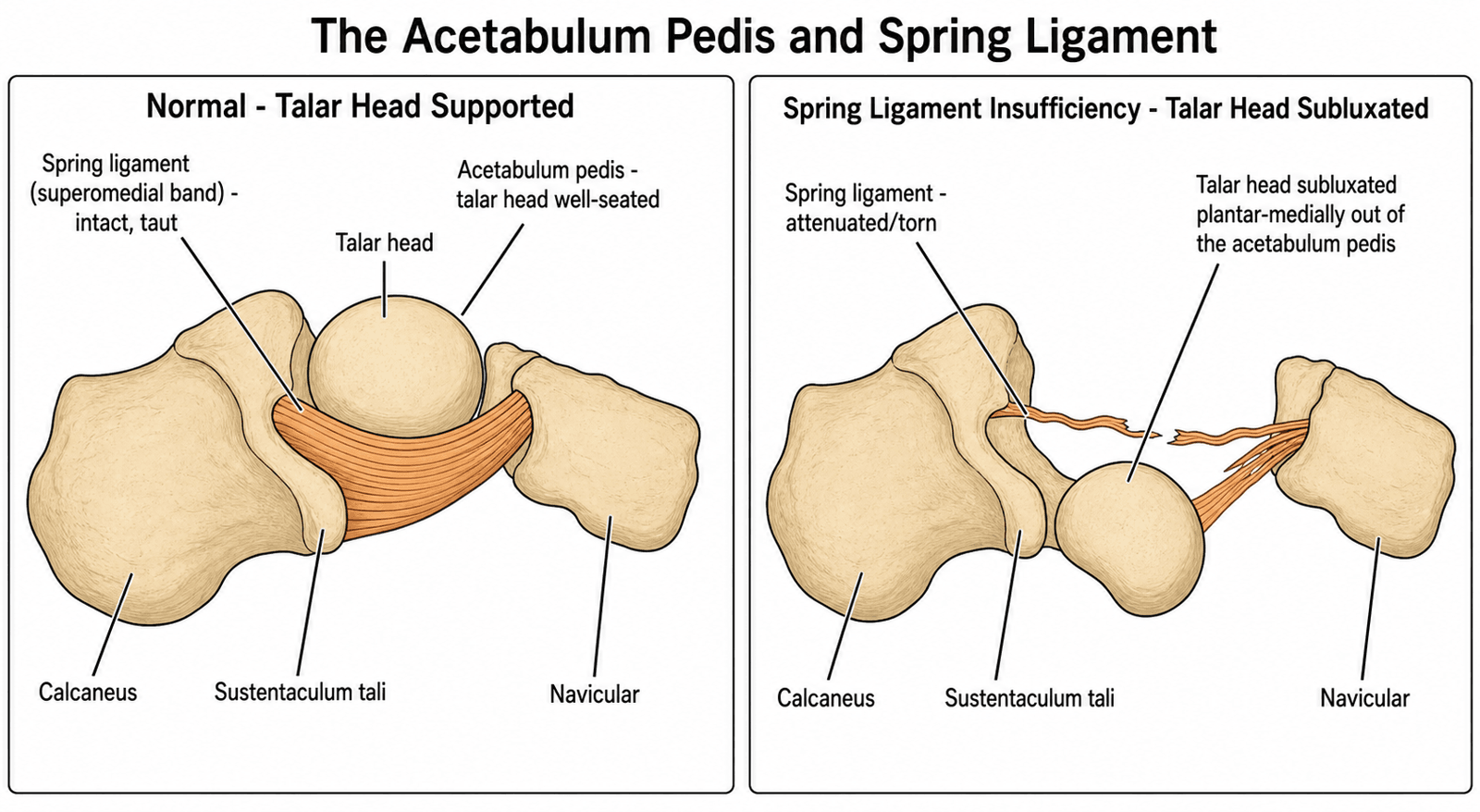
When the floor fails. As the spring ligament attenuates, the medial-plantar floor of the socket gives way and the talar head rotates plantar-medially out of its socket: true peritalar (subtalar) subluxation. The navicular and midfoot swing into abduction and dorsiflexion around the sagging head, producing the talonavicular uncoverage and the break in Meary's line measured on weight-bearing films.
Reframing flatfoot as subluxation of the talus out of the acetabulum pedis, rather than passive arch sag, explains why reconstruction targets restoration of the socket floor and talonavicular coverage, not merely arch height.
Think of the talar head like a femoral head sitting in an acetabulum whose medial-plantar wall is soft tissue (the spring ligament) rather than bone. Lose that wall and the "hip of the foot" subluxates medially — the mechanical basis of peritalar subluxation and progressive collapsing foot deformity.
Pathophysiology
The degenerative cascade. Insufficiency develops through a progressive degenerative process, nearly always in the context of PTTD. The sequence below describes the process; its steps are not the stages of the classification that follows.
- The PTT loses strength and begins to elongate, and increased load is transferred to the spring ligament.
- Chronic overload elongates the ligament. The superomedial band begins to stretch, allowing the talar head to sag plantarwards.
- The superomedial band develops longitudinal tears or interstitial degeneration, and a flexible flatfoot deformity becomes apparent.
- Full-thickness disruption of the superomedial band lets the talar head fully plantarflex, creating a rigid flatfoot if untreated.
Isolated acute spring ligament rupture is exceedingly rare but can occur with severe hindfoot eversion trauma (e.g., motor vehicle accident). Unlike degenerative failure, acute injury may present without pre-existing PTTD. MRI shows acute haemorrhage and complete discontinuity.
Classification Systems
The spring ligament stages parallel the Johnson and Strom PTTD staging, because the two lesions nearly always occur together.
- Pathology
- Elongation, no tear
- MRI Findings
- Thickening under 8mm, normal signal
- Deformity
- Flexible, reducible
- Treatment
- Conservative + UCBL orthosis
- Pathology
- Partial tear
- MRI Findings
- Thickening greater than 8mm, increased T2 signal, partial discontinuity
- Deformity
- Flexible with talar sag
- Treatment
- Augmentation + PTT transfer
- Pathology
- Complete rupture
- MRI Findings
- Complete discontinuity, fluid gap
- Deformity
- Rigid, fixed flatfoot
- Treatment
- Reconstruction + Osteotomy
Reading the two tables together. Spring ligament reconstruction is performed in Stage II and occasionally Stage III PTTD, when the deformity remains flexible. The reconstruction listed against spring ligament Stage III, a rigid deformity, has to be read against that: once the foot is rigid, the Johnson and Strom stage III treatment is triple arthrodesis.
Clinical Presentation
Who. Typically a middle-aged woman aged 40-60; the female-to-male ratio is 9:1.
The story. Gradual progression over months to years. The patient reports medial midfoot pain, worse with prolonged standing or walking, a progressive flatfoot ("my arch is falling"), and difficulty with a single-leg heel rise and on uneven terrain.
Red flags for acute injury. These suggest acute traumatic rupture rather than degenerative insufficiency:
- Sudden onset after trauma (rare)
- Immediate inability to weight bear
- Massive medial swelling
- Palpable medial defect
Inspection. Standing, the medial arch has collapsed and the talar head is prominent medially. From behind, hindfoot valgus shows as the too many toes sign, more than three toes visible. Gait shows excessive pronation and loss of heel rise.
Palpation. Feel the spring ligament zone medial to the talar head, between the sustentaculum and the navicular; the talar head itself is prominent and may be tender. With complete rupture a gap can be palpated there, especially with hindfoot eversion stress, but this is rare.
Special tests. These assess the combined PTTD and spring ligament pathology, not the spring ligament in isolation:
- Single heel rise - inability indicates PTT weakness, an associated finding
- Passive arch correction - assesses flexibility against rigidity
- Jack test - toe extension recreates the arch if the deformity is flexible
Investigations
Weight-bearing radiographs come first: AP, lateral and hindfoot alignment views. They show arch collapse (Meary angle, calcaneal pitch), talonavicular uncoverage and hindfoot valgus. They are not specific for the spring ligament but are essential for surgical planning.
MRI is the gold standard, and coronal T2-weighted sequences are critical. Sagittal views show the plantar sag of the talar head, and the same study assesses the PTT. In the superomedial band look for:
- High fluid signal on T2
- Thickening greater than 8mm
- Undersurface irregularity, from fibrocartilage disruption
- Interstitial tears: longitudinal splits within the substance
- Discontinuity, a full-thickness gap in complete (severe) tears
Thickness thresholds. The staging uses 8mm, but in Williams' series of 13 surgically proven tears the consistent signs were proximal thickening of the superomedial band over 5mm (92%) and distal thinning under 2mm (85%), while medioplantar band findings were far less reliable. Thickening with distal thinning is the most reproducible sign of a tear.
Ultrasound can visualise spring ligament tears dynamically but is operator-dependent and less commonly used than MRI.
Differential Diagnosis
Spring ligament insufficiency presents as medial-sided foot pain with arch collapse. The task is to distinguish it from the other causes of acquired flatfoot and medial foot pain, and to recognise that it usually coexists with PTTD rather than occurring in isolation.
- Distinguishing Features
- Talar head plantar-medial prominence, tenderness between sustentaculum and navicular
- Key Investigation
- Coronal MRI: superomedial band thickening then distal thinning
- Pitfall
- Assuming it is always secondary to PTTD
- Distinguishing Features
- Weak/absent single heel rise, too-many-toes sign, retromalleolar tenderness
- Key Investigation
- MRI of PTT (tenosynovitis, split, gap)
- Pitfall
- Treating PTTD alone and missing the spring tear
- Distinguishing Features
- Flexible flatfoot with a normal PTT and intact heel rise
- Key Investigation
- MRI tear plus normal PTT; confirmed intra-operatively
- Pitfall
- Mislabelling as PTTD and under-treating
- Distinguishing Features
- Valgus tilt of the talus within the ankle mortise
- Key Investigation
- Weight-bearing ankle AP shows valgus talar tilt
- Pitfall
- Missing the ankle component above the hindfoot
- Distinguishing Features
- Apex of deformity at the midfoot, not talonavicular
- Key Investigation
- Lateral weight-bearing radiograph: sag at NC or TMT
- Pitfall
- Osteotomy fails if true apex is more distal
- Distinguishing Features
- Diabetes/neuropathy, warmth, swelling, bony fragmentation
- Key Investigation
- Radiographs and MRI; check sensation and glucose
- Pitfall
- Operating during the active fragmentation phase
- Distinguishing Features
- Younger patient, rigid hindfoot, peroneal spasm
- Key Investigation
- CT: talocalcaneal or calcaneonavicular bar
- Pitfall
- Attempting soft-tissue reconstruction of a rigid foot
Management Algorithm
Who. Stage I (elongation without tear), minimal symptoms, a reducible deformity, or a patient unfit for surgery.
Phase 1, 0-6 weeks: symptom control. A CAM walker or Arizona brace offloads the medial arch, with anti-inflammatory medication (NSAIDs) and avoidance of prolonged standing.
Phase 2, from 6 weeks: orthotic support. A custom UCBL (University of California Biomechanics Laboratory) orthosis, with medial posting to support the talar head and reduce spring ligament load, and a rigid arch support to maintain alignment.
Phase 3: rehabilitation. PTT strengthening (resisted inversion, toe curls), intrinsic foot muscle work (toe spreading, short foot exercises) and proprioception (single-leg balance, unstable surface training).
What it achieves. Conservative management addresses PTT weakness but cannot reverse spring ligament elongation or tear. It relieves symptoms in 60-70% but does not prevent progression.
Surgical Technique
Set-up. Supine with a bump under the ipsilateral hip, a thigh tourniquet at 250-300 mmHg, and the leg free-draped so the foot can be manipulated.
Incision. Medial, centred over the interval between PTT and FHL, 8-12 cm from the navicular tuberosity to the sustentaculum. Deepen onto the PTT sheath first, the dorsal structure, and then the spring ligament, which is plantar.
Exposure.
- Incise the PTT sheath longitudinally
- Inspect the PTT, which usually requires debridement or transfer
- Identify the spring ligament inferior to the talar head
- Assess the tear pattern: longitudinal split or complete rupture
The plantar medial neurovascular bundle runs deep to the spring ligament. The medial plantar nerve can be injured during deep dissection or bone tunnel creation, causing numbness of the medial forefoot and weakness of the intrinsic muscles. Retract carefully and stay superficial to the neurovascular bundle.
Suture-Tape (Internal Brace) Augmentation
What it is. A high-strength non-absorbable suture tape, for example a braided FiberTape-type construct, is anchored bone-to-bone from the sustentaculum tali or medial calcaneus to the navicular tuberosity. It runs along the anatomic course of the superomedial band and is tensioned with the foot held in the corrected position (talar head reduced, hindfoot neutral).
The rationale. The tape acts as a load-sharing internal ligament, a "seatbelt":
- It offloads the healing native repair or tendon graft during the vulnerable early phase
- It augments rather than replaces, alongside primary repair, tendon autograft or deltoid-spring (TCNL) reconstruction
- There is no tendon-harvest donor morbidity, and the immediate mechanical restraint may permit earlier protected rehabilitation
The cautions.
- A non-elastic tape over-constrains a normally viscoelastic ligament, and may stress-shield native tissue or cut through bone or soft tissue if over-tensioned
- Isometric anchor placement and correct tension are critical: a poorly placed tape either does nothing or blocks reduction
- Comparative outcome data are limited to small level IV series, so it remains an adjunct, not a proven standalone
Tape augmentation follows the rule for every soft-tissue step in this operation: it does not substitute for a medialising (or lateral column lengthening) osteotomy when fixed hindfoot valgus or forefoot abduction is present. Bony realignment restores alignment; the internal brace protects the medial soft-tissue reconstruction that maintains it.
Complications
- Incidence
- 10-15%
- Risk Factors
- Inadequate correction, non-compliance
- Management
- Revision reconstruction, osteotomy
- Incidence
- 5-8%
- Risk Factors
- Diabetes, smoking, peripheral vascular disease
- Management
- Local wound care, VAC therapy
- Incidence
- 2-3%
- Risk Factors
- Deep dissection, excessive retraction
- Management
- Observation (usually neuropraxia), neurolysis if persistent
- Incidence
- 5-10%
- Risk Factors
- Inadequate fixation, early mobilisation
- Management
- Revision with allograft augmentation
- Incidence
- 10-20%
- Risk Factors
- Over-correction, aggressive immobilisation
- Management
- Physiotherapy, subtalar mobilisation
Postoperative Care and Rehabilitation
Rehabilitation Protocol
Splint immobilisation in a below-knee backslab or boot, with leg elevation, DVT prophylaxis and wound care.
Transition to a removable boot, still non-weight bearing. Begin ankle ROM exercises, plantarflexion and dorsiflexion only, no inversion or eversion.
Progressive weight bearing in the boot, worn full-time: 25% at week 6, 50% at week 8, 75% at week 10, full at week 12.
Wean from the boot to a supportive shoe with a custom orthosis; a UCBL or full-length rigid orthotic is mandatory. Continue gait retraining and strengthening.
Gradual return to sports and high-demand activities. Permanent orthotic use is recommended; avoid barefoot walking and unsupportive shoes.
Outcomes and Prognosis
Reconstruction is more likely to fail with:
- Rigid deformity (fixed flatfoot despite reconstruction)
- Severe hindfoot valgus not corrected (greater than 20 degrees)
- Obesity (BMI greater than 35)
- Peripheral neuropathy (diabetes)
- Non-compliance with orthotic use postoperatively
Guidelines, Registries & Global Practice
Spring ligament insufficiency is managed within the broader framework of adult acquired flatfoot deformity (AAFD), now increasingly termed progressive collapsing foot deformity (PCFD). There is no isolated society guideline for the spring ligament itself; practice is guided by foot-and-ankle society consensus on flatfoot and by the underlying evidence.
Global epidemiology
- AAFD predominantly affects middle-aged women (typical onset 40 to 65 years), with a strong female preponderance.
- Spring ligament pathology is identified in the large majority of advanced (flexible stage II and beyond) flatfeet at surgery; isolated rupture with a normal PTT is rare but real and under-recognised.
- Obesity, hypertension, diabetes and seronegative inflammatory arthropathy are recognised associations with degenerative medial-arch failure.
- Position Relevant to Spring Ligament
- Classify by flexibility and deformity class; soft-tissue reconstruction is an adjunct to osseous realignment
- Emphasis
- Class-based, deformity-specific algorithm
- Position Relevant to Spring Ligament
- Trial structured non-operative care first; reserve reconstruction for failed conservative management
- Emphasis
- Stepwise, evidence-graded care
- Position Relevant to Spring Ligament
- Stage-based flatfoot pathway; combined tendon transfer, osteotomy and ligament repair for flexible deformity
- Emphasis
- Combined-procedure reconstruction
- Position Relevant to Spring Ligament
- Anatomic reduction of talonavicular sag with osteotomy plus medial soft-tissue restoration
- Emphasis
- Restore the medial column mechanically
- Position Relevant to Spring Ligament
- Endorse flexible-deformity reconstruction; recognise heterogeneity and low-level evidence
- Emphasis
- Joint preservation where feasible
Registry note. No arthroplasty-style registry tracks spring ligament reconstruction; it is a soft-tissue procedure with no implant. Evidence is therefore confined to small retrospective and prospective series rather than registry survivorship data, which is why recommendations remain level IV.
- MRI-guided staging and 3T imaging of the superomedial band
- Combined reconstruction: FDL transfer + medializing calcaneal osteotomy + spring/TCNL reconstruction, with allograft or suture-tape augmentation available
- Custom orthoses and supervised rehabilitation
- Clinical staging and weight-bearing radiographs where MRI is unavailable
- Reliance on autograft (FDL/FHL/peroneus longus) and standard osteotomy without costly implants or allograft
- Prefabricated arch supports; arthrodesis reserved for rigid or salvage deformity
Set expectations: spring ligament reconstruction is part of a combined flatfoot operation, recovery is prolonged (around 12 months to full activity), long-term orthotic support is usually advised, and recurrence occurs in roughly 10 to 15 percent. Document the flexibility assessment and the failed conservative trial before surgery.
Related pages: Adult Flatfoot Deformity is the parent condition and carries the staging, the bony procedures and the reconstruction ladder in full - note the Chan card above, which found the medialising calcaneal osteotomy to be the only independent driver of hindfoot correction, so the ligament work on this page is an adjunct to that page's operations; Posterior Tibial Tendon Dysfunction for the dynamic restraint whose failure usually accompanies this, and whose NORMALITY is what defines the isolated spring ligament injury Orr and Nunley described; Deltoid Ligament Injuries for the medial ankle complex that blends with the superomedial band to form the tibiocalcaneonavicular ligament reconstructed in the Brodell card; Flexible Flatfoot and Rigid Flatfoot for the correctability assessment that decides between reconstruction and fusion; Tarsal Coalition for the commonest cause of a rigid flatfoot in a younger patient, which must be excluded before soft-tissue failure is blamed; Subtalar Arthritis for the endpoint of untreated peritalar subluxation; and Charcot Neuroarthropathy for the neuropathic midfoot collapse that mimics this and in which reconstruction of a ligament would be futile.
Controversies and Areas of Uncertainty
Primary or secondary pathology. The long-held view that spring ligament failure is always secondary to PTTD has been challenged: small series document isolated rupture with a normal PTT (Orr and Nunley). The true incidence of isolated injury is unknown and likely under-recognised.
Anatomic or non-anatomic reconstruction. Cadaveric work suggests that a strictly anatomic superomedial-band reconstruction may correct less deformity than grafts with more proximal or oblique fixation lines, implying that other medial structures share the load. The optimal graft path remains debated.
Graft choice and synthetic augmentation. FHL and FDL autograft, peroneus longus, allograft and synthetic suture-tape augmentation all have advocates. High-quality comparative outcome data are lacking, so the choice is largely surgeon preference and tissue availability.
Soft tissue or bony correction. Regression data show that the medialising calcaneal osteotomy, not the ligament reconstruction, drives hindfoot correction. How much soft-tissue reconstruction adds once bony alignment is restored, and whether it improves durability, is unresolved.
Acknowledge the uncertainty honestly: spring ligament reconstruction is an adjunct within a staged flatfoot algorithm, the evidence base is level IV with small numbers, and correction of bony alignment (osteotomy, lateral column lengthening) is the foundation. Avoid claiming any single graft or technique is proven superior.
MCQ Practice Points
Q: What percentage of medial arch load is resisted by the superomedial band of the spring ligament? A: 50% - The superomedial band is the primary static restraint to talar head plantar displacement, bearing approximately half of the medial longitudinal arch load during weight bearing.
Q: What is the most common associated pathology in spring ligament insufficiency? A: Posterior tibial tendon dysfunction (PTTD) - Spring ligament insufficiency is reported in roughly 90% of patients with Stage II or higher PTTD (a conventional figure from small surgical series, not a measured prevalence). Isolated spring ligament injury without PTTD is exceedingly rare and typically only seen with acute trauma.
Q: Which MRI sequence and plane are most sensitive for diagnosing spring ligament tears? A: Coronal T2-weighted sequences - These show high signal intensity (fluid), thickening greater than 8mm, and discontinuity of the superomedial band. Sagittal views are adjunctive for assessing talar head plantar sag.
Q: Why does primary repair of the spring ligament fail, requiring augmentation? A: Degenerative tissue quality and chronic attenuation - The native spring ligament in insufficiency has undergone degenerative elongation and has poor healing potential. Primary suture repair cannot restore the ligament's original length and strength. Augmentation with autograft or allograft is required to recreate the superomedial band.
Q: What is the minimum conservative management trial before considering surgical reconstruction for spring ligament insufficiency? A: 6 months - Conservative management with UCBL orthosis, NSAIDs, activity modification, and PTT strengthening should be trialed for at least 6 months. Surgery is reserved for patients who fail conservative management with persistent symptoms and functional limitation.
Exam Viva Scenarios
Practise clinical reasoning and management decisions out loud
“A 52-year-old female presents with progressive medial foot pain and arch collapse over 2 years. MRI shows thickening and partial discontinuity of the spring ligament superomedial band. How would you manage this patient?”
“You are performing spring ligament reconstruction using FHL autograft. Walk me through your surgical technique, focusing on graft passage and fixation.”
“A patient returns 8 months after spring ligament reconstruction with FHL autograft, FDL transfer, and medializing calcaneal osteotomy. They report recurrent medial foot pain and progressive arch collapse. X-rays show loss of correction. How would you manage?”
Key Anatomy
- 3 bands: Superomedial (largest, most commonly torn), Inferior, Oblique
- Superomedial band = sustentaculum tali to navicular tuberosity
- Fibrocartilaginous undersurface articulates with talar head
- Primary static restraint to talar head plantar displacement (50% load)
- Medial plantar nerve runs deep to ligament (at risk during surgery)
Classification
- Stage I = Elongation, no tear, reducible = Conservative + Orthosis
- Stage II = Partial tear, flexible deformity = Augmentation + PTT transfer
- Stage III = Complete tear, rigid deformity = Reconstruction + Osteotomy
- Nearly always associated with PTTD (90%)
Diagnosis
- Clinical: Medial foot pain, arch collapse, palpable gap (if complete rupture)
- MRI: Coronal T2 shows thickening greater than 8mm, fluid signal, discontinuity
- Weight-bearing X-rays: Assess arch collapse (Meary angle, calcaneal pitch)
- Always assess PTT function: single heel rise test, too many toes sign
Management Algorithm
- Conservative first: UCBL orthosis, NSAIDs, PTT strengthening (6 months minimum)
- Surgery for failed conservative, flexible deformity, functional limitation
- Reconstruction: FHL autograft augmentation (sustentaculum to navicular tunnels)
- Always combined: PTT transfer (FDL) + Calcaneal osteotomy (if hindfoot valgus)
- Never isolated spring ligament surgery (will fail)
Surgical Pearls
- FHL harvest distal to master knot of Henry (8-10 cm graft)
- Bone tunnels: Sustentaculum (medial to lateral), Navicular (dorsal to plantar)
- Tension graft with foot in corrected position (arch recreated, hindfoot neutral)
- Protect the medial plantar nerve: distal FHL harvest injured a nerve in 33% of cadaver feet - dissect the cross-attachments under vision
- Postop: Non-weight bearing 6 weeks, protected weight bearing 6 weeks, permanent orthotic
Complications
- Recurrent deformity: 10-15% (inadequate correction, non-compliance)
- Nerve injury (medial plantar): 2-3% (deep dissection)
- Wound healing: 5-8% (diabetes, smoking)
- Graft failure: 5-10% (inadequate fixation, early mobilization)
- Subtalar stiffness: 10-20% (over-correction)
Evidence Base and Key Studies
Anatomical Spring Ligament Reconstruction with Peroneus Longus (Biomechanical)
- Cadaveric model (10 foot-ankle specimens) of failed spring ligament with 5 to 15 degrees talonavicular abduction
- Compared three peroneus longus reconstruction passages under 357 N vertical ground-reaction load
- Superomedial/plantar passage through calcaneus and navicular corrected talonavicular abduction from 9.1 degrees abducted to 1.0 degree adducted
- Same passage restored subtalar joint from 3.1 degrees everted toward neutral
Peroneus Longus Autograft Spring Ligament Reconstruction (Clinical Outcomes)
- Retrospective series of 13 patients (14 feet), mean age 63.5 years, where lateral column lengthening failed to fully correct talonavicular deformity
- AOFAS ankle-hindfoot score improved from 43.1 to 90.3 at mean 8.9-year follow-up
- Significant radiographic correction of talonavicular coverage, calcaneal pitch and lateral talonavicular angles into normal ranges
- Mean residual hindfoot alignment 2.7 degrees valgus; few complications