Medial Calcaneus | FHL at Risk | Stable Reference
- Sustentaculum tali = medial shelf of calcaneus, attachment site for spring ligament and deltoid ligament
- FHL tendon at risk - Runs beneath sustentaculum, injury causes loss of great toe flexion
- Medial plantar nerve at risk - Runs medial to sustentaculum, injury causes medial foot numbness
- Stable reference for reduction - Sustentaculum usually stays attached to talus via interosseous ligament, serves as template for calcaneal fracture reduction
- ORIF if displaced - Prevents subtalar arthritis and FHL dysfunction
- “Sustentaculum tali = medial shelf, stable reference for calcaneal fracture reduction
- “FHL tendon runs beneath sustentaculum - at risk in medial approach
- “Medial plantar nerve at risk - runs medial to sustentaculum
- “ORIF if displaced - prevents subtalar arthritis
Overview and Epidemiology
Sustentaculum tali fractures are rare injuries of the medial shelf of the calcaneus, accounting for less than 1% of calcaneal fractures. The shelf is the stable reference for reducing a calcaneal fracture, and the FHL tendon and medial plantar nerve are at risk in any surgical approach to it.
Who. The peak age is 20-40 years, the trauma population, with no clear sex predominance.
How. Three mechanisms produce the fracture, and the injuries that come with it are calcaneal fractures and ankle injuries.
- High-energy trauma - the sustentaculum breaks as part of a calcaneal fracture
- Inversion injury - the isolated sustentaculum fracture
- Direct trauma to the medial heel
Anatomy and Pathophysiology
The shelf. The sustentaculum tali projects 1-2cm medially from the calcaneus, and the spring and deltoid ligaments attach to it. It forms the middle facet of the subtalar joint, articulating with the talus alongside the anterior and posterior facets; the joint provides inversion, eversion and stability.
Why it is the stable reference. The interosseous ligament attaches the sustentaculum to the talus and is usually intact, so the fragment usually stays attached to the talus. That is what makes it the template for reducing the other calcaneal fragments. How far the assumption holds is taken up under Controversies.
What runs beside it. The flexor hallucis longus runs beneath the shelf and flexes the great toe. The medial plantar nerve runs medial to it, between abductor hallucis and flexor digitorum brevis, and supplies sensation to the medial foot and motor supply to the intrinsic muscles, so its injury leaves medial foot numbness and intrinsic muscle weakness. Both are at risk in the medial approach.
Why displacement matters. Because the sustentaculum is part of the subtalar joint, displacement makes the articular surface incongruous, and a malunion leads to subtalar arthritis.
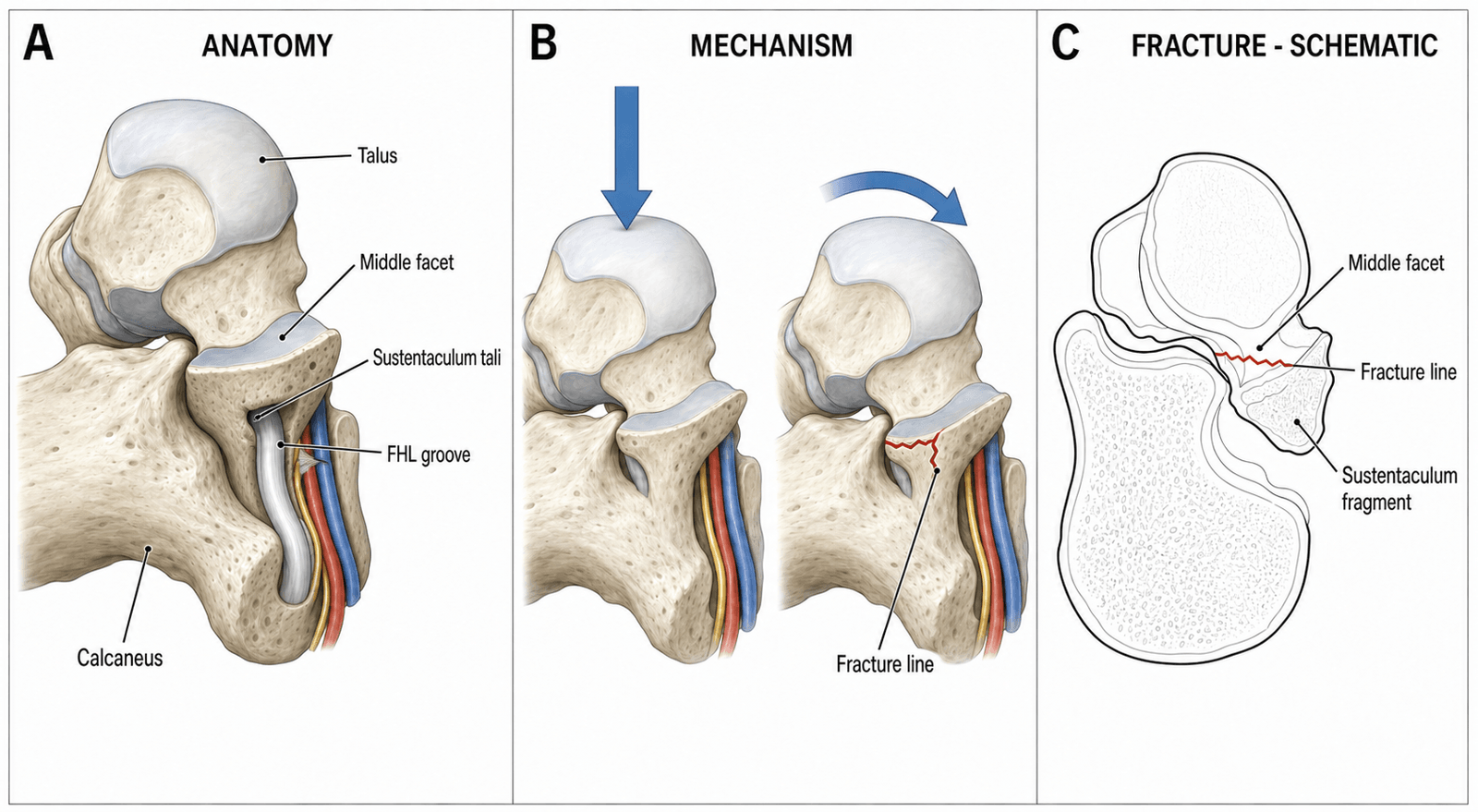
Classification Systems
Fractures are described by whether they are isolated or part of a calcaneal fracture, and by displacement. The pattern guides treatment.
- Pattern
- Isolated, non-displaced (less than 2mm step-off)
- Treatment
- Conservative (cast)
- Pattern
- Isolated, displaced (greater than 2mm step-off)
- Treatment
- ORIF
- Pattern
- Part of a calcaneal fracture
- Treatment
- ORIF as part of calcaneal fixation
The 2mm line. The threshold is a conventional working figure borrowed from intra-articular fracture practice, not one validated for this fracture, and no cited series defines a numeric cut-off. How most authors decide instead is set out under Controversies.
Clinical Assessment
History. Medial heel pain after the injury, with swelling localised to the medial heel and difficulty weight bearing. If the FHL is injured the patient loses great toe flexion.
Examination. The medial heel is swollen, ecchymosis may be delayed, and deformity is rare. Tenderness lies over the sustentaculum, medial to the calcaneus, with subtalar joint tenderness, and subtalar movement is limited and painful. Three tests matter:
- Active great toe flexion - FHL function, limited if the tendon is injured
- Sensation over the medial foot - the medial plantar nerve
- Subtalar stress - pain with inversion and eversion
Investigations
Radiographs. Plain films may show the fracture but are less reliable than CT.
- Axial (Harris) view - shows the sustentaculum from below, a better view than the lateral
- Lateral - may show the fracture
- AP - may show the fracture, less reliably
CT. CT is usually required for diagnosis and planning. It is recommended for any suspected sustentaculum fracture, for one that is part of a calcaneal fracture, and before surgery. Read it for:
- The fracture pattern
- Displacement, measuring the step-off
- Fragment size
- Subtalar joint involvement
- The relationship to the FHL
Differential diagnosis. Medial hindfoot pain after trauma is easily mislabelled as an ankle sprain, and CT distinguishes a sustentaculum fracture from its mimics.
- Key clinical clue
- Tenderness 2 cm below medial malleolus, painful FHL excursion
- Best investigation
- CT (coronal/axial)
- Discriminator
- Fracture through medial calcaneal shelf and middle facet
- Key clinical clue
- Lateral or anterolateral subtalar tenderness
- Best investigation
- CT
- Discriminator
- Fracture line in talus, not calcaneus
- Key clinical clue
- Tenderness over medial malleolus, no bony point pain
- Best investigation
- MRI / stress views
- Discriminator
- Ligamentous signal, no cortical break
- Key clinical clue
- Pain along tendon, no acute high-energy mechanism
- Best investigation
- MRI / ultrasound
- Discriminator
- Tendon signal change, normal bone
- Key clinical clue
- Heel widening, reduced Bohler angle, marked swelling
- Best investigation
- Lateral X-ray + CT
- Discriminator
- Posterior facet depression on CT
- Key clinical clue
- Incidental, smooth corticated margin, often bilateral
- Best investigation
- CT / compare contralateral side
- Discriminator
- Smooth cortex, no oedema, asymptomatic
Up to a third of sustentaculum fractures are initially missed and treated as ankle sprains. Any patient with medial hindfoot point tenderness, an inability to actively flex the great toe, or pain on resisted hallux flexion after a fall or inversion injury needs CT - plain films are unreliable.
Os Sustentaculi: the Sustentaculum-Specific Fracture Mimic
The single most important normal variant to separate from an acute sustentaculum fracture is the os sustentaculi, an accessory ossicle at the posterior margin of the sustentaculum tali. It arises from a secondary ossification centre that fails to fuse and is joined to the sustentaculum by a fibrocartilaginous synchondrosis. It is frequently bilateral, and that is itself a valuable clue.
- Os sustentaculi (variant)
- Smooth, rounded, well corticated on both sides
- Acute fracture
- Sharp, irregular, non-corticated lucency
- Os sustentaculi (variant)
- Absent
- Acute fracture
- Present, often with soft-tissue swelling
- Os sustentaculi (variant)
- Frequently bilateral - image the other foot
- Acute fracture
- Unilateral, matches the injured side
- Os sustentaculi (variant)
- Incidental, no high-energy history
- Acute fracture
- Point tenderness, lost hallux flexion after trauma
When the ossicle is the problem. An os sustentaculi is usually an asymptomatic incidental finding, but it is not always innocent. A painful synchondrosis, whether degenerate or disrupted by an acute injury, can itself generate medial subtalar pain that mimics a fracture, and the variant has been linked to symptomatic middle-facet subtalar pathology.
The rule runs both ways. Do not label a smooth, bilateral, non-oedematous ossicle as a fresh fracture. Equally, do not dismiss persistent medial hindfoot pain in a patient who happens to have one, because the junction can be the pain generator.
Management Algorithm
The decision. With CT in hand, the decision turns on displacement and on whether the fracture is isolated. An isolated fracture with less than 2mm step-off is treated in a cast. A displaced fracture (greater than 2mm) goes to ORIF, and one that is part of a calcaneal fracture is addressed within the calcaneal ORIF, where the sustentaculum serves as the stable reference for reduction.
Non-operative. For non-displaced (less than 2mm step-off) isolated fractures, and for patients who prefer it. A short leg cast, non-weight bearing, for 6-8 weeks, with serial radiographs or CT to monitor healing.
Operative indications.
- Absolute - displacement greater than 2mm step-off; part of a calcaneal fracture; subtalar joint instability
- Relative - FHL dysfunction; failed conservative treatment
FHL dysfunction sits in the relative list, but loss of active great toe flexion is treated as entrapment until proven otherwise, and entrapment of the FHL or FDL is an absolute indication whatever the displacement (see Flexor Tendon Entrapment below).
Timing. Within 2 weeks for an isolated fracture; as part of the calcaneal ORIF when the sustentaculum is part of a larger fracture.
Flexor Tendon Entrapment: an Absolute Operative Indication
Beneath and medial to the sustentaculum run the long flexors: the flexor hallucis longus (FHL) in its fibro-osseous groove directly on the undersurface of the shelf, and the flexor digitorum longus (FDL) passing more medially, superficial to the FHL. Either tendon can become incarcerated within a displaced sustentaculum fracture line. The reference operative series (Dürr, Zwipp and Rammelt) lists this explicitly, alongside articular incongruity, as a formal indication to operate.
It blocks reduction. An interposed tendon acts as a soft-tissue block. The fragment cannot be seated congruently until the tendon is retrieved, so any closed or percutaneous attempt will fail.
It abolishes active toe flexion. Incarceration of the FHL tethers the great toe flexor and abolishes active hallux flexion; FDL entrapment does the same for the lesser toes. This is the mechanical basis for the classic "cannot flex the great toe" sign, which is far more often entrapment than a primary tendon rupture.
It removes the millimetre debate. Because interposition both blocks reduction and disables the tendon, entrapment is an absolute operative indication whatever the amount of displacement, and the usual step-off threshold does not apply.
Recognising it. Test active great toe and lesser toe flexion in every medial hindfoot injury; loss of hallux flexion after a fall demands scrutiny rather than reassurance. On CT, look for the tendon lying within the fracture gap and for a fragment that will not seat. MRI confirms tendon incarceration and distinguishes entrapment from rupture.
Freeing it. Through the direct medial approach, identify, retract and free the FHL (and the FDL where involved) from the fracture before reduction. Then reduce to the medial facet and cortical outline and fix with two small-fragment screws directed medial to lateral. A tendon left entrapped risks adhesion, a flexion contracture or clawing of the hallux, and late attritional rupture.
Loss of active great toe flexion with a sustentaculum fracture is FHL entrapment until proven otherwise, not simply "FHL bruising." Free the tendon first, then reduce and fix.
Surgical Technique
Isolated fracture: the medial approach. For an isolated fracture displaced greater than 2mm, a medial approach to the calcaneus gives direct access to the sustentaculum, preserves the subtalar joint and prevents arthritis.
- Exposure - medial approach; identify and protect the FHL tendon
- Protection - identify and protect the medial plantar nerve
- Reduction - anatomical reduction of the sustentaculum to the calcaneus
- Fixation - screws (2.7-3.5mm) from medial to lateral
- Verification - confirm reduction and hardware position fluoroscopically
Part of a calcaneal fracture. This is the most common scenario. The extensile lateral approach is the primary exposure, and a medial approach may be needed for the sustentaculum itself.
- Lateral approach - extensile lateral approach for the calcaneal fracture
- Sustentaculum as reference - use the sustentaculum as the stable reference for reduction
- Reduce to the sustentaculum - bring the other fragments to it
- Fixation - screws from the lateral plate into the sustentaculum for medial support
- Medial screws - may be needed if the sustentaculum is itself displaced
Complications
The incidence figures below are conventional teaching ranges, not rates measured in any cited series. The Dürr reference series reported no wound-healing problems or infections in 31 operations through the medial approach. Subtalar arthritis is dealt with under Outcomes.
- Incidence
- 5-10%
- Risk Factors
- Medial approach (FHL runs beneath the sustentaculum)
- Prevention/Management
- Identify and protect the FHL early; repair if injured, FHL transfer may be needed if severe
- Incidence
- 5-10%
- Risk Factors
- Medial approach (nerve runs medial to the sustentaculum)
- Prevention/Management
- Identify and protect the nerve early; neuroma excision if symptomatic
- Incidence
- 5-10%
- Risk Factors
- Displacement, inadequate fixation
- Prevention/Management
- Rigid fixation, bone graft if needed
Postoperative Care
The first weeks. A short leg cast or boot, non-weight bearing for 6-8 weeks, with elevation to reduce swelling. Ankle range-of-motion exercises start after cast removal, or within the first six weeks if stable. Physiotherapy works on subtalar range of motion and FHL strengthening.
- Weeks 0-6 - short leg cast, non-weight bearing, elevation
- Weeks 6-8 - cast removed, walking boot, progressive weight bearing
- Weeks 8-12 - full weight bearing and progressive activity
- Return to sport - 3-4 months
Outcomes and Prognosis
Published series report good results in most patients, but no cited series validates a numeric rate. The percentages below are conventional teaching ranges: the cited literature, a 31-operation reference series reporting scores rather than rates, does not validate any of them.
- Success (union, pain relief)
- 85-90%
- Return to pre-injury level
- 80-85%
- Subtalar arthritis
- 5-10%
- Success (union, pain relief)
- 80-85%
- Return to pre-injury level
- 75-80%
- Subtalar arthritis
- 10-15%
- Success (union, pain relief)
- 75-85%
- Return to pre-injury level
- 70-75%
- Subtalar arthritis
- 15-20%
Long-term. Subtalar arthritis develops in 10-15% with proper treatment and 20-30% without it. Displacement, malunion and delayed treatment are the risk factors, and anatomical reduction with early treatment is the prevention.
Guidelines, Registries & Global Practice
Global Epidemiology
- Rarity: Isolated sustentaculum tali fractures are reported globally as under 1% of all calcaneal fractures.
- Pattern: The sustentaculum is fractured in roughly a third (around 34 to 36%) of intra-articular calcaneal fractures, rising with Sanders grade.
- Demographics: Typically young-to-middle-aged adults (peak ~20 to 45 years) after a fall from height or road-traffic trauma; a male predominance mirrors the wider calcaneal-fracture population.
- Resource link: Incidence tracks high falls and motorcycle/road trauma, so the burden is proportionally higher in regions with high road-injury rates and occupational falls.
Guidelines and Society Positions — Side by Side
No orthopaedic society publishes a sustentaculum-specific guideline; practice is extrapolated from calcaneal-fracture and intra-articular fracture principles.
- Position relevant to this fracture
- Anatomical reduction of articular facets; sustentaculum is the reduction key for the calcaneus; defined screw corridors
- Practical takeaway
- Restore middle-facet congruity; capture the constant fragment
- Position relevant to this fracture
- Hindfoot/calcaneal injuries managed in centres with CT and foot-and-ankle expertise; soft-tissue-led timing
- Practical takeaway
- Image with CT, refer complex/associated injuries, respect soft tissues
- Position relevant to this fracture
- No dedicated guideline; emphasis on individualised, evidence-informed decision-making for calcaneal fractures
- Practical takeaway
- Selective surgery, shared decision-making
- Position relevant to this fracture
- Supports operative care for displaced articular incongruity in selected patients by experienced surgeons
- Practical takeaway
- Surgeon experience and patient selection drive outcome
Registry and Trial Evidence
- Registries: Arthroplasty/implant registries (NJR, AJRR, AOANJRR, Swedish/Norwegian) do not capture sustentaculum or calcaneal fracture fixation, so there is no implant-survival data for this injury - a point worth stating explicitly in a viva.
- Best trial evidence: The UK Heel Fracture Trial (Griffin, BMJ 2014) found no two-year functional advantage of ORIF over non-operative care for typical displaced intra-articular calcaneal fractures, with far higher complication and reoperation rates after surgery. It frames the global caution around routine calcaneal surgery but does not address isolated sustentaculum fractures, where middle-facet incongruity and tendon entrapment remain operative indications.
High- vs Limited-Resource Practice
- High-resource: Routine CT for diagnosis and planning, fluoroscopy-guided or open anatomical fixation, foot-and-ankle subspecialist input, structured rehabilitation.
- Limited-resource: CT may be unavailable, so missed diagnoses are commoner; non-displaced and many displaced fractures are managed in a cast with non-weight-bearing; percutaneous screw fixation is favoured over extensile approaches to limit wound and infection risk where soft-tissue and perioperative support are constrained.
A common viva topic. Know that the sustentaculum = medial shelf and the classic (but no longer absolute) reduction reference for the calcaneus; the FHL runs beneath it and the medial neurovascular bundle lies medial - both at risk in the medial approach. Operate for middle-facet incongruity or tendon entrapment rather than a single millimetre figure. Quote the verified fragment-specific outcomes (mean AOFAS ~83.6 after medial-approach screw fixation; intact vs fractured sustentaculum AOFAS 84.4 vs 74.3) and cite the UK Heel Trial to show command of the wider debate.
Related pages: Calcaneal Fractures is the parent injury and carries the Sanders classification, the lateral extensile approach and the operative-versus-non-operative debate the UK Heel Fracture Trial above belongs to - remember that two cards on this page put the sustentaculum itself fractured or displaced in roughly a third of those fractures, so the constant fragment is a working assumption rather than a fact; Lateral Process Talus Fractures and Posterior Process Talus Fractures are the injuries Dürr found alongside this one in 23 percent, and both are missed on plain films for the same reason; Talus Fractures and Talar Body Fractures for the opposing articular surface of the middle facet; Subtalar Arthritis is the endpoint of an unreduced middle-facet step and the reason articular congruity is the operative indication here; Subtalar Dislocations for the higher-energy medial injury that shares the mechanism; Flexor Hallucis Longus Anatomy for the tendon that runs in its own groove beneath the sustentaculum and whose entrapment is an absolute indication to operate; Tarsal Tunnel Syndrome and Tibial Nerve Anatomy for the structures immediately medial to the fragment, at risk from both the approach and an over-long lateral-to-medial screw; Spring Ligament Insufficiency and Deltoid Ligament Injuries for the soft-tissue attachments the sustentaculum anchors, whose loss produces the same medial arch collapse; Os Trigonum for the analogous accessory ossicle at the other end of the talus and the same acute-versus-congenital problem the os sustentaculi poses on this page; and Posterior Tibial Tendon Dysfunction for the late medial-column failure that a malunited sustentaculum can precipitate.
Controversies and Areas of Uncertainty
The evidence base is thin: small series, biomechanical and anatomical studies, and no fracture-specific RCT. Several questions remain genuinely open.
Is the sustentaculum truly a constant fragment? The classic teaching that it reliably stays attached to the talus is challenged by modern CT series showing it fractured in roughly a third of intra-articular calcaneal fractures and displaced ("inconstant") in up to 34.5%. Fragment width under about 20.5 mm, comminution and diabetes predict an unreliable fragment. The pragmatic position is to verify constancy on CT before using it as the reduction reference.
The displacement threshold. Most authors operate for any incongruity of the middle facet, depression, an intra-articular line or tendon entrapment. The displacement number alone is a guide, not a hard rule.
Medial open or percutaneous. The direct medial approach gives controlled reduction and protects the FHL and neurovascular bundle under vision, but adds soft-tissue dissection. Fractures where the medial facet depresses as a single block can be reduced and fixed percutaneously. The choice is fragment- and surgeon-dependent, and no comparative trial exists.
Screw direction. Isolated fractures are typically fixed medial-to-lateral through the medial window. When the sustentaculum is captured as part of a lateral calcaneal-plate construct, screws run lateral-to-medial along a narrow safe corridor. Both are accepted; the risk with lateral-to-medial screws is medial cortical perforation injuring the FHL and neurovascular structures.
Acknowledge the constant-fragment dogma, then show you know it is no longer absolute and that a narrow or comminuted fragment is an unreliable template. State the operative indication as middle-facet incongruity or tendon entrapment rather than a single millimetre figure, and note that the wider calcaneal-fracture literature (UK Heel Trial) cautions against over-operating the surrounding joint-depression injury.
MCQ Practice Points
Q: What is the sustentaculum tali and why is it important in calcaneal fractures? A: Sustentaculum tali = medial shelf of calcaneus - Usually stays attached to talus via interosseous ligament, so it remains in anatomic position. Serves as stable reference for reducing other calcaneal fragments. Critical in calcaneal fracture ORIF.
Q: What structure is at risk beneath the sustentaculum tali? A: FHL (Flexor Hallucis Longus) tendon - Runs beneath sustentaculum. Injury causes loss of great toe flexion. Medial approach requires careful dissection to protect FHL. Injury is the recognised risk of the medial approach (no cited series gives a validated rate).
Q: What nerve is at risk medial to the sustentaculum tali? A: Medial plantar nerve - Runs medial to sustentaculum, between abductor hallucis and flexor digitorum brevis. Injury causes medial foot numbness and intrinsic muscle weakness. Protect during medial approach (conventionally quoted injury risk 5-10%, unvalidated).
Q: How is sustentaculum tali used in calcaneal fracture reduction? A: Serves as stable reference - Usually stays attached to talus via interosseous ligament, so remains in anatomic position. All other calcaneal fragments are reduced TO the sustentaculum. Posterior facet aligned to sustentaculum middle facet.
Q: When is ORIF required for sustentaculum tali fractures? A: Displacement greater than 2mm or part of calcaneal fracture - Prevents subtalar arthritis and FHL dysfunction. Medial approach with protection of FHL and medial plantar nerve. Screw fixation from medial to lateral. Published series report good results in most patients; no cited series validates a numeric rate.
Exam Viva Scenarios
Practise clinical reasoning and management decisions out loud
“A 35-year-old patient presents with medial heel pain after inversion injury. CT shows isolated displaced sustentaculum tali fracture with 3mm displacement. Clinical examination shows loss of great toe flexion (FHL dysfunction).”
“A 30-year-old patient has a displaced calcaneal fracture (Sanders Type II). The examiner asks you to explain how you use the sustentaculum tali in the reduction.”
“A 28-year-old fell from a ladder six weeks ago and was diagnosed with an ankle sprain. He returns with persistent medial heel pain and cannot actively flex his great toe. X-rays were reported as normal. How do you proceed, and what is the likely diagnosis?”
Key Concepts
- Sustentaculum tali = medial shelf of calcaneus
- Usually stays attached to talus via interosseous ligament
- Serves as stable reference for calcaneal fracture reduction
- FHL tendon runs beneath sustentaculum (at risk)
Classification
- Type I: Non-displaced, isolated - conservative (85-90% good results)
- Type II: Displaced, isolated - ORIF (80-85% good results)
- Type III: Part of calcaneal fracture - ORIF as part of calcaneal (75-85% good results)
- Classification guides treatment approach
Treatment
- Non-displaced, isolated: Conservative (cast, NWB 6-8 weeks)
- Displaced, isolated: ORIF via medial approach (80-85% good results)
- Part of calcaneal: ORIF as part of calcaneal fixation (75-85% good results)
- Displacement greater than 2mm: ORIF required
Surgical Technique
- Medial approach: Protect FHL (beneath sustentaculum) and medial plantar nerve (medial to sustentaculum)
- Screws: 2.7-3.5mm from medial to lateral
- Part of calcaneal: Use sustentaculum as stable reference, reduce other fragments to it
- Verify reduction fluoroscopically
Complications
- FHL injury: 5-10% (prevent by protecting FHL)
- Medial plantar nerve injury: 5-10% (prevent by protecting nerve)
- Subtalar arthritis: 10-15% if untreated, 10-15% with proper treatment
- Nonunion: 5-10% (prevent with rigid fixation)
Evidence Base
Every cited statistic below is taken directly from the linked paper. Where source data exists, fragment-specific outcome figures (AOFAS, Foot Function Index) are quoted rather than generic "80-85% good results" estimates. Sustentaculum tali fractures are rare, so the literature is dominated by small operative series, anatomical/biomechanical studies, and the broader calcaneal-fracture trial evidence.
Direct medial approach ORIF — the reference operative series
- 87% had additional foot/ankle fractures - rarely truly isolated
- Mean AOFAS 83.6, FFI 21.6 at 80 months after screw fixation
- Isolated fractures outperform those with associated injuries
- Look for lateral talar process (23%) and midtarsal (45%) injuries
Sustentaculum integrity predicts outcome in calcaneal fractures
- Sustentaculum fractured in 36% of intra-articular calcaneal fractures
- Higher Sanders grade = higher chance of sustentacular involvement
- Intact sustentaculum: AOFAS 84.4 vs 74.3 if fractured (p less than 0.001)
- The 'constant fragment' is not always constant
When is the sustentaculum NOT a constant fragment?
- Sustentaculum fragment 'inconstant' in 34.5% of calcaneal fractures
- Predictors: small width, comminution, intra-articular line, diabetes
- Cut-off fragment width 20.5 mm for inconstancy
- Verify the fragment on CT before using it as a template
Sustentaculum (constant-fragment) screw improves construct stability
- Sustentaculum screw reduces fracture-line displacement vs plate alone
- Lower peak stress in bone and implant with sustentacular screw
- More even stress distribution across the construct
- Supports routine 'constant-fragment' screw in Sanders II
Safe corridor for the sustentaculum screw — anatomical study
- Entry ~14 mm posterior, ~3 mm above lowest tarsal-sinus point
- Screw anteversion ~16 degrees (males) / ~15 degrees (females)
- Mean screw length ~41.6 mm
- A defined corridor reduces malposition and FHL/neurovascular risk
UK Heel Fracture Trial — operative vs non-operative calcaneal fractures
- No functional advantage of ORIF for typical displaced calcaneal fractures
- Complications/reoperations far higher with surgery (OR 7.5)
- Tempers enthusiasm for routine operative calcaneal fixation
- Reduction quality and patient selection matter more than the incision