Benign Synovial Cartilage Metaplasia | Multiple Loose Bodies | Usually Monoarticular
- Benign metaplasia of synovium producing multiple cartilage nodules that detach as loose bodies - usually a single large joint (knee most common)
- Primary (idiopathic, true metaplastic disease) vs secondary (loose bodies from OA, trauma, osteochondritis dissecans, Charcot)
- Milgram staging drives surgery: stage 1-2 need synovectomy because active synovium is the source of recurrence
- Radiographs show multiple similar-sized calcified loose bodies; ~1/3 are non-calcified and only seen on MRI/arthroscopy
- Malignant transformation to secondary chondrosarcoma is quoted at ~5%, an upper bound from referral series - suspect with rapid recurrence, symptom progression, or bone/marrow invasion
- “Classic radiograph: numerous loose bodies of roughly equal size with ring-and-arc ('popcorn') chondroid calcification
- “Non-calcified disease can be radiographically occult - a normal X-ray does NOT exclude it; image with MRI
- “Primary disease is monoarticular and the nodules are uniform; secondary disease has fewer, variably-sized bodies plus a clear underlying joint disorder
- “Recurrence after simple loose-body removal alone is common in stage 1-2; remove the diseased synovium
Overview and Epidemiology
Synovial chondromatosis, called synovial osteochondromatosis when the nodules ossify, is an uncommon benign disorder in which the synovial membrane of a joint, tendon sheath or bursa undergoes cartilaginous metaplasia. The nodules it forms detach to become loose bodies. Although benign, it can damage the joint over time and carries a small but real risk of malignant transformation to secondary synovial chondrosarcoma.
Who. Most patients present in the third to fifth decades (30-50 years), and men outnumber women by roughly 2:1 in most series. It is a disease of the large joints of adults, and it is almost always monoarticular.
Where. The knee dominates:
- Knee - most common, over 50% of cases
- Hip, elbow and shoulder - the next most frequent large joints
- Ankle, wrist and temporomandibular joint - less common but reported
- Over 30 anatomical sites have been described, including bursae and tendon sheaths
Primary and secondary disease. The two reach the same radiographic endpoint, multiple loose bodies, by different routes, and telling them apart changes prognosis and counselling. Primary disease is a true idiopathic metaplastic, neoplastic disorder of the synovium in an otherwise normal joint. Secondary disease is loose bodies shed by an underlying joint disorder, with obvious background joint pathology.
- Primary
- Otherwise normal joint
- Secondary
- Pre-existing disorder (OA, trauma or osteochondral fracture, OCD, Charcot, osteonecrosis)
- Primary
- Numerous (often dozens)
- Secondary
- Fewer
- Primary
- Relatively uniform
- Secondary
- Variable in size
- Primary
- Synovial metaplasia (clonal)
- Secondary
- Shed osteochondral fragments
- Primary
- Small but recognised (~5%)
- Secondary
- Negligible
Pathophysiology and Pathology
Pathogenesis. In primary disease the synovial lining undergoes chondroid metaplasia, forming foci of hyaline cartilage within the subsynovial connective tissue. The nodules enlarge within the synovium, may calcify and then ossify, and ultimately pedunculate and detach into the joint as loose bodies. The synovium then settles and the free bodies remain; these three phases are the three Milgram stages.
The loose bodies live on. Detached bodies survive by nutrient diffusion from synovial fluid and may continue to grow, sometimes coalescing into large lobulated masses.
Gross appearance. Multiple pearly-white to bluish cartilage nodules, from millimetres to centimetres across and of broadly similar size in primary disease. They may be embedded in the synovium or lying free, and calcified or ossified bodies feel gritty or bony.
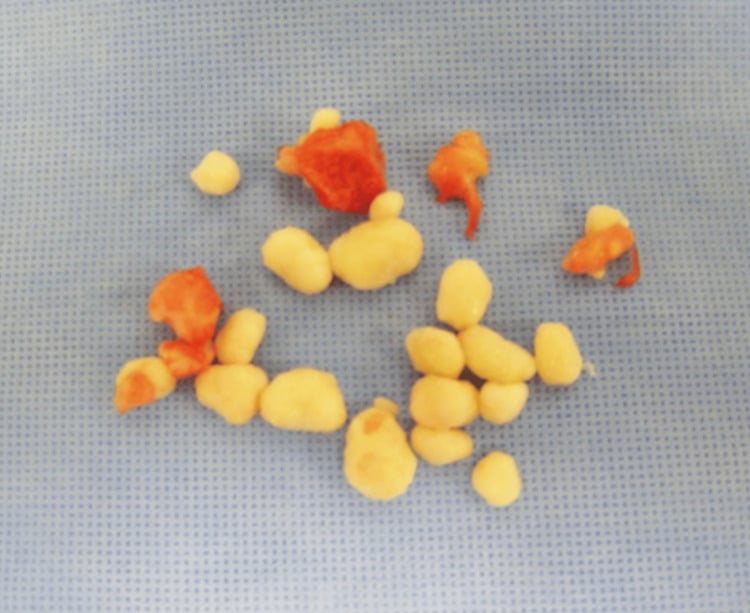
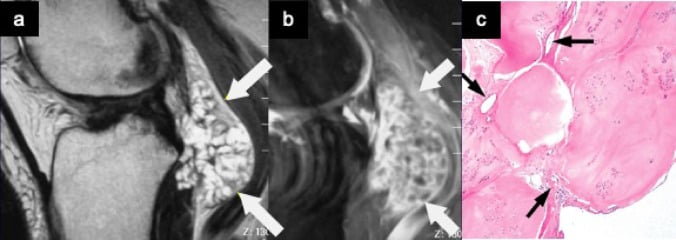
Microscopy. Nodules of hyaline cartilage with the chondrocytes arranged in clusters. Enchondral ossification produces the osteochondromatosis variant, and calcification gives the ring-and-arc pattern seen on radiographs.
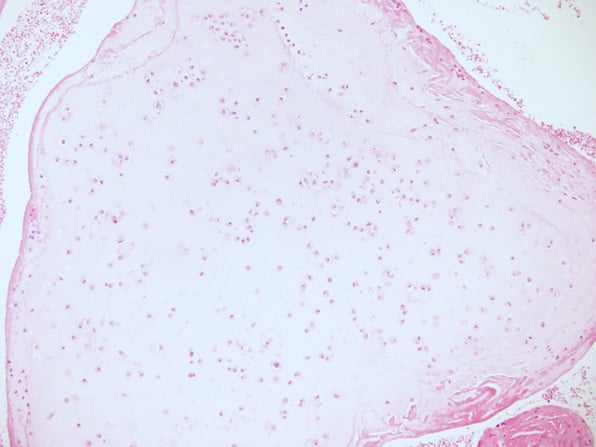
The atypia trap. Benign synovial chondromatosis can show mild chondrocyte atypia and binucleate cells that overlap with low-grade chondrosarcoma, a known pitfall for over-diagnosing malignancy. Cellular atypia alone is unreliable, and the most reliable discriminators of malignancy are architectural:
- Spindling at the periphery
- Sheets of cells losing the clustered (chondroid lobule) architecture
- Myxoid change in the matrix
- Necrosis
- Especially, permeative invasion of bone and marrow
This is why diagnosis on a small biopsy is error-prone and suspicious cases belong in a sarcoma unit.
The Molecular Basis: FN1-ACVR2A and Why It Is 'Neoplastic'
Clonal, not reactive. Cytogenetic and molecular studies show that the metaplastic chondrocytes are a clonal population, and chromosome-12 abnormalities have been reported. Primary synovial chondromatosis is therefore regarded as a benign neoplasm rather than a purely reactive process: it regenerates from residual active synovium instead of resolving once a trigger is removed.
The recurrent fusion. Primary disease characteristically harbours a recurrent FN1-ACVR2A gene fusion, and its reciprocal ACVR2A-FN1, joining the fibronectin (FN1) promoter to the activin receptor ACVR2A. It is a molecular hallmark of the disease's neoplastic, not degenerative, nature.
How often, and what a negative test means. In the largest molecular series (27 cases from two sarcoma centres), FN1 and/or ACVR2A rearrangement was found in 67%, and the FN1-ACVR2A fusion was confirmed in 56%, so a third of confirmed cases carried neither abnormality. FISH is therefore a rule-in test for a histologically equivocal cartilage lesion, and a negative result does not exclude the diagnosis.
Transformation. A single case of malignant transformation in that series carried a KMT2A-BCOR fusion, but no other case did. Its significance is unknown, and it is not the established mechanism of malignant change.
Why it matters clinically. Self-renewing clonal synovium is the molecular reason for synovectomy in active (Milgram 1-2) disease: leaving fusion-driven clonal synovium behind is what drives recurrence. It also frames secondary chondrosarcoma as malignant transformation of a lesion that was already neoplastic.
Classification
Milgram's histological staging follows the disease through three phases, and it is the classic exam framework because it links the pathology directly to the operation (see Management).
- Name
- Active intrasynovial disease
- Synovium
- Metaplasia within the synovium, which is the entire disease
- Loose bodies
- None
- Name
- Transitional
- Synovium
- Active synovial disease
- Loose bodies
- Present and free
- Name
- Free loose bodies
- Synovium
- Quiescent
- Loose bodies
- Multiple free bodies
Staging is histological. Imaging and the arthroscopic appearance help to estimate activity before the operation.
Clinical Presentation
Symptoms. Chronic joint pain and swelling, often for years, with stiffness, a reduced range of motion and mechanical symptoms: locking, catching, clicking and giving way. The onset is insidious and the delay to diagnosis is often long.
Signs. On examination, look for:
- Effusion with diffuse synovial thickening or fullness
- Palpable loose bodies that move ("joint mice")
- Crepitus and restricted motion
- Mass effect or nerve compression where disease extends outside the joint (for example the ulnar nerve at the elbow, or a peri-articular mass)
The textbook case. A young-to-middle-aged adult, often male, with months to years of one swollen, painful, occasionally locking knee, and radiographs showing multiple similar-sized calcified loose bodies.
Extra-Articular Disease: Tenosynovial and Bursal Chondromatosis
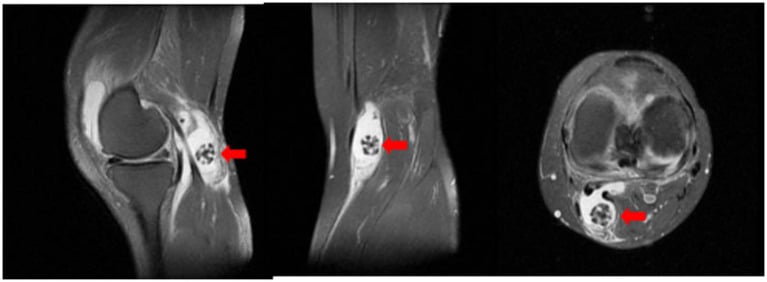
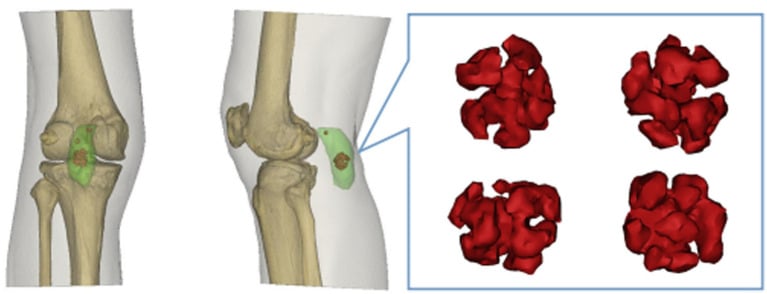
The same disease outside the joint. The cartilaginous metaplasia can arise in the synovium of a tendon sheath (tenosynovial chondromatosis) or a bursa (bursal chondromatosis) rather than inside a joint. It is found most often in the hand, wrist, foot and ankle, and it behaves differently enough to be worth separating.
A mass, not a locking joint. In place of the effusion and mechanical locking of intra-articular disease, it presents as a firm, slowly growing para-articular soft-tissue mass with calcified nodules on imaging. The mass can erode adjacent bone by pressure and, near the elbow or wrist, compress a nerve.
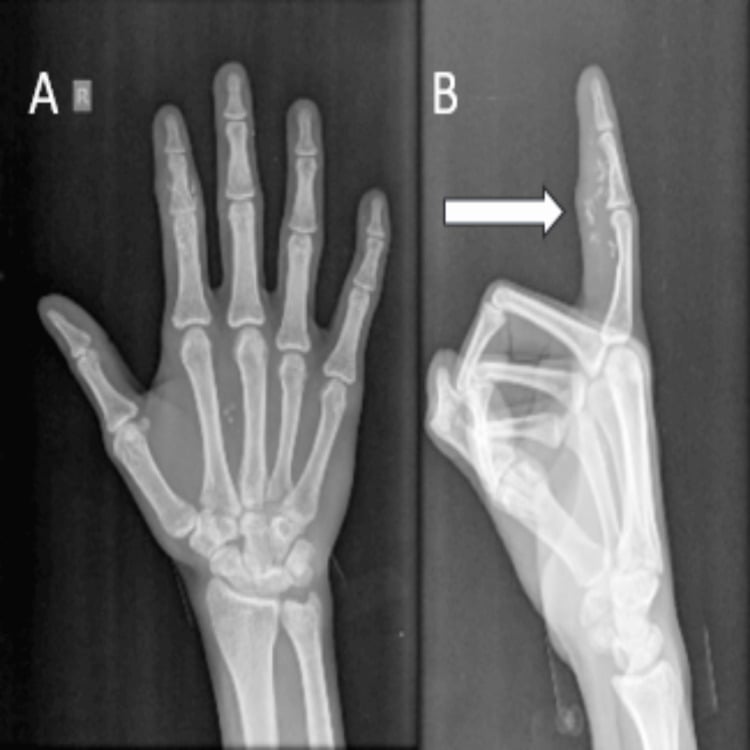
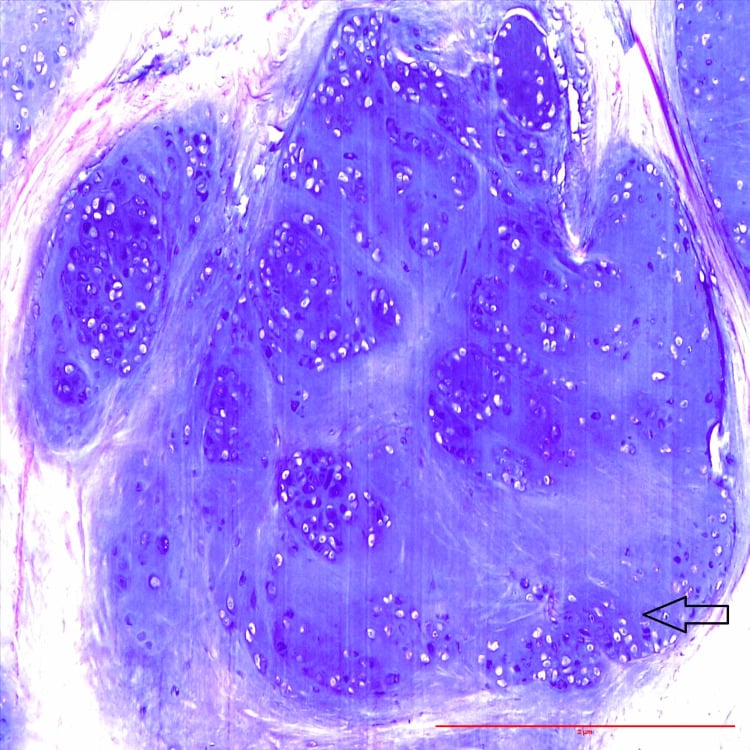
Diagnosis and treatment. MRI shows lobulated cartilage-signal nodules within the sheath or bursa. Treatment is excision of the involved tenosynovium or bursa together with the nodules, the sheath equivalent of a joint synovectomy, and as inside the joint, incomplete excision recurs.
Do not mistake it for its neighbour. In the hand or finger a nodular tendon-sheath lesion is more often a giant cell tumour of the tendon sheath, which has its own topic. Tenosynovial chondromatosis is distinguished by its chondroid (ring-and-arc) calcification and cartilage-signal nodules.
Investigations
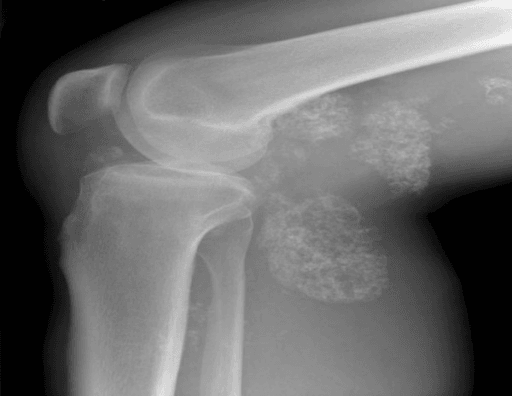
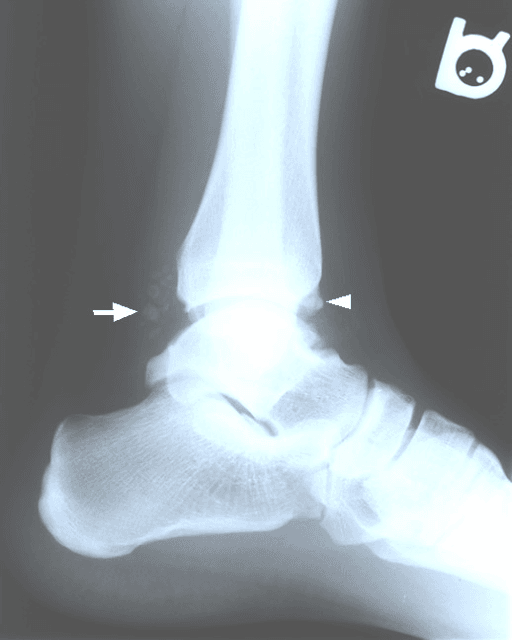
Radiographs. The classic film shows:
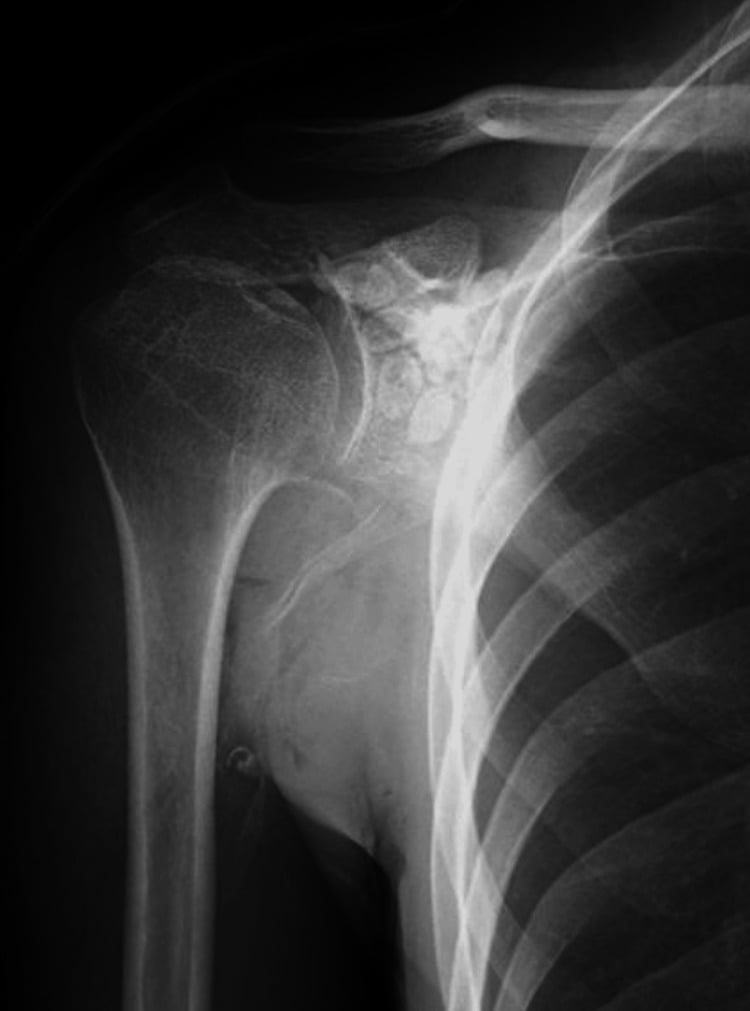
- Multiple intra-articular calcified or ossified bodies of broadly similar size, classically with ring-and-arc ("popcorn") chondroid calcification
- A preserved or only mildly narrowed joint space in primary disease, against the marked changes of secondary, OA-related disease
- Pressure erosion of adjacent bone, which may occur in long-standing or extensive disease
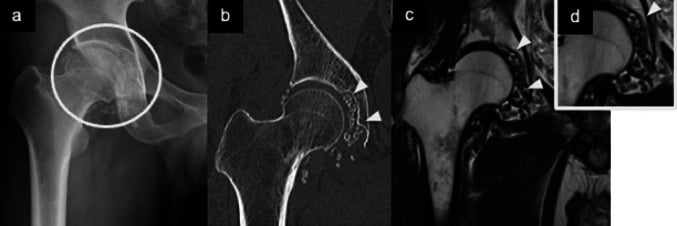
Roughly one third of cases are non-calcified, and non-mineralised cartilage is invisible on plain films, so a normal radiograph does not exclude the diagnosis. Persistent monoarticular symptoms with a normal film still warrant MRI; many cases are missed on X-ray alone.
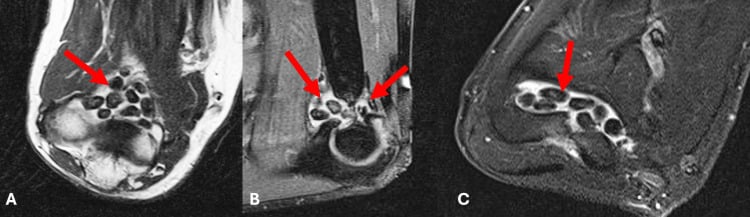
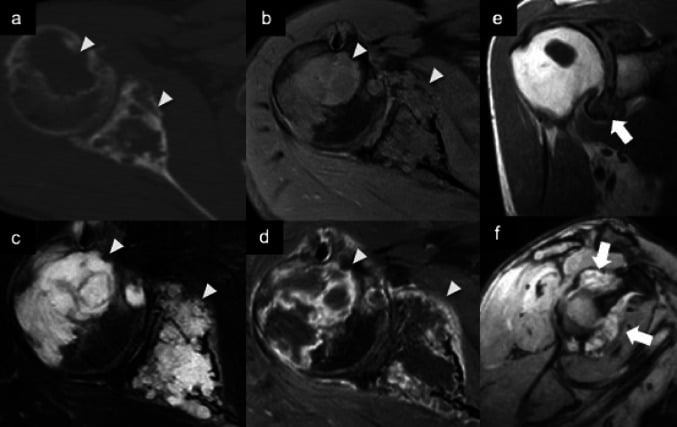
MRI is the investigation of choice for non-calcified disease and for mapping extent. Look for multiple lobulated bodies of cartilage signal (intermediate-high on T2, low-intermediate on T1) within a distended, thickened synovium; the combination is highly suggestive. Calcified bodies show signal voids, and ossified bodies show central fatty marrow signal, a helpful confirmatory sign. The non-mineralised lobulated mass has hypointense septa and, after contrast, peripheral and septal enhancement.
What MRI decides. It defines extra-articular extension, bursal involvement and articular cartilage damage, which guide the choice between an arthroscopic and an open approach. It also helps to flag the aggressive features, bone and marrow invasion, that suggest malignant transformation.
CT best demonstrates calcified and ossified bodies and subtle cortical erosion, and is useful where mineralisation is faint on radiographs. Ultrasound can show non-calcified bodies and an effusion at the bedside.
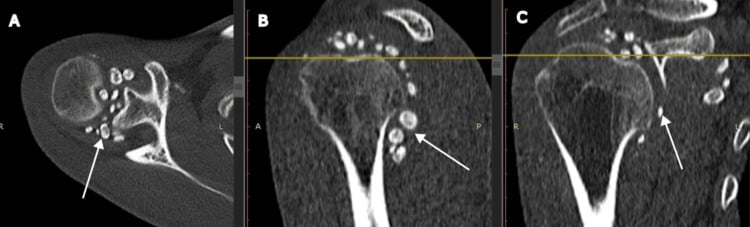
Biopsy is generally avoided as a first step in classic benign disease. It is reserved for atypical or aggressive presentations, and is best performed at a sarcoma centre because benign atypia can mimic low-grade chondrosarcoma.
If imaging shows aggressive features (rapid growth, bone/marrow invasion, large dominant mass), treat as a possible sarcoma: stage and biopsy through a sarcoma multidisciplinary team rather than excising locally.
Differential Diagnosis
The pivotal exam distinction is benign synovial chondromatosis versus secondary synovial chondrosarcoma.
- Key Distinguishing Features
- Monoarticular, numerous uniform bodies, otherwise normal joint
- Imaging Clues
- Ring-and-arc calcified bodies; lobulated synovial cartilage on MRI
- Key Distinguishing Features
- Fewer, variable-sized bodies with obvious background joint disease
- Imaging Clues
- Joint-space loss, osteophytes, donor defect (OCD)
- Key Distinguishing Features
- Haemosiderin-laden proliferative synovitis, recurrent haemarthrosis
- Imaging Clues
- Low T1 and T2 signal with GRE 'blooming' (no cartilage bodies)
- Key Distinguishing Features
- Rapid recurrence, progressive pain, dominant enlarging mass
- Imaging Clues
- Cortical/medullary bone invasion, soft-tissue extension
- Key Distinguishing Features
- Numerous tiny fibrinous bodies, inflammatory background
- Imaging Clues
- Small uniform low-signal bodies, no chondroid calcification
Management
The goal. Relieve the mechanical symptoms, remove the loose bodies, deal with the active synovium when it is present and protect the joint, while staying alert to malignant transformation.
The stage chooses the operation. In active disease (Milgram 1-2) the synovium is still generating nodules, so a synovectomy is added to the removal of any loose bodies to remove the source of recurrence. Recurrence after simple loose-body removal in active disease is well recognised. In quiescent disease (stage 3) removal of the loose bodies may suffice, with lower recurrence, and in Milgram's words synovectomy "may not be necessary" in this phase.
Milgram's own caveat, usually dropped. In stages 1 and 2, extrasynovial intra-articular cartilaginous lesions may persist after synovectomy and grow, causing recurrent symptoms without any new intrasynovial disease. Synovectomy reduces the intrasynovial source but does not reach what has already left the synovium, so do not promise that it prevents recurrence.
The extent chooses the approach. Where the disease lies, inside or outside the joint, and how accessible it is decide between arthroscopic and open surgery.
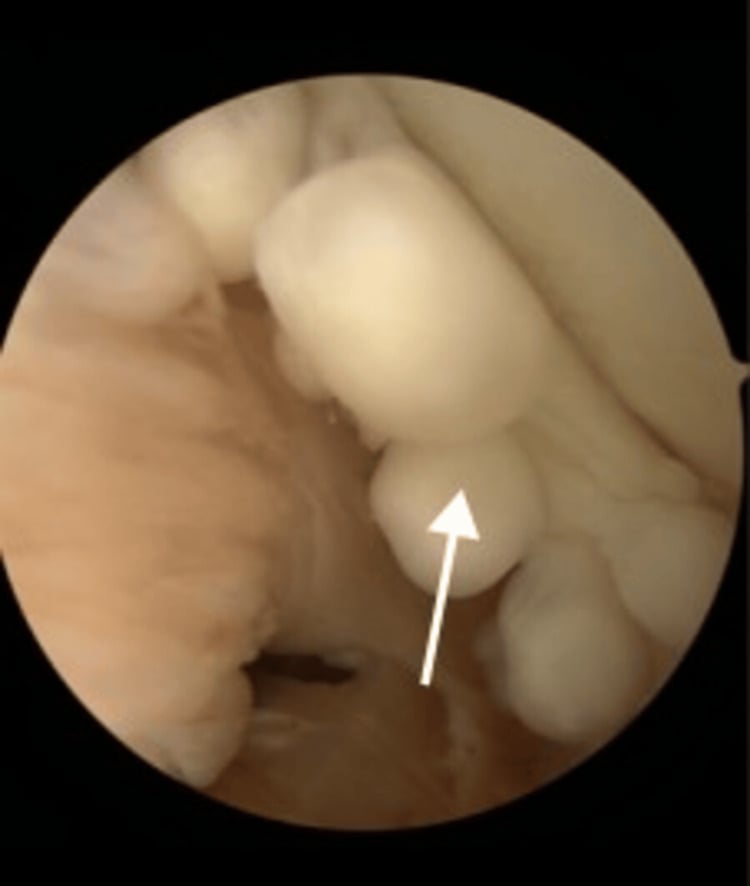
Arthroscopic synovectomy and loose-body removal is preferred when feasible: minimally invasive, with lower morbidity and faster recovery. It is increasingly used for accessible disease (the ankle and knee, for example) and is effective when the disease is confined to the joint and the loose bodies are not too large. Reported recurrence and complication rates are low in selected cases.
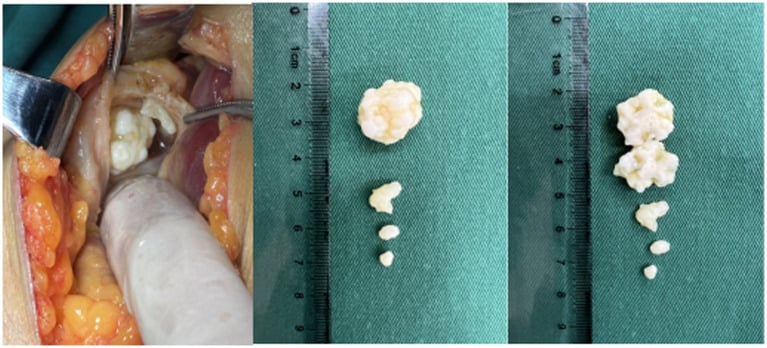
Open arthrotomy and synovectomy is indicated for large bodies, extra-articular extension, or posterior and inaccessible compartments. It allows a more complete synovectomy and removal of bulky masses, and is sometimes combined with arthroscopy for recesses that are difficult to reach.
Arthroplasty is considered for end-stage secondary osteoarthritis in appropriate joints, notably the hip, once the chondromatosis is controlled.
Suspected malignancy is referred to a sarcoma unit for staging and oncological resection (see Complications).
Surveillance. Follow patients clinically and with imaging, because recurrence is common, particularly after incomplete synovectomy or in active disease. Recurrence typically presents with returning effusion, pain and mechanical symptoms, and is re-imaged with MRI. Clearance of the mineralised bodies on a postoperative film does not exclude retained non-mineralised nodules or residual active synovium. Late recurrence years after surgery, or rapid recurrence, should prompt evaluation for malignant transformation.
A slowly returning crop of loose bodies suggests benign recurrence from residual synovium. Rapid recurrence with an enlarging mass or bone invasion suggests secondary chondrosarcoma and mandates referral.
Complications
Disease-related. Over time the disease itself can cause:
- Recurrence from residual active synovium
- Secondary osteoarthritis from chronic mechanical damage
- Joint destruction and deformity in advanced disease
- Extra-articular spread through the capsule and bursae in extensive disease
Secondary synovial chondrosarcoma. It typically arises many years after onset, after one or more recurrences. The prognosis is worse than for conventional chondrosarcoma, because of the intra-articular site and the delay in diagnosis. Treatment is wide resection at a sarcoma centre; historically a high proportion needed amputation, and chemotherapy and radiotherapy have limited roles, as for conventional chondrosarcoma.
~5% is the number every source repeats, and no source on this page supports it with a denominator. It appears here only as a background sentence in a systematic review of 22 patients having ankle arthroscopy, stated without a primary citation.
Set it against what the page's own evidence base establishes. Ng's systematic review found 48 published cases of secondary synovial chondrosarcoma in the world literature since 1957. Biazzo found 67 cases of synovial chondrosarcoma from all causes, of which about four in five were transformations. The two searches overlap heavily, so the entire reported world experience is well under a hundred cases in six decades, which is not what a 5% transformation rate in a condition seen in every large orthopaedic unit would produce.
The figure descends from small tertiary sarcoma-centre series, where referral bias concentrates exactly the cases that transformed, and no population-based estimate exists. Treat 5% as an upper bound derived from referral practice, not as a risk to quote to a patient: malignant transformation is rare, real, and of unknown frequency.
How to detect it. This is the examinable part. Suspect transformation from the clinical course - progressive symptoms over months, rapid recurrence after adequate resection, an enlarging mass - because Ng showed that the pathognomonic radiological signs are absent in most cases and that biopsy of a small sample is prone to error. Refer suspicious cases to a sarcoma unit.
RAPIDRed Flags for Malignant Transformation
Hook:RAPID change in a long-standing 'benign' joint = think secondary chondrosarcoma and refer.
Guidelines, Registries and Global Practice
- The WHO Classification of Soft Tissue and Bone Tumours lists synovial chondromatosis among benign chondrogenic tumours and recognises rare malignant transformation.
- Milgram staging is the internationally used histological framework linking activity to surgical strategy.
- MRI is the consensus cross-sectional modality worldwide for non-calcified disease and extent mapping.
- Arthroscopic synovectomy is increasingly favoured in well-resourced centres for accessible joints; open surgery remains standard for extensive or deep disease.
- In resource-limited settings, plain radiographs and open surgery predominate; non-calcified disease may be under-diagnosed without MRI access.
- Suspected malignant transformation is managed within sarcoma referral networks (e.g. national bone and soft-tissue tumour services) rather than locally.
Wherever you practise, the principles are constant: stage by Milgram, image with MRI when non-calcified disease is suspected, remove the active synovium to limit recurrence, and escalate rapidly changing or bone-invading disease to a sarcoma service. Exact surgical access (arthroscopic vs open) varies with resources and disease extent, not with geography.
Related pages: Chondrosarcoma is what secondary transformation produces, and the page to read before quoting any prognosis - note that an intra-articular chondrosarcoma behaves worse than a conventional one, which the Biazzo card above attributes to the site, the diagnostic delay and previous inadequate surgery rather than to grade; Pigmented Villonodular Synovitis and Tenosynovial Giant Cell Tumour are the other clonal, fusion-driven synovial neoplasms that recur from residual synovium for exactly the same reason, and the closest differential for a monoarticular proliferative synovitis with a joint effusion; Loose Body in the Knee for the presentation this most often hides behind, and for why a solitary body is a different problem from dozens of similar-sized ones; Osteochondritis Dissecans of the Knee and Osteochondral Lesion of the Talus for the donor-site lesion that generates a secondary chondromatosis, which is the distinction between primary and secondary disease this page turns on; Gout and Crystal Arthropathy and Pseudogout (CPPD) for the crystal deposition that mimics multiple mineralised intra-articular bodies on radiographs; Enchondroma for the benign cartilage lesion whose histology overlaps enough that atypia alone cannot settle malignancy; Synovial Fluid and Synovium for the tissue of origin; Hip Arthroscopy for the access problem that makes complete synovectomy hardest in the joint where this disease is second commonest; and Synovial Sarcoma purely to keep the names apart - it is not a synovial tumour and has nothing to do with this condition.
Exam Day Cheat Sheet
Core Concept
- Benign cartilaginous metaplasia of synovium producing multiple loose bodies
- Usually monoarticular; knee is the most common joint (over 50%)
- Primary (idiopathic, uniform bodies, normal joint) vs secondary (underlying OA/trauma/OCD, variable bodies)
- Now regarded as a benign clonal neoplastic process, not purely reactive
Milgram Staging (drives surgery)
- Stage 1: active synovium, NO loose bodies - synovectomy
- Stage 2: active synovium PLUS loose bodies - synovectomy + body removal
- Stage 3: free bodies, synovium quiescent - loose-body removal may suffice
- Active disease (1-2) recurs if synovium is left behind
Imaging
- X-ray: multiple similar-sized calcified bodies, ring-and-arc ('popcorn') calcification, preserved space
- About one third are non-calcified and X-ray occult - normal film does NOT exclude
- MRI: investigation of choice; lobulated cartilage-signal bodies in thickened synovium; maps extent
- CT best for calcified bodies and cortical erosion
Management
- Arthroscopic synovectomy + loose-body removal when accessible (low recurrence in selected cases)
- Open arthrotomy for large bodies, extra-articular extension, or inaccessible recesses
- Arthroplasty for end-stage secondary OA (e.g. hip)
- Suspected malignancy: stage and refer to a sarcoma unit
Malignant Transformation (~5%)
- Secondary synovial chondrosarcoma, typically ~a decade later, often after recurrence
- Red flags: rapid recurrence, progressive pain, enlarging dominant mass, bone/marrow invasion
- Atypia alone is unreliable - judge by clinical course and architecture
- Wide resection at a sarcoma centre; historically high amputation rates, guarded prognosis
Exam Viva Scenarios
Practise clinical reasoning and management decisions out loud
“A 35-year-old man presents with a 2-year history of a swollen, intermittently painful right knee with episodes of locking and catching. Radiographs show multiple rounded calcified bodies of similar size around the knee with a relatively preserved joint space. How do you make the diagnosis and what is your management?”
“A 40-year-old woman has a chronically swollen, occasionally catching knee, but her plain radiographs are reported as normal. How do you proceed and what conditions are you considering?”
“A 58-year-old patient previously treated with open synovectomy for hip synovial chondromatosis returns within months with worsening pain, a rapidly enlarging mass, and a radiograph showing cortical bone destruction. How do you manage this?”
Evidence Base
Synovial Osteochondromatosis - A Histopathological Study of Thirty Cases
- The source of the staging this entire page runs on: thirty cases studied clinically and pathologically, showing the disease follows a temporal sequence of three recognisable phases
- PHASE 1 - active intrasynovial disease only, with NO loose bodies
- PHASE 2 - transitional: active intrasynovial proliferation AND free loose bodies together
- PHASE 3 - multiple free osteochondral bodies with NO demonstrable intrasynovial disease
- Milgram's own conclusion for phase 3: 'it would appear that synovectomy may not be necessary'
- AND THE CAVEAT THAT IS USUALLY DROPPED: in phases 1 and 2, extrasynovial intra-articular cartilaginous lesions may PERSIST after synovectomy and grow, causing recurrent symptoms in the absence of any new intrasynovial disease