Posterior Tibial Nerve Compression | Flexor Retinaculum | Medial Ankle
- Posterior Tibial Nerve Branches: Medial plantar (abductor hallucis), lateral plantar (intrinsics), medial calcaneal (heel sensation)
- Tinel Sign: Tap posterior to medial malleolus - 58% sensitive, 92% specific
- Space-Occupying Lesions: 20-30% have an identifiable space-occupying lesion (ganglion, lipoma, varicosities)
- Double Crush: Exclude proximal nerve compression (L4-S2 radiculopathy)
- Surgical Release: Must decompress entire tunnel including abductor hallucis fascia
- “Burning plantar pain worse at night = classic presentation
- “Always examine for intrinsic muscle weakness (toe spread)
- “MRI before surgery to identify space-occupying lesions
- “Incomplete release = recurrence - extend distally through abductor tunnel
Overview and Epidemiology
Tarsal tunnel syndrome (TTS) is compression of the posterior tibial nerve or its terminal branches beneath the flexor retinaculum on the medial side of the ankle. It is the lower-limb analogue of carpal tunnel syndrome: much less common, but important to recognise.
Who. Women are affected twice as often as men (2:1), the peak age is 40-60 years, and 25% of cases are bilateral. Pes planus, diabetes and rheumatoid arthritis are the associated conditions to ask about.
Anatomy and Pathophysiology
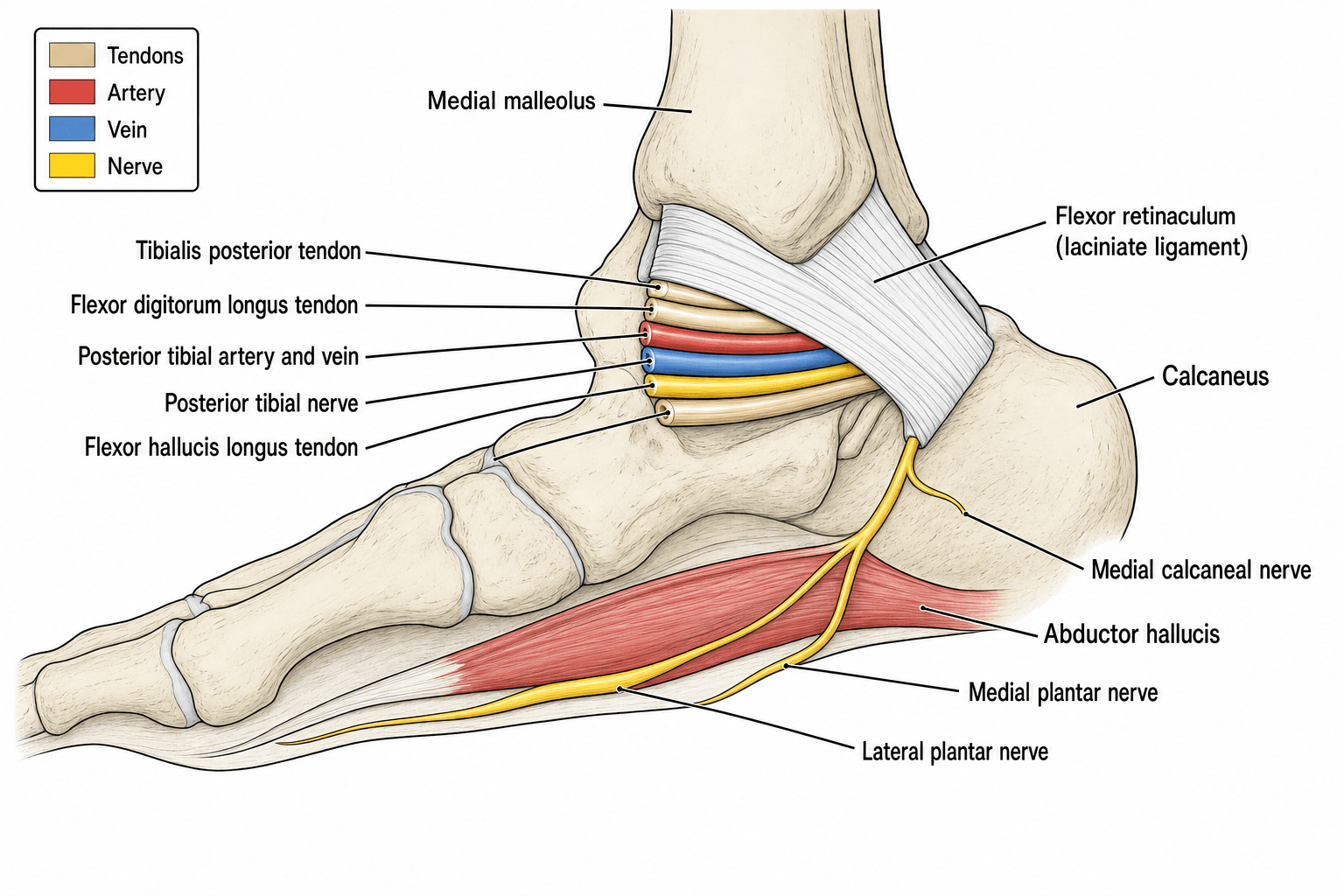
The tunnel. A fibro-osseous tunnel on the medial ankle. Its roof is the flexor retinaculum (laciniate ligament), which runs from the medial malleolus to the calcaneus; its floor is the medial surface of the talus, the sustentaculum tali and the medial calcaneus. The medial malleolus bounds it in front and the medial calcaneal tuberosity behind.
The contents. From anterior to posterior, Tom, Dick And Very Nervous Harry:
- Tibialis posterior tendon
- Flexor digitorum longus tendon
- Posterior tibial artery and veins
- Posterior tibial nerve
- Flexor hallucis longus tendon
The nerve is the vulnerable structure, lying between the vessels in front and FHL behind.
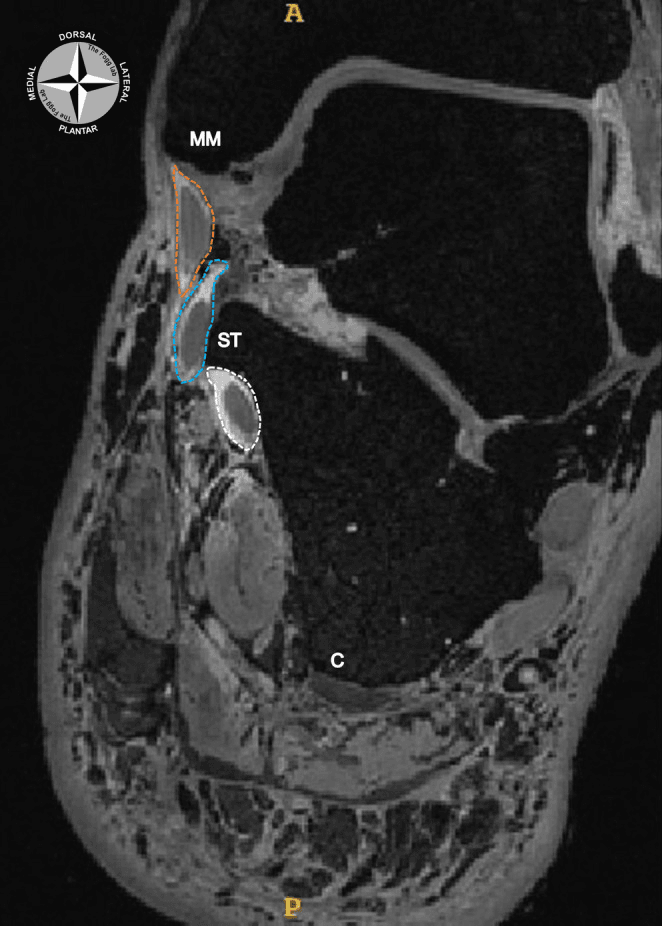
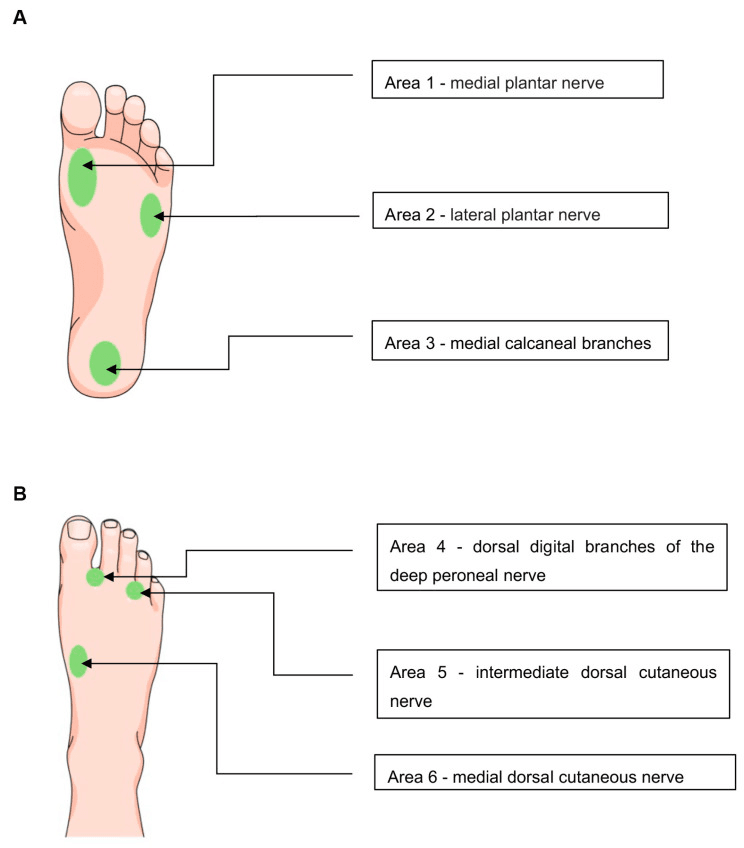
The branches. The medial calcaneal nerve branches first, proximally, and supplies sensation to the medial heel. The nerve then bifurcates into its two terminal branches, and any of the three may be affected:
- Medial plantar nerve - the larger, sensory-dominant branch: sensation to the medial 3.5 toes, motor to abductor hallucis, FHB, FDB and the first lumbrical
- Lateral plantar nerve - the smaller, motor-dominant branch: motor to the intrinsics, sensation to the lateral 1.5 toes
Beyond the retinaculum. The flexor retinaculum roofs only the proximal part of the course. Abductor hallucis continues the medial roof distally, and both plantar nerves pass deep to it into the sole through distal osteofibrous channels, so a release limited to the proximal retinaculum can leave the medial and lateral plantar branches compressed.
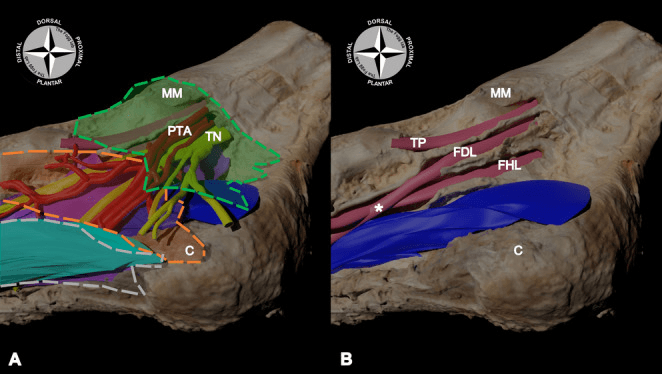
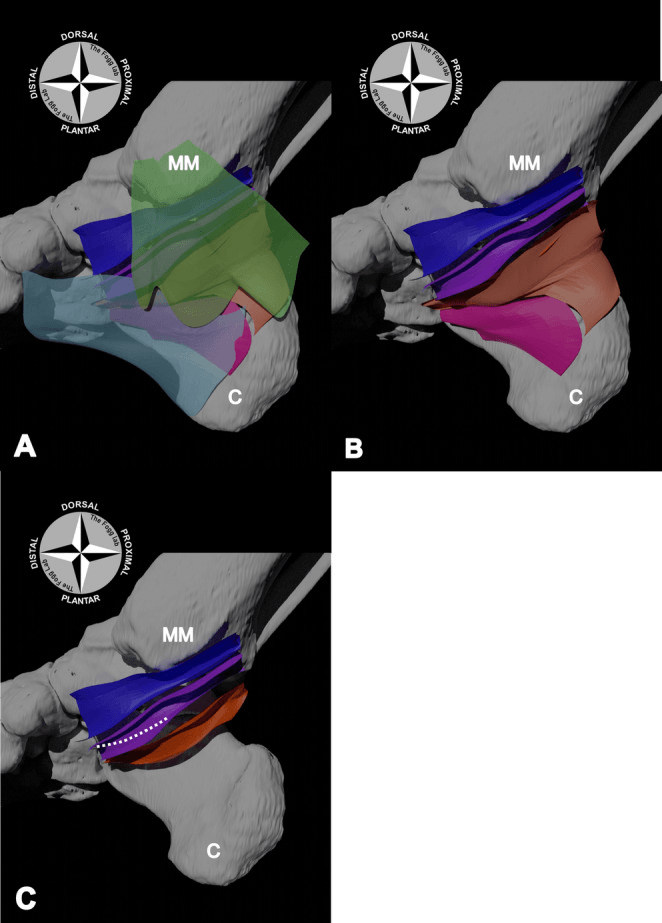
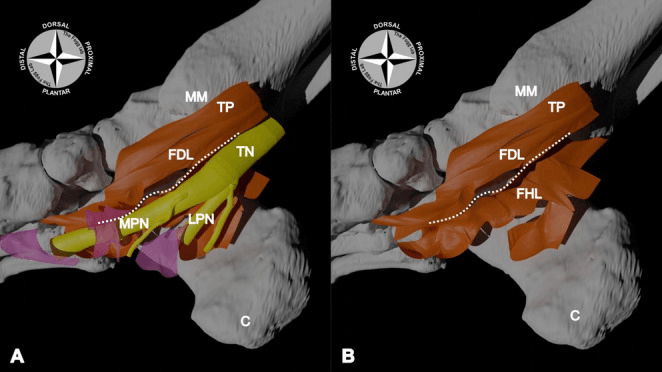
Pathophysiology. The sequence runs from increased pressure within the tunnel (greater than 30 mmHg) to venous congestion and nerve ischaemia, then demyelination, which is reversible in the early stages. Axonal damage comes next and is irreversible, showing as motor weakness and atrophy; chronic cases add fibrosis and adhesions.
Aetiology and Classification
Causes. Trauma, from ankle fractures, sprains and dislocations and the scarring they leave, is the commonest cause; the frequencies of the others are in the table. Always look for an underlying cause, with MRI, before surgery. Beyond the categories in the table, anatomical variants (accessory muscles, bony prominences) and external factors (tight footwear, prolonged standing) can compress the nerve.
- Examples
- Ankle fractures, sprains, dislocation
- Frequency
- Most common
- Examples
- Ganglion, lipoma, neurilemoma, varicosities
- Frequency
- 20-30%
- Examples
- Pes planus, hindfoot valgus, tarsal coalition
- Frequency
- Common
- Examples
- Diabetes, hypothyroidism, RA, amyloidosis
- Frequency
- Variable
- Examples
- No identifiable cause
- Frequency
- 30-40%
Tenosynovitis. Flexor tenosynovitis can crowd the tunnel: expansion in any tendon sheath can reduce the space for the adjacent nerve. It must be treated together with its underlying mechanical or inflammatory driver.
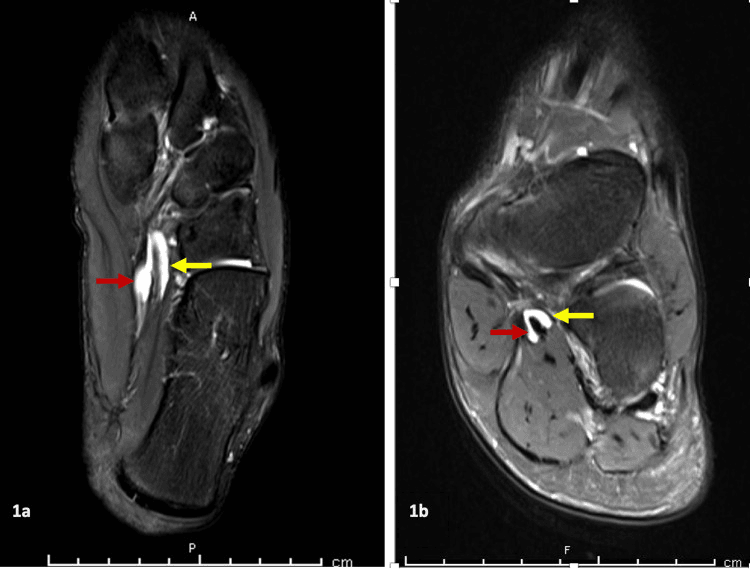
Vascular causes. Varicosities are among the space-occupying lesions, and ultrasound shows the vascular causes. A tortuous, ectatic lateral plantar vein in the distal tunnel can contact the lateral plantar nerve, and dynamic scanning establishes whether that contact displaces or compresses the nerve. A focal venous aneurysm is a discrete cause that can be addressed surgically when symptoms and nerve changes localise to the same level.
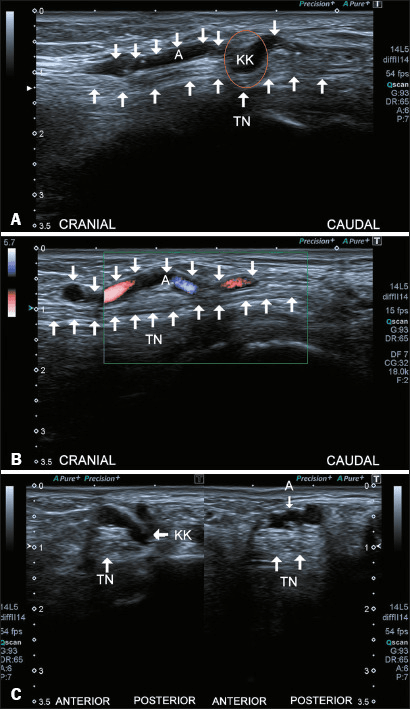
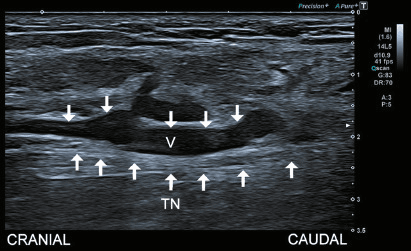
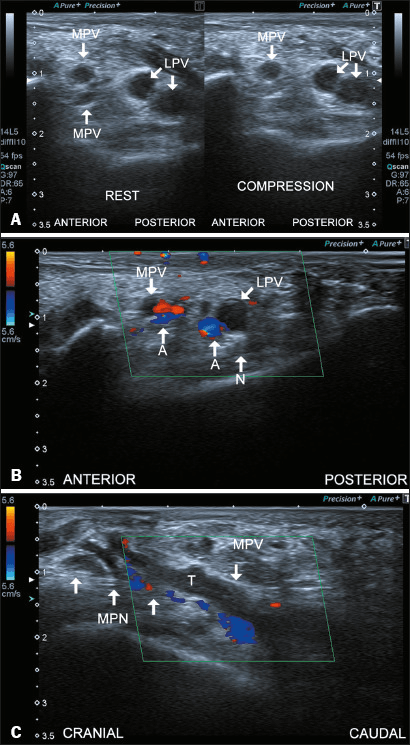
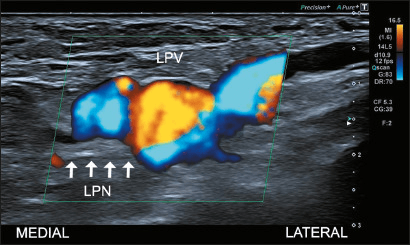
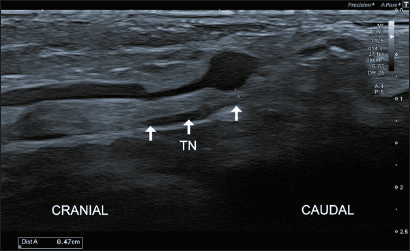
Zones. The level of compression decides which branches are involved, and so the symptoms and the surgical plan.
- Location
- Proximal tunnel
- Affected Branches
- Entire PTN
- Location
- Mid tunnel
- Affected Branches
- MC + MPN + LPN
- Location
- Distal tunnel
- Affected Branches
- MPN + LPN
- Location
- Distal to bifurcation
- Affected Branches
- Individual branches
Biomechanical TTS: The Traction Neuropathy of the Valgus Hindfoot
Traction. A planovalgus hindfoot (collapsed medial arch with heel valgus) places the posterior tibial nerve and its branches under stretch. As the heel everts and the arch falls, the nerve is tensioned and angulated where it curves around the medial malleolus and sustentaculum tali. Dorsiflexion-eversion, the position of the provocative test of that name, is essentially the resting posture of the valgus foot, so the nerve is chronically loaded: a traction (stretch) neuropathy, distinct from the pressure of a ganglion or lipoma.
Assessment. Always examine and document standing hindfoot alignment. A flexible planovalgus foot that corrects on tiptoe (double-heel-rise) flags a biomechanical, potentially correctable contributor; a rigid valgus, as in tarsal coalition, does not.
Conservative care. For biomechanical TTS, orthotic correction of the valgus (medial arch support, medial heel posting) comes first and is genuinely therapeutic. It offloads the traction and can relieve symptoms without surgery, which is why orthotics feature so prominently in the conservative plan.
Surgery, the unresolved point. A tunnel release that leaves the deforming traction force uncorrected may fail. For a fixed symptomatic valgus, some surgeons advocate realigning the hindfoot (a medialising calcaneal osteotomy or flatfoot reconstruction, for example) alongside, or instead of, a simple release, on the principle that the cause of the stretch must be addressed, not just the tunnel. This is not standardised. General flatfoot reconstruction is developed in the pes planus and flatfoot topics.
Clinical Assessment
History. Burning pain in the plantar foot and toes, radiating along the medial arch, is worse at night and wakes the patient from sleep; prolonged standing and walking aggravate it. Weakness of toe flexion is an associated symptom. Burning plantar pain worse at night is the classic presentation.
Examination. Compare with the other side throughout.
- Tinel sign - tap posterior to the medial malleolus
- Dorsiflexion-eversion test - see the table below
- Two-point discrimination - greater than 6mm is abnormal
- Intrinsic muscle testing - toe spread, FHB power
- Hindfoot alignment - look for pes planus
- Technique
- Tap posterior to medial malleolus
- Sensitivity
- 58%
- Specificity
- 92%
- Technique
- Hold 5-10 seconds, reproduces symptoms
- Sensitivity
- 81%
- Specificity
- 85%
- Technique
- 30 seconds over tunnel
- Sensitivity
- 50%
- Specificity
- 90%
- Technique
- DF + eversion + compression
- Sensitivity
- 85%
- Specificity
- 88%
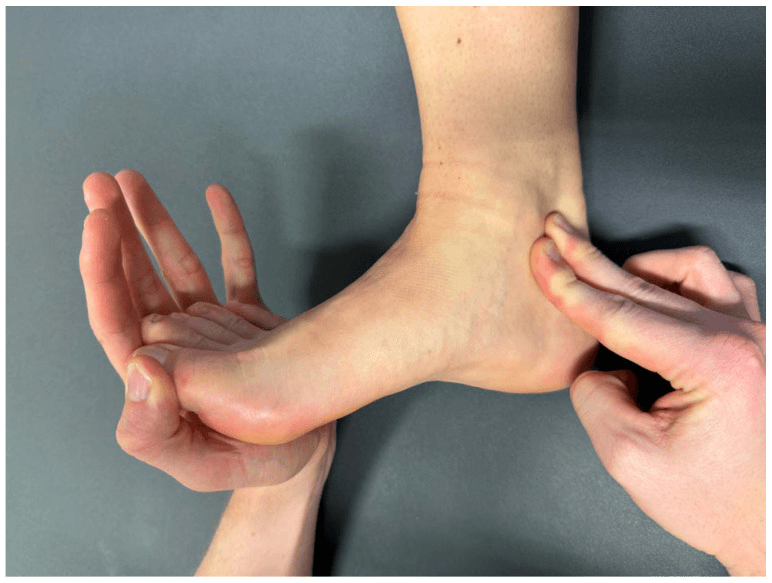
Treat this table as a ranking, not as measured accuracy. These figures descend from small series comparing patients with surgically confirmed tarsal tunnel syndrome against asymptomatic volunteers. That is a case-control design, and it inflates both columns: the clinical question is asked of an undifferentiated painful foot, not of two pre-sorted groups.
Take the dorsiflexion-eversion test, the only one whose primary source appears in the Evidence Base below. Kinoshita reports counts, not percentages. Symptoms were induced or intensified in 15 of 20 feet with numbness, 15 of 17 with pain, and 6 of 7 with both, 36 of 44, which is where the 81% comes from, and in 100 feet of 50 normal volunteers nothing could be induced at all, so the paper's own control data give a specificity of 100% against normals. Every patient in that series was already going to theatre.
The practical consequences. A positive provocative test in a foot that hurts is useful and supports the diagnosis. A negative one excludes very little, because these manoeuvres were never measured against the conditions TTS must actually be distinguished from: plantar fasciitis, Baxter neuropathy, S1 radiculopathy and polyneuropathy all coexist with a normal tarsal tunnel. And none has been tested for inter-observer reliability, which matters for a sign scored as "reproduces the patient's symptoms".
Differential diagnosis. Each of these has a discriminating feature to look for:
- Plantar fasciitis - pain in a different location
- Morton neuroma - forefoot
- L5-S1 radiculopathy - examine the back
- Peripheral neuropathy - bilateral, diabetics
- Baxter neuropathy - the first branch of the lateral plantar nerve
Double Crush Syndrome: The Proximal Lesion You Must Not Miss
Double crush is one of the commonest reasons a tarsal tunnel release fails.
The double-crush hypothesis (Upton and McComas). A nerve compressed at one point along its length is rendered more susceptible to symptomatic dysfunction from a second, often subclinical, compression elsewhere; the two lesions summate rather than acting independently. The proposed mechanism is that the proximal compression impairs axoplasmic flow, lowering the threshold at which a distal site becomes symptomatic.
Why it applies to TTS. The tibial nerve carries L4-S3 fibres, so a coexisting lumbosacral radiculopathy (disc or foraminal stenosis), or a more proximal sciatic or tibial lesion, can prime the very axons that are then finished off at the tarsal tunnel. The same logic links TTS to a coexisting diabetic polyneuropathy, which is itself a diffuse crush.
What it changes. It explains some idiopathic and failed-release TTS, because a distal decompression cannot fix a missed proximal contributor. It mandates a proximal screen before committing to surgery: examine the lumbar spine, straight-leg raise, reflexes and proximal myotomes, image the spine, and ask the electrodiagnostician to sample proximal muscles and paraspinals, not just the foot. When two lesions coexist it supports treating both sites and tempering surgical expectations, and it raises the threshold for releasing a tunnel when the dominant problem is proximal.
Investigations
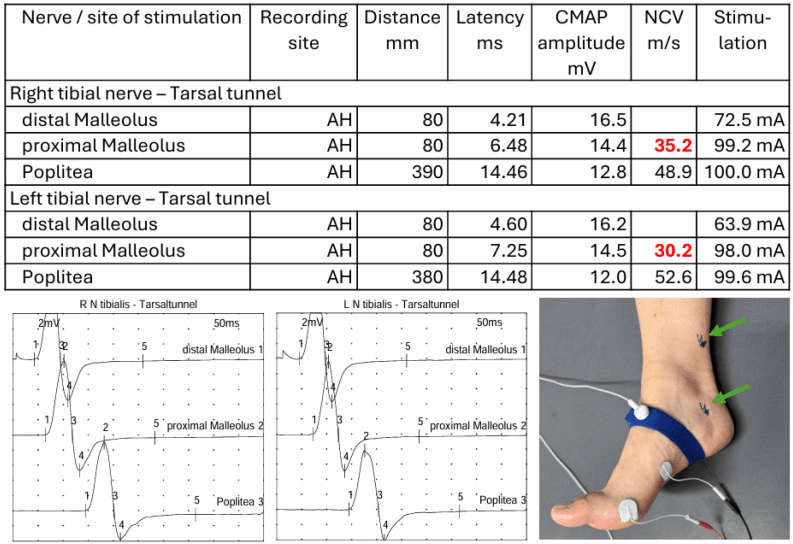
Nerve conduction studies support the diagnosis; they neither confirm nor exclude it. Calling NCS a gold standard overstates it. The AANEM evidence-based review found only four studies meeting its criteria, all Class III, and states explicitly that the sensitivity and specificity of nerve conduction studies could not be determined, nor the sensitivity of needle EMG. Its recommendation is Level C: NCS may be useful for confirming tibial neuropathy at the ankle.
Quote it that way. A normal study in a convincing clinical picture does not rule TTS out, an abnormal one supports a clinical diagnosis, and any specific false-negative percentage attached to the test comes from evidence that did not meet the review's standards.
- Normal
- Less than 4.4 ms
- Abnormal
- Greater than 4.4 ms
- Normal
- Less than 4.6 ms
- Abnormal
- Greater than 4.6 ms
- Normal
- Greater than 5 mcV
- Abnormal
- Reduced or absent
With motor involvement, EMG shows fibrillation potentials in the intrinsics, positive sharp waves and reduced recruitment.
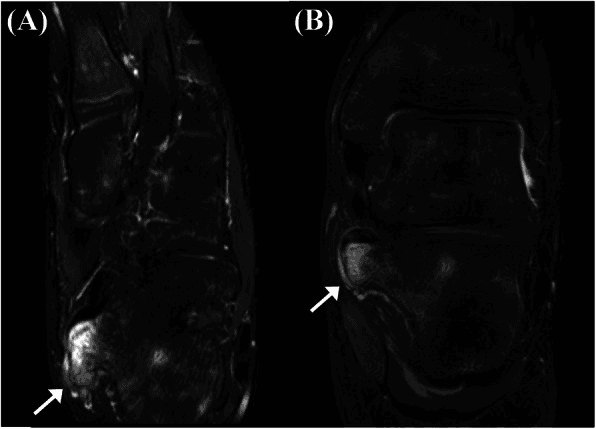
MRI is essential before surgery. It identifies space-occupying lesions such as a ganglion or lipoma, flexor tenosynovitis and accessory muscles, shows hyperintense nerve signal on T2, and rules out other pathology. MRI changes surgical planning in 20-30% of cases.
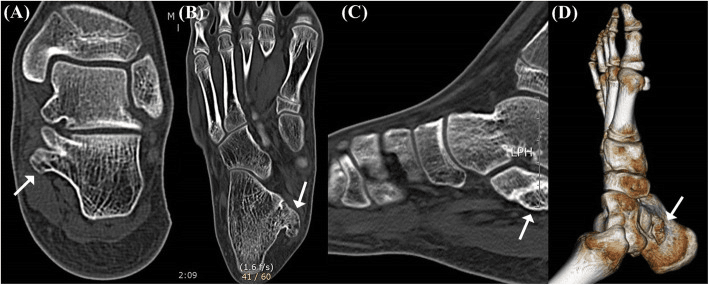
Ultrasound is dynamic, detects varicosities, guides injections and is cost-effective; it is operator-dependent but a useful adjunct. It can show nerve thickening (greater than 5mm), loss of the fascicular pattern, surrounding lesions and varicosities.
Management
Conservative care first, for 3-6 months. It succeeds in 40-50%. The components:
- Activity modification - avoid prolonged standing, limit high-impact activities, wear comfortable supportive footwear
- Orthotics - medial arch support for pes planus, heel cushioning, custom orthotics if required
- Medication - NSAIDs for pain, gabapentin for neuropathic pain, topical capsaicin
- Physiotherapy - nerve gliding exercises, a stretching programme, strengthening
Corticosteroid injection. Used diagnostically, after failed conservative treatment, or as a bridge to surgery. Inject 1ml methylprednisolone with 2ml local anaesthetic around the nerve, not into it, preferably under ultrasound guidance. 50-60% get temporary relief, typically lasting 2-4 months. A positive response supports the diagnosis and may help predict surgical success.
- Investigations
- NCS baseline
- Treatment
- Orthotics, activity modification
- Key Pearl
- Trial 3 months conservative treatment
- Investigations
- MRI to exclude lesion
- Treatment
- Corticosteroid injection trial
- Key Pearl
- Relief from injection supports the diagnosis
- Investigations
- Urgent MRI and NCS
- Treatment
- Surgical decompression
- Key Pearl
- Complete release including distally
Surgical Technique
Indications. Open release is indicated after failed conservative treatment (3-6 months), for a space-occupying lesion, for a progressive motor deficit, or for intractable symptoms.
Set-up and incision. Supine with the leg externally rotated, a thigh tourniquet, and the foot at the end of the table. A 6-8 cm curvilinear incision runs posterior to the medial malleolus and extends distally along abductor hallucis.
The release. The whole tunnel is decompressed, retinaculum and abductor hallucis origin, because an incomplete release is what brings patients back:
- Identify and protect the posterior tibial vessels
- Incise the flexor retinaculum completely
- Identify the main PTN trunk and trace it proximally and distally, inspecting the exposed nerve and adjacent vessels for persistent focal compression before the distal branches are released
- Identify, protect and release all three branches, including the medial calcaneal nerve
- Continue the release distally through the abductor hallucis tunnel
- Excise any mass lesion completely, and perform a neurolysis if there is fibrosis
Closure. Leave the retinaculum open, close the subcutaneous tissue and skin, and apply a bulky dressing.
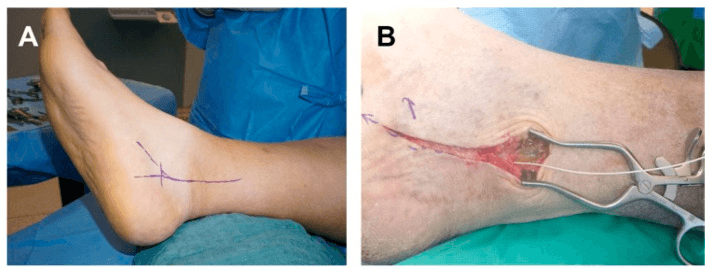
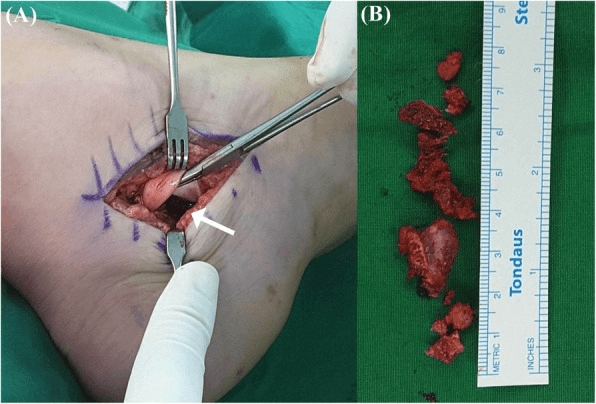
Endoscopic release. A two-portal approach releases the retinaculum retrogradely, with only a limited distal release. It offers a smaller incision, earlier mobilisation and potentially less scar tissue, but it has a learning curve, cannot excise mass lesions and risks an incomplete release. The evidence compared with open release is limited.
Complications
Most complications come from an inadequate release. Beyond the complete release described above and a preoperative MRI to plan for any mass lesion, gentle handling minimises nerve trauma and early mobilisation reduces adhesions.
- Incidence
- 10-20%
- Prevention
- Full exposure distally
- Management
- Revision surgery
- Incidence
- 5%
- Prevention
- Careful closure, offload
- Management
- Wound care, possible grafting
- Incidence
- 15-30%
- Prevention
- Proper patient selection
- Management
- NCS, consider revision
- Incidence
- 2-5%
- Prevention
- Early mobilisation
- Management
- Pain management, therapy
Recurrence, at 10-20%, is the result of incomplete release. The other complications are wound problems (delayed healing, infection), injury to the branches, scar tethering of the nerve by adhesions, and persistent symptoms from incomplete decompression.
Postoperative Care and Rehabilitation
The protocol.
- Immediately - bulky dressing and posterior splint, elevation above heart level, non-weight bearing for 2 weeks
- Weeks 0-2 - rest, ice and elevation, ankle pumps, wound check at 2 weeks
- Weeks 2-6 - weight-bearing as tolerated, gentle range of motion, scar massage once healed
- Weeks 6-12 - progressive strengthening, return to normal footwear, gradual return to activity
Recovery. Burning pain eases in 2-4 weeks, and sensation improves over 3-6 months. Motor recovery, where there was a deficit, and full recovery take 6-12 months.
Outcomes and Prognosis
Overall surgical success is quoted at 60-85%.
- Poor Prognosis
- Idiopathic TTS
- Poor Prognosis
- Chronic symptoms over 12 months
- Poor Prognosis
- Failed injection
- Poor Prognosis
- Motor deficit present
- Poor Prognosis
- Denervation on EMG
Guidelines, Registries & Global Practice
There are no dedicated national-society clinical practice guidelines specific to tarsal tunnel syndrome from the major bodies, reflecting its rarity and the limited high-level evidence. Practice is instead shaped by foot-and-ankle society consensus, electrodiagnostic practice parameters and surgical experience, and is broadly consistent worldwide.
- Region
- International / US
- Position
- NCS may confirm tibial neuropathy at the ankle (Level C); diagnosis remains clinical
- Region
- US
- Position
- Stepwise care - conservative first, image to exclude mass lesion, release for refractory or compressive cases
- Region
- UK
- Position
- Similar stepwise pathway; MRI and electrodiagnostics used selectively before surgery
- Region
- Europe
- Position
- Emphasise excluding differentials (polyneuropathy, radiculopathy) and identifying a structural cause
- Region
- International
- Position
- No robust evidence base; calls for a structured, step-wise approach and RCTs
Global epidemiology and practice variation:
- TTS is uncommon and consistently under-recognised; precise population incidence is unknown across all regions.
- No arthroplasty/implant-style registries track TTS, as treatment is soft-tissue decompression rather than implantation.
- High-resource settings: routine pre-operative MRI and electrodiagnostics, ultrasound-guided diagnostic injection, and access to microsurgical neurolysis.
- Limited-resource settings: diagnosis is predominantly clinical with provocative tests; MRI and nerve conduction studies may be unavailable, so identifiable causes (post-traumatic deformity, large masses) are prioritised for surgery.
- Across all settings the surgical principle is identical: complete release of the flexor retinaculum, decompression of all branches, distal release through the abductor hallucis fascia, and excision of any space-occupying lesion.
Related pages: Tibial Nerve Anatomy for the course, the terminal branches and the variable bifurcation level the Banik card above measures - the practical point being that a release stopping at the flexor retinaculum can leave a proximally arising branch compressed; Baxter Neuropathy is entrapment of the first branch of the lateral plantar nerve and the single most important distinction on this page, because it presents as heel pain, is missed as plantar fasciitis, and needs a different release; Plantar Fasciitis is the condition most tarsal tunnel patients are treated for first, and the discriminator is that fasciitis hurts on the first steps of the morning at the medial calcaneal tuberosity while a neuropathy burns, radiates and is worse with activity and at night; Morton's Neuroma for the forefoot interdigital equivalent; Lumbar Radiculopathy for the proximal lesion this page's double-crush section addresses, and the reason a normal tarsal tunnel does not end the search; Diabetic Neuropathy for the commonest cause of burning feet and the confounder that makes electrodiagnosis uninterpretable - bilateral symptoms should move the diagnosis away from a tunnel; Charcot-Marie-Tooth Disease for the hereditary neuropathy that presents with foot symptoms and a cavus foot; Posterior Tibial Tendon Dysfunction, Adult Flatfoot Deformity and Rigid Flatfoot for the valgus hindfoot that produces the traction neuropathy this page describes - and the reason correcting the deformity may matter more than releasing the tunnel; Ganglion Cysts for the commonest space-occupying lesion found on MRI; and Carpal Tunnel Syndrome for the upper-limb comparison examiners invite - noting that the contrast is unflattering, because carpal tunnel has validated electrodiagnostic criteria and randomised surgical evidence, and this condition has neither.
Controversies and Areas of Uncertainty
TTS is a high-yield viva topic precisely because much of its management rests on low-level evidence. Be ready to defend a position while acknowledging the uncertainty.
No accepted diagnostic gold standard exists. Clinical criteria, provocative tests and electrodiagnostics each have limitations, and there is no validated case definition - so the same foot may be labelled TTS by one clinician and plantar heel pain or polyneuropathy by another.
True sensitivity/specificity of NCS could not be determined in the AANEM review, and a normal study does not exclude TTS. Some surgeons require electrodiagnostic confirmation before release; others operate on a strong clinical picture plus imaging.
Endoscopic release offers smaller incisions but cannot address mass lesions and risks incomplete decompression. There are no high-quality randomised comparisons; open complete release remains the reference standard, especially when a space-occupying lesion is present.
Outcomes are substantially worse without an identifiable cause. Whether truly idiopathic cases benefit from surgery at all is debated, and many advocate exhausting conservative options and confirming with diagnostic injection first.
MCQ Practice Points
Q: What is the order of structures in the tarsal tunnel from anterior to posterior? A: Tom, Dick And Very Nervous Harry - Tibialis posterior, Flexor Digitorum longus, Artery (posterior tibial), Vein, Nerve (posterior tibial), Flexor Hallucis longus. The posterior tibial nerve lies between the vessels anteriorly and FHL posteriorly.
Q: A patient has burning pain in the plantar foot. Which test is most sensitive for tarsal tunnel syndrome? A: Dorsiflexion-eversion stress test has highest sensitivity (81%) and specificity (85%). Hold position for 5-10 seconds to reproduce symptoms. Tinel sign is more specific (92%) but less sensitive (58%).
Q: What is the most common cause of recurrence after tarsal tunnel release? A: Incomplete release, particularly failure to decompress distally through the abductor hallucis tunnel. Complete release must include the flexor retinaculum proximally and extend through the abductor hallucis fascia distally to fully decompress the medial and lateral plantar nerves.
Q: Which patient with tarsal tunnel syndrome is most likely to have a good surgical outcome? A: Patient with space-occupying lesion (ganglion, lipoma) has approximately 90% success rate. Idiopathic cases have only 50% success. Other good prognostic factors include short duration of symptoms, sensory only symptoms, and positive response to diagnostic injection.
Q: Which branch of the posterior tibial nerve branches first within the tarsal tunnel? A: Medial calcaneal nerve branches first (proximal in the tunnel), providing sensory innervation to the medial heel. The nerve then bifurcates into medial plantar (larger, sensory dominant) and lateral plantar (motor dominant) branches more distally.
Clinical Decision Scenarios
Practise clinical reasoning and management decisions out loud
“How would you assess this patient?”
“What is your management plan?”
“How would you approach this?”
Anatomy
- Tom, Dick And Very Nervous Harry = contents anterior to posterior
- Three terminal branches: medial calcaneal (first), medial plantar, lateral plantar
- Flexor retinaculum = roof; medial talus, sustentaculum tali and medial calcaneus = floor
Clinical Features
- Burning plantar pain worse at night
- Tinel positive posterior to medial malleolus
- Dorsiflexion-eversion test most sensitive
- Intrinsic weakness = advanced disease
Investigations
- NCS: prolonged distal motor latency (less than 4.4ms MPN)
- MRI: essential to identify mass lesions (20-30% have one)
- NCS sensitivity and specificity in TTS were never established (AANEM Level C) - a normal study does not exclude it
Treatment Algorithm
- Conservative 3-6 months: orthotics, activity modification, medications
- Injection: diagnostic and therapeutic, 50-60% temporary relief
- Surgery if failed conservative or progressive motor deficit
Surgical Pearls
- Curvilinear incision posterior to medial malleolus
- Complete release of flexor retinaculum
- MUST extend through abductor hallucis tunnel distally
- Identify and protect all three branches
Outcomes
- 60-85% overall success
- 90% success with mass lesion
- 50% success idiopathic
- Recurrence 10-20% (incomplete release)
Evidence Base
Surgical Release Outcomes (Objective vs Subjective)
- 60 patients (68 feet) undergoing tarsal tunnel release; all had positive Tinel sign and abnormal motor nerve conduction
- 85% complete symptom relief by objective assessment, but only 51% by subjective patient-reported assessment
- Significant improvement in work quality, productivity and interpersonal relationships
- Highlights a dichotomy between objective and patient-perceived outcomes - counsel realistically
Anatomic Pain Scale & Predictors of Non-operative Failure
- Prospective evaluation of 46 patients (56 feet) treated non-operatively or surgically
- Surgery improved medial calcaneal and medial plantar - but not lateral plantar - nerve region pain
- Predictors of failed conservative treatment: longer motor nerve conduction latency and more foot comorbidities
- Anatomic pain mapping aids pre- and post-treatment assessment
Electrodiagnostic Testing in TTS (AANEM Evidence-Based Review)
- Systematic review of 317 articles; only 4 met methodological criteria, all Class III evidence
- Sensory NCS more often abnormal than motor NCS, but true sensitivity and specificity could not be determined
- NCS may help confirm tibial neuropathy at the ankle (Level C recommendation)
- Diagnosis remains primarily clinical; well-designed studies still needed
Dorsiflexion-Eversion Provocative Test
- Test described in 50 normal volunteers (100 feet) and 37 patients (44 feet) treated operatively
- Maximal ankle dorsiflexion + eversion + MTPJ dorsiflexion held 5-10 s stretches and compresses the nerve beneath the laciniate ligament
- Reproduced or intensified symptoms in the large majority of affected feet; induced no symptoms in any normal foot
- Symptoms abolished post-release (mean 2.9 months) except in calcaneal fracture-related cases
Variable Tibial Nerve Branching in the Tarsal Tunnel
- Gross anatomical study of 20 cadaveric lower limbs using the malleolar-calcaneal axis as reference
- Bifurcation proximal to the axis (within/above the tunnel) in 55%, at the axis in 30%, distal in 15%
- High and variable bifurcation means branches must be sought across the whole tunnel at surgery
- Knowledge of branching reduces risk of incomplete release and iatrogenic nerve injury
Narrative Review of Diagnosis and Management
- Narrative review identifying 88 relevant articles across multiple databases
- TTS is rare and frequently under-diagnosed; the optimal stage for conservative vs surgical care remains unclear
- Limited high-level evidence exists to guide management; no robust RCTs available
- Calls for a structured, step-wise, evidence-based treatment pathway