Dislocation + Radial Head + Coronoid | LCL Always Torn | Address All Components
- All three components (bone and soft tissue) must be addressed for stability
- LCL repair is essential - always torn in posterior dislocation mechanism
- Radial head must be fixed or replaced (never excise)
- Coronoid tip fractures may not need fixation but LCL repair critical
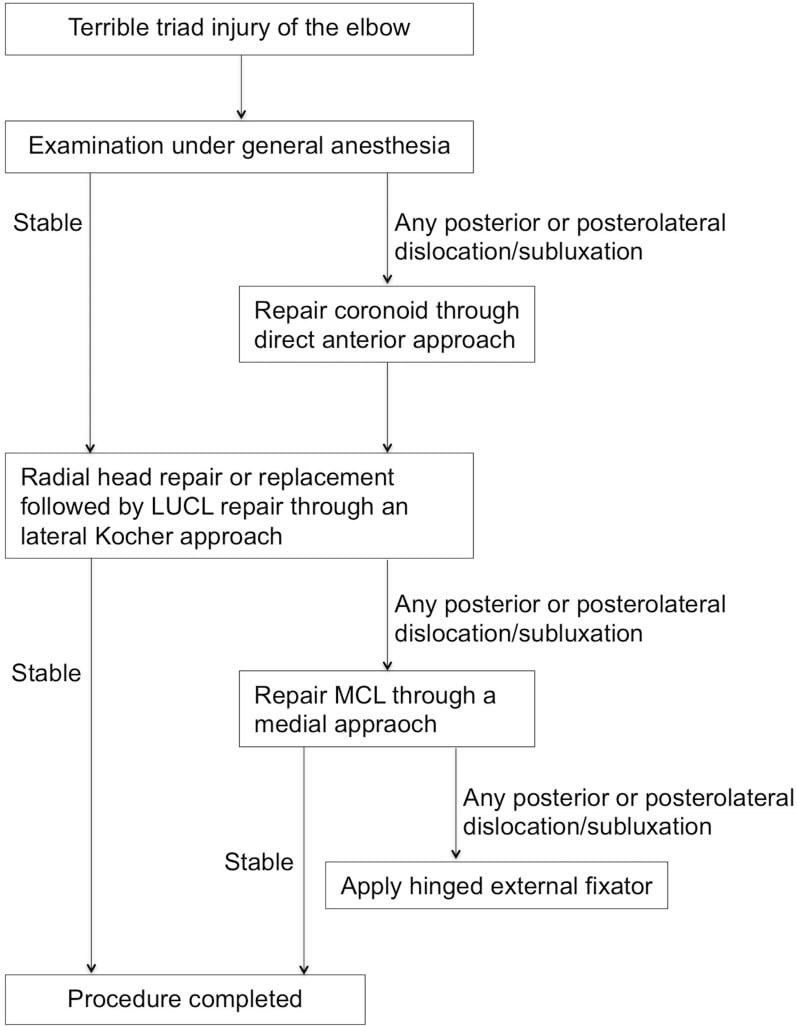
- Surgical sequence: coronoid first, radial head, LCL repair, assess MCL
- “Terrible triad = dislocation + radial head + coronoid + LCL rupture
- “Coronoid is anterior buttress - prevents posterior subluxation
- “LUCL is key component of LCL - originates from lateral epicondyle
- “Redislocation rate high if components not all addressed
Overview and Epidemiology
The terrible triad of the elbow is a posterior elbow dislocation combined with a fracture of the radial head and a fracture of the coronoid process. "Terrible" reflects the historically poor outcomes when these injuries were undertreated.
Four lesions, not three. The name counts three injuries, but a fourth is always present and was historically under-recognised: rupture of the lateral collateral ligament. The tear often takes the common extensor origin and the capsule with it.
- Posterior elbow dislocation
- Radial head fracture (Mason Type IV by definition)
- Coronoid fracture
- LCL rupture
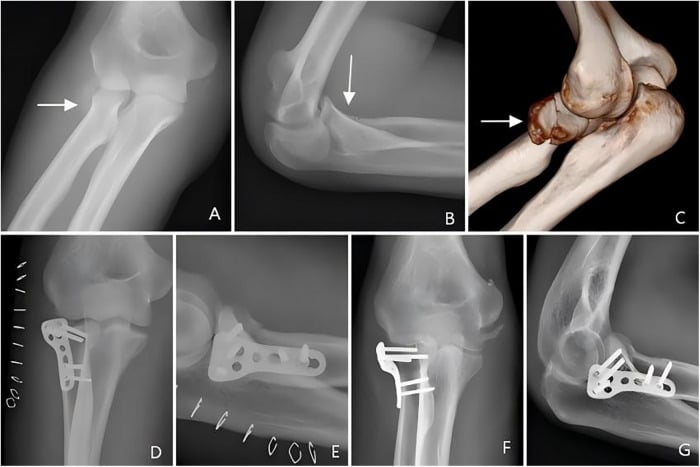
Mechanism. A fall on the outstretched hand with the elbow in extension delivers an axial load combined with a valgus and supination moment. The elbow dislocates posteriorly first; as the ulna subluxates posterolaterally the coronoid shears against the trochlea, and the radial head impacts the capitellum.
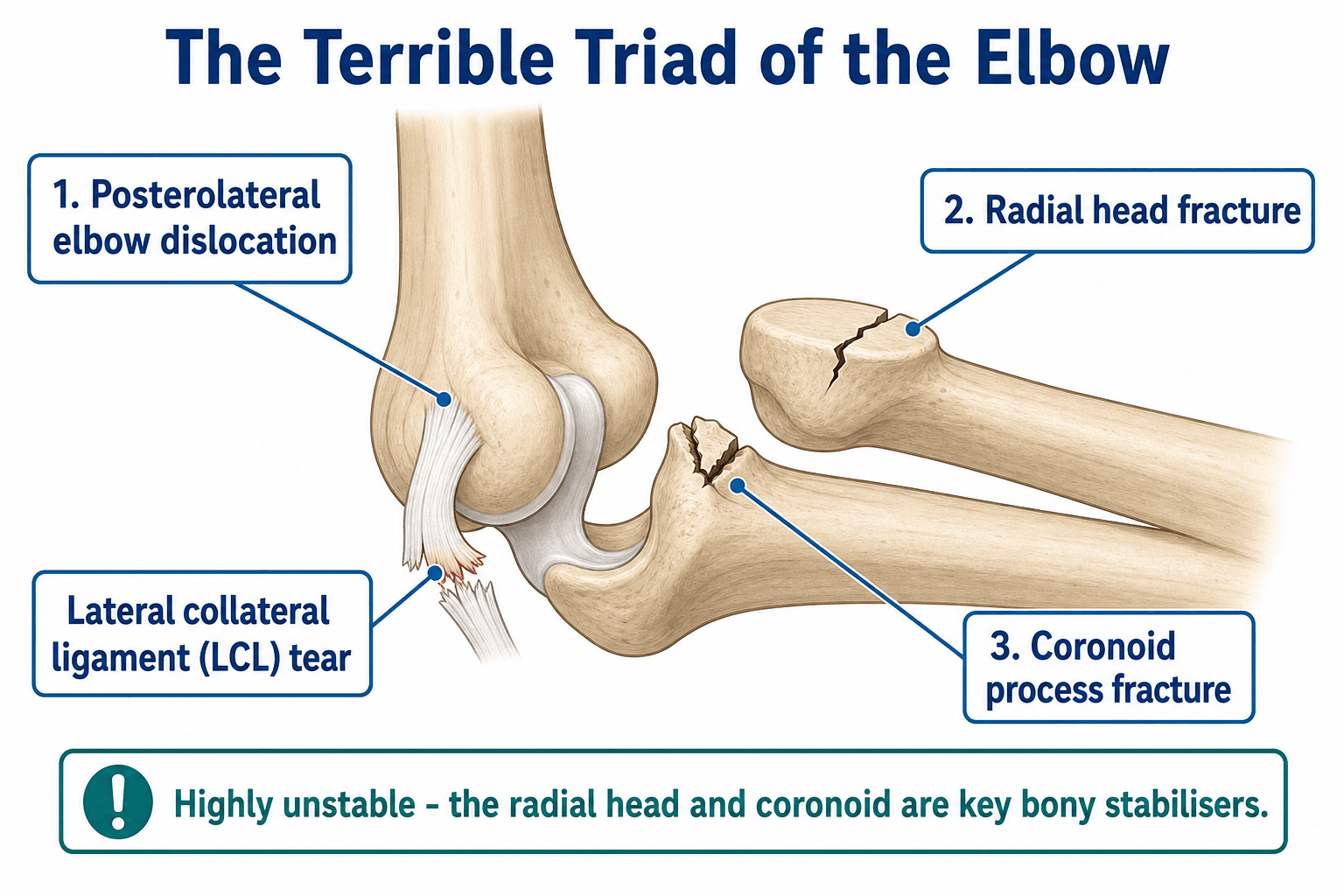
Historical outcomes were poor because the soft tissue components (especially the LCL) were not recognised or addressed. Modern understanding that this is a pattern of instability, not just a radial head fracture, requiring treatment of all components has improved outcomes significantly.
Anatomy and Biomechanics
The stabilisers. The elbow is one of the most stable joints, and its stability is shared between primary and secondary restraints.
- Primary: the ulnohumeral articulation, the anterior bundle of the MCL, and the LCL complex
- Secondary: the radial head, the common flexor and extensor origins, and the joint capsule
The lateral collateral ligament complex. The LCL is the primary lateral stabiliser. It comprises the radial collateral ligament, running from the lateral epicondyle to the annular ligament; the annular ligament, which encircles the radial head; and the lateral ulnar collateral ligament (LUCL), the key structure of the complex.
The LUCL is the primary restraint to posterolateral rotatory instability (PLRI). It originates from the lateral epicondyle (isometric point) and inserts on the supinator crest of the ulna. In terrible triad, the LUCL is always ruptured and must be repaired.
The coronoid. The coronoid is the anterior buttress against posterior subluxation of the ulna, and the anterior bundle of the MCL inserts on it. Its anteromedial facet is the key to varus-posteromedial instability.
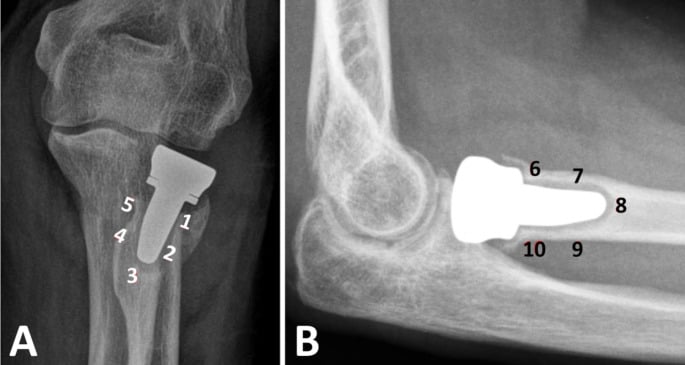
The radial head. A secondary valgus stabiliser that becomes critical when the MCL is deficient. It also contributes to longitudinal stability of the forearm.
Think of elbow stability as a ring: MCL + coronoid + radial head + LCL. Breaking the ring at two or more points creates instability. In terrible triad, the ring is broken at multiple points - all must be addressed.
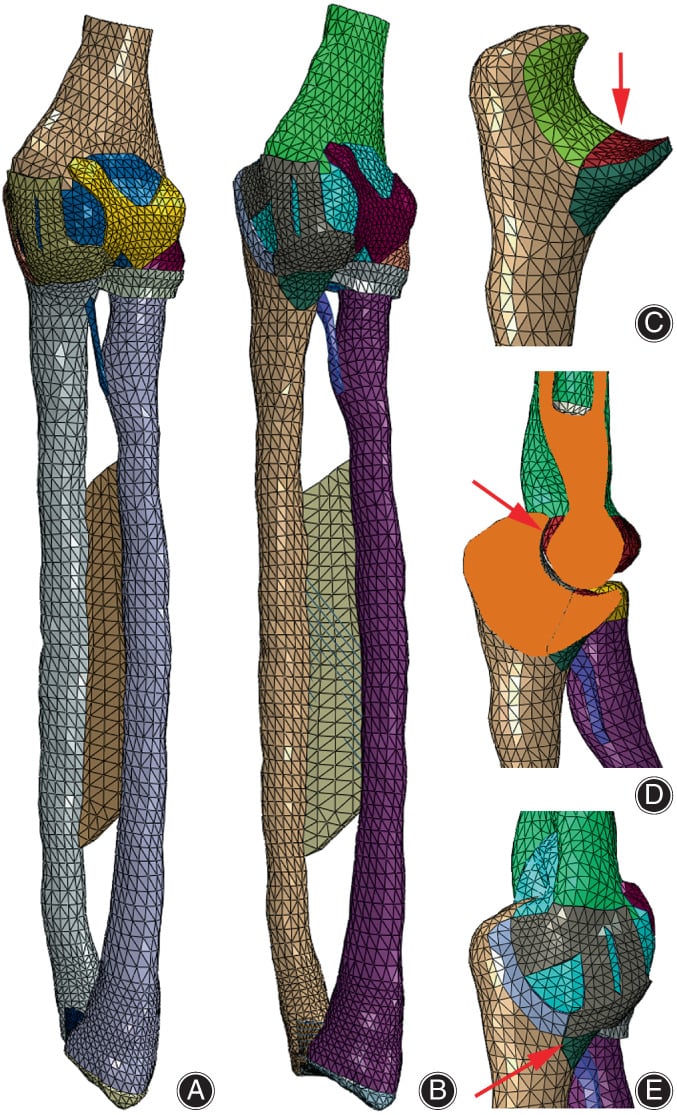
Classification Systems
Two systems are in use. Regan-Morrey is the simple one and grades the fracture by the height of coronoid involved.
- Description
- Tip fracture
- Involvement
- Less than 10% height
- Description
- Less than 50% of process
- Involvement
- 10-50% height
- Description
- More than 50% of process
- Involvement
- More than 50% height
O'Driscoll is more comprehensive and classifies by the anatomy of the fragment.
- Description
- Tip fractures (subtype 1 = less than 2mm, subtype 2 = more than 2mm)
- Description
- Anteromedial facet fractures (subtypes based on extension)
- Description
- Basal fractures (subtypes based on extension)
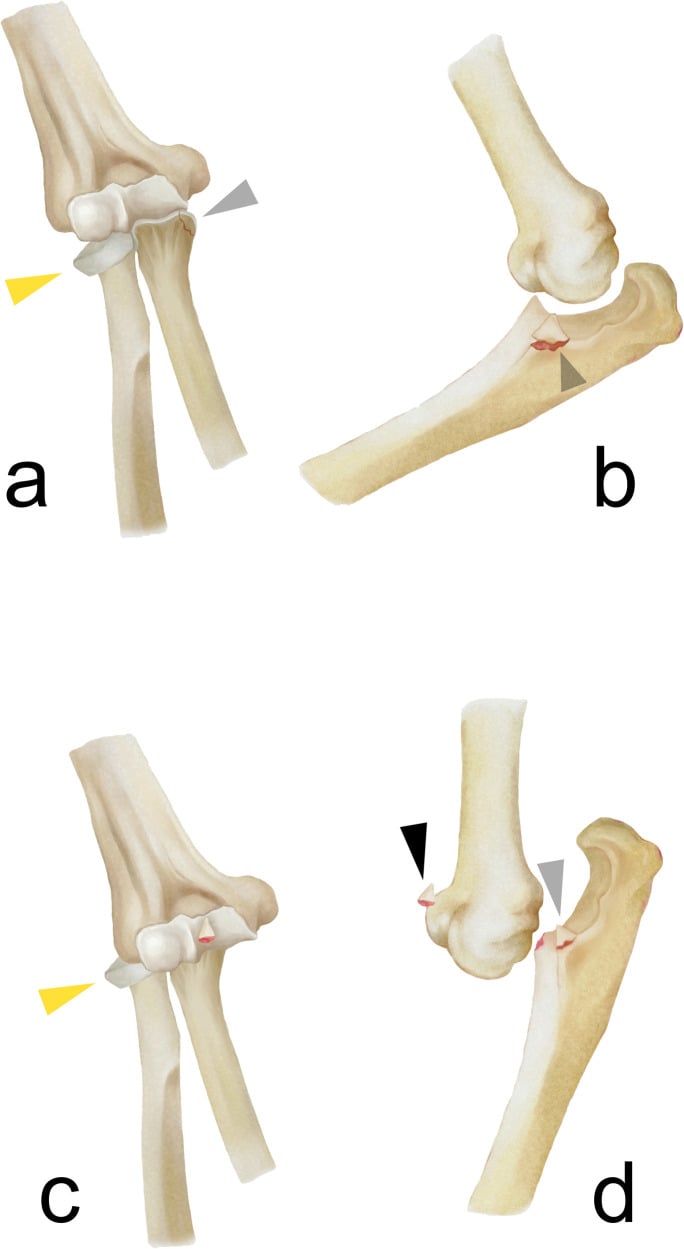
Anteromedial facet fractures (O'Driscoll Type 2) are associated with varus-posteromedial rotatory instability, a different pattern from the terrible triad, which is a posterolateral rotatory mechanism. Distinguish them: the treatment and the surgical approach differ.
Clinical Presentation and Assessment
History. Establish the mechanism (a fall on the outstretched hand, sport or a motor vehicle accident) and whether the patient felt the elbow "going out". Previous elbow problems, hand dominance and occupation complete the picture.
- Significance
- Dislocation still present
- Action
- Reduce urgently
- Significance
- Significant injury
- Action
- Assess skin, neurovascular status
- Significance
- LCL injury, radial head fracture
- Action
- Part of the triad
- Significance
- Possible MCL involvement
- Action
- May need medial repair
- Significance
- Unstable pattern
- Action
- Surgical stabilization required
- Significance
- Nerve or vessel injury
- Action
- Document, urgent assessment
After reduction. Stability is tested through the range of motion, under anaesthesia if needed, noting the angle at which the elbow redislocates. Valgus stress tests the MCL, varus stress the LCL, and a posterolateral rotatory stress completes the examination.
After closed reduction, test stability through the full arc of motion. If the elbow redislocates before 30-45 degrees of extension, it is highly unstable and requires urgent surgical stabilisation.
Neurovascular status. The ulnar nerve is the most commonly affected, in up to 20%. The median and radial nerves (including the PIN) are examined and recorded too, and so is the brachial artery, whose injury is rare but serious.
Investigations
Radiographs. AP and lateral views before reduction confirm the dislocation and identify the fractures, although pain may limit them. The same views after reduction confirm that the reduction is concentric and show the radial head and coronoid fractures.
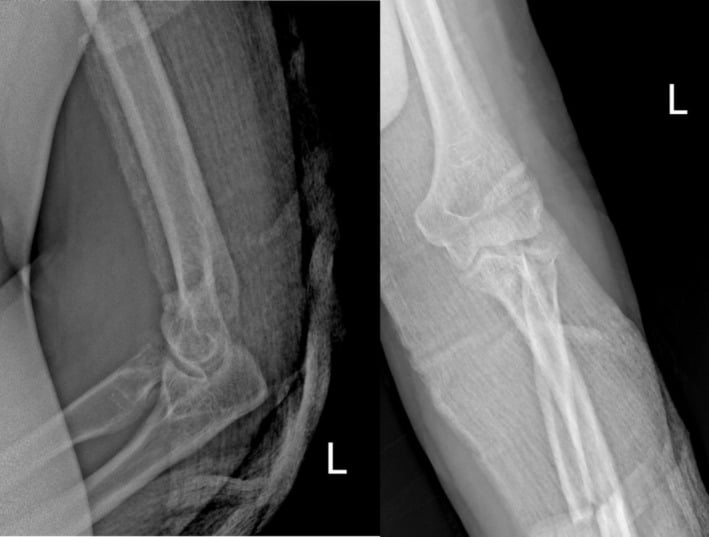
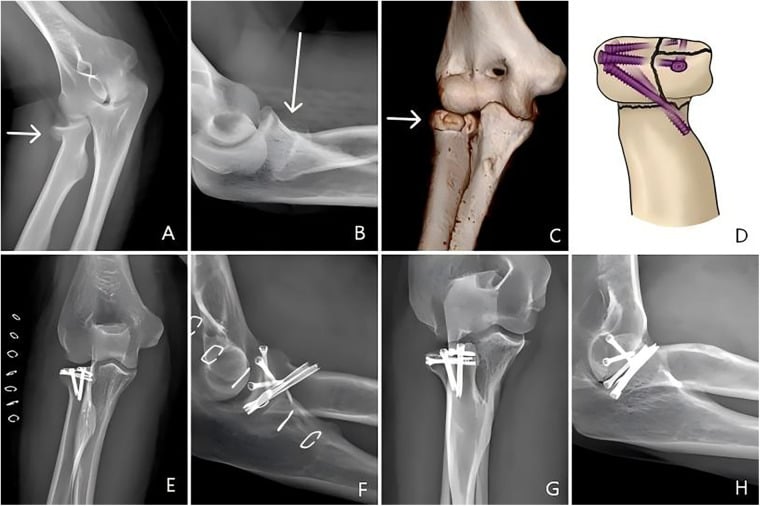
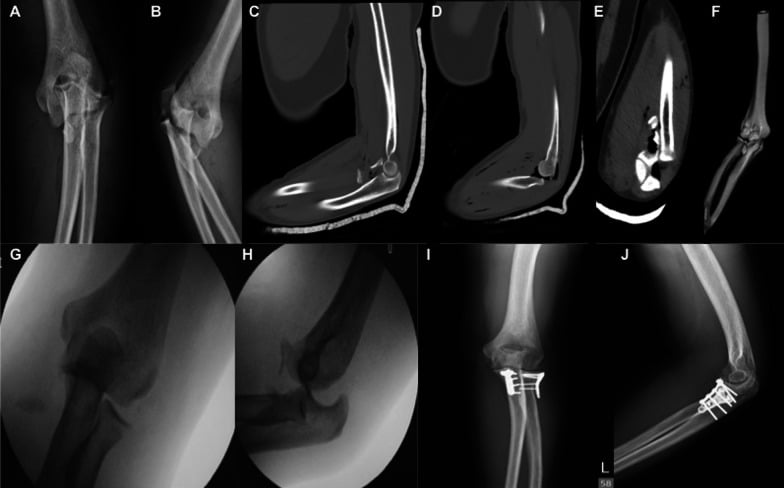
What the CT must show. The coronoid fragment's type and its size as a percentage of coronoid height; the number of radial head fragments and whether the head can be reconstructed; associated injuries of the capitellum or medial epicondyle; and any loose bodies in the joint.
CT is mandatory before surgery. Coronoid fragment size determines whether fixation is needed, and the radial head fragment count determines ORIF versus arthroplasty. Do not operate without it.
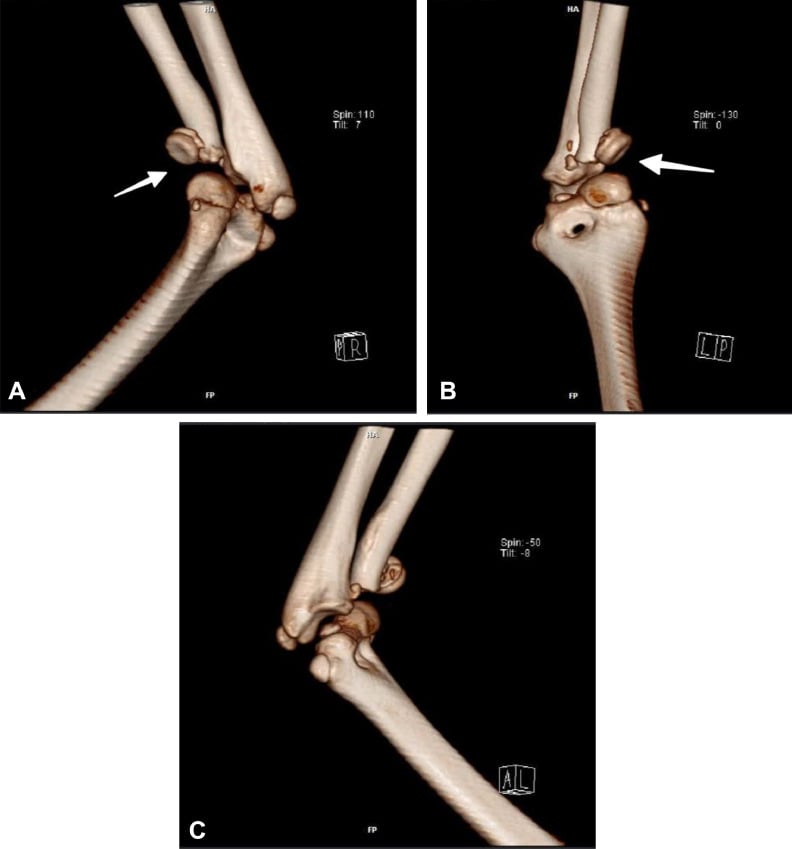
Management
In the emergency department. The elbow is reduced closed, usually in the ED under sedation, then radiographed and splinted at 90 degrees. Stability is assessed, although this may be deferred to theatre if it is too painful, and a CT is requested for surgical planning.
Terrible triad injuries require surgical intervention. Do not discharge with a plan for delayed surgery. Recurrent instability, stiffness, and heterotopic ossification increase with delay.
Surgery and its timing. All terrible triad injuries need surgical fixation, ideally within 1-2 weeks, and sooner if the elbow is unstable. The goal is to restore enough stability to allow early motion, by addressing the coronoid, the radial head and the LCL, and considering the MCL if instability persists.
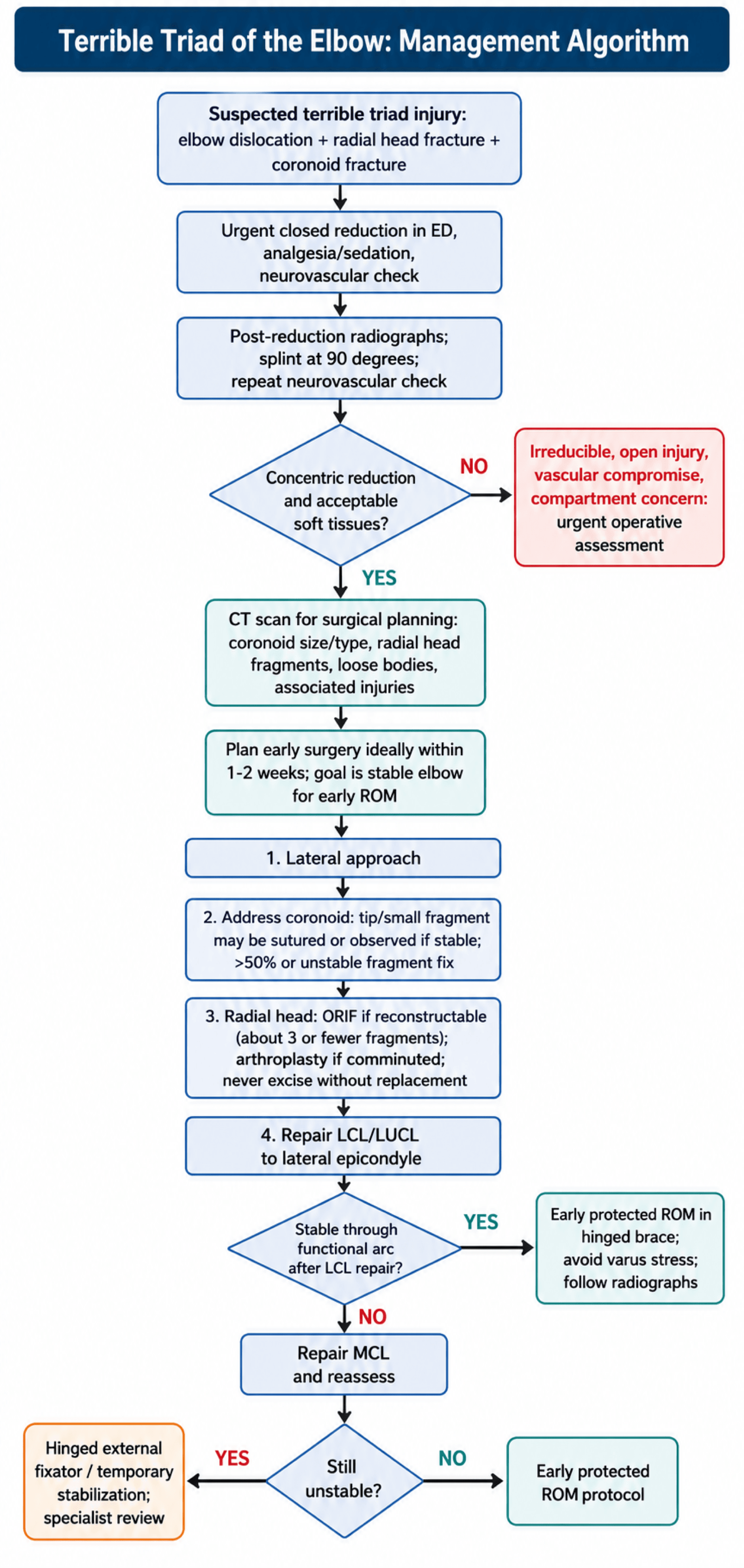
Although the default is operative, a small subset can be managed non-operatively, and this is the answer to the classic viva follow-up. The criteria for a trial of non-operative care are strict: a small or minimally displaced radial head fracture that does not block forearm rotation, a small coronoid (tip) fragment, and — the decisive test — a concentric, stable reduction maintained through a functional arc of motion (typically extension to about 30 degrees) confirmed on examination and live fluoroscopy, with the ulnohumeral and radiocapitellar joints congruent. Such patients are mobilised early in a hinged brace blocking terminal extension, with close weekly radiographs for the first 2-3 weeks to detect any subluxation (watch for the drop sign / ulnohumeral widening). Any loss of concentric reduction, a block to motion, or a larger fragment mandates conversion to surgery — the threshold to operate stays low because missed instability does badly.
Surgical Technique
The order is coronoid, radial head, LCL, then a stability check that decides whether the MCL needs attention.
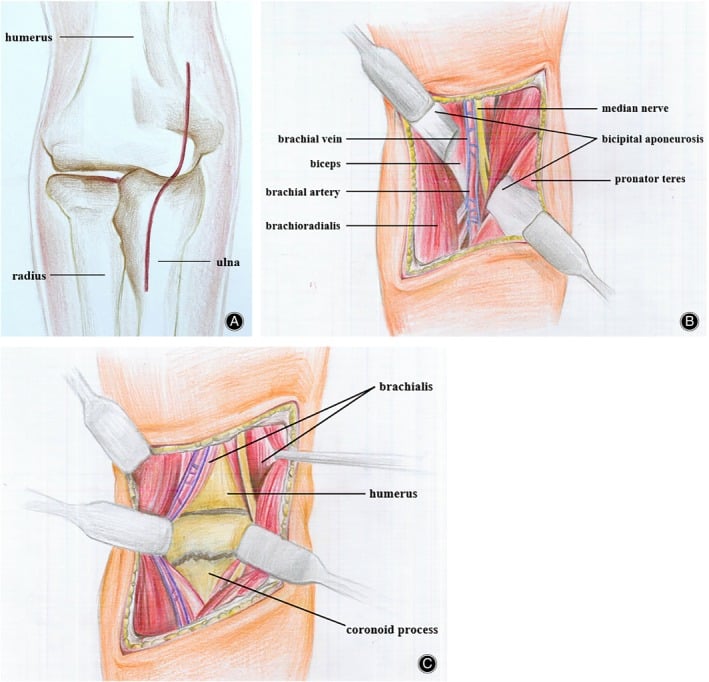
The lateral approach is standard, either Kocher's or the extended lateral (Hotchkiss) approach. Some surgeons begin with an arthroscopy for loose bodies, which is optional.
Kocher. Through the interval between anconeus and ECU, identifying and protecting the LCL origin. It gives excellent access to the radial head and the lateral coronoid.
Extended lateral (Hotchkiss). An extension of Kocher that can split the common extensor origin, and gives better access to the coronoid through the radial head defect.
Use the tear as the window. The LCL is already torn, so do not detach it from the epicondyle; work through the tear and identify the LUCL for later repair. Working through the existing disruption avoids further soft-tissue damage and maintains the exposure.
Complications
- Incidence
- 5-15% (modern techniques)
- Prevention/Management
- Address all components, adequate LCL repair
- Incidence
- 20-40%
- Prevention/Management
- Early motion, avoid over-immobilization
- Incidence
- 10-20%
- Prevention/Management
- Indomethacin prophylaxis, early motion
- Incidence
- 10-30%
- Prevention/Management
- Anatomic reduction of articular surfaces
- Incidence
- 10-15%
- Prevention/Management
- Careful retraction, may need transposition
- Incidence
- 5-10%
- Prevention/Management
- Adequate fixation, hardware removal if symptomatic
- Incidence
- Rare (less than 5%)
- Prevention/Management
- Adequate fixation, bone graft if at-risk
Recurrent instability is the most serious complication, and it is usually due to undertreated components. Prevention lies in meticulous technique that addresses every structure; treatment is revision surgery, which may need a hinged external fixator.
Stiffness is very common after complex elbow trauma. The goal is a functional arc of 30-130 degrees. Early motion, within the first week, is the prevention, and physiotherapy, dynamic splinting and surgical release are the treatment.
Heterotopic ossification (HO) is common in terrible triad. Consider prophylaxis with indomethacin 75mg/day for 2-3 weeks or single-dose radiation. Early motion also reduces HO risk.
Complication tables tend to itemise individual problems and omit the figure a patient actually needs at consent — how likely is further surgery.
A systematic review of 16 studies and 312 patients, with mean follow-up of 25 to 30 months (DOI), found that 70 of 312 patients (22.4%) required reoperation for a complication. The commonest drivers were hardware problems, stiffness, instability and ulnar neuropathy. Complications not requiring reoperation included heterotopic ossification in 39 of 312 (12.5%) and arthrosis in 35 of 312 (11.2%) — figures that sit comfortably inside the ranges above and anchor them to a real denominator.
Read the spread, not just the average. Reoperation ranged from 0% to 54.5% between individual studies. That variation is itself the message: outcome depends heavily on whether every component is addressed and on surgeon experience, which is precisely the argument for a systematic sequence rather than a partial repair. Single-centre series applying a standard protocol sit at the favourable end — one series of 42 terrible-triad elbows treated by a modified Pugh protocol reported four reoperations, a mean Mayo score of 88 and a mean arc of 107 degrees. Quote the pooled 22.4% when counselling a general population and the protocol series when arguing that a disciplined sequence improves the odds; the two are consistent, not contradictory.
Functional outcome is nonetheless generally satisfactory where the injury is properly reconstructed — mean Mayo Elbow Performance Scores ranged from 78 to 95, Broberg-Morrey 76 to 90, and DASH 9 to 31 across the included series.
Use it at consent. Tell the patient the elbow usually ends up functional, that stiffness is common, and that around one in five will need a further procedure — most often for hardware, stiffness or ulnar nerve symptoms. A patient warned in advance experiences a second operation as an anticipated step; one who was not experiences it as a failure.
Postoperative Care and Rehabilitation
Principles. Early motion is critical but must be balanced against stability. A hinged brace allows motion while limiting terminal extension, and varus stress is avoided because it stresses the LCL repair. Patients are educated about activity restrictions, and the long-term outcome depends heavily on compliance with rehabilitation.
- Posterior splint at 90 degrees
- Elevation, ice
- Wound monitoring
- Finger motion encouraged
- Remove splint, begin ROM
- Active and active-assisted motion
- May use hinged brace if stability concerns
- Avoid terminal extension if any instability
- Progressive ROM
- Goal: functional arc by 6 weeks
- Dynamic splinting if stiff
- Avoid varus stress and forced extension
- Begin pronation/supination as tolerated
- Full active ROM expected
- Begin gentle strengthening
- Progressive loading
- Wean from brace if used
- Progressive strengthening
- Return to work (desk work earlier)
- Sports depending on demands
- May take 6-12 months for full recovery
Outcomes and Prognosis
The eras differ in whether the soft tissues were treated.
- Good/Excellent
- 40-50%
- Key Issues
- Undertreatment of soft tissues
- Good/Excellent
- 70-85%
- Key Issues
- All components addressed
Prognostic factors. A larger coronoid fragment carries a worse prognosis, and delay to surgery increases stiffness and HO. The quality of the repairs, associated injuries (MCL, capitellum) and the patient's compliance with rehabilitation also shape the result.
Guidelines, Registries & Global Practice
Global epidemiology
The terrible triad is a subset of elbow fracture-dislocation, so its frequency tracks elbow dislocation epidemiology. Population data are consistent across continents.
- Measure
- Elbow dislocation incidence
- Figure
- 5.21 per 100,000 person-years
- Measure
- Peak age / mechanism
- Figure
- 10-19 years; ~45% sports-related
- Measure
- Elbow dislocation incidence
- Figure
- 7.7 per 100,000 per year
- Measure
- Dislocations with concomitant fracture
- Figure
- ~17%
US NEISS data (Stoneback et al., DOI) give an elbow dislocation incidence of 5.21 per 100,000 person-years, peaking in adolescent males and largely sports-related, while a Taiwanese nationwide cohort (Yang et al., DOI) reports 7.7 per 100,000 per year with roughly one in six dislocations carrying an associated fracture. The terrible triad sits at the severe end of this complex-dislocation group.
Guidance across regions (principles converge)
There is no single randomised-trial-based guideline for the terrible triad; recommendations rest on the Pugh/King protocol and consistent expert consensus. The principles are essentially uniform worldwide.
- Position on the terrible triad
- Operative stabilisation as default; fix or replace radial head, address coronoid, repair LCL, then reassess; hinged fixation as salvage
- Evidence level
- Expert consensus / Level V
- Position on the terrible triad
- Early specialist (upper-limb) referral and operative management; CT before surgery; early mobilisation
- Evidence level
- Consensus / Level V
- Position on the terrible triad
- Reflects Pugh standard protocol — restore all four components to permit motion at 7-10 days
- Evidence level
- Level IV evidence base
- Position on the terrible triad
- Systematic component-by-component repair; reconstruct radial head if stable fixation achievable, otherwise replace
- Evidence level
- Level III-V
Registry and meta-analytic evidence
No national joint registry tracks terrible-triad outcomes specifically (registries capture arthroplasty episodes, not this trauma pattern), so the best pooled evidence is from systematic reviews. Kyriacou et al. (DOI) found no functional difference between radial head replacement and reconstruction (MEPS 88.6 vs 88.5) but a 65% overall complication rate and ~18% reoperation rate, while Chen et al. (DOI) favoured replacement for comminuted heads.
Genuine practice variation
- Surgical approach — a meta-analysis (Meena et al., DOI) found a combined lateral-plus-anteromedial approach gave more elbow and forearm motion than a lateral-only approach, at the cost of longer operating time; lateral-only remains common where the coronoid is small and accessible through the radial head defect.
- Radial head: fix vs replace — higher-resource centres replace comminuted heads readily; in limited-resource settings reconstruction or, rarely, staged management predominates.
- Hinged external fixation — availability varies; where unavailable, surgeons rely on meticulous ligament/bone repair and protected bracing.
Be prepared to describe the systematic surgical approach to terrible triad. Know the coronoid fixation thresholds, radial head decision-making, and that LCL repair is mandatory. Understand the concept of elbow instability as a pattern requiring treatment of all components.
MCQ Practice Points
Q: What are the three osseous components of the terrible triad of the elbow? A: (1) Posterior elbow dislocation, (2) radial head fracture, (3) coronoid fracture. Note: the LCL rupture is the fourth component (soft tissue) that is always present.
Q: What is the function of the coronoid process in elbow stability? A: The coronoid is the anterior buttress that resists posterior subluxation of the ulna. It is also the insertion point for the anterior bundle of the MCL (sublime tubercle).
Q: What is the recommended surgical sequence for terrible triad repair? A: (1) Address coronoid first (fix if more than 50% or unstable), (2) radial head (ORIF or replace), (3) LCL repair (essential), (4) assess stability, (5) MCL repair if still unstable.
Q: Why must the LCL be repaired in terrible triad even if the coronoid is just a tip fracture? A: The LCL is always torn in posterior elbow dislocations. The LUCL is the primary restraint to posterolateral rotatory instability. Without repair, even small coronoid fractures can result in recurrent instability.
Q: In terrible triad, when should the radial head be replaced rather than fixed? A: When there are more than 3 fragments (unreconstructable). The radial head should never be excised without replacement as it is a critical secondary stabilizer in the MCL-deficient elbow.
Clinical Decision Scenarios
Practise clinical reasoning and management decisions out loud
“A 40-year-old man presents after falling off a ladder. X-rays show a posterior elbow dislocation that has been reduced. Post-reduction X-rays show a radial head fracture and coronoid tip fracture. The elbow feels unstable to the ED doctor. What is your assessment and management?”
“You have performed ORIF of the coronoid (suture lasso), radial head arthroplasty, and LCL repair for a terrible triad. On testing, the elbow still redislocates at 40 degrees of extension. What do you do next?”
“A patient presents 3 weeks after a terrible triad injury that was initially splinted and sent home with plan for delayed surgery. The elbow is now stiff, with only 30-80 degrees motion, and X-ray shows early heterotopic ossification. How do you manage this?”
THE FOUR COMPONENTS
- 1. Posterior elbow dislocation
- 2. Radial head fracture (Mason IV by definition)
- 3. Coronoid fracture
- 4. LCL rupture (always present, often forgotten)
SURGICAL SEQUENCE
- 1. Coronoid: fix if more than 50% (suture, screw, or plate)
- 2. Radial head: ORIF (3 or fewer fragments) or replace (more than 3)
- 3. LCL: ALWAYS repair (suture anchors to isometric point)
- 4. Stability check: if unstable, consider MCL or hinged ex-fix
CORONOID DECISION
- Tip (less than 10%): LCL repair may be sufficient
- Less than 50% (Regan-Morrey II): consider fixation
- More than 50% (Regan-Morrey III): fixation required
- Access through radial head defect if present
RADIAL HEAD DECISION
- 3 or fewer fragments: ORIF (headless screws, safe zone)
- More than 3 fragments: arthroplasty
- NEVER excise without replacement
- Secondary stabilizer - critical in MCL-deficient elbow
LCL REPAIR
- ALWAYS required - non-negotiable
- LUCL is key component
- Repair to isometric point (center of lateral epicondyle)
- Suture anchors or bone tunnels with non-absorbable suture
TRAPS AND PEARLS
- Don't treat as simple radial head fracture
- Don't forget LCL repair
- CT is mandatory before surgery
- Early motion essential but balance with stability
- HO prophylaxis (indomethacin) recommended
Evidence Base
Pugh et al. — Standard surgical protocol for elbow dislocation with radial head and coronoid fractures (the landmark series defining modern management)
- 36 consecutive elbows managed with a standard protocol: radial head fixation or replacement, coronoid fixation where possible, lateral ligament and capsular repair, with selective MCL repair and hinged external fixation.
- At mean 34 months, flexion-extension arc averaged 112 degrees and forearm rotation 136 degrees. Mean Mayo Elbow Performance Score 88, with 28 of 36 good or excellent.
- Concentric stability restored in 34 of 36 elbows; 8 patients required reoperation (synostosis, recurrent instability, hardware removal/release, infection).
Regan & Morrey — Fractures of the coronoid process of the ulna (original Regan-Morrey classification)
- Three-type classification: I (tip avulsion), II (50% or less of process), III (more than 50%). Satisfactory results in 92%, 73% and 20% of types I, II and III respectively.
- Concurrent dislocation or associated fracture rose with severity (14%, 56% and 80% for types I-III), and residual stiffness was most frequent with type III.
O'Driscoll et al. — Difficult elbow fractures: pearls and pitfalls (anatomy-based coronoid classification)
- Classifies coronoid fractures by anatomy: tip, anteromedial facet, and base/body. Anteromedial facet fractures are varus posteromedial rotatory fracture-subluxations and behave very differently from the terrible triad.
- Injury pattern predicts associated injuries, instability direction, surgical approach and treatment — emphasising pattern recognition over size alone.
Kyriacou et al. — Radial head replacement versus reconstruction in the terrible triad: systematic review and meta-analysis
- 9 studies, 210 patients (98 replacements, 112 reconstructions). No significant difference in mean MEPS (88.6 replacement vs 88.5 reconstruction) or range of motion.
- Reoperation rates were high in both groups (18.4% replacement, 17.9% reconstruction); overall complication rate across the cohort was 65%.
Chen et al. — Repair versus replacement of the radial head in the terrible triad: systematic review and meta-analysis
- 4 studies, 115 patients (51 repair, 64 replacement), mostly Mason II-III heads. Replacement was associated with better DASH and MEPS scores and better flexion, extension and pronation.
- Fewer post-surgical complications were reported in the replacement group than the repair group in this analysis.