Wear Rates | Particle Disease | Material Properties | Patient Selection
- HXLPE (highly cross-linked polyethylene) has replaced conventional PE - 90% reduction in wear
- Ceramic-on-ceramic has lowest wear but risk of squeaking (1-5%) and fracture (rare under 0.1%)
- Metal-on-metal failed due to ALVAL (pseudotumour), metallosis, high revision rates - essentially abandoned
- Dual mobility reduces dislocation by 50-75% - excellent for instability risk
- Particle disease (osteolysis) driven by volume and biologic activity of wear debris
- “HXLPE is standard - cross-linking reduces wear but decreases mechanical properties
- “Large heads (36mm+) reduce dislocation but increase volumetric wear in MoP
- “Ceramic has excellent wear but brittleness - avoid in high-impact activities
- “MoM abandoned due to ALVAL - chromium and cobalt ion release causes pseudotumour
Overview and Historical Context
Why the choice matters. Bearing surface selection is one of the most important decisions in total hip arthroplasty, because it directly affects longevity, wear, particle disease and revision risk. The evolution of bearing surfaces reflects advances in materials science and hard-earned lessons from clinical failures.
Sir John Charnley's low-friction arthroplasty using metal femoral head on polyethylene acetabular component with bone cement established THA as a reliable procedure. His principle of low friction (small 22mm head) minimised wear but increased dislocation risk - modern surgery balances these competing factors.
From Charnley to now. The timeline of bearing surfaces:
- 1960s-1990s: Charnley's metal-on-conventional polyethylene (MoP) established the gold standard
- 1970s-1980s: the first ceramic bearings, alumina-on-alumina
- 1990s-2000s: metal-on-metal (MoM) resurgence for large heads and young patients
- 2000s: highly cross-linked polyethylene (HXLPE) introduced
- 2010-2012: MoM catastrophic failure, MHRA alerts and widespread abandonment
- 2010s-present: HXLPE becomes standard, with ceramic refinements and dual mobility expansion
The current landscape (2024). Shares of primary THA globally:
- Metal-on-HXLPE: 70-80%, the most common
- Ceramic-on-HXLPE: 10-15%, growing in young patients
- Ceramic-on-ceramic: 5-10%, in selected young patients
- Dual mobility: 5-10% in primary THA, higher (20-30%) in revision
- Metal-on-metal: less than 1%, legacy cases, essentially abandoned
The registry. The AOANJRR provides world-leading registry data on bearing surface performance. Its findings inform global practice patterns and exam answers.
Anatomy and Biomechanics - Tribology Fundamentals
The working conditions. Tribology is the science of friction, wear and lubrication. A hip bearing carries loads of 2-8 times body weight during gait, runs through 1-2 million cycles a year in an active patient, and is lubricated by synovial fluid under boundary and fluid-film lubrication.
Wear mechanisms.
- Adhesive wear: material transfer between surfaces
- Abrasive wear: hard particles (cement, bone, metal) scratch the softer surface
- Fatigue wear: cyclic loading causes subsurface crack propagation
- Corrosion: electrochemical degradation, especially in MoM
The Stribeck curve describes lubrication regimes. THA operates in mixed lubrication (boundary + fluid film). Large heads with good clearance promote fluid film lubrication, reducing wear. This explains why proper component positioning and head size selection matter.
The materials. The bearing materials compare as follows. Note the low fracture toughness of alumina, brittle where polyethylene is ductile, and the improvement in Biolox Delta.
- Hardness (HV)
- Low (20-30)
- Elastic Modulus (GPa)
- 1
- Fracture Toughness
- High (ductile)
- Hardness (HV)
- High (400-500)
- Elastic Modulus (GPa)
- 210
- Fracture Toughness
- Moderate
- Hardness (HV)
- Very High (2000+)
- Elastic Modulus (GPa)
- 380
- Fracture Toughness
- Low (brittle)
- Hardness (HV)
- Very High (2000+)
- Elastic Modulus (GPa)
- 358
- Fracture Toughness
- Moderate (improved)
- Hardness (HV)
- High (1300+)
- Elastic Modulus (GPa)
- 200
- Fracture Toughness
- Moderate
Classification Systems - Bearing Surface Types
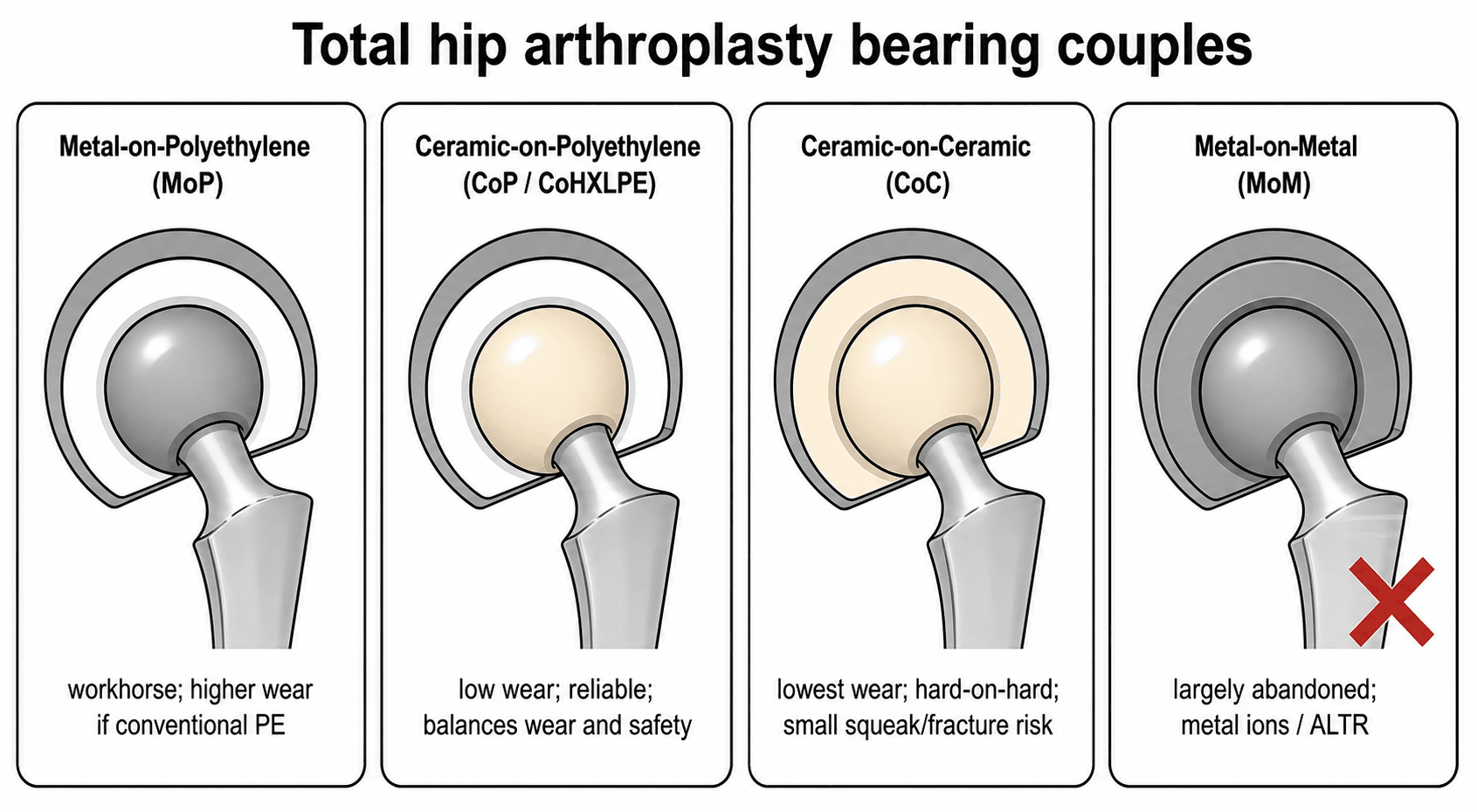
The soft partner. Polyethylene is the liner in the metal-on-polyethylene and ceramic-on-polyethylene couples, and it comes in three forms: conventional, highly cross-linked and vitamin E stabilised. The ceramic options have their own section below.
What it was. Ultra-high molecular weight polyethylene (UHMWPE), gamma-sterilised in air, was the historical standard from the 1960s to the 2000s. Its linear wear rate was 0.1-0.2mm per year, and its volumetric wear increased with head size.
What went wrong. Free radicals from sterilisation caused oxidative degradation, ageing the polyethylene. Its particles, 0.1-10 micrometres, are highly osteolytic, and osteolysis reached 10-40% at 10-15 years. Revision for wear was the leading cause of late THA failure.
Where it stands. Conventional PE is essentially obsolete in primary THA, although it may still be used in constrained liners for its better mechanical properties. It taught us about particle disease and has been superseded by HXLPE.
Clinical Assessment - Patient Evaluation for Bearing Selection
When and how. Bearing choice should be individualised on a comprehensive assessment of the patient, typically at the pre-operative consultation once THA is indicated. The factors, and what each implies:
- Assessment
- Longevity requirements, life expectancy
- Bearing Implications
- Under 50: ceramic options. Over 65: MoP standard
- Assessment
- Sports, occupation, daily demands
- Bearing Implications
- High activity: ceramic-on-HXLPE or CoC. Standard: MoP
- Assessment
- Prior dislocation, abductor deficiency, neurologic
- Bearing Implications
- High risk: dual mobility first choice
- Assessment
- Previous reactions, implant sensitivity
- Bearing Implications
- Avoid MoP if severe. Choose ceramic-on-ceramic or CoP
- Assessment
- Weight optimisation, liner thickness concerns
- Bearing Implications
- Obesity: ensure adequate liner thickness (over 6mm)
- Assessment
- Acceptance of squeak risk, cost considerations
- Bearing Implications
- Discuss ceramic squeak risk. Balance expectations
History. Beyond age, activity and allergy, ask about previous joint replacements and the patient's experience of those bearings, and about neuromuscular conditions (Parkinson's, stroke, dementia), each a dual mobility indication. Establish the falls risk from cognitive impairment or balance disorders, the activities the patient wants to return to, and what they have heard about different bearings.
Examination. BMI matters because obesity affects the liner-thickness calculation, and dysplasia or bone loss may affect cup size. Examine for spasticity, tremor and weakness. Abductor weakness indicates considering dual mobility, and fixed spinopelvic deformities affect stability, another dual mobility consideration.
Imaging. Radiographs show bone quality, acetabular anatomy and dysplasia, with CT for accurate component sizing when the anatomy is complex. The acetabular dimensions give an estimate of cup size for the liner-thickness calculation.
Ceramic Bearing Options - Hard-on-Hard Surfaces
Four generations. Modern-generation ceramics (alumina matrix composite, Biolox Delta) have a lower fracture risk than older alumina:
- 1st generation (1970s): pure alumina, fracture risk up to 1%
- 2nd generation (1990s): improved alumina, 0.2-0.5%
- 3rd generation (2000s): high-purity alumina (Biolox Forte), under 0.1%
- 4th generation (2010s on): alumina matrix composite (Biolox Delta)
Head and liner are not the same. In National Joint Registry data on 223,362 bearings (PMID 28768777), Delta heads fractured in 0.009%, but Delta liners in 0.126%, no better than Forte's 0.112%. The under-0.1% figure quoted for modern ceramics holds for the head, not the liner.
Biolox Delta. An alumina matrix with zirconia platelets for crack resistance, 20-25% stronger than pure alumina, while maintaining the low wear.
What it offers. CoC has the lowest wear rate of any couple, 4-5 micrometres per year, 10-20 times less than HXLPE. Ceramic particles are less biologically active, so particle disease is minimal, and the hydrophilic surface gives better fluid-film lubrication. Together these give excellent longevity potential, ideal for young patients (under 50).
What it costs. Squeaking in 1-5%, multifactorial; fracture, rare with modern ceramics but catastrophic if it occurs; stripe wear with component malposition or microseparation; a price 2-3 times that of MoP; and a demanding technique, in which impaction is critical and the ceramic must not be damaged. Squeaking and fracture are covered under Complications.
Ceramic fracture is rare but devastating. Metal particles embedded in surrounding tissue make revision extremely difficult. All ceramic debris must be removed, usually requiring ceramic-on-HXLPE or MoP at revision. Prevention: avoid high-impact activities (rugby, martial arts), ensure perfect impaction technique.
Indications and contraindications. CoC offers the best wear performance but demands perfect technique and patient selection.
- Indicated: young patients (under 50) with high longevity requirements, a high activity level but not extreme impact sports, who accept the squeak risk after counselling
- Contraindicated: high-impact sports (rugby, parachuting, martial arts), significant component malposition anticipated, or a patient unwilling to accept the squeak risk
Investigations - Bearing Performance Assessment
Why it was adopted. In the 1990s and 2000s metal-on-metal allowed large heads, up to 60mm and more, for stability. It had low volumetric wear because it self-polished with use, it suited young active patients as metal-on-metal resurfacing, and it appeared to solve the polyethylene particle disease problem.
Metal-on-metal is essentially abandoned because of devastating soft tissue reactions, one of the greatest failures in modern arthroplasty. Know what went wrong, how to surveil legacy patients, and why it failed despite promising early wear data.
How it failed.
- Metal ion release: chromium and cobalt ions from tribocorrosion and wear
- ALVAL (aseptic lymphocytic vasculitis-associated lesion), with pseudotumour formation, a fluid-filled or solid mass
- Soft tissue destruction: muscles, tendons and nerves destroyed by pseudotumour
- Metallosis: metal staining of the tissues
ALVAL as usually taught. Histologically ALVAL is a lymphocyte-dominated perivascular infiltrate with tissue necrosis, and it is conventionally described as a type IV delayed hypersensitivity reaction. Do not stop at "allergy", because the Langton study argues against it as the main driver.
What Langton found. The revised hips had greater measured surface wear on explant analysis and were associated with smaller components and higher acetabular anteversion, both of which increase wear through poorer fluid-film lubrication and edge loading. Post-revision lymphocyte transformation testing showed no reactivity to chromium or cobalt at all.
The working model is dose-dependent. Excess wear generates the particle and ion burden, and the lymphocytic reaction follows it. True idiosyncratic hypersensitivity at low wear exists but is the minority. That is why cup position and component design predict failure, and why a painful MoM hip with a well-positioned cup and low ions needs a different explanation.
Dual Mobility Bearings
The design. Dual mobility is an articulation within an articulation. A small femoral head (22-28mm) articulates with a polyethylene liner, and the liner's large outer diameter (typically 36-42mm or more) articulates with a metal shell. The small inner articulation is the primary one and the large outer the secondary, and the result is a large effective head size for stability.
Why it resists dislocation.
- A large head-to-neck ratio increases range of motion before impingement
- Two centres of rotation: impingement causes rotation, not dislocation
- The effective head diameter is equivalent to 36-44mm for jump distance
- Range of motion is retained, better than with constrained liners
Indications. High dislocation risk, for which dual mobility is the first choice:
- Revision THA, especially for instability
- Prior dislocation
- Neuromuscular disorders: Parkinson's, stroke (CVA), dementia
- Abductor deficiency, from prior surgery, tumour or insufficiency
- Tumour resection, with bone or soft tissue loss
- Spinal deformity or fusion, which alters the biomechanics
- In primary THA, selected patients: the elderly with cognitive impairment, those at high fall risk, and those unable to comply with precautions
Dual mobility reduces dislocation rates by 50-75% in high-risk patients. In revision THA the AOANJRR figures are 1-2% dislocation with dual mobility against 3-5% with standard bearings (a wider 5-15% is also quoted for standard bearings in revision), and in high-risk primary THA the dislocation rate is 1-3%. This is the primary indication - instability prevention, not treatment of all patients.
Bearing options. The standard is a cobalt-chrome head on an HXLPE liner, the most common; a ceramic head on HXLPE is the premium option for lower wear. All have the metal shell as the outer bearing surface (the shell-liner interface).
Intraprosthetic dislocation. One concern is intraprosthetic dislocation (IPD), rare at under 1%, which is described under Complications.
Two wear surfaces. The inner head-liner bearing wears little with HXLPE, but there are concerns about wear at the outer liner-shell bearing, and total wear is slightly higher than with a single bearing. Long-term data, over 20 years of European experience, are reassuring.
Metallosis from the outer bearing. Early designs had metal-on-metal outer bearing issues. Modern designs with a retentive rim reduce motion at the outer bearing, and most wear occurs at the inner bearing.
The registry. On AOANJRR data, dual mobility has significantly lower dislocation and revision rates in revision THA, growing use with excellent outcomes in high-risk primary patients, and no increase in aseptic loosening or late complications.
Where it is going. Some surgeons advocate routine use in all elderly patients. Ceramic-on-HXLPE dual mobility may further reduce wear, and improved outer bearing surfaces are under development.
Wear Mechanisms and Particle Disease
Particles and their biology. What wear debris does in the tissues depends on what it is made of and its size:
- Size Range
- 0.1-10 micrometers
- Biological Response
- Highly osteolytic per particle
- Clinical Effect
- Osteolysis (main concern with conventional PE)
- Size Range
- Under 0.1 micrometers (nanometer)
- Biological Response
- Low biological activity
- Clinical Effect
- Minimal osteolysis
- Size Range
- 20-100 nanometers
- Biological Response
- ALVAL/hypersensitivity (ions)
- Clinical Effect
- Pseudotumour, tissue destruction
- Size Range
- 1-100 micrometers
- Biological Response
- Moderate inflammatory
- Clinical Effect
- Interface osteolysis
The osteolysis cascade.
- Wear particles enter the periprosthetic tissue through the effective joint space
- Macrophages phagocytose the particles
- Cytokines are released: TNF-alpha, IL-1, IL-6, RANKL
- Osteoclasts are activated through the RANK-RANKL pathway
- Bone is resorbed: progressive osteolysis
- The implant loosens as bone loss costs it fixation
The effective joint space is the path particles can travel - joint capsule, screw holes, thin bone-implant interface. Particles accumulate at weak points (stress risers, thin cement mantle, uncemented ingrowth surfaces). Granuloma formation causes progressive osteolysis and eventual loosening.
What sets the risk.
- Particle volume: the total amount of wear debris, which HXLPE dramatically reduces
- Particle size: 0.1-10 micrometres is the most osteolytic range
- Particle shape: elongated worse than round
- Patient biology: some patients are more susceptible (genetic factors)
- Time: cumulative exposure, which is why young patients were historically at highest risk
- Implant design: the access particles have to bone
What HXLPE changed. Osteolysis rates are now under 5% at 15 years, against 30-40% historically, which transformed THA outcomes in young patients. Most osteolysis now comes from other sources: cement, metal debris and backside wear.
Backside wear. Backside wear occurs at the liner-shell interface when the liner moves against the metal shell, and the locking mechanism is critical. The clue is increasing metallosis without obvious bearing wear, and prevention is adequate liner locking and avoiding thin liners (under 3-4mm backside thickness).
Third-body wear. Cement particles, bone chips and metal debris from the components scratch the polyethylene surface and accelerate wear dramatically. Meticulous surgical technique, thorough lavage and avoiding cement extrusion prevent it.
WEARWEAR - Factors Affecting Bearing Surface Wear
Hook:WEAR factors - remember it's not just the material but also mechanical environment
Management Algorithm
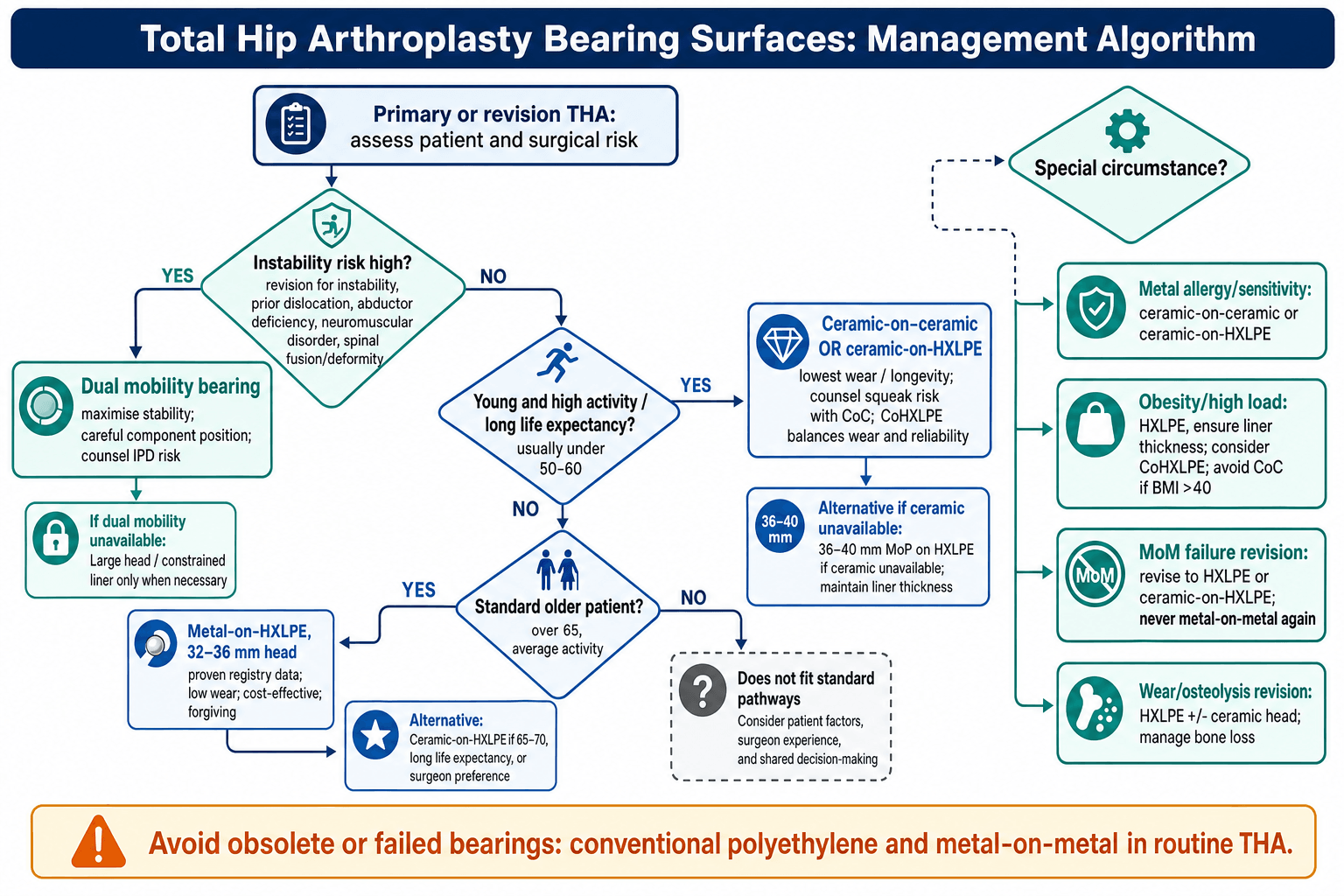
The order of questions. Instability risk comes first, then age and demand, then whether this is a standard older patient, with special circumstances branching off (figure). Every patient still needs an individualised choice based on multiple factors, and the table at the end of this section summarises the choices by profile.
First choice: metal-on-HXLPE with a 32-36mm head. For most patients over 65 of average activity this is the gold standard. It has the most proven long-term data (HXLPE over 15 years), it is cost-effective, and it forgives minor malposition.
Head size. 32mm is a good balance and the most common; 36mm gives slightly more stability with acceptable wear on HXLPE. Avoid heads under 28mm (dislocation risk) or over 40mm (potential wear concerns).
Alternative: ceramic-on-HXLPE. At the younger end of the range (65-70) or with a long life expectancy, for slightly better wear than MoP and without the squeak risk of CoC.
Not for this patient. Conventional PE (obsolete), MoM (failed technology), CoC (unnecessary in this age group), and dual mobility unless there are instability risk factors.
- First Choice
- MoP (metal-on-HXLPE), 32-36mm head
- Alternative
- Ceramic-on-HXLPE if young end of range
- Avoid
- MoM (obsolete)
- First Choice
- Ceramic-on-ceramic or Ceramic-on-HXLPE
- Alternative
- MoP with large HXLPE head (36mm+)
- Avoid
- Conventional PE, thin liners
- First Choice
- Dual mobility (MoP or Ceramic-on-HXLPE)
- Alternative
- Large head MoP (36-40mm) with constraint
- Avoid
- Small heads (under 32mm)
- First Choice
- MoP (HXLPE), ceramic-on-HXLPE
- Alternative
- Reinforced ceramic-on-ceramic (Biolox Delta)
- Avoid
- Older generation ceramics, conventional PE
- First Choice
- Ceramic-on-ceramic or Ceramic-on-HXLPE
- Alternative
- Oxidised zirconium-on-HXLPE
- Avoid
- MoP (standard cobalt-chrome), MoM
Surgical Technique - Bearing-Specific Considerations
Liner thickness. Standard metal-on-HXLPE technique is straightforward and forgiving, but the liner must be thick enough. Calculate it: (cup ID - head OD) / 2 must be over 6mm.
- 54mm cup, 36mm head: (54-36)/2 = 9mm, safe
- 48mm cup, 36mm head: (48-36)/2 = 6mm, marginal
If the thickness is under 6mm, choose a smaller head or a larger cup.
Liner insertion. Ensure complete seating, listening for the snap and feeling for a stable rim lock, and check the integrity of the locking mechanism. Avoid backside damage, because scratches accelerate backside wear. Some systems require a specific impaction technique.
Head impaction. Clean the Morse taper thoroughly of blood and debris, align the head with the taper and seat it with a single firm strike. Avoid repeated impaction, which damages the taper, and test stability before closure.
When it goes wrong.
- Liner will not seat: check for debris or shell deformation
- Head will not lock: check for taper damage or blood contamination
- Backside scratches: consider liner replacement if severe
Complications Specific to Bearing Surfaces
- Specific Complication
- Osteolysis/particle disease
- Incidence
- 30-40% at 15 years
- Management
- Revision with HXLPE, bone grafting
- Specific Complication
- Liner fracture (thin liners)
- Incidence
- Under 1% if adequate thickness
- Management
- Revision, ensure minimum 6mm
- Specific Complication
- Squeaking
- Incidence
- 1-5%
- Management
- Usually benign, revision if severe/painful
- Specific Complication
- Fracture (modern Delta)
- Incidence
- Head 0.009%, LINER 0.126%
- Management
- Revision, all debris removal, MoP or CoP
- Specific Complication
- Stripe wear
- Incidence
- 1-3% with malposition
- Management
- May progress to fracture, revise if progressive
- Specific Complication
- ALVAL/pseudotumour
- Incidence
- 10-30% at 10 years
- Management
- Revision with debridement, bearing change
- Specific Complication
- Intraprosthetic dislocation
- Incidence
- Under 1%
- Management
- Open reduction, may need revision
- Specific Complication
- Dislocation
- Incidence
- 1-5% (lower with DM/large heads)
- Management
- Closed reduction, address instability
Postoperative Care and Surveillance
Surveillance by stage. Rehabilitation is independent of the bearing; follow-up varies by bearing.
Standard THA rehabilitation, with no bearing-specific restrictions for HXLPE or ceramic. Dual mobility takes standard precautions, no more restrictive; warn ceramic patients about falls and direct trauma to the hip.
Clinical assessment and X-rays of every bearing for position, stability and early complications. Document any ceramic squeak and counsel the patient; assess dual mobility for early IPD (rare).
Clinical and radiographic assessment, with routine surveillance for the standard bearings (MoP, CoC, CoP). Document any ceramic squeak and whether it is changing. Legacy MoM patients follow the MHRA protocol: metal ions annually, MRI if symptomatic or ions are high.
Clinical and radiographic review every 1-2 years. Monitor HXLPE for late osteolysis (rare but possible), assess ceramics for squeak and wear, and continue lifetime MoM surveillance. For every bearing, monitor for aseptic loosening, infection and periprosthetic fracture.
Outcomes and Prognosis - Long-term Performance
Metal-on-HXLPE. The most data: 94-96% 15-year survivorship (AOANJRR data), excellent outcomes across all age groups and the most predictable long-term performance.
Ceramic-on-HXLPE. Emerging data, with a growing body of 10-15-year results: 95-96% 15-year survivorship and the best outcomes in the under-55 age group (AOANJRR).
Ceramic-on-ceramic. 92-95% 15-year survivorship and the best wear performance over decades in young patients. Revision for squeak is under 1%, a rare indication.
Dual mobility. Its dislocation and registry figures are given under Dual Mobility Bearings; outcomes are excellent in appropriate indications.
Metal-on-metal. A 10-15-year revision rate of 15-30%, a catastrophic failure, and legacy patients require ongoing surveillance.
Guidelines, Registries & Global Practice
Global epidemiology and demand:
Hip osteoarthritis is the principal indication for THA, and its burden is rising worldwide. Global Burden of Disease 2019 analysis for Australia showed hip OA prevalence grew 171% between 1990 and 2019, with population ageing and high BMI as key drivers, and OA-related disability now exceeding that of ischaemic heart disease and type 2 diabetes (Ackerman et al, Intern Med J 2022, DOI). GBD analyses report parallel growth in other large populations - for example, OA prevalence in India rose from 23.5 million (1990) to 62.4 million (2019) (Singh et al, Osteoarthritis Cartilage 2022, DOI). This expanding, ageing and increasingly younger patient base makes durable, low-wear bearing selection a lifetime issue rather than a short-term one.
Registry evidence (Level II observational, very large numbers):
National registries are the strongest real-world evidence on bearing performance. The largest dataset is the National Joint Registry of England and Wales, which demonstrated unequivocally that stemmed metal-on-metal articulations fail at high rates and should not be implanted, with failure worsening as head diameter increased (Smith et al, Lancet 2012, DOI). The AOANJRR, capturing over 98% of Australian arthroplasties since 1999, shows cross-linked polyethylene markedly outperforming non-cross-linked polyethylene, ceramic and cross-linked bearings dominating contemporary use, and 32-36mm heads as the most common size. Major registries (AOANJRR, NJR, the American AJRR, and the Nordic registries) are broadly concordant on these conclusions.
- Population/Coverage
- Over 98% capture since 1999
- Key Bearing Signal
- Cross-linked PE much lower revision than non-cross-linked; ceramic/XLPE dominate; 32-36mm heads standard
- Population/Coverage
- Over 3 million procedures
- Key Bearing Signal
- Stemmed MoM high failure (head-size dependent); larger ceramic-on-ceramic heads perform well
- Population/Coverage
- Largest US arthroplasty registry
- Key Bearing Signal
- Ceramic-on-XLPE and metal-on-XLPE predominate; MoM essentially abandoned
- Population/Coverage
- Pooled Scandinavian data
- Key Bearing Signal
- Cross-linked PE reduces revision for wear/osteolysis vs conventional PE
International guidance, regulators and professional bodies:
- Position on Bearings
- Cross-linked PE supported to reduce wear/osteolysis; no single hard-on-hard bearing mandated; individualise by age/activity
- Strength/Basis
- Evidence-based guideline / registry-informed
- Position on Bearings
- Implants should meet the 10A benchmark (over 95% survival at 10 years); cross-linked PE accepted as standard
- Strength/Basis
- Benchmark-based commissioning
- Position on Bearings
- Stemmed MoM not recommended; lifelong surveillance of legacy MoM; dual mobility endorsed for instability risk
- Strength/Basis
- Consensus + MHRA alerts
- Position on Bearings
- Mandatory surveillance of MoM (Co/Cr ions, MARS MRI); recalls of high-failure MoM systems (e.g. ASR)
- Strength/Basis
- Device safety regulation
- Position on Bearings
- Cross-linked PE and ceramic articulations as mainstays; bearing choice tailored to age, activity and instability risk
- Strength/Basis
- Educational consensus
Practice variation across regions:
- Ceramic-on-ceramic: High uptake in parts of Europe and Asia (notably South Korea, France); lower in North America where ceramic-on-XLPE and metal-on-XLPE predominate.
- Dual mobility: Long-established in France (origin of the concept); rapid recent growth elsewhere for instability prophylaxis in primary and revision THA.
- Cross-linked polyethylene: Near-universal as the standard liner across all high-income registries; conventional PE largely obsolete.
- Metal-on-metal: Abandoned globally for stemmed THA following Lancet/NJR data and regulator alerts; only legacy-patient surveillance remains.
Anchor bearing answers to registry and guideline evidence: "The NJR (Smith et al, Lancet 2012) showed stemmed metal-on-metal fails at high, head-size-dependent rates and should not be used, while the AOANJRR confirms cross-linked polyethylene and ceramic bearings as durable mainstays with 32-36mm heads as standard." Cite the latest AOANJRR Annual Report (Australia) for current figures.
Regulatory and consent essentials:
- TGA (Australia) / FDA / MHRA / CE-mark approval required for all bearing components.
- MoM legacy surveillance is mandated (annual cobalt/chromium ions, MARS MRI if symptomatic or ions elevated; revise if symptomatic with pseudotumour or persistently very high ions).
- Informed consent must include bearing-specific risks (ceramic squeak and fracture; HXLPE liner fracture if thin; intraprosthetic dislocation with dual mobility; metal sensitivity).
MCQ Practice Points
Q: How does highly cross-linked polyethylene reduce wear compared to conventional polyethylene? A: Irradiation (gamma or e-beam) creates cross-links between polymer chains, increasing wear resistance. Post-irradiation treatment (remelting or annealing) eliminates free radicals. This results in 90% wear reduction but decreased mechanical properties (fatigue strength). Minimum 6mm thickness required.
Q: What is the fracture risk of modern fourth-generation ceramic bearings (Biolox Delta)? A: Under 0.1% (less than 1 in 1000). Biolox Delta is alumina matrix composite with zirconia platelets for increased fracture toughness. This is much lower than first-generation pure alumina (1%) and second-generation (0.2-0.5%). Still, fracture is catastrophic requiring extensive debridement.
Q: What is ALVAL and how does it lead to metal-on-metal THA failure? A: ALVAL (Aseptic Lymphocytic Vasculitis-Associated Lesion) is a Type IV delayed hypersensitivity reaction to chromium and cobalt ions released from MoM bearings. Results in lymphocytic infiltration, tissue necrosis, and pseudotumor formation with progressive soft tissue destruction. Diagnosed by elevated metal ions (over 7 ppb) and MRI showing pseudotumor.
Q: How does dual mobility reduce dislocation risk compared to standard bearings? A: Dual mobility has two articulations: small inner head (22-28mm) in polyethylene liner, and large outer liner (36-42mm+) in metal shell. This creates large effective head size for stability while maintaining small inner bearing. Results in 50-75% dislocation reduction in high-risk patients. Main complication is intraprosthetic dislocation (IPD) under 1%.
Q: According to AOANJRR, which bearing has the lowest revision rate in patients under 55? A: Ceramic-on-HXLPE shows the lowest revision rates in the under-55 age group at 15-year follow-up (approximately 4-5%), followed by ceramic-on-ceramic and metal-on-HXLPE (5-7%). Metal-on-metal has highest revision rates (15-30%) and is obsolete. In patients over 65, metal-on-HXLPE is excellent and cost-effective.
Q: What particle size range is most osteolytic in polyethylene wear debris? A: 0.1-10 micrometers is the most biologically active size range. These particles are phagocytosed by macrophages, triggering cytokine release (TNF-alpha, IL-1, RANKL) and osteoclast activation. HXLPE dramatically reduces particle generation, resulting in 95% reduction in osteolysis vs conventional PE at 10-year follow-up.
Q: What is the optimal femoral head size for metal-on-HXLPE bearing in standard patient? A: 32-36mm represents optimal balance. Larger heads reduce dislocation risk and increase ROM, but increase volumetric wear. Heads under 28mm have unacceptably high dislocation rates. Heads over 40mm provide no additional stability benefit and may increase wear. Must ensure minimum 6mm liner thickness with larger heads.
Clinical Decision Scenarios
Practise clinical reasoning and management decisions out loud
“A 42-year-old engineer presents with end-stage hip arthritis from prior acetabular fracture. He is very active (cycling, golf, occasional tennis). BMI 26. He asks about bearing surfaces and wants the best option for longevity. What do you recommend and why?”
“A 58-year-old man had metal-on-metal THA (DePuy ASR) in 2007. He now presents with progressive hip pain over the past 6 months. Examination shows a palpable soft tissue mass laterally. X-rays show well-fixed components. Blood tests show cobalt 18 ppb, chromium 16 ppb. What is your management?”
“A 38-year-old woman had ceramic-on-ceramic THA 18 months ago. She now complains of loud squeaking with sitting to standing and climbing stairs. The hip is otherwise pain-free and functional. X-rays show well-positioned components. She is very distressed by the noise. How do you manage this?”
BEARING OPTIONS OVERVIEW
- Metal-on-HXLPE: 70-80% of THAs, standard of care, excellent outcomes
- Ceramic-on-HXLPE: 10-15%, best for young patients, no squeak
- Ceramic-on-Ceramic: 5-10%, lowest wear, 1-5% squeak risk
- Dual Mobility: 5-10% primary (higher in revision), 50-75% dislocation reduction
- Metal-on-Metal: Obsolete (under 0.1%), ALVAL/pseudotumor failure
HXLPE (HIGHLY CROSS-LINKED PE)
- Manufacturing: Irradiation (50-100 kGy) + remelting/annealing
- Benefits: 90% wear reduction vs conventional PE, 95% less osteolysis
- Trade-off: Decreased mechanical properties (fatigue strength)
- Minimum thickness: 6mm to prevent fracture
- Used in over 90% of modern THAs globally
CERAMIC BEARINGS
- CoC: Lowest wear (4-5 micrometers/year), 1-5% squeak, under 0.1% fracture (Biolox Delta)
- CoP (ceramic-on-HXLPE): 30-50% less wear than MoP, no squeak, excellent for young
- Indications: Young patients (under 50), high longevity requirements
- Avoid: High-impact sports (rugby, martial arts), extreme trauma risk
- AOANJRR: CoP lowest revision rate in under 55 age group
MOM FAILURE (LEGACY SURVEILLANCE)
- ALVAL: Type IV hypersensitivity to Co/Cr ions → pseudotumor
- Surveillance (MHRA 2012): Annual metal ions, MRI if symptomatic or ions over 7 ppb
- Revision if: Symptomatic + pseudotumor, or ions over 20 ppb
- At revision: Complete debridement, bearing change (never MoM again)
- Essentially abandoned globally - under 0.1% current usage
DUAL MOBILITY
- Design: Small inner head (22-28mm) in PE liner, large outer (36-42mm+) effective
- Dislocation reduction: 50-75% in high-risk patients
- Indications: Revision THA, abductor deficiency, neurologic/cognitive impairment
- Complication: Intraprosthetic dislocation (IPD) under 1%, requires open reduction
- AOANJRR: 1-2% dislocation rate vs 3-5% conventional in revision THA
SELECTION BY PATIENT
- Standard (over 65): MoP (HXLPE) 32-36mm head - proven, cost-effective
- Young active (under 50): CoP or CoC - longevity priority, counsel squeak risk
- Instability risk: Dual mobility first choice - dramatic dislocation reduction
- Metal allergy: CoC or CoP - avoid metal bearing surfaces
- Obesity: MoP or CoP, ensure adequate liner thickness (over 6mm)
AOANJRR KEY DATA
- Ceramic-on-HXLPE: Lowest revision rate (4-5% at 15 years), especially under 55
- Metal-on-HXLPE: Excellent all ages (5-6% at 15 years), cost-effective
- Head size: 32-36mm optimal balance (dislocation vs wear)
- Dual mobility: Significantly lower dislocation in revision THA
- Always reference registry data in Australian exam answers
COMPLICATIONS
- HXLPE: Liner fracture if under 6mm thickness
- CoC: Squeaking 1-5% (usually benign), fracture under 0.1% (catastrophic)
- CoC: Stripe wear from malposition (can progress to fracture)
- MoM: ALVAL/pseudotumor 10-30% at 10 years, surveillance mandatory
- Dual mobility: IPD under 1%, requires open reduction
EXAM PEARLS
- HXLPE solved the particle disease problem - 90% wear reduction
- Ceramic-on-HXLPE best balance for young patients (low wear, no squeak)
- MoM failed due to ALVAL - know MHRA 2012 surveillance protocol
- Dual mobility transforms instability outcomes - 50-75% dislocation reduction
- Reference AOANJRR registry data for evidence-based practice
Evidence Base
Highly Cross-Linked vs Conventional Polyethylene - 15- to 18-Year Follow-up
- Single-centre cohort of 134 primary THAs (mean age 50.7 years) followed at least 15 years. HXLPE showed significantly lower linear and volumetric wear than conventional polyethylene, with no radiographic loosening or osteolysis in the HXLPE group. Wear-related reoperation-free survival was 100% for HXLPE versus 90.9% for conventional PE at 15-18 years. THE ALL-CAUSE FIGURE IS THE HONEST COMPARISON AND IT IS MUCH CLOSER: 95.5% for HXLPE against 90.9% for conventional polyethylene. The authors themselves conclude that BOTH bearings showed excellent survival, and rest their recommendation on the future reoperation risk implied by wear and osteolysis rather than on a large survival gap already realised at 15 years.
Ceramic-on-Ceramic THA in Patients Younger Than 60 - 10-Year Survival Meta-Analysis
- Systematic review and meta-analysis of 13 studies (2,278 hips, mean age 44 years). Modern ceramic-on-ceramic THA achieved 96% 10-year survival, with a squeaking rate of 2.7%, ceramic fracture 0.6%, and aseptic loosening 0.5%. Versus polyethylene cups in the four randomised trials, the risk ratio for revision was 0.27 (95% CI 0.15-0.47) and for aseptic loosening 0.15 (0.03-0.70), both favouring ceramic-on-ceramic and both with intervals excluding 1.
Early Failure of Metal-on-Metal Bearings - Excess Wear and Adverse Reaction to Metal Debris
- Series of 660 metal-on-metal resurfacings and large-bearing ASR THAs. 3.4% required revision for adverse reaction to metal debris (all ASR), associated with significantly higher whole-blood chromium and cobalt ion concentrations, smaller components and increased acetabular anteversion. Excess bearing wear, not hypersensitivity alone, drove most failures.
Failure Rates of Stemmed Metal-on-Metal Hip Replacements - National Joint Registry
- Analysis of 402,051 primary THAs (31,171 stemmed MoM) from the National Joint Registry of England and Wales. MoM failed at high rates that increased with head size (5-year revision 3.2% for 28mm vs 5.1% for 52mm in men). In young women, 46mm MoM had a 6.1% 5-year revision rate versus 1.6% for 28mm metal-on-polyethylene. By contrast, larger CERAMIC-ON-CERAMIC heads did better, not worse: 5-year revision 3.3% (95% CI 2.6-4.1) with a 28mm head against 2.0% (1.5-2.7) with a 40mm head in men aged 60 - which is why the authors explicitly SUPPORT continued use of large-diameter ceramic bearings in the same paper that condemns metal-on-metal. Analysis used a multivariable flexible parametric survival model adjusting for the competing risk of death.
Dual Mobility Components in Total Hip Arthroplasty - Systematic Review
- Systematic review of 54 studies published 2007-2016. In 10,783 PRIMARY dual mobility THAs: aseptic loosening 1.3% (142 hips), intraprosthetic dislocation 1.1% (122), extra-articular dislocation 0.46% (41), and 98.0% survivorship at a mean 8.5 years (range 2 to 16.5). In 3,008 REVISION dual mobility THAs: aseptic acetabular loosening 1.4%, intraprosthetic dislocation only 0.3% (8 hips) but extra-articular dislocation 2.2% (67 hips) - nearly five times the primary rate, which is the number that matters since revision is where dual mobility is most often chosen for instability. Survivorship 96.6% at a mean 5.4 years. A further 554 hips were done for femoral neck fracture: extra-articular dislocation 2.3%, survivorship 97.8% at a mean of just 1.3 years. Intraprosthetic dislocation was largely confined to earlier designs, and the authors call for high-quality prospective comparative studies.
Global Burden of Disease 2019 - Growing Prevalence of Hip Osteoarthritis
- GBD 2019 data for Australia showed hip OA prevalence grew 171% from 1990 to 2019 (3.20 million Australians with any OA in 2019), driven by population ageing and high BMI. Age-standardised OA years-lived-with-disability rates (313 per 100,000) exceeded those of ischaemic heart disease, stroke and type 2 diabetes.
AOANJRR Annual Report - Bearing Surface and Head Size Outcomes
- The AOANJRR captures over 98% of arthroplasty procedures in Australia. Cross-linked polyethylene bearings have markedly lower revision rates than non-cross-linked polyethylene. Ceramic and cross-linked-polyethylene articulations dominate contemporary practice, while large-head metal-on-metal and conventional polyethylene have been associated with the highest revision rates and are now rarely used. Femoral heads of 32-36mm are the most commonly used size.