Prevention | Measurement | Intraoperative Tools | Medicolegal Risk
- Document preoperative LLD - medicolegal essential, compare to contralateral
- 10mm threshold - patient dissatisfaction increases dramatically over 10mm
- Lengthening safer than shortening - nerve palsy risk with overlengthening over 4cm
- Multiple measurement methods - intraoperative verification with at least 2 techniques
- Offset restoration - LLD often related to femoral offset reconstruction errors
- “LLD is a leading source of negligence complaints after THA
- “3D CT planning predicts combined cup and stem size in 96% vs 16% for 2D templating
- “Navigation's pooled benefit for LLD is modest; clearest gain is cup orientation
- “Shoe lift usually needed only once LLD approaches 20mm
Overview and Epidemiology
Leg length discrepancy (LLD) after total hip arthroplasty is a leading source of patient dissatisfaction and of negligence complaints, despite being a recognised and often unavoidable consequence of the procedure. Even with modern techniques, some degree of LLD is almost universal.
The litigation claim. "The commonest cause of litigation after THA" is widely repeated but rests on small medicolegal case-series rather than population data. Say a leading source, and let the documentation argument carry the weight.
Why it matters. LLD affects gait mechanics, patient satisfaction and medicolegal risk. Small discrepancies, under 10mm, are usually well tolerated, but the patient's perception often exceeds the measured LLD. The key is documentation: proof of preoperative assessment and intraoperative diligence protects against litigation even if LLD occurs.
How often. With careful technique most primary THAs achieve a residual LLD under 10mm. Larger discrepancies, over 15mm, are less common but cause functional gait changes, and revision and dysplasia carry higher rates of significant LLD. Up to 10mm of natural LLD exists in 60-95% of the population (O'Brien 2010).
Risk factors.
- Developmental dysplasia, with its high hip centre
- Severe deformity (Crowe III-IV DDH)
- Revision surgery: bone loss and soft-tissue laxity
- Inadequate templating, the most preventable cause
The patient. Some patients tolerate LLD better than others. High-demand patients, fixed spinal deformity and bilateral disease require extra caution, so baseline gait and spine pathology are documented before surgery.
Perception. O'Brien imposed discrepancies on volunteers: about 97% perceived a 10mm discrepancy, and no subject perceived a 5mm increase as uncomfortable. Beyond the millimetres, psychological factors influence perception, and body image and expectations play a major role.
The medicolegal picture. Whittingham-Jones (2012) found uncemented stems less forgiving of LLD and emphasised preoperative planning where the anatomy is abnormal. Documentation is the defence, because it proves due diligence.
Anatomy and Biomechanics
True and apparent length. True leg length runs from the ASIS to the medial malleolus. Apparent length runs from the umbilicus to the medial malleolus and reflects pelvic obliquity. THA aims to restore true length while accounting for fixed pelvic tilt and spinal deformity.
- Landmarks
- ASIS to medial malleolus
- What It Assesses
- Actual skeletal length
- Clinical Use
- Primary measurement for LLD
- Landmarks
- Umbilicus to medial malleolus
- What It Assesses
- Functional length with pelvic tilt
- Clinical Use
- Screening for pelvic obliquity
- Landmarks
- Lesser trochanter to acetabular teardrops
- What It Assesses
- Hip offset and neck length
- Clinical Use
- Templating and intraoperative check
Femoral offset. The perpendicular distance from the centre of rotation of the femoral head to the long axis of the femur. Restoring it is essential, because inadequate offset forces the surgeon to lengthen the leg to achieve stability and abductor tension. Restored offset:
- Restores the abductor moment arm, reducing limp
- Gives stability without excessive lengthening
- Improves range of motion
- Normalises gait efficiency
Offset errors. Under-restoring offset leads to compensatory lengthening for stability; over-restoring it risks impingement. An offset error of 5mm can translate to 10mm of LLD. Template offset first, then adjust length, and measure both length and offset intraoperatively.
The acetabular side. Teaching on length restoration concentrates on the femur, but the acetabular component is an equal determinant of both length and offset, as the Weber trial's use of global offset makes explicit.
The hip centre. The vertical position of the cup sets the acetabular contribution to leg length. A cup placed superiorly, a high hip centre, shortens the limb relative to anatomic, and restoring the centre of rotation inferiorly to its anatomic level lengthens it. This is why a high, medialised cup tempts the surgeon into compensatory femoral overlengthening to regain stability.
Global offset. Global (total) offset is acetabular offset plus femoral offset. Acetabular offset is the horizontal distance from the cup centre of rotation to the pelvic (teardrop) reference. Medialising the cup reduces acetabular offset and therefore global offset, weakening the abductor lever arm exactly as an under-restored femoral offset does; restoring the anatomic centre of rotation preserves global offset and avoids the trap of lengthening the leg to chase abductor tension.
A perfectly templated femoral stem cannot rescue a cup that is too high or too medial. Set the acetabular centre of rotation anatomically first, then template the femoral side to it: restore the hip centre, then restore offset, then fine-tune length.
Soft-tissue tension. The soft-tissue envelope determines the acceptable change in length. Overlengthening stretches neurovascular structures; excessive shortening creates laxity and instability.
- Effect of Lengthening
- Traction neuropraxia
- Critical Threshold
- Over 4cm lengthening
- Clinical Consequence
- Foot drop, sciatic palsy
- Effect of Lengthening
- Excessive tension
- Critical Threshold
- Over 2cm lengthening
- Clinical Consequence
- Pain, Trendelenburg gait
- Effect of Lengthening
- Laxity if shortened
- Critical Threshold
- Over 1cm shortening
- Clinical Consequence
- Instability, dislocation risk
Classification Systems
LLD is classified by its cause, present before surgery or created by it, and by whether the patient's perception matches the measurement.
A discrepancy present before THA, from the underlying hip disease or a developmental abnormality.
- Typical LLD
- 5-15mm shortening
- Clinical Features
- Joint space loss, femoral head collapse
- Surgical Consideration
- Document baseline, can often equalize safely
- Typical LLD
- 10-25mm shortening
- Clinical Features
- High hip center, shallow acetabulum
- Surgical Consideration
- Gradual correction, may need soft tissue releases
- Typical LLD
- Over 40mm shortening
- Clinical Features
- High dislocation, severe bone loss
- Surgical Consideration
- Accept residual LLD - nerve palsy risk if fully equalized
- Typical LLD
- Variable (10-30mm)
- Clinical Features
- Malunion, bone loss, deformity
- Surgical Consideration
- Complex reconstruction, may need femoral osteotomy
Clinical Assessment
History. Ask about:
- Baseline gait: did the patient limp before surgery, or use walking aids
- Shoe modifications: prior use of a shoe lift indicates tolerance
- Spine: fixed scoliosis or kyphosis, spinal fusion, low back pain
- Contralateral hip: arthritis or a prior THA affects the comparison
- Expectations: tolerance for minor LLD; some patients fixate on perfect symmetry
- Functional goals: high-level athletics versus basic mobility
Examination. Measure both sides identically, and look for the cause of any shortening: bone loss, joint destruction or soft-tissue contracture.
- Gait: Trendelenburg, limp, compensatory trunk lean
- True and apparent leg length, bilaterally
- Pelvic obliquity: fixed or compensatory
- Block test: blocks under the short leg until the pelvis is level
- Spine: fixed scoliosis or a compensatory curve
Measuring true length. The clinical protocol:
Clinical Measurement Protocol
Supine on a firm surface (an examination table, not a soft bed), with both ASIS and the pubic symphysis palpable. Check that both ASIS are at the same height, so the pelvis is level.
Both limbs aligned identically in neutral rotation and extension. Draw a line from the umbilicus through the pubic symphysis as a midline reference, and correct any pelvic obliquity or rotation.
Palpate and mark both ASIS and both medial malleoli with a pen, using the same technique on each side (same fingertip, same bony point).
Tape measure from ASIS to medial malleolus on each side, recorded in centimetres. Repeat twice to confirm, and document which side is longer or shorter and by how much.
Stack measured blocks (5mm increments) under the short leg until the pelvis is level, checking the ASIS heights. The final block height confirms the magnitude of the functional LLD.
Document every measurement in the clinic notes, the operative planning and the operative note: (1) true leg length bilaterally, (2) apparent leg length, (3) direction and magnitude of the LLD, (4) whether the patient currently uses a shoe lift, (5) the discussion with the patient about LLD risk and management options. This record defends against litigation even if postoperative LLD occurs.
The patient who feels unequal. Not every patient who reports a "long" or "short" leg after THA has a true skeletal LLD. The task is to separate true (skeletal) LLD from functional (apparent) LLD and from the other causes of a gait that feels asymmetric.
- Mechanism
- Real difference in ASIS-to-medial-malleolus length
- Distinguishing Feature
- Block test levels pelvis; teardrop-to-lesser-trochanter differs on AP pelvis
- Management
- Shoe lift if symptomatic; address cause
- Mechanism
- Fixed pelvic obliquity, hip adduction/flexion contracture or scoliosis
- Distinguishing Feature
- True lengths equal but apparent (umbilicus-malleolus) lengths differ
- Management
- Treat contracture/spine; lift rarely helps
- Mechanism
- Under-restored offset or abductor insufficiency
- Distinguishing Feature
- Trendelenburg gait, weak abduction; offset reduced on radiograph
- Management
- Strengthening; revise offset if structural
- Mechanism
- Fixed lumbar deformity or prior fusion altering pelvic tilt
- Distinguishing Feature
- Compensatory trunk lean, persists when supine pelvis levelled
- Management
- Spine assessment; cautious lift trial
- Mechanism
- Altered proprioception and heightened expectation post-THA
- Distinguishing Feature
- Measured LLD minimal; complaint disproportionate; often improves over months
- Management
- Reassurance, education, show radiographs
True versus functional length. The surgeon equalises the true (skeletal) length at THA; the patient feels the functional length, which a fixed pelvic obliquity or a hip contracture can distort even when the skeletal lengths are equal. The apparent-length measurement and the check for fixed versus compensatory obliquity exist precisely to separate the two.
Where the obliquity comes from. The source decides whether THA, or a lift, can help:
- Suprapelvic: driven from above by a fixed structural scoliosis or sagittal imbalance. It persists after a perfectly balanced THA, so the patient may still perceive inequality; the spinopelvic and component-positioning consequences belong to the hip-spine relationship and spinopelvic-parameter topics.
- Infrapelvic: driven from below by a hip adduction or flexion contracture, or a knee or ankle deformity. A fixed adduction contracture makes the leg sit functionally short; an abduction contracture makes it sit functionally long. Releasing the contracture at THA corrects this functional component without changing skeletal length.
- Intrapelvic: asymmetry within the pelvic ring itself (post-traumatic, post-radiation, congenital).
Fixed or flexible. A flexible, compensatory obliquity corrects once the hip is balanced, so aim for true skeletal equality. A fixed obliquity can leave the patient feeling unequal even after full skeletal equalisation: document it, set expectations before surgery, and base any shoe-lift trial on the functional (block-test) length rather than the radiographic skeletal difference.
Only skeletal length can be restored at THA. Find a fixed obliquity or contracture before surgery, with the block test, standing films and a spine examination, document it, and make it part of the consent conversation. It is a common reason a "radiographically perfect" THA still generates an LLD complaint.
Investigations
The imaging sequence.
- Standing AP pelvis: the gold standard for measuring LLD and the essential view for bilateral comparison. Weight-bearing on both legs, with the pelvis level (symmetrical obturator foramina); measure from the acetabular teardrops to the lesser trochanters on each side, and assess hip-centre height and pelvic obliquity.
- Lateral hip: for templating. Femoral offset (the perpendicular distance from the femoral axis to the centre of the head) and neck length, stem size and canal width for stem selection, the landmarks for the neck-cut level, and the anterior femoral bow, which affects how deep the stem seats.
- Full-length hip-to-ankle, if indicated: preoperative LLD over 2cm, DDH or bilateral disease. Mechanical axis and true leg length on calibrated images, compensatory knee or ankle changes and fixed deformities; plan gradual correction if the LLD is large.
- CT, optional: severe DDH, post-traumatic deformity or revision with bone loss. It shows bone stock and 3D anatomy for planning custom implants or osteotomy, and is required for robotic-assisted planning.
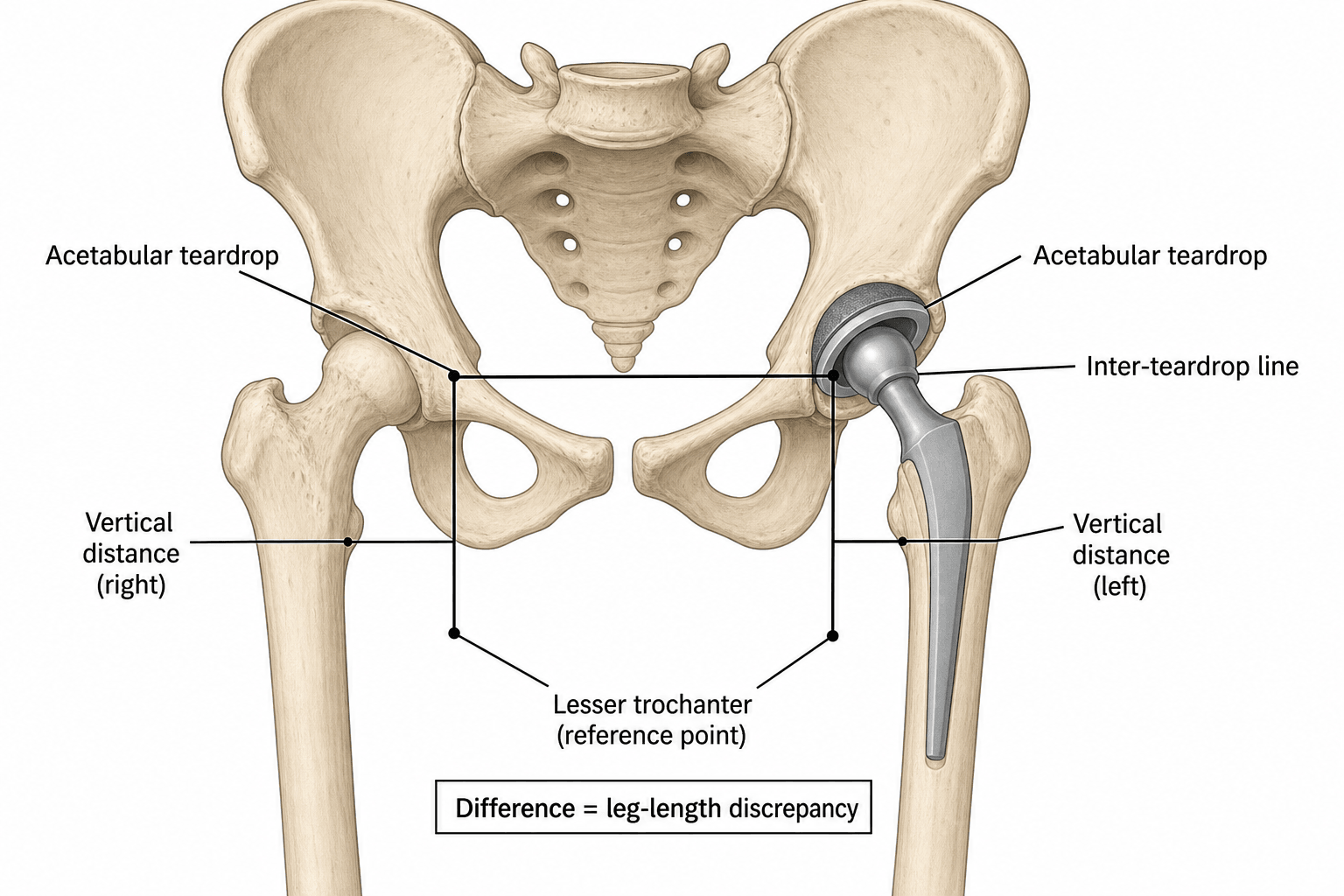
The inter-teardrop method. The most common method. Draw a horizontal line joining the medial acetabular teardrops, measure the vertical distance from it to the tip of each lesser trochanter, and take the difference. It is standardised and reproducible, independent of the acetabular component, not affected by pelvic tilt, used in most published studies and easy to measure on PACS. Its limits:
- Assumes the teardrops are symmetrical, which they may not be in DDH
- Teardrops are obscured in severe arthritis
- Small measurement errors are magnified
- Needs a good-quality AP pelvis
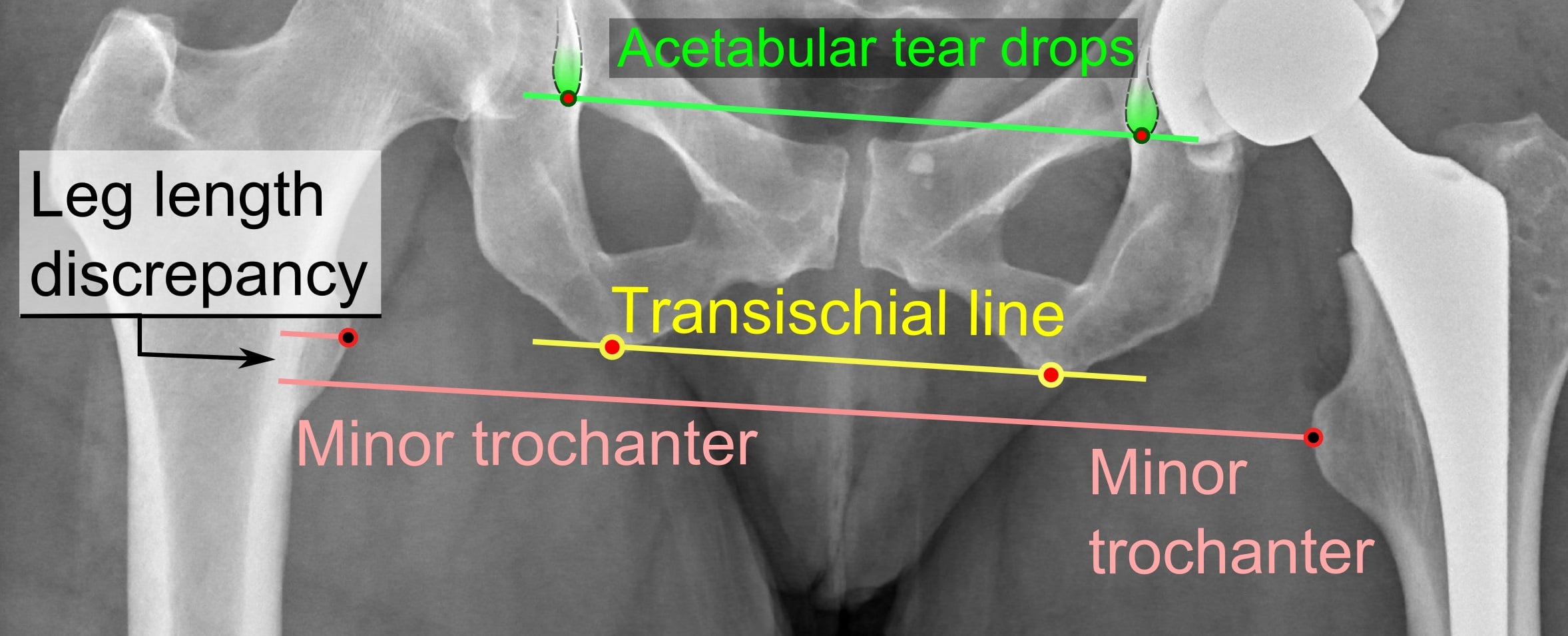
The ischial method. Draw the line through the tips of the ischial tuberosities instead and measure to the lesser trochanters in the same way. It is less affected by acetabular asymmetry, so use it when the teardrops are obscured by severe arthritis, prior surgery or DDH, particularly in Crowe III-IV dysplasia where the acetabular anatomy is abnormal.
Digital templating. PACS or templating software allows precise calibration and measurement, and is most accurate with a calibration marker (a 25mm ball or other known object). Templating improves the accuracy of restoring length and offset and is now standard of care; 3D CT-based planning predicts combined cup and stem size in 96% of cases against 16% for conventional 2D templating (Sariali 2012). The workflow:
- Calibrate to a known object (femoral head diameter or marker ball), set the PACS scale, and verify it by measuring a known anatomic structure
- Draw the reference line (teardrop or ischial) and measure to the lesser trochanters; the software calculates the difference in millimetres, accounting for magnification
- Template the acetabulum first: position, size and inclination
- Template the femur: stem size, neck length and offset
- Measure the predicted postoperative length and offset, and document the targets: hip-centre height relative to the teardrops, femoral offset, neck length (stem shoulder to head centre) and the planned change in length
In unilateral disease, template the normal contralateral hip: it gives the target values for offset and neck length. In bilateral disease, template the worst hip first and use it as the reference for the second side, to minimise bilateral LLD.
Management Algorithm
Prevention first. The best approach is prevention: careful planning and intraoperative measurement substantially reduce the incidence of clinically significant LLD. The planning, measurement and technique are set out in the sections that follow; the table below gives the acceptable LLD by scenario.
- Acceptable LLD
- Under 5mm
- Management
- Strict intraoperative measurement, both offset and length
- Key Pearl
- Computer navigation or robotics may be considered; pooled LLD benefit is modest
- Acceptable LLD
- 5-10mm
- Management
- Template carefully, use 2+ measurement methods
- Key Pearl
- Most patients tolerate this range well
- Acceptable LLD
- 10-15mm
- Management
- Accept lengthening for stability if needed
- Key Pearl
- Document trade-off: stability vs LLD
- Acceptable LLD
- 15-20mm acceptable
- Management
- Nerve monitoring, gradual lengthening protocol
- Key Pearl
- Over 4cm = high sciatic nerve palsy risk
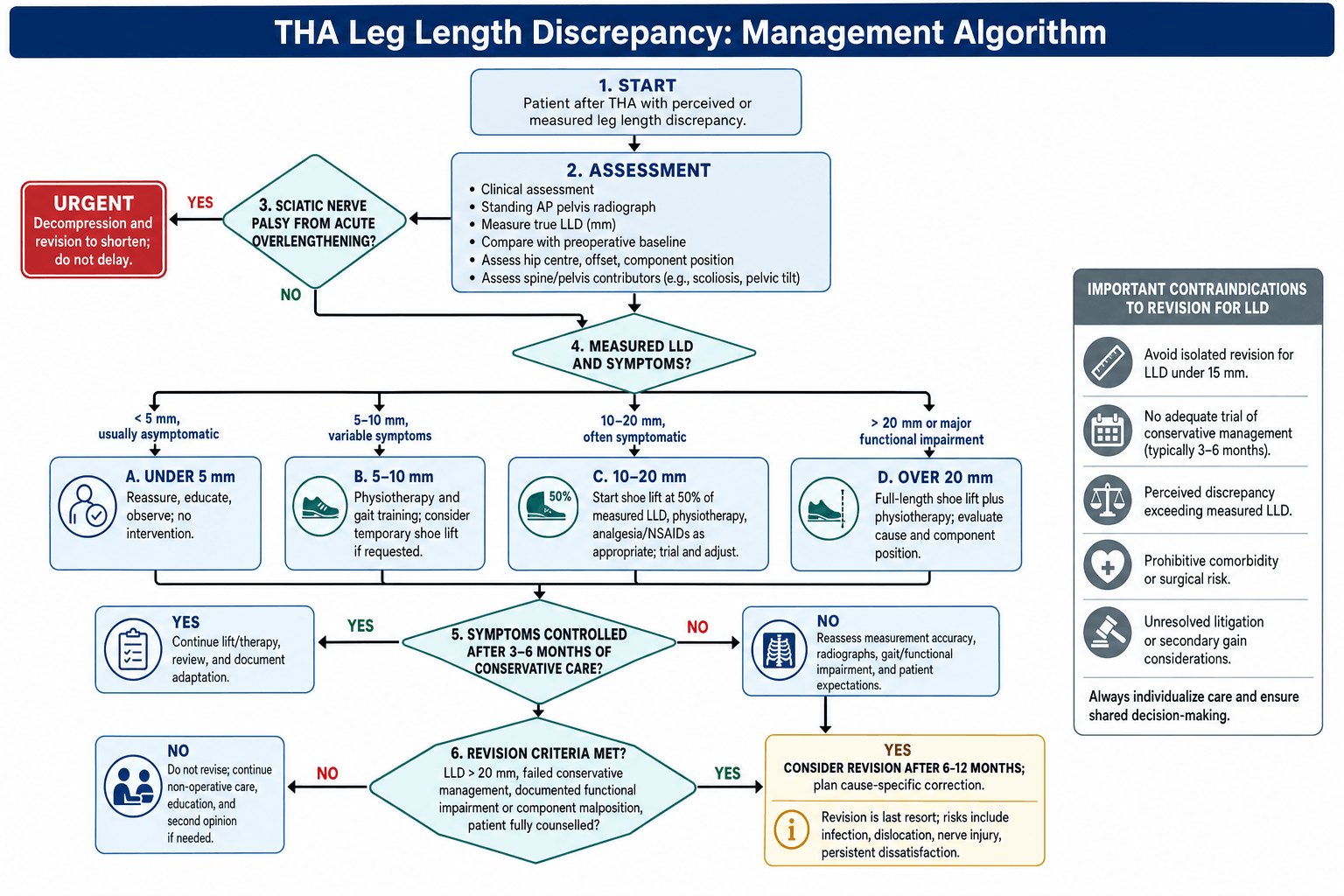
The established discrepancy. Once LLD is present, management is set by its magnitude and the patient's symptoms, after a sciatic palsy from overlengthening has been excluded.
Postoperative Assessment Protocol
Clinical examination: apparent and true leg lengths, compared with the preoperative baseline and documented in the notes. Discuss the findings with the patient and family.
Standing AP pelvis: teardrops to lesser trochanters on each side, hip-centre position and offset, compared with the templated plan to give the actual LLD.
Shoe-lift trial, starting at half the measured LLD (a 5mm lift for a 10mm LLD), assessing gait and comfort and increasing incrementally if needed. Consider full-length films in bilateral disease or spine pathology.
By magnitude. Most LLD under 20mm is managed non-operatively, with shoe modifications and physiotherapy.
- Clinical Impact
- Usually asymptomatic
- Management
- Reassurance only, no intervention needed
- Expected Outcome
- 95% adapt without complaint
- Clinical Impact
- Variable - some symptomatic
- Management
- PT for gait training, trial shoe lift if requested
- Expected Outcome
- 80% adapt, 20% need temporary lift
- Clinical Impact
- Often symptomatic - gait changes
- Management
- Shoe lift (start at 50% of LLD), PT, NSAIDs
- Expected Outcome
- 60% manage with lift, 40% remain dissatisfied
- Clinical Impact
- Functionally significant
- Management
- Full-length shoe lift, PT, consider revision if failed conservative
- Expected Outcome
- Most need permanent lift, 20% request revision
The shoe lift. Most patients need one once the LLD is over 20mm; between 10 and 20mm it is the patient's preference. Under 10mm a lift often makes symptoms worse through altered biomechanics; the table offers one below that level only when the patient asks. Trial before a permanent prescription, and prescribe with care:
- Start low, at 50% of the measured LLD
- An external lift is easier to adjust, and to remove if uncomfortable
- An internal lift is more cosmetic but limited to 10mm
- A full-length insole is better than a heel lift alone
Physiotherapy. Gait training teaches energy-efficient patterns, core strengthening addresses a compensatory trunk lean, hip abductor exercises restore normal biomechanics, and flexibility work addresses soft-tissue contractures.
Patient perception often exceeds the actual LLD: some patients with 5mm of actual LLD report feeling a 2cm discrepancy. Reassurance and education are critical. Show them the radiographs, explain the measurements, explain that some LLD is expected even with perfect technique, and avoid dismissing the concern. Empathy and communication prevent escalation to litigation.
Revision. The last resort, with high risks and uncertain outcomes, and rarely indicated for isolated LLD.
- Absolute, urgent: sciatic nerve palsy from overlengthening. Decompress and revise to shorten immediately; the risk of permanent foot drop increases with delay.
- Relative, after 6-12 months: LLD over 20mm with failed conservative management, documented functional impairment (gait analysis, energy expenditure), component malposition contributing to the LLD, patient demand, and a patient fully informed of the risks and benefits.
- Do not revise: LLD under 15mm, conservative management not attempted, perception exceeding the measured LLD (a psychological issue), comorbidities that prohibit surgery, or litigation pending (wait for its resolution).
Planning a revision. Identify the cause first: cup position, femoral offset, neck-cut level or stem depth. Template the revision strategy, ensure there is adequate bone stock for the reconstruction, and consent for the risk of persistent LLD.
- Too long: lower the cup (limited by bone), shorten the femoral neck cut (modular neck), downsize the head diameter, or revise to a shorter stem
- Too short: distal femoral strut allograft (rarely), a constrained liner, or accept the discrepancy
What revision achieves. Correction of the LLD succeeds in 70-80%, at the risk of new complications (infection, dislocation, loosening), and it may not fully resolve the patient's dissatisfaction.
Revising for isolated LLD carries significant complications: infection (5%), dislocation (10%), nerve injury (3%) and continued dissatisfaction (20%), and it may create a new LLD. Documentation is critical: prove that conservative measures were exhausted and that risks and benefits were discussed. Consider an independent second opinion before proceeding.
Intraoperative LLD Measurement Techniques
No single measurement technique is 100% reliable. Best practice is to use at least two different methods and cross-check the results.
The most common bedside technique: it assesses the laxity of the reduced hip against the contralateral hip.
- Setup. Patient supine; the contralateral hip flexed and externally rotated, which removes it from the pelvis; the operative hip extended in neutral rotation.
- Baseline. Grasp the operative limb at the ankle, apply axial traction and compression, and note the excursion (typically 5-10mm of normal laxity).
- Trial reduction. Reduce the trial components, repeat the traction and compression, and compare the excursion with the baseline and with the contralateral side.
- Interpretation. Equal laxity is a good match. A tight hip, with less laxity, is overlengthened; a loose one, with more laxity, is underlengthened or unstable.
Strengths and limits. It is quick and simple, needs no equipment, and assesses soft-tissue tension against the other side. It is also subjective, unreliable in bilateral disease, affected by muscle relaxation, and gives no absolute measurement.
Surgical Technique for LLD Prevention
Counselling. The informed consent includes the possibility of LLD, even with perfect technique, a discussion of the acceptable range, and the shoe lift as an option if one is needed. Record the baseline preoperative leg lengths with it.
The template. Template both hips digitally, comparing with the normal side; document the target values for offset, neck length and cup position; measure the preoperative LLD on the images; and plan component sizes with backup sizes available.
Planning Sequence
Measure and document true and apparent leg lengths. Assess the spine and the contralateral hip. Discuss LLD risk and management options with the patient.
Obtain a good-quality AP pelvis and lateral hip. Template digitally on the calibrated AP pelvis, calculate the target hip centre, offset and neck length, and plan the acetabular position.
Ensure the measurement tools are available (calipers, pins, navigation if planned) and confirm the component sizes, including backup sizes, are in stock.
Review the template with the surgical team. Position the patient carefully with the pelvis level and secured.
Complications of LLD
- Threshold
- Over 10mm perceived LLD
- Clinical Features
- Complaints of limp, uneven shoe wear, low back pain
- Management
- Reassurance, PT, shoe lift trial, revision if over 20mm
- Threshold
- LLD over 15mm
- Clinical Features
- Trendelenburg gait, increased energy expenditure, limp
- Management
- Gait training, shoe lift, consider revision
- Threshold
- LLD over 10mm with scoliosis
- Clinical Features
- Compensatory lumbar curve, muscle spasm, radiculopathy
- Management
- PT, NSAIDs, shoe lift, rarely spine surgery
- Threshold
- Overlengthening over 4cm
- Clinical Features
- Foot drop, sensory loss, pain posterior leg
- Management
- Decompress acutely, nerve monitoring, revision to shorten
- Threshold
- Any LLD if not documented
- Clinical Features
- Patient files lawsuit, claims negligence
- Management
- Defense requires preop documentation and informed consent
Sciatic nerve traction injury is conventionally associated with acute lengthening beyond about 4cm (40mm), and the risk is higher in DDH and revision surgery. Treat 4cm as a caution, not a validated cut-off. The nerve-injury review cited on this page found no single risk factor consistently significant across studies, and many palsies in patients with no identifiable risk factor at all, so lengthening less than 4cm does not make the nerve safe, and exceeding it does not make injury inevitable.
What the number is genuinely good for is planning: it tells you when to consider a subtrochanteric shortening osteotomy rather than pulling the femur down, and when to discuss nerve injury explicitly at consent. Prevent it with a gradual lengthening protocol if needed and nerve monitoring, accepting some residual LLD rather than risking palsy. If a palsy occurs, decompress immediately and revise to shorten the limb.
Early, within 6 weeks. Sciatic or femoral traction palsy; wound breakdown from the tension of overlengthening; dislocation from inadequate soft-tissue tension after shortening; and dissatisfaction, because the patient perceives the LLD at once.
Late, after 6 months. Chronic back pain from compensatory spinal changes, hip abductor weakness from the altered biomechanics of an offset error, and contralateral knee pain from overload. Litigation belongs here too: a lawsuit may be filed up to 3 years later.
Outcomes and Prognosis
Prognosis. It depends on the magnitude of the LLD, the patient and the management. Most patients with minor LLD, under 10mm, adapt well and are satisfied. Larger discrepancies often require intervention, but in the majority can be managed successfully without an operation.
- Patient Satisfaction
- 95% satisfied
- Functional Outcome
- Normal gait and function
- Long-term Prognosis
- Excellent - no intervention needed
- Patient Satisfaction
- 85-90% satisfied
- Functional Outcome
- Minimal gait changes, most adapt
- Long-term Prognosis
- Good - temporary shoe lift in 20%, most discontinue
- Patient Satisfaction
- 60-70% satisfied
- Functional Outcome
- Visible limp, compensatory trunk lean
- Long-term Prognosis
- Fair - 60% need permanent shoe lift, 10% consider revision
- Patient Satisfaction
- 40-50% satisfied
- Functional Outcome
- Significant gait abnormality, increased energy
- Long-term Prognosis
- Poor - permanent lift required, 20-30% request revision
Predictors of satisfaction. Good prognostic factors:
- Preoperative counselling that set expectations realistically
- A small LLD, under 10mm
- Gradual onset, the body adapting over months
- Restored offset
- Good communication, with the surgeon responsive to concerns
- No spine pathology, so compensation is flexible
Poor prognostic factors:
- No preoperative discussion, so the patient feels blindsided
- A large LLD, over 15mm
- High expectations, a perfectionist personality
- Inadequate offset
- A fixed spinal deformity that cannot compensate
- Bilateral hip disease, with the other THA for comparison
Function by management. Outcomes differ by strategy:
- Gait Improvement
- Gradual improvement over 6-12 months
- Energy Expenditure
- Normalized in most with LLD under 10mm
- Return to Activities
- 95% return to pre-disease activity level
- Gait Improvement
- Immediate gait improvement with lift
- Energy Expenditure
- Reduced by 30-50% with properly fitted lift
- Return to Activities
- 80% return to activities with lift use
- Gait Improvement
- Variable - 60-70% gait improvement
- Energy Expenditure
- May worsen initially, improve by 6 months
- Return to Activities
- 70% return to activities, 20% new complications
Follow-up. Adaptation takes months, and surveillance continues after it:
Long-term Follow-up Considerations
The period of gait adaptation. Most patients improve as the abductors strengthen and the gait pattern normalises. Reassess LLD clinically and radiographically, and trial a shoe lift if symptomatic.
Peak adaptation: the patient should have reached their new baseline gait. If still significantly symptomatic, consider formal gait analysis, full-length imaging and spine assessment, and refer to orthotics for a professional shoe lift if needed.
Monitor for secondary changes: (1) contralateral hip or knee pain from overload, (2) low back pain or progressive scoliosis, (3) prosthetic loosening, which may cause subsidence and an increasing LLD, (4) trends in patient satisfaction. Document for medicolegal protection.
Patient perception of LLD often improves over time even without intervention. Studies show that 40% of patients who initially complain of LLD at 6 weeks no longer report it as problematic at 1 year. Avoid rushing to intervention - give the body time to adapt. Premature revision rarely helps.
Litigation. LLD is a leading allegation in THA negligence claims, but most cases are defensible with proper documentation. A successful defence requires proof of:
- Preoperative measurement and documentation of the LLD
- An informed consent discussion specific to LLD risk
- Templating, with the target values documented
- Intraoperative measurement, with multiple methods
- Postoperative follow-up and management, with conservative care attempted before any revision
The vulnerable case. Missing documentation, a generic consent without an LLD discussion, no templating or intraoperative measurement, and delayed or inadequate follow-up each leave the surgeon exposed. So does the result: an outcome within the acceptable range (under 15mm) is defensible, whereas component malposition contributing to the LLD, or an LLD over 20mm without explanation, makes the case vulnerable. Claims are often filed well after surgery, so keep excellent records and communication throughout follow-up.
Guidelines, Registries & Global Practice
Global Epidemiology
Minor leg length inequality is part of normal human variation: discrepancies of up to 10mm exist in 60-95% of the asymptomatic population and are usually neither symptomatic nor functionally significant (O'Brien 2010). Against this background, even a small change in length after THA can be perceived by the patient. THA volumes are rising worldwide - the major registries (NJR England & Wales, AJRR USA, AOANJRR Australia, Swedish/SHAR and Norwegian registries) each capture hundreds of thousands of procedures - so LLD, although rarely the sole reason for revision, is a high-frequency source of dissatisfaction and complaint across all health systems.
Society Guidance, Side by Side
- Position on LLD
- LLD is a recognised, consentable complication; emphasises preoperative templating
- Practical recommendation
- Routine digital templating and intraoperative leg-length assessment; disclose LLD risk
- Evidence level
- Consensus / expert opinion (Grade C)
- Position on LLD
- No LLD-specific threshold; addressed within primary THA quality and consent standards
- Practical recommendation
- Shared decision-making and documented consent covering length change
- Evidence level
- Guideline-based consensus
- Position on LLD
- Restore hip biomechanics (offset AND length) as a single planning goal
- Practical recommendation
- Template offset first; aim residual LLD under 10mm; accept residual LLD in severe dysplasia
- Evidence level
- Expert consensus, level III-IV supporting data
- Position on LLD
- LLD seldom recorded as an isolated revision indication; tracked via instability/malposition
- Practical recommendation
- Benchmark dislocation and revision-for-instability as surrogates for malposition
- Evidence level
- Registry observational data
Registry Evidence and Practice Variation
- Isolated revision for LLD is rare across AOANJRR, NJR and AJRR
- LLD is captured indirectly through dislocation and revision-for-instability
- Registries benchmark prostheses and surgeons but do not set an LLD threshold
- Offset/length error contributes to instability, the commonest early revision cause
- Target threshold (under 10mm) is broadly consistent internationally
- Verification method varies: caliper/shuck (most centres) to navigation/robotics (selected high-resource units)
- Limited-resource settings rely on clinical measurement and 2D templating
- Dysplasia-endemic regions accept larger residual LLD to avoid nerve palsy
Essential documentation to defend against LLD litigation:
-
Preoperative: Measure and document true and apparent leg lengths bilaterally. State magnitude and direction of any preexisting LLD. Document discussion of LLD risk in clinic notes and consent form.
-
Templating: Save digital templating images with measurements. Document target values for cup position, femoral offset, and neck length.
-
Intraoperative: Record measurement method(s) used. Document trial reduction findings and any adjustments made. State final LLD in operative note.
-
Postoperative: Measure and document leg lengths at first follow-up. Discuss radiographic findings with patient. Document any conservative management instituted (shoe lift, PT).
This documentation proves due diligence even if LLD occurs. Absence of documentation is the primary factor in successful litigation against surgeons.
- Written consent must include LLD risk explicitly
- Verbal discussion should cover: possibility of LLD even with perfect technique, shoe lift as management option, revision rarely needed
- Set expectations - explain acceptable range (under 10mm) and that patient may perceive LLD even if minimal
- Document discussion in clinic notes for medicolegal protection
Common Litigation Scenarios
- Patient Allegation
- Surgeon did not assess baseline LLD
- Surgeon Defense
- Difficult to defend without records
- Prevention Strategy
- Always measure and document preoperative leg lengths
- Patient Allegation
- LLD risk was not disclosed
- Surgeon Defense
- Consent form shows generic risks only
- Prevention Strategy
- Specific discussion of LLD possibility, document in notes
- Patient Allegation
- Surgeon was negligent in technique
- Surgeon Defense
- No record of measurement attempts
- Prevention Strategy
- Use and document multiple measurement methods intraoperatively
- Patient Allegation
- Surgical error caused LLD
- Surgeon Defense
- Radiographs show cup too high/medial or offset error
- Prevention Strategy
- Template carefully, verify component position intraoperatively
MCQ Practice Points
Q: What is the most accurate radiographic method for measuring leg length discrepancy in THA? A: Measuring the vertical distance from the inter-teardrop line to the lesser trochanters bilaterally on a standing AP pelvis radiograph. The pelvis must be level (check obturator foramina symmetry) and magnification must be accounted for.
Q: What is the most accurate intraoperative method for assessing leg length in THA? A: Calibrated pin device with one pin in the pelvis and one in the femur, with a measuring device between them. This is independent of limb position and muscle relaxation. Accuracy within 2mm in most studies.
Q: What is the recommended intraoperative target for residual leg length discrepancy after THA, and what evidence supports it? A: Less than 10mm. O'Brien and Beverland (2010) imposed graded discrepancies in healthy volunteers and found 96.7% perceived a 10mm difference while a 5mm increase went unnoticed, supporting a sub-10mm target. Up to 10mm of natural LLD exists in 60-95% of the population.
Q: What is the critical threshold for sciatic nerve palsy from overlengthening in THA? A: About 4cm (40mm) of acute lengthening is the figure conventionally quoted, with risk rising particularly in developmental dysplasia and revision surgery. Add the caveat, because it is what separates a good answer from a recited one: this is a conventional caution rather than a validated cut-off. The review evidence finds no single risk factor consistently significant, and a substantial share of nerve palsies occur in patients with no identifiable risk factor - so staying under 4cm does not make the nerve safe, and going over it does not make palsy inevitable. Prevention: gradual lengthening, nerve monitoring, subtrochanteric shortening osteotomy where a large correction is needed, and accepting residual LLD rather than risking palsy.
Q: What is the effect of computer navigation on leg length discrepancy outcomes in THA compared to conventional technique? A: Evidence is mixed. A pooled meta-analysis of RCTs (Jia et al. 2019) found no significant LLD difference between imageless navigation and conventional THA, its clearest benefit being cup orientation. A single RCT (Weber et al. 2014) found navigation matched fluoroscopy for accuracy but improved precision and reduced outliers (93% vs 54% within 5mm). Net effect on LLD is modest; technology is best targeted to complex cases.
Q: Why is leg length discrepancy such a prominent driver of medicolegal claims after THA? A: Medicolegal case-series (e.g. Whittingham-Jones et al. 2012) identify LLD as a leading source of negligence complaints after THA, because patients perceive it readily and it is often attributed to surgical error. Defence depends on documented preoperative LLD, templating, intraoperative measurement and an LLD-specific consent discussion.
Exam Viva Scenarios
Practise clinical reasoning and management decisions out loud
“You are planning a primary THA for a 65-year-old woman with end-stage hip osteoarthritis. She has no significant past medical history. On examination, her true leg length is 85cm on the left (operative side) and 88cm on the right. How do you assess and plan for leg length discrepancy?”
“You are performing a primary THA via posterior approach. After trial reduction with a 28mm +0 head on a size 12 stem and 54mm cup, your shuck test suggests the hip is tight compared to baseline. Your direct measurement from the ASIS to medial malleolus shows the operative leg is 8mm longer than the contralateral side. The hip feels stable. How do you proceed?”
“You see a 58-year-old man in clinic 6 weeks after primary THA. He is very unhappy and complains that his operated leg is significantly longer. He has difficulty walking and feels unbalanced. On examination, true leg length measurement shows 12mm lengthening on the operative side. His radiographs show well-positioned components with good fixation. He demands you fix this immediately. How do you manage this situation?”
Key Thresholds
- 6-9mm = acceptable LLD in most patients
- 10mm = patient dissatisfaction threshold (32% dissatisfied if over 10mm)
- 15mm = functional gait abnormality threshold
- 20mm = shoe lift typically needed
- 40mm (4cm) = sciatic nerve palsy risk with acute lengthening
Preoperative Assessment
- Measure true leg length (ASIS to medial malleolus) - document in notes
- Radiographic measurement (teardrops to lesser trochanter bilaterally)
- Digital templating - hip center, femoral offset, neck length targets
- Informed consent - include LLD risk discussion, document in clinic notes
Measurement Methods
- Shuck test = quick bedside, compare laxity to contralateral
- Direct measurement = caliper from ASIS to femur, needs identical positioning
- Calibrated pins = most accurate (within 2mm), independent of position
- Fluoroscopy = K-wire from sacrum to lesser trochanter bilaterally
- Navigation vs fluoroscopy: mean accuracy equivalent, but reconstruction within 5mm achieved in 93% vs 54%; a pooled meta-analysis found no LLD difference vs conventional technique
Intraoperative Prevention
- Restore femoral offset FIRST - inadequate offset forces lengthening
- Multiple measurement methods - never rely on single technique
- Femoral neck cut per template - 1cm above lesser trochanter typically
- Trial reduction checks - adjust head size, stem depth, or offset
- Final verification before closure - document in operative note
Postoperative Management
- LLD under 10mm = reassurance, most patients adapt well
- LLD 10-20mm = shoe lift trial (start at 50% of measured LLD), PT, NSAIDs
- LLD over 20mm = full-length shoe lift, gait training, consider revision if conservative fails
- Nerve palsy from overlengthening = urgent revision to decompress and shorten
Medicolegal Essentials
- LLD is a leading allegation in THA negligence claims (Whittingham-Jones 2012)
- Document preoperative LLD, templating, intraoperative measurements, consent
- Uncemented stems are less forgiving - plan carefully in abnormal anatomy
- Defense requires proof of due diligence - documentation is key
- Navigation/fluoroscopy may reduce outliers but pooled LLD benefit is modest
Evidence Base and Key Studies
Imageless Navigation vs Intraoperative Fluoroscopy for Leg Length and Offset in THA (RCT)
- RCT of 125 patients randomised to imageless navigation or intraoperative fluoroscopy during minimally invasive THA
- Relative accuracy of leg length restoration was equivalent (mean difference 0.2mm between methods, p=0.729)
- Reconstruction within 5mm succeeded in 93 per cent with navigation against 54 per cent with fluoroscopy - BUT THAT GAP IS THRESHOLD-DEPENDENT AND ALMOST DISAPPEARS AT 8mm, where the figures are 98 against 95 per cent. This is why the paper's own title and conclusion call the two methods EQUIVALENT: navigation tightens the distribution without changing the clinically relevant outcome
- Navigation improved ABSOLUTE precision (deviation regardless of direction) by a mean of 1.7 plus or minus 0.3mm, p less than 0.001
- Relative accuracy was equivalent for leg length (0.2mm, p=0.729) and global offset (0.2mm, p=0.740), but NOT for FEMORAL offset, where there was a significant 1.7mm difference (95% CI 0.4 to 2.9, p=0.008) - the one parameter on which the two methods genuinely differed
- Post-operative radiographs were measured by an independent and BLINDED examiner, and analysis was by intention to treat
Perception Threshold for Imposed Leg Length Inequality (Landmark)
- Experimental study imposing 5-25mm leg length inequality with calibrated blocks in 30 healthy young adults
- No subject perceived a 5mm increase as uncomfortable, but 29 of 30 (96.7%) detected a 10mm discrepancy
- All subjects were aware of discrepancies of 20mm and 25mm
- Authors conclude the surgeon should aim for a residual LLD of less than 10mm at THA
Negligence Claims in UK Total Hip Arthroplasty
- Review of negligence reports detailing 227 complaints from the practices of two orthopaedic surgeons (167 consecutive cases)
- Leg length discrepancy was a leading source of complaints, alongside femoral fracture and cup malposition
- Complaint patterns differed between cemented and uncemented implants, with uncemented stems being less forgiving
- Preoperative planning, particularly in abnormal anatomy, was emphasised as central to avoiding claims