Congenital Underdevelopment of the Thumb
- Blauth Classification: Types I-V based on thumb development (I mild to V absent).
- Type IIIB or Higher: Absolute indication for pollicisation (unstable CMC joint).
- TAR Syndrome: Thrombocytopenia-Absent Radius - thumbs are PRESENT (vs radial club hand).
- Fanconi Anaemia: Must screen with chromosome breakage test - bone marrow failure risk.
- Pollicisation: Transfer index finger to thumb position - Buck-Gramcko technique gold standard.
- “Blauth IIIB = pollicisation (unstable CMC)
- “TAR = thumbs present, radii absent
- “Screen for Fanconi with chromosome breakage
- “Pollicisation at 12-18 months optimal
- “Four-flap Z-plasty for web space deepening
Overview and Epidemiology
Thumb hypoplasia is congenital underdevelopment of the thumb, ranging from mild hypoplasia to complete absence (aplasia). It is a spectrum of deficiency affecting bones, joints, muscles, tendons, nerves and vessels.
Who. The incidence is approximately 1 per 100,000 live births, with an equal sex ratio. 60% of cases are bilateral and 60-70% have associated anomalies. Most cases are sporadic; occasionally inheritance is autosomal dominant.
Embryology. The thumb forms with the limb bud at 4-8 weeks' gestation. Radial ray formation is controlled by the apical ectodermal ridge (AER) and the zone of polarising activity (ZPA), and disruption of the FGF and Sonic Hedgehog (SHH) signalling pathways produces the spectrum, from mild hypoplasia to complete absence.
Anatomy
The skeleton. The first metacarpal is shorter and wider than the digital metacarpals. It articulates with the trapezium at the carpometacarpal (CMC) joint, a saddle joint, and it is this joint that allows opposition. Distal to it lie the condylar MP joint with its sesamoids, the proximal phalanx, the hinged IP joint and the distal phalanx.
The intrinsic muscles. Three thenar muscles and the adductor move the thumb within the hand:
- Abductor pollicis brevis (APB) - abduction, median nerve
- Flexor pollicis brevis (FPB) - flexion at the MP joint, median and ulnar nerves
- Opponens pollicis (OP) - opposition, median nerve
- Adductor pollicis (AdP) - adduction, ulnar nerve
The extrinsic tendons. Four forearm muscles act on the thumb:
- FPL - flexes the IP joint (anterior interosseous branch of the median nerve)
- EPL - extends the IP joint (posterior interosseous branch of the radial nerve)
- EPB - extends the MP joint (posterior interosseous nerve)
- APL - abducts at the CMC joint (posterior interosseous nerve)
The blood supply. The supply is the princeps pollicis artery (from the radial artery), digital arteries to both sides of the thumb, and a dorsal network from the first dorsal metacarpal artery.
Blauth Classification
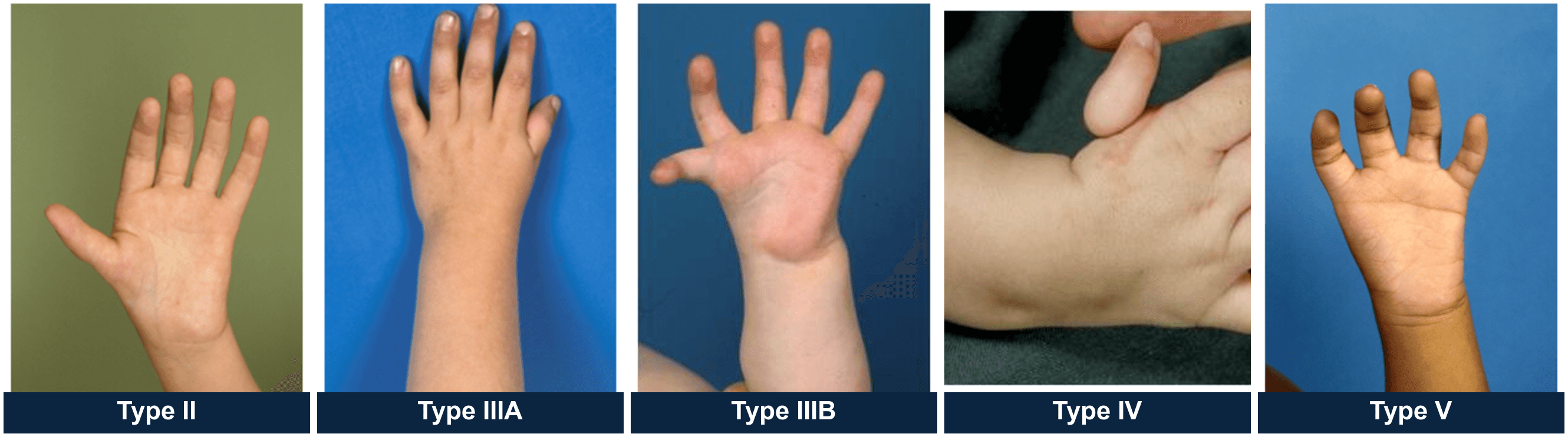
The Blauth classification (Types I-V) is the gold standard for grading the severity of thumb hypoplasia and guiding its treatment. It is based on the degree of skeletal and soft-tissue development. Manske and McCarroll modified Blauth's original scheme to emphasise the IIIA/IIIB distinction, and that split is the key decision point of the whole classification.
- Key Features
- Minor generalised hypoplasia
- CMC Joint
- Stable
- Thenar Muscles
- Present but weak
- Treatment
- Opponensplasty +/- augmentation
- Key Features
- Absent thenar, narrow web
- CMC Joint
- Stable
- Thenar Muscles
- Absent
- Treatment
- Opponensplasty + web deepening + UCL reconstruction
- Key Features
- Absent extrinsics, stable CMC
- CMC Joint
- STABLE
- Thenar Muscles
- Absent
- Treatment
- CONTROVERSIAL - reconstruction vs pollicisation
- Key Features
- Absent extrinsics, unstable CMC, partial MC
- CMC Joint
- UNSTABLE
- Thenar Muscles
- Absent
- Treatment
- POLLICISATION (absolute)
- Key Features
- Pouce flottant - proximal phalanx only
- CMC Joint
- Absent
- Thenar Muscles
- Absent
- Treatment
- POLLICISATION (absolute)
- Key Features
- Complete absence (aplasia)
- CMC Joint
- Absent
- Thenar Muscles
- Absent
- Treatment
- POLLICISATION (absolute)
Type I - minor generalised hypoplasia. Every structure is present but smaller than normal. The CMC and MP joints are stable, the thenar muscles are present but hypoplastic, and the first web space is adequate.
Type II - absent thenar muscles. APB, FPB and OP are absent, the first web is narrowed by an adduction contracture, and the ulnar collateral ligament (UCL) of the MP joint is lax or absent. The CMC joint is stable and the extrinsic muscles (FPL, EPL) are present.
Type IIIA - extrinsic deficiency, stable CMC. FPL and EPL are absent or hypoplastic as well as the thenar muscles, and the first web is severely narrowed. The metacarpal is present and the CMC joint is stable, which is what keeps reconstruction on the table.
Type IIIB - unstable CMC. The metacarpal is partial or hypoplastic, the CMC joint is unstable or subluxated, and the extrinsic and intrinsic muscles are absent or severely deficient. Reconstruction yields poor results, and index transfer gives better function.
Type IV - pouce flottant. The floating thumb is a rudimentary proximal phalanx floating on soft tissue and attached by a narrow skin bridge. There is no metacarpal, or only a minimal nubbin, and no functional muscle.
Type V - aplasia. The thumb is completely absent, with no skeletal or muscular structures.
Associated Conditions
Thumb hypoplasia is often part of the radial longitudinal deficiency spectrum, which ranges from a hypoplastic radius to complete radial aplasia, and a radial club hand deformity is common. In the radial club hand the radius is absent and the thumb is hypoplastic or absent. Several syndromes carry a thumb deficiency, and some bring haematological or cardiac problems.
TAR syndrome (thrombocytopenia-absent radius). Bilateral radial aplasia with thrombocytopenia, platelets usually below 50,000, but the thumbs are present: they may be hypoplastic, but they are always there, and that is what separates TAR from the typical radial club hand. It is often associated with cow's milk allergy, and cardiac anomalies occur in 30%. Inheritance is compound, an RBM8A deletion plus a modifier allele, in an autosomal recessive pattern.
- Check the platelet count before any surgery, and transfuse platelets for surgery if the count is below 50,000
- The thrombocytopenia usually improves after the age of 1 year
- The radial club hand requires centralisation
- The thumbs usually do not require pollicisation, being present and functional
Fanconi anaemia. Progressive bone marrow failure (aplastic anaemia) with radial ray abnormalities, from radial dysplasia to thumb hypoplasia or aplasia. The other features are short stature, café-au-lait spots and hyperpigmentation, renal anomalies (horseshoe kidney, renal agenesis), microcephaly and developmental delay, and an increased risk of cancer: leukaemia (AML), head and neck squamous cell carcinoma and other solid tumours. It is a DNA repair defect, autosomal recessive in most cases, with over 20 FANC genes identified. Every child with radial dysplasia must be screened with a chromosome breakage test (see Investigations).
- Haematology follow-up for marrow function, and monitoring for malignancy with long-term cancer surveillance
- Timing of orthopaedic surgery coordinated with the haematologist; bone marrow transplant may be needed
- Genetic counselling
- Pollicisation or reconstruction can proceed if the blood counts are adequate, with an increased bleeding risk if the child is thrombocytopenic
Holt-Oram syndrome. Upper limb radial ray deficiency, from thumb hypoplasia or aplasia to phocomelia, with cardiac septal defects (ASD, VSD) in 75% and conduction abnormalities (first-degree AV block). It is autosomal dominant with variable expressivity, caused by mutation of TBX5, a transcription factor important in both heart and limb development. Echocardiography is mandatory, an ECG may show the AV block, and the child needs cardiology clearance before surgery; cardiac status may affect surgical timing. The thumb is pollicised as indicated.
VACTERL association. A non-random association, not a syndrome, with no single genetic cause; the diagnosis requires at least 3 of the components:
- Vertebral anomalies - hemivertebrae, scoliosis
- Anal atresia or imperforate anus
- Cardiac defects - VSD, ASD, tetralogy of Fallot
- Tracheo-oesophageal (TE) fistula or oesophageal atresia
- Renal anomalies - agenesis, dysplasia, hydronephrosis
- Limb abnormalities - radial ray deficiency, including the thumb
The work-up is spine radiographs, echocardiography, renal ultrasound, and GI evaluation if there are feeding difficulties. The thumb is treated by its Blauth type, and the scoliosis is monitored and treated if needed.
Other associations. Four more to recognise:
- Diamond-Blackfan anaemia - congenital red cell aplasia with thumb hypoplasia, radial dysplasia, short stature and craniofacial anomalies
- Aase syndrome - hypoplastic anaemia, triphalangeal thumbs, cleft palate, narrow shoulders
- Nager syndrome (acrofacial dysostosis) - mandibular hypoplasia with radial ray deficiency and thumb hypoplasia or aplasia
- Maternal diabetes
Clinical Assessment
History. Ask about maternal diabetes and teratogen exposure, developmental milestones, and hand dominance if the child is old enough. Ask about similar anomalies in the family and look for an autosomal dominant pattern. Record how the child uses the hand now: grip patterns, pinch, and which activities of daily living are affected. The systemic review hunts the syndromes:
- Cardiac symptoms - Holt-Oram
- GI problems - VACTERL
- Bruising or petechiae - TAR, Fanconi
- Renal problems
Inspection. Examine both hands and note overall hand size and proportions. Look up the limb: the forearm for a radial club hand, the elbow for radial head dislocation. Look too for syndactyly, polydactyly and other limb anomalies.
The thumb. Compare the length and width with the other side, and measure the depth and width of the first web for an adduction contracture. Test the MP joint for stability and UCL integrity, and the IP joint for its presence and stability. The CMC joint has its own test, below.
Muscle and tendon. Assess thenar bulk (APB, FPB, OP) and whether the child can oppose the thumb to the small finger. Active IP flexion shows FPL function, and active IP and MP extension shows EPL.
Vessels and nerves. Check capillary refill in the thumb, and use the Allen test to judge radial or ulnar artery dominance. The presence of the digital arteries is critical to planning a pollicisation. Examine median nerve sensation and two-point discrimination.
CMC stability. Stress the CMC joint and look for subluxation or dislocation. This is the test that separates IIIA from IIIB, and fluoroscopy is used if the examination is uncertain.
Pinch force. Measured against the other side, as a functional assessment.
Investigations
Radiographs. AP and lateral films show the metacarpal and phalanges, the CMC joint (its stability and articular surfaces), and the development of the carpal bones, the scaphoid and trapezium in particular. Include the forearm to assess the radius for dysplasia, radial length and radial head dislocation.
MRI and ultrasound. MRI is reserved for selected cases, to assess the thenar and extrinsic muscles, the CMC joint cartilage and stability, and the vascular anatomy before pollicisation. Ultrasound maps the vessels, in particular the radial digital artery of the index, and assesses thenar bulk.
Blood tests. These screen for the associated syndromes.
- Full blood count - the platelets for TAR, the haemoglobin for Fanconi and Diamond-Blackfan anaemia
- Chromosome breakage test - the DEB (diepoxybutane) or MMC (mitomycin C) test is mandatory in every case of radial dysplasia to rule out Fanconi anaemia. Fanconi cells show increased chromosomal breaks and rearrangements when exposed to these DNA crosslinking agents
- Genetic testing - TBX5 (Holt-Oram), RBM8A/FAAP (TAR), and a Fanconi gene panel (FANC genes)
Screening the other systems. Echocardiography rules out the cardiac defects of Holt-Oram and VACTERL, especially if a murmur is present. Renal ultrasound looks for the renal anomalies of VACTERL and Fanconi anaemia, and spine radiographs for the vertebral anomalies of VACTERL.
Differential Diagnosis
- Key Distinguishing Feature
- Underdeveloped or absent thumb; assess CMC stability
- Classification
- Blauth I-V
- Treatment Direction
- Reconstruct (I-IIIA) vs pollicise (IIIB-V)
- Key Distinguishing Feature
- Extra rather than deficient thumb
- Classification
- Wassel-Flatt
- Treatment Direction
- Excise/combine less dominant component
- Key Distinguishing Feature
- Extra (third) phalanx, longer in-line thumb
- Classification
- Wood / opposability-based
- Treatment Direction
- Phalanx excision or delta correction
- Key Distinguishing Feature
- Fixed IP flexion with Notta node; thumb normally formed
- Classification
- Sling/Dinham
- Treatment Direction
- A1 pulley release if persistent
- Key Distinguishing Feature
- Thumb-in-palm from absent/weak EPL-EPB
- Classification
- Tsuyuguchi/McCarroll
- Treatment Direction
- Splinting, tendon transfer if persistent
- Key Distinguishing Feature
- Multiple joint contractures, other limbs involved
- Classification
- Part of amyoplasia spectrum
- Treatment Direction
- Release, transfers, web reconstruction
- Key Distinguishing Feature
- Short/webbed digits, often nubbins; usually sporadic
- Classification
- Blauth-Gekeler
- Treatment Direction
- Distraction, transfers, web release
Overlaps. A congenital trigger thumb is usually not associated with hypoplasia. The clasped thumb is held in the palm in adduction and flexion, and symbrachydactyly can involve the thumb. Radial polydactyly can combine duplication with hypoplasia: both thumbs may be hypoplastic, and the Bilhaut-Cloquet procedure, which combines the two hypoplastic thumbs into one, may be required.
Management
The decision. Treatment follows the Blauth type, the stability of the CMC joint and the child's functional needs. A thumb with a stable CMC joint can be reconstructed; one with an unstable or absent CMC joint is replaced by pollicising the index. The table in the classification section gives the treatment by type.
Reconstruction. Indicated in Types I, II and IIIA, where:
- The CMC joint is stable
- The metacarpal is present and of reasonable quality
- The family prefers to keep the thumb's appearance
Pollicisation. The absolute indications are Blauth IIIB (unstable CMC), IV (pouce flottant) and V (aplasia); in Type IV the rudimentary thumb may be ablated before pollicisation. The relative indication is a Type IIIA thumb with a poor-quality metacarpal, absent extrinsics, or a family who prefer it.
Without surgery. Observation alone suits a mild Type I thumb with good function, in which conservative management is often acceptable, and bilateral cases in which the timing of pollicisation differs between the hands. Occupational therapy, adaptive equipment for daily activities and side-to-side pinch patterns help the child adapt.
The Type IIIA decision. This is the controversial grade. The CMC joint is stable, so reconstruction may be attempted, but it takes multiple staged procedures (opponensplasty, web deepening, tendon transfers and possibly metacarpal lengthening) and its outcomes are variable. Pollicisation gives a more predictable functional outcome. The decision rests on CMC stability, metacarpal quality, thenar function, the family's preference and the surgeon's experience. If the CMC joint proves unstable, or the thenar muscles are absent and grip is poor, pollicise. The trend is towards pollicisation for a IIIA thumb with absent FPL or poor extrinsic function, because its functional outcomes are superior.
- Advantages
- Maintains thumb appearance; five-fingered hand; may have better cosmesis
- Disadvantages
- Multiple staged procedures; less predictable functional outcome; requires a compliant patient and family for therapy
- Advantages
- More predictable functional outcome; single procedure; better pinch strength; proven long-term results
- Disadvantages
- Four-fingered hand; cosmetic concern for some families; irreversible
Timing. The optimal window is 12-18 months, before the cortical representation for pinch develops at around 18-24 months. Brain plasticity then lets the cortex reorganise, so that the index finger's cortical area becomes the thumb's, and early surgery preserves that reorganisation without delaying the development of hand function. The acceptable range is 6 months to 3 years, and each age has its trade-off.
- Outcome
- Good outcomes, but smaller structures make it technically demanding
- Outcome
- Excellent cortical reorganisation, best functional outcomes
- Outcome
- Good outcomes, less cortical plasticity
- Outcome
- Poorer outcomes, less cortical plasticity
- Outcome
- Fair outcomes: poor cortical reorganisation and less intuitive thumb use
Late pollicisation is still worthwhile, and is considered when the diagnosis was delayed or the family previously declined surgery.
Surgical Technique
Opponensplasty (Types I-II). Indicated for absent or weak thenar muscles when the CMC joint is stable and the thumb skeleton is adequate. Three transfers restore opposition:
- FDS of the ring finger - the most common, providing an opposition vector (technique below)
- Abductor digiti minimi (Huber transfer) - transferred to the thumb with its neurovascular pedicle preserved; good for both opposition and first web abduction
- ECRL - when FDS or ADM is not suitable. Routed through the interosseous membrane or around FCU, and attached at the APB insertion
FDS opponensplasty, step by step.
- Harvest the ring finger FDS at the A1 pulley, preserving A2
- Pass it through a window at the ulnar wrist, volar to FCU, around the ulnar border of the hand
- Tunnel it subcutaneously to the thumb
- Attach it to the radial base of the proximal phalanx at the APB insertion
- Set the tension with the thumb in full opposition and the wrist neutral
First web deepening. For a narrow first web (adduction contracture) in Types II and III, by four-flap Z-plasty.
- Design two opposing Z-plasties on the dorsal and volar surfaces
- Use 60-degree angles for maximum lengthening
- Raise full-thickness skin flaps
- Transpose the flaps to deepen the web
- A skin graft may be needed for closure if the contracture is severe
The alternative is a large dorsal rotation flap turned into the web space, with a skin graft to the donor site.
UCL reconstruction (Type II). For a lax or absent UCL at the MP joint.
- Harvest palmaris longus or plantaris tendon
- Drill bone tunnels in the proximal phalanx and metacarpal
- Weave the graft in a figure-of-8
- Tension it with the thumb in slight radial deviation
Thumb augmentation. For a hypoplastic metacarpal or proximal phalanx in Types I-II. The options are bone grafting to the metacarpal, distraction lengthening (rarely used), and an on-top plasty for the older patient who presents late. In Type II, consider skeletal augmentation if the thumb is severely hypoplastic.
When there is no usable index. Pollicisation needs a satisfactory index. When the index is absent, destroyed or already used, or in the older child or adult who presents late or declines pollicisation, a free microvascular toe-to-hand transfer reconstructs the thumb. The second toe is the usual donor, because it sacrifices less of the foot and leaves a more acceptable donor site, although the great or "trimmed great toe" gives a bulkier, more thumb-like digit.
The transferred toe brings its own nail, joints, tendons, neurovascular bundles and, in a child, an open physis, so it continues to grow. It is technically demanding free tissue transfer, with microvascular anastomosis to the radial artery and a dorsal vein and nerve coaptation for sensation, and it carries flap-failure and donor-foot-morbidity risks. The reconstructed digit is weaker and less mobile than a pollicised index, so pollicisation remains first choice in the young child with a usable index. An on-top plasty is a different operation: it transposes local tissue rather than a free vascularised toe.
Complications
After opponensplasty. The transfer brings its own complications.
- Under-tensioning - weak opposition and inadequate thumb abduction
- Over-tensioning - MP joint hyperextension, swan-neck deformity
- Tendon adhesions - limited excursion and poor function
- Loss of ring finger flexion - if the FDS harvest affects FDP function
After web deepening and UCL reconstruction. The web contracture recurs and needs revision in 10-20%, a skin graft used for closure can be lost, and hypertrophic scar can contract the web. A reconstructed UCL can stay unstable through graft failure or poor fixation, and the MP joint can stiffen with capsular contracture.
Vascular compromise after pollicisation. The most serious complication. Its incidence is below 1% if the radial digital artery is preserved, and it presents as arterial insufficiency or venous congestion, caused by tension on the pedicle, kinking or compression by haematoma.
Return to theatre immediately. Release every constrictive dressing and suture, make sure there is no tension on the pedicle, and revise the position of the thumb if needed.
Other early complications. Stretch injury to the digital nerves, usually a neurapraxia that recovers with time and is prevented by gentle handling and a closure without tension. Wound problems include skin necrosis, especially at the web apex, infection and haematoma.
Late complications of pollicisation.
- Web space contracture (10-15%) - the first web narrows with growth and limits span and grasp. Treated by a revision four-flap Z-plasty, skin grafting if needed, and splinting after the revision
- Malposition (5-10%) - excessive or inadequate abduction or pronation (nail rotation). Correction may require a revision osteotomy at the metacarpal level if it is severe, after 6-12 months if it is not improving
- Joint instability - of the MP or IP joint if the collaterals were injured; may require ligament reconstruction
- Tendon imbalance - an extensor lag if EDC is too loose, a flexion contracture if FDP is too tight; revision tendon balancing may be needed
- Stiffness - of the MP or IP joint, or intrinsic tightness, treated with therapy and splinting
- Growth disturbance - the new thumb may become relatively shorter with growth because the metacarpal physis is removed, usually without functional significance
- Cold intolerance - transient, usually resolved by 1 year
How often. The overall complication rate: 15-25% require minor revision.
Postoperative Care
After pollicisation. The cast stays on for 4-6 weeks, and the K-wires are removed at 4-6 weeks. Monitor the vascular status closely, especially over the first 48 hours, which are critical. Later follow-up watches for web space contracture, which may need a revision Z-plasty, and for growth of the new thumb.
After reconstruction. A short arm splint for 4 weeks, protection of an opponensplasty for 6 weeks, and active motion from 4-6 weeks.
Rehabilitation. Three phases follow either operation.
- Phase 1 (0-6 weeks) - immobilisation in the cast or splint, oedema control, motion of the adjacent joints
- Phase 2 (6-12 weeks) - gentle passive motion from 6 weeks, then active motion from 8 weeks after pollicisation; scar management and light grasp activities
- Phase 3 (3-6 months) - progressive strengthening from 3 months, functional activities and play-based therapy
Children typically regain function spontaneously through play, without formal therapy.
Outcomes
Reconstruction. Opponensplasty gives good opposition in 80-90%, improves pinch strength by 50-100%, keeps the thumb's appearance and brings high satisfaction. Web deepening improves grasp span, and the web is maintained in 80-90%. UCL reconstruction restores stability in 85-90%, although slight residual laxity may remain. Revision procedures may be needed.
Pollicisation. Opposition is achieved in over 90%, and grasp function is excellent, with an adequate span for functional activities. Measured against a normal thumb:
- Pinch strength - 50-75%
- IP and MP motion - 70-80%
- Length - 80-85% of the contralateral thumb
- Sensibility - slightly diminished but functional; two-point discrimination 6-10mm against a normal 3-5mm
- Overall function - 70-85%
The long term. Over 90% of patients are satisfied, the pollicised thumb integrates into daily activities, and hand dominance develops normally. Cosmetic acceptance is high, especially when surgery is done early. Beyond 10 years the functional outcomes are stable, the new thumb grows in proportion to the hand, and 90% use it in daily activities.
Bilateral pollicisation. Outcomes are excellent. With no "good" side to compensate, both hands are used equally and develop symmetrical function.
Guidelines, Registries & Global Practice
Global Epidemiology
Thumb hypoplasia and aplasia sit within radial longitudinal deficiency, the commonest congenital longitudinal deficiency of the upper limb. Severity of the thumb deficiency rises in lockstep with the severity of the radial deficiency, a relationship confirmed both in historical cohorts and in contemporary multicentre registry data (James 2004, PMID 15466728; Forman/CoULD 2020, PMID 33086350). Roughly one-third of patients carry a recognised syndrome, and registry data show syndromic children are twice as likely to be bilateral and 2.5 times more likely to have combined radial and thumb involvement.
- Region / Body
- Global
- Role
- Grades thumb severity I-V and drives reconstruct-vs-pollicise decision
- Status
- Universal standard
- Region / Body
- IFSSH-endorsed
- Role
- Dysmorphology-based classification of all congenital hand anomalies
- Status
- Current IFSSH system
- Region / Body
- Global
- Role
- Grades associated radial longitudinal deficiency
- Status
- Standard for radius
- Region / Body
- USA, multicentre
- Role
- Prospective outcome / complication benchmarking
- Status
- Largest active registry
Guidance & Practice Consensus
There is no randomised-trial-level guideline for this rare condition; international practice is built on case series, registry data and society consensus rather than graded recommendations. Bodies such as the IFSSH (classification), ASSH and BSSH (paediatric hand standards) and AAOS instructional material converge on the same operative principles.
- Consensus Position
- Reconstruct stable Blauth I-IIIA; pollicise unstable IIIB-V
- Evidence / Variation
- Consensus on CMC stability as the threshold (Manske/McCarroll, PMID 1572922)
- Consensus Position
- Buck-Gramcko index pollicisation is the global standard
- Evidence / Variation
- Original series PMID 5121802; minor regional technical modifications
- Consensus Position
- Most centres operate at 12-18 months
- Evidence / Variation
- Range 6 months-3 years; expert opinion, not trial-based
- Consensus Position
- Chromosome breakage (DEB/MMC) for all radial-ray cases
- Evidence / Variation
- Strongly supported (Esmer, PMID 14679584); variably applied in practice
- Consensus Position
- Increasingly favours pollicisation when extrinsics/FPL absent
- Evidence / Variation
- Genuine practice variation; shared decision-making essential
Registry Evidence & Complication Benchmarks
The CoULD registry provides the most robust contemporary outcome data. Across 2,430 congenital upper-limb procedures the overall complication rate was 5.3% (4.1% excluding trivial events), with thumb deficiency surgery among the higher-complication groups and post-pollicisation vascular compromise among the most severe events (Bae/CoULD 2026, PMID 41500756). No reliable patient-level risk factors were identified, underscoring that complications are multifactorial.
Multidisciplinary tertiary care integrating hand surgery, clinical genetics and haematology enables comprehensive syndrome screening including mandatory chromosome-breakage testing; early referral by 3-6 months allows assessment and planning within the optimal 12-18 month surgical window.
MCQ Practice Points
Q: What is the Blauth classification for thumb hypoplasia and which types require pollicization?
A: Blauth classification (modified by Manske/McCarroll): Type I: Minor hypoplasia, all structures present; Type II: Intrinsic muscle hypoplasia, first web space narrowing, UCL instability; Type IIIA: Type II + extrinsic tendon abnormalities, stable CMC joint; Type IIIB: Type III + unstable CMC joint (global proximal deficiency); Type IV: Floating thumb (pouce flottant); Type V: Absent thumb. Pollicization indicated for Types IIIB, IV, and V - reconstructing an unstable or floating thumb yields inferior results to pollicization.
Q: What is the critical distinction between Blauth Type IIIA and Type IIIB thumb hypoplasia?
A: The critical distinction is CMC joint stability. Type IIIA: CMC joint is stable (basal joint elements intact) - amenable to reconstruction (opponensplasty, tendon transfers, first web release). Type IIIB: CMC joint is unstable (deficient trapezium, metacarpal base) - reconstruction gives poor results, pollicization preferred. Clinical assessment: passively stress the CMC joint; radiographs may show hypoplastic trapezium. This distinction is crucial for surgical planning - Type IIIB represents a threshold below which pollicization gives superior functional outcomes.
Q: What is pollicization and what are the key technical principles?
A: Pollicization converts the index finger into a thumb. Key principles: 1) Shorten and rotate index metacarpal approximately 160 degrees into pronation; 2) Position in palmar abduction and opposition; 3) Transfer intrinsics to recreate thenar function (first dorsal interosseous becomes APB, first palmar interosseous becomes adductor); 4) Preserve neurovascular bundles; 5) Close first web space primarily. Optimal timing is 12-18 months of age. The index finger never achieves normal thumb strength but provides excellent pinch and grasp function.
Q: What conditions are associated with thumb hypoplasia?
A: Thumb hypoplasia is commonly associated with: Radial longitudinal deficiency (radial club hand) - most common association; Holt-Oram syndrome (heart-hand syndrome - cardiac septal defects + radial ray deficiency); VACTERL association; Fanconi anemia (bone marrow failure, short stature); TAR syndrome (thrombocytopenia-absent radius - thumbs present); Trisomy 18. Isolated thumb hypoplasia also occurs. All patients require cardiac echocardiography, renal ultrasound, and hematology workup (CBC, chromosomal breakage studies for Fanconi).
Q: What are the surgical options for Blauth Type II thumb hypoplasia?
A: Type II hypoplasia has all skeletal elements but deficient thenar muscles, first web narrowing, and UCL laxity. Surgical options: 1) First web space release/Z-plasty - address contracture; 2) Opponensplasty - restore opposition (Huber transfer using ADM, FDS ring finger transfer, EIP transfer); 3) UCL reconstruction - stabilize MCP joint; 4) FPL augmentation if weak. Surgery is typically staged: web release first, then tendon transfers after 6-12 months. Combination of procedures can achieve functional thumb with stable pinch.
Exam Viva Scenarios
Practise clinical reasoning and management decisions out loud
“A 9-month-old child presents with bilateral thumb hypoplasia. On the right, there is a small thumb with absent thenar muscles, narrow web space, but stable CMC and MP joints. On the left, the thumb appears as a small nubbin attached by a skin bridge with no functional structures. How would you assess and manage this child?”
“You are performing a pollicization for a Blauth Type V thumb aplasia in an 18-month-old child. Walk me through your surgical technique, focusing on the key steps and critical structures to preserve.”
“A 14-month-old presents with Blauth Type IIIA thumb hypoplasia. The CMC joint is stable on stress testing, but the thumb is very small with absent thenar muscles and no FPL function. The family is concerned about their child having a four-fingered hand. How do you counsel them and what factors influence your decision between reconstruction and pollicization?”
Blauth Classification (CRITICAL)
- Type I: Minor hypoplasia, all structures present - OPPONENSPLASTY
- Type II: Absent thenar, narrow web, stable CMC - RECONSTRUCTION
- Type IIIA: Stable CMC, absent extrinsics/intrinsics - CONTROVERSIAL
- Type IIIB: UNSTABLE CMC, partial MC - POLLICIZATION
- Type IV: Pouce flottant (floating, PP only) - POLLICIZATION
- Type V: Complete absence (aplasia) - POLLICIZATION
Key Decision Point: IIIA vs IIIB
- IIIA: Stable CMC - Reconstruct OR pollicize (controversial)
- IIIB: UNSTABLE CMC - Pollicize (absolute)
- Test CMC stability with stress testing, fluoroscopy if uncertain
- Absent FPL/EPL favors pollicization even if CMC stable
Associated Syndromes (Screen ALL cases)
- TAR: Thrombocytopenia + Absent Radius + thumbs PRESENT
- Fanconi: Radial dysplasia + Chromosome breakage test (DEB/MMC)
- VACTERL: Vertebral, Anal, Cardiac, TE fistula, Renal, Limb
- Holt-Oram: Cardiac septal defects + radial dysplasia (TBX5 gene)
- ALWAYS: CBC, chromosome breakage, echo, renal US
Pollicization Technique (Buck-Gramcko)
- Four-flap skin incision for web space Z-plasty
- Preserve radial digital artery of index (CRITICAL)
- Metacarpal neck wedge osteotomy: 20-30 deg for pronation
- Position: 140-160 deg abduction, 120-140 deg pronation
- First DI repositioned as thenar muscle (radial base PP)
- FDP becomes FPL, EDC/EIP become EPL/EPB
- Immobilize 4-6 weeks in thumb spica
Reconstruction Components (Type I-II)
- Opponensplasty: FDS ring (most common), ADM (Huber), or ECRL
- Web deepening: Four-flap Z-plasty (60-deg angles)
- UCL reconstruction: PL graft, figure-8 through bone tunnels
- Skeletal augmentation: Bone graft to MC if severely hypoplastic
Surgical Timing and Outcomes
- OPTIMAL: 12-18 months (before cortical pinch representation)
- Pollicization outcomes: Pinch 50-75% normal, opposition over 90%
- Satisfaction over 90%, cosmetic acceptance high if early
- Late pollicization (older than 5 years): poorer outcomes, less plasticity
Complications
- MOST SERIOUS: Vascular compromise - immediate re-exploration
- Web contracture 10-15% - revision Z-plasty
- Malposition 5-10% - may need revision osteotomy
- Opponensplasty: under-tensioning (weak) or over-tensioning (swan-neck)
Exam Traps
- TAR: Thumbs PRESENT (vs radial club hand: thumbs absent/hypoplastic)
- MUST screen Fanconi with chromosome breakage test (bone marrow failure)
- Type IIIB requires pollicization (UNSTABLE CMC is absolute indication)
- Pollicization timing: 12-18mo optimal (brain plasticity critical)
Evidence Base
Reconstruction of the Congenitally Deficient Thumb
- Operation is dictated by the type of hypoplasia present
- Type III thumbs are the most difficult decision-making group
- Pollicisation as a salvage after failed reconstruction is nearly impossible
- Parents must be counselled that secondary procedures are often required
Pollicization of the Index Finger: Method and Results in Aplasia and Hypoplasia of the Thumb
- Index metacarpal shortened and rotated into pronation with the head fixed to the base
- First dorsal interosseous repositioned to act as abductor pollicis brevis
- First palmar interosseous repositioned to act as adductor pollicis
- Digital neurovascular bundles preserved to maintain perfusion of the new thumb
The Association of Radial Deficiency with Thumb Hypoplasia
- Thumb deficiency severity directly proportional to radial deficiency severity (p value below 0.0001)
- Two-thirds (63/95) of limbs with a normal radius had a reconstructible thumb
- 48 of 51 limbs (94%) with complete radial absence had a non-reconstructible thumb
- Every limb with a radial and/or carpal deficiency also had a thumb deficiency
- BUT THE CONVERSE DOES NOT HOLD: half of the extremities had a thumb deficiency, or thumb and carpal deficiency, with NO radial deficiency at all - a normal forearm radiograph does not predict a normal thumb
- Of 227 extremities reviewed, radial deficiency could be classified in only 191 (119 patients)
DEB Test for Fanconi Anaemia Detection in Patients with Atypical Phenotypes
- DEB hypersensitivity diagnoses Fanconi anaemia before pancytopenia develops
- Fanconi anaemia was detected among children presenting with radial-ray abnormalities alone
- Clinical phenotype alone is unreliable, so screening must be triggered by the limb anomaly
- Early diagnosis has major implications for the patient and at-risk family members
Association of Radial Longitudinal Deficiency and Thumb Hypoplasia: An Update Using the CoULD Registry
- Radial severity correlated with thumb severity (Kendall tau = 0.49)
- Patients with a syndrome were twice as likely to have bilateral deficiency
- Syndromic patients were 2.5 times more likely to have combined radial and thumb deficiency
- Holt-Oram, TAR and Fanconi anaemia showed distinct deficiency patterns versus VACTERL
Complications Following Congenital Hand and Upper Limb Surgery: Lessons from the CoULD Registry
- Overall complication rate 5.3% (4.1% excluding minor Clavien-Dindo I events)
- Vascular compromise after pollicisation was among the most severe complications recorded
- Thumb deficiency, syndactyly and polydactyly surgery carried the most complications
- Clavien-Dindo breakdown: 34 type I, 45 type II, 50 type III and 1 type IV among 130 complications - so roughly two in five of the complications recorded required surgical or endoscopic intervention
- 77 were early and 53 late events, in 100 patients (18 had two complications, six had three)
- No reliable patient-specific risk factors (syndrome, bilaterality, comorbidity) were identified
References
-
Blauth W. Der hypoplastische Daumen. Arch Orthop Unfall-Chir. 1967;62(3):225-246.
-
Buck-Gramcko D. Pollicization of the index finger: Method and results in aplasia and hypoplasia of the thumb. J Bone Joint Surg Am. 1971;53(8):1605-1617.
-
Manske PR, McCarroll HR Jr. Reconstruction of the congenitally deficient thumb. Hand Clin. 1992;8(1):177-196.
-
Goldfarb CA, Murtha YM, Gordon JE, et al. Developmental outcomes of the digits pollicized for congenital thumb hypoplasia. J Bone Joint Surg Am. 2006;88(2):279-287.
-
Cheng JC, Ng BK, Ying SY, Fung BK. A 10-year study of 300 cases of thumb hypoplasia. J Hand Surg Br. 1999;24(4):472-476.
-
Kozin SH. Pollicization: the concept, technical details, and outcome. Clin Orthop Surg. 2012;4(1):18-35.
-
Alter BP. Diagnosis, genetics, and management of inherited bone marrow failure syndromes. Hematology Am Soc Hematol Educ Program. 2007:29-39.
-
Greenhalgh DG, Warden GD, Moncrief JA, et al. The pollicization procedure: a review of 139 cases. J Hand Surg Am. 1993;18(1):4-12.
-
Light TR, Ogden JA. Congenital constriction band syndrome: pathophysiology and treatment. Yale J Biol Med. 1993;66(3):143-155.
-
James MA, Green HD, McCarroll HR Jr, Manske PR. The association of radial deficiency with thumb hypoplasia. J Bone Joint Surg Am. 2004;86(10):2196-2205.
-
Tonkin MA, Tolerton SK, Quick TJ, et al. Classification of congenital anomalies of the hand and upper limb: development and assessment of a new system. J Hand Surg Am. 2013;38(9):1845-1853.
-
Bayne LG, Klug MS. Long-term review of the surgical treatment of radial deficiencies. J Hand Surg Am. 1987;12(2):169-179.
-
McCarroll HR Jr. Congenital anomalies: a 25-year overview. J Hand Surg Am. 2000;25(6):1007-1037.
-
Netscher DT, Baumholtz MA. Treatment of congenital hypoplasia and absence of the thumb. Hand Clin. 2009;25(2):151-171.
-
Mih AD, Villareal-Rios A, Abrams RA, Hanel DP. Hypoplastic thumb. J Am Acad Orthop Surg. 2014;22(4):246-255.
-
Bae DS, Canizares MF, Miller PE, et al. Predictors of functional outcomes following index finger pollicization for congenital thumb hypoplasia. J Hand Surg Am. 2015;40(11):2227-2233.
-
Sammer DM, Chung KC. Congenital hand differences: embryology and classification. Hand Clin. 2009;25(2):151-171.
-
Staines KG, Majzoub R, Thornby J, Netscher DT. Functional outcomes following pollicization for treatment of thumb hypoplasia/aplasia. J Hand Surg Am. 2005;30(6):1201-1213.
-
Wang AA, Tan J, Leit ME. Thrombocytopenia-absent radius syndrome: a clinical review. J Pediatr Orthop. 2013;33(3):e27-e30.
-
Hosalkar HS, Shah MA, Yoon M, et al. Pollicization of the index finger for congenitally absent or hypoplastic thumb. Orthopedics. 2009;32(8):571-577.