Proximal Tibial Physis Growth Disturbance
Types
Critical Must-Knows
- Pathophysiology: Compressive forces (Heuter-Volkmann law) on the posteromedial proximal tibial physis cause growth suppression.
- Risk Factors: Obesity (early walking), African American ethnicity.
- Infantile Blount's: Differentiate from Physiologic Bowing. Has Drennan Angle over 16°.
- Langenskiöld Classification: Describes the depression of the medial plateau. Stage VI = Physeal bar.
- Treatment: Bracing effective only in early Infantile (under 3 yrs). Surgery (Osteotomy) for all others.
Clinical Pearls
- "Physiologic bowing usually resolves by age 2. Blount's PROgresses.
- "Metaphyseal-Diaphyseal Angle (Drennan): over 16° indicates Blount's; under 10° is physiologic.
- "Infantile Blount's has INTERNAL tibial torsion. Adolescent has MILD or neutral.
- "The epiphysis, physis, and metaphysis are ALL involved.
Blount's Pitfalls
Physiologic Bowing
Don't Overcall. Most bowing under 2 years is physiologic. Use Drennan angle (over 16) to differentiate.
Obesity
High Failure Rate. Obese patients have higher implant failure and recurrence rates. Correct the weight if possible.
Compartment Syndrome
Osteotomy Risk. High tibial osteotomy carries risk of compartment syndrome. Prophylactic release needed?
Peroneal Nerve
Nerve at Risk. Correction of varus (valgus osteotomy) stretches the peroneal nerve. Monitor post-op.
At a Glance: Infantile vs Adolescent Blount's
| Feature | Infantile (under 3 yrs) | Adolescent (over 10 yrs) |
|---|---|---|
| Laterality | Bilateral (50%) | Unilateral (90%) |
| Deformity | Severe Varus + Internal Torsion | Mild Varus + Leg Length Discrepancy |
| Physeal Bar | Common (Stage VI) | Rare |
| Drennan Angle | Over 16 degrees | Not used (Physis closed/closing) |
| Treatment | Brace → Osteotomy | Hemiepiphysiodesis or Osteotomy |
FATRisk Factors
| F | Female (Adolescent) For Adolescent type |
| A | African American Genetic predisposition |
| T | Toddler (Early Walk) Walking early + Heavy |
| F | Female (Adolescent) For Adolescent type |
| A | African American Genetic predisposition |
| T | Toddler (Early Walk) Walking early + Heavy |
Hook:FAT and EARLY walking.
M-D-S-BLangenskiöld Classification
| M | Medial Beak Stage I-II (Simple beaking) |
| D | Deepening Stage III-IV (Step-off forms) |
| S | Slope/Split Stage V (Double epiphysis appearance) |
| B | Bar Stage VI (Physeal bar forms) |
| M | Medial Beak Stage I-II (Simple beaking) | S | Slope/Split Stage V (Double epiphysis appearance) |
| D | Deepening Stage III-IV (Step-off forms) | B | Bar Stage VI (Physeal bar forms) |
Hook:Progression from beak to bar.
VARUSVARUS - Blount's Deformity Components
| V | Varus Medial tibial bowing - main deformity |
| A | Anterior slope Procurvatum (extension deformity) |
| R | Rotation Internal tibial torsion (infantile) |
| U | Unilateral More common in adolescent form |
| S | Shortening Leg length discrepancy develops |
| V | Varus Medial tibial bowing - main deformity | U | Unilateral More common in adolescent form |
| A | Anterior slope Procurvatum (extension deformity) | S | Shortening Leg length discrepancy develops |
| R | Rotation Internal tibial torsion (infantile) |
Hook:VARUS corrects to NORMAL - correct all deformity components.
Overview and Epidemiology
Definition: Growth disorder of the proximal tibia primarily affecting the posteromedial physis, causing progressive varus, procurvatum, and internal rotation deformity.
Epidemiology:
- Infantile: Onset under 3 years. Often bilateral. Associated with early walking and obesity.
- Adolescent: Onset over 10 years. Often unilateral. Associated with obesity.
- Race: Much more common in African/Afro-Caribbean descent.
Pathophysiology (Heuter-Volkmann Law):
- Excessive compressive forces on the medial physis inhibit growth.
- The lateral physis continues to grow → Varus deformity.
- Also affects posterior aspect → Procurvatum (Extension deformity).
Pathophysiology and Mechanisms
The Heuter-Volkmann mechanostat. Tibia vara is fundamentally a mechanically-driven physeal disorder. Compression slows physeal growth; distraction accelerates it. In a varus knee, the joint reaction force shifts medially, overloading the posteromedial proximal tibial physis. Growth there is suppressed while the lateral physis keeps growing, which increases varus further — a self-perpetuating vicious cycle.
Why obesity is central. Excess body mass amplifies the medial compartment load, and early independent walking (often in heavy toddlers) applies this overload before the physis is mechanically mature. This explains the dose-relationship between BMI and both incidence and severity, and why deformity progresses rather than remodels.
What gets involved. Unlike a pure growth-plate arrest, the entire epiphysis-physis-metaphysis complex is affected:
- Physis — posteromedial growth suppression, ultimately a bony bar (Langenskiöld VI).
- Epiphysis — medial articular cartilage and ossific nucleus depression (the medial plateau "drops").
- Metaphysis — medial beaking and the fragmentation/step seen radiographically.
Three-plane deformity (not just varus). Because the affected zone is posteromedial, the result is a combined deformity that every exam answer must name:
- Coronal — tibia vara (the primary deformity).
- Sagittal — procurvatum (apex-anterior; the "extension/flexion" deformity often neglected at osteotomy).
- Axial — internal tibial torsion (prominent in infantile, mild/absent in adolescent).
- Plus progressive medial tibial plateau depression and limb shortening (leg-length discrepancy).
The femur lies too. Coronal malalignment in tibia vara is frequently not purely tibial — distal femoral varus contributes to overall mechanical axis deviation, especially in late-onset disease, and must be assessed on a full-length standing radiograph before planning correction.
Classification Systems
Infantile (under 3 years)
Bilateral in ~50%. Associated with internal tibial torsion and marked medial physeal changes. Staged using the Langenskiöld classification (I-VI). Greatest remodelling potential, so amenable to bracing and guided growth if caught early.
Juvenile (4-10 years)
An intermediate group recognised in some schemes; behaves more like late-onset disease with limited remodelling.
Adolescent / late-onset (over 10 years)
Unilateral in ~90%. Less severe initial varus but harder to treat because remodelling potential is nearly exhausted, the limbs are large/heavy (high implant load), and leg-length discrepancy and medial joint pain dominate. Langenskiöld staging is not applicable once the physis is closing.
Clinical Assessment
Physical Examination:
- Gait: Varus thrust (lateral knee thrust) during stance phase.
- Deformity:
- Varus (Bow leg).
- Internal Tibial Torsion (Infantile).
- Leg Length Discrepancy (Affected side short).
- Obesity: Commonly BMI over 95th percentile.
Differentiating from Physiologic Bowing:
- Physiologic: Symmetrical, Gentle curve (femur and tibia), Resolves by age 2.
- Blount's: Abrupt angulation at proximal tibia, Asymmetric, Progressive, Lateral thrust.
Differential Diagnosis of the Bow-Legged Child
| Condition | Key Discriminator | Radiograph / Test |
|---|---|---|
| Physiologic genu varum | Symmetrical, smooth femorotibial bow, resolves by ~2 yrs | Drennan MDA under 10 degrees; normal physis |
| Infantile Blount disease | Abrupt proximal tibial varus, lateral thrust, progressive | Drennan MDA over 16 degrees; medial beaking/step |
| Rickets (nutritional / hypophosphataemic) | Bilateral, widened/cupped/frayed physes, often genu varum AND valgum | Low phosphate or vitamin D; raised ALP; widened physes |
| Skeletal dysplasia (e.g. metaphyseal chondrodysplasia, achondroplasia) | Short stature, generalised metaphyseal changes, family history | Skeletal survey; disproportionate limb shortening |
| Post-traumatic / post-infective physeal arrest | Unilateral, history of fracture or osteomyelitis | Focal bar on MRI/CT; asymmetric growth |
| Focal fibrocartilaginous dysplasia | Sharply localised cortical defect at pes anserinus, often self-resolving | Cortical irregularity at medial metaphysis; usually resolves |
Investigations (X-ray analysis)
Radiographic Parameters:
-
Metaphyseal-Diaphyseal Angle (Drennan Angle):
- Angle between line perpendicular to tibial diaphysis and line through metaphysis.
- Under 10 degrees: 95% chance Physiologic.
- Over 16°: 95% chance Blount's.
- 10-16°: Grey zone (Observe).
-
Langenskiöld Classification (Infantile):
- Describes morphology of medial metaphysis/epiphysis.
- Stage I-II: Irregular medial metaphysis / Beaking.
- Stage III-IV: Deepening of medial slope ("Step").
- Stage V: Double epiphysis sign.
- Stage VI: Bony bridge (Physeal Bar).
-
MRI: Evaluate for physeal bar (Stage VI) and intra-articular cartilage depression.
Management Algorithm
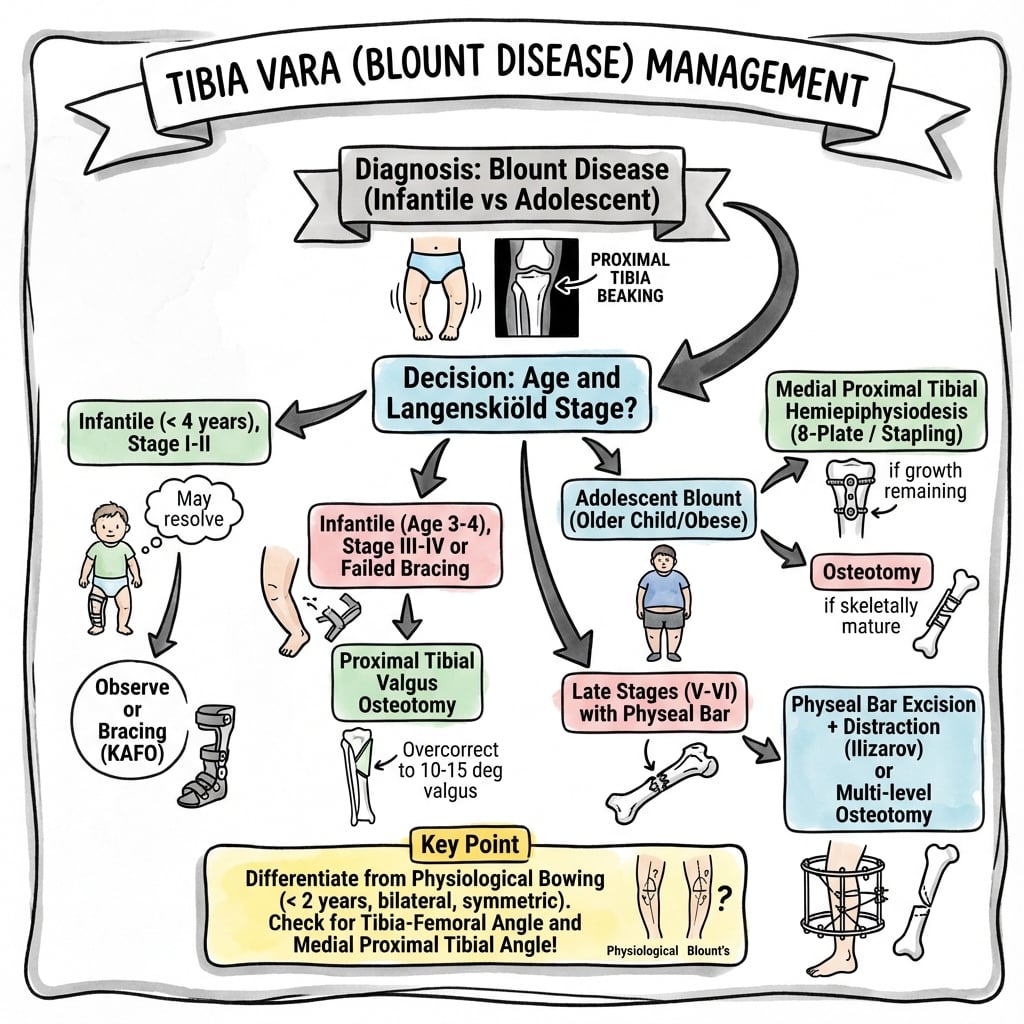
Infantile Blount's Management
Age under 3 Years (Stage I-II):
KAFO bracing with locked knee in extension, worn 23 hours per day. Approximately 50% success rate if started young and with unilateral disease.
Age over 3 Years or Stage III+:
Surgery indicated with High Tibial Osteotomy (HTO). Technique involves valgus correction, extension correction, and external rotation. Fixation with plate or external fixator (TSF/Ilizarov allows gradual correction). Aim to overcorrect to 5-10° valgus (physiologic for age).
Surgical Technique
High Tibial Osteotomy (Acute)
Indications: Infantile Blount's, Moderate deformity.
- Access: Curved incision proximal tibia.
- Fibulectomy: Often needed (mid-shaft) to allow correction.
- Osteotomy: Curved (Dome) or Wedge below tuberosity.
- Correction:
- Valgus (Correct varus).
- External Rotation (Correct torsion).
- Extension (Correct procurvatum often neglected).
- Fixation: Plate or Pins/Cast.
- Decompression: Prophylactic anterior compartment fasciotomy usually done.
Complications
Complications
| Complication | Risk Factor | Management |
|---|---|---|
| Recurrence | Obesity, Incomplete correction | Repeat Osteotomy / Guided Growth |
| Compartment Syndrome | Acute Osteotomy | Fasciotomy |
| Peroneal Nerve Palsy | Acute Valgus correction | Nerve release / Gradual correction |
| Physeal Arrest | Implant crossing physis | Bar resection |
| DVT | Obesity, Adolescents | Prophylaxis |
Postoperative Care
Protocol:
- Immobilization: Initial splinting/casting to protect the repair/fracture.
- Rehabilitation: Gradual Range of Motion (ROM) and strengthening as healing progresses.
- Weight Bearing: Progression depends on stability of fixation and healing.
Outcomes and Prognosis
Infantile Blount Disease:
- Langenskiöld I-II: Excellent prognosis with guided growth (85-90% success)
- Langenskiöld III-IV: Good prognosis with osteotomy (75-85% success)
- Langenskiöld V-VI: Fair prognosis, higher recurrence rates (20-40%)
- Recurrence risk: 10-25% overall, higher with obesity and late treatment
Adolescent Blount Disease:
- More challenging to treat with higher recurrence rates (25-40%)
- Obesity significantly impacts outcomes and implant durability
- Taylor Spatial Frame may have better outcomes in complex cases
Factors Affecting Outcome:
- Age at treatment (earlier = better for infantile)
- Body mass index (obesity = worse outcomes)
- Langenskiöld stage at presentation
- Compliance with postoperative bracing/weight bearing restrictions
Controversies & Areas of Uncertainty
- Does bracing actually work? Despite decades of use, there is no consensus on KAFO efficacy. Reported "success" is confounded by spontaneous resolution of physiologic bowing and selection of mild cases. Most agree it is reasonable only in genuine Langenskiöld I-II disease under age 3, abandoning it quickly if deformity progresses.
- The grey zone of the Drennan angle (10-16°). Neither original (over 11°) nor refined (over 16°) thresholds cleanly separate early Blount from physiologic bowing. Serial measurement over time, lateral thrust, and asymmetry carry as much weight as a single angle.
- Guided growth vs osteotomy in the adolescent. Tension-band plating is attractive (minimally invasive, no frame) but fails in severe deformity and high-BMI adolescents. The threshold of deformity/weight at which to abandon it for osteotomy is not well defined.
- Acute vs gradual osteotomy. Acute correction is quicker and cheaper but carries higher risk of compartment syndrome and peroneal nerve injury; gradual (hexapod/Ilizarov) is more accurate and multiplanar but burdened by pin-site morbidity and patient compliance. No high-level trial directly compares them for Blount disease.
- Single-bone vs femoral correction. The recognition that distal femoral varus contributes to malalignment (especially late-onset) challenges the "tibia-only" mindset; whether to plate the femur prophylactically remains debated.
- The medial plateau depression. In advanced disease an intra-articular medial slope persists despite metaphyseal correction; the role and timing of medial hemiplateau elevation osteotomy is unsettled.
Evidence Base
Metaphyseal-Diaphyseal Angle — original description
- Defined the metaphyseal-diaphyseal angle (MDA) to distinguish infantile tibia vara from physiologic bowing before diagnostic radiographic changes appear.
- 29 of 30 extremities with an MDA over 11 degrees went on to develop radiographic tibia vara.
- Only 3 of 58 extremities with an MDA of 11 degrees or less developed changes.
- ~60% of deformity in tibia vara arises from the proximal metaphysis vs ~20% in physiologic bowing.
MDA validation — refined thresholds
- 106 children (179 limbs) with physiologic bowing vs 19 children (32 limbs) with documented Blount disease.
- Mean MDA 9 degrees (physiologic) vs 19 degrees (Blount); difference highly significant.
- False-positive/false-negative rate exceeded 5% in the 10-16 degree grey zone.
- Concluded the MDA is helpful but should not be the sole diagnostic criterion.
Bracing for infantile tibia vara
- Controlled trial of 35 limbs (22 children) aged 19-38 months using three KAFO designs.
- Mean treatment duration 25.3 weeks (range 9-41 weeks).
- Five-point corrective force along the full limb length was effective up to 38 months of age.
- No significant correlation between treatment success and weight percentile in this young cohort.
Guided growth fails in obese adolescent Blount
- 6 limbs (5 obese adolescents, mean BMI 33.5) with severe (Zone III) tibia vara treated by lateral 8-plate hemiepiphysiodesis.
- Mean MPTA was essentially unchanged (81 to 80 degrees) at follow-up.
- Two limbs progressed, two showed no correction, two improved minimally — all subsequently required osteotomy.
- Authors explicitly recommend AGAINST tension-band plating for severe adolescent Blount in obese children.
Femoral deformity contributes and responds to modulation
- 127 limbs undergoing lateral tension-band plating for tibia vara reviewed; 35 also had femoral plating.
- Femoral varus frequently contributes to overall limb malalignment in tibia vara.
- After femoral plating, mean mLDFA improved from 98 to 87 degrees, with 80% achieving complete correction.
- In early-onset disease, 73% of associated femoral varus corrected with tibial plating alone — femoral intervention can often be deferred.
Hexapod external fixator for paediatric tibial deformity
- Multicentre series of 31 tibial deformities (Blount disease in 29%) corrected with a hexapod frame (TL-HEX).
- Mean mechanical axis deviation improved from 32.1 mm to 10.2 mm and mean LLD from 36.8 mm to 9.1 mm.
- MPTA improved from 80.6 to 88.5 degrees after proximal tibial osteotomy.
- Overall complication rate 61%, predominantly superficial pin-tract infection.
Treatment of infantile Blount disease — narrative update
- Consensus on bracing efficacy has still not been reached.
- Children with Blount disease commonly have advanced bone age, affecting timing and magnitude of overcorrection.
- Growth-modulation (tension-band) techniques continue to gain popularity; acute and gradual osteotomy remain valid.
- Older children (over 7 yrs) with advanced disease may need medial hemiplateau elevation plus lateral hemiepiphysiodesis; follow all to skeletal maturity.
Clinical Decision Scenarios
Use these scenarios to practise clinical reasoning and management decisions
The Bow-Legged Toddler
"Is this Blount's or Physiologic?"
The Obese Adolescent
"What is your management plan?"
Recurrence After Osteotomy
"Why has this recurred and what do you do now?"
MCQ Practice Points
Drennan Angle
Q: What Drennan angle strongly suggests Blount's disease? A: Over 16 degrees (under 10 is physiologic).
Pathology Location
Q: Which part of the physis is affected in Blount's? A: Posteromedial proximal tibial physis. (Leads to Varus + Procurvatum/Internal Rotation).
Treatment Age
Q: Up to what age is bracing effective in Infantile Blount's? A: Generally up to age 3. After age 3 or Stage III, surgery is usually required.
Langenskiöld VI
Q: What characterizes Langenskiöld Stage VI? A: Formation of a bony Physeal Bar (bridge) across the medial physis.
Infantile vs Adolescent
Q: How does infantile Blount's differ from adolescent Blount's? A: Infantile Blount's (under 3 years) is bilateral in 50%, has internal tibial torsion, and uses Langenskiöld staging. Adolescent Blount's (over 10 years) is unilateral in 90%, has leg length discrepancy, and less remodeling potential making it harder to treat.
Surgical Approach
Q: Why is Taylor Spatial Frame preferred in obese adolescent Blount's? A: TSF allows gradual multiplanar correction (varus, rotation, length), provides stable fixation in large limbs, and has lower risk of peroneal nerve palsy and compartment syndrome compared to acute osteotomy correction.
Guidelines, Registries & Global Practice
Global epidemiology
- Disproportionately reported in populations of African and Afro-Caribbean descent, and in regions/communities with high rates of early independent walking and childhood obesity.
- Adolescent (late-onset) disease tracks closely with the global rise in childhood obesity, so incidence is increasing in high-income and rapidly urbanising middle-income countries alike.
- No single registry captures Blount disease; epidemiology comes from regional hospital series, which under-represent limited-resource settings where late presentation is common.
Practice consensus (no single authoritative guideline)
| Theme | Broad international consensus |
|---|---|
| Diagnosis | Standing AP full-length radiograph; metaphyseal-diaphyseal angle to separate physiologic bowing from Blount; serial review for the 10-16° grey zone |
| Early infantile (under 3, Stage I-II) | Trial of KAFO bracing accepted but contested; abandon if progressing |
| Surgery threshold | Stage III+ or age over 3, or any progressive late-onset deformity |
| Correction goal | Overcorrect to ~5-10° valgus appropriate for age; correct all three planes plus length |
| Surveillance | Follow to skeletal maturity given unpredictable physeal behaviour |
High- vs limited-resource practice variation
- Well-resourced settings: ready access to guided-growth implants (tension-band plates), hexapod/computer-assisted frames (TSF, TL-HEX) for accurate multiplanar correction, MRI for bar mapping, and multidisciplinary obesity services.
- Limited-resource settings: later presentation with severe deformity; reliance on acute closing/opening-wedge osteotomy with plate or Ilizarov fixation; limited MRI access for bar assessment; weight-management infrastructure often unavailable, raising recurrence risk.
- The fundamental principles — early differentiation from physiologic bowing, overcorrection, three-plane correction, and follow-up to maturity — apply universally regardless of which fixation technology is available.
Clinical summary
Key Features
- •Posteromedial physis growth arrest
- •Obesity and early walking are risk factors
- •Internal tibial torsion (infantile)
- •Drennan Angle over 16 degrees diagnostic
- •African American ethnicity more common
Classification
- •Infantile (under 3 years): Bilateral 50%
- •Adolescent (over 10 years): Unilateral 90%
- •Langenskiöld I-II: Beaking
- •Langenskiöld III-IV: Step-off
- •Langenskiöld V-VI: Bar formation
Treatment
- •KAFO brace if under 3 years (Stage I-II)
- •Osteotomy if over 3 years or Stage III+
- •TSF for obese or complex deformity
- •Hemiepiphysiodesis for mild adolescent
- •Overcorrect to 5-10 degrees valgus
Complications
- •Compartment syndrome - prophylactic fasciotomy
- •Peroneal nerve palsy - stretch injury
- •Recurrence - higher with obesity
- •Physeal arrest from implant
- •DVT risk in obese adolescents