Occult Spiral Tibia | Clinical Diagnosis | 9 Months to 3 Years
- Classically 9 months to 3 years and the child MUST be ambulatory - but the age ceiling is soft: the largest accidental spiral tibial fracture series had a mean age over 4 years, so do not exclude the diagnosis in an older child
- X-ray is OFTEN NEGATIVE initially - treat clinically if suspected
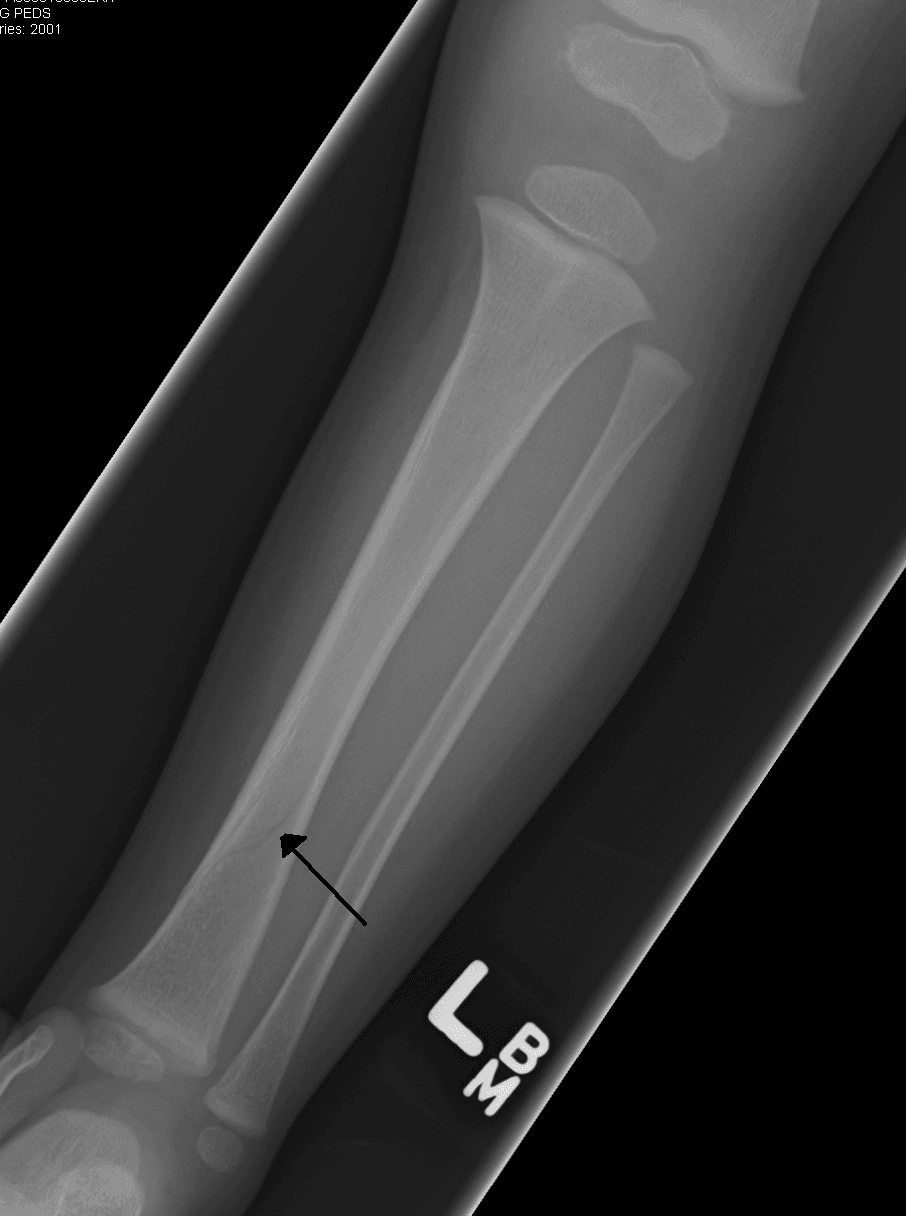
- Spiral fracture pattern on distal to mid tibial shaft
- Repeat X-ray at 2 weeks shows periosteal reaction confirming fracture
- Consider NAI if pattern inconsistent with developmental stage
- “Negative X-ray does NOT rule out toddler's fracture
- “Bone scan or MRI only if diagnosis uncertain and not improving
- “3-4 weeks in below-knee or above-knee cast
- “Look for spiral line on oblique view if AP/lateral negative
Overview and Epidemiology
A toddler's fracture is a subtle spiral or oblique fracture of the tibial shaft in a young walking child, produced by a low-energy twist. It is a common paediatric fracture, and it often presents to the emergency department or the GP.
Who. Classically a walking child of 9 months to 3 years, and boys are slightly more often affected. The child must be ambulatory: a spiral tibial fracture needs a twisting force a baby who cannot walk should not be able to generate, so the pre-walking infant is the one who raises safeguarding concern.
The age ceiling is soft. The largest series of isolated accidental spiral tibial fractures cited on this page (Mellick) found a mean age of 50.7 months, over four years, with only 32.7% aged three or under and none under one year. Its authors argued that the injury is a spectrum across early childhood rather than a distinct toddler entity. Below walking age, think safeguarding; above three, still think toddler's fracture.
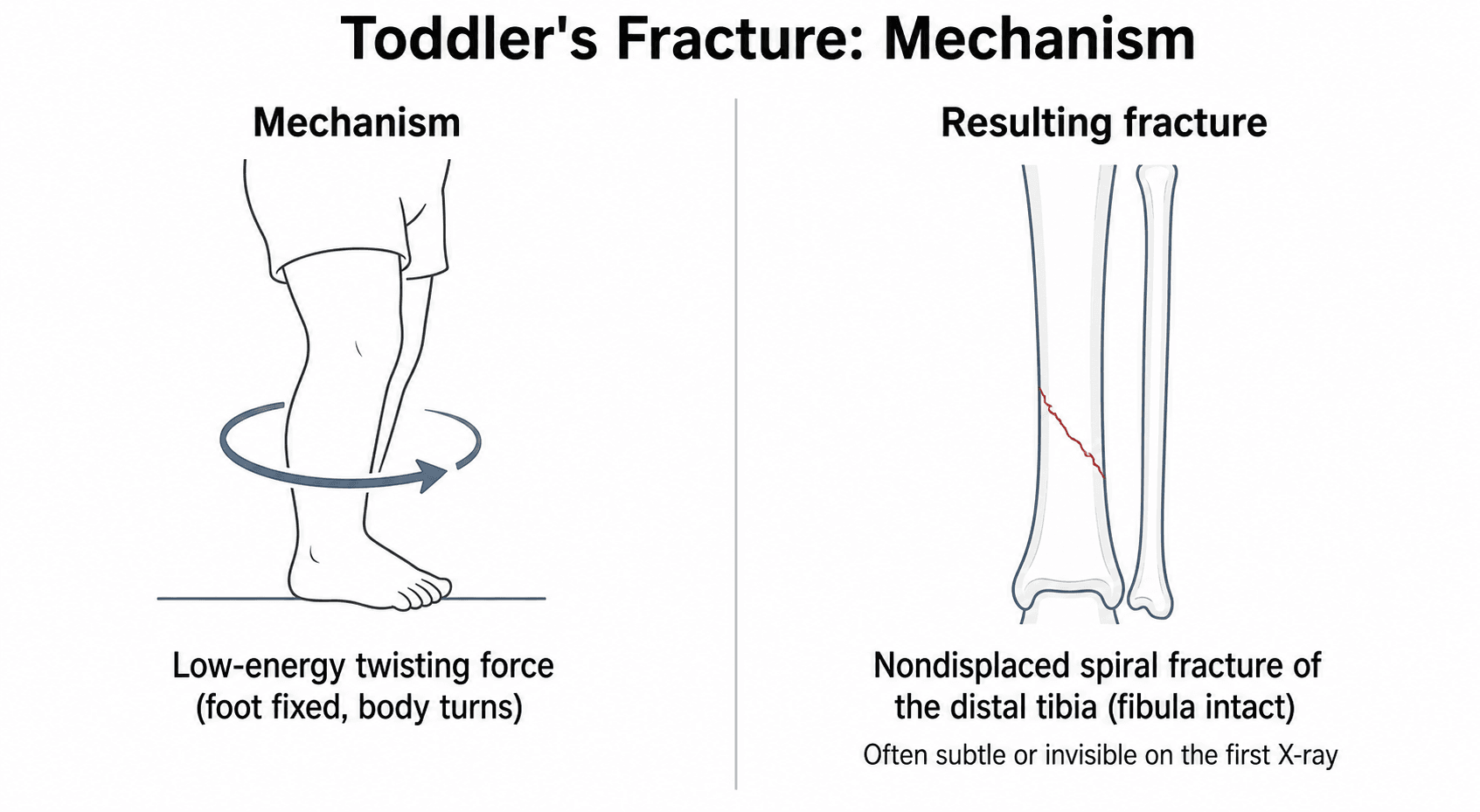
Mechanism. A low-energy twisting injury: running and stumbling, or a fall in the playground. The event is often unwitnessed, and the child cannot describe it.
Anatomy and Biomechanics
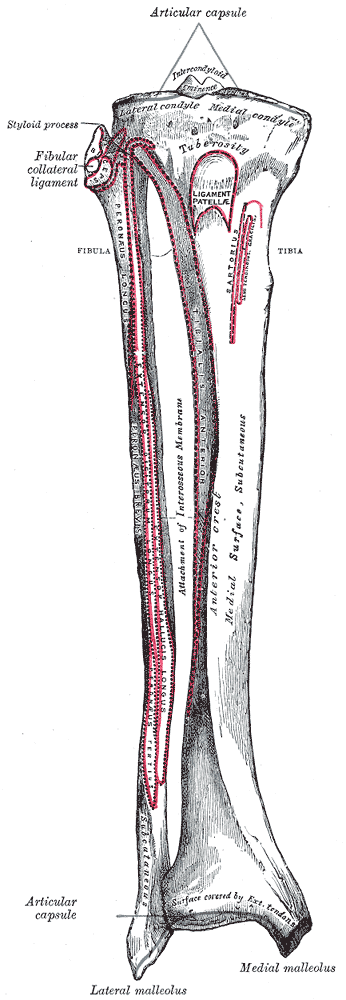
Where it breaks. The fracture typically lies in the distal third to middle third of the tibial diaphysis.
Why toddlers. A child just learning to walk has an immature gait, wide-based and unsteady, and falls are common during play. The tibia is relatively weak compared with the forces generated. After the age of 3-4, gait matures and coordination improves.
Why a spiral. If the foot is fixed, on the ground or in a shoe, and the body rotates, a spiral force is transmitted to the tibia. Young bone is more porous and less mineralised and fails under torsional stress. The periosteum is thick in children and often remains intact, which limits displacement.
Why it heals fast. The paediatric tibia has an excellent blood supply, and union is rapid, 3-4 weeks, compared with adults.
Classification and Variants
The classic pattern. A spiral or oblique fracture of the distal to mid tibial diaphysis, non-displaced or minimally displaced. It is often subtle or invisible on the initial X-ray, so look carefully for a faint spiral line or a cortical discontinuity. A transverse pattern means higher energy, and a high-energy mechanism makes the injury atypical.
Variants. Any lower-limb bone can sustain a low-energy fracture in this age group:
- Cuboid, with a similar mechanism: the "cuboid toddler's fracture"
- Calcaneus, rare but reported
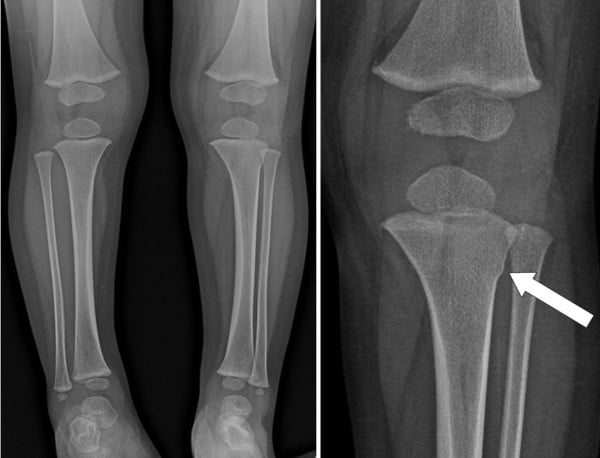
- Fibula: an isolated fibular fracture is less common but can occur
Clinical Assessment
History. The child is limping or refusing to walk, often with no witnessed injury. If anyone saw it happen, the mechanism was low-energy, with no significant trauma. Ask about developmental milestones, because the question that matters is whether the child is walking.
Examination. Point tenderness along the tibial shaft, with minimal or no swelling, no obvious deformity and a normal neurovascular status. The child refuses to bear weight.
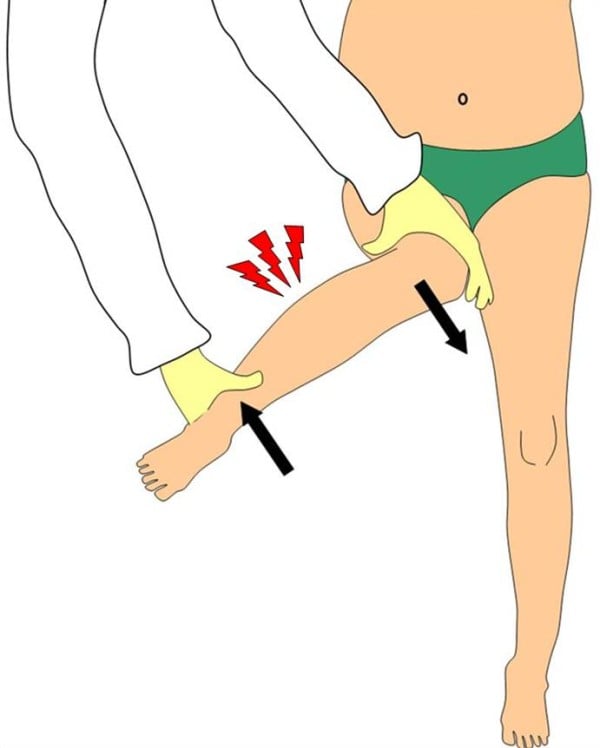
Trust your clinical examination. A walking-age toddler who refuses to bear weight, has point tenderness over the tibia and has no other explanation (hip, knee and foot pathology ruled out) likely has a toddler's fracture even if the X-ray is negative. Treat clinically.
The differential. A toddler's fracture is a diagnosis reached only after the dangerous mimics of the acutely limping or non-weight-bearing child have been considered. Before making it, assess the hip (septic joint, Perthes, transient synovitis), the knee (injury, infection), the foot (foreign body, injury) and the soft tissues (bruising, infection). The work-up may include inflammatory markers if infection is suspected.
- Discriminating clues
- Point tibial tenderness, afebrile, normal inflammatory markers, ambulant child
- Key test
- Tibia X-ray then 10-14 day repeat film
- Discriminating clues
- Fever, refusal to move joint, raised CRP/ESR/WCC, pseudoparalysis
- Key test
- Joint US then aspiration (Kocher criteria)
- Discriminating clues
- Localised metaphyseal tenderness, fever, raised CRP
- Key test
- MRI, blood cultures
- Discriminating clues
- Recent viral illness, low-grade or no fever, near-normal markers, weight-bears
- Key test
- US (effusion), markers to exclude sepsis
- Discriminating clues
- Non-ambulant child, mechanism mismatch, other/old injuries, delayed presentation
- Key test
- Skeletal survey, safeguarding referral
- Discriminating clues
- Midfoot/heel tenderness, normal tibia film
- Key test
- Oblique foot views, follow-up film/MRI
- Discriminating clues
- Night pain, systemic upset, multifocal pain, cytopenias, hepatosplenomegaly
- Key test
- FBC + film, LDH, marrow if suspected
- Discriminating clues
- Painless or chronic limp, abnormal hip ROM
- Key test
- Pelvis X-ray, frog-lateral
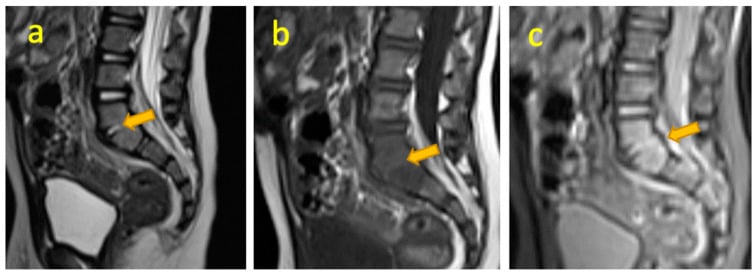
The Kocher Criteria: Septic Arthritis versus Transient Synovitis
The single most important cannot-miss diagnosis in the limping toddler is septic arthritis of the hip, and the Kocher criteria are the classic decision rule the differential refers to. Know them by name and number.
- Threshold
- Present
- Threshold
- Reported fever, conventionally over 38.5 degrees C - the child need not be febrile on arrival
- Threshold
- At least 40 mm/hr - exactly 40 is positive
- Threshold
- Over 12,000 cells per microlitre
How the count translates. The probability of septic arthritis rises steeply with the number of predictors met. In Kocher's original series it was roughly less than 1% with none, about 3% with one, about 40% with two, over 90% with three, and about 99% with all four; later validation cohorts gave somewhat lower figures. A raised CRP (over about 20 mg/L) is an additional strong predictor in modified versions.
What to do. A child meeting several criteria needs urgent hip ultrasound and joint aspiration, not a cast.
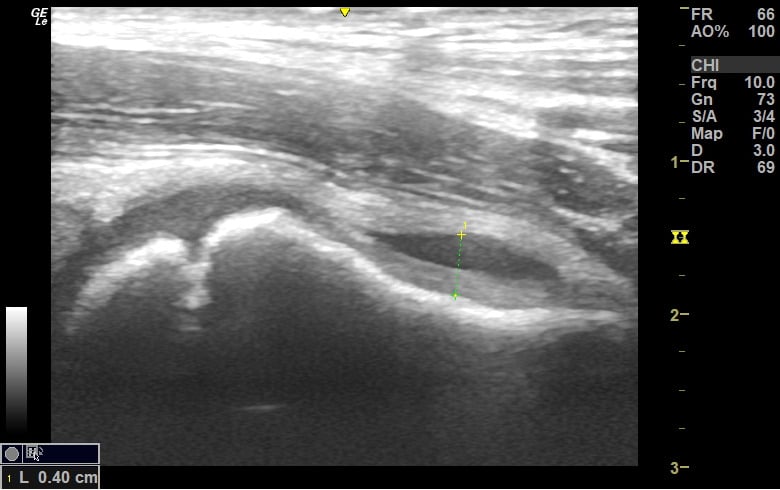
With all four Kocher predictors the probability climbs to around 93-99%. A febrile toddler who refuses to weight-bear is septic arthritis until proven otherwise. Inflammatory markers and hip ultrasound take priority over assuming a fracture, and a febrile, non-weight-bearing toddler with raised markers has the hip aspirated.
Investigations
Radiographs. AP and lateral views of the full length of the tibia and fibula, including the ankle and the knee. The fracture is often non-displaced with minimal periosteal reaction at first, so look for a subtle spiral line, cortical irregularity, or only soft-tissue swelling. When the AP and lateral are negative, an internal oblique view may reveal the spiral line, and it is often where the fracture is best seen.
- Finding
- May show spiral line
- Sensitivity
- Variable
- Finding
- Often negative
- Sensitivity
- Low
- Finding
- Best for spiral
- Sensitivity
- Higher
- Finding
- Periosteal reaction
- Sensitivity
- High
Read every view. The lateral is often negative, but it can be the one projection that shows the fracture.
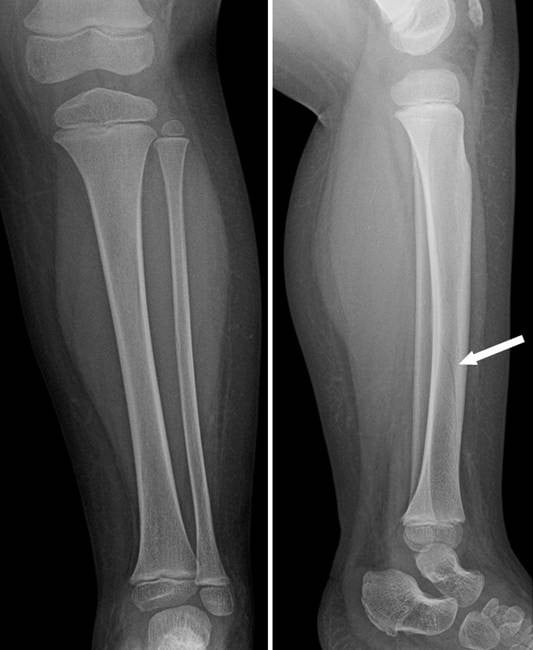
The negative film. The initial X-ray is negative in 50%, and a negative X-ray does not rule out a toddler's fracture.
The repeat film. A repeat X-ray at 2 weeks is the most reliable next test: periosteal reaction and early callus confirm the fracture. In practice most cases are treated clinically, and if the child is improving at 2 weeks the diagnosis is confirmed.
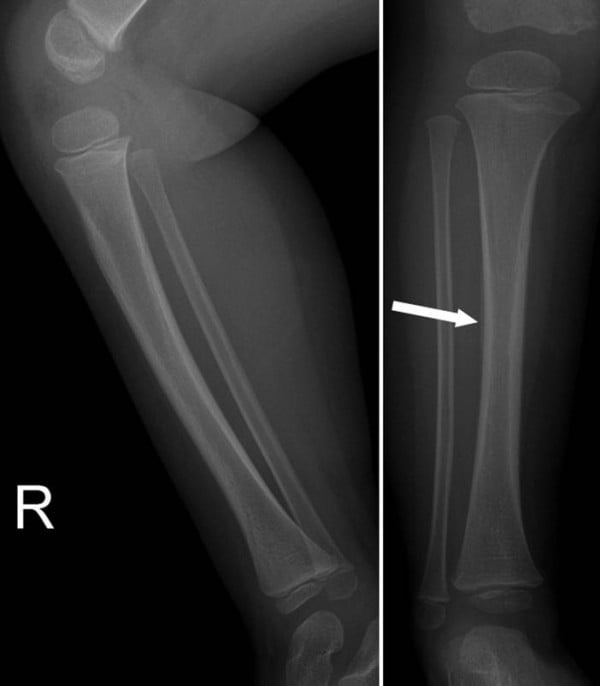
Bone scan and MRI. Only if the diagnosis is uncertain and the child is not improving. A bone scan is very sensitive but involves radiation and is rarely needed. MRI can show bone marrow oedema and the fracture line and is reserved for atypical cases.
Management
Treat on suspicion. Do not wait for a positive X-ray. If clinical suspicion is high (a limping walking-age toddler, tibial tenderness, a low-energy mechanism), apply a cast: the child will improve, and the follow-up X-ray confirms the diagnosis.
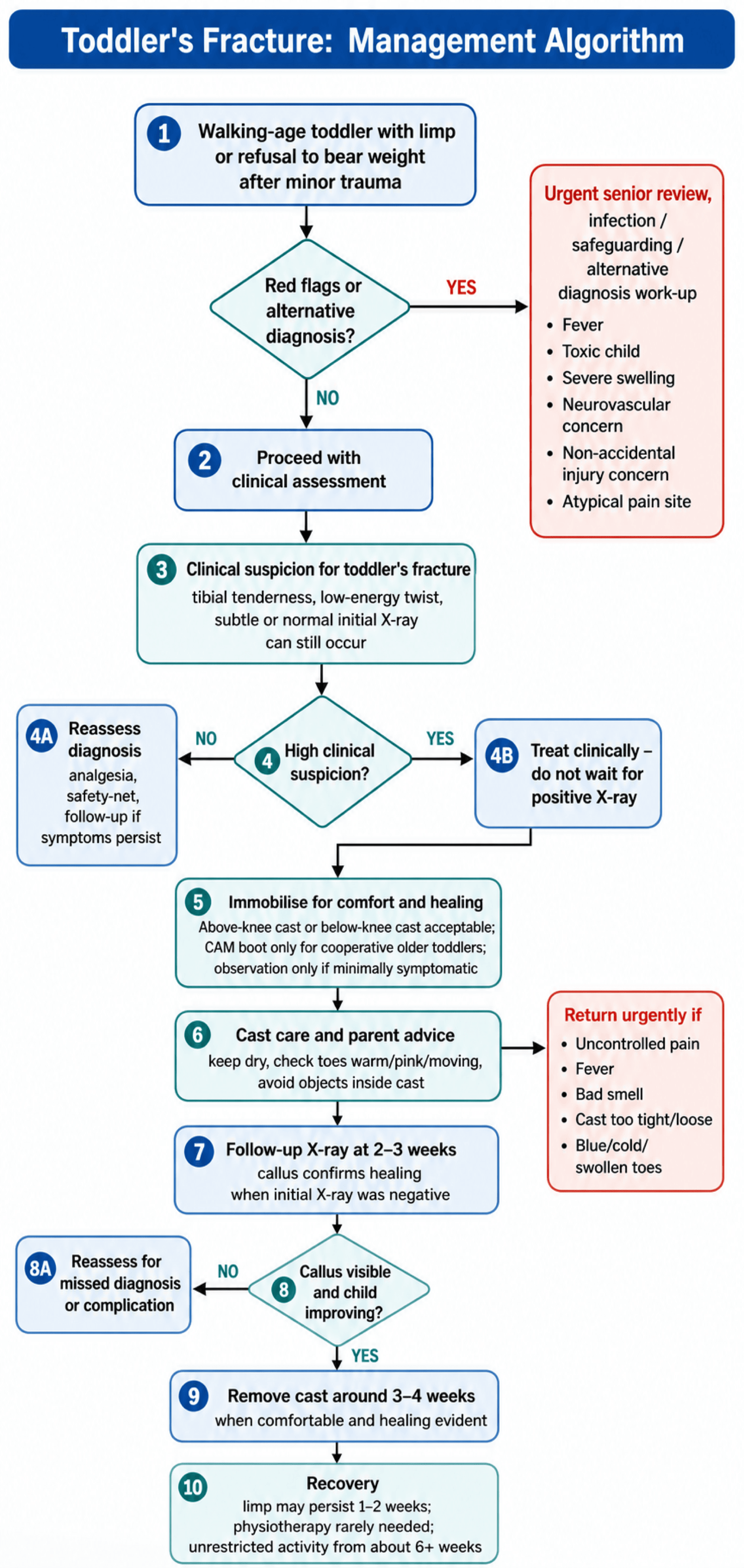
The cast. An above-knee cast (AKC) and a below-knee cast (BKC) are both acceptable. The above-knee cast controls rotation better and is well tolerated, because toddlers adapt quickly; the below-knee cast is lighter and allows knee motion. The cast stays on for 3-4 weeks, as healing is rapid at this age.
Alternatives. A CAM boot can be used in cooperative older toddlers, though compliance is less reliable. A very minimally symptomatic child may be observed, but a cast is generally preferred for comfort and to allow mobilisation, and most practitioners prefer it because it is simple, well tolerated and definitive. That preference is now contested by a randomised trial favouring the removable boot and by a cohort managed without immobilisation; both are set out under Controversies below.
Cast care. Parental education is crucial to successful management:
- A plaster cast must stay dry. Fibreglass with a waterproof liner can get wet if specified, but standard wool padding must be kept dry.
- Check the skin at the cast edges for redness or rubbing, and put nothing down the cast to scratch, because of the risk of infection.
- Check the toes are pink, warm and moving; cold, blue or swollen toes need medical attention.
- The child can crawl or scoot. Walking on a reinforced walking cast is generally allowed, though some prefer non-weight-bearing for the first week for pain control.
- Return for uncontrolled pain, fever, a bad smell from the cast, or a cast that becomes loose or tight.
What to tell the parents. "We suspect a minor fracture that may not show on today's X-ray. We will treat with a cast for 3-4 weeks. A repeat X-ray will confirm healing. Your child will be walking normally again soon."
Surgical Considerations
Surgery is not required. Toddler's fractures are almost universally treated non-operatively, and surgery is not indicated for the typical fracture. It is non-displaced, paediatric healing is excellent, the thick periosteum maintains alignment and there is no instability.
Referral. Most cases are managed by the emergency department or GP without orthopaedic referral, as treatment is straightforward. Refer to paediatric orthopaedics for:
- An atypical presentation
- Concern for non-accidental injury
- Failure to improve with casting
- Other associated injuries
- Diagnostic uncertainty
- A suspected pathological fracture
Complications and Prognosis
Prognosis. Excellent. Union is virtually 100% and nonunion essentially does not occur. Remodelling is not needed, since the fracture is usually non-displaced, and the child makes a complete return to normal gait and activity within weeks, with no long-term sequelae.
- Incidence
- Common
- Management
- Repeat X-ray at 2 weeks
- Incidence
- Occasional
- Management
- Skin checks, cast modification
- Incidence
- Extremely rare
- Management
- Almost never occurs in children
- Incidence
- None
- Management
- Fracture is diaphyseal, not physeal
- Incidence
- None
- Management
- Excellent prognosis
Non-Accidental Injury
The question is mobility. A spiral tibial fracture in a non-ambulatory child, one not yet walking, raises suspicion for non-accidental injury. Document developmental milestones carefully. Consider abuse when the picture is atypical:
- The child is non-ambulatory, or a spiral fracture is found in an infant
- The history is inconsistent or changing, or the explanation does not match the injury
- A developmental mismatch: the injury is impossible for the child's age
- Delayed presentation
- Other injuries in different stages of healing, or multiple fractures
- Rib fractures, or a metaphyseal (bucket-handle) fracture
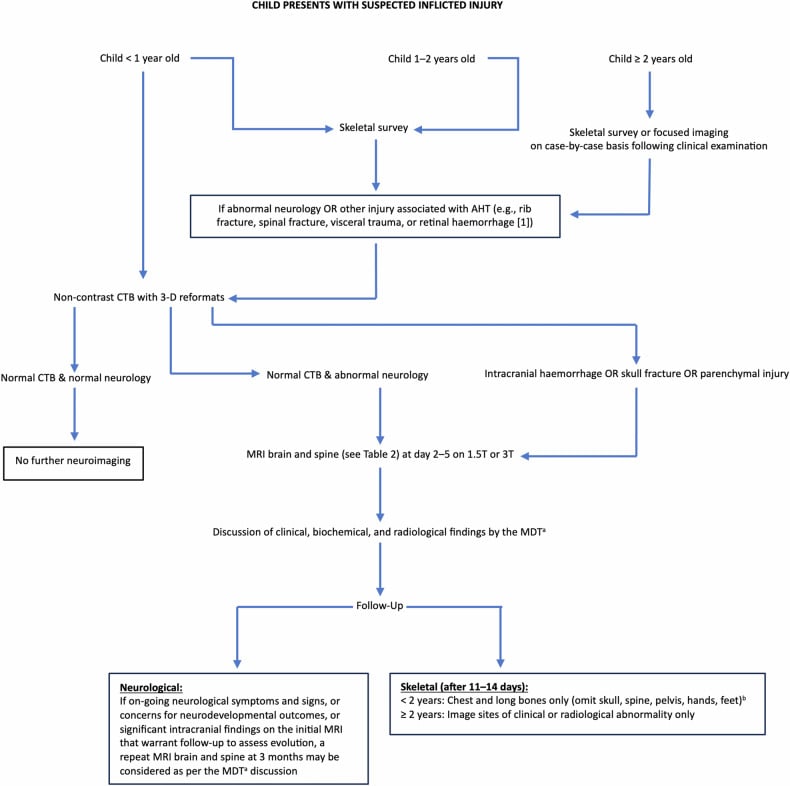
Action. If non-accidental injury is suspected, obtain a full skeletal survey, refer to child protection and document thoroughly.
The Classic Metaphyseal Lesion and NAI Fracture Specificity
The red flags above include the "bucket-handle" fracture, and the viva below asks about it. The examiner expects you to know what it is and where the spiral tibial fracture sits on the abuse-specificity scale.
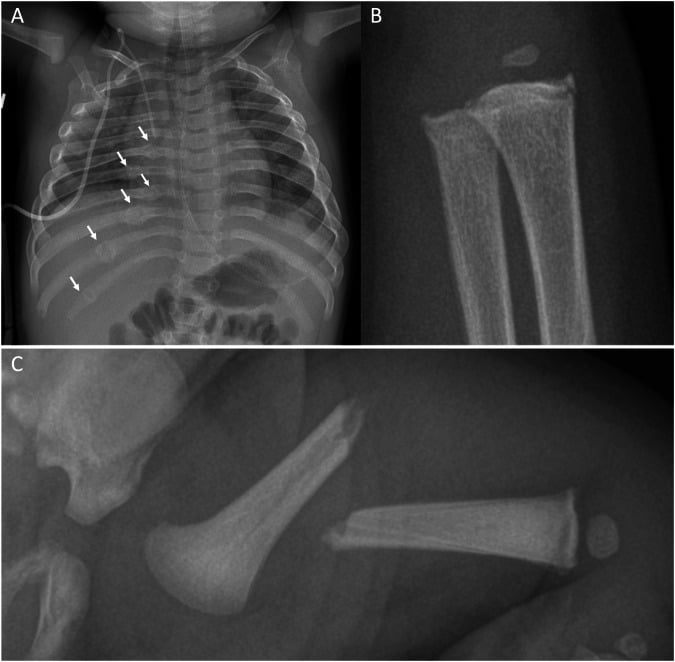
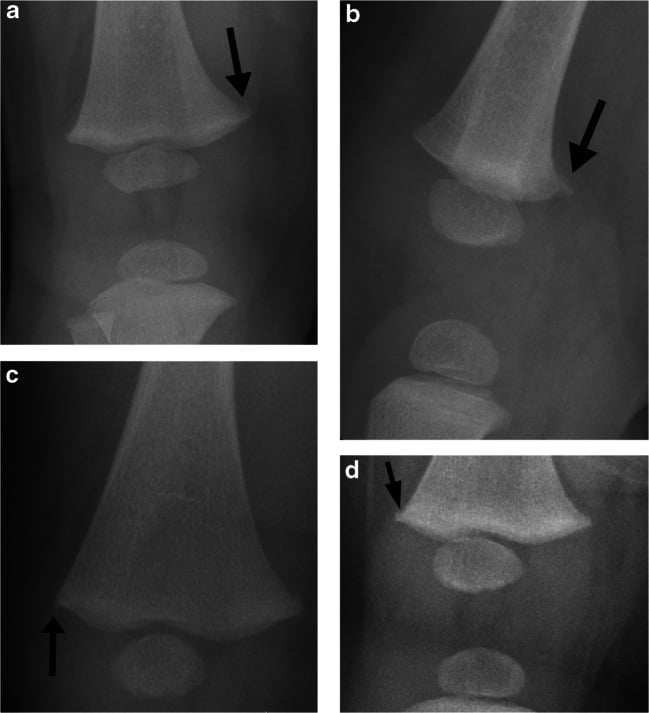
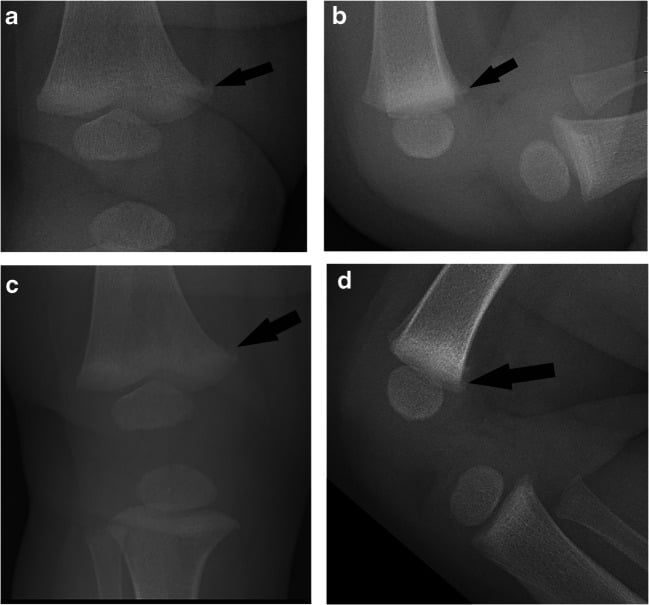
What it is. The classic metaphyseal lesion (CML) is a planar fracture through the immature metaphysis (the primary spongiosa), running roughly parallel to the physis. Its radiographic name depends on the projection:
- Seen tangentially, it looks like a small triangular "corner" fracture
- Seen en face or obliquely, the same lesion looks like a crescentic disc, the "bucket-handle" appearance
Why it matters. It is produced by shearing and traction-torsion forces (pulling, twisting or shaking a limb) and is highly specific for inflicted (non-accidental) injury, classically at the distal femur, the proximal and distal tibia, and the proximal humerus.
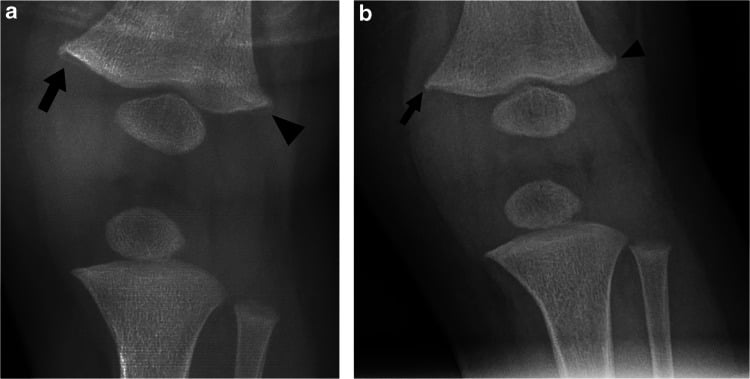
The limit of the word "specific". The association is real and strong, and it is what should raise the alarm - yet it has never been quantified. Kemp's systematic review (BMJ 2008, PMID 18832412) was able to compute a probability of abuse for rib (0.71), humerus, femur and skull fractures, but found insufficient comparative studies to calculate one for the classic metaphyseal lesion at all, and its conclusion applies to every pattern on this page: no fracture, on its own, distinguishes an abusive from a non-abusive cause. In an exam, in a report and in court, "highly suggestive of inflicted injury, and requiring full safeguarding assessment" is defensible; "diagnostic of abuse" is not. The CML earns its place by prompting the assessment, not by concluding it.
Mimics. Normal metaphyseal variants can look like a CML, and telling them apart is a job for both projections, the distribution of the findings and an experienced paediatric radiologist.
- Fractures
- Classic metaphyseal lesions (corner / bucket-handle); posterior rib fractures; scapular, spinous-process and sternal fractures
- Fractures
- Multiple fractures (especially bilateral); fractures of different ages; epiphyseal separations; vertebral and digital fractures; complex skull fractures
- Fractures
- Clavicle, long-bone shaft fractures (including the ambulant child's spiral tibia) and linear skull fractures
An isolated spiral tibial fracture in a walking child is a low-specificity pattern, usually accidental. The same-looking spiral fracture in a non-ambulant infant, or any CML (corner and bucket-handle are one lesion in two projections), posterior rib, scapular, spinous-process or sternal fracture, is high-concern and mandates a skeletal survey and safeguarding referral.
Follow-Up Protocol
Toddler's Fracture Follow-Up
Clinical assessment, X-ray (may be negative), apply cast if suspected. Document developmental milestones.
Optional - check cast fit if any concerns. Phone follow-up acceptable.
X-ray through cast or after cast removal. Look for periosteal reaction / callus confirming fracture healing.
Remove cast once callus visible and child comfortable. Allow gradual return to walking.
Child should be walking normally. No further follow-up needed unless concerns.
Full unrestricted activity, including running and jumping.
After the cast. Stiffness is minimal in toddlers and usually resolves spontaneously within days. The child may limp for 1-2 weeks out of habit or mild stiffness, which is normal.
Rehabilitation. Formal physiotherapy is rarely needed. Spontaneous play is the best rehabilitation and is sufficient for a return to full function in the vast majority of cases.
Is the routine film needed? The protocol above includes a film at 2-3 weeks, but some pathways discharge with safety-netting alone; that debate is set out under Controversies.
Guidelines, Registries & Global Practice
- Spiral tibial fracture is among the most common fractures of the ambulant toddler worldwide
- Mellick's series: mean age ~51 months, none under 1 year, slight male predominance, left side marginally more common
- Lower two-thirds of the tibia in ~95% of cases; the fibula is characteristically intact
- Incidence is hard to quantify because radiograph-negative cases are inconsistently recorded
- No implant registry applies (non-operative injury), so evidence comes from ED/paediatric cohorts and one RCT
- Bradman RCT (Australia) and Coveney cohort (Ireland) both point toward lighter, removable immobilisation
- Re-attendance, not union, is the practical outcome - union is effectively universal
- Bone scintigraphy (historical) has largely given way to follow-up radiographs or MRI for true diagnostic doubt
- Diagnosis emphasis
- Clinical diagnosis; radiograph-negative limp can still be a fracture; safeguarding screen
- Immobilisation stance
- Below-knee cast or removable boot; many discharge with safety-netting
- Diagnosis emphasis
- Tibia films, treat presumptively if classic; broaden search if atypical
- Immobilisation stance
- Long or short leg cast traditional; CAM boot increasingly accepted
- Diagnosis emphasis
- Stable, low-energy diaphyseal pattern; intact periosteal sleeve
- Immobilisation stance
- Conservative immobilisation; surgery essentially never indicated
- Diagnosis emphasis
- Clinical diagnosis, frequently documented on X-ray
- Immobilisation stance
- Prefer CAM boot or short-leg back-slab; usually no orthopaedic referral
- Ready access to repeat radiographs, ultrasound and MRI to exclude sepsis and occult fracture
- Formal safeguarding teams and skeletal-survey protocols for suspected NAI
- Growing use of removable boots and nurse-led / virtual fracture-clinic follow-up
- Heavier reliance on clinical diagnosis and a single radiograph; advanced imaging may be unavailable
- Plaster cast remains the default - cheap, robust and reliable for the unsupervised toddler
- Safeguarding pathways may be informal; clinicians must still document mechanism and milestones carefully
Whatever the resource setting, a spiral long-bone fracture in a non-ambulant infant, a mechanism that does not fit, delayed presentation, or injuries of differing ages mandates consideration of inflicted injury, documentation of developmental milestones, and referral through the local safeguarding process. Mandatory-reporting law exists in most jurisdictions but the clinical duty to protect the child is global.
Controversies and Areas of Uncertainty
Immobilise the radiograph-negative limp? The longstanding teaching is to cast every clinically suspected toddler's fracture. Newer data (Coveney 2024) show that selected presumptive cases do as well without immobilisation. There is no consensus, and practice varies widely.
Cast, CAM boot or back-slab? A randomised trial (Bradman 2021) found a removable CAM boot gave easier care and faster weight-bearing with equal healing. Many still default to an above-knee cast for the unreliable toddler, and the best device remains debated.
Is routine follow-up needed? Some pathways discharge with safety-netting only; others mandate a 2-week clinic film to "confirm" a clinically obvious diagnosis. In the typical case, repeat imaging mainly adds reassurance and exposure, not a change in management.
Terminology and age limits. Mellick's CAST (childhood accidental spiral tibial) fracture work argues that the rigid "9 months to 3 years" definition is artificial, because accidental spiral tibial fractures occur across early childhood. The classic age band is a teaching aid, not a strict diagnostic gate.
The controversy is a trap and an opportunity. State that the fracture is benign and that the live debates are about how much immobilisation and follow-up, not whether to exclude sepsis and NAI. Anchoring on the safe principles (rule out septic arthritis, consider NAI in the non-ambulant child) scores marks regardless of which immobilisation philosophy you favour.
MCQ Practice Points
Q: What is the typical age range for toddler's fracture? A: 9 months to 3 years. The child must be ambulatory (walking age). Before walking age, consider NAI.
Q: What percentage of toddler's fractures have a negative initial X-ray? A: Approximately 50%. Repeat X-ray at 2 weeks shows periosteal reaction, confirming the diagnosis.
Q: How should you manage a suspected toddler's fracture with negative X-ray? A: Apply a cast and treat clinically. A negative X-ray does not rule out the diagnosis. Treat based on clinical suspicion.
Q: What is the typical fracture pattern in toddler's fracture? A: Spiral or oblique, non-displaced, distal to mid tibial shaft. The spiral pattern results from rotational force.
Q: How long should a toddler's fracture be casted? A: 3-4 weeks. Healing is rapid in this age group.
Q: In what circumstance is a spiral tibial fracture concerning for NAI? A: In a non-ambulatory child (not yet walking). Toddler's fracture requires the child to be walking. Spiral fracture in a non-walker raises abuse concern.
Exam Viva Scenarios
Practise clinical reasoning and management decisions out loud
“An 18-month-old boy presents with acute onset limping. Mum reports he was playing in the backyard and then started crying and refusing to walk. He is afebrile. X-rays of the tibia are normal. How would you manage this?”
“A 7-month-old infant presents with a spiral tibial fracture. The parents report she rolled off the couch and hasn't been moving her leg since. She is not yet walking. What are your concerns?”
“A 22-month-old was treated for suspected toddler's fracture in a cast 2 weeks ago after presenting with a limp and negative X-ray. On review today, the parents report she is still not walking. Repeat X-ray is also normal. What are your next steps?”
Key Features
- Age 9 months to 3 years (walking)
- Spiral/oblique tibial shaft fracture
- Low-energy twisting mechanism
- X-ray often negative initially
Clinical Diagnosis
- Point tenderness over tibia
- Refuses to bear weight
- No visible deformity
- Treat even if X-ray negative
Treatment
- Above or below knee cast
- 3-4 weeks duration
- Repeat X-ray at 2 weeks
- 100% union rate
NAI Concerns
- Non-ambulatory child = red flag
- Spiral fracture in infant suspicious
- Inconsistent mechanism
- Document developmental stage
Prognosis
- Excellent - complete recovery
- No growth disturbance
- No long-term sequelae
- Normal gait by 4-6 weeks
Evidence Base and Key Studies
Dunbar et al. - Original Description (1964)
- Coined the term 'toddler's fracture' / obscure tibial fracture of infants
- Subtle spiral or hairline fracture of the tibial shaft in ambulant young children
- Often occult on the initial radiograph; soft-tissue swelling may be the only clue
- Excellent prognosis with simple immobilisation
Mellick et al. - CAST Fractures Series
- Retrospective review of 55 children with isolated spiral tibial fractures (two US tertiary centres)
- Age range 12 to 94 months (mean 50.7 months); no child was under 1 year of age
- Lower two-thirds of the tibia involved in 95%; displacement usually none or minimal
- No fracture was confirmed to be non-accidental - the pattern is overwhelmingly accidental
Bradman et al. - RCT: CAM Boot vs Above-Knee Cast
- Randomised controlled trial, 87 children aged 1 to 5 years with proven or suspected toddler's fracture
- Controlled-ankle-motion (CAM) boot vs above-knee plaster-of-Paris cast
- CAM boot gave significantly better caregiver care-and-comfort scores at every time-point (all p of 0.001 or less)
- Faster return to weight-bearing at day 7-10 (77.5% vs 53.8%) with NO difference in fracture healing or pressure injuries
John et al. - Expanding the Concept
- Pictorial review broadening 'toddler's fracture' beyond the classic spiral tibia
- Includes occult fibular buckle/plastic-bowing, tibial stress/compression and tarsal/metatarsal fractures
- Some fractures so subtle that bone scintigraphy or follow-up radiographs are needed to detect them
- All share an identical clinical picture - the limping or non-weight-bearing toddler
Starshak et al. - Occult Calcaneal 'Toddler's' Fracture
- Ten occult calcaneal fractures in children aged 19 to 41 months presenting with acute limp
- All had non-contributory initial radiographs and were detected by bone scintigraphy
- Follow-up films later showed the fracture in 4 of 10 and confirmed healing
- Described as 'another toddler's fracture' - the foot can be the hidden source