Diagnosis of Exclusion
- Diagnosis of Exclusion: You MUST rule out CP, Duchenne's, and Autism/Sensory processing issues.
- Key Exam Finding: Normal neurological exam (no clonus, normal reflexes, normal tone).
- Gowers Sign: Check for proximal myopathy (Duchenne).
- Spasticity: Check for catch (Tardieu scale) to rule out CP.
- Management: Stretching to Casting to Surgery (TAL/Gastrocs).
- “Ask about birth history (prematurity = CP risk)
- “Ask about 'late walker' (Duchenne)
- “Can they stand flat on command? (Differentiates habit from fixed contracture)
- “Check localized back skin changes (hair tuft = tethered cord)
Overview and Epidemiology
Idiopathic toe walking (ITW) is walking on the toes (forefoot contact) in a child with no identifiable neurological or orthopaedic cause.
Natural history. New walkers often toe-walk intermittently for the first 3-6 months, and this is normal. Most ITW resolves spontaneously, but toe walking that persists beyond age 3 is considered pathological or habitual.
Sequelae. Long-term toe walking leads to adaptive shortening of the Achilles tendon (equinus contracture) and widening of the forefoot (splay foot), and rarely to traumatic symptoms in adolescence.
Associations. Toe walking has a high prevalence in children with autism spectrum disorder (ASD), where it is attributed to sensory processing. Speech delay and ADHD are also associated.
Aetiology. The cause is unknown: no single neurological or musculoskeletal mechanism has been proven, and the theories fall into three groups.
- Neurological: incomplete maturation of central pattern generators, abnormal supraspinal control of gait, vestibular dysfunction affecting postural control, and sensory processing abnormalities
- Musculoskeletal: primary shortening of the gastrocnemius-soleus complex, developmental variation in tendon length, or a habitual pattern leading to adaptive shortening
- Genetic: strong familial clustering, with a positive family history in 30-70%; an autosomal dominant inheritance pattern has been suggested, and ITW may represent a phenotypic spectrum with variable penetrance. The clustering suggests a heritable component, but no gene has been defined
Muscle fibres. Altered fibre composition belongs to the musculoskeletal hypothesis: histological studies of the calf muscle in ITW show increased Type I (slow-twitch) fibres. The pattern suggests a chronic adaptation to sustained activity rather than a primary myopathy.
True Idiopathic Toe Walking vs 'Short Tendo Achilles'
The distinction. In the population cohort of Engström and Tedroff (JBJS Am 2018), true idiopathic toe walking did not cause a triceps surae contracture: around 79% resolved spontaneously by age 10 with passive dorsiflexion preserved. The small group who carried a fixed equinus from the start behaved differently. They should be diagnosed separately as a (often congenital) short tendo Achilles, which overturns the old habit of labelling every toe-walker "idiopathic".
- True idiopathic toe walking
- Intermittent, can often stand/walk flat on command
- Short tendo Achilles
- Persistent; cannot reach the floor flat
- True idiopathic toe walking
- Preserved (no fixed contracture)
- Short tendo Achilles
- Fixed equinus from early on (cannot reach neutral)
- True idiopathic toe walking
- ~79% resolve spontaneously by age 10, no contracture
- Short tendo Achilles
- Does NOT self-resolve; contracture persists/worsens
- True idiopathic toe walking
- Reassurance and observation appropriate
- Short tendo Achilles
- Treat early (casting/surgery); do not just reassure
Why it matters. A fixed contracture (passive dorsiflexion that cannot reach neutral) in a persistent toe-walker should make you doubt the "idiopathic" label. It may be a non-idiopathic cause (CP, neuromuscular disease, tethered cord); and even when the neurology is normal, it is better classified as short tendo Achilles and treated rather than watched.
The corollary. A flexible toe-walker who can get flat has true ITW and a high chance of spontaneous resolution, so reserve "idiopathic" for the flexible, intermittently toe-walking child. This is the modern nuance behind the older teaching that ITW is a diagnosis of exclusion, and the distinction is still debated (see Controversies).
Pathophysiology, Anatomy & Pathomechanics
The gastrocnemius-soleus complex. Gastrocnemius crosses the knee and the ankle, so its tightness is tested with the knee extended. Soleus crosses only the ankle, and its tightness is tested with the knee flexed.
The Silfverskiöld test separates the two. If ankle dorsiflexion improves when the knee is flexed, the gastrocnemius is tight, which is the most common finding in ITW. If dorsiflexion stays limited with the knee flexed, the tightness is soleus or combined.
The gait. The pattern through stance, and how the body compensates:
- Initial contact: forefoot strike instead of heel strike
- Midstance: "vaulting" over the stiff ankle
- Push-off: often powerful, giving a "bouncing" gait
- Compensations: anterior pelvic tilt and lumbar lordosis (sway back) shift the centre of gravity forward
Classification Systems
Alvarez classification. Designed to guide treatment by the severity of the contracture.
- Mild: no fixed contracture; can stand flat on command; dynamic deformity only
- Moderate: transient contracture; can be passively corrected but walks on the toes
- Severe: fixed equinus contracture; cannot reach neutral dorsiflexion even passively
Pompeo types. Used for surgical planning, and read directly from the Silfverskiöld test.
- Type 1: gastrocnemius tightness only (Silfverskiöld positive), treated by a Zone 1 lengthening (Strayer)
- Type 2: gastrocnemius-soleus tightness (Silfverskiöld negative), treated by a Zone 2 (Baumann) or Zone 3 (TAL) lengthening
Clinical Assessment
History. The questions are aimed at the non-idiopathic causes:
- Birth: prematurity or a NICU stay raises the risk of CP
- Milestones: late walking suggests Duchenne or another myopathy
- Family history: does either parent walk on the toes?
- Pattern: intermittent or constant, and worse when tired?
- Progression: getting worse suggests a neuromuscular cause
- Pain: not a feature of ITW; it usually points to a tarsal coalition, infection or tumour
Examination. Three parts, in order:
- Gait: watch walking and running, and ask the child to "walk like a penguin" (heels only) and "walk like a giant" (toes)
- Neurological: patellar and Achilles reflexes; clonus (rapid rhythmic beating), where more than 3 beats is abnormal and suggests an upper motor neuron lesion (CP); tone, feeling for a catch; and Gowers sign, the child walking the hands up the thighs to stand from the floor
- Orthopaedic: the Silfverskiöld test (dorsiflexion with the knee straight and then bent); the popliteal angle for hamstring tightness, which is often associated; and the spine for a hairy patch or dimple (spina bifida occulta)
Mild CP or ITW. Mild spastic diplegia is the form of cerebral palsy that most often presents as an apparently idiopathic toe-walker, and these features separate the two.
- Mild Cerebral Palsy
- Often Premature / NICU
- Idiopathic Toe Walking
- Usually Normal Term
- Mild Cerebral Palsy
- Spastic (Clasp-Knife)
- Idiopathic Toe Walking
- Normal (or only tightness)
- Mild Cerebral Palsy
- Hyperreflexic / Clonus
- Idiopathic Toe Walking
- Normal
- Mild Cerebral Palsy
- Crouch / Scissoring / Intoeing
- Idiopathic Toe Walking
- Pure Equinus (Bouncing)
- Mild Cerebral Palsy
- Difficult
- Idiopathic Toe Walking
- Often can do on command (early)
Differential diagnosis. ITW is a diagnosis of exclusion, reached once these have been ruled out:
- Tone: cerebral palsy (spasticity)
- Muscle: Duchenne muscular dystrophy (weakness)
- Spine: tethered cord, diastematomyelia
- Sensory: autism and sensory processing disorders
- Orthopaedic: clubfoot, leg-length discrepancy, DDH, tarsal coalition
Investigations
Creatine kinase. A CK level is mandatory in all boys with toe walking to rule out Duchenne muscular dystrophy before the label "idiopathic" is applied. Genetic testing is added if there are suspicious features.
Radiographs. A lateral standing film looks for talar beaking (chronic impingement) and for a tarsal coalition (the C-sign).
Spine MRI. Indicated if there are any neurological signs: asymmetry, atrophy, reflex change or bladder symptoms. It rules out tethered cord, syrinx and diastematomyelia.
Gait analysis. It shows an absent "double bump" pattern and premature calf activation. It is used in research and is rarely essential in a straightforward clinical case.
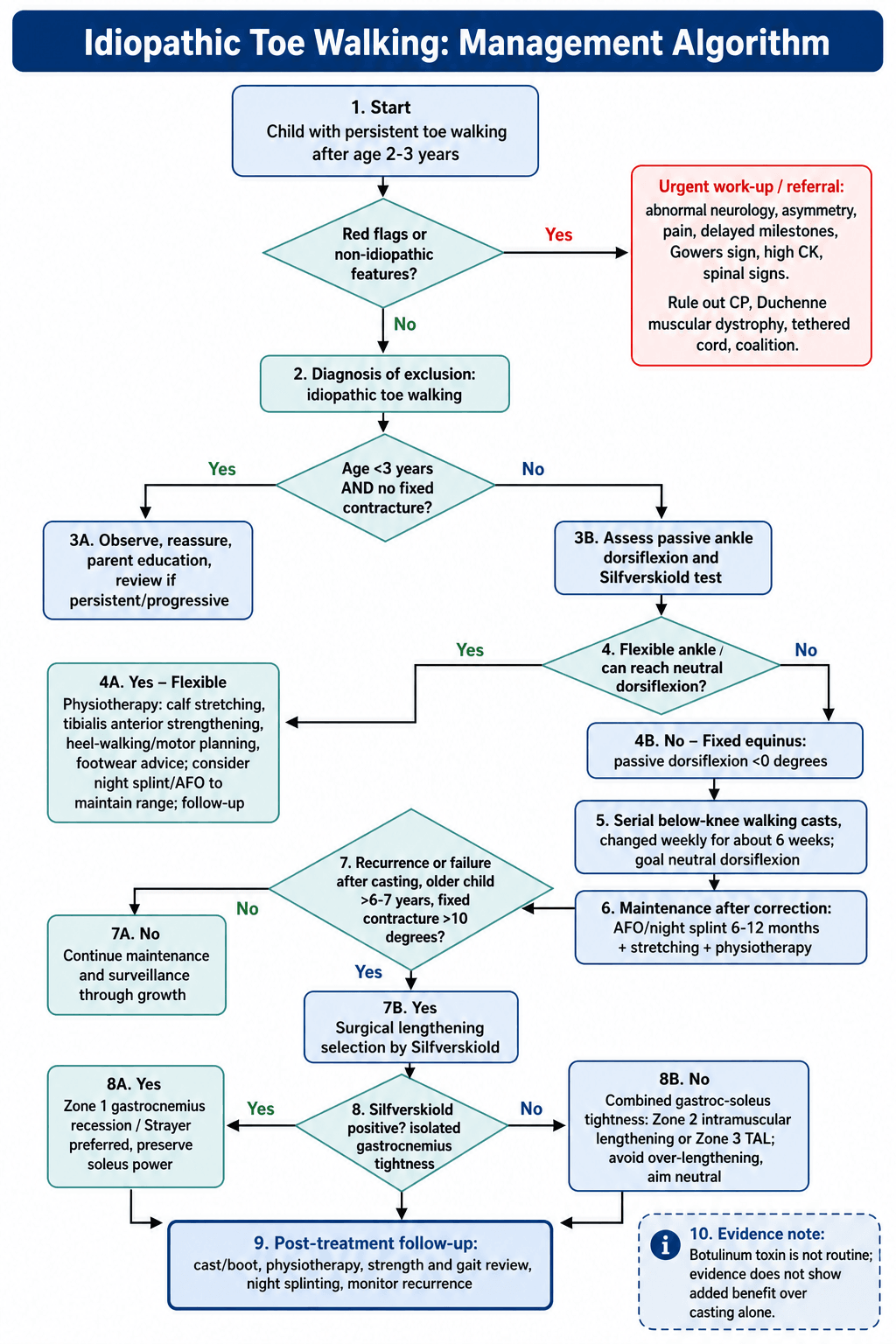
Management Algorithm
Observation. A child under 3 with no contracture is reassured, because most resolve.
Physiotherapy. Calf stretching, tibialis anterior strengthening, and motor-planning games such as walking on the heels.
Serial casting is the gold standard once there is a fixed contracture (dorsiflexion below 0°). Below-knee walking casts are changed weekly for 6 weeks. Short-term success is high, but recurrence is common; the next section explains how the cast works and why the equinus returns.
Botulinum toxin. It paralyses the gastrocnemius temporarily to allow easier stretching and casting. Some studies have reported that adding it to casting is better than casting alone, but the best RCT (Engström 2013) and systematic review (van Kuijk 2014) show that botulinum toxin A adds nothing to casting. Despite this it is widely used, and some centres still use it to ease casting; the evidence does not support routine use.
Surgical lengthening. The indications are:
- Age over 6-7 years
- Fixed contracture over 10°
- Failed serial casting
The level is chosen by the Silfverskiöld test, as the Pompeo types set out.
How Serial Casting Lengthens Muscle and Why It Recurs
Why a cast works when a stretch does not. The difference is the load profile, and it decides whether the tissue springs back or remodels.
- Manual/quick stretch
- High load, short duration
- Serial cast (sustained)
- Low load, long duration
- Manual/quick stretch
- Elastic - springs back to length
- Serial cast (sustained)
- Viscoelastic creep + biological remodelling
- Manual/quick stretch
- None lasting
- Serial cast (sustained)
- Adds sarcomeres in series (true lengthening of the muscle belly)
- Manual/quick stretch
- Transient
- Serial cast (sustained)
- Genuine, retained gain in dorsiflexion
Sarcomerogenesis. A muscle held at a sustained stretch responds by serial sarcomerogenesis, laying down new sarcomeres in series along each myofibril and genuinely lengthening the muscle belly, while the tendon undergoes viscoelastic stress-relaxation and creep. A brief manual stretch only deforms the tissue elastically, so it recoils. That is why casting, not stretching, is the conservative workhorse for a true contracture.
Why it recurs. Longitudinal muscle growth normally keeps pace with bone by adding sarcomeres at the myotendinous junction, driven by the stretch the growing bone applies. In a toe-walker the muscle-tendon unit fails to keep pace with the bone lengthening at the physis, so every growth spurt re-shortens it and the equinus returns.
What follows. Recurrence reflects the biology of a growing child rather than a failed technique, so correction in a skeletally immature child is inherently fragile. Night splinting follows correction and surveillance continues through growth, and rapid or repeated recurrence should prompt a re-screen for a missed driver (tethered cord, evolving CP).
Surgical Technique: Zone 1 vs Zone 3
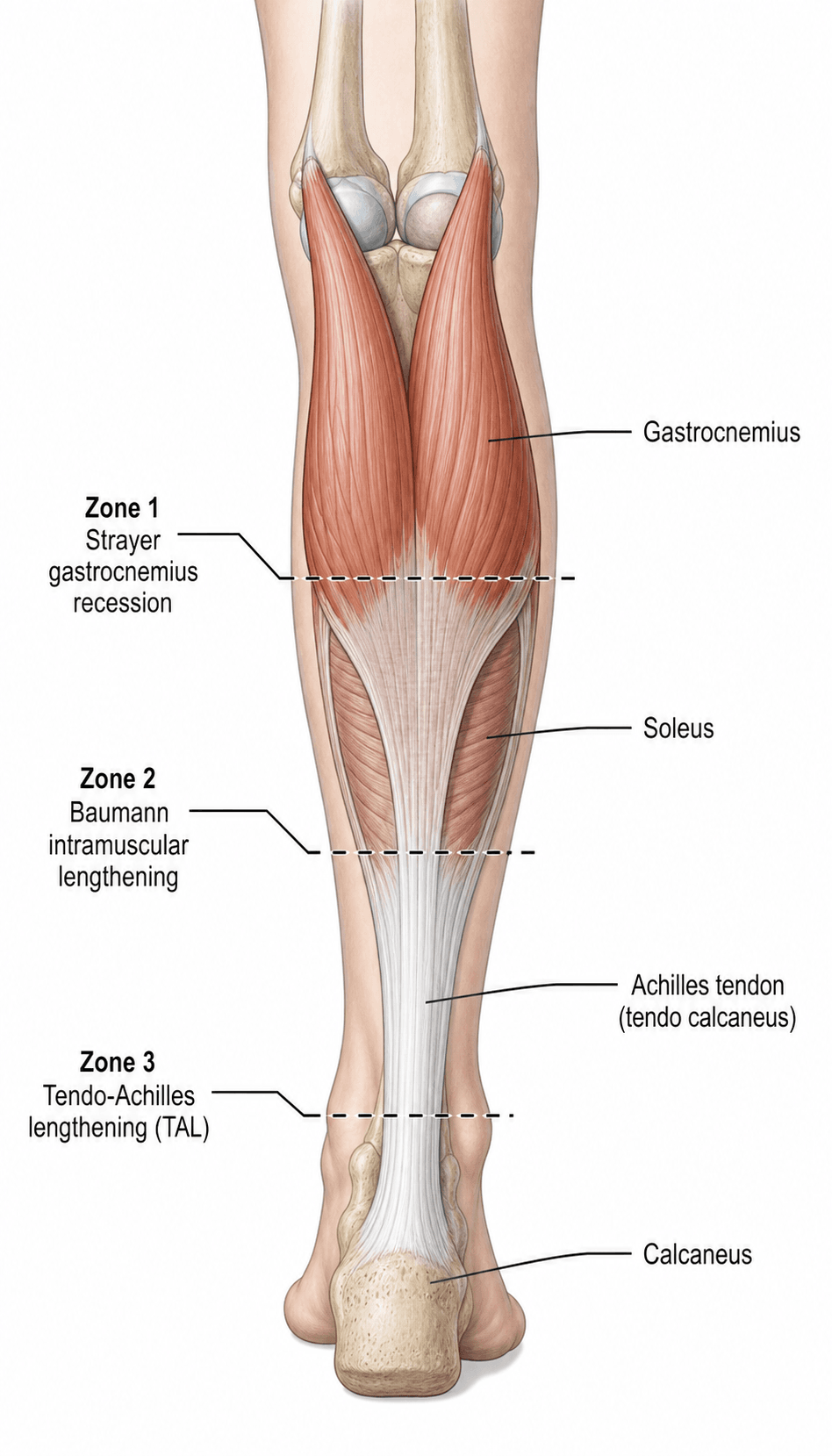
Gastrocnemius recession (Strayer) is for isolated gastrocnemius tightness. It maintains soleus power (push-off strength) and carries a low risk of over-lengthening.
- Incise the posteromedial calf just distal to the muscle belly
- Identify the sural nerve (lateral)
- Separate the gastrocnemius tendon from the underlying soleus fascia
- Divide the gastrocnemius tendon transversely
- Push the foot into dorsiflexion: the cut ends separate, usually by about 2 cm
- Close the skin only
Complications
- Rate
- High (20-30%)
- Prevention/Management
- Continue night splints and stretching after surgery
- Rate
- Rare (TAL)
- Prevention/Management
- Avoid TAL where possible and do a Strayer; aim for neutral, not 10° dorsiflexion
- Rate
- Severe
- Prevention/Management
- The result of over-lengthening
- Rate
- Rare
- Prevention/Management
- Sural nerve at risk in lateral release
- Rate
- greater than 1%
- Prevention/Management
- Standard protocol
Recurrence is managed by escalating back up the ladder: re-stretch, re-cast, then revision surgery.
Calcaneal gait is largely preventable by never lengthening past neutral. Once established it is very difficult to reverse, and it is supported with an AFO and gastrocnemius strengthening.
Push-off weakness after TAL usually compensates over 6-12 months, but it may limit elite sprint and jump performance, a further reason to prefer the Strayer.
Postoperative Care
- Timing
- Weeks 0-4
- Focus
- Below-knee walking cast/CAM boot in neutral dorsiflexion (slight plantarflexion if repair tension is high); weight-bear as tolerated.
- Timing
- Weeks 4-8
- Focus
- Transition to AFO/night splint; begin active dorsiflexion and proprioceptive work; pool therapy if available.
- Timing
- Weeks 8-12
- Focus
- Progressive tibialis anterior and eccentric calf strengthening; single-leg balance; cycling.
- Timing
- Weeks 12+
- Focus
- Walk-jog progression then jump/hop drills; full sport once power normalises.
Night splints are critical. Evidence supports night splinting through the first 12 months to prevent recurrence.
Outcomes/Prognosis
Recurrence. ITW is notorious for recurrence, especially during growth spurts, and night splinting mitigates this.
Surgical durability. Functional gait gains after lengthening are maintained at 5 years (McMulkin, Gait Posture 2016).
Adult sequelae. Data are limited; most function well, occasionally with calf tightness or forefoot symptoms.
- Worse prognosis
- Older at presentation (over 7 years)
- Worse prognosis
- Severe fixed equinus (over 15 degrees)
- Worse prognosis
- Associated ASD or sensory-processing disorder
- Worse prognosis
- Multiple failed casting attempts; poor splint compliance
- Worse prognosis
- Rapid or repeated recurrence
Follow-up. The schedule differs after casting and after surgery:
- After casting: review at 6 weeks, then 3, 6 and 12 months, measuring dorsiflexion; continue night splints for 6-12 months and re-cast early recurrence
- After surgery: wound check at 2 weeks; immobilisation removed and physiotherapy started at 6 weeks; gait and strength review at 3 months; sport clearance at 6 months; then annual review to skeletal maturity
Guidelines, Registries & Global Practice
Global epidemiology:
- Prevalence approximately 2-5% in the general paediatric population; the best population data (Swedish cohort, n=1,401) give approximately 5% at age 5.5 years (Engström & Tedroff, JBJS Am 2018).
- Around 79% resolve spontaneously by age 10 without treatment or contracture.
- Family history positive in roughly 30-70% of series; slight male predominance.
- Toe walking is far more common in autism spectrum disorder (approximately 20% in one large series) and in language/developmental disorders.
Side-by-side guidance (no single national society "owns" ITW — practice is consensus-driven):
- Position on Toe Walking
- Observe children under 3-5 years with no contracture; most resolve.
- Position on Toe Walking
- Confirm diagnosis of exclusion first (rule out CP, neuromuscular disease, tethered cord); stretching and serial casting before surgery.
- Position on Toe Walking
- Serial casting and surgery improve dorsiflexion and gait; botulinum toxin A adds no benefit to casting.
- Position on Toe Walking
- Any boy with toe walking plus calf hypertrophy, late walking or proximal weakness needs a CK before an "idiopathic" label.
there is no dedicated ITW registry. ITW is a benign, self-limiting condition not tracked in arthroplasty/implant registries; outcome evidence comes from single-centre series and gait-analysis cohorts rather than national registries.
- Well-resourced centres: access to 3D instrumented gait analysis, formal serial-casting clinics, occupational therapy for sensory-driven toe walking, and selective surgery (Strayer/gastrocnemius recession preferred).
- Limited-resource settings: diagnosis is clinical; CK and spine MRI may be hard to obtain, so a careful neurological exam carries more weight. Home stretching and below-knee casting are low-cost and effective; surgery is reserved for fixed contractures that fail conservative care.
- A common global pitfall is late referral — toe walking dismissed as "they will grow out of it" until a fixed equinus contracture has developed.
Related pages: Cerebral Palsy is the diagnosis idiopathic toe walking is a diagnosis of exclusion FROM, and the comparison table in the clinical assessment section of this page sets out the discriminators - mild spastic diplegia is the one that most often presents as an apparently idiopathic toe-walker; Cerebral Palsy Gait and Single-Event Multilevel Surgery for how the same equinus is managed when it is neurological, and for the gait-analysis vocabulary the McMulkin cards use; Gastrocnemius Equinus Contracture for the Silfverskiöld test and the Zone 1 versus Zone 3 lengthening decision this page turns on; Gastrocnemius Anatomy for why a knee-extended contracture implicates gastrocnemius and a knee-flexed one implicates soleus; Duchenne Muscular Dystrophy is the red-flag diagnosis a boy who toe-walks with calf hypertrophy and a positive Gowers must not leave clinic without excluding; Charcot-Marie-Tooth Disease and Hereditary Spastic Paraplegia for the progressive neurological causes that declare themselves late; Tethered Cord Syndrome for the spinal cause suggested by asymmetry, back or bladder symptoms or a midline cutaneous marker; Spastic Equinovarus Foot for the deformity when tone drives it; Clubfoot for the residual or relapsed deformity that can present as toe-walking in a child with a treated foot; and Achilles Tendon Rupture for the over-lengthening complication at the far end of this page's surgical section - a calcaneal gait is harder to live with than a toe-walk.
Controversies & Areas of Uncertainty
Distinct entity or spectrum? The 2018 natural-history cohort argues that children with an early fixed contracture are a separate "short tendo Achilles" group, not true ITW, which challenges the older habit of labelling all toe-walkers idiopathic.
When, and whether, to intervene. Because most children resolve spontaneously, the threshold for casting versus observation in a flexible foot is genuinely uncertain, and over-treatment of a self-limiting condition is a real risk.
Strayer, TAL or intramuscular lengthening. Strayer (gastrocnemius recession) is favoured for isolated gastrocnemius tightness to preserve push-off power, but high-level comparative data are lacking. The choice is guided by the Silfverskiöld test and surgeon preference.
Sensory drive in ASD. In autism or sensory-processing toe walking, mechanical correction may fail if the sensory drive persists. The place of occupational or sensory therapy versus orthopaedic treatment is not standardised.
Deep Dive: Sensory Processing
Why do they do it? In children with ASD or Sensory Processing Disorder, toe walking is theorized to be:
- Seekers: Seeking intense proprioceptive input through the calf muscles.
- Avoiders: Avoiding tactile sensation of the floor on their heels/soles.
- Vestibular: Altering head position in space. Implication: Mechanical treatment alone (casting/surgery) may fail if the sensory drive remains. Occupational Therapy is key.
Parent's Guide: Frequently Asked Questions
Q: Will he grow out of it? A: If he is under 3, possibly. If he is 7 and has tight heels, no. He needs help (stretches or casting).
Q: Is surgery dangerous? A: It is low risk, but "over-lengthening" is a disaster where the child walks flat but has no power to run or jump. We are very conservative to avoid this.
Q: Why do we have to cast? Can't we just stretch? A: Once the tendon is physically short (contracture), manual stretching is like trying to stretch a leather belt. It doesn't work well. Casting provides a "low load, long duration" stretch that actually remodels the tissue.
Q: Does Botox cure it? A: No. Botox just relaxes the muscle temporarily. We use it to make the casting easier and more effective, but the casting does the work.
Q: What about AFOs (ankle braces)? A: AFOs can help maintain correction after casting or surgery, and are useful as night splints to prevent recurrence. They don't actively stretch the tendon but prevent it from shortening again. Solid AFOs are best for contracture prevention.
Q: Can toe walking cause back pain? A: Chronic toe walking can cause compensatory lumbar lordosis (swayback) to shift the centre of gravity forward. This may contribute to back pain in some cases, though studies haven't shown a strong long-term association.
Q: My child was diagnosed with autism. Will the toe walking treatment still work? A: Treatment outcomes are somewhat less predictable in children with autism spectrum disorder. The mechanical treatment (casting/surgery) can still work for the contracture, but the sensory-seeking behaviour may persist. Occupational therapy addressing sensory processing is an important part of management.
Case Study: The Late Presenter
9-year-old male. History: Tioe walker since age 2. "Physio didn't work". Exam:
- Fixed equinus: -20 degrees dorsiflexion with knee straight. -10 degrees with knee bent.
- Neuro: Normal. CK: Normal.
- Gait: Bouncing, early heel rise.
- Attempted Serial Casting x 6 weeks. Improved to neutral, but recurred within 3 months.
- Surgery: Zone 1 Gastrocnemius Recession (Strayer).
- Intra-op: 2.5cm gap obtained in muscle belly. Dorsiflexion improved to +15 degrees.
- Post-op: Walking boot 4 weeks. Night splints 6 months.
- Outcome: Walks flat. Plays soccer. No recurrence at 2 years.
Key Learning Points from Case
- Serial casting should be attempted first even in older children with fixed contractures
- Zone 1 (Strayer) is preferred when gastrocnemius is the primary problem (positive Silfverskiold)
- Post-operative splinting is crucial - minimum 6 months to prevent recurrence
- Complete neurological workup (CK, neuro exam) must precede any surgical intervention
- Realistic expectations - improvement takes time and compliance is essential
Additional Case Scenarios
Case 2: The Toddler
- 2.5-year-old female, intermittent toe walking noticed by parents
- Can stand flat on command, no contracture
- Normal neurological examination
- Management: Reassurance, observation, reassess at age 3-4 if persists
Case 3: The Duchenne Suspect
- 4-year-old male with toe walking, difficulty climbing stairs
- Positive Gowers sign, enlarged calves
- CK level: 15,000 U/L (normal less than 200)
- Management: Urgent referral to paediatric neurologist, genetic testing, NOT orthopaedic surgery
MCQ Practice Points
Q: Which feature is consistent with Idiopathic Toe Walking? A: Normal Reflexes. Hyperreflexia suggests CP. Absent reflexes suggests neuropathy/myopathy.
Q: What is the primary advantage of a Strayer procedure over a TAL? A: Preservation of Push-off Power. The soleus is left intact to generate force.
Q: What neuro-developmental disorder is most strongly associated with toe walking? A: Autism Spectrum Disorder (ASD).
Q: A positive Silfverskiold test implies tightness of which muscle? A: Gastrocnemius. (Improved DF with knee flexion).
Self-Assessment Quiz
2. Describe a positive Gowers sign.
The child uses their hands to 'climb up' their legs when standing from a floor sitting position. Indicates proximal muscle weakness.
Viva Scenarios
Practise clinical reasoning and management decisions out loud
“4-year-old boy. Parents concerned he walks on toes. Constant. No pain.”
“7-year-old girl. Casted twice. Recurved. Now has -15 deg dorsiflexion.”
“Child toes walk, but when standing flat, they have a severe flat foot.”
RULE OUT
- Cerebral Palsy (Spasticity)
- Duchenne (CK)
- Tethered Cord (Spine MRI)
- Autism (Sensory)
- Habitual Toe Walking
CLINICAL
- Normal Neuro Exam
- Bouncing Gait
- Positive Silfverskiold
- Family Hx
CLASSIFICATION
- Alvarez Type 1 (Mild/Dynamic)
- Alvarez Type 2 (Moderate)
- Alvarez Type 3 (Fixed greater than 20 deg)
- Pompeo Type 1 (Gastroc)
- Pompeo Type 2 (Combined)
MANAGEMENT
- Stretch/Physio
- Serial Cast (Gold Stal)
- Strayer (Zone 1)
- TAL (Zone 3)
Evidence Base
Read the evidence base with one fact held in front of it: about 79% of children who have ever toe-walked develop a normal gait by age 10 with no intervention at all, and true idiopathic toe walking does not produce a contracture (Engström & Tedroff, carded below).
Now look at what the treatment studies actually compared:
- Fox — 44 children, serial casting, 66% improved. No control group. That success rate is lower than the untreated resolution rate.
- Engström RCT — cast versus botulinum-plus-cast. Both improved, no difference. There is no untreated arm, so it establishes that the injection adds nothing — not that casting does anything.
- McMulkin — before-and-after gait analysis in children selected for surgery. No control group.
- van Kuijk — one RCT and eighteen level-4 studies; the authors call the evidence preliminary and state that effectiveness on functional activities and social participation has yet to be demonstrated for any treatment.
So the honest position is not "casting works and surgery is durable" but "most of these children get better, treatment probably helps the persistent ones, and no study has separated the two." That is a stronger viva answer than a list of success rates, and it is the reason the management algorithm on this page is weighted toward observation in the young child without contracture.
The corollary for practice: the child who justifies treatment is the one the natural history does not cover — a fixed equinus that cannot reach neutral, persistence beyond the age at which resolution is expected, or a neurodevelopmental diagnosis that makes spontaneous resolution less likely.
Engström & Tedroff — Prevalence and Natural History
- Population-based cohort of 1,401 Swedish children; ITW prevalence approximately 5% (63 of 1,401) at age 5.5 years
- By age 10, 79% (50 of 63) had spontaneously developed a typical gait without intervention
- Idiopathic toe walking did NOT cause triceps surae contracture; a separate subgroup with early ankle contracture is 'short tendo Achilles', not ITW
- Neurodevelopmental comorbidity was common among persistent toe-walkers
Barrow, Jaworski & Accardo — Toe Walking in Autism
- Review of 954 ambulatory children seen by a developmental paediatrician
- Persistent toe walking occurred in 20.1% of 324 children with autism spectrum disorder
- Tight heel cords occurred in 12.0% of ASD children
- Confirms a high incidence of toe walking and secondary contracture risk in autism and language disorders