Rare | All Joints | Urgent Reduction | High AVN Risk
- Total talar dislocation = talus completely dislocated from all articulations (ankle, subtalar, talonavicular) - extremely rare, urgent reduction required
- Urgent reduction required - Skin tension causes necrosis, neurovascular compromise, high AVN risk. Reduce within hours, do not delay
- High AVN risk - complete disruption of blood supply; the conventional "50-100%" is not supported by the published series (4 of 21), which are small and short
- Often open injury - Skin disruption common due to high-energy mechanism. Urgent debridement required
- ORIF if fractures present - After reduction, address talar fractures with ORIF. Restore joint congruity
- “Subtalar dislocation leaves the talus in the mortise; total dislocation extrudes it from all three joints
- “Reimplant the extruded talus rather than discard it
- “Hawkins sign at 6-8 weeks: subchondral lucency is reassuring
- “In the open injuries, infection, not AVN, drives secondary surgery
Overview and Epidemiology
Total talar dislocation is an extremely rare but serious injury in which the talus is completely dislocated from all its articulations: the ankle (tibiotalar), subtalar (talocalcaneal) and talonavicular joints. It needs urgent reduction, carries a high risk of AVN, and the outcome is poor because of that AVN risk.
Mechanism. High-energy trauma, from motor vehicle accidents and falls from height; sports injuries are also described. Extreme rotation, translation and axial loading disrupt every ligament and capsule around the bone.
Who. The peak is at 20-40 years, the trauma population, with no clear predominance of either sex. The injury makes up less than 0.1% of dislocations. Talar fractures and open wounds are the associated injuries, and they define the patterns under Classification.
Reduce within hours. Tension in tented skin causes necrosis within hours, neurovascular compromise risks ischaemia, and prolonged dislocation is listed among the risk factors for AVN.
Anatomy and Pathophysiology
Articulations. The talus meets the tibia and fibula at the ankle, the calcaneus at the subtalar joint and the navicular at the talonavicular joint. A total dislocation leaves all three.
Blood supply. Three arteries reach the talus:
- Posterior tibial artery, through the artery of the tarsal canal, supplying most of the talar body
- Anterior tibial artery (dorsalis pedis), supplying only the neck and head
- Peroneal artery, through the artery of the tarsal sinus, forming an anastomotic sling beneath the body
The supply is tenuous: 60% articular cartilage and no muscle attachments.
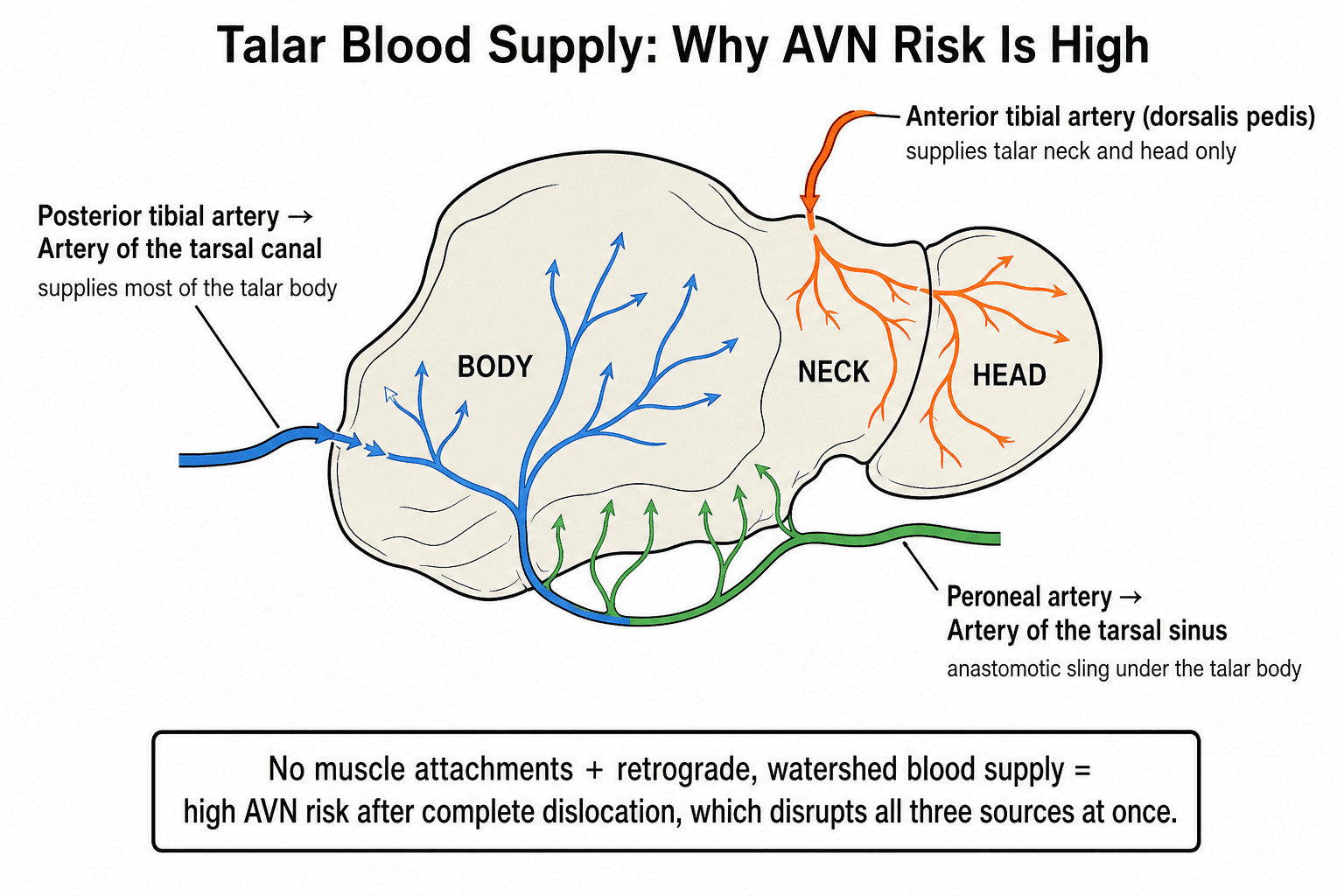
Why AVN risk is high. A complete dislocation disrupts the whole supply at once, in a bone whose supply is already tenuous. Prolonged dislocation is listed as a further risk factor, although whether timing changes AVN in this injury has never been tested (see Controversies).
Classification Systems
The injury is described by its pattern, by whether it is open, and by the direction of dislocation. The pattern guides the treatment.
- Frequency
- Rare, no fractures
- Treatment
- Urgent reduction
- Quoted outcome
- Good results typical (no validated rate)
- Frequency
- Common, talar fractures
- Treatment
- Urgent reduction, ORIF
- Quoted outcome
- 40-60% good results
- Frequency
- Common, skin disrupted
- Treatment
- Urgent reduction, debridement
- Quoted outcome
- 30-50% good results
Open or closed. A closed injury, skin intact, has the better prognosis. An open injury needs urgent debridement as well as reduction, carries a higher infection risk and has worse outcomes.
Direction. Lateral dislocation is the most common, medial less common and anterior rare. The direction guides the reduction manoeuvre.
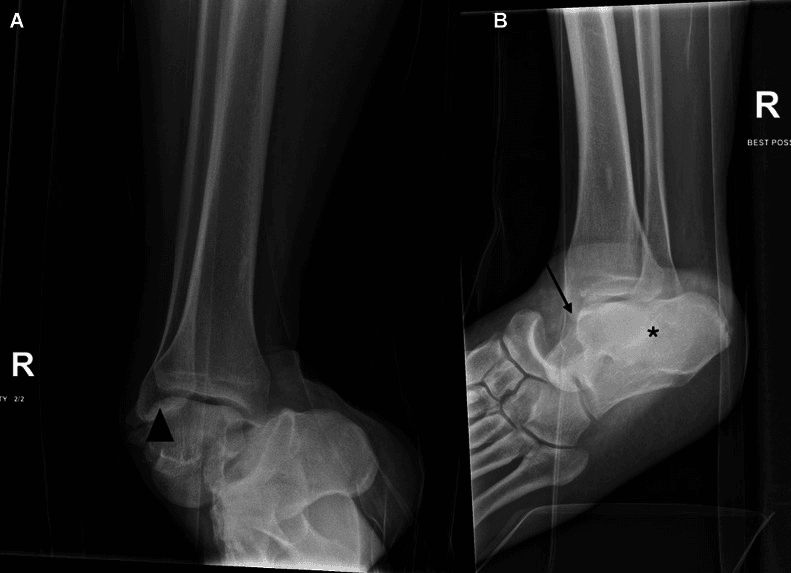
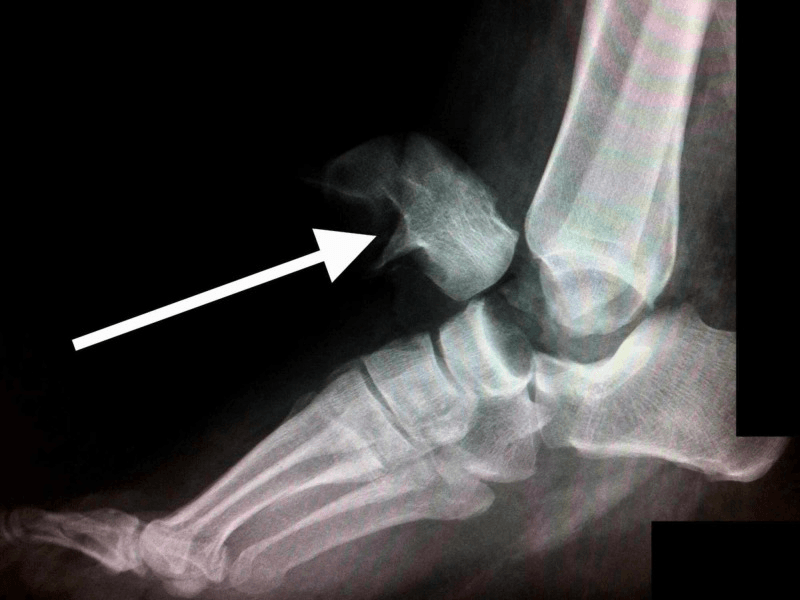
Clinical Assessment
History. Severe ankle and foot pain after high-energy trauma, with an obvious deformity and inability to bear weight.
Examination. Look for deformity, swelling, an open wound and skin tenting, which calls for urgent reduction. The ankle and foot are tender, with crepitus if there are fractures, and range of motion is limited, painful and cannot be tested for pain.
Neurovascular status. Record it before reduction, which is critical for both clinical and medicolegal reasons, and repeat it afterwards:
- Pulses - dorsalis pedis and posterior tibial
- Sensation - dorsal and plantar foot
- Motor - ankle dorsiflexion and plantarflexion
Investigations
Radiographs. Three views, but do not delay reduction for imaging if the skin is compromised:
- AP - the dislocation, the position of the talus and any fracture
- Lateral - the direction of dislocation, the position of the talus and any fracture
- Mortise - mortise alignment and the position of the talus
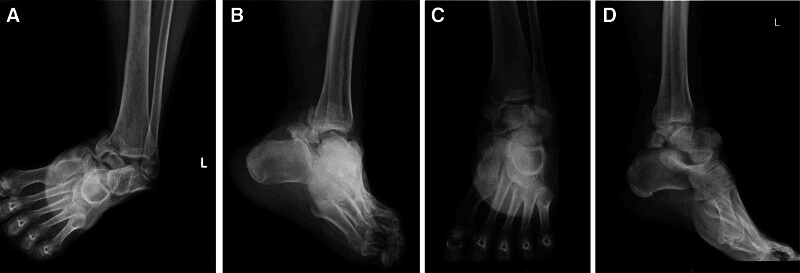
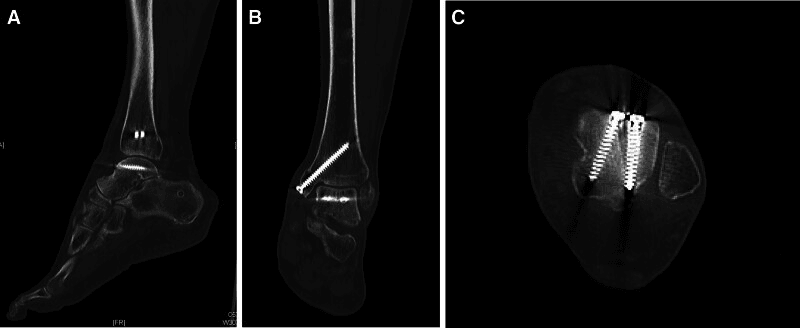
CT after reduction. Recommended once the talus is back in place. 60-80% have associated talar fractures, and CT shows the fracture pattern, displacement and joint congruity, which is what ORIF is planned from; it also checks the quality of the reduction.
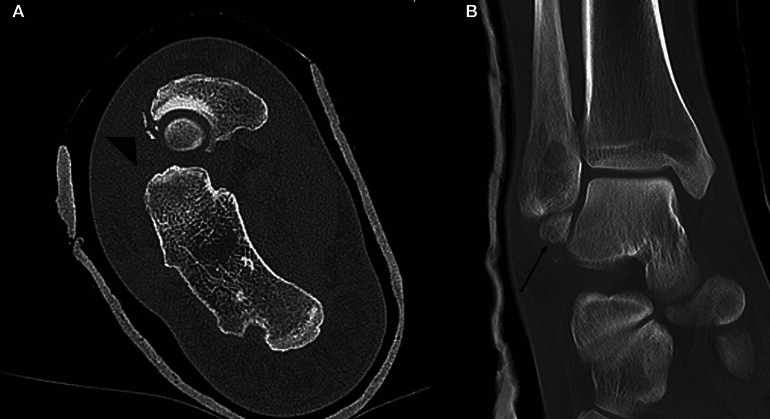
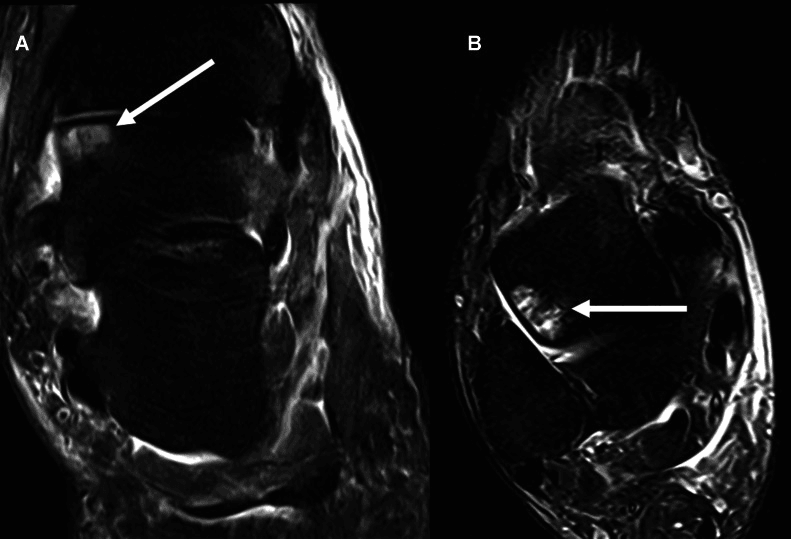
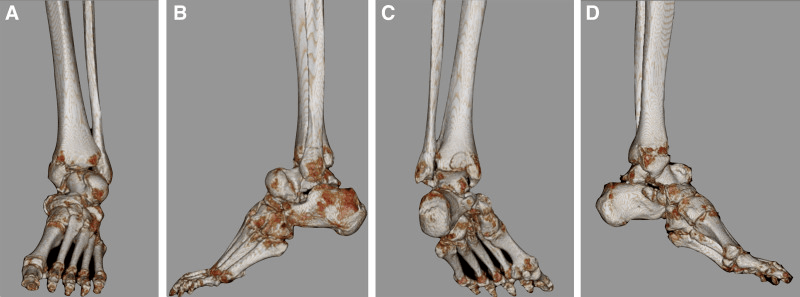
Differential Diagnosis
The key exam discriminator is between total (pan-talar) dislocation and the more common partial peritalar injuries. How many of the three articulations are dislocated, and whether the talus keeps its tibiotalar relationship, guides both the terminology and the treatment.
- Joints Dislocated
- Tibiotalar + subtalar + talonavicular
- Key Radiographic Feature
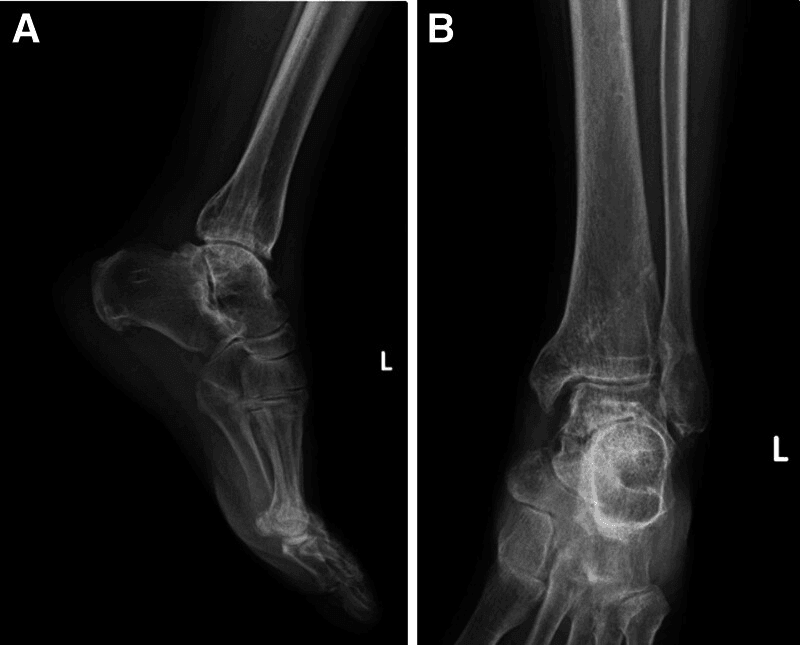
- Talus extruded from all articulations, empty mortise
- Distinguishing Point
- Talus separated from tibia, calcaneus AND navicular
- Joints Dislocated
- Subtalar + talonavicular (talus stays in mortise)
- Key Radiographic Feature
- Talus normal in mortise, foot displaced beneath it
- Distinguishing Point
- Tibiotalar joint intact - talus stays with tibia
- Joints Dislocated
- Subtalar and/or tibiotalar via fracture plane
- Key Radiographic Feature
- Fracture line through neck, body displaced
- Distinguishing Point
- Talar body fractured, not whole-bone extrusion
- Joints Dislocated
- Tibiotalar only
- Key Radiographic Feature
- Malleolar fractures, talar shift in mortise
- Distinguishing Point
- Subtalar and talonavicular remain congruent
- Joints Dislocated
- Talonavicular + calcaneocuboid
- Key Radiographic Feature
- Disruption at midtarsal line
- Distinguishing Point
- Talus stays in mortise and on calcaneus
The single most testable distinction: in subtalar dislocation the talus stays in the mortise and the foot dislocates beneath it, whereas in total talar dislocation the talus itself is extruded from all three articulations (tibiotalar, subtalar and talonavicular). Count the joints.
Management Algorithm
The sequence. Reduction comes first and fixation second:
- Assess - diagnose clinically and radiographically, and document neurovascular status
- Reduce - within hours, closed, under sedation or general anaesthesia; closed reduction is quoted as succeeding in 60-70%
- CT - to assess talar fractures and plan fixation
- ORIF - for displaced fractures, restoring joint congruity; the quoted success rate is 50-70% due to the high AVN risk
Non-operative treatment. Rare. It suits the pure dislocation that is stable after reduction with no displacement: a short leg cast or boot, non-weight-bearing for 8-12 weeks, and serial radiographs to monitor for AVN. Good results are typical when AVN does not develop, but that is conventional teaching and no cited series validates a rate.
Surgical indications. Surgery is needed in most cases, after reduction and within 1-2 weeks.
Absolute
- Associated talar fractures with displacement
- Unstable after reduction
- Open injury
Relative
- Large talar body fractures
- Joint incongruity
Surgical Technique
ORIF of the talus. For displaced talar fractures with the dislocation, or a talus unstable after reduction. The approach follows the fracture: anterior for the talar neck, medial or lateral for the body, and dual incisions if needed.
- Exposure - by fracture location, protecting the neurovascular structures
- Reduction - anatomic, to restore joint congruity
- Fixation - 3.5-4.5mm screws or a plate
- Verification - fluoroscopic confirmation of reduction, hardware position and restored joint congruity
ORIF restores joint congruity, prevents arthritis and allows early motion.
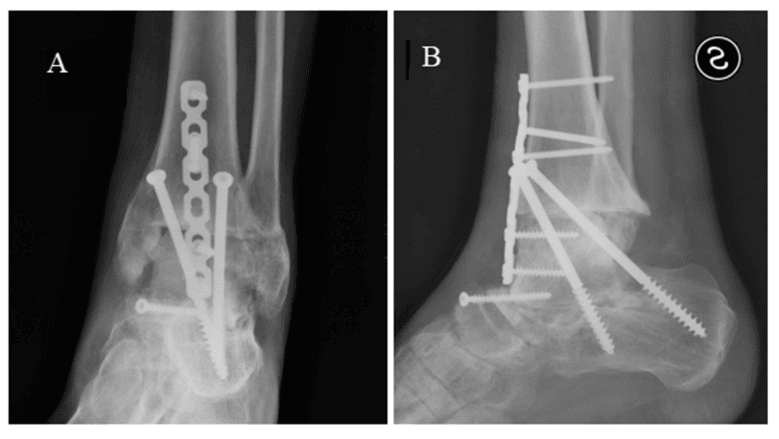
Salvage. For AVN with collapse, severe arthritis or failed ORIF:
- Tibiotalar fusion - ankle fusion
- Tibiocalcaneal fusion - ankle and subtalar fusion
- Talar replacement - rare and experimental
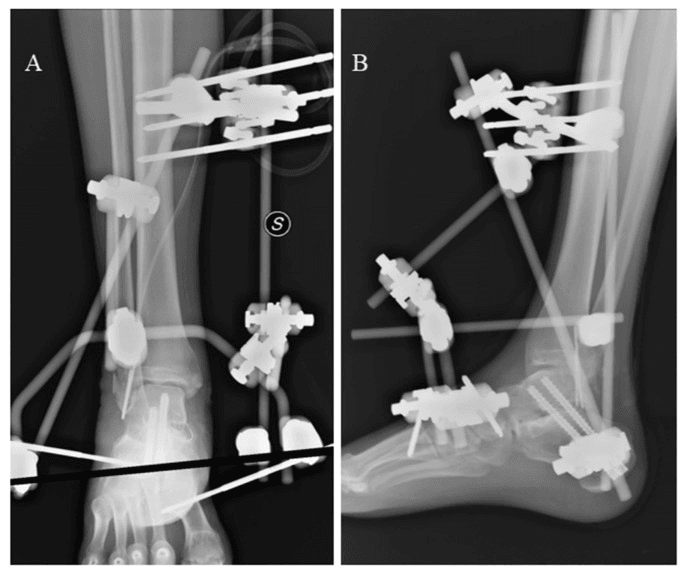
Why Closed Reduction Often Fails and the Direction-Specific Technique
Why the talus buttonholes. In a total (pan-talar) dislocation the extruded talus commonly buttonholes through a rent in the capsule, retinaculum or skin, and tendons and the neurovascular bundle can become interposed around its neck. Once the bone has herniated through a soft-tissue defect, longitudinal traction alone tends to tighten the noose of soft tissue around it rather than let it slip back. That is why forced closed manipulation so often fails, and why many published series ultimately required open reduction.
One gentle attempt, then open reduction. A single gentle closed attempt followed by prompt open reduction is widely advocated:
- Optimise conditions - procedural sedation or general anaesthesia with full muscle relaxation, and the knee flexed to relax the gastrocnemius so the ankle can be dorsiflexed and the mortise opened
- One controlled attempt - longitudinal traction to re-establish length, then reverse the displacement according to the direction of dislocation, with an assistant providing counter-traction and, where relevant, direct thumb pressure over the prominent talus
- Do not repeat forceful attempts - each one risks further stripping of the already tenuous blood supply and worsening of the soft-tissue and skin injury
- Open reduction - promptly, by extending the traumatic wound in open injuries or through a standard anteromedial or anterolateral exposure, releasing the interposed structures under direct vision
Check every joint. After reduction, confirm the talonavicular, subtalar and tibiotalar relationships one by one rather than accepting mortise alignment alone.
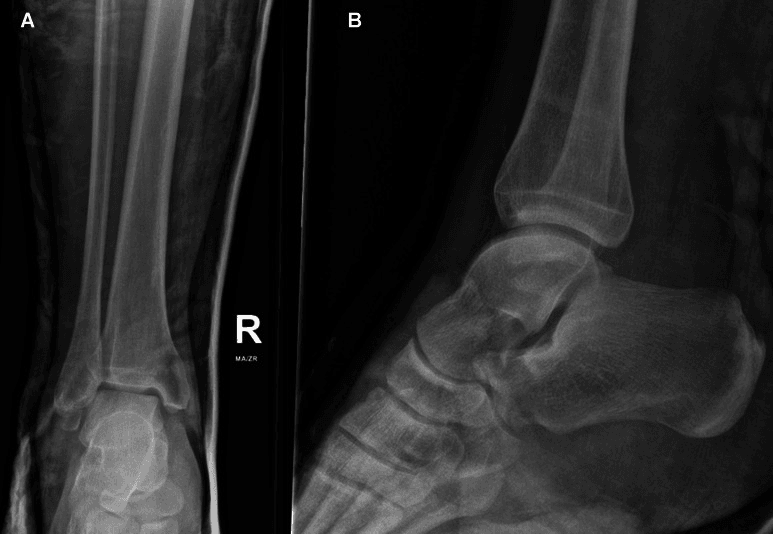
Managing the Extruded Talus in the Open Injury
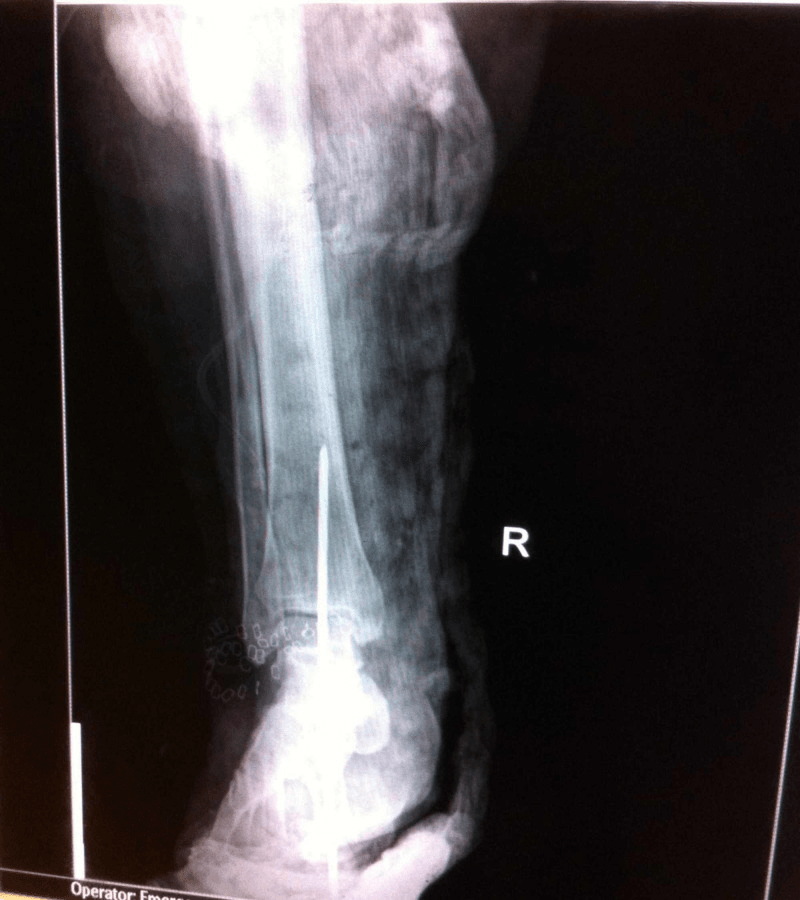
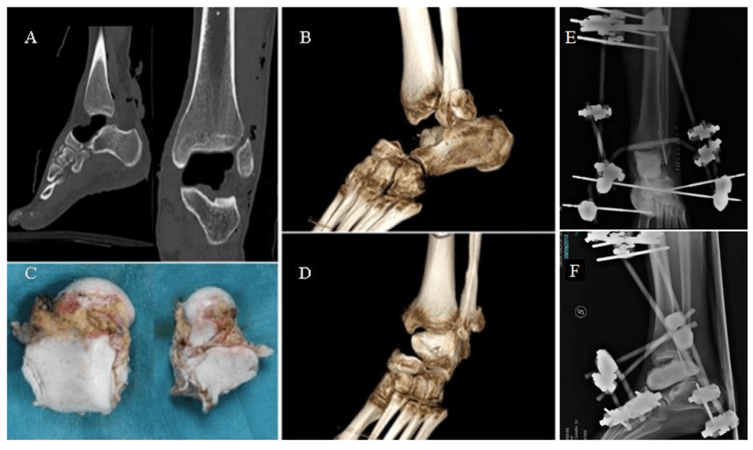
Do not discard the extruded talus. Even a grossly contaminated, fully extruded talus should be retained. Discarding it commits the patient to a large bone-stock deficit; keeping it preserves length and bone stock for reimplantation and for any later arthrodesis, and published series report acceptable function after reimplantation when debridement is thorough. Deep infection still occurs, and in the open injuries it is infection that drives secondary surgery (see Outcomes).
Retrieve, clean, reimplant.
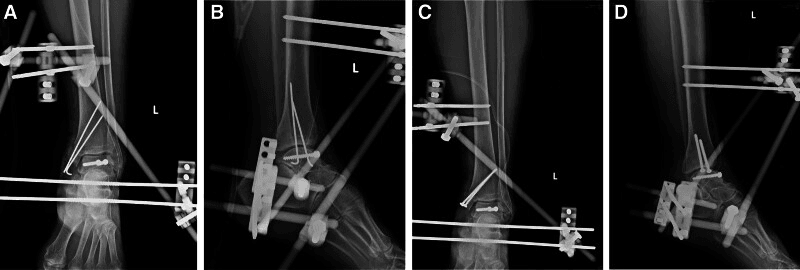
- Debride and irrigate - meticulous excision of contaminated and devitalised tissue, copious pulsatile lavage of the wound and the extruded bone, tissue sent for culture, IV antibiotics on the open-fracture pathway (early broad-spectrum cover, tetanus prophylaxis) and combined orthoplastic planning
- Reimplant immediately - replace the talus in its bed
- Stabilise - reported constructs use Kirschner wires or Steinmann pins passed through the calcaneus into the talus and tibia, protected by a spanning calcaneo-tibial external fixator, which holds alignment while the soft-tissue envelope recovers and avoids extensive internal dissection that would further devascularise the bone
- Follow the AVN pathway - as under Complications
Counselling. Infection and osteonecrosis remain difficult to predict at presentation despite optimal care. Even if AVN later supervenes, the retained talus still provides bone stock for salvage arthrodesis.
Complications
- Incidence
- 4 of 21 (19%) in the carded series; conventionally quoted as 50-100%
- Risk Factors
- Prolonged dislocation, complete extrusion, infection
- Prevention/Management
- Early reduction; serial imaging; protect weight-bearing until revascularisation
- Incidence
- 4 of 15 open injuries (27%)
- Risk Factors
- Open injury, contamination, delayed debridement
- Prevention/Management
- Urgent debridement, antibiotics, external fixation
- Incidence
- 4 of 21 (19%)
- Risk Factors
- Infection, talar collapse, subtalar arthritis
- Prevention/Management
- Salvage: subtalar or tibiocalcaneal arthrodesis
- Incidence
- Common; no reliable denominator published
- Risk Factors
- AVN, cartilage injury, residual incongruity
- Prevention/Management
- Anatomic reduction; fusion if severe
- Incidence
- Only relevant if an associated fracture is present
- Risk Factors
- A pure dislocation has nothing to unite
- Prevention/Management
- Rigid fixation of any associated talar neck or body fracture
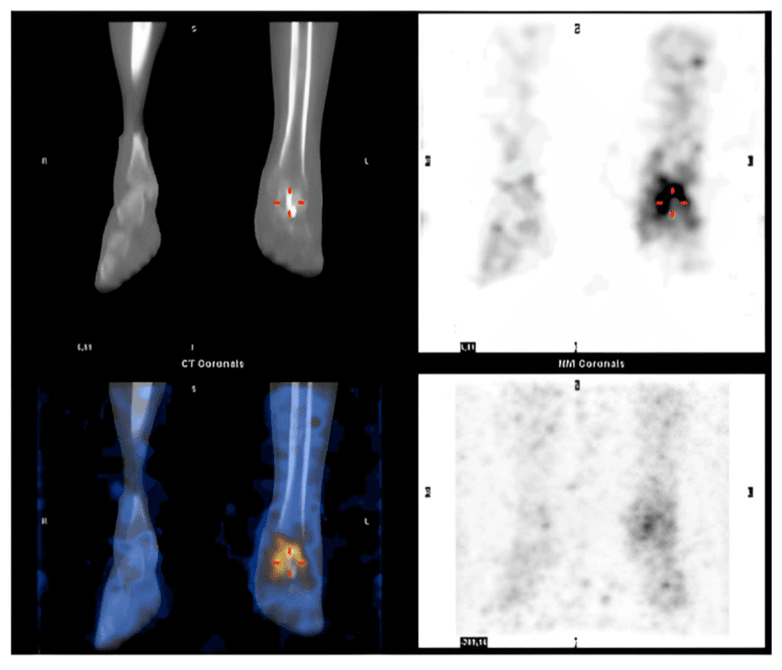
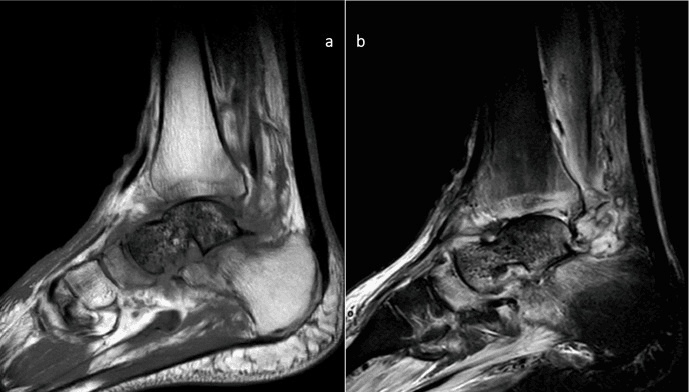
AVN. A complete extrusion avulses the extraosseous supply: the artery of the tarsal canal, the deltoid branch and the dorsalis pedis contributions all tear. Prevention is early reduction and avoiding further stripping at reimplantation.
Monitoring for AVN.
- Hawkins sign at 6-8 weeks - subchondral lucency indicates preserved vascularity and is reassuring; its absence is less specific
- MRI if in doubt
- Eight weeks is too early to exclude osteonecrosis
Managing AVN. Protect weight-bearing. Radiographic AVN without collapse is compatible with a functioning ankle and is not in itself an indication to fuse.
Post-traumatic arthritis. No reliable incidence exists for this injury: the carded series report subtalar arthritis and secondary fusion individually rather than an arthritis rate, and follow-up is under two years in two of them. The causes are AVN, cartilage injury at the moment of dislocation and residual incongruity, and anatomic reduction is the prevention. Severe arthritis is fused, subtalar or tibiotalar; arthroplasty is rarely appropriate in a talus that has been extruded.
Postoperative Care
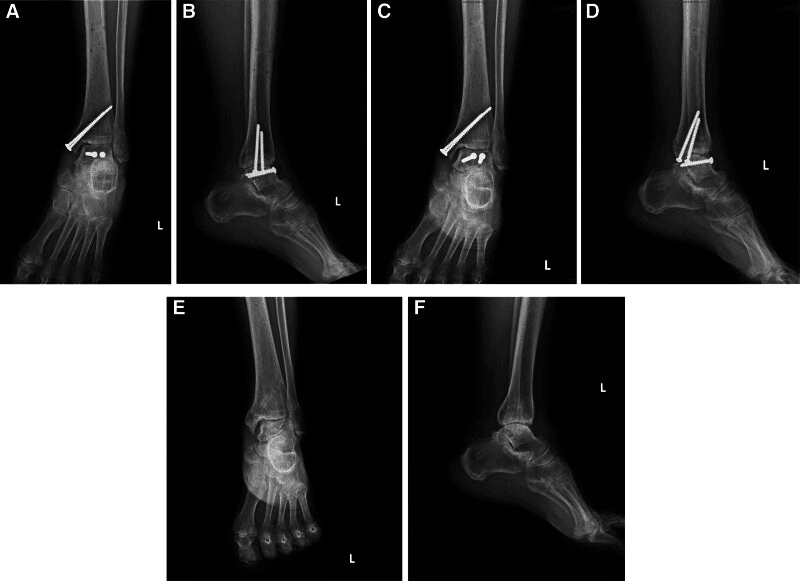
Immobilisation. A short leg cast or boot, non-weight-bearing for 8-12 weeks, then physiotherapy for ankle range of motion and strengthening.
- Weeks 0-8 - cast or boot, non-weight-bearing, elevation to reduce swelling; ankle range-of-motion exercises if stable, otherwise after cast removal
- Weeks 8-12 - CT to confirm healing and a check for the Hawkins sign; if healing, remove the cast, move to a walking boot and progress weight-bearing
- Weeks 12-16 - full weight-bearing and progressive activity, with continued AVN monitoring
Outcomes and Prognosis
What the carded evidence reports. Every published series of this injury is tiny, so the honest way to present outcome is to show all of them rather than quote a range. These are the four series carded in the Evidence Base below: 21 patients in total, worldwide, across 33 years.
- n
- 5
- Injury
- Total dislocation, rapid open reduction
- AVN
- 2 (40%)
- Deep infection
- not stated
- Secondary fusion
- 0
- n
- 9
- Injury
- Open extrusion, immediate reimplantation
- AVN
- 1 (11%)
- Deep infection
- 2 (22%)
- Secondary fusion
- 2
- n
- 6
- Injury
- Open extrusion, immediate reimplantation
- AVN
- 1 (17%)
- Deep infection
- 2 (33%)
- Secondary fusion
- 2
- n
- 1
- Injury
- Closed, early closed reduction
- AVN
- 0
- Deep infection
- 0
- Secondary fusion
- 0
- n
- 21
- Injury
- AVN
- 4 (19%)
- Deep infection
- 4 of 15 open (27%)
- Secondary fusion
- 4 (19%)
The quoted figure. "AVN 50-100%" is quoted everywhere in the literature, with "70-90%" for open injuries, yet the only two series of open extrusion carded here report AVN in 1 of 9 and 1 of 6. The teaching figure is four to eight times the observed one.
Why 19% is no better. Do not simply replace one number with the other; the pooled figure is also unreliable, in the opposite direction:
- Follow-up is far too short. Karampinas 21.1 months, Veselý 24.2 months. Talar osteonecrosis declares itself over years, and revascularisation may be incomplete long after a radiograph looks acceptable. Ritsema, the series with the longest follow-up at 4.5 years, has the highest AVN rate at 40%, which is what you would expect if the short series are simply looking too early. Eda's MRI was at eight weeks, far too early to exclude anything.
- Definition varies. Radiographic sclerosis, absent Hawkins sign, MRI signal change and symptomatic collapse are not the same endpoint, and no two of these papers define AVN identically.
- Publication favours success. A unit that reimplanted a talus and watched it die is less likely to publish than one that saved it.
Risk factors. Prolonged dislocation, complete extrusion, open injury and infection. Frequently quoted figures come from heterogeneous small series with wide confidence intervals and selection bias toward published cases, so quote them as estimates and emphasise the trend: open and prolonged-dislocation injuries do worse.
The defensible position for an exam or a consent discussion. Osteonecrosis is common, reported in roughly one in five to two in five patients in the small published series, with a real possibility that longer follow-up would raise that. Radiographic osteonecrosis is not the same as clinical failure, since several patients in these series had radiographic AVN with a functioning ankle. In the open injuries the outcome that actually drives secondary surgery is infection, not AVN.
Guidelines, Registries & Global Practice
There are no condition-specific society guidelines for total talar dislocation given its rarity; management is extrapolated from talar fracture-dislocation principles and open-fracture guidance. Below is the global picture and how core principles are framed across societies.
Global Epidemiology
- Rarity: Total (pan-talar) dislocation accounts for roughly 3.4% of major talar injuries and is itself a small fraction of all foot/ankle trauma (Johnson et al, 2012 - a figure inherited from earlier literature rather than measured, against an undefined denominator).
- Open predominance: A high proportion present open (historically quoted around 70% in case reviews), reflecting the high-energy mechanism.
- Demographics: Predominantly young adults (20-40 years) after motor-vehicle trauma, falls from height or high-energy sport.
- Pooled outcome trend: Across the four small series carded above - 21 patients in total - osteonecrosis occurred in 4, deep infection in 4 of the 15 open injuries, and 4 needed a secondary fusion. Follow-up is under two years in two of the series, and the one followed longest reports the highest osteonecrosis rate, so read these as a floor rather than an estimate.
Guidance Framed by Society / System
- Relevant Principle
- Talar neck fracture timing; urgent reduction of dislocation
- Application to Total Talar Dislocation
- Reduce the dislocation urgently; definitive fixation can be staged once soft tissues allow
- Relevant Principle
- Open-fracture pathway: early IV antibiotics, combined ortho-plastic care, definitive fixation with soft-tissue cover
- Application to Total Talar Dislocation
- Apply directly to open extrusions - antibiotics within 1 hour, joint ortho-plastic planning
- Relevant Principle
- Preserve talar blood supply; avoid tarsal canal/sinus tarsi stripping
- Application to Total Talar Dislocation
- Limit dissection; reduce promptly and stabilise (K-wires + external fixator commonly used)
- Relevant Principle
- Joint-preserving salvage; reimplant rather than discard extruded talus
- Application to Total Talar Dislocation
- Reimplant the talus to retain bone stock even if later fusion is needed
Registry Notes
No arthroplasty or implant registry (NJR, AJRR, AOANJRR, SHAR) tracks this injury, as treatment is reduction and fixation rather than joint replacement. Emerging custom total talar prostheses for talar collapse are reported chiefly from Japanese centres and are not yet captured by mainstream registries; cadaveric data flag anterior instability and dislocation of downsized implants (Sato et al, 2021).
High- vs Limited-Resource Practice
- Well-resourced settings: Immediate ortho-plastic care, external fixation, CT planning, MRI for AVN surveillance, and access to delayed reconstruction/arthrodesis or custom prostheses.
- Limited-resource settings: Emphasis on prompt reduction, K-wire stabilisation and external fixation, vigilant infection control, and arthrodesis as the principal salvage; advanced reconstruction may be unavailable.
Total talar dislocation is a rare but important viva topic. Know that urgent reduction is required within hours (skin necrosis risk), that osteonecrosis is common but that the quoted "50-100%" is not supported by the published series (4 of 21, with short follow-up), that the injury is often open, that infection is the complication which most often drives secondary surgery, and that the extruded talus should be reimplanted rather than discarded. Document neurovascular status before and after reduction. Be prepared to discuss the reduction technique, the Hawkins sign and the management of osteonecrosis.
Related pages: Talus Fractures and Talar Body Fractures carry the Hawkins classification, the blood supply and the osteonecrosis evidence this injury borrows from - and the borrowing must be done carefully, since displacement stratifies risk in a fracture and cannot in a complete dislocation; Subtalar Dislocations is the far commoner injury this must be distinguished from, where the talus stays in the mortise and the foot displaces beneath it, and is the discriminator every viva on this topic turns on; Lateral Process Talus Fractures and Posterior Process Talus Fractures are the associated injuries a post-reduction CT is looking for; Open Fracture Management governs the debridement, antibiotic timing and ortho-plastic planning for the extruded talus, which is the pathway that most determines outcome here; Osteochondral Lesion of the Talus and Subtalar Arthritis cover the late cartilage consequences; Ankle Fractures and Pilon Fractures are the high-energy differentials on the initial radiograph; and Compartment Syndrome of the Leg because the mechanism that extrudes a talus is energetic enough to demand the leg be assessed as well as the hindfoot.
Controversies and Areas of Uncertainty
The injury is rare and the evidence is limited to small retrospective series, so several management questions remain genuinely unsettled.
Reimplantation or primary talectomy in the open injury. Older teaching favoured discarding a fully extruded, contaminated talus. Contemporary series (Karampinas, Veselý) show that immediate reimplantation can achieve good function and preserves bone stock for later fusion. Most authors now favour reimplantation even when AVN later supervenes, reserving primary talectomy for catastrophic contamination or unreconstructable bone, and talectomy for failed salvage.
Does reduction timing change AVN? For talar neck fractures, Clare and Maloney conclude that initial displacement, not the timing of definitive fixation, drives osteonecrosis. Be careful transporting that here. In a neck fracture the vascular injury is proportional to displacement, which is why displacement stratifies risk and timing does not; in a total dislocation the extraosseous supply is avulsed completely at the moment of injury, displacement is total in every case and cannot stratify anyone, and nobody has tested whether timing matters.
Why the urgency stands regardless. The urgency of this injury does not rest on osteonecrosis at all: tented skin necroses within hours, and an extruded talus is contaminated from the moment it appears in the wound. Reduce tonight; definitive bony fixation can be staged once the soft tissues recover.
Total talar prosthesis. Custom total talar replacement is emerging, predominantly from Japanese centres, as a salvage option for talar AVN or collapse. Cadaveric data raise concerns about anterior instability, and downsized implants dislocate. Its role after total dislocation is experimental and not established.
MCQ Practice Points
Q: Why is urgent reduction required for total talar dislocation? A: Skin tension causes necrosis within hours, neurovascular compromise, high AVN risk - Reduce within hours, do not delay for imaging if skin compromised. Document neurovascular status before and after reduction.
Q: What is the AVN risk for total talar dislocation? A: High, but not the "50-100%" usually quoted. The four published series total 21 patients and report osteonecrosis in 4. That figure is itself unreliable - follow-up is 21 to 24 months in two of them, and the series followed longest (Ritsema, 4.5 years) has the highest rate at 2 of 5. Say that osteonecrosis is common, that no dependable percentage exists, and that surveillance runs for years. Monitor with the Hawkins sign at 6-8 weeks (a lucency is REASSURING) and MRI if equivocal. Radiographic osteonecrosis without collapse is compatible with a working ankle.
Q: Are total talar dislocations often open injuries? A: Yes, often open injury - Skin disruption common due to high-energy mechanism. Urgent debridement required. Higher infection risk. Worse outcomes than closed injuries (30-50% good results vs 50-70%).
Q: What is the treatment for total talar dislocation? A: Urgent closed reduction, then ORIF if fractures present - Reduce within hours, document neurovascular status, CT after reduction to assess fractures, ORIF if displaced. Success rate 50-70% with proper treatment.
Q: What are the complications of total talar dislocation? A: Osteonecrosis (4 of 21 in the published series), deep infection (4 of 15 open injuries - the commonest driver of secondary surgery), secondary fusion or talectomy (4 of 21), and post-traumatic arthritis (common, no reliable denominator). Nonunion only applies where an associated fracture is present - a pure dislocation has nothing to unite. Prevent with urgent reduction, thorough debridement of the open injury and preservation of what blood supply remains.
Exam Viva Scenarios
Practise clinical reasoning and management decisions out loud
“A 30-year-old patient presents with total talar dislocation after high-energy trauma. Talus is completely dislocated from ankle, subtalar, and talonavicular joints. Skin is tented but intact.”
“A 35-year-old patient has an open total talar dislocation with exposed talus. The examiner asks you to explain your management approach.”
“A trauma radiograph is shown. The examiner asks how you would distinguish a total talar dislocation from a subtalar dislocation, and how you would monitor for avascular necrosis afterwards.”
Key Concepts
- Extremely rare injury (less than 0.1% of dislocations)
- Talus completely dislocated from all articulations
- Urgent reduction required within hours (skin necrosis risk)
- AVN common - 4 of 21 in published series, follow-up too short to trust
Classification
- Pure: No fractures, rare - urgent reduction (good results typical)
- With fractures: Talar fractures, common - urgent reduction, ORIF (good results typical)
- Open: Skin disrupted, common - urgent reduction, debridement (30-50% good results)
- Direction: Lateral (common), Medial (less common), Anterior (rare)
Treatment
- Urgent closed reduction: Within hours, document neurovascular status
- CT after reduction: Assess talar fractures (60-80% have fractures)
- ORIF if fractures displaced: Restore joint congruity (good results typical)
- Pure dislocation: Conservative if stable (good results typical)
Surgical Technique
- Reduction: Flex knee, traction, reverse deformity
- ORIF talus: Anterior, medial, or lateral approach
- Salvage: Tibiotalar or tibiocalcaneal fusion if AVN
- Verify reduction fluoroscopically
Complications
- AVN: 4 of 21 in the published series (monitor with Hawkins sign, then MRI)
- Deep infection: 4 of 15 open injuries - the commonest driver of secondary surgery
- Secondary fusion or talectomy: 4 of 21
- Nonunion: only if an associated fracture is present
Evidence Base
Total talar dislocation is a rare injury, so the literature is dominated by small retrospective series and case reports — no randomised data exist, and stated complication rates carry wide confidence intervals.
Rapid open reduction with talar preservation - an argument against routine talectomy
- 5 patients, all reduced openly, mean follow-up 4.5 years
- AVN in 2 of 5 (40%); no talectomy required
- 3 good and 2 fair clinical results
- Preserve the talus - avoid primary talectomy
Total dislocation is 3.4% of major talar injuries
- Total dislocation = 3.4% of major talar injuries
- Dominant complications: osteomyelitis and AVN
- Evidence base limited to small series and case reports
- Tenuous blood supply underlies the high AVN rate
Immediate reimplantation of the extruded talus
- 9 open extrusions, immediate reimplantation + external fixation
- Mean AOFAS 82.5; 6 of 9 complication-free
- Infection in 2, AVN in 1, arthrodesis in 2
- Reimplantation preserves bone stock even if salvage later needed
Open extrusion: reimplantation with external fixation
- 6 open dislocations, reimplantation + external fixation
- Infection in 2, AVN in 1
- Salvage (arthrodesis/talectomy) required in 2
- Infection and AVN are unpredictable at the time of injury
Initial displacement, not surgical timing, predicts osteonecrosis
- Initial displacement is the strongest predictor of AVN
- Timing of DEFINITIVE fixation does not change AVN risk
- Urgently reduce the dislocation; definitive surgery can be staged
- Avoid tarsal canal/sinus tarsi dissection to spare blood supply
Closed dislocation: early closed reduction can preserve vascularity
- Closed dislocation, no fracture - early closed reduction
- 8 weeks non-weight-bearing, MRI confirmed no AVN
- Return to sport at 18 months with minor symptoms
- Confirm absence of AVN before progressing weight-bearing