Low Transverse Fracture of Distal Humerus | Intra-capsular | High Nonunion Rate
- Definition: A fracture across the condyles of the distal humerus, passing through the olecranon fossa and coronoid fossa.
- Distinction: Unlike supracondylar fractures (extra-capsular), transcondylar fractures are intra-capsular.
- Challenge: The distal fragment is very small ('wafer thin'), making screw purchase difficult.
- Treatment: Primary Total Elbow Arthroplasty (TEA) is favoured in independent elderly patients due to high failure rate of ORIF.
- “Transcondylar fractures are intra-capsular (haemarthrosis). Supracondylar are extra-capsular.
- “Dual plating (90-90 or Parallel) is required if ORIF is attempted.
- “Ulnar nerve transposition is controversial but often done during ORIF to prevent tardy palsy.
Overview and Epidemiology
A transcondylar fracture crosses the distal humerus transversely at the level of the condyles, passing through the olecranon and coronoid fossae. That puts it lower than a supracondylar fracture and, crucially, inside the capsule. In AO/OTA terms it is 13-A3: the distal fragment carries the articular surface, but the surface itself is not split, so the fracture is intra-capsular yet extra-articular.
Supracondylar or transcondylar. The supracondylar fracture is the classic paediatric distal humerus fracture: it lies above the fossae and is extra-capsular. The transcondylar fracture is the adult pattern, low and through the fossae, and intra-capsular. That is the key distinction.
Who. The distribution is bimodal: young men after high-energy trauma, and elderly women after osteoporotic falls, who are much more common. The incidence of fragility fractures of the distal humerus is rising, the "silver tsunami".
Anatomy
The triangle. The distal humerus is a triangle of two columns, medial and lateral, supporting the articular block of trochlea and capitellum. The columns diverge distally to form the supracondylar ridges, a structure likened to a suspension bridge or a tie-beam construct.
- Medial column diverges at 45° and ends in the medial epicondyle. Its broad medial crest makes it the easier column to plate.
- Lateral column diverges at 20° and ends in the lateral epicondyle. It is flat posteriorly, which accommodates a posterior plate.
Where the fracture falls. The transcondylar line separates both columns from the articular block at the lowest level, through the fossae. This is the thinnest part of the distal humerus, the "wafer", often only a few millimetres in AP dimension. It gives screws poor bone stock, and in osteoporotic bone pull-out rates after ORIF are high.
The articular block. The trochlea and capitellum form a spool-shaped surface, and the trochlea acts as the tie-beam connecting the two columns. The trochlea is covered by hyaline cartilage over 300° of its surface and has a sulcus that articulates with the ulnar ridge. The capitellum is spheroidal, projects anteriorly and articulates with the radial head. Three fossae accommodate the forearm bones:
- Olecranon fossa, posteriorly: the olecranon tip in extension
- Coronoid fossa, anteriorly: the coronoid process in flexion
- Radial fossa, anterolaterally: the radial head in flexion
Deforming forces. The triceps inserts on the olecranon and pulls the proximal ulna proximally; the brachialis inserts on the coronoid and pulls the forearm distally. In a very low transcondylar fracture the triceps does not de-rotate the distal fragment. If the fracture involves the epicondyles, the flexor and extensor origins rotate them: the common flexor origin flexes and pronates the medial fragment, and the common extensor origin extends and supinates the lateral fragment.
Ligaments and capsule. The anterior bundle of the MCL (ulnar collateral ligament) attaches to the inferior aspect of the medial epicondyle and is the essential valgus stabiliser. The LCL complex, including the LUCL, attaches to the lateral epicondyle and is the essential varus and rotatory stabiliser. The anterior and posterior capsule is thin, reinforced by brachialis and triceps respectively.
Nerves. The ulnar nerve runs in the cubital tunnel behind the medial epicondyle and is at high risk during fixation of the medial column. The radial nerve runs in the spiral groove and pierces the lateral intermuscular septum 10 cm proximal to the joint line to enter the anterior compartment. The median nerve runs medial to the brachial artery, well protected anteriorly by brachialis.
Why 'Intra-Capsular' Is the Defining Feature (and What It Costs)
Lying inside the capsule is more than a labelling point: it drives the diagnosis and the higher nonunion rate.
Haemarthrosis and the fat pads. Because the fracture lies inside the capsule, bleeding fills the joint and lifts the fat pads. A posterior fat-pad sign is always pathological in an adult and means an intra-articular or intra-capsular fracture until proven otherwise. It is often the only clue to a minimally displaced transcondylar fracture on plain films.
Synovial fluid and healing. The fracture surfaces bathe in synovial fluid, which dilutes the fracture haematoma and the fibrin scaffold that ordinary extra-capsular fractures rely on. This is a major reason the A3 pattern has a higher nonunion rate than the supracondylar fracture. The distal fragment's lack of extensive soft-tissue attachment adds to it.
Blood supply. The trochlea is supplied by terminal branches of the ulnar and collateral arteries, and the capitellum has a precarious retrograde supply. The short distal wafer has a largely intra-osseous and capsular blood supply; the fracture disrupts the intra-osseous part, leaving healing to rely on the capsular vessels. Poor biology is added to poor mechanics.
The contrast to hold. The supracondylar fracture has a larger fragment, better bone for fixation and better healing. The transcondylar fracture has a thin wafer, a haemarthrosis, healing impaired by synovial fluid and a higher nonunion rate. That is why fixation is hard and why primary TEA is attractive in the osteoporotic elderly.
Classification Systems
AO/OTA places the transcondylar fracture among the extra-articular 13-A fractures. The pattern it must be told apart from is the complete articular 13-C fracture, in which an intercondylar split runs into the joint.
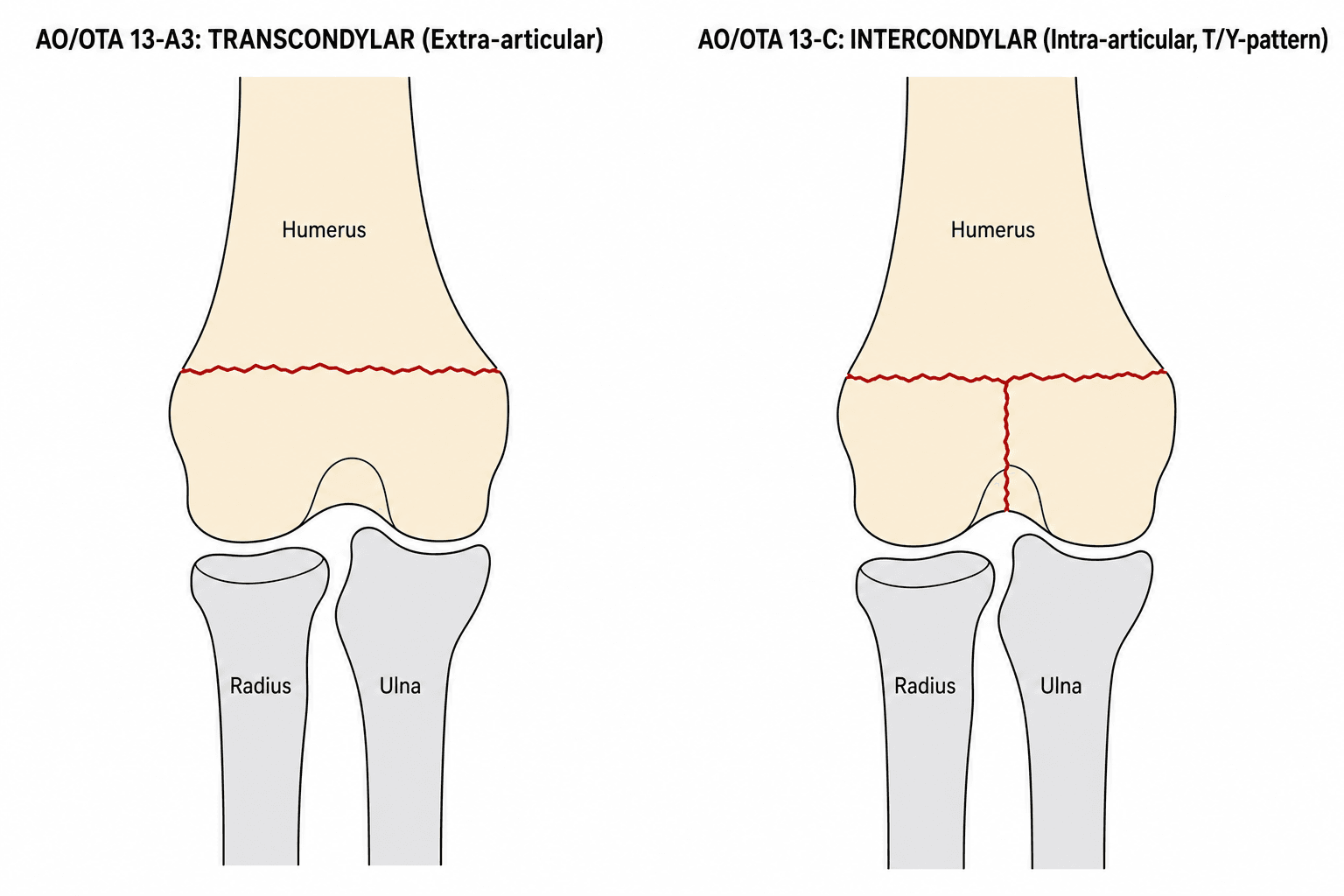
- 13-A, extra-articular. 13-A3 is the transcondylar unifocal fracture: the distal fragment includes the articular surface, but the surface itself is not split.
- 13-C, complete articular: an intercondylar split, and intra-articular. C3 is multifragmentary.
Clinical Assessment
History. A fall on the outstretched hand or a direct blow, followed by immediate pain, swelling and inability to move the elbow.
Examination. The elbow is grossly unstable, the "floppy elbow". Check the skin for open wounds, especially posteriorly.
Nerves. The ulnar nerve is the one most commonly injured, by contusion or stretch, and its status must always be documented before any operation.
- Ulnar nerve: intrinsic strength and little-finger sensation
- Radial nerve: wrist and thumb extension
- Anterior interosseous nerve: the "OK" sign (FPL, FDP)
Investigations
Radiographs. AP and lateral views of the elbow are standard, with hand and shoulder views if indicated. Look for:
- the fracture line, transverse at the supracondylar level but passing through the fossae
- the fat pads: the posterior fat-pad sign described above; the anterior fat pad may also be elevated, the "sail sign"
- varus or valgus angulation and rotational malalignment
- the drop sign, an increase in the distance between ulna and humerus (distraction), which may indicate gross instability or ligament injury
Traction view. Performed by the surgeon in the emergency department or under anaesthesia, it neutralises the deforming forces of triceps and brachialis. It shows the comminution better, and whether the articular block is one piece (a simple A3) or split (C-type).
CT. Essential for almost all adult distal humerus fractures; it defines the "personality" of the fracture.
- Coronal: the integrity of the tie-beam, the calcified trochlear arch
- Sagittal: the capitellum, the "headless ghost" of osteopenia
- Axial: best for assessing rotation of the columns
- 3D with the humerus subtracted: the articular surface from above, the "bird's-eye view"
- 3D with the ulna and radius subtracted: the articular surface from below
Bone stock on CT. Look for the wafer, the thin shell of bone between the fracture line and the joint. If it is less than 5 mm or very osteopenic, screw purchase is unlikely to be sufficient for ORIF, and the decision moves towards TEA.
MRI. Rarely indicated for the acute fracture, unless collateral ligament injury is suspected in a simple dislocation masking as a fracture-dislocation. It may be used for late assessment of the ulnar collateral ligament in high-demand athletes, who are unlikely in this demographic.
The Functional Arc of Elbow Motion (Why a Stiff Elbow Can Still Work)
Morrey's functional arc. Most activities of daily living are performed within a 100° flexion-extension arc, about 30-130°, and a 100° forearm-rotation arc, about 50° of pronation to 50° of supination. Motion outside this arc contributes relatively little to everyday function. The management logic of this fracture rests on it: accepting a "bag of bones" functional nonunion, tolerating lost terminal extension, and aiming to restore motion.
The bag of bones. A transcondylar fracture treated non-operatively often heals as a functional (fibrous) nonunion or malunion with a reduced but still functional arc. That is acceptable in a frail, low-demand patient, because daily activities live inside the 30-130° window.
Extension matters less than flexion. Losing the last ~30° of extension keeps the patient within the functional arc, whereas losing flexion, which is needed to reach the face and head, is far more disabling. Rehabilitation and any later release therefore prioritise restoring flexion over a cosmetically full range.
The surgical corollary. ORIF and TEA both aim to restore this arc through early motion. Rigid fixation exists to keep the elbow moving within, and ideally beyond, Morrey's arc before it stiffens.
ARMSurgical Goals
Hook:The elbow needs to ARM for movement.
Differential Diagnosis
The low transverse distal humerus fracture in an elderly patient can mimic or coexist with several other injuries, and telling them apart changes the operative plan.
- Key Distinguishing Feature
- Transverse line through both fossae, intact articular block
- Capsule
- Intra-capsular
- Implication
- Thin distal 'wafer'; ORIF vs TEA decision
- Key Distinguishing Feature
- Line above the fossae, larger distal fragment
- Capsule
- Extra-capsular
- Implication
- More bone for fixation; rare in adults
- Key Distinguishing Feature
- Articular split into the joint (Y/T pattern on CT)
- Capsule
- Intra-capsular
- Implication
- Needs articular reconstruction before column fixation
- Key Distinguishing Feature
- Coronal-plane articular fragment, 'double-arc' sign
- Capsule
- Intra-capsular
- Implication
- Headless screws from front; CT essential
- Key Distinguishing Feature
- Ulnohumeral incongruity, terrible-triad pattern
- Capsule
- Capsuloligamentous
- Implication
- Assess LCL/MCL and coronoid; stability focus
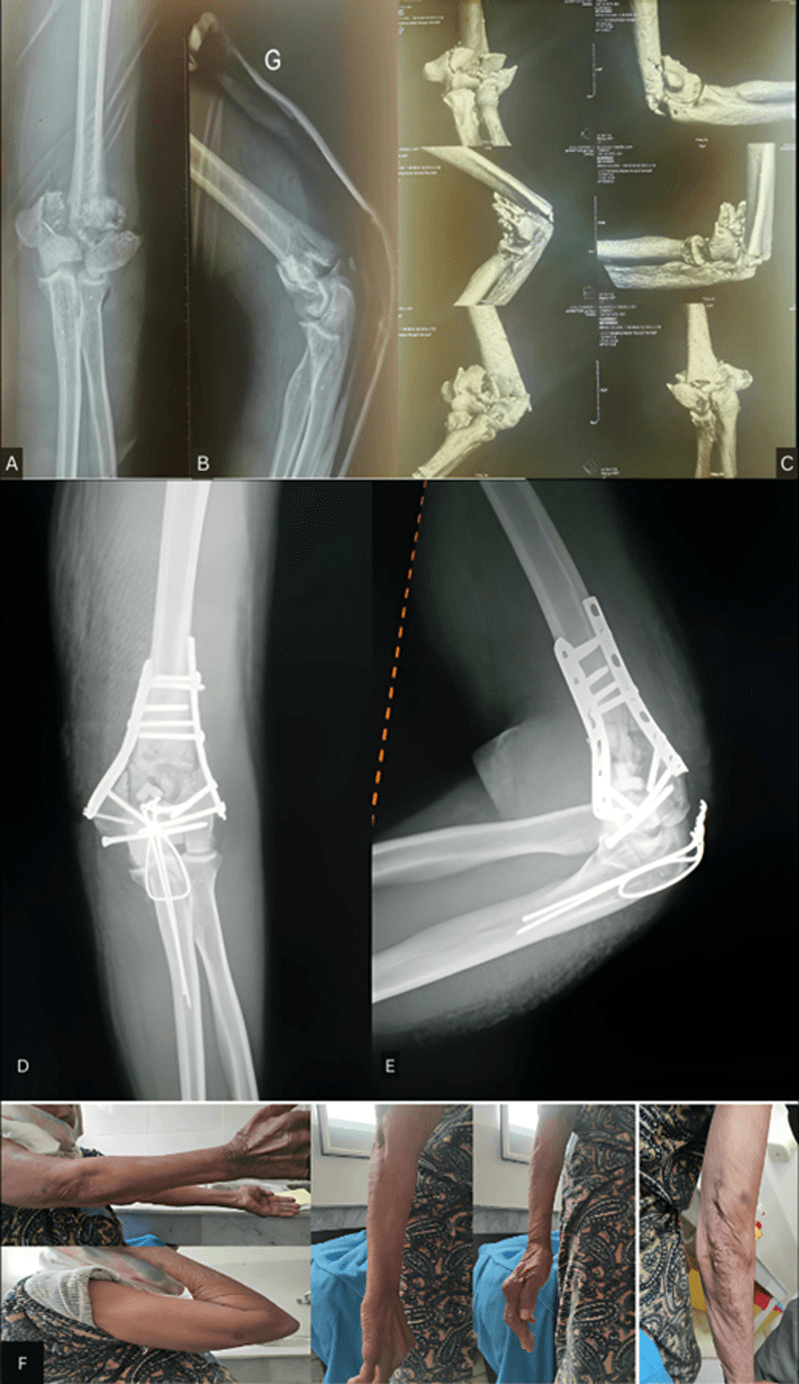
Management Algorithm
The decision rests on the patient and the bone as much as on the fracture. Arthroplasty is selected by reconstructability, bone stock, function, comorbidity and the ability to accept lifelong restrictions, not by age alone.
- Bone Quality
- Good
- Treatment
- ORIF
- Reason
- Preserve joint, high load tolerance
- Bone Quality
- Osteoporotic
- Treatment
- TEA (Total Elbow)
- Reason
- Immediate ROM, avoids ORIF failure
- Bone Quality
- Poor
- Treatment
- Cast ('Bag of Bones')
- Reason
- Functional ROM achievable, low complication risk
Indications. An undisplaced fracture, which is rare, or the frail elderly patient: the "bag of bones", reserved for the sedentary or demented.
Technique. A collar and cuff aimed at 110° of flexion (gravity reduction) for 2 weeks, then gentle mobilisation, moving as tolerated. Ignore the X-ray and treat the patient.
Outcome. It usually creates a functional nonunion with decent range of motion but weak extension, which is acceptable for low demand.
Surgical Techniques
Principle. Convert the complex articular fracture into a simple supracondylar fracture, then fix it to the shaft. That requires perfect articular reduction.
- Positioning. Lateral decubitus with the arm over a bolster gives easy access to the posterior elbow and to the iliac crest for graft. Prone gives good visualisation, but airway access is harder. Apply a sterile tourniquet high on the arm.
- Approach. A posterior midline incision from 5 cm proximal to 5 cm distal to the olecranon, curved around its medial or lateral side so the scar avoids the bony prominence. Raise full-thickness flaps of skin and fascia together to protect the cutaneous nerves.
- Ulnar nerve. Identify it in the cubital tunnel before any other dissection and release the cubital tunnel retinaculum (Osborne's ligament). Protect it with a vessel loop and do not retract it forcefully. If the nerve subluxes, or the hardware will be prominent medially, plan for transposition.
- Deep exposure. Choose the window:
- Chevron olecranon osteotomy, which gives the best view of the trochlea and capitellum. Pre-drill the proximal ulna for the tension band or screw, cut three-quarters of the way through with an oscillating saw at the bare area of the sigmoid notch, and complete the cut with an osteotome to leave an interdigitating chevron surface.
- Paratricipital (triceps-sparing): identify the medial and lateral borders of triceps and lift the muscle off the posterior humerus. It preserves the extensor mechanism for faster rehabilitation and suits A-type and simple C-type fractures.
- Articular reduction. This is the critical step: the shaft cannot be fixed until the block is rebuilt. Clear clot and interposed tissue, reassemble the capitellum and trochlea with a large reduction clamp, and hold them with temporary K-wires, 3.0/3.5 mm headless compression screws (Herbert/Acutrak) or separate cannulated screws, buried in the cartilage. Inspect the joint visually for congruency.
- Column fixation. Use parallel plates, one medial and one lateral; 90-90 plating (one posterior, one medial) is biomechanically inferior for varus-valgus stability. The medial plate sits on the medial crest and must wrap around the epicondyle, and the lateral plate on the posterior aspect of the lateral column or directly lateral. The distal screws from each side must interdigitate like a zipper within the distal fragment, creating a fixed-angle arch that ties the columns back to the shaft. Use the oval hole to compress the articular block to the shaft.
- Closure. Reduce the olecranon and fix it with a heavy tension band wire (1.2 mm wire, 1.6 mm K-wires) or a 6.5 mm cancellous screw with a washer. Decide on subcutaneous transposition of the nerve; if it is left in situ, make sure the medial plate does not impinge on it. A drain is usually placed deep to muscle.
Complications
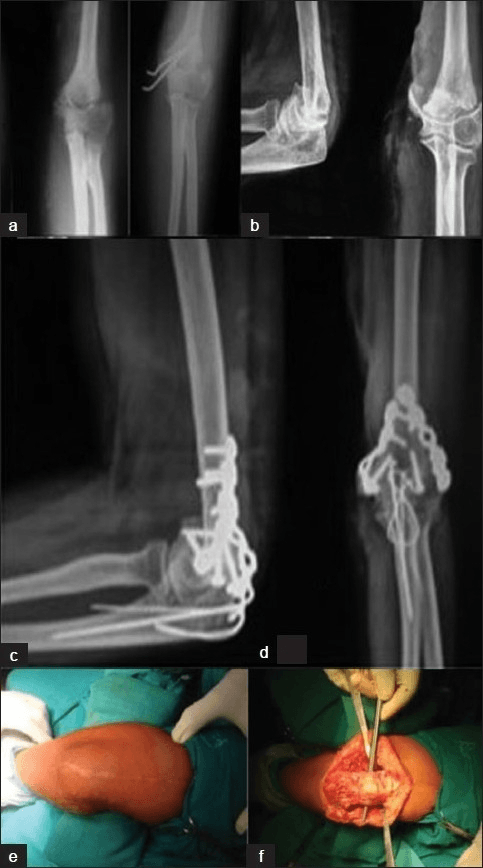
Ulnar neuropathy (15-20%). Causes are contusion at injury, stretch during reduction, irritation from a medial plate and scar formation. It is managed by release in situ or anterior transposition.
Wound dehiscence. The posterior skin is thin, and a haematoma can put it under tension. Full-thickness flaps, sub-muscular drains and careful closure prevent it, and flexion beyond 90° should be avoided while the skin is under tension.
Infection (2-6%). Higher in revision cases and after TEA. Debride; retain the hardware if stable, and if it is unstable or loose, remove it and place an antibiotic spacer, staging to TEA.
Stiffness (arthrofibrosis). The most common late complaint. Early active motion, the "M" of ARM, prevents it; static progressive (turnbuckle) splinting and then surgical release (capsulectomy) treat it.
Heterotopic ossification. Risk factors are head injury, delayed surgery and forceful passive stretching. Prophylaxis is indomethacin 75 mg sustained-release daily for 6 weeks or radiation, 700 cGy as a single dose. Routine prophylaxis is not supported for all cases: given the GI and union concerns, reserve it for high-risk elbows (head injury, delayed or repeat surgery).
Nonunion. Quoted at 2-10%, and at 5-10% in the ORIF group. It is higher in the transcondylar A3 pattern, for the reasons set out above. Treatment is revision ORIF with bone graft and plate augmentation (90-90 or quad plating), or conversion to TEA in the elderly.
Hardware failure. Screws pull out of the distal fragment, and plates break by fatigue failure when the fracture does not unite.
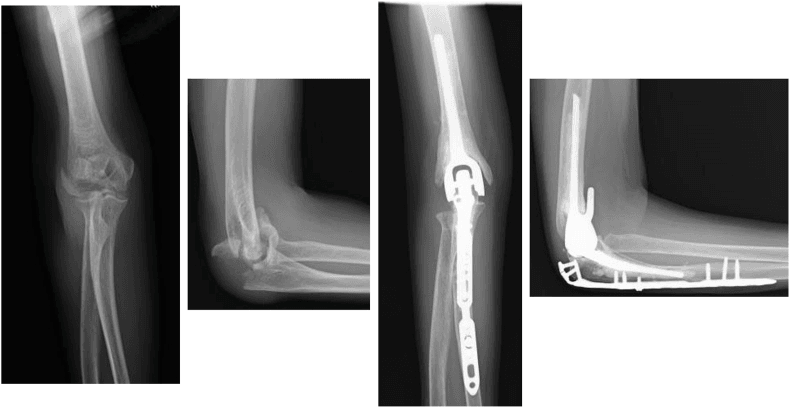
After TEA. The arthroplasty brings complications of its own:
- aseptic loosening of the stems, 10-15% at 10 years
- bushing wear: the polyethylene bushing wears out, causing metal-on-metal contact and osteolysis
- triceps insufficiency: failure of the triceps repair leaves the patient unable to extend against gravity
Postoperative Care
Weeks 0-2, protection. A posterior splint at 60-90° of flexion to offload the triceps repair, high elevation for oedema ("hand above heart"), and active finger, wrist and shoulder motion immediately. X-ray at 2 weeks to check alignment.
Weeks 2-6, mobilisation. Remove the sutures and start active assisted motion, with gravity-assisted exercises: supine overhead flexion and seated gravity extension. Consider turnbuckle splinting if the elbow is stiff at 6 weeks. No passive stretching, which increases the HO risk, and no lifting heavier than a coffee cup.
Weeks 6-12, strengthening. When callus is visible, aim for the functional arc (30-130°) and add isometric triceps strengthening, then progressive resistive exercises.
Outcomes/Prognosis
ORIF. Good to excellent in 75-80% of young patients; stiffness is the main complaint.
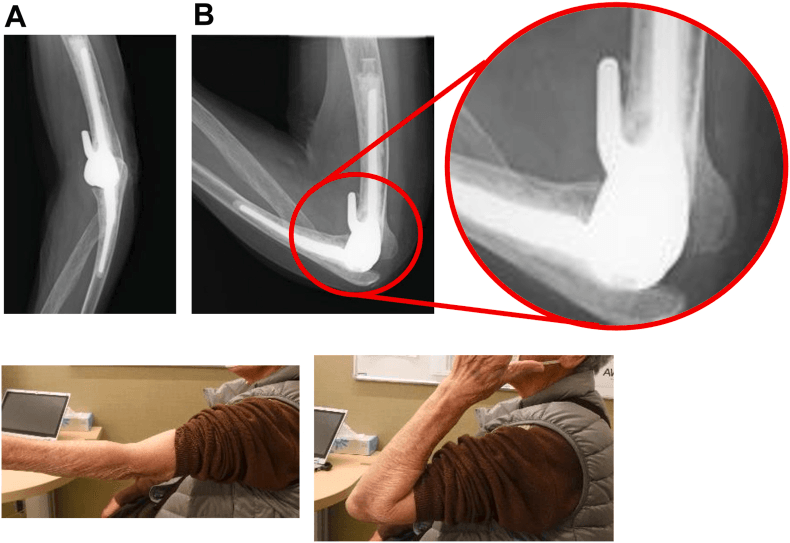
TEA. Survivorship is not one number: it depends on the diagnosis. In the Mayo series with a minimum of 10 years' follow-up (Barco 2017, carded below), elbows without inflammatory arthritis survived 92% at both 5 and 10 years, and elbows with rheumatoid arthritis 85% at 5 years and 76% at 10. Function in the surviving elbow is genuinely good (mean MEPS 90.5, flexion 123°, extension loss 24°, pain VAS 0.6).
The cost of TEA. Quote it alongside the survivorship: deep infection 11%, revision or resection 18%, and further periprosthetic fractures in 5 of 44. Male sex was the strongest risk factor for revision.
Guidelines, Registries & Global Practice
Global Epidemiology
- Distal humeral fractures account for roughly 2 to 3% of all adult fractures and around one-third of all elbow fractures.
- Distribution is bimodal: high-energy injuries in young men and low-energy fragility fractures in older women. The fragility-fracture share is rising with population ageing ("the silver tsunami").
- Transcondylar (low transverse, OTA 13-A3) patterns are over-represented in the osteoporotic elderly because the fracture follows the thinnest, weakest distal bone.
Side-by-Side Society Positions
- Emphasis
- Column theory and the parallel-plate ("principle-based") construct; restore the triangular distal humerus and enable early motion.
- Emphasis
- Early senior-led decision-making, CT for intra-articular patterns, orthogeriatric co-management of fragility fractures, and timely definitive surgery.
- Emphasis
- No fracture-specific clinical practice guideline; recommendations follow general fragility-fracture and bone-health (secondary prevention) guidance.
- Emphasis
- Endorses primary TEA for the comminuted elderly elbow not amenable to stable fixation, citing the McKee RCT.
Registry & Outcome Signals
- National joint registries that capture elbow arthroplasty (e.g. the Australian, UK and Nordic registries) consistently show that a large share of TEAs are now performed for acute trauma or fracture sequelae rather than inflammatory arthritis.
- Registry and cohort data show higher revision burden in younger, more active recipients and in men — reinforcing TEA as a procedure for low-demand patients.
High- vs Limited-Resource Practice Variation
- Well-resourced settings: CT-based planning, pre-contoured locking plates, headless compression screws, and ready availability of TEA implants and fellowship-trained elbow surgeons.
- Limited-resource settings: Reliance on plain films and traction views, conventional reconstruction/recon plates, and a lower threshold for non-operative ("bag of bones") management where arthroplasty implants, cement or revision capacity are scarce. Orthogeriatric co-management and falls/bone-health pathways may be unavailable.
Related pages: Distal Humerus Fractures is the parent topic and carries the bicolumnar patterns, the AO/OTA 13 classification and the approaches in full - a transcondylar fracture is the LOW, intra-capsular variant of that injury, and everything difficult about it follows from having almost no distal bone to fix to; Total Elbow Arthroplasty for the implant, the permanent lifting restriction, and the semiconstrained linkage the McKee and Barco cards above evaluate; Revision Total Elbow Arthroplasty for what an 18 percent revision rate actually commits the patient to; Periprosthetic Shoulder and Elbow Fracture for the complication Barco found in five of 44 elbows; Olecranon Fractures for the fixation of the osteotomy this exposure often requires, and for the nonunion and hardware problems that osteotomy adds; Elbow Stiffness and Contracture is the commonest complaint after ORIF and the reason five of Sanchez-Sotelo's 32 patients needed a second operation - it also carries the functional arc this page discusses; Heterotopic Ossification for the prophylaxis debate summarised in the Controversies section; Ulnar Nerve Anatomy, Cubital Tunnel Syndrome and Ulnar Nerve Palsy for the nerve that is dysfunctional in at least one in six of these patients after fixation; Capitellum Fractures and Coronoid Fractures for the other intra-capsular elbow fractures with the same healing environment; Nonunion Management for the 5 to 10 percent that fail to unite; and Osteoporosis for the bone quality that decides between fixing and replacing.
Controversies & Areas of Uncertainty
ORIF versus primary TEA. The McKee RCT supports TEA in the comminuted elderly elbow, but the right age and activity cut-off is not evidence-defined. Many surgeons now push the boundary upward, attempting fixation in fitter 65 to 75-year-olds, because TEA imposes a permanent lifting restriction and revision is difficult. Both McKee and the supporting Frankle cohort enrolled intra-articular 13-C fractures rather than the A3 pattern (see the Evidence section).
Distal humeral hemiarthroplasty. Proposed for low fractures with an intact or reconstructable column and competent collateral ligaments, avoiding the TEA lifting limit. The evidence remains low-level and implant availability is limited; long-term wear of the native ulna and radial head is unknown.
Olecranon osteotomy or triceps-sparing exposure. The osteotomy gives the best articular view but adds an osteotomy nonunion and hardware risk, with 5 to 10% reoperation for hardware. Paratricipital and triceps-reflecting approaches avoid this but limit articular access, so the choice is fracture- and surgeon-dependent.
Ulnar nerve: transpose or leave in situ. Vazquez et al found that transposition was not protective and may add risk, so routine transposition during ORIF is contested. In TEA most surgeons still handle or transpose the nerve to avoid traction.
Parallel or perpendicular plating. Parallel plating is biomechanically and clinically favoured for comminuted articular patterns, but high-quality comparative clinical trials are lacking, and 90-90 remains acceptable for simpler patterns.
MCQ Practice Points
Q: What is the primary contraindication to Total Elbow Arthroplasty for fracture? A: Active Infection or High Physical Demand (heavy laborer). TEA cannot withstand heavy lifting (greater than 1-2kg).
Q: Which nerve is most frequently injured iatrogenically during distal humerus ORIF? A: Ulnar Nerve. Usually due to entrapment or retraction neurapraxia.
Q: Which plating configuration provides the greatest stability for distal humerus fractures? A: Parallel Plating (Medial and Lateral columns).
Q: What is the preferred osteotomy technique for surgical exposure of the distal humerus articular surface? A: Chevron olecranon osteotomy - provides the best visualization of the trochlea and capitellum. Pre-drill before cutting.
Q: What did the McKee multicentre RCT (JSES 2008) conclude about ORIF vs TEA in elderly patients with distal humerus fractures? A: TEA had better 2-year Mayo Elbow Performance Scores and shorter operative time; about 24% of patients randomised to ORIF could not be stably fixed and were converted to TEA intra-operatively.
Clinical Decision Scenarios
Practise clinical reasoning and management decisions out loud
“A 78-year-old active lady presents with a comminuted distal humerus fracture (Transcondylar). CT shows 'osteopenia' and 'comminuted articular block'.”
“You decide to perform ORIF on a younger patient. Describe your fixation strategy.”
“An 80-year-old falls and has a swollen elbow. AP and lateral radiographs show a low transverse line with a posterior fat pad sign but the articular detail is unclear.”
Key Features
- Intra-capsular low fracture
- Small distal fragment (wafer)
- Elderly osteoporotic females
- High nonunion rate with ORIF
Treatment Matrix
- Young to ORIF (Parallel Plates)
- Elderly Active to TEA (Total Elbow)
- Elderly Demented to Bag of Bones
- Consider patient function/compliance for TEA vs ORIF
- TEA has a lifelong lifting restriction (~2 kg repetitive, a 'cup of tea')
Surgical Tips
- Olecranon osteotomy for exposure
- Identify Ulnar nerve immediately
- Interdigitate distal screws
- Avoid varus malreduction
Complications
- Stiffness (HO)
- Ulnar neuropathy
- Nonunion / Hardware failure
- Implant loosening (TEA)
Evidence
ORIF vs TEA in Elderly — Landmark RCT
- Multicentre RCT: 42 patients over 65 with displaced intra-articular (OTA 13C) distal humerus fractures randomised to ORIF vs semiconstrained TEA.
- 5 of 21 (24%) randomised to ORIF were converted to TEA intra-operatively because stable fixation could not be achieved.
- TEA had significantly better Mayo Elbow Performance Scores at 2 years (86 vs 73, P=0.015) and 32 minutes shorter operative time.
- Reoperation rates (TEA 12% vs ORIF 27%) did not reach significance.
ORIF vs Primary TEA — Supporting Cohort
- Retrospective comparison of ORIF vs TEA in 24 women over 65 with OTA 13.C2/C3 fractures (12 per group).
- TEA: 11 excellent, 1 good Mayo scores; no revisions. ORIF: 4 excellent, 4 good, 1 fair, 3 poor.
- 3 of 12 ORIF cases (25%) required conversion to TEA.
- Benefit of TEA most pronounced with rheumatoid arthritis, osteoporosis or steroid use.