Partial Knee | Medial vs Lateral | Oxford vs Fixed Bearing
- Strict Indication Criteria: Essential for success. 50% of revisions are due to poor selection.
- ACL Requirement: Must be intact and functional for UKA kinematics.
- Oxford Criteria: Bone-on-bone medial, Full thickness lateral/PF, Correctable varus, FFD under 15 deg.
- Inflammatory Arthritis: Absolute contraindication (disease will progress).
- Outcomes: Faster recovery and better function than TKA, but 2-3x higher revision rate.
- “Oxford criteria: intact ACL, correctable deformity, isolated compartment
- “Mobile bearing: lower wear, higher dislocation
- “Medial UKA most common
- “Good for active younger patients
Overview and Epidemiology
Unicompartmental knee arthroplasty (UKA) replaces only the damaged compartment of the knee, medial or lateral, and preserves the cruciate ligaments and the healthy compartments.
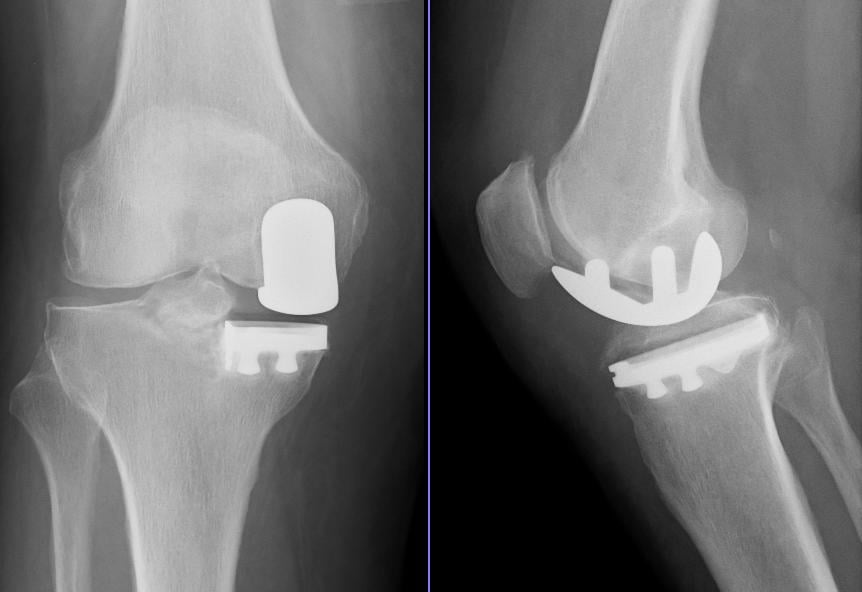
Usage. Most large registries cluster around 8-12% of primary knee arthroplasties, but usage is highly variable, from under 5% to over 40% depending on surgeon philosophy and country.
Who. Men and women are equally represented, and the age distribution is bimodal, with a different goal at each end:
- Young and active, under 55: bone preservation and high function
- Elderly and frail, over 80: less morbidity, quicker recovery and a lower risk of medical complications (MI, stroke) than TKA
Why it works. Preserving the ACL and PCL maintains near-normal knee kinematics and proprioception, including the screw-home mechanism and femoral rollback. The result is a "forgotten knee" more often than after TKA.
Indications and Contraindications
Classic criteria. Kozinn and Scott (1989) restricted UKA by demography as well as by anatomy:
- Age greater than 60
- Weight less than 82kg (180lbs)
- Low activity demand
- Minimal rest pain
- ROM greater than 90°
- Flexion contracture less than 5°
- Varus angular deformity less than 10°
Modern criteria. The Oxford group ignores age and weight and applies anatomical criteria to all patients. Usage has since expanded to younger, heavier and more active patients with good results, provided the anatomical criteria are met:
- Anteromedial OA, bone-on-bone
- Functionally intact ACL and MCL
- Correctable intra-articular varus
- Full-thickness cartilage in the lateral compartment
Correctable means intra-articular. UKA corrects intra-articular deformity only. It does not fix an extra-articular deformity.
ABCDEUKA Indications (Oxford Criteria)
Hook:ABCDE for UKA eligibility!
Absolute contraindications. Any one of these sends the patient to TKA.
- ACL deficiency - posterior tibial wear, rocking-horse kinematics and loosening
- Inflammatory arthritis (RA, lupus, gout) - pan-synovitis affects all compartments and the disease will progress to the lateral and PF compartments
- Fixed deformity - fixed varus greater than 15° suggests a deep MCL contracture and fixed flexion greater than 15° a posterior capsule contracture; UKA releases are minimal and cannot correct a severe fixed deformity
- Multicompartment disease - the pain will persist
Relative contraindications. A BMI greater than 40 is associated with early loosening through tibial subsidence. Chondrocalcinosis carries a risk of progression (pseudogout) but is not absolute. Patellofemoral OA is controversial: lateral facet wear with grooving is a contraindication, while mild medial facet wear is acceptable (see Controversies).
Pathophysiology and Mechanisms
Anteromedial wear. Varus OA with an intact ACL typically wears the knee anteromedially. The femoral wear is on the distal condyle, and the tibial wear lies anteriorly or centrally, often as a 'cup' defect. The medial meniscus is excised at surgery, and the polyethylene effectively replaces its function.
Rotation. The tibia internally rotates during flexion, and UKA designs must accommodate this screw-home mechanism.
The ACL. The ACL prevents anterior tibial translation. Without it the tibia subluxes anteriorly and loads the posterior aspect of the UKA insert eccentrically, the "rocking horse" phenomenon, and the result is early loosening and failure. Posterior tibial wear therefore suggests ACL deficiency, and ACL integrity is non-negotiable.
Classification Systems
Two radiographic grades describe how far the disease has progressed. Ahlbäck quantifies bone loss and helps decide between UKA and HTO; Kellgren-Lawrence grades OA in general.
- Radiographic finding
- Joint space narrowing (less than 3mm)
- Radiographic finding
- Joint space obliteration
- Radiographic finding
- Minor bone attrition (0-5mm)
- Radiographic finding
- Moderate bone attrition (5-10mm)
- Radiographic finding
- Severe subluxation of the tibia
UKA is ideal for grades 2-4. Grade 5 may imply excessive deformity or instability that requires TKA.
The kissing lesion. Bone-on-bone contact is ideal because it confirms full-thickness cartilage loss. Pain relief is more predictable when bone is on bone than when some cartilage remains.
Clinical Assessment
History. Ask the patient to point to the pain: in the "one finger test" they should point directly to the medial joint line, and generalised or retropatellar pain is a red flag. Start-up pain is typical of OA, and mechanical symptoms such as meniscal locking and catching fit with UKA pathology.
- Giving way suggests ACL deficiency, a contraindication
- Patellofemoral symptoms, significant pain on stairs or rising from a chair, are a relative contraindication if severe
Gait and alignment. Look for an antalgic gait or a varus thrust, which suggests dynamic instability, and judge whether the standing varus is mild, moderate or severe. The lateral joint line and the patellofemoral joint should be pain-free to palpation; painful PF crepitus is concerning.
Range of motion. Fixed flexion is hard to correct, so check that it is under 15°. Flexion needs to be greater than 110° for surgical exposure.
Ligaments. Lachman and anterior drawer must be stable, with a firm endpoint. The MCL must be competent, especially for a mobile bearing: on valgus stress at 30° of flexion it opens, but with a solid endpoint.
Correctability. With the knee in 20° of flexion, apply a valgus stress and see whether the varus corrects to neutral. If it is rigid, TKA is better.
- Distinguishing Feature
- One-finger medial joint-line pain, intact ACL, correctable varus, anterior wear on lateral X-ray
- Why it Matters for UKA
- The target pathology — predictable UKA result
- Distinguishing Feature
- Diffuse pain, lateral or retropatellar symptoms, lateral/PF narrowing on X-ray
- Why it Matters for UKA
- Contraindicates UKA — pain persists; needs TKA
- Distinguishing Feature
- History of giving-way, positive Lachman, posterior tibial wear on lateral X-ray
- Why it Matters for UKA
- Absolute contraindication to standard UKA (edge loading)
- Distinguishing Feature
- Inflammatory pattern, effusion, raised CRP/ESR, pan-compartment changes
- Why it Matters for UKA
- Absolute contraindication — disease progresses to other compartments
- Distinguishing Feature
- Sudden severe pain, focal medial femoral condyle lesion on MRI, often older female
- Why it Matters for UKA
- May be a UKA indication if confined and ACL intact; confirm extent on MRI
- Distinguishing Feature
- Mechanical symptoms, preserved joint space, normal alignment
- Why it Matters for UKA
- Arthroplasty not indicated — arthroscopic/conservative management
- Distinguishing Feature
- Groin or thigh pain, restricted hip rotation, normal knee X-ray
- Why it Matters for UKA
- Wrong joint — examine the hip and spine before listing for knee surgery
Investigations
The standard series. Four views, each answering a different question:
- Weight-bearing AP - medial joint space narrowing; look for bone-on-bone
- Lateral - posterior wear (ACL status) and patellofemoral osteophytes
- Skyline - the PF joint, and particularly the lateral facet
- 45° PA (Rosenberg) - the most sensitive view for posterior wear
Stress views. The valgus stress radiograph is the "gold standard" investigation for candidacy. It confirms both that lateral compartment cartilage thickness is maintained and that the varus is correctable. A varus stress view, to check whether the medial gap opens (MCL integrity), is less commonly used.
MRI. Not routinely needed if the radiographs are classic. It verifies ACL integrity when the Lachman is equivocal, checks the lateral cartilage when a stress view is not available, and checks the PF cartilage. Beware that MRI often over-calls damage: normal ageing changes in the lateral compartment cartilage do not necessarily preclude UKA if the radiograph is normal.
SPECT-CT. A bone scan can help identify the pain generator when the radiographs are mild, for example grade 2 OA with unexplained severe pain.
Management Algorithm
UKA or TKA. The criteria above reduce to one comparison. The UKA patient must also accept a slightly higher revision risk in return for better function.
- UKA Candidate
- Mechanical, localised to one compartment
- TKA Candidate
- Diffuse or patellofemoral pain
- UKA Candidate
- Intact & functional, clinically and radiographically
- TKA Candidate
- Intact or Ruptured
- UKA Candidate
- Bone-on-bone in one compartment only (medial or lateral)
- TKA Candidate
- Multicompartmental
- UKA Candidate
- Mild and passively correctable, under 15 deg
- TKA Candidate
- Fixed or severe (greater than 15 deg)
- UKA Candidate
- Under 15 degrees
- TKA Candidate
- Any degree
- UKA Candidate
- No (Contraindicated)
- TKA Candidate
- Yes (Indicated)
- UKA Candidate
- BMI under 40 (Relative)
- TKA Candidate
- Any BMI; BMI greater than 40 favours TKA, though relative
Step-by-step selection. Screen in this order:
- Clinical screen - medial pain, no giving way
- Radiographic screen - isolated medial OA
- Ligament screen - Lachman negative, MCL stable
- Deformity screen - correctable on the valgus stress view
- Counselling - the functional gain against the revision risk
- Decision - UKA, TKA or HTO
UKA or HTO. HTO is preferred for young active males with heavy labour demands, and UKA for older patients or those with less impact loading. The trade-offs are set out under Controversies.
Mobile vs Fixed Bearing
- Mobile Bearing (e.g., Oxford)
- Polyethylene moves on tibia
- Fixed Bearing (e.g., Miller-Galante)
- Polyethylene locked to tibia
- Mobile Bearing (e.g., Oxford)
- High (Conformity)
- Fixed Bearing (e.g., Miller-Galante)
- Low (Point loading)
- Mobile Bearing (e.g., Oxford)
- Low (Linear)
- Fixed Bearing (e.g., Miller-Galante)
- High (Point stress)
- Mobile Bearing (e.g., Oxford)
- Soft tissue dependent
- Fixed Bearing (e.g., Miller-Galante)
- Implant dependent
- Mobile Bearing (e.g., Oxford)
- Risk (1-2%)
- Fixed Bearing (e.g., Miller-Galante)
- No risk
- Mobile Bearing (e.g., Oxford)
- Must be intact/tensioned
- Fixed Bearing (e.g., Miller-Galante)
- Tolerates some laxity
- Mobile Bearing (e.g., Oxford)
- Excellent long term
- Fixed Bearing (e.g., Miller-Galante)
- Excellent long term
Mobile bearing. In the Oxford design a spherical femur articulates with a matched spherical meniscal bearing, which slides on a flat tibial tray. The joint is fully congruent through the whole range of motion, minimising contact stress and polyethylene wear. The price is that it needs perfect soft-tissue balance (ligamentotaxis) to hold the bearing in place: if the MCL is lax or the flexion gap loose, the bearing can spin out or dislocate.
Fixed bearing. The polyethylene is snapped or screwed into the tibial tray and meets a poly-radial femur, round on flat, so the joint is not fully congruent. Higher point-loading stresses mean potentially higher wear, though modern polyethylene helps. The surgery is simpler and more forgiving, and the bearing cannot dislocate.
Fixed vs Mobile Bearing — Systematic Review & Meta-analysis
- 44 studies, 9,463 medial UKA knees pooled.
- Crude revision rate: fixed bearing 0.90 (95% CI 0.65-1.21) vs mobile bearing 1.51 (95% CI 1.11-1.93) per 100 component-years - intervals that nearly touch.
- After stratifying for follow-up duration and age, revision rates were NOT substantially different.
- No essential difference in survivorship between the two designs.
Surgical Technique
Principles. The operation rests on these:
- Restore constitutional alignment. Do not aim for a 0° mechanical axis. Aim for the patient's pre-disease alignment, usually slight varus, and align the femoral component to restore the pre-disease joint-line height. Native alignment or slight under-correction is the target, because overcorrection unloads the UKA and accelerates lateral compartment wear.
- Spare the ligaments. The ACL and PCL are preserved, and the MCL is preserved, not released.
- Resect minimal bone. Take only enough to fit the implant, usually 6-8mm.
- Balance the gaps. Flexion and extension gaps must be equal, especially for a mobile bearing.
Steps. The sequence below is the Oxford technique.
- Exposure. A minimally invasive medial parapatellar incision; sublux the patella laterally rather than everting it. Examine the ACL (see the alert below) and the lateral compartment, and stop if the lateral compartment is damaged.
- Tibial resection. Perpendicular to the mechanical axis of the tibia in the coronal plane, with the posterior slope matched to the native slope (usually 7°) to balance the flexion gap. The depth is conservative.
- Femoral preparation. Align with an intramedullary rod, drill the holes for the posterior condyle mill, then mill the posterior condyle to remove the cartilage.
- Flexion gap. Insert a feeler gauge in flexion, tension the MCL and measure the gap (e.g., 4mm).
- Extension gap. In full extension the feeler gauge gap must match the flexion gap. If it is tight in extension, remove more distal femur; a gap loose in extension is not possible if the tibial cut is correct (or recut the tibia less deep).
- Implantation. Cement components of the computed size (some designs use a press-fit tibial tray) and insert the polyethylene bearing. Meticulous balancing is what prevents bearing dislocation.
Intra-operative ACL check. Even if the MRI was normal, you MUST visualise and probe the ACL. Chronic attenuation or mucinous degeneration may not show on MRI. If the ACL is floppy or absent, you must abandon the UKA and perform a TKA.
Complications
- Specific to UKA?
- Yes (Mobile)
- Incidence
- 1-2%
- Management
- Closed reduction or Revision
- Specific to UKA?
- Yes
- Incidence
- 5-10% (10y)
- Management
- Revision to TKA
- Specific to UKA?
- Yes (Exposure)
- Incidence
- Rare
- Management
- Repair + Brace or Convert to TKA
- Specific to UKA?
- Yes (Stress)
- Incidence
- less than 1%
- Management
- Fixation or Revision
- Specific to UKA?
- No (Common)
- Incidence
- 5-10%
- Management
- Revision
- Specific to UKA?
- No
- Incidence
- 0.5-1%
- Management
- DAIR or 2-stage Revision
Bearing dislocation. Specific to the mobile bearing. It follows a flexion gap that is too loose, an MCL injury or impingement on osteophytes, and presents with sudden pain, locking and a lump. Management is closed reduction or revision; at surgery the bearing is exchanged for a thicker one if the gap is loose.
Tibial plateau fracture. A vertical shear fracture through the keel slot, usually intra-operative or a postoperative stress fracture.
Progression of OA. The most common late cause of failure: the lateral compartment wears out over 10-15 years and requires conversion to TKA. Overcorrection accelerates it.
Loosening, infection and VTE. Aseptic loosening is usually on the tibial side. The risk of DVT and PE is lower than after TKA.
Postoperative Care
Rehabilitation Protocol
Patient mobilises Full Weight Bearing (FWB) immediately. Crutches for comfort.
Most patients discharged DOS (Day Surgery) or Day 1. Criteria: Safe ambulation, pain control.
Clip removal. ROM should be 0-90 degrees minimum.
Wean crutches. Driving permitted. ROM 0-120.
Return to low-impact sports (Golf, Doubles Tennis, Cycling).
UKA recovers significantly faster than TKA (weeks vs months), with less pain, less bleeding, less swelling, a shorter length of stay and a faster return to work. This is a key selling point for working patients.
Outcomes and Prognosis
Survival. Designer series report excellent 10-year survivorship: greater than 95% for the Oxford, ~96-99% in Pandit's 2011 series. National registries report 85-90% at 10 years, lower than TKA.
Why the gap. Partly a threshold artefact. A painful UKA is easily revised to a primary TKA, whereas revising a TKA is a far bigger undertaking, so surgeons and patients tolerate more pain before pulling the trigger, and revision should not be read as a pure measure of clinical failure.
The rest of the answer. Do not offer the artefact as the whole answer in a viva, because part of the gap is real. The registry pools every surgeon, including those doing a handful of these a year and those still on the learning curve, whereas the designer series come from high-volume units applying the selection criteria strictly. Since poor patient selection is itself a leading cause of early failure, the two explanations are linked: a well-selected UKA in experienced hands behaves like the designer series, and the registry figure is what happens on average across all comers.
Function. UKA consistently scores better on the Forgotten Knee Score (FKS) and gives better ROM, usually greater than 120° against 110° for TKA. Patients walk faster, with a more normal gait pattern and better gait analysis scores than TKA patients.
Lateral UKA and Revision
Lateral UKA. Lateral UKA accounts for only about 10% of UKAs and is technically more demanding than medial, and examiners expect you to know why it is different, not just that it exists. The indication is isolated lateral compartment OA, often post-traumatic or following lateral meniscectomy, with a correctable valgus deformity, an intact ACL and preserved medial and patellofemoral compartments.
Why the lateral side is different. The lateral compartment is normally lax in flexion, with greater femoral rollback, and the femur lifts off. A flat mobile bearing therefore has a much higher dislocation or "spin-out" rate laterally than medially: historically ~10%, and 17% with the flat tibia in the Yang meta-analysis in the evidence section. A domed (biconcave) tibial bearing, which increases entrapment, or a fixed-bearing design is generally preferred; if intra-operative bearing stability is unacceptable, convert a mobile to a fixed bearing.
Approach. Usually a lateral parapatellar approach. Beware over-correction: correct the valgus only to neutral, not into varus.
Revising a failed UKA. Revision to TKA is usually more straightforward than revising a TKA, because bone stock and the cruciate-preserving anatomy are largely intact; this is the driver of the revision-rate artefact. The common reasons to revise are:
- Progression of OA in the other compartment
- Aseptic loosening
- Bearing dislocation
- Unexplained pain
- Infection
Bone loss. After a loose or subsided tibial component there may be a medial tibial defect. It is often manageable with a standard primary TKA plus a tibial augment or wedge or a modest bone graft, with a stem if metaphyseal support is compromised. Femoral defects are usually small.
Results of revision. UKA-to-TKA revision generally does better than TKA-to-TKA revision, and approaches, but is slightly inferior to, a primary TKA, provided bone loss is modest.
Guidelines, Registries & Global Practice
Global epidemiology & utilisation:
- UKA accounts for roughly 8-12% of primary knee arthroplasty in most major registries, but usage varies enormously (under 5% to over 40%) between surgeons and health systems — a function of surgeon selection philosophy rather than disease prevalence.
- Isolated anteromedial OA with an intact ACL — the ideal UKA substrate — is present in a substantial minority of patients otherwise listed for TKA, so most registries report UKA as "under-used" relative to the ideal indication pool.
Registry evidence (side by side):
- Region
- England & Wales
- Key UKA signal
- UKA revision ~2x TKA at 8 yrs, but lower mortality/complications (Liddle 2014); revision lowest at 40-60% surgeon usage (Liddle 2015)
- Region
- Australia
- Key UKA signal
- Higher cumulative revision than TKA; aseptic loosening and disease progression are leading revision diagnoses
- Region
- New Zealand
- Key UKA signal
- Higher revision rate than TKA; revision strongly volume-dependent
- Region
- Sweden
- Key UKA signal
- Long-standing data; mobile-bearing dislocation and loosening as failure modes; survival improves with experience
Guideline positions (side by side):
- Position on UKA
- Offer partial OR total knee replacement for single-compartment OA where appropriate; discuss higher revision but faster recovery of UKA
- Position on UKA
- Recognises UKA as an option for isolated unicompartmental OA with strict selection; emphasises patient selection over age/weight cut-offs
- Position on UKA
- UKA appropriate for anteromedial OA with functional ACL, correctable deformity, intact lateral/PF compartments
- Position on UKA
- Supports broadened modern indications (Oxford group) when anatomical criteria met; cautions on low-volume practice
Historical selection criteria (Kozinn & Scott):
- The classic restrictive criteria (age over 60, weight under 82 kg, low activity, deformity under 10-15 degrees) were popularised by Kozinn & Scott. Modern evidence (TOPKAT, designer series) shows these age/weight limits are NOT independent predictors of failure when anatomical criteria are met — the field has moved toward anatomical, not demographic, selection.
High- vs limited-resource practice variation:
- High-resource settings: robotic/navigated UKA increasingly used to improve component positioning; early registry signals suggest comparable-to-lower short-term revision, but long-term and cost-effectiveness data remain immature. Day-case/outpatient UKA is well established.
- Limited-resource settings: UKA's smaller implant, shorter stay, lower transfusion need and faster rehabilitation are attractive, but the technique-sensitivity and need for adequate UKA volume mean outcomes depend heavily on surgeon experience; in low-volume centres TKA may be the more reproducible choice.
Controversies and Areas of Uncertainty
Cemented or cementless fixation. Cementless mobile-bearing UKA was introduced to reduce radiolucent lines and aseptic loosening. Some series and registry signals suggest lower revision for cementless designs, but the evidence is not yet definitive, and cementing errors remain a recognised cause of early failure.
Robotic and navigated UKA. Robotic assistance improves the accuracy of component positioning and reduces outliers, and early registry data hint at lower short-term revision. Long-term survival benefit and cost-effectiveness are unproven, however, and the dominant determinant of outcome remains correct patient selection.
Patellofemoral OA. Historically any PFJ disease excluded UKA. The Oxford group's work suggests that medial PFJ changes, and even some lateral facet damage without severe lateral grooving, do not compromise the outcome of a medial UKA. Severe lateral facet wear with grooving remains a contraindication, and the area is genuinely debated.
UKA or HTO in the young, active patient. For the young heavy labourer, HTO preserves bone and permits unrestricted activity but has a longer recovery and complicates future arthroplasty. UKA offers faster, more predictable pain relief. A prior HTO markedly worsens later UKA survival (66% vs 96% at 10 years; Rees 2001), so sequencing matters.
Expanding indications. Anatomical rather than demographic selection has extended UKA to younger, heavier and more active patients. Whether this broadening will hold up in long-term registry survival, or simply shift more revisions into the data, is still being resolved.
Viva Scenarios
Clinical Decision Scenarios
Practise clinical reasoning and management decisions out loud
“question: Discuss the options of UKA vs HTO vs TKA.”
“question: How do you manage this?”
“question: Can you perform a UKA in this patient?”
MCQ Practice Points
Q: Which UKA design absolutely requires a competent MCL? A: Mobile Bearing (Oxford). Without a competent MCL, the bearing will spin out or dislocate. Fixed bearing is more tolerant of mild laxity.
Q: Is ACL deficiency a relative or absolute contraindication for Mobile Bearing UKA? A: Absolute Contraindication. ACL deficiency allows anterior tibial translation, causing posterior edge loading and rapid failure.
Q: What is the most common cause of re-operation after UKA in the first 5 years? A: Aseptic Loosening or Bearing Dislocation (depending on series/bearing). Late failure is usually Progression of OA.
Q: What is the upper limit of Fixed Flexion Deformity (FFD) for UKA? A: 15 degrees. Beyond this, the posterior capsule cannot be released sufficiently through a UKA approach to achieve extension.
Q: What is the 10-year survival rate of UKA in registry data? A: 90-95% (slightly lower than TKA). Designer series report higher (98%). UKA has 2-3x higher revision rate than TKA.
Q: What is the alignment goal in UKA? A: Constitutional varus (pre-disease alignment). Do NOT aim for 0 degrees mechanical axis - this overcorrects and overloads the lateral compartment.
Indications (ABCDE)
- A: ACL Intact
- B: Bone-on-bone medial
- C: Correctable deformity
- D: Deformity (FFD) under 15 deg
- E: Exclude lateral/PF
Contraindications
- Inflammatory Arthritis
- ACL deficiency
- Fixed Varus greater than 15 deg
- BMI greater than 40 (Relative)
Complications
- Bearing Dislocation (Mobile)
- Fracture (Tibial plateau)
- Loosening
- Progression of OA
Key Numbers
- 8-12% of all knees
- 90% 10-year survival
- 1-2% dislocation rate
- 2-3x revision vs TKA
Evidence
- TOPKAT (RCT): OKS equal to TKA at 5y
- Liddle NJR: UKA 2x revision, lower mortality
- Liddle 2015: optimal usage 40-60%
- Pandit: 96% survival at 10y (designer)
Pearl
- Don't overcorrect valgus
- Respect the ACL
- One finger pain test
- Avoid overstuffing (tight gap)
Evidence Base and Key Studies
TOPKAT — Total or Partial Knee Arthroplasty Trial
- 528 patients randomised to partial (PKR/UKA) or total knee replacement for medial OA across 27 UK centres.
- No difference in Oxford Knee Score at 5 years (mean difference 1.04, 95% CI minus 0.42 to 2.50; p=0.159).
- PKR was both more effective (0.240 additional QALYs, 95% CI 0.046 to 0.434) and less expensive (minus 910 pounds, 95% CI minus 1503 to minus 317) over 5 years.
- Similar incidence of re-operations and complications between groups.
Adverse Outcomes UKA vs TKA — National Joint Registry
- 25,334 UKRs propensity-matched to 75,996 TKRs (101,330 total) in the NJR for England and Wales.
- UKA had worse implant survival: revision subhazard ratio 2.12 (95% CI 1.99-2.26) at 8 years - but for the composite of revision OR re-operation, which is what the authors use in their own conclusion, the subhazard ratio is only 1.38 (95% CI 1.31-1.44).
- Mortality was significantly lower for UKA at every timepoint, and the early difference is the striking one: 30-day hazard ratio 0.23 (95% CI 0.11-0.50), settling to 0.85 (95% CI 0.79-0.92) at 8 years.
- UKA had fewer complications (VTE, MI, stroke), shorter stay and fewer readmissions.
- Per 100 patients switched from TKA to UKA: about one fewer death but three more re-operations within 4 years.
Oxford Phase 3 UKR — 1000 Cases (Designer-Centre Series)
- First 1000 minimally invasive medial Oxford UKRs by two surgeons, independently reviewed (mean 5.6 years).
- 10-year survival 96% (95% CI 92.5-99.5) counting all implant-related re-operations as failure.
- 10-year survival 99.8% under a much narrower failure definition - counting only the TWO cases that needed revision components with stems and wedges, and excluding the 17 conversions to a primary total knee that most registries would record as revisions.
- Commonest causes of re-operation: lateral OA progression (0.9%), bearing dislocation (0.6%), unexplained pain (0.6%).
- Mean maximum flexion 130 degrees; function better than standard open approach.
Optimal UKA Usage & the Volume Effect — NJR
- 41,986 UKAs from the NJR for England and Wales analysed.
- Non-linear relationship between a surgeon's UKA usage and revision risk.
- Optimal results when UKA constitutes 40-60% of knee arthroplasty practice; acceptable at 20% or more.
- With optimal usage AND the most commonly used implant, five-year survival is 96% versus 90% (95% CI 88.4 to 91.6) at the 5% usage previously considered ideal.
- Lowest usage surgeons have the HIGHEST revision rates — implying overly narrow, inappropriate selection.
UKA After Failed High Tibial Osteotomy
- 631 medial Oxford UKAs pooled from three series; 18 had a previous HTO.
- 10-year cumulative survival 96% for primary UKA vs only 66% after failed HTO (p less than 0.0001).
- 27.8% of post-HTO UKAs were revised versus 3.1% of primary UKAs - which is FIVE revisions among the 18 post-osteotomy knees, against 19 among 613 primaries.
Lateral UKA Bearing Dislocation — Domed vs Flat Tibia
- 9 studies, 937 lateral Oxford UKR knees (3 flat, 6 domed tibia).
- Bearing dislocation fell from 17% (flat) to 3.7% (domed biconcave) tibial design.
- 10-year survival excluding dislocation rose to 93% with the domed design, and the revision rate excluding dislocation fell from 1.1% to 0.7% per annum.
- Most dislocations occurred at ~16 months; medial dislocations most common.