Cement Injection for VCF | Pain Relief | Controversial Evidence
- Kallmes (INVEST) and Buchbinder - two double-blind sham-controlled NEJM 2009 RCTs found no benefit of vertebroplasty over a sham procedure
- VERTOS IV (BMJ 2018) confirmed no benefit even in acute fractures (pain up to 6 weeks, widened to 9 during recruitment); Cochrane 2018 advises against routine use
- Thoracolumbar junction (T11-L2) most common location
- Cement leakage is the most common complication; on direct comparison vertebroplasty leaks more than kyphoplasty (about 39% vs 29%), but leaks are usually clinically silent
- VAPOUR (Lancet 2016) is the dissenting positive sham RCT - benefit in acute fractures under 6 weeks
- “Buchbinder and Kallmes (both NEJM 2009): no benefit of vertebroplasty over sham
- “VERTOS II (Klazen, Lancet 2010) was open-label vs conservative care and DID show benefit - design explains the discordance
- “Absolute contraindication: neurological deficit from fracture (needs decompression)
- “Kyphoplasty: may restore height but no proven clinical advantage over vertebroplasty
Overview
Vertebroplasty and kyphoplasty are minimally invasive procedures that inject bone cement, typically PMMA (polymethylmethacrylate), percutaneously into a vertebral compression fracture (VCF) to relieve pain and stabilise it mechanically. Vertebroplasty injects the cement alone; kyphoplasty first expands a balloon in the vertebral body and may restore some height. Both were popular before landmark sham-controlled trials called their efficacy into question.
History. Galibert first performed vertebroplasty in France in 1987, for a painful cervical haemangioma. Kyphoplasty followed in the 1990s, adding a balloon to create a cavity and potentially restore vertebral height. Adoption was rapid, and it came before rigorous evidence existed.
The controversy. The evidence splits cleanly along trial design, and that is the single most examined point in this topic. Open-label trials comparing augmentation with conservative care were positive, showing superior early pain and function; double-blind sham-controlled trials found no benefit over a sham injection, even in acute fractures. The one dissenting sham-controlled trial, VAPOUR, enrolled only very acute (under 6-week), severely painful fractures, used an "adequate vertebral fill" technique, and was positive.
Where practice stands. The 2018 Cochrane review concluded there is no important benefit over sham. Practice has consequently shifted toward conservative management first, rigorous selection and shared decision-making. The individual trials are set out under Outcomes.
The recurring exam trap is to call "VERTOS II" a negative sham-controlled trial. It is not: VERTOS II (Klazen, Lancet 2010) was open-label, compared vertebroplasty with conservative care, and was positive. The negative sham-controlled trials are Kallmes (INVEST) and Buchbinder, both NEJM 2009. Knowing which trial used which design is the whole point examiners probe.
Pathophysiology and Mechanisms
The anatomy that matters. The target is the vertebral body, the anterior column, and the needle reaches it through the pedicle. Behind the body lie its posterior wall and then the spinal canal with the neural structures. The basivertebral venous plexus is the pathway along which cement leaks.
The fracture. Axial loading on osteoporotic bone fails the anterior column, and the vertebra wedges anteriorly; the posterior wall and pedicles are usually spared. The pain comes from the periosteal nerves, from instability and from the inflammatory response. The thoracolumbar junction (T11-L2) is the most common level.
Osteoporosis is the primary risk factor. The others:
- Corticosteroid use
- Metastatic disease
- Multiple myeloma
- Primary bone tumours
The cement. PMMA provides immediate stability, but it has no biological incorporation and remains a foreign body. It polymerises exothermically, generating heat, and its viscosity changes during injection.
Height restoration. In kyphoplasty the balloon creates a cavity in the cancellous bone and may restore some vertebral height. Kyphosis correction is usually modest, and height restoration may not correlate with clinical outcome.
Classification Systems
Fractures are graded by how much height they have lost and grouped by cause; the procedures are grouped by approach and by how the cavity, if any, is made.
The Genant semi-quantitative classification is the standard for quantifying VCF severity, based on height loss.
- Height Loss
- 0%
- Description
- Normal, no fracture
- Height Loss
- 20-25%
- Description
- Mild compression
- Height Loss
- 25-40%
- Description
- Moderate compression
- Height Loss
- More than 40%
- Description
- Severe compression
Clinical Assessment
Who is a candidate. A painful osteoporotic VCF that has failed 3-6 weeks of conservative treatment, in a patient in whom:
- MRI shows bone marrow oedema, confirming the fracture is acute
- The pain localises to the fracture level
- There is no neurological deficit
- The posterior wall is intact on imaging
History. The mechanism is typically minimal trauma in an osteoporotic fracture. Establish how long the symptoms have lasted, the character and location of the pain, and the functional limitation, and ask about the red flags for malignancy or infection.
Examination. Look for midline tenderness over the fracture level and for tenderness elsewhere in the spine that may mean more than one level. Examine the neurology to rule out a deficit, and assess sagittal alignment for kyphosis.
Contraindications. A neurological deficit needs decompression, not cement, and heads the absolute list.
Absolute
- Neurological deficit requiring decompression
- Active infection, vertebral or systemic (osteomyelitis, discitis)
- Uncorrectable coagulopathy
- Severe posterior wall destruction or burst fracture with canal compromise
Relative
- Healed fracture, with no oedema on MRI
- Minimal symptoms (consider other sources of the pain)
- Retropulsion of fragments
- More than 3 levels requiring treatment
- Young patient (consider other options)
STOPSTOP - Contraindications to Augmentation
Hook:STOP and assess contraindications before any augmentation
Differential diagnosis. Before augmenting, the surgeon must be certain the fracture is benign and osteoporotic, not a sinister mimic. Augmenting a malignant or infected vertebra without a tissue diagnosis is a classic exam trap.
- Discriminating features
- Low-energy/no trauma, T1 low and STIR high oedema confined to body, intact posterior elements, normal pedicles
- Implication for augmentation
- Standard candidate if acute and refractory
- Discriminating features
- Pedicle involvement, posterior cortex bulge, soft-tissue mass, convex posterior wall, diffuse low T1 marrow
- Implication for augmentation
- Needs biopsy and oncological plan; augmentation only palliative and higher leak risk
- Discriminating features
- Diffuse osteopenia, multiple lytic lesions, abnormal SPEP/UPEP/light chains
- Implication for augmentation
- Confirm diagnosis before any procedure
- Discriminating features
- Endplate erosion, disc and paravertebral collection, raised CRP/ESR, fever
- Implication for augmentation
- Absolute contraindication - cement seeds infection
- Discriminating features
- High-energy, younger patient, posterior wall retropulsion, canal compromise
- Implication for augmentation
- Usually surgical, not augmentation
Investigations
Radiographs. AP and lateral views of the affected region document the height loss and show alignment and kyphosis. They cannot determine whether the fracture is acute, cannot assess the soft tissues and may miss subtle fractures, so they serve for initial screening and follow-up but are not sufficient for planning augmentation.
MRI is the gold standard for fracture acuity and for ruling out other pathology, and it is essential to patient selection. The acute fracture is T1 hypointense and T2/STIR hyperintense, and it is the bone marrow oedema on STIR that confirms acuity. Oedema typically persists 3-6 months; a fracture without it is chronic or healed and unlikely to benefit from cement. The same scan assesses the integrity of the posterior wall, rules out infection (endplate changes, a paravertebral collection) and evaluates for malignancy.
CT gives superior bony detail for planning. It defines the posterior wall integrity, which is critical, along with the fracture morphology and any canal compromise, and it plans the needle trajectory and evaluates cement from any previous procedure. It is essential when posterior wall involvement is suspected, when planning for a burst-type pattern, and for evaluating bone quality.
Other tests.
- DEXA confirms osteoporosis, gives a baseline for monitoring treatment, and its T-score guides systemic treatment
- Laboratory tests: SPEP, UPEP and light chains to rule out myeloma; inflammatory markers if infection is suspected; coagulation studies before the procedure
- Bone scan: the alternative if MRI is contraindicated. Increased uptake means an active fracture, but it is less specific than MRI
Management Algorithm
Most VCFs improve with conservative care, and augmentation is reserved for the fracture that does not. The pathway runs:
- Diagnose and assess. Confirm a painful VCF on history and examination, image with an X-ray and then MRI to assess acuity and rule out tumour or infection, and assess for a neurological deficit and posterior wall involvement.
- Rule out contraindications. A neurological deficit means considering surgery, and a burst fracture with canal compromise means surgery. Active infection is treated, and coagulopathy is corrected before any procedure.
- Conservative treatment for 3-6 weeks. Most patients improve.
- Persistent severe pain. Confirm the MRI oedema is still present (an acute fracture), discuss the evidence and the VERTOS controversy with the patient, and make the decision together. Because the trial evidence is mixed, that shared decision includes the risks of cement leak and embolism.
- If augmentation is chosen. Vertebroplasty or kyphoplasty (outcomes are similar), informed consent that includes the risks of extravasation, a transpedicular approach under fluoroscopic guidance, and continued osteoporosis management after the procedure.
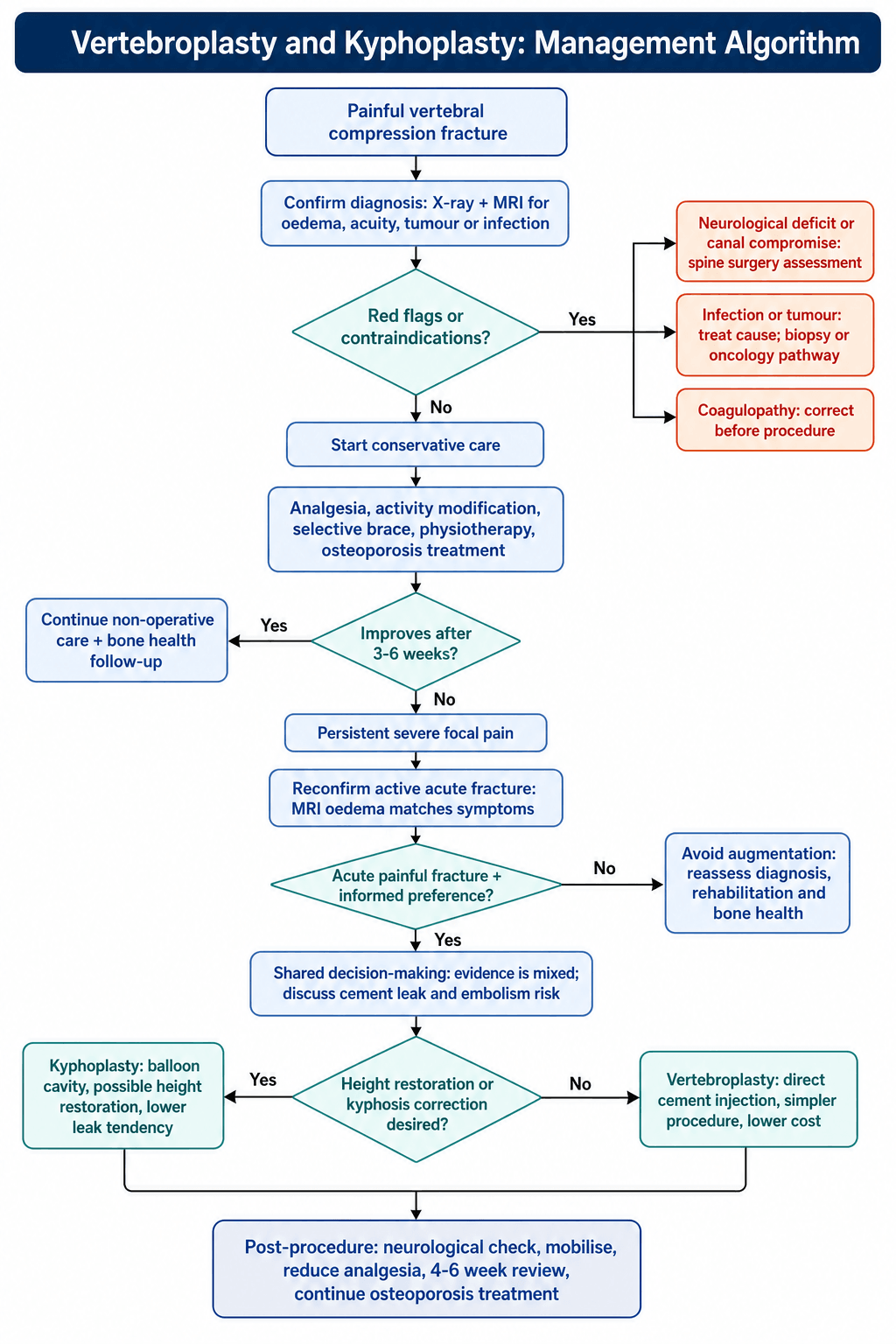
Conservative care. Analgesia (paracetamol, NSAIDs, opioids if needed), activity modification, physiotherapy as tolerated and osteoporosis treatment. Bracing is controversial and its evidence limited. The trial typically runs 3-6 weeks before intervention is considered, though persistent severe pain may prompt earlier intervention.
Treat the osteoporosis. Whatever is decided about cement, the systemic treatment is essential:
- Calcium and vitamin D supplementation
- Bisphosphonates or denosumab
- Anabolic agents (teriparatide) considered for severe cases
- Fall prevention and lifestyle modification
Treating the underlying osteoporosis is more important than the augmentation procedure itself. Patients with VCF need comprehensive osteoporosis management to prevent additional fractures.
Vertebroplasty or kyphoplasty. The choice depends on the fracture characteristics and the desired outcome.
- Vertebroplasty
- Direct cement injection
- Kyphoplasty
- Balloon expansion then cement
- Vertebroplasty
- Minimal
- Kyphoplasty
- May restore some height
- Vertebroplasty
- Lower
- Kyphoplasty
- Higher (balloon cost)
- Vertebroplasty
- Higher (no cavity)
- Kyphoplasty
- Lower (controlled cavity)
- Vertebroplasty
- Shorter
- Kyphoplasty
- Longer
- Vertebroplasty
- Negative vs sham (Kallmes, Buchbinder NEJM 2009; VERTOS IV)
- Kyphoplasty
- FREE trial positive vs conservative (open-label, not sham)
When to operate instead. Open surgery is indicated for neurological compromise or instability:
- Neurological deficit
- Significant canal compromise
- Unstable burst fracture
- Progressive kyphosis requiring correction
- Infection (debridement needed)
- Tumour requiring resection
Surgical Technique
Both procedures are done under local anaesthesia with sedation, or general anaesthesia, with the patient prone and biplanar fluoroscopy (AP and lateral).
Needle placement.
- Local anaesthetic to the skin and periosteum
- An 11-13G trocar needle through the pedicle (transpedicular)
- Advance to the anterior third of the vertebral body
- AP view: the needle should not cross the medial pedicle wall until it is in the body
- Lateral view: the tip in the anterior third of the body
Cement injection.
- Mix the PMMA to an appropriate viscosity
- Inject slowly under continuous fluoroscopy
- Watch for extravasation (epidural, disc, venous)
- Stop if cement approaches the posterior wall
- Fill typically 2-5 mL per level
One pedicle or two. A unipedicular approach uses a single needle and may not fill the contralateral side. A bipedicular approach uses two needles and fills better, at the cost of a longer procedure.
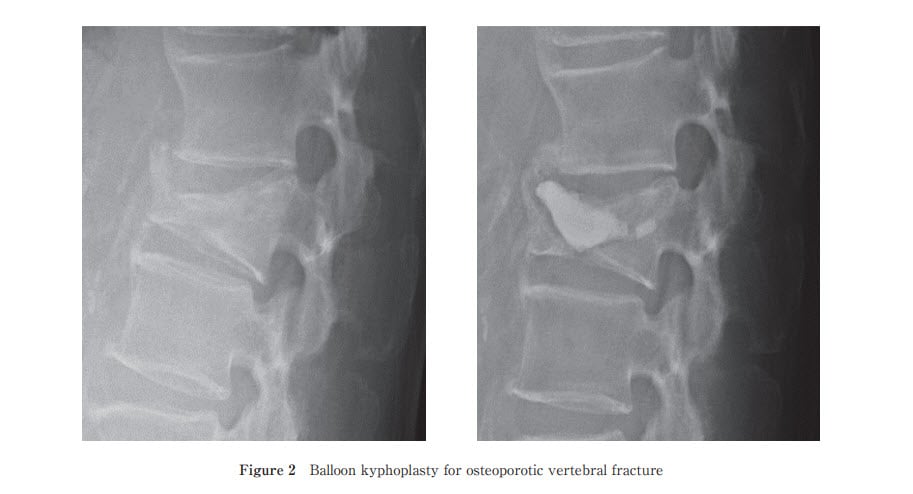
Cement. A "toothpaste" consistency is preferred. Too thin and it risks extravasation; too thick and it is difficult to inject. Avoid overfilling: quality of fill matters more than quantity.
Fluoroscopy. Monitor continuously throughout the injection, with the lateral view watching the posterior wall and the AP view the midline and pedicle. Continuous screening is the key: it detects extravasation the moment it starts.
The classic choice is "vertebroplasty (cement only) versus balloon kyphoplasty (cavity then cement)," but examiners increasingly expect awareness of implant-assisted augmentation, which leaves a permanent mechanical scaffold to hold the restored height rather than relying on cement alone:
- Vertebral body stenting (VBS): an expandable metal stent is deployed through the pedicle and then filled with cement, intended to maintain the height gained (balloon kyphoplasty often loses some of its height when the balloon is deflated before cement is injected - "balloon deflation height loss").
- SpineJack (titanium intravertebral jack/implant): a craniocaudally-expanding titanium implant that lifts the endplates and is then cemented in. The SAKOS randomised trial compared SpineJack with balloon kyphoplasty and found at least equivalent (and in some measures better and more durably maintained) height restoration and pain/function outcomes.
Why it matters: the rationale is better and more durable height/kyphosis restoration than cement-only techniques, with similar leak profiles. The trade-offs are higher implant cost and the same unresolved question that haunts the whole field - whether any radiographic height gain translates into a clinically important benefit over conservative care. Quote it as: vertebroplasty and balloon kyphoplasty are the cement-only options; vertebral body stenting and SpineJack add a retained implant to better hold the restored height (SAKOS), at higher cost and with the same evidence caveat.
Complications
Cement leakage is the most common complication. On direct comparison vertebroplasty leaks more often than kyphoplasty, at about 39% of levels against 29% (Rose 2024). Leaks usually go into the disc, the epidural space or the paravertebral veins and are almost always asymptomatic; they become symptomatic only through neural compression or pulmonary cement embolism. High-viscosity cement and continuous fluoroscopy reduce the risk.
- Incidence
- Common (10-20%)
- Clinical Significance
- Usually asymptomatic, may stress adjacent levels
- Management
- Observation
- Incidence
- 5-10%
- Clinical Significance
- May cause neural compression
- Management
- Observe if asymptomatic, decompress if deficit
- Incidence
- 5-10%
- Clinical Significance
- Risk of pulmonary embolism
- Management
- Monitor, anticoagulation if symptomatic PE
- Incidence
- Rare
- Clinical Significance
- Nerve root compression
- Management
- May need decompression
- Incidence
- Rare
- Clinical Significance
- Cosmetic, usually minor
- Management
- Observation
New neurological symptoms after augmentation require urgent imaging and spine-surgical assessment rather than observation. Radiographs after kyphoplasty may miss an epidural cement leak.
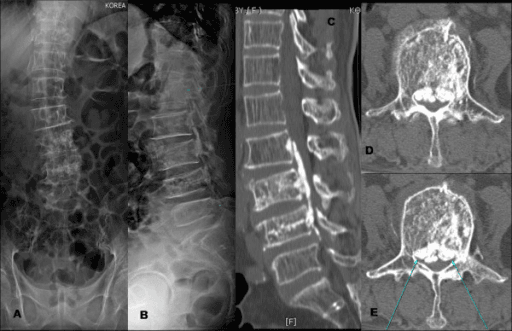
Pulmonary cement embolism. Cement migrates through the paravertebral and basivertebral venous system to the lungs. Reported incidence varies widely, from about 2% to 26% (systematic review, Wang 2012); most emboli are asymptomatic and detected incidentally, and rarely they cause cardiopulmonary compromise or death.
- Prevention: high-viscosity cement, slow injection, and stop immediately if venous filling is seen on fluoroscopy
- Treatment: supportive; anticoagulation for symptomatic peripheral emboli; surgical retrieval only for large central emboli
New and adjacent fractures. Across the randomised trials, new symptomatic vertebral fractures occur at broadly similar rates after vertebroplasty and after control, and the Cochrane 2018 review found no clear increase attributable to cement. Whether cement increases the adjacent-level risk remains genuinely contested.
- Some argue cement stiffening increases the adjacent-segment risk
- Cement leaking into the disc space may increase stress at the adjacent levels, potentially contributing to adjacent-level fractures
- Others argue new fractures simply reflect the underlying osteoporotic progression, and both augmented and non-augmented patients sustain them
- They likely reflect the osteoporotic progression as much as the procedure
- Risk factors: osteoporosis severity, cement volume, residual kyphosis
Other complications. Infection (rare, less than 1%), pedicle fracture, rib fracture at thoracic levels, haematoma and transient radiculopathy. Thermal injury from the exothermic reaction is rare.
Postoperative Care
Recovery. Monitor for 2-4 hours, with neurological and pain assessment, and mobilise when comfortable. Discharge is typically the same day or the next, with a return to normal activities as tolerated and analgesia as needed, often reduced. Follow-up is a clinical assessment at 4-6 weeks, with radiographs if new symptoms appear, and DEXA per the osteoporosis guidelines.
- Timeline
- Same day
- Notes
- As tolerated
- Timeline
- Same day
- Notes
- As tolerated
- Timeline
- 1-2 weeks
- Notes
- When comfortable, off narcotics
- Timeline
- 1-2 weeks
- Notes
- Gradual increase
- Timeline
- 4-6 weeks
- Notes
- Use caution given osteoporosis
Outcomes and Prognosis
The negative sham-controlled trials. Three double-blind sham-controlled RCTs found no benefit:
- Kallmes / INVEST (NEJM 2009), 131 patients: no significant difference in RDQ disability or pain at 1 month, with high crossover from control to vertebroplasty by 3 months (51% vs 13%)
- Buchbinder (NEJM 2009), 78 patients in Australia with MRI-confirmed unhealed fractures less than 12 months old: no benefit over sham at 1 week or at 1, 3 or 6 months
- VERTOS IV / Firanescu (BMJ 2018), 180 patients with acute fractures: no significant difference in VAS pain across 12 months, extending the negative sham finding to acute fractures
The positive open-label trials. Both compared augmentation with conservative care without a sham arm, and the open-label design limits interpretation.
- VERTOS II / Klazen (Lancet 2010), 202 patients with acute fractures (MRI oedema, under 6 weeks): greater pain relief with vertebroplasty at 1 month and 1 year
- FREE / Wardlaw (Lancet 2009), 300 patients, balloon kyphoplasty against non-surgical care: SF-36 PCS improved 7.2 vs 2.0 points at 1 month (difference 5.2), the benefit diminishing by 12 months
The dissenting sham trial. VAPOUR / Clark (Lancet 2016) was a double-blind, placebo-controlled RCT of 120 patients with acute fractures (under 6 weeks) and NRS pain of at least 7/10. 44% vs 21% achieved NRS pain below 4/10 at 14 days, a between-group difference of 23 percentage points, which suggests that acuity and vertebral fill matter.
Reading the split. Patient selection, fracture age and vertebral-fill technique are all disputed between the trials.
Against augmentation. The sham-controlled trials show no benefit, the placebo effect is likely significant, and the complications from cement are real.
For selective use. Acute fractures (under 6-8 weeks) may benefit, and pain relief is rapid, even if it diminishes over time. VAPOUR and other trials suggest early intervention helps, and patient selection may be key.
Guidelines, Registries & Global Practice
Global Epidemiology
Osteoporotic vertebral compression fracture is the most common fragility fracture worldwide, and its burden is rising with population ageing - the over-65 population is the fastest-growing demographic globally, driving a parallel rise in age-related spinal disorders including osteoporotic compression fractures. The thoracolumbar junction (T11-L2) is the predominant level because it is the mechanical transition between the rigid thoracic and mobile lumbar spine. Most fractures are low-energy in women over 60 with established osteoporosis; only a minority are clinically recognised, as many are detected incidentally on imaging.
Major Guidance, Side by Side
- Position
- Advises against vertebroplasty in routine practice; no clinically important benefit over sham
- Evidence basis
- Systematic review of 21 RCTs, high-to-moderate certainty (Buchbinder 2018)
- Position
- Vertebroplasty/kyphoplasty an option only for severe ongoing pain after recent fracture despite optimal non-surgical care
- Evidence basis
- Restricts to a refractory, recent-fracture subgroup
- Position
- Continue to support augmentation in carefully selected refractory patients, citing VAPOUR and open-label data
- Evidence basis
- Emphasise acute fractures and adequate vertebral fill
- Position
- Conservative care first; reserve augmentation for refractory acute pain after shared decision-making
- Evidence basis
- Convergent across guidance despite the controversy
The practical exam point is that the disagreement is real and design-driven: bodies weighting the double-blind sham-controlled trials (Cochrane, NICE) are restrictive, while those weighting open-label and the positive VAPOUR sham trial are more permissive.
Registry and Outcome Evidence
There is no dedicated international vertebral-augmentation joint registry analogous to the arthroplasty registries (NJR, AJRR, AOANJRR). Evidence therefore comes from RCTs and large administrative cohorts, which is part of why the controversy persists. Across the randomised literature, new symptomatic vertebral fractures after vertebroplasty occur at broadly similar rates to controls (Cochrane 2018: no clear increase), arguing against the older fear that cement reliably causes adjacent-level fracture.
Global Practice Variation
- Typical pattern
- Higher augmentation rates, often kyphoplasty
- Driver
- Access to fluoroscopy, devices and reimbursement
- Typical pattern
- Lower rates, augmentation reserved for refractory cases
- Driver
- Adoption of Cochrane/NICE guidance
- Typical pattern
- Predominantly conservative; augmentation limited
- Driver
- Cost of cement/balloons and imaging access
- Typical pattern
- Systemic osteoporosis therapy after any fragility fracture
- Driver
- Secondary fracture prevention outweighs the augmentation debate
Special Considerations
Pathological (neoplastic) fractures. The intent is palliative: pain relief and quality of life. Cement may provide stability for radiation therapy and is considered in conjunction with radiation or systemic therapy, but the extravasation risk may be higher where tumour has destroyed the bone. Consider surgery instead for a neurological deficit or significant canal compromise, where a tissue diagnosis is needed, or where life expectancy warrants more definitive treatment.
Multiple levels. Each level adds procedural time and risk, and the cement load is cumulative. Prioritise the most symptomatic levels and consider staged procedures.
Timing. Acuity is judged on the MRI oedema:
- Acute (under 6 weeks): VAPOUR suggests possible benefit, and augmentation may offer faster pain relief
- Subacute (6 weeks to 3 months): benefit debatable and conservative treatment often effective; consider for severe refractory pain
- Chronic (more than 3 months): little evidence of benefit, and a healed fracture is unlikely to respond to cement
Young patients. Avoid augmentation if possible and reserve it for exceptional circumstances. Traumatic VCF in young patients is usually treated surgically, an underlying bone pathology should be considered, and the long-term effects of cement are unknown.
The same percutaneous-cement principle is applied to the sacrum for painful sacral insufficiency fractures (the typical osteoporotic, often bilateral sacral-ala "Honda/H-pattern" fracture in an elderly patient, frequently coexisting with a pelvic fragility fracture) - this is sacroplasty:
- Indication: refractory pain from an osteoporotic/insufficiency sacral fracture (commonly the sacral ala, lateral to the foramina) after a trial of conservative care - the sacral equivalent of the VCF augmentation decision.
- Technique: CT or fluoroscopic guidance with a short-axis (lateral-to-medial) or long-axis (caudal-to-cranial, down the ala) needle path; small cement volumes into the ala.
- The key distinct danger: cement leakage into the sacral neural foramina or the central canal, threatening the L5/S1 (and lower sacral) nerve roots - foraminal leak is the feared, function-limiting complication and is why meticulous imaging and slow, low-pressure injection matter even more than in the spine.
- Evidence: like vertebral augmentation, the high-level evidence is limited and observational - rapid pain relief is reported but it is not a substitute for osteoporosis treatment and fall prevention.
Exam point: sacroplasty is cement augmentation of a sacral insufficiency fracture (think the elderly osteoporotic patient with a Honda-sign sacral fracture); the technique mirrors vertebroplasty but the cardinal risk shifts to cement leakage into the sacral foramina with nerve-root injury.
MCQ Practice Points
Q: Which trials showed vertebroplasty was no better than a sham procedure?
A: Two double-blind sham-controlled RCTs published together in NEJM 2009 - Kallmes (INVEST) and Buchbinder - plus VERTOS IV (BMJ 2018). Note that VERTOS II (Klazen, Lancet 2010) was open-label and positive, a common exam trap.
Q: What is the most common complication of vertebroplasty/kyphoplasty?
A: Cement leakage. On direct comparison vertebroplasty leaks more than kyphoplasty (about 39% vs 29% of levels). Usually asymptomatic but can leak into disc space, epidural space, paravertebral veins (pulmonary embolism), or foramina (nerve compression).
Q: What MRI finding confirms an acute VCF suitable for augmentation?
A: Bone marrow edema (STIR hyperintensity, T1 hypointense). This confirms the fracture is acute (typically persists 3-6 months). Chronic healed fractures without edema are unlikely to benefit from augmentation.
Q: What is an absolute contraindication to vertebral augmentation?
A: Neurological deficit requiring decompression. Other absolute contraindications include active infection, uncorrectable coagulopathy, and severe posterior wall destruction with canal compromise.
Q: What is the main technical difference between vertebroplasty and kyphoplasty?
A: Kyphoplasty uses a balloon to create a cavity before cement injection. This may restore some vertebral height and has lower cement extravasation rates, but clinical outcomes are similar between techniques.
Summary
Key Takeaways
-
Design-Driven Controversy: Double-blind sham-controlled trials (Kallmes/INVEST and Buchbinder, NEJM 2009; VERTOS IV, BMJ 2018) found no benefit over sham, while open-label trials (VERTOS II Lancet 2010, FREE Lancet 2009) were positive. Do not confuse VERTOS II (open-label, positive) with the negative NEJM trials - this is the commonest exam trap.
-
Acute Fractures May Differ: The VAPOUR sham-controlled trial (Lancet 2016) showed benefit for very acute fractures (under 6 weeks). Timing may matter - MRI oedema confirms acuity.
-
Cement Leakage is Common: Leakage occurs in about 39% of vertebroplasty and 29% of kyphoplasty levels, mostly asymptomatic. Serious complications (epidural compression, pulmonary cement embolism) are rare but can occur.
-
Contraindications are Critical: Neurological deficit requires decompression, not cement. Healed fractures without edema will not benefit.
-
Kyphoplasty vs Vertebroplasty: Kyphoplasty creates a cavity (lower extravasation, may restore height) but clinical outcomes are similar. Height restoration does not clearly correlate with pain relief.
-
Treat the Osteoporosis: Systemic osteoporosis management is more important than the augmentation procedure. All patients need calcium, vitamin D, and anti-resorptive therapy.
-
Shared Decision-Making: Given the controversial evidence, honest discussion with patients about the limited evidence is essential. Conservative treatment remains a reasonable alternative.
Clinical Decision Scenarios
Practise clinical reasoning and management decisions out loud
“A 75-year-old woman with known osteoporosis has acute back pain after a minor fall. X-ray and MRI show an acute L1 compression fracture with bone marrow edema. She has severe pain despite 4 weeks of conservative treatment including analgesics and bracing. She asks about vertebroplasty. How do you counsel her?”
“During a vertebroplasty at T12, you notice cement extravasating into the epidural space on fluoroscopy. What do you do?”
“Why do the major vertebroplasty trials seem to disagree, and how has the evidence changed practice?”
“What is the difference between vertebroplasty and kyphoplasty? When might you choose one over the other?”
Landmark Trials
- Kallmes (INVEST) & Buchbinder, NEJM 2009: sham-controlled, no benefit
- VERTOS IV (BMJ 2018): no benefit even in acute fractures
- VERTOS II (Lancet 2010) & FREE (Lancet 2009): open-label, positive
- VAPOUR (Lancet 2016): sham-controlled, positive in acute under-6-week fractures
Indications
- Acute painful osteoporotic VCF
- Failed conservative treatment (3-6 weeks)
- MRI confirms edema (acute fracture)
- No neurological deficit
Contraindications
- Neurological deficit (needs decompression)
- Active infection
- Posterior wall disruption with canal compromise
- Healed fracture (no edema)
Cement Leakage
- Most common complication
- Vertebroplasty about 39% vs kyphoplasty about 29% of levels
- Usually asymptomatic; routes: disc, epidural, veins, foramen
- Pulmonary cement embolism: 2-26%, mostly asymptomatic
Evidence-Based Practice
Kallmes INVEST Trial (Kallmes et al., 2009)
- Multicentre double-blind sham-controlled RCT of vertebroplasty
- 131 patients with 1-3 painful osteoporotic VCFs (simulated procedure without cement as control)
- No significant difference in RDQ disability or pain at 1 month
- Trend toward more meaningful pain improvement with vertebroplasty (64% vs 48%, p=0.06)
- Higher crossover from control to active by 3 months (51% vs 13%)
Buchbinder Trial (Buchbinder et al., 2009)
- Multicentre double-blind sham-controlled RCT (Australia)
- 78 patients with MRI-confirmed unhealed fractures less than 12 months old
- No beneficial effect of vertebroplasty over sham at 1 week or 1, 3 or 6 months
- Both groups had significant pain reduction over time
- Stratified by symptom duration (under vs over 6 weeks) - no subgroup benefit
VAPOUR Trial (Clark et al., 2016)
- Multicentre double-blind placebo (sham) controlled RCT of vertebroplasty
- 120 patients with acute fractures under 6 weeks and NRS pain at least 7/10
- Used an 'adequate vertebral fill' technique
- 44% vs 21% achieved NRS pain below 4/10 at 14 days (difference 23 percentage points, p=0.011)
- The dissenting positive sham-controlled trial - supports early intervention
VERTOS II Trial (Klazen et al., 2010)
- Open-label RCT of vertebroplasty vs optimal conservative pain care
- 202 patients with acute (under 6 weeks) MRI-oedema-positive VCFs and VAS at least 5
- THE DENOMINATOR THAT FRAMES THIS WHOLE TOPIC: 431 patients were screened and 229 of them (53%) had SPONTANEOUS pain relief during the assessment period, before randomisation. The 202 randomised are the minority who did NOT settle
- Greater VAS pain reduction with vertebroplasty at 1 month and 1 year (both p<0.0001)
- No serious complications reported
- Frequently mislabelled as a negative sham trial - it is open-label and positive
VERTOS IV Trial (Firanescu et al., 2018)
- Double-blind sham-controlled RCT of vertebroplasty (not kyphoplasty)
- 180 patients with acute osteoporotic VCFs
- No significant difference in VAS pain across 12 months
- Both groups improved; analgesic use fell equally
- Extends the negative sham finding specifically to acute fractures
FREE Trial (Wardlaw et al., 2009)
- Open-label RCT of balloon kyphoplasty vs non-surgical care
- 300 patients across 21 sites in 8 countries with acute vertebral fractures
- SF-36 PCS improved 7.2 vs 2.0 points at 1 month (difference 5.2, p<0.0001)
- Benefit diminished by 12 months
- Not sham-controlled - cannot exclude placebo effect
Cochrane Review: Vertebroplasty for Osteoporotic VCF (Buchbinder et al., 2018)
- Systematic review of 21 trials (5 vs placebo/sham, 8 vs usual care, 7 vs kyphoplasty, 1 vs facet-joint glucocorticoid injection)
- High- to moderate-quality evidence: no clinically important benefit over sham at 1 month
- Mean pain difference 0.7/10 vs placebo - below the 1.5-point minimal important difference
- Open usual-care trials overestimate benefit (sensitivity analysis)
- Recommends against vertebroplasty in routine practice
- THE FINDING THAT BEARS ON VAPOUR: prespecified subgroup analysis found the effects did NOT differ according to duration of pain (acute versus subacute), and the authors state results were consistent 'irrespective of the average duration of pain'. The search ran to November 2017, so VAPOUR is INSIDE this review, not outside it
- Serious adverse events reported after vertebroplasty across the trials included osteomyelitis, cord compression, thecal sac injury and respiratory failure - rare, but not nothing
- New symptomatic vertebral fractures: 48/418 with vertebroplasty vs 31/422 control, RR 1.29 (0.46 to 3.62) - too few events to confirm or exclude the adjacent-level fracture concern
Cement Leakage in Kyphoplasty vs Vertebroplasty (Rose et al., 2024)
- Systematic review of 6 comparative studies (532 vertebroplasties, 493 kyphoplasties)
- Cement leakage: 39.3% of vertebroplasty vs 28.9% of kyphoplasty levels (p<0.0005)
- No leak in either group caused neural compromise, PE or need for decompression
- Confirms leakage is more frequent but rarely clinically significant
- Pulmonary cement embolism incidence reported 2-26% (Wang 2012), usually asymptomatic