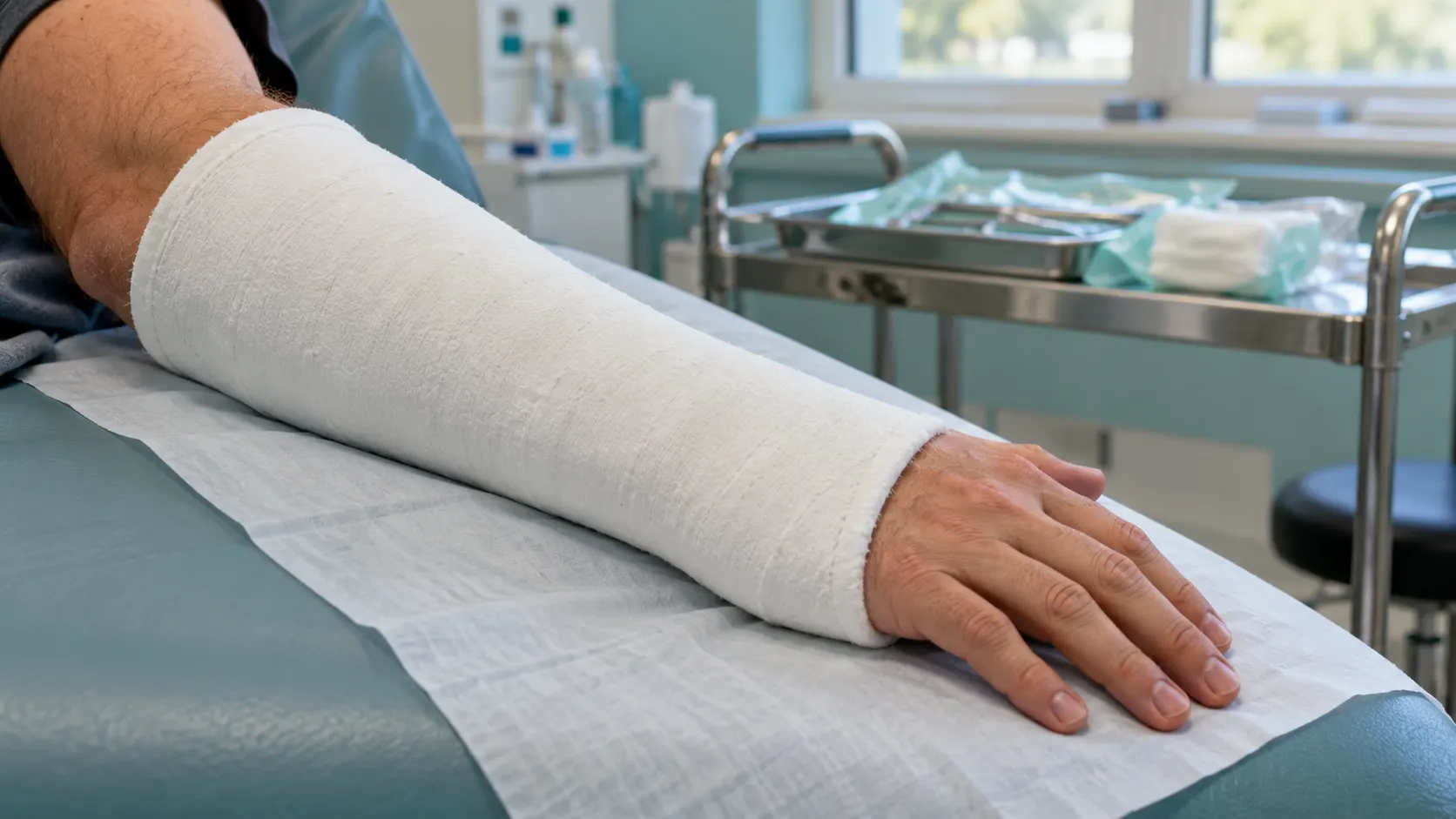
Achilles Rupture: Surgery vs Non-surgical Treatment With Functional Rehab
Achilles rupture surgery vs non-surgical care with functional rehab: what Willits, UKSTAR and the ACHILLES trial show on re-rupture, function and complications.
By OrthoVellum Editorial TeamPublished 11 min read
Educational content for clinicians, not medical advice. Editorial policy
Key points
- With early functional rehabilitation, function after surgery and after non-operative care is similar. The ACHILLES trial (554 patients) found no difference in the change in ATRS at 12 months between non-operative treatment, open repair and minimally invasive repair.
- Surgery still lowers re-rupture: 6.2% non-operative against 0.6% after either operation in ACHILLES, and 3.9% against 2.3% across 15,862 patients in Ochen's meta-analysis.
- The price is other complications: 4.9% against 1.6% in Ochen, mainly infection, and nerve injury in 5.2% of patients after minimally invasive repair in ACHILLES.
- UKSTAR was not a surgery trial. In 540 patients already treated without surgery, immediate weight-bearing in a functional brace matched a plaster cast on ATRS at 9 months, with re-rupture in 5% and 6%.
- Equal re-rupture risk has never been demonstrated. The honest counsel is a small absolute reduction in re-rupture bought with wound and nerve risk, decided with the patient.
On this page10 sections
A fit 40-year-old ruptures their Achilles tendon on the squash court and asks whether they need an operation. For a generation the answer was yes, because surgery cut the re-rupture rate. The question of Achilles rupture surgery vs non-surgical treatment has changed since rehabilitation changed: with early functional rehabilitation, function at a year is the same either way. Surgery still lowers re-rupture by a few percentage points and adds wound and nerve complications, so the decision belongs to the patient once those numbers are on the table. This post decodes the trials behind that answer, including UKSTAR, which is often cited for the wrong thing. The full clinical picture is on the Achilles tendon rupture topic page.
Why does the comparator decide the answer?
The case for routine repair was built against a plaster cast. Khan's 2005 meta-analysis of 12 trials and 800 patients found open repair cut re-rupture (relative risk 0.27) but raised infection, adhesions and altered skin sensation (relative risk 10.6). As Willits later noted, in all but one of the earlier comparative studies the limb was immobilised for six to eight weeks.
Soroceanu's 2012 meta-analysis of 10 randomised trials split them by rehabilitation. Where non-operative patients had functional rehabilitation with early range of motion, the re-rupture difference was not significant (risk difference 1.7%, p = 0.45; the authors called the rates equal). Where they did not, surgery reduced re-rupture by an absolute 8.8% (p = 0.001). Surgery added 15.8% in complications other than re-rupture and returned patients to work 19 days sooner.
The practical rule follows: quote any re-rupture rate with its rehabilitation regimen. The topic page makes the same point, that the often-quoted non-operative rate of 10–15% belongs to cast immobilisation.
What did Willits show?
Willits and colleagues randomised 144 patients (mean age 40) to repair or no repair, and put both arms through the same accelerated protocol of early weight-bearing and early range of motion. Re-rupture occurred in 2 of 72 operated patients and 3 of 72 non-operative patients. Strength, range of motion, calf circumference and the Leppilahti score showed no clinically important difference. There were 13 complications after surgery and 6 without, mostly soft-tissue problems in the operative group.
The topic page counts it among the trials behind the shift away from routine repair. It was also small: five re-ruptures in total cannot tell you whether a difference of a few percentage points is real.
What did the ACHILLES trial find?
The ACHILLES trial (Myhrvold, NEJM 2022) is a large three-way randomised comparison. Four Norwegian centres randomised 554 adults to non-operative treatment, open repair or minimally invasive surgery, and 526 were analysed. The trial registration limits entry to ages 18 to 60 with a first rupture, operated within 7 days, and excludes diabetes, recent fluoroquinolone or local steroid exposure, and systemic steroids. It specifies the same rehabilitation for all three arms: a below-knee cast in equinus for 2 weeks, then a brace for 6 weeks with three heel lifts removed down to none.
Function. The primary outcome was the change from baseline in the Achilles tendon Total Rupture Score (ATRS, 0–100) at 12 months: −17.0 non-operative, −16.0 open and −14.7 minimally invasive (P = 0.57). No pairwise comparison differed, and physical performance tests and patient-reported physical function changed similarly in all three groups.
Re-rupture. It was higher without surgery: 6.2% against 0.6% in each operative group.
Nerve injury. There were 9 nerve injuries after minimally invasive surgery (5.2% of patients), 5 after open repair (2.8%) and 1 without surgery (0.6%).
The authors concluded that surgery was not associated with better outcomes than non-operative treatment at 12 months. Read the trial whole: function was the same, re-rupture favoured surgery, and nerve injury favoured not operating.
What did UKSTAR actually test?
UKSTAR (Costa, Lancet 2020) is often cited in the surgery debate, but it did not randomise anyone to surgery. It enrolled 540 patients at 39 UK hospitals who had already decided, with their surgeon, against an operation. Mean age was 48.7 and 79% were men; patients presenting more than 14 days after injury were excluded.
The two arms were the two ways of treating the tendon without surgery:
- Plaster cast: below-knee cast in gravity equinus, brought gradually to plantigrade, full weight-bearing usually from about 6 weeks, removed at 8 weeks.
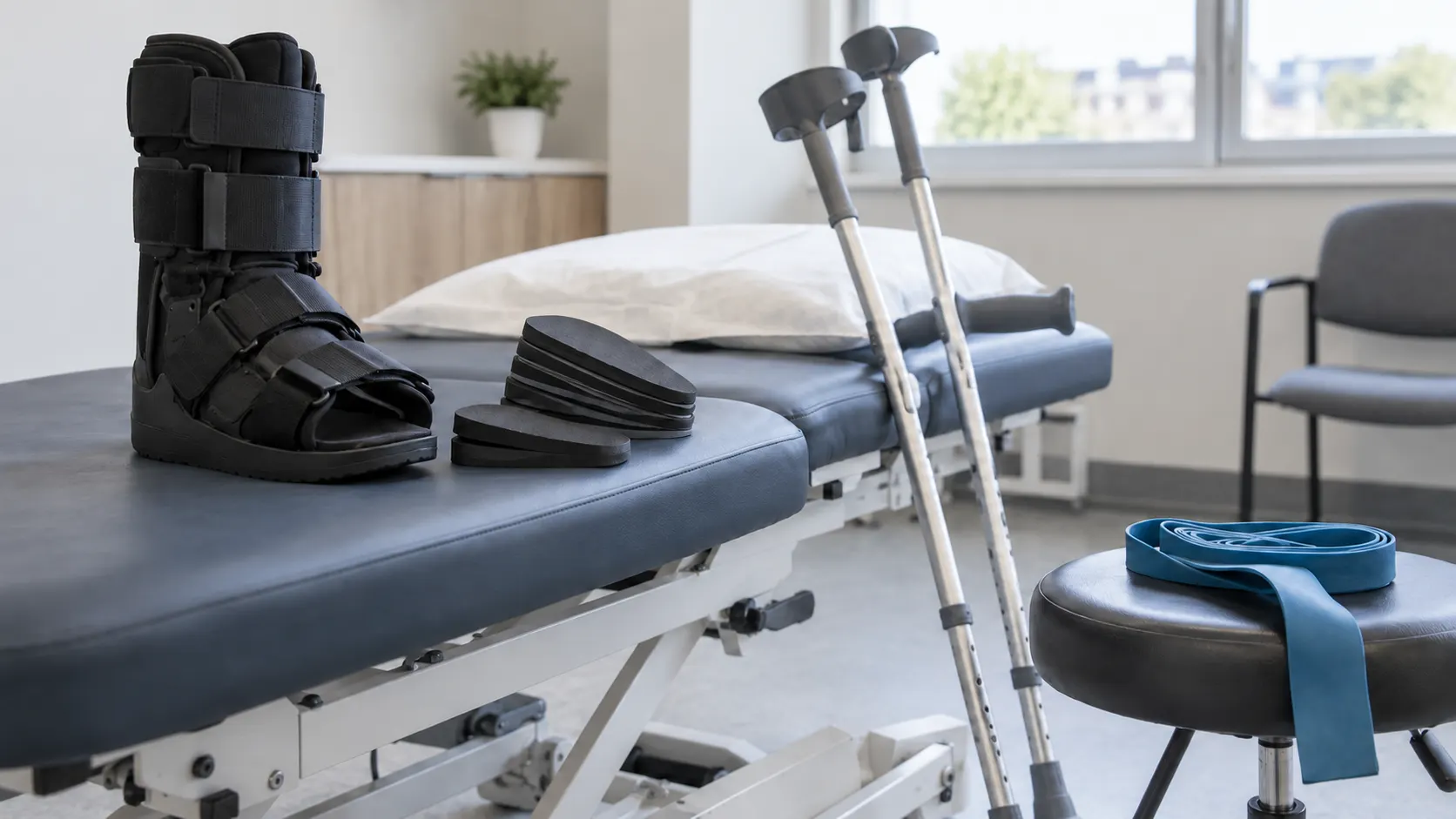
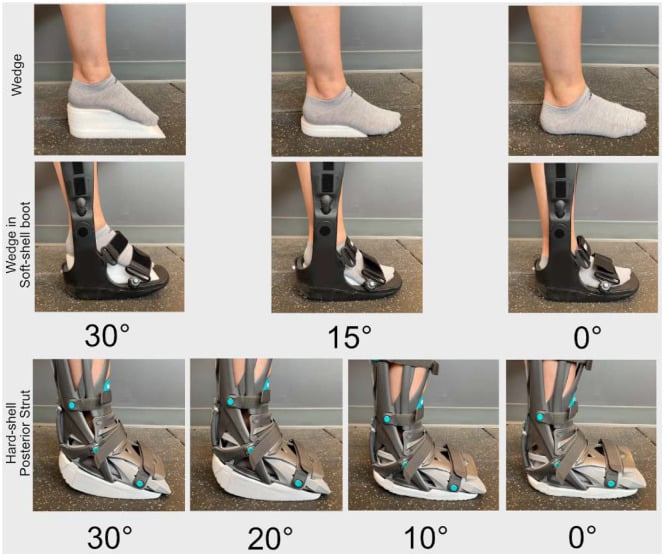
- Functional brace: a removable rigid walking boot with two solid heel wedges, full weight-bearing from the day it was fitted, wedges reduced over 8 weeks.
ATRS at 9 months was 74.4 in the cast group and 72.8 in the brace group (adjusted difference −1.38, 95% CI −4.9 to 2.1; the trial's minimal clinically important difference was 8 points). Re-rupture occurred in 17 of 266 (6%) with a cast and 13 of 274 (5%) with a brace, and none occurred more than 6 months after injury. The brace scored better at 8 weeks (adjusted difference 5.53) but not at 3, 6 or 9 months. Mean cost was £1,181 for the cast and £1,078 for the brace.
What UKSTAR settles is the non-operative regimen: immediate weight-bearing in a boot is safe and probably cost-effective, so a cast offers no advantage. What it shows indirectly is that non-operative re-rupture in a large pragmatic UK population sat at 5–6% in both arms, well below the cast-era figure.
The trials side by side
| Study | Design and patients | Comparison | Re-rupture | Function | Other harms |
|---|---|---|---|---|---|
| Khan 2005 | Meta-analysis, 12 RCTs, 800 patients | Open repair vs non-operative (mostly casts) | RR 0.27 favouring surgery | Not pooled | Complications RR 10.6 with open repair |
| Willits 2010 | RCT, 144 patients | Repair vs none, both accelerated rehab | 2/72 vs 3/72 | No clinically important difference | 13 vs 6 complications, mainly soft tissue |
| Soroceanu 2012 | Meta-analysis, 10 RCTs | Surgery vs non-operative | No significant difference with early ROM (RD 1.7%); surgery −8.8% without | No difference | +15.8% other complications with surgery |
| Ochen 2019 | Meta-analysis, 29 studies, 15,862 patients | Surgery vs non-operative | 2.3% vs 3.9% (RR 0.43) | — | 4.9% vs 1.6%, mainly infection |
| UKSTAR 2020 | RCT, 540 non-operative patients, 39 UK sites | Plaster cast vs functional brace | 6% vs 5% | ATRS at 9 months equal | DVT 1% vs 2% |
| ACHILLES 2022 | RCT, 554 patients aged 18–60 | Non-operative vs open vs minimally invasive | 6.2% vs 0.6% vs 0.6% | ATRS change at 12 months equal | Nerve injury 0.6% vs 2.8% vs 5.2% |
Is non-operative treatment equivalent?
Not for re-rupture. Ochen's 2019 meta-analysis pooled 10 randomised trials and 19 observational studies (15,862 patients): re-rupture was 2.3% after surgery and 3.9% without (risk difference 1.6%, risk ratio 0.43), and complications were 4.9% against 1.6% (risk difference 3.3%), mainly from infection in 2.8% of operated patients. In studies with accelerated functional rehabilitation and early range of motion, the re-rupture difference was not significant (risk ratio 0.60, 95% CI 0.26 to 1.37).
"Not significant" is not "equal". Reito and colleagues re-examined four meta-analyses and found that none could exclude a clinically relevant difference: the smallest risk difference that could be rejected was 6.4%, so non-operative care may carry up to 6.4% more re-ruptures. A 2024 meta-analysis of 14 randomised trials (1,399 patients) found surgery lowered re-rupture (odds ratio 0.30) and raised other complications (odds ratio 3.28), with no significant difference in return to sport or ATRS.
The same picture emerges from every direction. Surgery gives a real but small absolute reduction in re-rupture. Non-operative care avoids the wound and nerve complications. Function is similar.
Who should still have surgery?
The topic page (with the operative guide on patient factors) sets out the patients who lean operative:
| Leans operative | Leans non-operative |
|---|---|
| Young, high-demand or elite athlete; manual worker wanting maximal push-off | Older, low-demand or sedentary patient |
| Cannot accept the higher re-rupture risk, or previous contralateral rupture | Willing to accept a slightly higher re-rupture risk to avoid an incision |
| Healthy skin, non-smoker, low surgical risk | Diabetes, peripheral vascular disease, smoking, immunosuppression, poor skin |
| Insertional avulsion, chronic rupture (over 4 weeks), re-rupture, or a gap over 2 cm that does not close in plantarflexion | Acute mid-substance rupture with apposing ends |
| Unable to comply with a boot protocol | Motivated, compliant, able to attend close follow-up |
Two cautions apply when you transfer the trials to the patient in front of you. ACHILLES excluded people over 60 and people with diabetes or steroid exposure, the patients in whom the topic page already leans away from surgery. And both trials enrolled acute presentations: UKSTAR within 14 days, ACHILLES with surgery within 7 days. A presentation after 4 weeks, with scar in the gap and retracted ends, is a different problem: the operation is planned around the gap after debridement, and a gap over 2 cm needs augmentation.
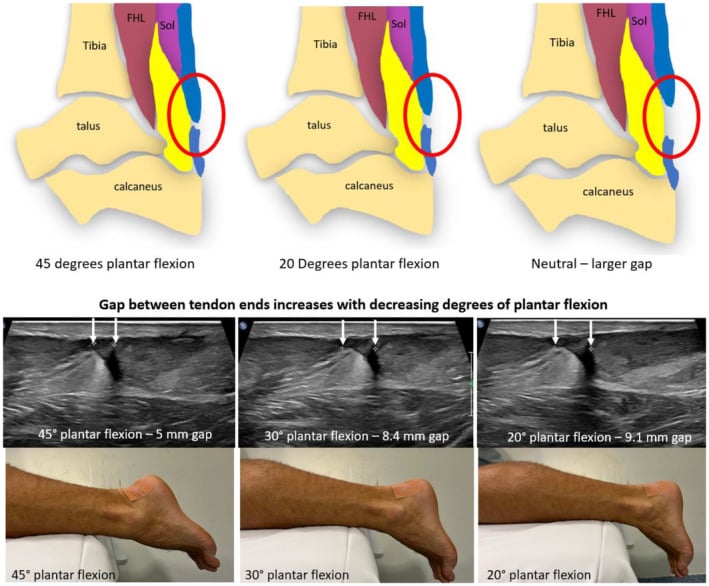
Using the gap. Dynamic ultrasound shows whether the ends appose as the ankle is plantarflexed. Measure the gap in plantarflexion and record the ankle angle; a scan in neutral overstates it. UKSTAR did not select patients by gap size, so it does not give you a safe threshold; a gap that will not close remains an indication on the topic page, not a trial-derived cut-off.
What does "functional rehabilitation" mean?
It is not one protocol. Willits used early weight-bearing and early range of motion; UKSTAR allowed full weight-bearing in a wedged boot from day one; ACHILLES used 2 weeks in a cast before 6 weeks in a brace. The common ground is early protected load and early motion in place of 6–8 weeks of rigid immobilisation. Soroceanu's subgroup analysis suggests that is the variable that closes most of the re-rupture gap.
The topic page sets out a typical pathway: equinus for the first 2 weeks, wedges removed progressively to reach neutral by about week 6, weaning from the boot at 8–12 weeks, heel raises from 8 weeks, jogging at 3–4 months once strength is about 80% of the other side, and return to sport no earlier than 6 months. The same page warns that patients who take the boot off early or load too soon have re-rupture rates up to 30–40%, so compliance is part of the selection. A patient who cannot follow the protocol is a reason to reconsider surgery, not a reason to abandon early mobilisation after it. Thromboprophylaxis still needs a decision: UKSTAR recorded deep vein thrombosis in 1% of cast patients and 2% of brace patients.
Open or minimally invasive repair?
If the patient chooses surgery, ACHILLES gives no functional or re-rupture reason to prefer either technique, and a nerve-injury rate nearly twice as high after the minimally invasive operation. The sural nerve runs lateral to the tendon and blind percutaneous passes put it at risk. Open repair trades this for a longer wound and the wound complications that come with it. The operative guide to Achilles tendon repair uses a posteromedial incision that keeps clear of the sural nerve, full-thickness flaps to paratenon, a Krackow core suture with an epitendinous running suture, and paratenon closure, followed by the same accelerated rehabilitation.
In the exam
The viva rarely stops at "operate or not". Expect the examiner to ask for the numbers, the trials and the rehabilitation, and to probe whether you know what UKSTAR compared. The diagnosis comes first: a patient with a complete rupture can still plantarflex using the long toe flexors, peronei and tibialis posterior, so the prone calf squeeze is the test, and its cluster differs from that of Achilles tendinopathy (see how to examine the Achilles). The same habit of reading the comparison carefully applies to other "conservative first" trials, such as SWIFFT for the scaphoid, and to the stability question in ankle fracture classification.
Frequently asked questions
Is surgery better than non-surgical treatment for an Achilles rupture?
Not for function, when both are followed by early functional rehabilitation. The ACHILLES trial found no difference in patient-reported function at 12 months between non-operative care, open repair and minimally invasive repair. Surgery does lower the re-rupture rate (6.2% against 0.6% in that trial) but adds wound, infection and nerve complications. The choice turns on how the individual patient weighs those risks.
What is the re-rupture rate after non-operative treatment of an Achilles rupture?
It depends on the regimen and the population. In UKSTAR, 6% of patients in a plaster cast and 5% in a functional brace re-ruptured within 9 months. In ACHILLES, in adults aged 18 to 60, it was 6.2% against 0.6% after surgery. Ochen's meta-analysis of 15,862 patients pooled 3.9% non-operative against 2.3% operative.
What did the UKSTAR trial show?
UKSTAR randomised 540 patients aged 16 or over at 39 UK hospitals who were being treated without surgery to a plaster cast or a functional brace, each worn for 8 weeks. The brace allowed full weight-bearing from the day it was fitted. There was no difference in the Achilles tendon Total Rupture Score at 9 months or in re-rupture (6% cast, 5% brace), and the brace was likely to be cost-effective.
Is minimally invasive Achilles repair safer than open repair?
Not on the evidence of the ACHILLES trial. Function at 12 months and re-rupture (0.6% each) were the same after open and minimally invasive repair, but nerve injury occurred in 5.2% of patients after minimally invasive surgery against 2.8% after open repair and 0.6% without surgery. Blind needle passes put the sural nerve at risk.
References
- Myhrvold SB, Brouwer EF, Andresen TKM, et al. Nonoperative or surgical treatment of acute Achilles' tendon rupture. N Engl J Med 2022;386(15):1409-1420. DOI (opens in a new tab)
- Costa ML, Achten J, Marian IR, et al. Plaster cast versus functional brace for non-surgical treatment of Achilles tendon rupture (UKSTAR): a multicentre randomised controlled trial and economic evaluation. Lancet 2020;395(10222):441-448. DOI (opens in a new tab)
- Willits K, Amendola A, Bryant D, et al. Operative versus nonoperative treatment of acute Achilles tendon ruptures: a multicenter randomized trial using accelerated functional rehabilitation. J Bone Joint Surg Am 2010;92(17):2767-2775. DOI (opens in a new tab)
- Soroceanu A, Sidhwa F, Aarabi S, Kaufman A, Glazebrook M. Surgical versus nonsurgical treatment of acute Achilles tendon rupture: a meta-analysis of randomized trials. J Bone Joint Surg Am 2012;94(23):2136-2143. DOI (opens in a new tab)
- Ochen Y, Beks RB, van Heijl M, et al. Operative treatment versus nonoperative treatment of Achilles tendon ruptures: systematic review and meta-analysis. BMJ 2019;364:k5120. DOI (opens in a new tab)
- Khan RJ, Fick D, Keogh A, et al. Treatment of acute Achilles tendon ruptures: a meta-analysis of randomized, controlled trials. J Bone Joint Surg Am 2005;87(10):2202-2210. DOI (opens in a new tab)
- Reito A, Mattila V, Karjalainen T. Operative vs nonoperative treatment of Achilles tendon ruptures using early functional rehabilitation: critical analysis of evidence. Foot Ankle Int 2022;43(7):887-890. DOI (opens in a new tab)
- Fan L, Hu Y, Zhou L, Fu W. Surgical vs. nonoperative treatment for acute Achilles' tendon rupture: a meta-analysis of randomized controlled trials. Front Surg 2024;11:1483584. DOI (opens in a new tab)
Study the full topic
Included in Pro
Go deeper with Pro
See what Pro includesShare this article
Cite this article
OrthoVellum Editorial Team. Achilles Rupture: Surgery vs Non-surgical Treatment With Functional Rehab [Internet]. OrthoVellum; 2026 Oct 2 [cited 2026 Oct 2]. Available from: https://www.orthovellum.com/blog/achilles-rupture-surgery-vs-non-surgical
About this content
Prepared by the OrthoVellum Editorial Team from cited sources, under our editorial policy.
For education and exam preparation; not medical advice or a substitute for clinical judgement and local guidance.
Spotted an error? Tell us; every report is read.
Get new articles by email
New clinical explainers, landmark-trial summaries and exam guidance from the OrthoVellum blog. No account needed; unsubscribe from any email.