Scaphoid Waist Fractures After SWIFFT: Cast First or Fix?
What the SWIFFT trial showed for scaphoid waist fractures displaced 2 mm or less, which fractures are still fixed, and how to run cast-first follow-up safely.
By OrthoVellum Editorial TeamPublished 12 min read
Educational content for clinicians, not medical advice. Editorial policy
Key points
- SWIFFT randomised 439 adults with a bicortical scaphoid waist fracture displaced 2 mm or less to early screw fixation or a below-elbow cast with CT-confirmed fixation of any nonunion.
- Wrist function (PRWE) did not differ at 52 weeks (adjusted difference -2.1, 95% CI -5.8 to 1.6) or at five years (0.6, 95% CI -2.4 to 3.6).
- Surgery traded 18% cast-related complications for 14% potentially serious surgical ones, cost £1,295 more per patient at a year, and needed about 73 fixations to prevent one nonunion.
- The trial excluded displacement over 2 mm, proximal and distal pole fractures and trans-scaphoid perilunate injuries; the classic fixation criteria still govern those.
- Cast-first only works if suspected nonunion is looked for at 6 to 12 weeks, confirmed on CT and fixed promptly.
On this page8 sections
A young adult falls on an outstretched hand, and the scaphoid series shows a clear fracture through the waist, displaced by a millimetre or less. Cast or screw? For years practice drifted towards early fixation. The SWIFFT trial of scaphoid waist fractures, 439 adults in 31 hospitals in England and Wales, answered the question for fractures displaced 2 mm or less: start in a cast, confirm any suspected nonunion on CT, and fix it promptly. Wrist function was no different at one year, or at five. This post explains what the trial tested, what it left out, and how to run cast-first safely. The anatomy and full management are on the scaphoid fractures topic page.
What did the SWIFFT trial test?
SWIFFT (the Scaphoid Waist Internal Fixation for Fractures Trial) was a pragmatic, multicentre, open-label randomised superiority trial led from Leicester and York and funded by the NIHR Health Technology Assessment programme. It recruited from July 2013 to July 2016 and reported in The Lancet in 2020, with a full HTA report the same year.
Who was in it. Adults aged 16 or over, presenting within 2 weeks of injury, with a clear bicortical fracture of the scaphoid waist on radiographs and no more than 2 mm of displacement. Randomisation was stratified by whether a step or gap of 1 to 2 mm was visible on any view. Of the 439 participants, 269 (61%) had an undisplaced fracture. Mean age was 33, and 83% were men.
Who was not. Fractures displaced more than 2 mm, proximal and distal pole fractures, trans-scaphoid perilunate dislocations, multiple injuries in the same limb and a fracture of the opposite wrist were all excluded.
The two arms.
- Early surgery (219 patients). A headless compression screw, inserted percutaneously or open as the surgeon preferred.
- Cast pathway (220 patients). A below-elbow cast for 6 to 10 weeks, with or without the thumb. If the treating surgeon suspected nonunion on the 6- or 12-week radiographs, CT was used to confirm it and immediate fixation was offered.
The second arm is the part most often misquoted. It was never cast alone. It was cast first, with a built-in route to surgery for the fractures that fail to unite.
Primary outcome. The Patient-Rated Wrist Evaluation (PRWE) total score at 52 weeks, from 0 (no disability) to 100. The trial set 6 points as the smallest difference that would matter clinically.
What did SWIFFT find?
There was no significant difference in PRWE at 52 weeks. The adjusted mean was 11.9 after surgery and 14.0 after the cast pathway: a difference of -2.1 in favour of surgery (95% CI -5.8 to 1.6; p = 0.27). The whole confidence interval falls short of the 6-point threshold the trial set for a difference that matters. The PRWE pain and function subscales, grip strength and range of movement did not differ either. The SF-12 physical component score favoured surgery by 1.6 points (95% CI 0.2 to 3.1), a small difference on a general health measure.
| At 52 weeks (unless stated) | Early surgery | Cast pathway |
|---|---|---|
| Randomised | 219 | 220 |
| PRWE total, adjusted mean (lower is better) | 11.9 | 14.0 |
| Potentially serious complication from surgery | 31 (14%) | 3 (1%) |
| Cast-related complication | 5 (2%) | 40 (18%) |
| Medical complication | 4 (2%) | 5 (2%) |
| Nonunion or slight union on imaging | 4 (2%) | 9 (4%) |
| Reoperations | 11, in 8 patients | 1, for persistent nonunion |
| PRWE at five years | difference 0.6 (95% CI -2.4 to 3.6) |
Sources: Dias et al., Lancet 2020 and HTA 2020; five-year row from Dias et al., Bone Joint J 2026.
Complications were traded, not avoided. Surgery brought 14% potentially serious complications, including nerve symptoms around the scar in four patients, infection in two and complex regional pain syndrome in three. The cast pathway brought 18% cast-related complications. On the 52-week CT, the screw penetrated the articular surface in 93 of the 142 operated wrists assessed (65%), by a mean of 1.6 mm.
Union. Nonunion was rarer than the investigators expected in both groups. They estimated that 73 fractures (95% CI 24 to 100) would need early fixation to prevent one nonunion.
Crossover. Six patients in the cast group (3%) had early surgery outside the protocol. After nonunion was confirmed, 17 (8%) had fixation, on average 159 days after injury. Only five of those were fixed within the 12 weeks the protocol intended. A complier-average analysis gave the same answer as the main analysis.
Cost and time off work. Time off work was similar in the two groups. Surgery cost £1,295 more per patient at one year (95% CI £1,084 to £1,504), and the lifetime model also favoured the cast pathway.
The authors' conclusion: adults with a scaphoid waist fracture displaced 2 mm or less should start in a cast, and suspected nonunions should be confirmed and fixed immediately.
Did the result hold at five years?
Yes. Two follow-up papers in The Bone & Joint Journal (2026) reported the five-year results.
- Function. 344 patients (78.4%) returned a valid PRWE. The difference was 0.6 points (95% CI -2.4 to 3.6; p = 0.709). Neither fracture displacement, nor non-compliance with allocation, nor the patient's preferred treatment at baseline changed that comparison. Grip and movement were similar.
- Union. 267 patients (60.8%) had imaging. Seven had a nonunion: 3 of 146 after fixation (2.1%) and 4 of 121 in the cast group (3.3%). Fractures with at least 20% bridging at one year went on to consolidate without further treatment.
- Arthritis. By five years, 140 of those imaged (52.4%) had osteoarthritis in at least one joint around the scaphoid, at similar rates in both groups. Worse arthritis went with worse PRWE scores.
Treat the imaging results with some caution, because only six in ten patients had imaging at five years. The functional result, with nearly eight in ten followed up, is the stronger finding.
Why SWIFFT collides with the 1 mm rule
Classic teaching, set out on the scaphoid fractures topic page, calls a fracture unstable, and recommends fixation, if any one of these is present: displacement or step-off over 1 mm, angulation over 15°, comminution, a proximal pole location, or carpal malalignment or a perilunate injury. Herbert's classification uses the same idea, with Type A stable and Type B unstable.
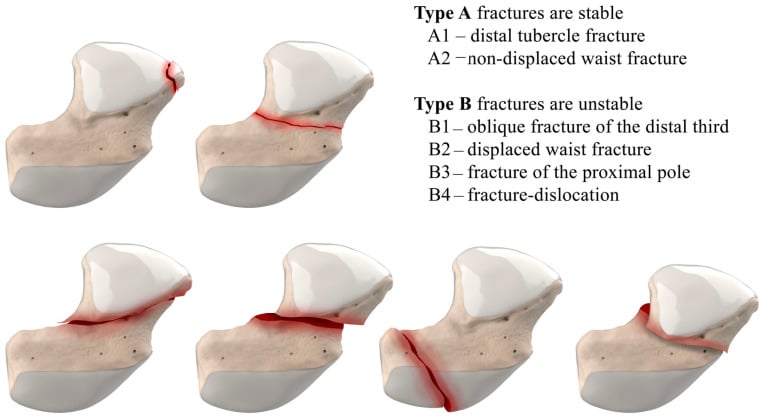
The full Herbert table separates A2, an incomplete waist fracture, from B2, a complete one. Every SWIFFT fracture was a complete, bicortical waist fracture, and about two in five (170 of 439) had a 1 to 2 mm step or gap. On a strict reading of either rule, many SWIFFT patients would have been booked for theatre.
The trial found no interaction between displacement and treatment, at one year or at five. A subgroup analysis cannot prove that the two treatments are equivalent in that subgroup. It is still the best evidence available, it points the same way at both time points, and the trial authors themselves suggested restricting early fixation to fractures displaced more than 2 mm. In practice this means a 1 to 2 mm step or gap on its own is no longer a reason to operate on a waist fracture.
The classification has a weakness of its own. Herbert published it in 1984 alongside the screw he designed, without testing its reliability, and observers disagree about exactly the A-versus-B boundary that drives the operative decision. Use it to describe the fracture, and use SWIFFT to decide what to do with a waist fracture.
Which scaphoid fractures are still fixed?
SWIFFT answers one question about one fracture. Everything it excluded, and the patterns it did not analyse separately, are still managed on the classic criteria.
| Fracture | In SWIFFT? | Usual management |
|---|---|---|
| Bicortical waist, undisplaced or displaced up to 2 mm | Yes | Below-elbow cast; CT and prompt fixation if nonunion is suspected |
| Waist, displaced more than 2 mm | No | Reduction and fixation |
| Proximal pole | No | Fixation strongly considered: highest nonunion and AVN risk |
| Comminuted, or with carpal malalignment (DISI) | Not excluded, but not analysed separately | Usually fixed on the classic criteria; SWIFFT gives no subgroup evidence |
| Trans-scaphoid perilunate fracture-dislocation | No | Urgent operative treatment (perilunate dislocations) |
| Tubercle or distal pole | No | Splint or cast; these almost always heal |
| Confirmed nonunion | Fixed within the cast pathway | Fixation, with bone graft as needed |
The patient who wants surgery. The topic page lists patient preference, athletes and manual workers as relative indications. The evidence gives early fixation one real advantage. In Dias's earlier trial of 88 working-age patients (2005), motion, grip and a patient-rated score were better after fixation at 8 weeks, when the cast came off, and grip was still better at 12 weeks. There was no difference after that, and patients in both groups were back at work by 5 to 6 weeks. SWIFFT found similar time off work in both groups. An informed patient may reasonably choose a quicker early recovery and accept the surgical complication profile, but it is a choice, not an indication.
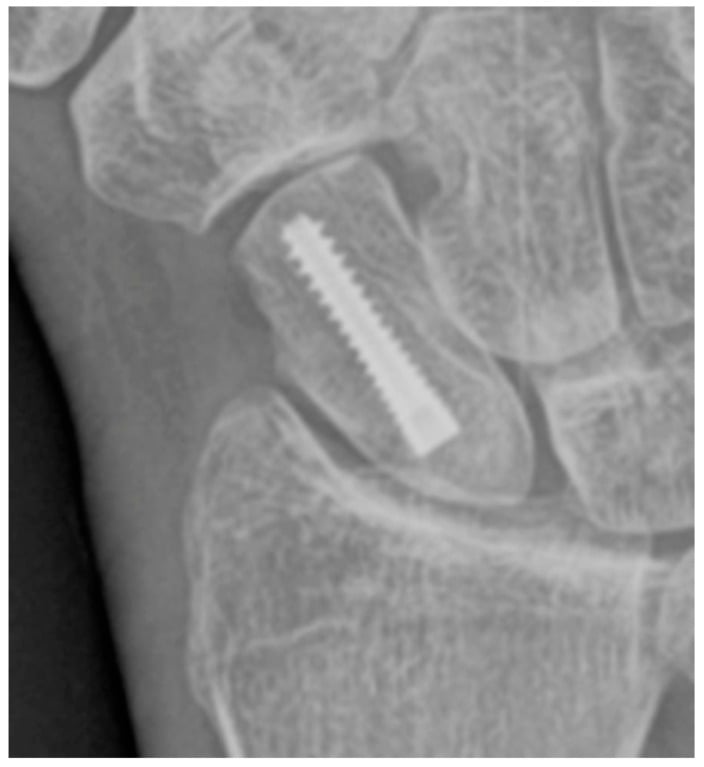
The approach. Waist and distal fractures are fixed through the volar approach, in the floor of the flexor carpi radialis sheath. Gelberman and Menon's injection study showed that 70 to 80% of the bone, including the whole proximal pole, is supplied by radial artery branches entering through the dorsal ridge. They concluded that a volar exposure is the least damaging to the proximal pole's blood supply. The radioscaphocapitate ligament is divided on the way in and must be repaired on the way out. The volar (Russe) approach guide covers the steps. Proximal pole fractures are fixed dorsally, between the third and fourth extensor compartments, which gives a better central-axis trajectory into a small fragment. The cost is that the exposure crosses the dorsal ridge, the only entry point for that fragment's blood (dorsal approach for the proximal pole).
How do you run cast-first safely?
The cast-first result depends on finding the fractures that fail. Set out step by step, the SWIFFT pathway has four parts.
- Confirm the fracture and its pattern. Request a four-view scaphoid series, not a wrist series. SWIFFT patients had a clear bicortical waist fracture. If displacement, comminution or the fracture's location is in doubt, CT measures them.
- Cast below the elbow. A meta-analysis of four randomised trials (523 patients) found no difference in union, pain, grip, time to union or osteonecrosis between above- and below-elbow casts, thumb in or out, or wrist flexion versus extension.
- Look for union at 6 and 12 weeks. The topic page advises a radiograph at 6 weeks, a cast for 8 to 12 weeks if the fracture is healing, and CT if it is not. SWIFFT used 6 to 10 weeks of cast, with radiographs at 6 and 12 weeks.
- Confirm a suspected nonunion on CT and fix it. In the trial, suspicion on the 6- or 12-week radiographs was enough to trigger the CT; the protocol did not wait for a nonunion to become obvious.
The trial is candid about where this went wrong. Only five of the 17 nonunions in the cast group were fixed within 12 weeks, and three of the four patients with a nonunion at 52 weeks were never offered surgery. The pathway is safe only if the fracture clinic actually completes it: booked reviews, CT on request, and theatre time for the few who need it. Counsel smokers too, because smoking impairs healing.
What a missed nonunion costs. An ununited scaphoid lets the carpus collapse into flexion (the humpback), and the wrist progresses through scaphoid nonunion advanced collapse, from the radial styloid to the whole carpus (SNAC wrist). Reconstruction then depends on whether the proximal pole is alive. A viable pole is treated with a non-vascularised graft and a screw; an avascular one needs a vascularised graft, such as the pedicled 1,2 ICSRA graft from the distal radius or a free medial femoral condyle graft. The details are on the scaphoid nonunion topic page.
The occult fracture is a different question
SWIFFT enrolled only fractures that were clearly visible on radiographs. Between 10 and 20% of scaphoid fractures are not visible on the first films, and that patient follows a separate diagnostic pathway. A Cochrane review (Mallee et al., 2015) pooled MRI sensitivity at 0.88 (95% CI 0.64 to 0.97) and specificity at 1.00 (0.38 to 1.00) for suspected fractures with normal radiographs. A positive MRI can be trusted, but a negative one in a wrist that is still clinically convincing calls for review rather than discharge. Once a waist fracture is confirmed and meets the SWIFFT criteria, the cast-first logic applies.
In the exam
Examiners use SWIFFT to test whether you can quote a trial within its limits. State the population, the comparator and the result, then name what the trial did not study. If you need a framework for appraising the trial itself, the post on levels of evidence covers it. For the structure of a viva answer, see passing the orthopaedic viva. The same pull back from routine fixation runs through distal radius fractures in older adults.
Frequently asked questions
What did the SWIFFT trial show?
SWIFFT randomised 439 adults with a bicortical scaphoid waist fracture displaced 2 mm or less to early screw fixation or a below-elbow cast, with CT confirmation and prompt fixation of any nonunion. Patient-rated wrist function was no different at one year or five years. Surgery caused more potentially serious complications, cost more, and around 73 fractures had to be fixed to prevent one nonunion.
Should a scaphoid waist fracture displaced 1 to 2 mm be fixed?
Not routinely, on the SWIFFT evidence. About two in five SWIFFT fractures had a 1 to 2 mm step or gap, and displacement did not change the comparison between cast and surgery at one year or at five years. The older rule that more than 1 mm of displacement mandates fixation predates the trial. Over 2 mm was not tested and is still usually fixed.
How long is a scaphoid waist fracture kept in a cast?
In SWIFFT the cast was below the elbow for 6 to 10 weeks, with or without the thumb, and radiographs at 6 and 12 weeks looked for nonunion. Standard teaching gives 8 to 12 weeks with a radiograph at 6 weeks. No cast configuration, above or below the elbow, thumb in or out, has proved better in randomised trials.
Which scaphoid fractures still need surgery?
Fractures the trial excluded: displacement over 2 mm, proximal pole fractures and trans-scaphoid perilunate fracture-dislocations. Comminution and carpal malalignment were not exclusions, but SWIFFT did not analyse them separately, and the classic criteria still treat them as unstable. A confirmed nonunion is fixed, usually with bone graft. An informed patient who wants early movement may still choose fixation, accepting the surgical complication risk.
What happens if a scaphoid fracture does not unite in a cast?
In the SWIFFT pathway a suspected nonunion is confirmed on CT and fixed straight away with a headless compression screw. Left untreated, a nonunion lets the carpus collapse into flexion and progresses to scaphoid nonunion advanced collapse (SNAC) arthritis. Established nonunions need debridement, grafting and fixation, with a vascularised graft if the proximal pole is avascular.
References
- Dias JJ, Brealey SD, Fairhurst C, et al. Surgery versus cast immobilisation for adults with a bicortical fracture of the scaphoid waist (SWIFFT): a pragmatic, multicentre, open-label, randomised superiority trial. Lancet 2020;396(10248):390-401. DOI (opens in a new tab)
- Dias J, Brealey S, Cook L, et al. Surgical fixation compared with cast immobilisation for adults with a bicortical fracture of the scaphoid waist: the SWIFFT RCT. Health Technol Assess 2020;24(52):1-234. DOI (opens in a new tab)
- Dias JJ, Brealey SD, Coleman E, et al. Clinical effectiveness of early surgical fixation versus cast immobilization for adults with a scaphoid waist fracture: five-year follow-up of the Scaphoid Waist Internal Fixation for Fractures Trial. Bone Joint J 2026;108-B(1):70-78. DOI (opens in a new tab)
- Dias JJ, Brealey SD, Coleman E, et al. Radiological outcome of early surgical fixation versus cast immobilization for adults with a scaphoid waist fracture: five-year follow-up of the Scaphoid Waist Internal Fixation for Fractures Trial. Bone Joint J 2026;108-B(1):87-95. DOI (opens in a new tab)
- Dias JJ, Wildin CJ, Bhowal B, Thompson JR. Should acute scaphoid fractures be fixed? A randomized controlled trial. J Bone Joint Surg Am 2005;87(10):2160-2168. DOI (opens in a new tab)
- Doornberg JN, Buijze GA, Ham SJ, Ring D, Bhandari M, Poolman RW. Nonoperative treatment for acute scaphoid fractures: a systematic review and meta-analysis of randomized controlled trials. J Trauma 2011;71(4):1073-1081. DOI (opens in a new tab)
- Herbert TJ, Fisher WE. Management of the fractured scaphoid using a new bone screw. J Bone Joint Surg Br 1984;66(1):114-123. DOI (opens in a new tab)
- Gelberman RH, Menon J. The vascularity of the scaphoid bone. J Hand Surg Am 1980;5(5):508-513. DOI (opens in a new tab)
- Mallee WH, Wang J, Poolman RW, et al. Computed tomography versus magnetic resonance imaging versus bone scintigraphy for clinically suspected scaphoid fractures in patients with negative plain radiographs. Cochrane Database Syst Rev 2015;(6):CD010023. DOI (opens in a new tab)
Study the full topic
Included in Pro
Go deeper with Pro
- Operative guide: volar (Russe) approach to the scaphoid
- Operative guide: scaphoid ORIF, dorsal approach for the proximal pole
Share this article
Cite this article
OrthoVellum Editorial Team. Scaphoid Waist Fractures After SWIFFT: Cast First or Fix? [Internet]. OrthoVellum; 2026 Oct 2 [cited 2026 Oct 2]. Available from: https://www.orthovellum.com/blog/swifft-trial-scaphoid-waist-fracture
About this content
Prepared by the OrthoVellum Editorial Team from cited sources, under our editorial policy.
For education and exam preparation; not medical advice or a substitute for clinical judgement and local guidance.
Spotted an error? Tell us; every report is read.
Get new articles by email
New clinical explainers, landmark-trial summaries and exam guidance from the OrthoVellum blog. No account needed; unsubscribe from any email.