OrthoVellum
Knowledge Hub

Study

  • Topics
  • MCQs
  • ISAWE
  • Operative Surgery
  • Flashcards

Company

  • About Us
  • Editorial Policy
  • Contact
  • FAQ
  • Blog

Legal

  • Terms of Service
  • Privacy Policy
  • Cookie Policy
  • Medical Disclaimer
  • Copyright & DMCA
  • Refund Policy

Support

  • Help Center
  • Accessibility
  • Report an Issue
OrthoVellum

© 2026 OrthoVellum. For educational purposes only.

Not affiliated with the Royal Australasian College of Surgeons.

Back to ISAWE Scenarios
Contents
0%
foot ankle

Lisfranc Injury (Tarsometatarsal Complex)
intermediate
6 min
28 marks
6 questions
Clinical Scenario
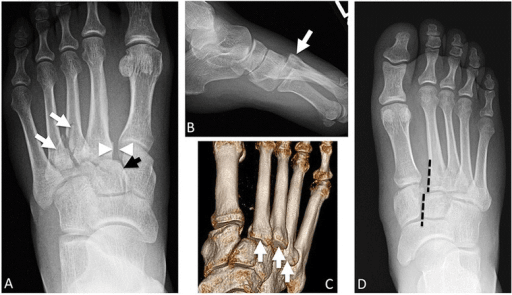
A 28-year-old footballer presents after landing awkwardly on a plantar-flexed foot. He experienced immediate severe midfoot pain and was unable to continue playing. On examination, there is marked midfoot swelling with plantar ecchymosis. He has point tenderness over the TMT joints and pain with passive abduction of the forefoot. Weight-bearing radiographs show loss of the normal alignment between the 2nd metatarsal and middle cuneiform with widening of the interval between the 1st and 2nd metatarsals.
Weight-bearing AP radiograph of the foot demonstrating a Lisfranc injury. There is loss of alignment between the medial border of the 2nd metatarsal and the medial border of the middle cuneiform (disrupted 2nd TMT joint). There is widening between the 1st and 2nd metatarsal bases (>2mm). A fleck sign is visible at the base of the 2nd metatarsal representing an avulsion of the Lisfranc ligament.
Open Full Size

Weight-bearing AP radiograph of the foot demonstrating a Lisfranc injury. There is loss of alignment between the medial border of the 2nd metatarsal and the medial border of the middle cuneiform (disrupted 2nd TMT joint). There is widening between the 1st and 2nd metatarsal bases (>2mm). A fleck sign is visible at the base of the 2nd metatarsal representing an avulsion of the Lisfranc ligament.

Image source: Open Access medical literature (NIH/PubMed Central) • CC-BY License

Questions

Question 1 (4 marks)

Describe the anatomy and importance of the Lisfranc ligament complex.

Question 2 (5 marks)

How do you diagnose a Lisfranc injury?

Question 3 (6 marks)

Classify Lisfranc injuries and describe the treatment algorithm.

Question 4 (5 marks)

Describe the surgical technique for Lisfranc ORIF.

Question 5 (4 marks)

When would you consider primary arthrodesis?

Question 6 (4 marks)

What are the outcomes and complications?

Exam Day Cheat Sheet

Must Mention

  • •Lisfranc ligament: medial cuneiform → 2nd MT base
  • •NO ligament between 1st and 2nd MT = weak point
  • •2nd MT recessed = keystone of arch
  • •Medial 2nd MT aligns with medial middle cuneiform
  • •Fleck sign = Lisfranc ligament avulsion
  • •Plantar ecchymosis = pathognomonic

Common Pitfalls

  • •Missing on non-weight-bearing films
  • •Not recognizing plantar ecchymosis
  • •Wrong reduction sequence
  • •ORIF for purely ligamentous
  • •Missing associated injuries
  • •Not checking compartments
Scenario Info
Answers Revealed0/6
Difficulty
intermediate
Time Allowed6 min
Total Marks28
Questions6
Related Scenarios

Achilles Tendon Rupture

foot ankle•28 marks

Adult Acquired Flatfoot Deformity (PTTD)

foot ankle•28 marks

Ankle Fractures (Weber/AO Classification)

foot ankle•28 marks

Calcaneal Fractures (Sanders Classification)

foot ankle•28 marks

Charcot Neuroarthropathy

foot ankle•28 marks