OrthoVellum
Knowledge Hub

Study

  • Topics
  • MCQs
  • ISAWE
  • Operative Surgery
  • Flashcards

Company

  • About Us
  • Editorial Policy
  • Contact
  • FAQ
  • Blog

Legal

  • Terms of Service
  • Privacy Policy
  • Cookie Policy
  • Medical Disclaimer
  • Copyright & DMCA
  • Refund Policy

Support

  • Help Center
  • Accessibility
  • Report an Issue
OrthoVellum

© 2026 OrthoVellum. For educational purposes only.

Not affiliated with the Royal Australasian College of Surgeons.

Back to ISAWE Scenarios
Contents
0%
foot ankle

Pilon Fractures (Tibial Plafond)
advanced
6 min
28 marks
6 questions
Clinical Scenario
A 45-year-old man presents after a fall from 4 meters, landing on his feet. He has severe pain and swelling of his right ankle with visible deformity. On examination, the ankle is markedly swollen with fracture blisters developing. The skin is tented anteriorly. There is a fractured fibula and the tibial plafond is comminuted on initial radiographs. CT scan confirms a high-energy pilon fracture with articular impaction and metaphyseal comminution.
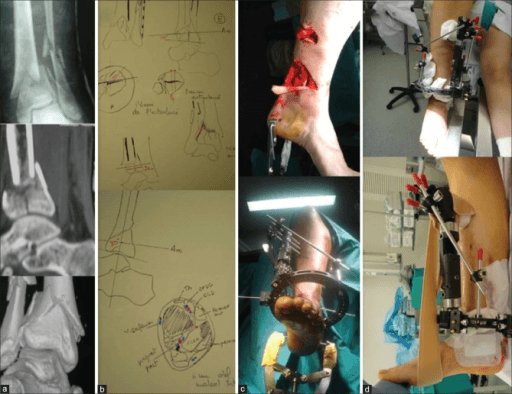
Coronal and sagittal CT reconstructions demonstrating a comminuted pilon fracture. The articular surface of the distal tibia is split into multiple fragments with central impaction (die-punch fragment). There is metaphyseal comminution and an associated fibular fracture. The talus has driven upward creating the 'explosion' injury pattern. This high-energy injury requires staged management.
Open Full Size

Coronal and sagittal CT reconstructions demonstrating a comminuted pilon fracture. The articular surface of the distal tibia is split into multiple fragments with central impaction (die-punch fragment). There is metaphyseal comminution and an associated fibular fracture. The talus has driven upward creating the 'explosion' injury pattern. This high-energy injury requires staged management.

Image source: Open Access medical literature (NIH/PubMed Central) • CC-BY License

Questions

Question 1 (4 marks)

Describe the mechanism and classification of pilon fractures.

Question 2 (5 marks)

Explain the staged management approach.

Question 3 (6 marks)

Describe the surgical technique for definitive ORIF.

Question 4 (5 marks)

What are the soft tissue considerations?

Question 5 (4 marks)

Discuss complications and their prevention.

Question 6 (4 marks)

What are the outcomes and salvage options?

Exam Day Cheat Sheet

Must Mention

  • •Pilon = "pestle" (axial load)
  • •Staged management: ex-fix → wait → ORIF
  • •Wrinkle test for timing (10-21 days)
  • •Ruedi-Allgower 4 steps
  • •Skin bridge ≥7cm between incisions
  • •50%+ develop arthritis

Common Pitfalls

  • •Operating too early
  • •Not recognizing soft tissue injury
  • •Missing compartment syndrome
  • •Insufficient bone grafting
  • •Wrong incision planning
  • •Not knowing staged approach
Scenario Info
Answers Revealed0/6
Difficulty
advanced
Time Allowed6 min
Total Marks28
Questions6
Related Scenarios

Achilles Tendon Rupture

foot ankle•28 marks

Adult Acquired Flatfoot Deformity (PTTD)

foot ankle•28 marks

Ankle Fractures (Weber/AO Classification)

foot ankle•28 marks

Calcaneal Fractures (Sanders Classification)

foot ankle•28 marks

Charcot Neuroarthropathy

foot ankle•28 marks