foot ankle
Total Ankle Arthroplasty
advanced
6 min
28 marks
6 questions
Clinical Scenario
A 62-year-old retired female teacher presents with severe right ankle pain over 5 years, progressively limiting her walking distance to 200 meters. She has post-traumatic ankle arthritis following a pilon fracture 12 years ago treated with ORIF. She requires daily analgesia and a walking stick. Clinical examination reveals a stiff, painful ankle with 15° total arc of motion (10° dorsiflexion, 5° plantarflexion), neutral hindfoot alignment, and no significant ligament laxity. The subtalar joint is well-preserved. She is a non-smoker with well-controlled Type 2 diabetes (HbA1c 6.5%).
Weight-bearing radiographs and CT are provided.
Weight-bearing radiographs and CT are provided.
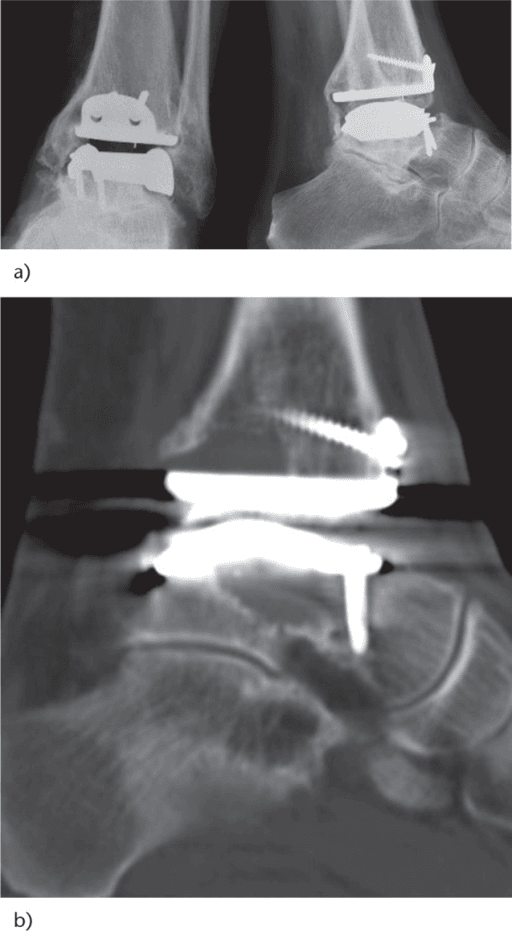
Clinical image for Total Ankle Arthroplasty
Source: Total Ankle Arthroplasty Radiograph • PMC5367591 • CC-BY
Questions
Question 1 (4 marks)
What are the causes of ankle arthritis? Describe the pathophysiology and natural history.
Question 2 (5 marks)
Compare and contrast total ankle arthroplasty (TAA) and ankle arthrodesis. What are the indications and contraindications for each?
Question 3 (6 marks)
Describe your preoperative assessment for this patient. What factors influence your surgical decision?
Question 4 (5 marks)
Describe the key principles and surgical technique for total ankle arthroplasty.
Question 5 (4 marks)
What are the common complications of TAA? How would you manage early failure?
Question 6 (4 marks)
What is the role of concurrent procedures with TAA? Discuss management of adjacent joint arthritis and deformity correction.
Exam Tips
- →Minimal tibial resection: 2-3mm below subchondral bone
- →Deformity limit: <10-15°
- →Talar cyst acceptable: <30% involvement
- →HbA1c target: <7.5%