OrthoVellum
Knowledge Hub

Study

  • Topics
  • MCQs
  • ISAWE
  • Operative Surgery
  • Flashcards

Company

  • About Us
  • Editorial Policy
  • Contact
  • FAQ
  • Blog

Legal

  • Terms of Service
  • Privacy Policy
  • Cookie Policy
  • Medical Disclaimer
  • Copyright & DMCA
  • Refund Policy

Support

  • Help Center
  • Accessibility
  • Report an Issue
OrthoVellum

© 2026 OrthoVellum. For educational purposes only.

Not affiliated with the Royal Australasian College of Surgeons.

Back to ISAWE Scenarios
Contents
0%
hand

Flexor Tendon Injury
advanced
6 min
28 marks
6 questions
Clinical Scenario
A 32-year-old chef presents 4 hours after sustaining a laceration to the volar aspect of his right ring finger while preparing food. The wound is over the proximal phalanx. On examination, the finger rests in relative extension compared to adjacent fingers. He is unable to flex the DIP joint when the PIP is held. He also cannot flex the PIP when adjacent fingers are held extended. Sensation is intact to both digital nerves. There is no active bleeding.
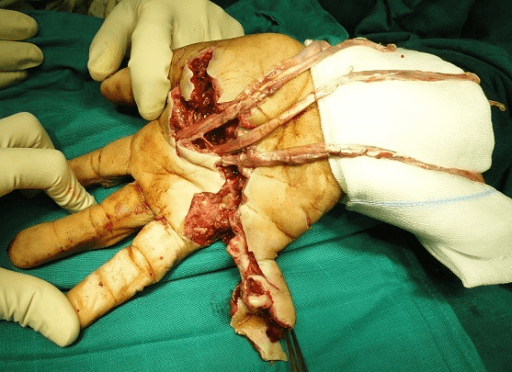
Clinical photograph demonstrating examination of flexor tendon function. The ring finger is held in extension at rest (cascade disrupted). Testing FDP: holding middle phalanx, patient cannot flex DIP. Testing FDS: holding adjacent fingers extended, patient cannot flex PIP. This demonstrates complete laceration of both FDP and FDS tendons in Zone II (no man's land). Urgent surgical repair is required.
Open Full Size

Clinical photograph demonstrating examination of flexor tendon function. The ring finger is held in extension at rest (cascade disrupted). Testing FDP: holding middle phalanx, patient cannot flex DIP. Testing FDS: holding adjacent fingers extended, patient cannot flex PIP. This demonstrates complete laceration of both FDP and FDS tendons in Zone II (no man's land). Urgent surgical repair is required.

Image source: Open Access medical literature (NIH/PubMed Central) • CC-BY License

Questions

Question 1 (4 marks)

Describe the anatomy of the flexor tendon system including zones and pulleys.

Question 2 (5 marks)

How do you examine flexor tendon function and what are the findings?

Question 3 (6 marks)

Describe the surgical technique for Zone II flexor tendon repair.

Question 4 (5 marks)

What are the rehabilitation protocols after flexor tendon repair?

Question 5 (4 marks)

What are the complications and how do you manage them?

Question 6 (4 marks)

What are special considerations for thumb flexor tendon injuries?

Exam Day Cheat Sheet

Must Mention

  • •Zone II = "No Man's Land" (A1 to FDS insertion)
  • •Critical pulleys: A2 and A4
  • •FDP test: hold PIP, flex DIP
  • •FDS test: hold adjacent fingers extended
  • •4-6 strand core + epitendinous repair
  • •Early active motion prevents adhesions

Common Pitfalls

  • •Wrong zone definition
  • •Missing critical pulleys
  • •Wrong testing technique
  • •Missing suture strength
  • •No rehabilitation mention
  • •Missing complications
Scenario Info
Answers Revealed0/6
Difficulty
advanced
Time Allowed6 min
Total Marks28
Questions6
Related Scenarios

Carpal Tunnel Syndrome

hand•28 marks

Cubital Tunnel Syndrome

hand•28 marks

De Quervain's Tenosynovitis

hand•28 marks

Distal Radius Fracture

hand•28 marks

Dupuytren's Disease

hand•28 marks