OrthoVellum
Knowledge Hub

Study

  • Topics
  • MCQs
  • ISAWE
  • Operative Surgery
  • Flashcards

Company

  • About Us
  • Editorial Policy
  • Contact
  • FAQ
  • Blog

Legal

  • Terms of Service
  • Privacy Policy
  • Cookie Policy
  • Medical Disclaimer
  • Copyright & DMCA
  • Refund Policy

Support

  • Help Center
  • Accessibility
  • Report an Issue
OrthoVellum

© 2026 OrthoVellum. For educational purposes only.

Not affiliated with the Royal Australasian College of Surgeons.

Back to ISAWE Scenarios
Contents
0%
hand

Hand Infections

advanced
6 min
28 marks
6 questions
Clinical Scenario
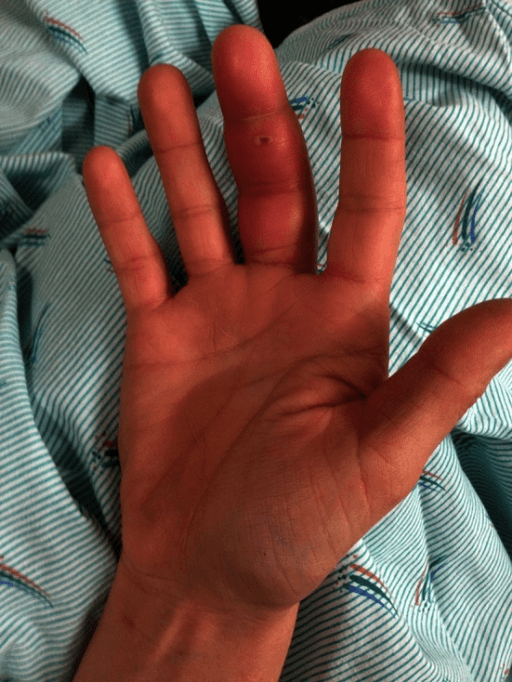
A 35-year-old man presents to ED with a 2-day history of increasing pain and swelling in his right middle finger. He sustained a puncture wound to the fingertip 4 days ago while working in his garden. On examination, the finger is swollen and held in flexion. There is tenderness along the entire flexor sheath. Passive extension is extremely painful. He is febrile (38.4°C). His WCC is elevated at 15 × 10⁹/L.
Clinical photographs demonstrating infectious flexor tenosynovitis of the middle finger. All four Kanavel signs are present: (1) fusiform swelling of the finger, (2) finger held in flexion, (3) tenderness along the flexor sheath, and (4) pain on passive extension. This represents a surgical emergency requiring urgent sheath irrigation to prevent tendon necrosis and loss of finger function.
Open Full Size

Clinical photographs demonstrating infectious flexor tenosynovitis of the middle finger. All four Kanavel signs are present: (1) fusiform swelling of the finger, (2) finger held in flexion, (3) tenderness along the flexor sheath, and (4) pain on passive extension. This represents a surgical emergency requiring urgent sheath irrigation to prevent tendon necrosis and loss of finger function.

Image source: Open Access medical literature (NIH/PubMed Central) • CC-BY License

Questions

Question 1 (4 marks)

Describe Kanavel's signs and the anatomy of the flexor sheath.

Question 2 (5 marks)

What are the principles of management for flexor tenosynovitis?

Question 3 (6 marks)

Describe the different types of hand infections and their treatment.

Question 4 (5 marks)

What are the deep space infections of the hand?

Question 5 (4 marks)

Discuss bite wounds and special considerations.

Question 6 (4 marks)

What are the complications and outcomes of hand infections?

Exam Day Cheat Sheet

Must Mention

  • •Kanavel's 4 signs: swelling, flexion, tenderness, pain passive extension
  • •Pain on passive extension = most specific
  • •Horseshoe abscess = radial + ulnar bursa
  • •Felon: high lateral incision, divide septae
  • •Fight bite: Eikenella, explore at MCP
  • •Cat bite: Pasteurella, deep penetration

Common Pitfalls

  • •Missing Kanavel signs
  • •Wrong felon incision
  • •Operating on herpetic whitlow
  • •Wrong antibiotics for bites
  • •Missing deep spaces
  • •Delay to surgery
Scenario Info
Answers Revealed0/6
Difficulty
advanced
Time Allowed6 min
Total Marks28
Questions6
Related Scenarios

Carpal Tunnel Syndrome

hand•28 marks

Cubital Tunnel Syndrome

hand•28 marks

De Quervain's Tenosynovitis

hand•28 marks

Distal Radius Fracture

hand•28 marks

Dupuytren's Disease

hand•28 marks