OrthoVellum
Knowledge Hub

Study

  • Topics
  • MCQs
  • ISAWE
  • Operative Surgery
  • Flashcards

Company

  • About Us
  • Editorial Policy
  • Contact
  • FAQ
  • Blog

Legal

  • Terms of Service
  • Privacy Policy
  • Cookie Policy
  • Medical Disclaimer
  • Copyright & DMCA
  • Refund Policy

Support

  • Help Center
  • Accessibility
  • Report an Issue
OrthoVellum

© 2026 OrthoVellum. For educational purposes only.

Not affiliated with the Royal Australasian College of Surgeons.

Back to ISAWE Scenarios
Contents
0%
hand

Scaphoid Fracture

advanced
6 min
28 marks
6 questions
Clinical Scenario
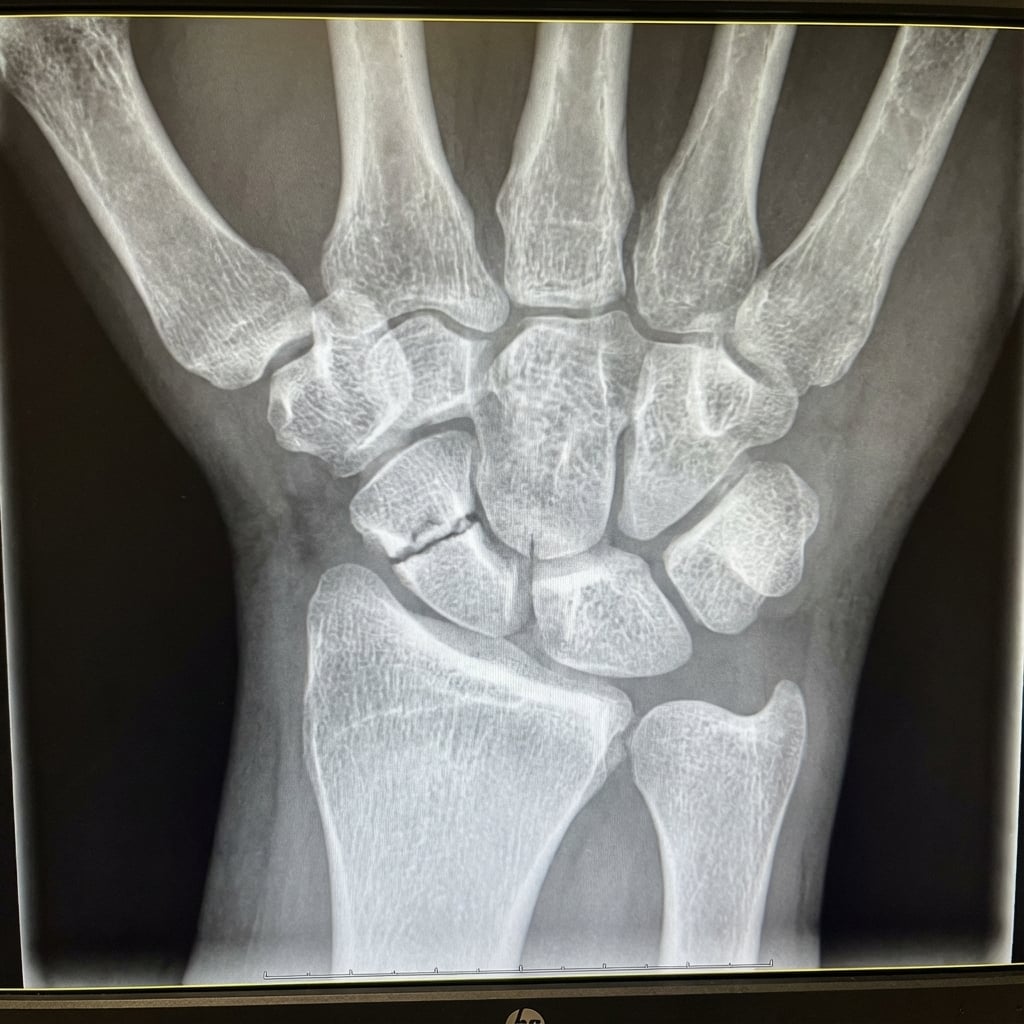
A 24-year-old male motorcyclist presents after a fall onto his outstretched right (dominant) hand. He has pain and swelling on the radial side of the wrist. On examination, there is tenderness in the anatomical snuffbox and over the scaphoid tubercle. Axial loading of the thumb reproduces pain. Wrist movements are restricted by pain. Standard wrist X-rays appear normal but a scaphoid view shows a minimally displaced waist fracture.
PA wrist radiograph with scaphoid (ulnar deviation) view demonstrating a displaced scaphoid waist fracture. There is >1mm displacement and >15° humpback deformity. The fracture line is clearly visible across the waist. No secondary arthritis is present. This fracture pattern has increased non-union risk and requires surgical fixation with headless compression screw.
Open Full Size

PA wrist radiograph with scaphoid (ulnar deviation) view demonstrating a displaced scaphoid waist fracture. There is >1mm displacement and >15° humpback deformity. The fracture line is clearly visible across the waist. No secondary arthritis is present. This fracture pattern has increased non-union risk and requires surgical fixation with headless compression screw.

Source: AI-Generated: Educational Radiograph of Displaced Scaphoid Waist Fracture • OrthoVellum AI • OrthoVellum Educational Use

Questions

Question 1 (4 marks)

Describe the anatomy of the scaphoid including blood supply and implications.

Question 2 (5 marks)

Classify scaphoid fractures and describe imaging requirements.

Question 3 (6 marks)

What is the treatment algorithm for acute scaphoid fractures?

Question 4 (5 marks)

Describe surgical technique for headless screw fixation.

Question 5 (4 marks)

What are the risk factors for non-union and how do you manage it?

Question 6 (4 marks)

What is SNAC wrist and how is it managed?

Exam Day Cheat Sheet

Must Mention

  • •Blood supply: distal to proximal (dorsal 80%, volar 20%)
  • •Proximal pole highest AVN risk
  • •Displacement >1mm = surgery
  • •Herbert classification (A stable, B unstable)
  • •Waist 70%, proximal 20%, distal 10%
  • •SNAC stages I-IV with treatment

Common Pitfalls

  • •Wrong blood supply direction
  • •Missing displacement threshold
  • •Wrong Herbert types
  • •Not knowing SNAC stages
  • •Missing vascularized graft
  • •Confusing SNAC/SLAC
Scenario Info
Answers Revealed0/6
Difficulty
advanced
Time Allowed6 min
Total Marks28
Questions6
Related Scenarios

Carpal Tunnel Syndrome

hand•28 marks

Cubital Tunnel Syndrome

hand•28 marks

De Quervain's Tenosynovitis

hand•28 marks

Distal Radius Fracture

hand•28 marks

Dupuytren's Disease

hand•28 marks