OrthoVellum
Knowledge Hub

Study

  • Topics
  • MCQs
  • ISAWE
  • Operative Surgery
  • Flashcards

Company

  • About Us
  • Editorial Policy
  • Contact
  • FAQ
  • Blog

Legal

  • Terms of Service
  • Privacy Policy
  • Cookie Policy
  • Medical Disclaimer
  • Copyright & DMCA
  • Refund Policy

Support

  • Help Center
  • Accessibility
  • Report an Issue
OrthoVellum

© 2026 OrthoVellum. For educational purposes only.

Not affiliated with the Royal Australasian College of Surgeons.

Back to ISAWE Scenarios
Contents
0%
hand

TFCC Injuries (Triangular Fibrocartilage Complex)
advanced
6 min
28 marks
6 questions
Clinical Scenario
A 34-year-old tennis player presents with 4 months of ulnar-sided wrist pain after a fall onto his outstretched hand. Pain is worse with gripping and rotation, especially on his backhand stroke. On examination, there is tenderness at the ulnar fovea and positive DRUJ ballottement. The piano key sign is positive. Ulnar variance appears neutral. MRI shows a tear at the ulnar attachment of the TFCC.
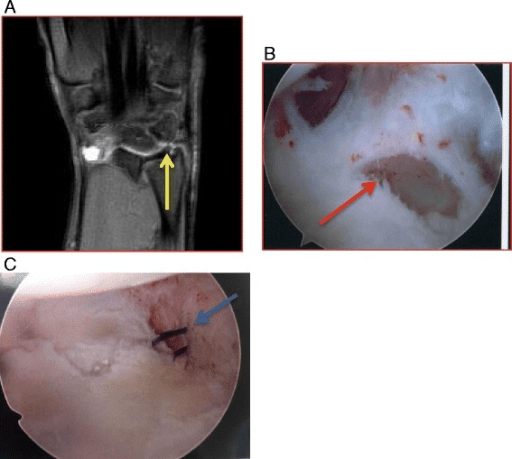
Coronal MRI demonstrating a peripheral TFCC tear (Palmer 1B) with high signal within the triangular fibrocartilage near the ulnar attachment. The arthroscopic image shows the corresponding tear at the fovea attachment with a positive trampoline test (loss of bounce). Peripheral tears (1B) are repairable with good healing potential, while central tears (1A) are debrided.
Open Full Size

Coronal MRI demonstrating a peripheral TFCC tear (Palmer 1B) with high signal within the triangular fibrocartilage near the ulnar attachment. The arthroscopic image shows the corresponding tear at the fovea attachment with a positive trampoline test (loss of bounce). Peripheral tears (1B) are repairable with good healing potential, while central tears (1A) are debrided.

Source: TFCC Tear MRI (Sports Wrist Injuries Review) • PMC5025579 • CC-BY

Questions

Question 1 (4 marks)

Describe the anatomy of the TFCC and its function.

Question 2 (5 marks)

How do you clinically assess TFCC injuries?

Question 3 (6 marks)

Describe the Palmer classification and its treatment implications.

Question 4 (5 marks)

What is the arthroscopic technique for TFCC repair?

Question 5 (4 marks)

Discuss ulnar impaction syndrome and its relationship to TFCC.

Question 6 (4 marks)

What are the outcomes and complications of TFCC surgery?

Exam Day Cheat Sheet

Must Mention

  • •TFCC = TFC + radioulnar ligaments + meniscus homologue
  • •Peripheral 10-40% = vascularized (repair)
  • •Central = avascular (debride)
  • •1A central, 1B peripheral, 1C ulnocarpal, 1D radial
  • •Fovea test = deep DRUJ stabilizer
  • •Trampoline test = arthroscopic

Common Pitfalls

  • •Wrong treatment by type
  • •Missing TFCC components
  • •Wrong vascularity
  • •Missing fovea test
  • •Wrong repair technique
  • •Missing Class 2
Scenario Info
Answers Revealed0/6
Difficulty
advanced
Time Allowed6 min
Total Marks28
Questions6
Related Scenarios

Carpal Tunnel Syndrome

hand•28 marks

Cubital Tunnel Syndrome

hand•28 marks

De Quervain's Tenosynovitis

hand•28 marks

Distal Radius Fracture

hand•28 marks

Dupuytren's Disease

hand•28 marks