hand
Thumb UCL Injury (Gamekeeper's/Skier's Thumb)
intermediate
6 min
28 marks
6 questions
Clinical Scenario
A 32-year-old woman presents to the emergency department after falling while skiing. Her thumb was caught in the ski pole strap and forced into radial deviation. She has immediate swelling and pain at the base of the thumb. On examination, there is ecchymosis and swelling over the ulnar aspect of the thumb MCP joint. Stress testing reveals 40° of laxity compared to 15° on the contralateral side, with no firm endpoint. A palpable mass is felt at the ulnar MCP joint. X-ray shows no fracture.
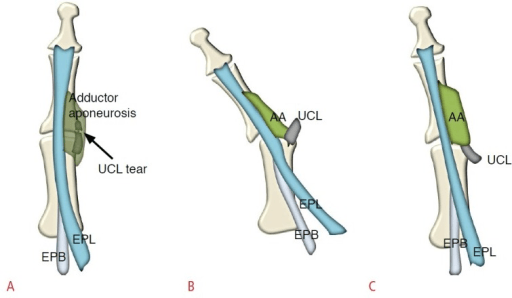
Clinical photograph showing stress testing of the thumb MCP joint for UCL injury - the examiner applies radial stress while palpating the ulnar border. Adjacent MRI shows a complete UCL tear with Stener lesion - the UCL (arrow) is displaced superficial to the adductor aponeurosis. Stener lesions require surgical repair as the ligament cannot heal in this position.
Image source: Open Access medical literature (NIH/PubMed Central) • CC-BY License
Questions
Question 1 (4 marks)
Describe the anatomy of the thumb MCP joint and UCL.
Question 2 (5 marks)
How do you clinically assess a suspected UCL injury?
Question 3 (6 marks)
Describe the Stener lesion and its significance.
Question 4 (5 marks)
What are the treatment options for acute UCL injury?
Question 5 (4 marks)
Describe the surgical technique for UCL repair.
Question 6 (4 marks)
How do you manage chronic UCL insufficiency?
Exam Day Cheat Sheet
Must Mention
- •Stener = UCL superficial to adductor aponeurosis
- •80% of complete ruptures have Stener
- •Stener cannot heal = needs surgery
- •Test at 0° (ACL) and 30° (PCL)
- •Complete: laxity >30° or >15° asymmetry
- •Palpable mass = Stener
Common Pitfalls
- •Missing Stener concept
- •Wrong test angles
- •Wrong laxity threshold
- •Missing palpable mass sign
- •Not knowing reconstruction
- •Confusing UCL/RCL