OrthoVellum
Knowledge Hub

Study

  • Topics
  • MCQs
  • ISAWE
  • Operative Surgery
  • Flashcards

Company

  • About Us
  • Editorial Policy
  • Contact
  • FAQ
  • Blog

Legal

  • Terms of Service
  • Privacy Policy
  • Cookie Policy
  • Medical Disclaimer
  • Copyright & DMCA
  • Refund Policy

Support

  • Help Center
  • Accessibility
  • Report an Issue
OrthoVellum

© 2026 OrthoVellum. For educational purposes only.

Not affiliated with the Royal Australasian College of Surgeons.

Back to ISAWE Scenarios
Contents
0%
hand

Trigger Finger (Stenosing Tenosynovitis)
intermediate
6 min
28 marks
6 questions
Clinical Scenario
A 55-year-old woman with type 2 diabetes presents with 6 months of painful clicking in her right ring finger. She now notices the finger locks in flexion in the morning and she must use her other hand to straighten it. On examination, there is tenderness over the A1 pulley region at the metacarpal head. A nodule is palpable on the flexor tendon. The finger triggers with active flexion and extension, with an audible click. She has similar but milder symptoms in her middle finger.
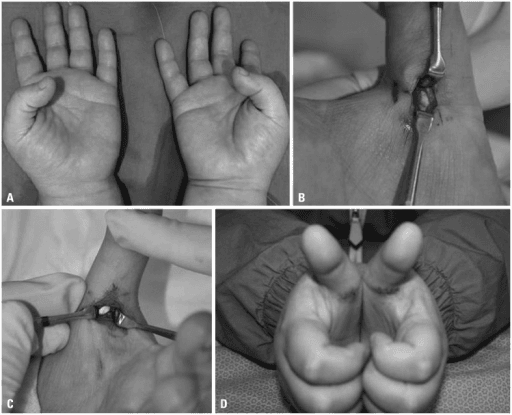
Clinical photograph of the right ring finger demonstrating locked trigger finger - the finger is flexed at the PIP and cannot actively extend. Passive extension is possible with a palpable click. The anatomical diagram shows the A1 pulley location at the metacarpal head and its relationship to the flexor tendons. Thickening of the A1 pulley and tendon nodule formation cause the triggering phenomenon.
Open Full Size

Clinical photograph of the right ring finger demonstrating locked trigger finger - the finger is flexed at the PIP and cannot actively extend. Passive extension is possible with a palpable click. The anatomical diagram shows the A1 pulley location at the metacarpal head and its relationship to the flexor tendons. Thickening of the A1 pulley and tendon nodule formation cause the triggering phenomenon.

Source: Trigger Finger Clinical Photograph • PMC4479852 • CC-BY

Questions

Question 1 (4 marks)

Describe the anatomy of the pulley system and pathophysiology of trigger finger.

Question 2 (5 marks)

What are the clinical features, classification, and associations?

Question 3 (6 marks)

Describe the treatment options and their indications.

Question 4 (5 marks)

What is the surgical technique for A1 pulley release?

Question 5 (4 marks)

Discuss trigger thumb in adults and children.

Question 6 (4 marks)

What are the complications and special considerations?

Exam Day Cheat Sheet

Must Mention

  • •A1 pulley at MCP level
  • •Preserve A2 pulley (bowstringing)
  • •Quinnell grading I-IV
  • •Injection success 60-70%
  • •Diabetes = multiple digits, lower injection success
  • •Thumb = protect radial digital nerve

Common Pitfalls

  • •Damaging A2 pulley
  • •Missing radial digital nerve
  • •Wrong injection site
  • •Missing diabetes association
  • •Wrong grading system
  • •Missing pediatric trigger thumb
Scenario Info
Answers Revealed0/6
Difficulty
intermediate
Time Allowed6 min
Total Marks28
Questions6
Related Scenarios

Carpal Tunnel Syndrome

hand•28 marks

Cubital Tunnel Syndrome

hand•28 marks

De Quervain's Tenosynovitis

hand•28 marks

Distal Radius Fracture

hand•28 marks

Dupuytren's Disease

hand•28 marks