OrthoVellum
Knowledge Hub

Study

  • Topics
  • MCQs
  • ISAWE
  • Operative Surgery
  • Flashcards

Company

  • About Us
  • Editorial Policy
  • Contact
  • FAQ
  • Blog

Legal

  • Terms of Service
  • Privacy Policy
  • Cookie Policy
  • Medical Disclaimer
  • Copyright & DMCA
  • Refund Policy

Support

  • Help Center
  • Accessibility
  • Report an Issue
OrthoVellum

© 2026 OrthoVellum. For educational purposes only.

Not affiliated with the Royal Australasian College of Surgeons.

Back to ISAWE Scenarios
Contents
0%
spine

Adolescent Idiopathic Scoliosis
advanced
6 min
28 marks
6 questions
Clinical Scenario
A 13-year-old girl is referred by her school nurse with a positive forward bend test. She had menarche 6 months ago. Her mother noticed asymmetry in her waist and shoulders. She has no back pain, no neurological symptoms, and no family history of scoliosis. On examination, she has a right thoracic prominence on forward bending and her shoulders and pelvis appear level.
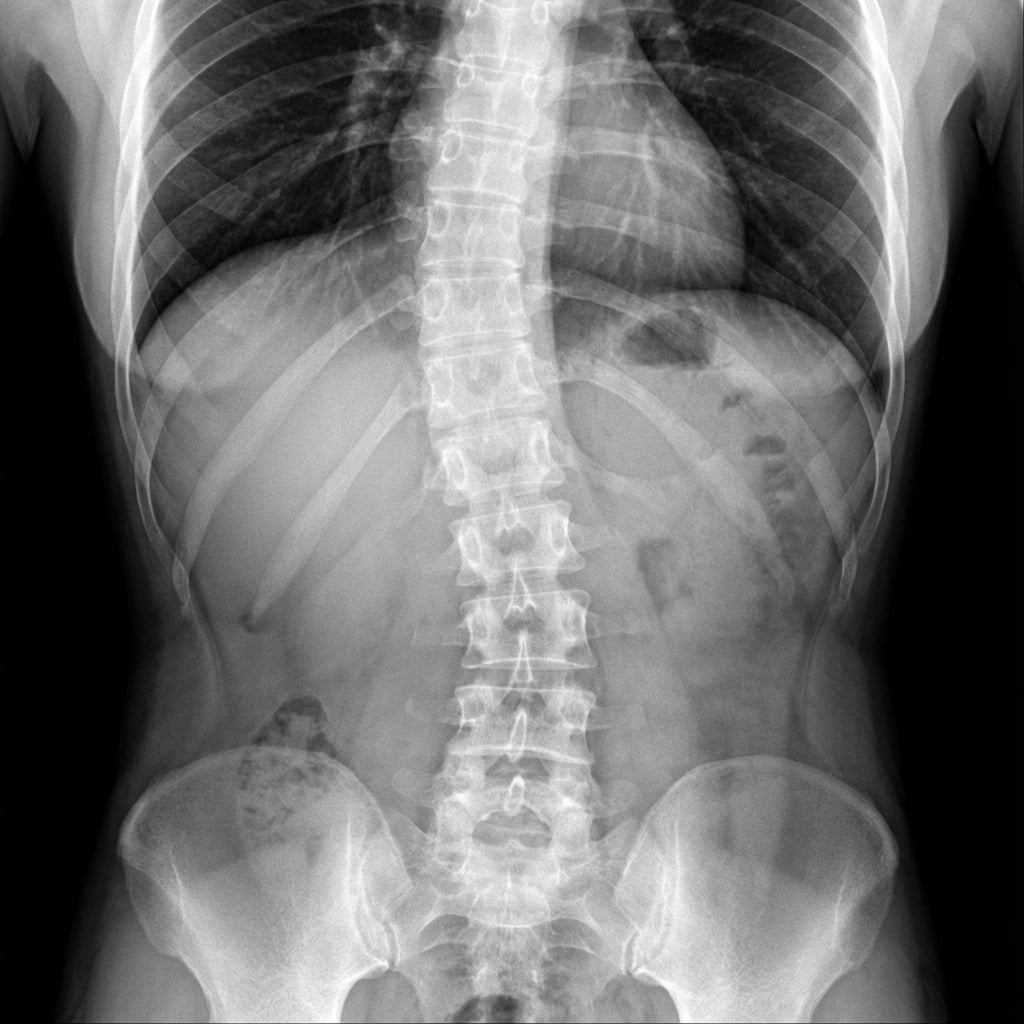
Standing PA radiograph demonstrating a right thoracic curve measuring 52 degrees (Cobb angle) from T5-T12 in a skeletally immature female (Risser 2). There is thoracic hypokyphosis. The curve is structural with >25 degrees on bending films. Lateral view shows thoracic hypokyphosis. This represents adolescent idiopathic scoliosis (AIS) with a large curve requiring surgical discussion.
Open Full Size

Standing PA radiograph demonstrating a right thoracic curve measuring 52 degrees (Cobb angle) from T5-T12 in a skeletally immature female (Risser 2). There is thoracic hypokyphosis. The curve is structural with >25 degrees on bending films. Lateral view shows thoracic hypokyphosis. This represents adolescent idiopathic scoliosis (AIS) with a large curve requiring surgical discussion.

Image source: Open Access medical literature (NIH/PubMed Central) • CC-BY License

Questions

Question 1 (4 marks)

Describe the radiographic findings and how do you measure and classify this curve?

Question 2 (5 marks)

What clinical examination findings are important and what red flags suggest non-idiopathic scoliosis?

Question 3 (6 marks)

What are the treatment options and what determines the choice?

Question 4 (5 marks)

Describe the Lenke classification and how it guides surgical planning.

Question 5 (4 marks)

What is your surgical technique for posterior spinal fusion?

Question 6 (4 marks)

What are the expected outcomes and potential complications?

Exam Day Cheat Sheet

Must Mention

  • •Cobb angle measurement
  • •Risser grade for maturity (0-5)
  • •Brace: 25-40°, immature (Risser 0-2)
  • •Surgery: >45-50° immature, >50° any maturity
  • •BrAIST: 72% success with bracing
  • •Lenke classification: type + lumbar + sagittal modifier
  • •Left thoracic = MRI for syrinx
  • •Neuromonitoring essential

Common Pitfalls

  • •Not measuring Cobb angle
  • •Wrong Risser staging
  • •Bracing mature patient
  • •Missing MRI indications
  • •Not knowing Lenke
  • •Forgetting neuromonitoring
Scenario Info
Answers Revealed0/6
Difficulty
advanced
Time Allowed6 min
Total Marks28
Questions6
Related Scenarios

Acute Spinal Cord Injury

spine•28 marks

Atlas Fracture (C1 Fracture)

spine•28 marks

Cauda Equina Syndrome

spine•28 marks

Central Cord Syndrome

spine•28 marks

Cervical Facet Dislocation

spine•28 marks