OrthoVellum
Knowledge Hub

Study

  • Topics
  • MCQs
  • ISAWE
  • Operative Surgery
  • Flashcards

Company

  • About Us
  • Editorial Policy
  • Contact
  • FAQ
  • Blog

Legal

  • Terms of Service
  • Privacy Policy
  • Cookie Policy
  • Medical Disclaimer
  • Copyright & DMCA
  • Refund Policy

Support

  • Help Center
  • Accessibility
  • Report an Issue
OrthoVellum

© 2026 OrthoVellum. For educational purposes only.

Not affiliated with the Royal Australasian College of Surgeons.

Back to ISAWE Scenarios
Contents
0%
spine

Cervical Facet Dislocation
advanced
6 min
28 marks
6 questions
Clinical Scenario
A 35-year-old man is brought in after a motorcycle accident. He was found with neck pain and left arm weakness. On examination, he is neurologically intact except for weakness of left triceps (3/5) and numbness in the left middle finger. His head is rotated slightly to the right and he resists attempts at movement. His cervical spine is immobilized.
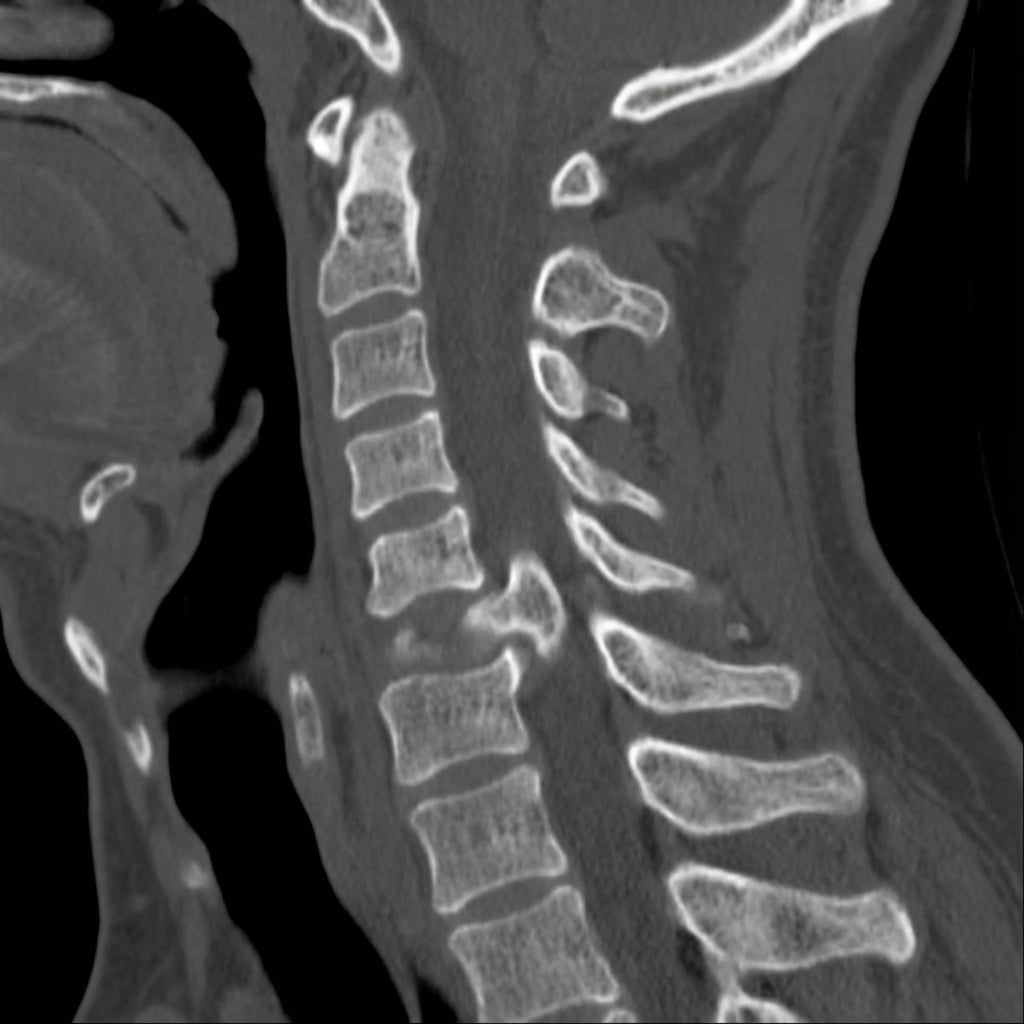
Sagittal and axial CT images demonstrating unilateral left facet dislocation at C6-7. The left C6 inferior articular process is locked anterior to the C7 superior articular process (jumped facet). There is approximately 25% anterior translation of C6 on C7 with rotation. The right facet is subluxed but not locked. This represents unilateral facet dislocation with associated radiculopathy pattern.
Open Full Size

Sagittal and axial CT images demonstrating unilateral left facet dislocation at C6-7. The left C6 inferior articular process is locked anterior to the C7 superior articular process (jumped facet). There is approximately 25% anterior translation of C6 on C7 with rotation. The right facet is subluxed but not locked. This represents unilateral facet dislocation with associated radiculopathy pattern.

Image source: Open Access medical literature (NIH/PubMed Central) • CC-BY License

Questions

Question 1 (4 marks)

Describe the CT findings and classify this injury.

Question 2 (5 marks)

Differentiate unilateral from bilateral facet dislocation including mechanism and presentation.

Question 3 (6 marks)

What is the controversy regarding MRI before reduction and how do you manage this patient?

Question 4 (5 marks)

Describe the techniques for closed and open reduction.

Question 5 (4 marks)

What are your surgical options and preferred approach?

Question 6 (4 marks)

What are the expected outcomes and potential complications?

Exam Day Cheat Sheet

Must Mention

  • •Unilateral = 25-50% translation, radiculopathy common
  • •Bilateral = >50% translation, cord injury common
  • •Unilateral = flexion-rotation mechanism
  • •MRI controversy: awake closed reduction safe, MRI if obtunded
  • •Posterior reduction and fusion = standard approach
  • •Closed reduction incremental weight with neuro checks

Common Pitfalls

  • •Wrong translation percentages
  • •MRI always/never
  • •Wrong approach
  • •No neuro monitoring during reduction
  • •Missing disc herniation
  • •Inadequate fixation
Scenario Info
Answers Revealed0/6
Difficulty
advanced
Time Allowed6 min
Total Marks28
Questions6
Related Scenarios

Acute Spinal Cord Injury

spine•28 marks

Adolescent Idiopathic Scoliosis

spine•28 marks

Atlas Fracture (C1 Fracture)

spine•28 marks

Cauda Equina Syndrome

spine•28 marks

Central Cord Syndrome

spine•28 marks